Al Qaeda Fighters Ordered the British SAS to Surrender. 40 Seconds Later They Were Captured
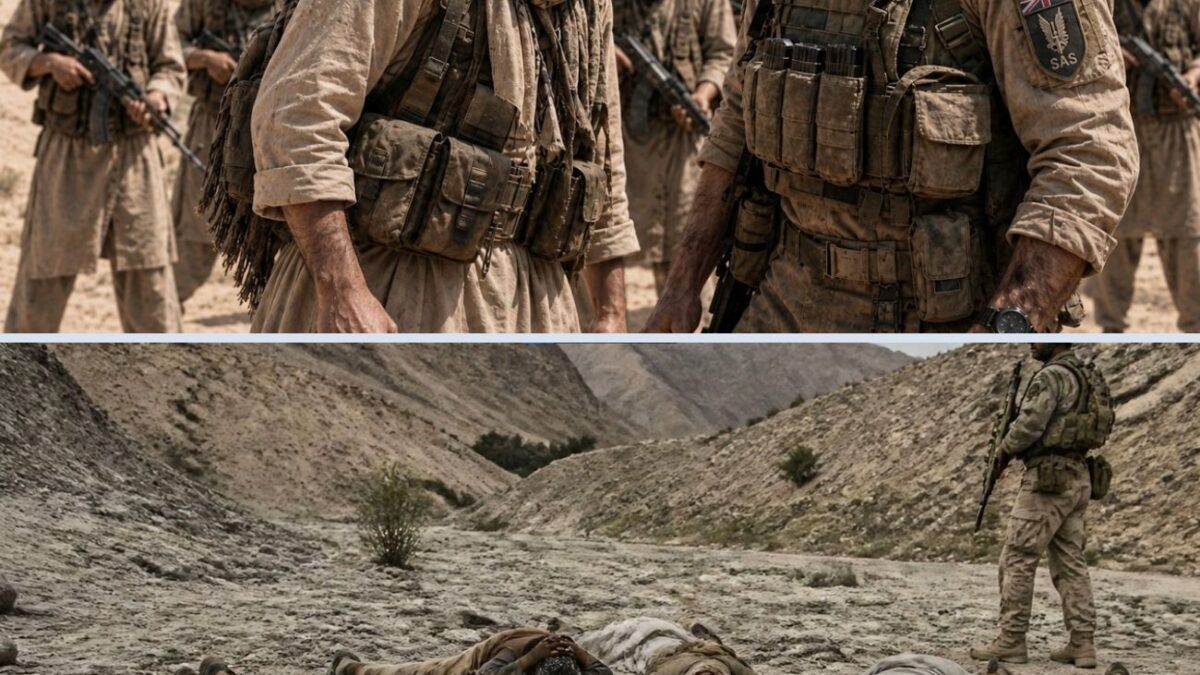
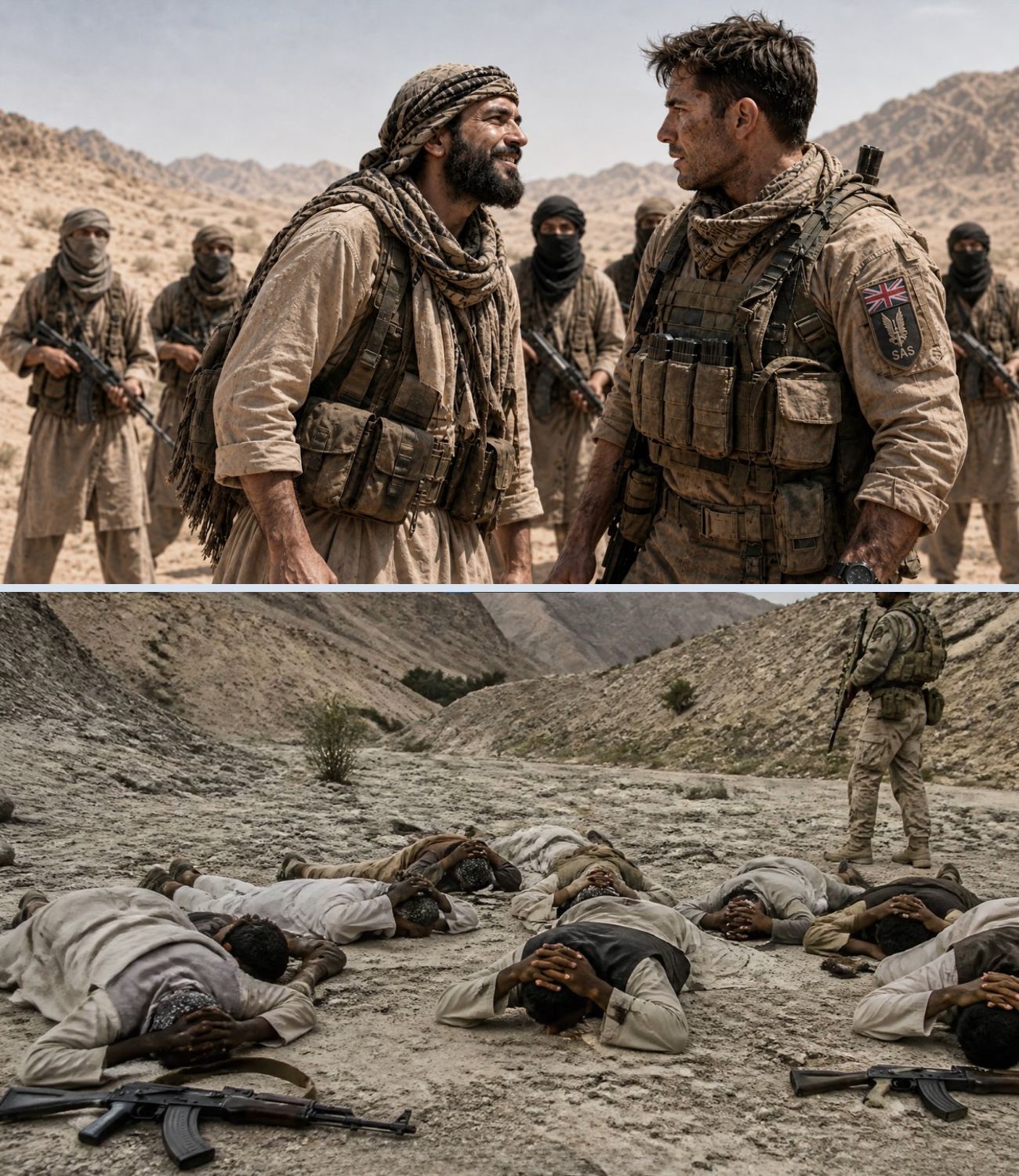
A man in a pale tunic stands 40 meters above you with a loudspeaker and gives you 40 seconds to lay down your weapons. Around him, on the ridges of a dry wadi in eastern Afghanistan, stand 240 Al-Qaeda fighters. Below him, in the bed of the same wadi, lie six soldiers of the British Special Air Service.
This is where you are. It’s a little after 11 a.m., a spring day in 2006 in an area that maps politely refuse to detail, and the man with the loudspeaker is smiling. He listed the British patrol. He counted his fighters. He performed the arithmetic that any commander does when he has surrounded enemy forces. 40 to 1, and arithmetic told him what it always tells him.
He is wrong. He doesn’t know he’s wrong. He had 38 seconds left to keep making mistakes, then 37, then 36. Six men against 240. 40 seconds over the loudspeaker, in broken English, the words echoing clearly through the walls of the wadi because stone conducts sound and the wind was on his side. “Put down your weapons. You won’t be touched. You have 40 seconds.”
Two dozen rifles were already aimed at the ridge behind him. On the opposite ridge, there are even more. In the dead zone near the mouth of the wadi, there are even more. The trap is closed. The countdown continued. And in the wadi bed, in the shadow of a ledge no wider than a garage door, the British staff sergeant looked at his signalman and quietly said one word. “Now.”
The operator pressed a button on the receiver and dictated six digits into it. Six digits. It was a mechanism. This was something the man in the pale tunic did not know, could not know, and only understood in the last 2 seconds of his 40, when the sky above the wadi did something the sky should not do. He was not a stupid person.
You have to remember this, because the story won’t work if you forget about it. He spent most of his adult life in such places. He had already closed the traps before. He occupied the heights on both sides, blocked the exit, and kept the reserves out of sight on the opposite slope. He did everything a capable commander does.
He simply didn’t count what was necessary. Later you will be told that the regiment defeated a force 40 times their own in the time it took to boil a kettle. They won’t tell you how. The whole question is how it happened. It is this “how” that explains why six men, driven into a dry riverbed without any real cover, with the enemy on three sides and a loudspeaker counting down, emerged from that wadi, each one on his feet, with a man in a light-colored tunic walking beside him in plastic handcuffs. 40 seconds.
That was their proposal. A few minutes later the fighters who had made this offer lay face down in the dust, disarmed, with their hands behind their heads; and the commander, who was smiling into the loudspeaker, was being led bound past a British corporal who was muttering under his breath something that, if you listened, could have been mistaken for the Welsh anthem.
Here’s how six men turned a 40-second ultimatum against those who issued it. Here’s what they did in the 38 seconds they had left. To understand what happened in the wadi, you need to understand why the six fighters from Squadron “B” ended up there in the first place. And to understand this, you need to know about a fortified post, a courier, and a depression in rough terrain about 40 km from the Pakistani border.
This site was a fenced farm with two outbuildings and a well located at the bottom of a natural depression. Local tribes called this place, roughly translated, “the bowl.” From the air, the “bowl” looked exactly like its name: a shallow indentation in the brown skin of the foothills, framed by ridges too low to be mountains but too high to be called anything else.
From the ground it looked like nothing special. That was the point. This point in the “bowl” was a transshipment base—not electrical, but human. It was a place where couriers arrived on foot from three different directions, exchanged sealed packages and learned messages, ate, slept for a few hours, and continued on a fourth route.
According to the assessment that led to the location being included in the operations plan, this chain supplied resources to Al-Qaeda cells on both sides of the border. The people who used this place didn’t stay there. Those who ran it were servants, cousins, and 12-year-old boys who had never held a rifle. By all the rules of modern warfare, this object was impossible to attack, because there was nothing to hit there.
The value of this place lay in the flow of people through it, and by dawn that flow would disappear. So, if you wanted to intercept the flow, you had to be in the “bowl” before it arrived and out of it before it became aware of your presence. You should have been observing. You had to identify yourself. You had to choose the right man from among many wrong ones, and you had to do it yourself, because no drone at that altitude would have been able to distinguish one bearded courier from another.
This was a patrol assignment, and it had a problem that you would have noticed immediately if you were in the planning headquarters. There was one road leading to the camp and one trail leading out. Both were under surveillance. And landing from a helicopter would alert the entire valley to your presence before the propellers had time to stop.
So you’re doing what the patrols in that country were doing that year. You are walking from afar through an area that no one uses, because no one can use it, and you are approaching the camp from the side that is not visible to the guard. In this case, it meant the dried-up riverbed behind the western ridge, which had been dry for ten years, narrowing to a gap at the bottom and eventually opening out into the pastures beyond the complex—a wadi.
It was a path inland, 2.5 km long, 3 meters deep at its shallowest point and 8 at its deepest, surrounded by rocks the color of stale bread, covered in dust, shale, and the bleached bones of goats that had died during the last drought. In the middle part, the path turned sharply twice: first to the left, then to the right.
At the second bend stood a rock that had once, in a century whose date no one knew, split right down the middle. This split rock was as tall as a house. It rose like a broken tooth in the throat of a wadi, and behind it the land dropped into a shadowy hollow where the sun did not peek until the very noon hour. Along the walls of this depression, the rock had been washed away by ancient floods, forming low canopies deep enough to hide under.
Staff Sergeant Elliot Crane had passed through this wadi 3 months ago on another mission and remembered that split rock. That’s the kind of person he was. He remembered the area the way other people remember faces. When the camp appeared on the mission map and someone asked how they could track down the couriers’ meeting without being noticed, Crane already had the answer in his head.
You enter through a wadi. You take up position in a hollow behind a split rock. You are watching the complex from under a canopy, where no one from the ridges can see. You walk back the same way at night and disappear before anyone even realizes they’re looking for you. It was a good plan. It had one weakness, and it was the same weakness that every plan involving wadis has.
Every officer who ever looked at a wadi on a map thought about it and rejected this option, because the other paths were even worse. The wadi is a place for killing. This is a trench without a roof. If the enemy is on top of you on both sides while you are inside, you lie in the bathtub and he stands above you with a hose.
Crane’s plan was that no one would know they were in that bathtub. They will move at night, hide in the shadows, watch for two days, and slip out the same way. The guards of the complex watched the road and the trail. They didn’t monitor the riverbed, which no one had used since the last drought, because there was no reason for anyone to be there.
There were no reasons, until the next morning, at three o’clock after dawn, a shepherd walking along the ridge above the wadi—a boy of about 14, with a stick, 11 goats, and a cell phone in the pocket of his trousers—looked down into the shadow behind a split rock and saw the barrel of a machine gun. He stopped. He looked again, long enough to make sure.
Then he took out his phone. He made one call. He said one sentence. Within 20 minutes, the ridges above the wadi began to fill with people who had not been there 20 minutes before. Within 40 minutes, there were already over a hundred on those ridges. Within an hour, there were over 200 of them. Within 75 minutes, a man in a light-colored tunic stood on the western edge of the wadi with a loudspeaker in his hand and a smile on his face.
A hose appeared in the bathtub, and the six men in the recess behind the rock, who had come only to observe the complex, were to learn that the earth, which had hidden them so well at the entrance, might behave quite differently at the exit. There were six of them in that recess. You must know their names before the loss count begins, because if you don’t know them, the count is just arithmetic, and it’s not arithmetic history.
This is a story about six specific people on a specific morning, and one of them was supposed to be injured by lunchtime. Staff Sergeant Elliot Crane was 39 years old and had spent 11 of them in the regiment. He was short. He wasn’t loud. He had a face that didn’t come out very well in photos and a voice that never had to be raised.
In the pocket of his tunic he held a folded photograph of a six-year-old girl in a school sweater; She was holding a drawing of a little man with a rifle, and above it was the word “Dad” written in the careful letters of a beginner. He hadn’t seen her for 11 weeks. That morning, before the shepherd gave the signal, he looked at the photo, put it back in his pocket, and never took it out again.
Sergeant Dominic Ashwell, known to his men as Dom, was the patrol’s second-in-command and sniper. He was left-handed, and that was important because his rifle was aimed under his left arm, and no one else on the patrol could shoot it accurately. He was 34, and he was drinking tea from a dented steel mug that had gotten its dent back in Sierra Leone in 2000, and he had refused to replace it ever since.
He drank the tea very hot, without sugar. That morning he brewed a cup of dry alcohol behind a cracked rock, drank it in six gulps, rinsed it with a sip of water, and put it back in his backpack. Ashwell didn’t speak unless he had something to say, and when he did, others listened. He spoke only twice that morning: to confirm the surveillance sectors and to report that there were two more people in the building than the briefing indicated.
Corporal Reese Pettyfer carried a radio and a medical kit. He was a Welshman from a village in a valley where a mine had closed before he was born, and the men of his father’s generation had spent their lives waiting for a new one to open. He joined the army at 16, the paratroopers at 18, and was selected for the Brecon Beacons at 24.
He was now 30. As he helped the wounded man, he softly hummed old church hymns that his grandmother had taught him. And he never realized he was doing it until someone told him. That morning in the valley he had not yet begun to hum. But it will start soon. Corporal Ivor Mackin was a chief scout and sapper, from a farm near Alnwick, 32 years old, with hands as rough as an old saddle.
He had a habit of never swearing in front of Crane, whom he called Boss, and of constantly cursing his enemy, giving him names his mother would not recognize. On the way here, Mackin went ahead in reconnaissance. He will get out of there, but not the way he came in, and not without a mark that will send him home for 6 months. Lance Corporal Bastian Quayle, Bas, carried a Minimi light machine gun.
He was 26, the youngest in the patrol, originally from Surrey, and had passed selection on his second attempt, having failed the first for reasons he never spoke about. At the bottom of his backpack was a paperback copy of Marcus Aurelius’s Meditations, bought for a pound and a half in a charity shop in Hereford, which he had read off and on for two years.
It was on page 91. That morning, he couldn’t get to page 92, but that wasn’t the point. The point was that he had read it at all, and no one teased him for it, because Quayle, lying behind the machine gun, was a man to whom others had already entrusted their lives. Trooper Terrence Halsey was responsible for rear cover. He was 31, had served in the Royal Marines before joining the regiment, and was missing two front teeth in his upper jaw thanks to a blow in the final of the 1998 inter-service boxing tournament, which he eventually won.
He never put new ones. He said the gap made him tougher, and people who saw him in bars, playing pool, or at the shooting range in Wales agreed. Halsey didn’t say much. Halsey watched. And shortly after ten that morning he was watching the eastern edge of the wadi when the first figure appeared on it, and it was his voice, low and utterly calm, that started it all. “Boss, we have guests. Two at the top, east side. And they are still going.”
Imagine them now, in a way the goatherd could not imagine. Six men huddled in the shadows behind a broken rock: the patrol leader with a photograph in his pocket, a sniper with a dented mug, a Welsh radio operator who didn’t know what he was mumbling, a Northumberland scout who didn’t swear in front of his boss.
A Surrey machine gunner reading a dead Roman emperor, a former marine with a crack in his smile. None of them moved when Halsey spoke. Crane simply turned his head very slowly toward the eastern horizon, and the others followed his gaze. In the next 90 minutes, one of them will be injured and will continue to work.
One of them will turn on the walkie-talkie and dictate six digits into it. One of them will stand four meters from the man in the light tunic through a band of smoky dust, and all six will get out of there alive. But before all that, they had to lie down and watch the ridges fill up. Halsey saw the two at 10:10.
At 10:15 there were already six of them. At 10:30 there were 19 of them. By the time the sun rose high enough to illuminate the bottom of the middle bend of the wadi, there were already over 60 men on both ridges above the basin, and more were arriving in transports that stopped before the horizon, dropping off passengers on foot.
Crane counted them the way a farmer counts sheep—in blocks of five, pressing the tip of his thumb into the fabric of his sleeve at each block. When he counted 20 marks, he told Ashwell, and Ashwell, looking at the eastern ridge through his scope, replied. Together they worked out a bill, which Pettyfer, leaning over the radio with his back to the wadi wall, relayed up in a whisper. 100, 120, 140, 180. The voice on the other end, in an operating room far from any trouble, asked him to repeat. Pettyfer repeated. The voice fell silent, then returned and ordered him to continue counting.
Watch what the man who organized these ridges did. Because that tells you who he was. He did not abandon his fighters. He did not send a wave of shouting warriors to the wadi walls, which would have cost him dozens of men against a machine gun in a confined space. He first placed a blocking party in the “dead zone” at the entrance to the wadi, before a single rifle appeared on the horizon, so the back door closed before the patrol knew it was open. He held a reserve on the back slope of the eastern ridge.
He placed the people in the lowlands to the west. This was a commander who had set traps before and knew that a captured British patrol was worth far more to him alive than dead. By 11:00 the score was 240, not nearly enough, not a great force. 240 men, counted in blocks of five by the tip of the staff sergeant’s thumb on two ridges, one blocking position at the entrance to the wadi and along the low ground to the west where the Northumbrian scout had planned to bring them out an hour ago.
Six against 240. You feel this ratio right down to your teeth. One rifle in the wadi for every 40 on the ridge. Draw a circle around six men in a hollow and place 240 around its edge—each standing a few paces from his neighbor, and each of the six inside will have 40 rifles looking at them from all sides at the same time.
Makin, watching from behind a rocky ledge on the western edge of the basin, muttered one word under his breath, and it was not a word his mother would have recognized. Crane heard this and did not react in any way. He looked to the western edge, where a figure had just risen to the horizon line and stopped. This man did not have a rifle.
He was holding a loudspeaker, the man was in his thirties or forties, it was hard to tell from this distance, with a thick dark beard, wearing a light tunic and trousers, a patterned scarf wrapped around his head and neck, and a tactical vest over the tunic. His face was dirty from the road. He smiled faintly, the way a person smiles when the hardest part is behind them.
Ashwell examined him through the binoculars and said, without taking his eyes off the lens, “That’s him.” Crane replied, “I know.”
A man in a light tunic raised a loudspeaker, and his voice rolled down the slopes in English, which was not his native language, but sounded quite clear. He only called himself the commander of the people on the ridges. He said the patrol was surrounded. He stated that this was non-negotiable. He said that British soldiers should lay down their weapons and stand with their hands visible, that no one would be harmed, that they would be treated with dignity and that the whole world would know that they had been treated with dignity. He said it twice: first slowly, then faster.
Then he said they had 40 seconds, lowered the speaker a little, and started the countdown. 40, 39, 38. Crane looked at Pettyfer. Pettyfer was already holding the phone. Crane spoke one word, again very quietly, and it was intended not for the loudspeaker or his own patrol, but for the voice on the other end of the radio link. That word was “now.”
The trap closed. Six men in the wadi, 240 rifles on the edges, 37 seconds on the clock, and along both ridges, one by one, the fighters rose to their full height to watch. Because surrender is something people stand up to see, and no commander who has set a trap with a 40-to-1 ratio expects anything from the enemy but submission.
It was a mistake to stand up to full height. There are moments in a soldier’s career that are later studied in classrooms in Herefordshire, at Fort Bragg, and in dozens of other places where those who plan wars try to teach those who fight them how to survive moments not foreseen in the plans. Crane’s decision behind the split rock at two minutes past eleven that morning was one of those.
It is not mentioned in textbooks. This fight is officially denied, and Crane is not the real name of the person who made the decision, because it was changed for this story, and the people who make such decisions prefer to remain in the shadows. But this solution is presented as a model, and the model looks like this. You are surrounded.
The enemy has come within striking distance, and you cannot escape. He offers you your life in exchange for a weapon, and by any logic, it’s a good offer, because the alternative is to die in a pit somewhere far from home, and your daughter will find out about it from the officer standing at the door of your apartment. This offer has a deadline.
You have less than a minute. Actually, you have 36 seconds, then 35, then 34. You have another option. You have a radio, and the fire support plan drawn up before going on a mission has predetermined targets, because a careful patrol leader always plans the fire he will call in if the situation becomes critical. There are four of them.
Three cover the wadi: one on the western ridge, one on the eastern ridge, one in the lowlands to the west, and the fourth—the one you argued with the fire support officer for 20 minutes at the briefing because he didn’t want to apply it, but you insisted. The fourth—right on the wadi itself, at your position; The term “dangerous proximity” has a technical meaning in artillery. This is the distance at which projectiles are almost as likely to kill you as they are to kill the enemy.
The fourth target was, by all professional standards, well within that distance. You insisted anyway, because 3 months ago you passed through this wadi, saw the depression behind the split rock and the canopies along the walls, and thought: if it comes to this, we will hide under the rock when the shells come. You thought about it during a walk that had nothing to do with the base in the pile.
It is 11:02. The speaker counts down the time, and that fourth goal consists of six digits. You have to say two things to two different groups of people in 4 seconds, and both have to be correct. Crane said them to Pettyfer without looking at him. “Read ‘Bravo Four’, fire mission, fire to kill, my sanction, dangerous proximity, my location, my location, my location.” Pettyfer said: “Dangerous intimacy.” Pettyfer pressed the button on the receiver. Six numbers went live. The voice on the other end asked him to confirm. He confirmed. The voice asked him to confirm the caller’s credentials. Pettyfer looked at Crane, and Crane nodded once. Pettyfer confirmed. The voice fell silent for a moment, long enough for someone far away to take a breath of air, and then returned with two words: “Shot, reception.” The shells were in the air. To the rest of the patrol, not looking at them, continuing to watch the man in the pale tunic on the western edge: “Under the rock, now, everyone, face down, hands over ears, immediately.”
They moved. Ashwell had forgotten the cup, Makin had forgotten the curse, Quayle had forgotten the machine gun under his chest, Halsey was looking back at the entrance to the wadi, Pettyfer had forgotten the walkie-talkie in his fist, crawling on his belly deep under the rock, and Crane, the last one, with a rifle on his forearms and a photograph in his pocket, pressed to the dust.
On the western edge, a man in a pale tunic saw them walking. For a moment his smile widened, because the people hiding under the loudspeaker’s countdown seemed, from above, to be losing their tempers. It was the most natural interpretation in the world. This was the interpretation that any competent commander would make. He picked up the loudspeaker again and continued the countdown, a little louder now, to cement the advantage he believed he had.
Ashwell, from his place under the rock, only asked, “How many?” Crane replied, “20 seconds.” Ashwell said, “Okay.” This was a decisive moment, not a firefight. This word is: “Good.” A sergeant, lying face down in the dust of an Afghan wadi, told his patrol commander that the shells flying at their heads were a good thing, because the alternative would be to get up and hand over his rifle to the man with the loudspeaker and a smile. Crane, hearing this, closed his eyes for a split second and didn’t answer, because there was nothing to answer.
Above them, the loudspeaker continued to count: “22, 21, 20.” There were 19 seconds left before the shells fell. No one on those ridges knew, only the six under the rock. 11:02:21. 19 seconds before the first shells fall. 240 men stand on two ridges to watch the surrender. Six of them lie face down under a cracked rock, hands over their ears, mouths open.
Open mouths matter. This is something you are taught beforehand if your job involves proximity to high explosives, and something you will never forget once you need it. You open your mouth because the pressure wave from the bursting of a heavy projectile nearby, if your mouth is closed, will do something to your inner ears and soft lung tissue that you would very much prefer not to do. Open your mouth. Hands over ears. Face down. Close your eyes. This is a manual written by people who saw others neglect it.
And that’s why all six mouths under the rock were open at 11:22. 15 seconds. On the western ridge, a man in a light tunic lowered his loudspeaker for a moment and said something to a fighter next to him, and he laughed. None of them looked into the recess behind the split rock, because they saw no need to.
The countdown was doing its job. In his experience, surrender occurred when the countdown was running out. But on the eastern ridge, three of his men still raised their rifles and aimed straight down into the wadi, because people who have lived in this country long enough don’t trust the enemy, and these people have lived long enough.
10 seconds. Under the rock, Pettyfer was still clutching the receiver. The voice on the other end fell silent, for there was nothing more to say. High above the wadi, shells were already falling, and you wouldn’t have seen them even if you knew where to look. A heavy artillery shell in flight is not what you see. This is what you hear during the last second or two, and only if you are close to the impact location. And if you’re close enough to hear it, you’re close enough for it to kill you.
5 seconds. Makin prayed under the rock. He will deny it for the rest of his life. Pettyfer hummed softly, his hands pressed to his ears, the opening bars of a church hymn in a language he didn’t really speak, but he knew the sound of. Quayle thought about the last line he had read in the book, about the obstacle in the path becoming the path itself. He didn’t see it as philosophy. He took this as a tactical instruction, because the obstacle was the arithmetic of the man with the loudspeaker, and the path through it was the land that that arithmetic did not take into account.
2 seconds. Sound. If you’ve never heard a 155mm shell in the last moment of its flight. No description will adequately convey this. This is not the whistle you see in the movies. It’s the sound of a rupture, low at first, then rising, as if it were coming from everywhere at once, as if a canvas were being torn across the entire width of the sky.
On the western ridge, a man in pale clothes heard this. His face changed. He opened his mouth to scream. And in that half-second, you could see how all of his life experience caught up with him in an instant. Realizing what that sound meant and where it was going. He didn’t have time to finish the word.
11:02:40. Shock. It wasn’t just one shell. It was a full-fledged fire mission. Four guns, four shells each, 16 rounds of ammunition, designed to arrive at 2-second intervals, striding in a 40-meter-by-40-meter rectangle in a pattern that artillerymen call a “ladder.” The first four hit the western ridge. The next four hit the lowlands to the west. Four more hit the eastern ridge. The last four struck the high slopes above the mouth of the wadi. 16 shells. One rectangle. Two seconds.
Under the split rock, the six felt it before they heard it. The earth rose. She didn’t flinch. She rose as if the earth had momentarily forgotten where the bottom was. Dust fell from the underside of the ledge in a continuous layer. The pressure pressed down on their chests, as if a heavy person had sat on each of them at the same time. Pettyfer stopped humming not because he wanted to, but because all the air had been squeezed out of him. Makin bit the inside of his cheek and tasted iron.
Quayle felt the Minimi jump an inch from the dust and then fall back. Ashwell, who had hid himself deepest under the rock, did not move at all. And then the sound, which came a split second later than the pressure, because the chest feels the force faster than the ear can make out the sound. It wasn’t 16 separate hits. It was one continuous roar that lasted, according to the estimates of the people who experienced it, somewhere between 3 seconds and the rest of their lives.
11:02:43. The first echo returned from the distant hills. The ridges above the wadi have lost their former shape. The people who stood on them were no longer standing. Not all of them died forever. 16 shells cannot explain the fate of 240 people on ridges of this shape. But those who survived were pinned to the ground, stunned, their ears ringing, and their weapons scattered in smoke.
The only ones who stayed on their feet were those standing farthest from the edge, and they were the ones who initially didn’t see what was happening in the valley. They still couldn’t see, because the wadi was now filled with dust. Six against 240 in two seconds turned into six against a number that no one on either side could yet count. The number of fighters on the ridges decreased sharply. In the end, the number remained the same because Crane had prepared the mechanism in advance, and this mechanism worked.
But that wasn’t the end. This broke the defenses on the ridges. The Wadi still had two exits, one of which had blocking forces in the “dead zone,” and these forces were fully combat-ready. Ashwell leaned on his elbows, leaned against the scope, and said calmly, “Bass, weapons for battle, entrance to the wadi, to the right of the split rock.”
Now Quayle took action, and the second phase began. Seven seconds after the impact, the dust in the void hung in the air, like a curtain that couldn’t decide whether to fall or rise. Through this curtain, at the entrance to the wadi, 120 meters east of the split rock, the fighters of the blocking forces were beginning to realize that something had happened above them for which they did not yet have the words.
According to later estimates by the patrol, there were between 25 and 30 of them. This was the part of the trap that closed the “back door.” They were not on the ridges. They waited in the “dead zone” behind a rocky outcrop until the surrender occurred and the order came to advance and take the prisoners into custody. Shells exploded on the heights above and behind them. The blast wave passed over them, but did not touch them. At that moment, they were alive, on their feet, and confused.
There was enough confusion. The confusion was the window of opportunity. Quayle positioned the Minimi at the edge of the hollow and opened fire; The tape began to move through the machine gun with that hoarse rhythmic bark that the Minimi makes when it is used as intended against a group of people in a confined space from 120 meters.
Ashwell, a meter to Quayle’s left, pressed the butt of his rifle into his shoulder and began to hit single targets. First the people with grenade launchers, then the radio operators, and then anyone who looked like they were about to give an order. The dust settled, the air froze, and at this distance Ashwell didn’t waste a single shot.
On Crane’s orders, Makin went to the western flank of the encirclement to inspect the lowland and check if there were any militants left there who were supposed to block the retreat after the shelling. He crawled 10 meters from the ledge along the wadi wall, reached a stone shoulder that overlooked the valley, and raised his head for a split second.
That split second was not enough for Makin, but for the gunman 40 meters away, who was half covered in debris, stunned, but still clutching his rifle: he noticed the movement and fired. The bullet passed through the muscles of Makin’s left shoulder from front to back, grazing the top of his shoulder blade on exit. He fell soundlessly against the wadi wall, his rifle falling with a clang next to him.
He lay on his side for perhaps four seconds, motionless, and then he began to curse—loudly and in a way that allowed Pettyfer, who was 30 meters below the ledge, to realize that he was still alive. Pettyfer moved like a man who had done it before and didn’t need orders. Quickly, crouching, with the medical bag open in his hand before he even reached Makin.
The muttering began again. He himself didn’t know what he had started. “Ivor. Ivor, my friend. Look at me. Where is it?” Makin through clenched teeth: “Shoulder. Left. Through.” Pettyfer cuts the jacket with scissors: “Front to back. Front to back. Clean, it seems. You’ll be fine. You’ll be okay, Ivor. Talk to me.”
And beneath the words—the same mumbling. A Welsh anthem, the name of which Makin did not know, but had heard before from the same throat in another country, in another year. He heard it now, closed his eyes, leaned his head back against the stone, and let Pettyfer work. All around them the machine gun kept its steady rhythm, and somewhere to the east a man shouted orders that were abruptly cut off when Ashwell’s shot rang out.
For about 90 seconds, the six men effectively became five. Then Makin, with one hand, reached for the rifle, pulled it to his knees, checked and readied it with his good hand, saying through the mumbling and pain, “I can still see. Give me a task.” Crane, who was back on the radio and had already called in a second fire strike, heard him. He called over his shoulder, “Ivor, watch the lowlands. Shoot anything that moves with a weapon.” Makin replied: “Yes, boss.” He did so.
For the next 11 minutes, Makin, with one hand, an individual package under his jacket and his left hand bandaged to his chest with Pettyfer’s tape, held the lowland. He laid down four, one of whom was just leaning against the mortar, reaching for a mine.
On paper, six against 240 turned into six against about 160, because shells on ridges do what shells on ridges are supposed to do. In fact, it was closer to five and a half, because Makin could fight, but he could no longer move. The number of people in the wadi was still six. The number of rifles capable of turning around and covering the new direction was five. The ratio changed in both directions simultaneously.
The combs were empty. The circle of entourage became thinner. And on the western ridge, above the smoke and dust, among those who had fallen and those who were beginning to rise, the man in the pale tunic was, despite everything, alive. Ashwell spotted him first through the scope.
The pale tunic was gray with dust, blood was visible on the patterned scarf, but the face beneath was the same. The loudspeaker in his hand was no longer there. The smile disappeared from his face. Instead, there was the expression of a person who had just, in the last 30 seconds, realized exactly where she had gone wrong in her calculations.
He didn’t panic. He looked down into the wadi, at the split rock, with the stillness of a man who rewinds a problem and finds the answer too late. Ashwell said, “Boss, I’m holding him.” Crane replied, “Not yet, boss. We want him alive. We want him to come down from that ridge with his hands on his head, and for everyone still standing there to see it. Not yet.”
Ashwell kept the crosshairs of his sights on the man in the pale tunic. His index finger lay along the safety clip. He didn’t move. On the western flank, Makin fired twice more, and Pettyfer, still humming, reloaded his magazine, one round at a time. The clock kept ticking. 4 minutes 12 seconds to twelve.
Two minutes had passed since the impact, and the mechanism that the man with the loudspeaker had not understood two minutes ago and was only beginning to comprehend now was about to reveal its second part. This is where the time of reckoning comes. It is here that you see what Crane had prepared in advance, and where the man with the loudspeaker led his fighters, without even knowing the terrain beneath them.
You already know that the wadi was the only approach ignored by observers in the complex. But the same thing that made him perfect for a covert patrol, from the moment of the shepherd’s signal, made him perfect for a gunner. The ridges above the wadi are the hit zone that gunners dream of. The heights on either side are so close together that a single volley of shells can cover both edges at once, and the bottom is deep enough for people below to take cover under a ledge while the shells come flying.
Crane had seen all this 3 months before. This “bathtub” was only a trap when you tried to get out of it. The solution was to let the enemy tip over the edge. That’s exactly what happened. The loudspeaker, the medicine, the demand for surrender—all this lured 240 fighters to the edges of the wadi. All this forced them to reach the horizon and stand at full height.
All of this made them targets for the fire plan that Crane had devised even before he heard about the cup. At 11:04:15, the second fire mission is already in the air. This time Crane didn’t call her on the ridge. He directed it to the lowland to the west, where the survivors of the first mission were trying to regroup, and to the back slope of the eastern ridge, where the reserve was trying to move forward.
12 shells, six guns, two shots each. Now he doesn’t need a volley. He needs the reverse slope because that’s where the deputy commander has gone, who now gives orders while the man with the loudspeaker kneels in the dust on the west ridge. The shells fall at 11:04:38. The pressure wave rolls over the wadi for the second time.
Beneath the split rock, the earth rises again. Dust settles. The roar fills everything around. When it dissipates, the back slope of the eastern ridge ceases to be a place from which anyone can organize an attack. The voice that had been shouting orders there fell silent. The rising reserve is scattered back to the foot of the slope, and no one is calling it forward anymore.
The mechanism did its job. In 2 minutes and 38 seconds, 240 men had become a scattered group of wounded, stunned survivors, scattered across two mangled ridges, without effective command, without heavy weapons in combat-ready hands, and without the confidence that the arithmetic at 11:00 gave them. At five minutes to twelve, Crane again radios for a Chinook under the cover of an Apache.
The voice replies that the aircraft will be there in 34 minutes. Crane says 34 minutes is acceptable and hangs up. Ashwell is still at the sight, still watching the man in the light tunic, who is now kneeling on the crest of the western ridge, his hands on his head. He didn’t put them there because someone from below ordered him to.
One of his fighters, bloodied and gray with dust, told him to do it because he understood: how it all ends depends only on what the people in the wadi are willing to do. Crane says, “Halsey, follow me. Bass, hold your weapon. Reese, stay with Ivor.” Crane and Halsey climb out of the canopy and up the wadi wall, using a crack in the rock as a ladder, and emerge on the western edge 40 seconds after the second group lands.
They walk, not run, across the smoky ground. They pass by people who don’t raise their weapons because the weapons are out of reach, or their hands can no longer hold them. They stop 4 meters from the man in the light tunic. He looks at Crane. Sweat drew clean lines through the dirt on his face. His scarf is torn at the shoulder, and there is a shallow cut on his cheekbone. His hands remain on his head.
And then, in the same cautious English he used over the loudspeaker, he speaks quietly only to Crane: “You were under a rock. You brought fire upon yourself.” This is not a question. This is a professional who draws the only conclusion allowed by the facts and voices it to a person who can confirm it.
Crane doesn’t answer. He doesn’t need to. Next to the man on his knees, on the ground, lies a loudspeaker. Its mouthpiece is bent. He is still working. Crane lifts it. He doesn’t bring it to his own lips. He hands it to Halsey. Halsey, a hunchback who has been silent for the past hour, picks up the loudspeaker and speaks Pashto—not like a native speaker, but perfectly understandable.
He learned these words in courses at the Ministry of Defense Language School and rehearsed them for just such a moment. These are not the words of the man with the loudspeaker, although they have the same meaning. “Put down your weapons, stand up, keeping your hands in sight. You will not be harmed.” He repeats this twice: once slowly, the second time faster. Same offer, same loudspeaker, but now the voice is coming from the patrol, and they are the ones offering the terms.
And along the ridges, one by one, then dozens, and then in a wave that rolls over the ridges like wind through grass, the fighters stand up, holding their hands in sight, and throw down their weapons. Some first look at their commander, who is on his knees. He does not order them to fight. He lowers his eyes, and that is enough of an answer.
At 11:06:12, 40 seconds after the loudspeaker changed hands, and 4 minutes and 11 seconds after Crane said the word “now”, Al-Qaeda militants ordered the British SAS to surrender. After 40 seconds, they themselves were taken prisoner. Not everyone. The shells did their job, and many no longer needed plastic ties. But everyone who was still standing at 11:06 put down their rifles, put their hands behind their heads, and knelt in the dust, because the man in the light tunic was already on his knees and the loudspeaker was in someone else’s hands.
The arithmetic that seemed so clear at 11:00 a.m. received a completely different solution. Terrain, foresight, and one timely radio call. The six men who stepped into the trap turned it into a place of death for those who hung over the edge. The Chinook arrived at 11:39, accompanied by two Apaches, which kept their distance but were eventually allowed to appear.
He sat down in the pasture behind the compound in the valley, because the wadi was not suitable for landing a Chinook, and the ridges were not a place for him to sit. The six emerged from the wadi with the man in the light tunic and 11 of his senior fighters handcuffed beside them. Makin came out alone, with his left hand pressed to his chest; Pettyfer held his good elbow, and he continued to curse—mostly at Pettyfer and mostly over the buzzing.
The count was later. As always. It was conducted by those who arrived that afternoon, evening, and the following morning; counted in groups of five, pressing their thumbs to their sleeves, just as Crane did at 10:10. They did this because counting is what closes the case. When the case was closed, 183 enemy dead and 49 wounded and captured were counted on the ridges. Total—232 people.
That’s eight fewer than the 240, and no one has ever figured out whether those eight had escaped into a fold of terrain that the search parties hadn’t noticed, or whether they were never there and Crane simply miscounted the eight people. When asked about it later, Crane said that he counted what he saw and he saw 240.
The count on the British side was six. Six men entered the wadi at 4 a.m. the day before. The six left at eleven thirty. One of them, Makin, had a hole in his shoulder muscles. He would spend six months on light duty, return to the regiment in the fall, serve another eight years, and never tell his mother what had happened in the wreck, because she was 71 and didn’t need to know. 183. Six.
These are numbers. A patrol of six men, ordered to surrender by a force 40 times their size, used the 40 seconds allotted and immediately turned them back. The enemy force said, “You have 40 seconds.” The patrolman essentially replied, “You too.” The man in the light coat was interrogated that same evening and again the next day.
And the interrogation was thorough and correct. He answered little, but the next day, when asked what had gone wrong on the ridge, he gave the only answer he had given voluntarily. And this was the response of a soldier, not a prisoner. “I counted six men,” he said. “I should have counted the land.” He didn’t say it with bitterness. He said it the way a person expresses a lesson they have paid for and intend to remember.
Earlier, as he was being led to the Chinook, he passed Ashwell, and the two men looked at each other for about 2 seconds. Ashwell drank from a cup. He brewed fresh tea on dry alcohol during the exit, because he didn’t consider a fire mission a reason to give up a cup of tea. He looked over the edge of his cup, didn’t smile, and didn’t say anything. After 2 seconds, the man in the light jacket looked away, he was helped into the belly of the plane, and he disappeared.
Pettyfer hummed under his breath. Quayle was checking out the Minimi. Halsey watched the mouth of the wadi, motionless, because Halsey was always watching. Crane kept his hand on Makin’s good shoulder and spoke quietly to him about whatever, because that’s what Crane did when one of his men was wounded.
The rotors lifted them at 11:44. Six men, the same six men, the photograph in Crane’s map pocket, still folded, the cup still in Ashwell’s hand, the encounter in the wadi behind the split rock is not mentioned in any official history in the form in which you have just heard. The time of year is right, the place is right, the equipment, ranks, and procedures are appropriate for the year and the unit. The names have been changed because most of these people are still alive, and because the men who did this work in that country that year prefer that their names not be published on the internet.
What hasn’t changed is the essence of the events. Staff Sergeant Crane, whose last name is not Crane, was decorated for this battle. The award letter does not specify the name of the wadi or the balance of power. It uses a phrase about courage in the face of overwhelming enemy forces—a wording chosen when the numbers themselves cannot be disclosed.
He served in the regiment for another six years, retired as a warrant officer second class, and now runs a small business on the Welsh borders that has nothing to do with military affairs, but only requires manual labor. His daughter is 15 years old. The photograph is somewhere in a drawer. He doesn’t look at her more often than necessary.
Ashwell was also awarded. He kept that mug for himself. As of this writing, he is still serving, and if you are the kind of person who notices what the military drinks from in the mess halls, you may see that dent one day. Pettyfer left the army in 2011 and became a paramedic in South Wales. He’s still humming to himself. He doesn’t always notice that he’s doing it.
Makin returned to patrol by November of that year with a scar the size of a small coin on the front of his shoulder and a longer one on his back. He served for another eight years. He never told his mother. Quayle finished reading the paperback on the flight home. He is now a sergeant. He is carrying a different book, and he doesn’t say which one.
Halsey replaced his missing teeth in 2014 at the insistence of his wife. He still says that the gap between his teeth made him look more menacing. Given the evidence, he was right. Six men, 240, 40 seconds. If you asked those who were there what number they remember, it wouldn’t be 240 or 183. It would be six.
Six went in, and six came out, and all that was in between was terrain, foresight, and one radio call made in time. Somewhere in a training class where war planners try to teach warfighters how to survive in moments not foreseen by any plan, an instructor draws a wadi on a whiteboard, adds a split rock, and asks the audience what they would do in 40 seconds.
Names are never taught, but form is, and the man who understood this form best was the one who leaned on the western ridge and said himself, “Count the land, not the people.” This form is six.
You Might Also Enjoy

“We Thought They Would Negotiate”—What Argentine Soldiers Said When The British Attacked Goose Green

“You’ll Never Finish My Ruck March, Limey” — US Sergeant Who Challenged the SAS, Then Fell Out First






