An American Sniper Challenged the SAS Veteran. The Answer Left the Room Silent
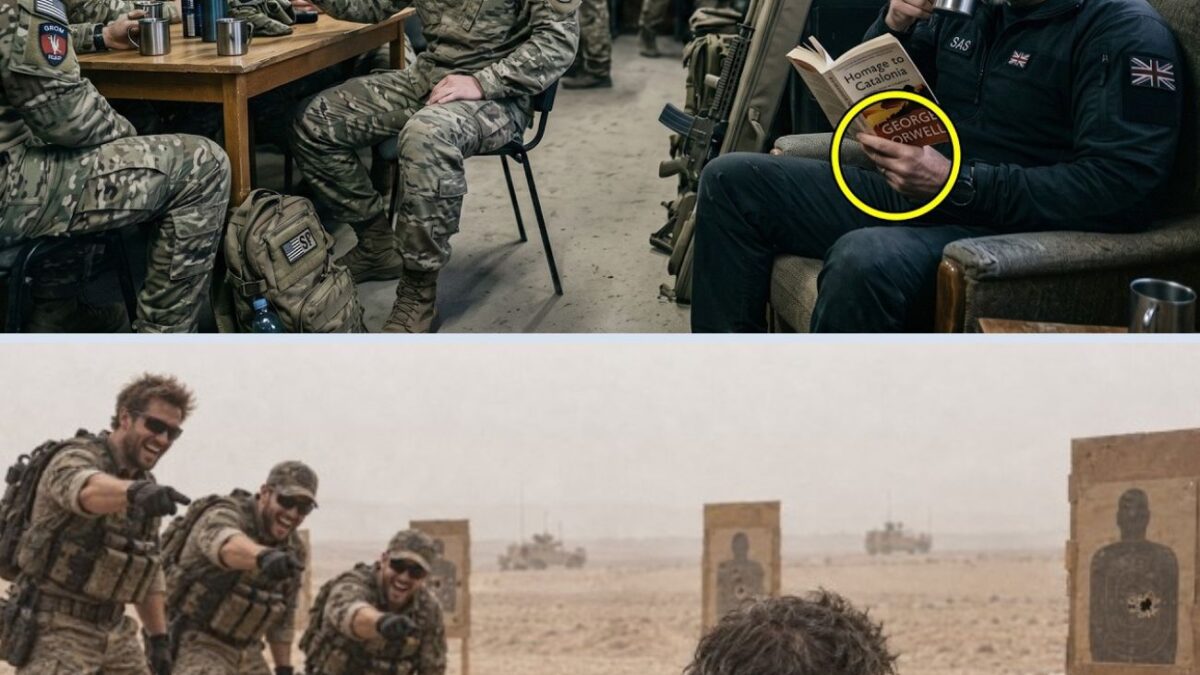
Silence isn’t empty. In a room full of killers, it weighs a ton. When a hotshot American sniper pushed his luck, demanding a kill count from a graying SAS veteran, he expected a ghost story. Instead, he got an answer that stripped the glory clean off the bone. Rain lashed against the corrugated iron roof of the makeshift rec room, a steady, deafening drumbeat that smelled of wet pine and aviation fuel. Staging base Charlie sat somewhere in the damp armpit of Eastern Europe, a purgatory where elite operators from four different nations waited for a green light that was already three days late. Inside, the air was thick with the scent of stale sweat, cheap Polish beer, and the distinctive metallic tang of bored men who polished their weapons too often.
Kolter Woods held court at the center of a scarred wooden table. At twenty-six, Kolter was a product of the modern American war machine. He wore his pedigree, Ranger Battalion, followed by selection, followed by a sniper qualification that put him in the top one percent of the top one percent like a perfectly tailored suit. He was handsome in that sharp, angular way that looked good on recruitment posters. His eyes a pale, unblinking blue. To Kolter, war was a solvable problem. It was a matter of algorithms, applied ballistics, Kestrel weather meters, and Doppler radar. He was currently dominating the conversation, his hands moving to illustrate the flight path of a bullet.
“So, the target is at one thousand eight hundred and forty yards,” Kolter said, leaning forward. His audience consisted of two younger Navy SEALs and a bored-looking CIA paramilitarist named Wyman Kelly. “Crosswind is full value from the left, blowing steady at about eight miles per hour. But, there’s a microterrain funnel about halfway down the flight path. You can see the mirage boiling right over this dry wadi.”
Wyman took a slow pull from his bottle, his face unreadable.
“And?”
“And you have to account for the spin drift,” Coulter continued, his voice tight with the thrill of the memory. “A three-hundred-grain Berger bullet is going to drift right just from the rifling. Then, you’ve got the Coriolis effect. At that distance, the earth is literally rotating underneath the bullet while it’s in the air. You don’t just aim at the guy. You aim at where the guy and the earth are going to be three seconds from now.”
One of the SEALs whistled softly. “Did he drop?”
Coulter grinned. It wasn’t a malicious smile. It was the smile of an engineer who had just watched a complex bridge hold its maximum weight. “Like a puppet with its strings cut. Clean. Total central nervous system shutdown. He was drinking from a tin cup. The bullet took the cup and the jaw. He never even heard the crack.”
“Nice math,” Wyman muttered, looking away.
“It’s not just math. It’s mastery,” Coulter corrected, leaning back in his creaking folding chair. “It’s control. When you’re behind glass, a mile out, you control the entire environment. They don’t know you’re there. They don’t have a say in the outcome. It’s the closest a man can get to playing God without actually dying.”
Across the room, sitting alone in the shadows near the sputtering space heater, Archie Sullivan turned a page of a battered paperback novel. Archie did not look like he belonged in the same room as Colter. If Colter was a scalpel, Archie was a rusted crowbar. He was somewhere in his late forties, his hair heavily salted with gray, cut brutally short. He wore a faded gray T-shirt that clung to a torso thick with the dense, unglamorous muscle of a man who had spent three decades carrying heavy things up steep hills. His face was a map of bad decisions and narrow escapes. A pale, jagged scar interrupted his left eyebrow. And his nose had clearly been broken more than once and set poorly. He belonged to the twenty-second Special Air Service Regiment. There were no unit patches on his shoulders, no badges, no boasting. He drank warm tea from a chipped ceramic mug and seemed entirely absorbed in his book.
Colter, high on his own adrenaline and the cheap beer, noticed the older man’s lack of attention. The American sniper was accustomed to rapt audiences. The younger guys worshipped the distance he could shoot. The older guys usually respected the undeniable skill it takes. Archie’s quiet indifference felt like a splinter.
“Hey Brit,” Colter called out, his voice cutting through the hum of the rain.
Archie didn’t look up immediately. He finished reading the sentence, carefully folded down the corner of the page, and closed the book. He rested it on his thigh and slowly turned his head. His eyes were dark, flat, and remarkably still.
“You speaking to me, mate?”
Archie’s voice was a low rasp, ruined by years of shouting over rotor wash and inhaling cordite.
“Yeah,” Colter said, flashing a confident, easy smile. “Just talking about the long game. You guys run the Accuracy International, right? The Lone One Fifteen, great piece of kit. A bit heavy, maybe a little outdated on the rail system, but it throws a point three-thirty-eight Lapua beautifully.”
“It does the job,” Archie said quietly. He took a sip of his tea.
“What’s your longest poke?” Coulter asked. He leaned his elbows on the table, an apex predator testing the perimeter of a new enclosure. “In theater. I know you guys spent a lot of time in the Helmand province. Lots of open ground. Perfect for stretching the legs on a heavy rifle.”
Wyman shifted uncomfortably in his chair. He had worked with the British elements before. He recognized the specific, dangerous stillness that had just settled over Archie.
“Coulter,” Wyman said, keeping his voice casual. “Let it go, man. Different generation. Different war.”
“I’m just asking a professional question,” Coulter replied, his eyes never leaving Archie. “We’re all shooters here. I told you mine. Eighteen hundred and forty. Documented. What about you, Archie? What’s the shot you’re most proud of? What’s the distance?”
Archie set his mug down on the metal casing of the space heater. The ceramic made a sharp, dull clink that somehow sounded louder than the rain. The atmosphere in the room shifted. It wasn’t sudden. It was a slow, creeping pressure. Like a submarine descending past its crush depth. The two SEALs stopped leaning forward. Wyman placed his beer bottle on the floor and crossed his arms. Even the ambient noise of the base outside seemed to muffle itself, deferring to the heavy, suffocating silence inside the rec room.
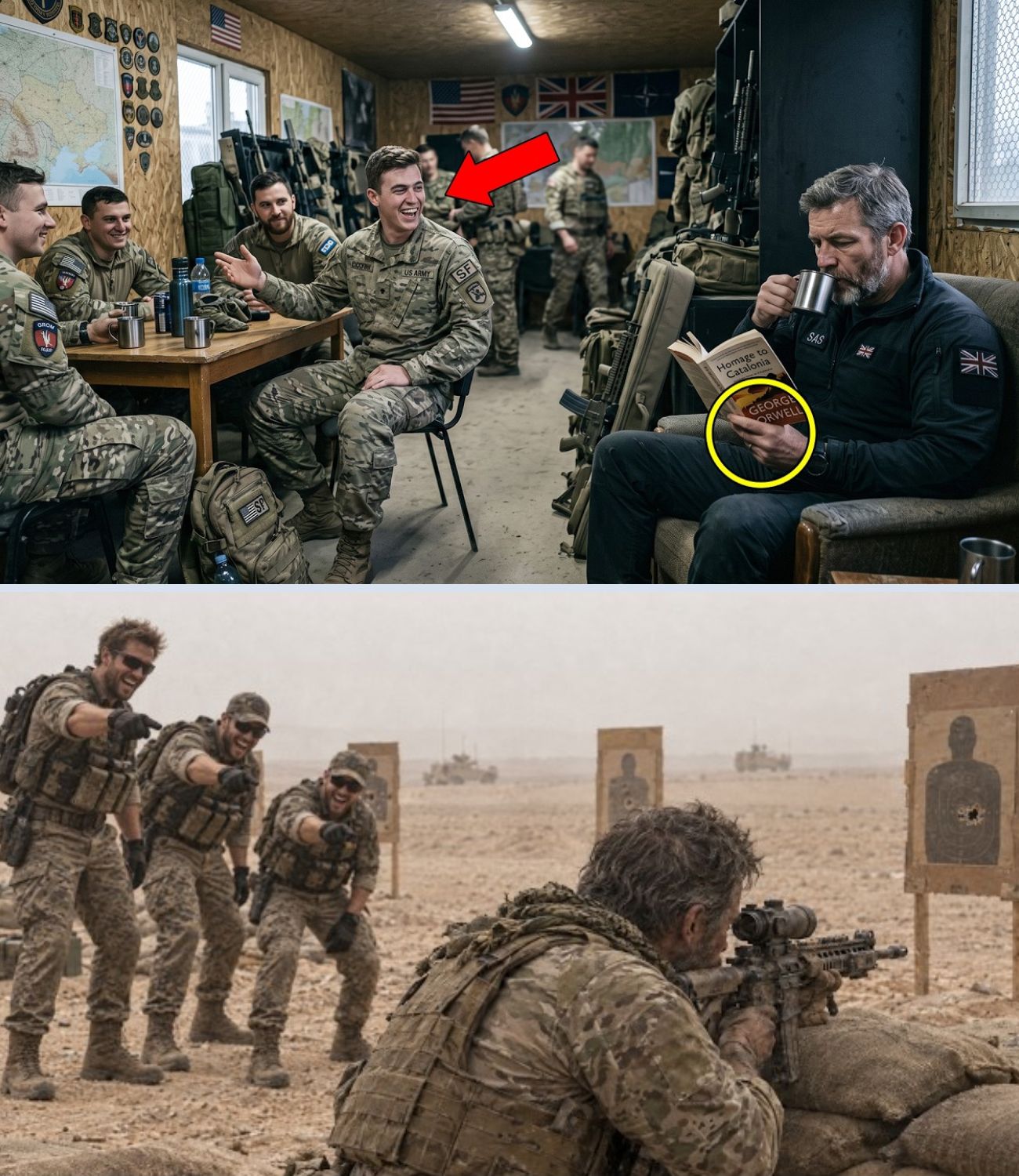
Coulter kept his smile, but the edges of it grew tight. He was used to the banter. He expected Archie to throw back a number, maybe fifteen hundred yards, maybe a classified two-mile shot from a mountain ridge. He expected a pissing contest. He was ready with ballistics data to prove why his shot was technically superior.
Archie slowly stood up. He didn’t pop up with the springy, nervous energy of the younger men. He rose like an old machine, joints protesting, movements deliberate. He walked with a slight, rhythmic limp in his left leg, dragging his heel just a fraction of an inch across the concrete floor. He stopped a few feet from Coulter’s table, close enough to smell the cheap beer on the American’s breath, close enough to see the faint pulse beating in Coulter’s neck.
“You want to know my longest shot?” Archie asked. His voice was no longer a rasp. It was smooth, conversational, and entirely devoid of warmth.
“Yeah,” Coulter said, lifting his chin. “I do.”
Archie looked down at his own hands. They were massive, heavily calloused, and missing the top digit of the left pinky finger.
“You’re a mathematician, son,” Archie said softly. “You measure success in yards, in windage, in the rotation of the bloody earth. You look through a piece of German glass, you do your sums, you press a trigger, and a shape falls over. You said it yourself, like turning off a television.”
Coulter frowned, his confidence wavering for a fraction of a second. “It’s precision.”
“It’s sanitation,” Archie corrected. He took half a step closer. The older man smelled of rain, old tobacco, and gun oil. “You want to know my best shot? The one I think about every night before the pills kick in? It wasn’t eighteen hundred yards.”
Archie held up a hand, extending his thumb and index finger about six inches apart.
“It was about that far,” Archie said.
The room was dead quiet. Colter stared at Archie’s hand, then up to the veteran’s flat, dark eyes.
“Six inches?” Colter asked, a nervous scoff caught in his throat. “With what? A pistol?”
“With a suppressed MP5,” Archie replied. “Belfast, nineteen ninety-eight. Before you were old enough to learn your times tables.”
Archie let his hand drop. He didn’t look angry. He looked tired. A profound, bone-deep exhaustion that seemed to radiate from him and suck the oxygen out of the air.
“It was a third-floor flat,” Archie continued, his voice dropping into a hypnotic, storytelling cadence. “We breached the door. Bad intel. We expected an empty room with a weapons cache. Instead, we found three lads making a device. One of them had his hand on the detonator.”
Archie looked past Colter, his eyes unfocusing, staring at a ghost only he could see against the corrugated iron wall.
“There was no wind to calculate,” Archie said. “No spin drift, no Coriolis effect, just the smell of boiling cabbage from the kitchen and the stink of unwashed bodies. I stepped through the door. He looked at me. I looked at him. We were so close I could see the acne scars on his cheeks. I could see the yellow in the whites of his eyes.”
Coulter swallowed hard. The American swagger was entirely gone, replaced by the instinctual stillness of a prey animal recognizing a predator.
“When you shoot a man from a mile away,” Archie said, returning his gaze to Coulter, pinning him to the chair. “You are a god. You decree his death from the heavens. When you shoot a man from six inches away, you are just a murderer in a dirty room.”
Archie leaned down, bracing his scarred hands on the table, bringing his face level with the young American.
“I pulled the trigger,” Archie whispered. “The muzzle flash lit up the room. The brass casing ejected and hit him in the collarbone before he even started to fall. He didn’t drop like a puppet with cut strings. He fell hard, heavy, and he dragged everything off the table with him. And as he went down, his eyes didn’t look at God or the sky or his country.”
Archie paused, letting the silence stretch out, letting the weight of the memory press down on the young men at the table.
“He looked right at me,” Archie finished softly. “He looked right into my eyes. And he asked me why without ever opening his mouth. I had to step over his twitching legs to clear the rest of the room. I felt his blood soak through the fabric of my trousers. It was hot.”
Archie stood back up, breaking the spell. He adjusted the hem of his gray shirt and looked down at Coulter with a mixture of pity and contempt.
“Keep your distance, mathematician,” Archie said, turning away. “Keep your eighteen hundred yards. Keep your glass and your equations because the moment you close that distance, the moment you have to smell their fear and feel their blood on your boots…”
Archie paused near the space heater, picking up his chipped mug of tea.
“…Well, you realize you aren’t a god at all. You’re just a man. And men have to live with the ghosts they make.”
Archie walked back to his chair in the shadows, sat down, and opened his battered paperback. He didn’t say another word. Nobody else did, either.
Kolter sat perfectly still. The half-empty bottle of Polish beer sweated onto the wooden table. The storm raged outside, pounding against the roof. But inside the rec room, the young sniper felt a cold that had nothing to do with the Eastern European weather. He looked at his own hands, clean and steady. And for the first time in his celebrated, highly decorated career, he wondered if he had ever actually been to war at all.
Alarms do not care about philosophical epiphanies. The klaxons severed the silence in the rec room at exactly zero two hours and fourteen minutes. A harsh, mechanical shriek that instantly vaporized the tension between Kolter and Archie. The purgatory of waiting was over. Within minutes, the abstract concept of war solidified into heavy ceramic plates, the metallic clack of magazines seating into magwells, and the overwhelming scent of JP-eight jet fuel.
The assault element crammed into the belly of an M-H forty-seven Chinook. Kolter sat near the ramp, his massive sniper system secured between his knees. Across from him, Archie sat with his eyes closed, his suppressed short-barreled rifle resting across his chest. The Brit looked entirely asleep, insulated by decades of repetitions. Coulter, for the first time in years, felt a cold knot tightening at the base of his throat. He kept seeing Archie’s hands. He kept hearing the description of the falling body dragging clutter off a table.
They infiltrated a heavily forested valley near the border, plunging into an environment that actively despised them. The rain had turned to a biting sleet. Mud sucked at their boots, eager to drag them down into the dark earth. Coulter broke off from the main element half a mile from the target compound. His job was overwatch. He clawed his way up a steep, shale-covered ridge. His spotter, a young SEAL named Kelly, panting softly behind him.
They established a hide on a rocky outcropping, looking down into a bowl-shaped depression. Below them sat a sprawling, dilapidated logging facility. This was the target. Intel said a high-value trafficker was using it as a transit hub. Coulter settled in behind his glass. He dialed in his magnification. The crosshairs snapped into focus, slicing the dark world into a clean, geometric grid.
“Distance to primary structure,” Coulter whispered, his voice a ghost in the freezing wind.
“Nine hundred and twenty yards,” Kelly replied, his face buried in his spotting scope. “Wind is swirling. Full value left to right down in the bowl, but we’ve got a harsh updraft coming off the ridgeline.”
Coulter adjusted his turrets. Click. Click. Click. The mechanical precision usually calmed him. Tonight, his fingers felt numb and his mind felt fractured. He kept picturing the men inside the buildings not as targets, but as breathing, sweating things.
Down in the valley, Archie and the assaulters moved like liquid shadows against the tree line. They were ghosts closing in on the perimeter. Coulter tracked them through his thermal optic, watching the bright white heat signatures of his team stack up on the rear door of the main processing building.
“Breaching three, two, one.”
The radio crackled in Coulter’s earpiece. A silent flare of heat bloomed on Coulter’s screen as the breaching charge blew the door hinges. Archie’s team flooded inside.
Then everything unraveled. The intel was catastrophically wrong. The logging facility wasn’t a transit hub. It was a heavily fortified staging ground. The moment Archie’s team crossed the threshold, the night ripped apart. Heavy machine gun fire erupted from an adjacent outbuilding that wasn’t supposed to be occupied. The tracer rounds, glowing a sickly green in the night vision, lashed across the courtyard, pinning the assault team inside the primary structure.
“Troops in contact, we are pinned. Heavy P-K-M fire from the secondary annex.” The radio screamed with the chaotic, terrified tenor of a man realizing he is cornered.
“I’ve got him,” Coulter said, his heart hammering a frantic rhythm against his ribs.
He swung his heavy rifle toward the annex. He found the muzzle flash. He calculated the hold. He pressed the trigger. The rifle bucked, a thunderous crack rolling over the valley. Through the glass, Coulter saw the splash of the bullet. It struck a concrete piling two feet to the left of the machine gunner’s window. The wind had shifted radically, funneling through the valley in an unpredictable vortex.
“Miss,” Kelly hissed. “Hold right zero point five mils.”
Coulter racked the bolt. The spent brass spun into the mud. He fired again, another miss. The bullet shattered a wooden beam above the shooter.
“They’re chewing the walls to pieces down here.” Archie’s voice cut through the comms, startlingly calm despite the deafening roar of gunfire behind him. “We cannot maneuver, overwatch. Suppress that gun or we are going to die in this room.”
Coulter stared through the scope. The sleet was thickening, blurring the thermals. The wind was a chaotic, unsolvable variable. The math was failing him. The distance, his beloved sterile distance, was no longer a shield. It was a prison, keeping him from saving his team.
“I can’t make the shot,” Coulter said, the admission tasting like ash in his mouth. “The wind is tearing it apart.”
“Then fix it,” Archie’s voice crackled back, cold and uncompromising.
Coulter looked at Kelly. He looked down at the heavy, useless precision rifle. The god of the battlefield was abruptly mortal.
“Stay on the glass,” Coulter ordered his spotter.
He grabbed his short-barreled M-four, slapped a fresh magazine into the well, and didn’t wait for a response. He slid down the steep shale embankment, abandoning the safety of the ridge. He plunged into the freezing, waist-high brush of the valley floor. Branches whipped his face, drawing blood. Mud dragged at his knees. He ran with a desperate, lung-burning intensity, guided by the green tracer fire streaking across the sky above him.
He was closing the distance. He hit the perimeter fence, vaulted a rusted guardrail, and landed in the flooded ditch surrounding the compound. The noise here was physical. It punched at his eardrums. The air smelled violently of cordite, wet concrete dust, and pulverized wood.
Colter moved along the blind side of the annex building. He could hear the heavy rhythmic thud of the P-K-M machine gun rattling the walls just a few feet away. He reached the door. It was partially off its hinges, swaying slightly in the draft. He didn’t have flashbangs. He didn’t have a team to stack with. He just had the doorway, the dark room, and the man inside trying to kill Archie.
Colter kicked the door hard. It splintered and slammed against the interior wall. He stepped into the darkness. Time collapsed into a terrifying singular fraction of a second. The room was a claustrophobic box choked with gun smoke that burned Colter’s eyes. The noise of the machine gun was deafening, a physical pressure hammering his skull.
The gunner was a young man, barely out of his teens, wearing a filthy green jacket. He was completely focused on the window, feeding a belt of ammunition into the smoking weapon. At the sound of the door crashing open, the gunner flinched and spun around.
Colter raised his rifle. They were five feet apart. There was no wind to calculate, no Coriolis effect, no spin drift. Colter saw the utter paralyzing terror widen the young man’s eyes. He saw the dirt caked in the creases of his neck. He saw the frantic, desperate twitch of the man’s muscles as he tried to swing a sidearm up toward Colter’s chest.
Archie’s voice echoed in Colter’s head. I could see the yellow in the whites of his eyes.
Colter squeezed the trigger twice. The flashes from his muzzle briefly illuminated the room in stark, strobe-like white. The impact was brutal. It wasn’t the clean, mechanical shutdown Colter had always witnessed from a mile away. The five-point-fifty-six rounds hit the man in the chest, the kinetic energy throwing him violently backward. He smashed into a metal shelving unit, bringing down a cascade of heavy tool boxes, empty brass casings, and loose engine parts with a deafening crash.
The man hit the floor hard. He didn’t stop moving. Colter kept his rifle raised, his breathing ragged, loud, and terrified in his own ears. He advanced slowly. The man was choking, his hands weakly clawing at his ruined chest. Blood, thick and alarmingly dark, pumped rhythmically onto the concrete floor, mixing with the muddy water leaking from the roof. The smell hit Colter instantly. A horrific, coppery stench of blood, opened bowels, and pure, raw panic.
The dying man’s head lolled to the side. His eyes found Colter. They weren’t looking at a god. They weren’t looking at an untouchable force of nature. They were looking at the man who had just ended his life in a dirty, freezing room. The boy’s lips moved, a silent, bloody bubble forming and popping, asking a question the universe would never answer.
Then, the life vanished. The tension left the body. He became a pile of meat and fabric on a dirty floor.
Kolter stood there, frozen. His hands were shaking so violently he could hear the sling swivels rattling against his rifle. The hot brass casing from his own weapon had bounced off the wall and landed on his collarbone, burning his skin through his combat shirt. He barely felt it.
“Gunner is down,” Kolter managed to key his radio, his voice cracking. “Annex is clear.”
The assault team swept the rest of the compound in a brutal, efficient ten minutes. By the time the exfil helicopters flared over the L-Z, the rain had washed the mud from Colter’s gear. But nothing could wash the smell of the room out of his nose.
The flight back to staging base Charlie was a silent affair. The adrenaline crash left the men hollowed out, their faces pale under the green glow of the cabin lights. Kolter sat near the ramp, his M-four resting between his knees. He didn’t look at the sniper rifle strapped to the bulkhead. He looked at his hands. There was a smear of the boy’s blood on his left glove, transferred when he had checked the body for a pulse.
Hours later, the storm outside the rec room had finally broken. The rain subsided into a miserable, quiet drizzle. Kolter sat in the same folding chair he had occupied earlier that evening. The room was empty except for him. He stared at the blank, corrugated iron wall. He wasn’t calculating trajectories. He wasn’t thinking about the curvature of the earth. He was replaying the strobe light of his muzzle flash. He was seeing the boy drag the shelves down.
Footsteps sounded softly against the concrete. Archie limped into the room. He walked over to the space heater, picked up his chipped ceramic mug, and poured some tepid water from a plastic kettle. He didn’t say anything. He walked over to Colter’s table and set a second mug down in front of the young American. It was instant coffee, black and terrible.
Archie sat down in the chair opposite Colter. He didn’t look triumphant. He didn’t say, I told you so. He simply looked at Colter with the weary, profound understanding of a man welcoming another soul into an exclusive, terrible fraternity.
Colter stared at the steam rising from the mug. He slowly reached out and wrapped his hands around the warm ceramic. He finally looked up. His pale blue eyes, stripped of all their arrogant certainty. They were the eyes of a man who had finally touched the ground.
“How long?” Colter asked, his voice a hoarse, ragged whisper.
Archie knew exactly what he was asking. “It doesn’t go away, son,” Archie said quietly, looking down at his own scarred hands. “The distance is gone now. He’s going to sit right there next to you for the rest of your life.”
Archie took a slow sip of his tea. “But you saved my team tonight. You closed the gap. That’s what matters.”
Colter nodded slowly. He looked back down at the dark, still surface of his coffee. The room fell silent again. But this time, it wasn’t the heavy, suffocating silence of a challenge. It was the solemn, enduring quiet of a graveyard occupied by two men and the ghosts they would carry forever.
You Might Also Enjoy

“We Thought They Would Negotiate”—What Argentine Soldiers Said When The British Attacked Goose Green

“You’ll Never Finish My Ruck March, Limey” — US Sergeant Who Challenged the SAS, Then Fell Out First






