Andrew Lownie Just Changed His Entire Perspective On Princess Diana
The Dark Reality Behind the Crown: Why Andrew Lownie’s Explosive New Diana Revelations Change Everything We Thought We Knew
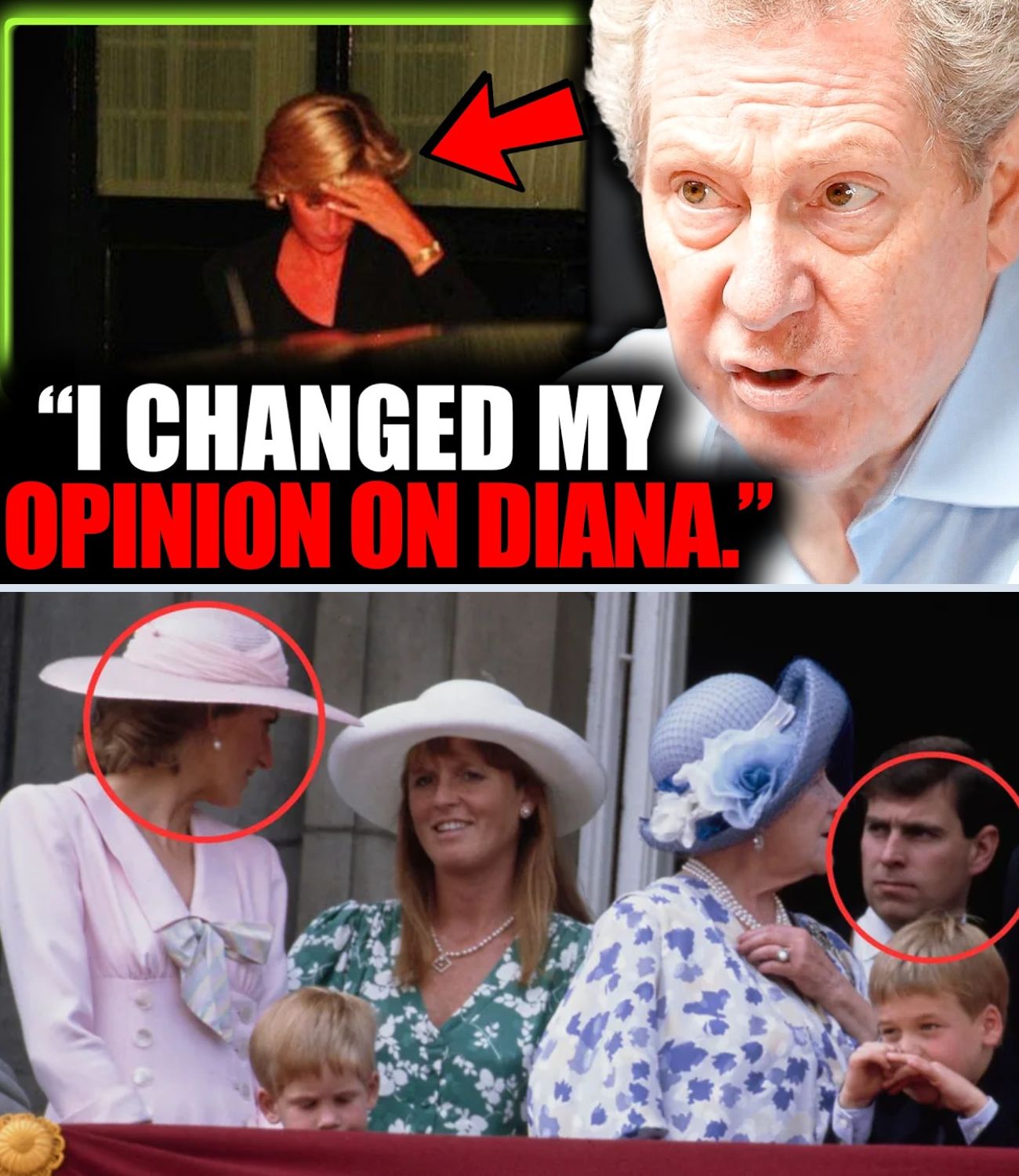
Nearly thirty years after the horrific tunnel crash in Paris that extinguished the life of Diana, Spencer, the world remains utterly enthralled by her ghost. Few public figures have been subjected to such relentless scrutiny, yet the narrative surrounding her brief, turbulent existence continues to shift. The latest and perhaps most seismic evolution in this ongoing historical post-mortem comes from none other than Andrew Lownie, one of Britain’s most formidable and tenacious royal biographers. Known for his unflinching exposés on the Mountbattens and other British establishment figures, Lownie has recently confessed to a radical about-turn in his perception of the late Princess of Wales—a conversion born from exposure to a series of explosive, unpublished transcripts that go far beyond anything revealed in Andrew Morton’s landmark 1992 biography.
To understand Lownie’s intellectual migration is to understand how the machinery of the British royal family operates behind velvet curtains and polished mahogany doors. For decades, the dominant institutional narrative—actively fostered by Prince Charles’s inner circle—cast Diana as an emotionally volatile, unstable figure who brought her own marital misfortunes upon herself. It was a carefully orchestrated public relations campaign designed to protect the future King while delegitimising a young woman who dared to air the dirty laundry of the House of Windsor. Today, however, as historians dig deeper into the archival rubble, that orthodox version of events is crumbling.
The Anatomy of an Arranged Trap: A Lamb to the Slaughter
The cornerstone of Lownie’s revised perspective lies in the mechanics of Diana’s introduction to the royal fold. Far from being a modern romance or a natural courtship, the marriage between Charles and the teenage Lady Diana Spencer was, at its core, a piece of calculated dynastic engineering. By 1981, Prince Charles was under intense, unrelenting pressure to secure the royal line of succession. His heart belonged elsewhere—firmly tethered to Camilla Parker Bowles, who by then was already married.
The Windsor establishment required a specific type of bride: young, aristocratic, entirely virginal, and crucially, malleable enough to accept a domestic arrangement where the husband’s mistress remained an unspoken fixture of daily life. This union was not hatched in heaven; it was plotted in the drawing rooms of the British aristocracy, orchestrated in no small part by two formidable matriarchs: Diana’s maternal grandmother, Ruth Lady Fermoy, and the Queen Mother herself.
Lownie notes the striking historical parallels within the family. Prince Philip had been a penniless foreign prince pushed into a suitable match with the young Queen, while the Queen Mother herself had navigated complex emotional currents before marrying into the royal line. The traditional royal playbook was clear: produce the heirs, secure the dynasty, and thereafter retreat into separate lives of sanctioned discretion.
The fatal flaw in this calcified formula was Diana herself. She was young—painfully young—and she entered the lion’s den expecting genuine emotional reciprocity. She believed that even if love was absent on their wedding day, it would organically blossom. Instead, she found herself isolated within the cavernous halls of Balmoral, kept under microscopic watch, and effectively treated as a biological vessel—a high-society broodmare whose primary utility was exhausted the moment she delivered two healthy male heirs. Once Prince William and Prince Harry were born, the expectation was that she would quietly step back, look picturesque during state functions, and tolerate the invisible shadow of Camilla.
Smear Campaigns and the Manufacture of Madness
When Diana refused to fade quietly into the background, the institutional counter-offensive was swift and merciless. The media was weaponised. Books commissioned and covertly supported by Charles’s camp—most notably works by writer Penny Junor—were deployed to seed the public consciousness with the notion that Diana was suffering from profound psychiatric disorders. She was painted as erratic, emotional, and fundamentally unhinged—a narrative designed to preemptively neutralise any public revelations she might make.
It was a brilliant, cynical exercise in psychological warfare. By framing Diana’s emotional distress as inherent mental instability rather than a rational reaction to systematic gaslighting and infidelity, the Palace insulated the future monarch from accountability. Diana was forced into desperate, guerrilla-style counter-tactics, culminating in her infamous Panorama interview with Martin Bashir—a desperate bid to reclaim her own narrative before the establishment could completely write her out of history.
Lownie admits that he, too, initially bought into elements of this establishment-crafted mythos. The sheer weight of the propaganda machine was formidable. Yet, as he immersed himself in archival research and, crucially, a cache of newly surfaced tape transcripts intended for a never-published book, the scales fell from his eyes.
Inside the Explosive New Tapes: Trauma and Unfiltered Truth
What makes Lownie’s recent revelations particularly arresting is the nature of the source material crossing his desk. While Andrew Morton’s famous tapes relied on intermediaries and were carefully curated for public consumption, the newly discovered recordings and transcripts go significantly further. So raw, incendiary, and legally perilous are the contents of these documents that mainstream publishers and literary agents initially recoiled in fear, refusing to touch them.
According to Lownie, these transcripts delve into territory previously regarded as untouchable. Among the most sensitive disclosures are intimate reflections on Diana’s early childhood, including accounts of experiencing sexual abuse. Such revelations provide a profound, heartbreaking psychological prism through which to view her adult vulnerabilities, her desperate search for unconditional validation, and her fierce, protective instincts as a mother.
Lownie faces the immense journalistic challenge of verifying these deeply personal and explosive claims before they see the light of print ahead of the thirtieth anniversary of her death. Yet, he maintains that the overarching ring of truth pervades the material. It paints a picture of a woman who was systematically exploited, led like a lamb to the slaughter by cynical courtiers who viewed human collateral as an acceptable cost of institutional preservation.
The Woman Who Broke the Mould: Charity, Charisma, and the Common Touch
Beyond the tragedy of her marriage, Lownie’s re-evaluation highlights why Diana remains an unmatched cultural phenomenon. Long before royal PR teams learned the value of staged relatability, Diana possessed an innate, electric charisma that allowed ordinary people across the globe to see themselves reflected in her.
Consider the historical context of the late 1980s and early 1990s. When the AIDS epidemic was met with hysterical public panic and social ostracisation, it was Diana who sat on the hospital bed of an infected patient and shook his hand bare-gloved—a gesture of radical, revolutionary empathy that shattered centuries of aloof royal protocol. She did not merely turn up, pull a string, and shake a handful of manicured hands from a safe distance; she got down into the trenches of human suffering.
She revolutionised royal parenting, fighting fiercely to give her sons, William and Harry, a taste of normal life outside palace walls—taking them to theme parks, fast-food restaurants, and public transport long before modern royals received praise for similar modern parenting milestones.
This authenticity terrified the traditionalists. Charles was notoriously jealous of the adoration Diana commanded wherever she went. While he laboured under the stiff, dutiful, ribbon-cutting traditions of mid-century royalty, Diana flowered like a majestic, modern butterfly, capturing the global imagination to become arguably the most famous woman in modern history. Crucially, as Lownie points out, unlike other royal figures who subsequently monetised their titles or caused ongoing institutional embarrassment, Diana never commercialised her royal status after her departure. Her post-royal life was entirely dedicated to international humanitarian campaigns, landmine clearance, and quiet acts of compassion.
The Generational Echo: William, Harry, and the Continuing Legacy
The shadow of Diana’s treatment and enduring charisma stretches directly into the modern dynamics of the Windsor family. Observers frequently draw a direct line between Diana’s warmth and the charismatic public persona that Prince Harry possessed before his acrimonious departure from the firm—a natural, magnetic warmth that contrasts sharply with Prince William’s necessary institutional stiffness as heir to the throne.
The tragedy of Harry’s current estrangement from his family is viewed by many royal analysts through the generational trauma inherited from Diana’s alienation. The establishment’s inability to accommodate strong-willed, emotionally expressive individuals within its rigid hierarchy remains the central structural flaw of the British monarchy.
Conclusion: A Reckoning That Won’t Go Away
Andrew Lownie’s shifting perspective is more than just a footnote in modern literary biography; it is a symptom of a broader cultural reckoning. As we march toward the solemn milestone of three decades since her tragic passing, the narrative of Princess Diana is undergoing a permanent, irreversible transition.
The sanitized, palace-approved caricature of a “troubled, difficult royal wife” has been thoroughly dismantled, replaced by the portrait of a resilient, deeply wronged young woman who was sacrificed on the altar of dynastic survival. Thanks to investigative historians willing to peer behind the archival veil and confront uncomfortable truths, Diana Spencer’s true legacy is finally coming into focus—not as a compliant piece of royal property, but as a revolutionary human being who forever changed the soul of the British nation.
You Might Also Enjoy

“We Thought They Would Negotiate”—What Argentine Soldiers Said When The British Attacked Goose Green

“You’ll Never Finish My Ruck March, Limey” — US Sergeant Who Challenged the SAS, Then Fell Out First






