Anne BREAKS DOWN As Diana’s Onyx Pendant Opens — Charles Recognises The Message Inside!
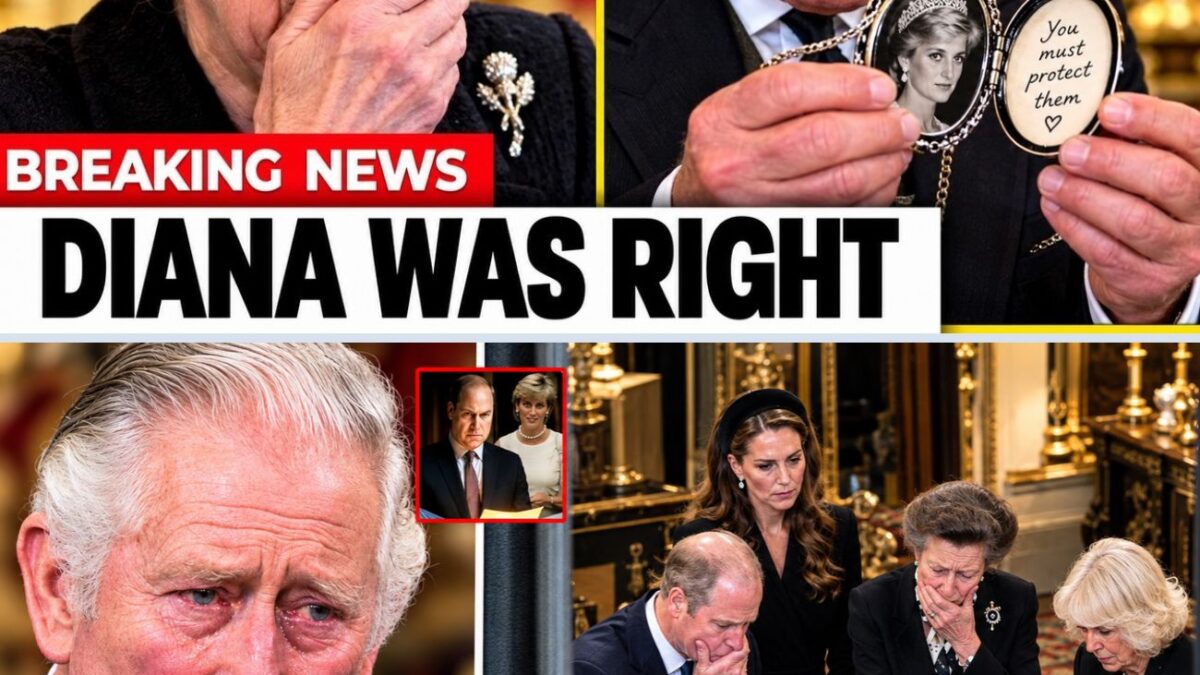
THE DIANA FILES: Inside the Windsor Castle Secret That Shattered King Charles and Forced Prince William to Demand the Truth About His Mother’s Hidden Pendant
Shadows Across Windsor Castle
There are rooms within Windsor Castle that seem immune to the passage of time, where the heavy velvet draperies, the scent of aged beeswax, and the portraits of Tudor monarchs conspire to create an atmosphere of permanent, unshakeable order. Yet, on a quiet evening that would permanently alter the landscape of the British royal family, the ancient stones of the fortress witnessed a reckoning that no amount of protocol could contain.
The gathering was ostensibly designed to be a modest, private family inventory. Princess Anne had brought several personal belongings associated with Diana, Princess of Wales, hoping to review and preserve memories that time had gradually pushed aside into dusty archives. Prince William had arrived expecting a quiet, melancholy conversation about his mother’s enduring possessions. King Charles anticipated nothing more troubling than a familiar, dull ache of sadness—a ghost of old regrets best left sleeping in the dark.
Nobody in that room could have imagined that a single, unassuming piece of jewellery would act as a crowbar, prying open a wound the family had spent nearly three decades trying to conceal beneath layers of duty, silence, and statecraft.
The Hidden Compartment
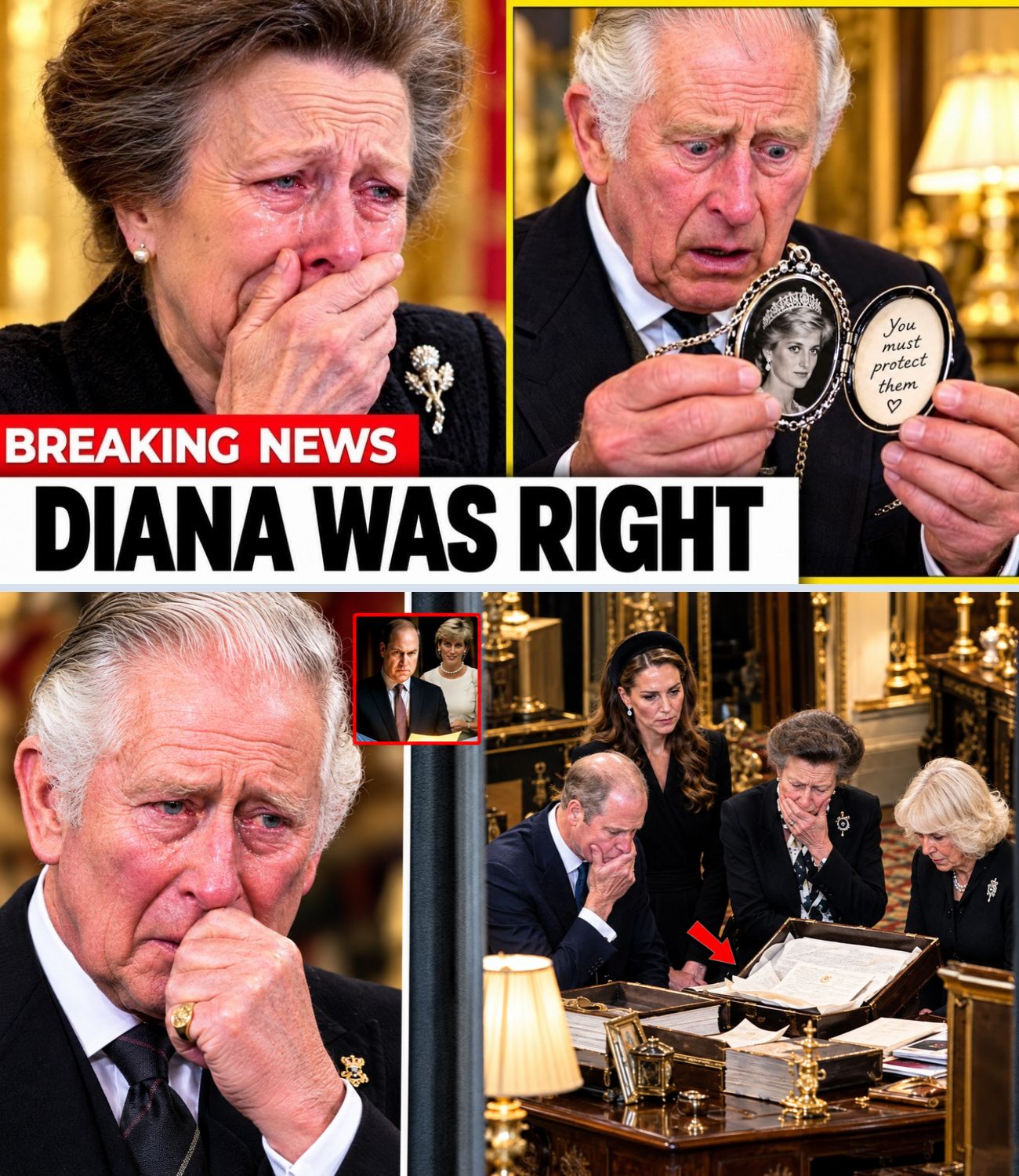
The discovery began almost by accident. Princess Anne, examining a distinctive black onyx pendant that had belonged to Diana, noticed an infinitesimal flaw in the craftsmanship—a tiny, loosened clasp that had eluded notice for years. As her fingers traced the edge of the stone, a concealed compartment clicked open with a faint, dry sound.
Inside lay a single, meticulously folded piece of paper.
Anne’s practiced, unflappable composure fractured the instant her eyes caught the familiar, sloping cursive. It was Diana’s handwriting. With hands that suddenly refused to steady themselves, the Princess Royal unfolded the paper and read the words aloud into the stunned silence of the room:
“Do not let our sons inherit the silence that destroyed us.”
An absolute, suffocating hush descended upon the study. King Charles stopped moving entirely. The sovereign, whose very position placed him at the absolute centre of Britain’s constitutional framework, suddenly appeared utterly incapable of commanding even his own voice. He stared at the slip of paper, his face draining of colour.
Anne turned toward her brother, her eyes swimming with uncharacteristic tears. “Charles,” she whispered, her voice tight with disbelief, “do you recognise this?”
The King’s answer was barely audible, a fractured murmur swallowed by the heavy air of the room. “Those were her words to me.”
William’s Demand for Truth
For Prince William, the emotional equilibrium of his entire life shattered in a single heartbeat. His mother had died decades ago, leaving behind a mountain of unanswered questions, fractured memories, and an official narrative carefully curated by palace spin doctors. Now, a handwritten confession smuggled inside an heirloom suggested that Diana had harboured a terrifying, deeply personal fear regarding the emotional inheritance of her children.
Why had she written those words? What specific silence was she warning them against? And, most critically, why did his father instantly recognise phrases that had evidently been kept hidden from the public eye?
William stepped forward, closing the physical distance between himself and the monarch. His voice was dangerously low, stripped of any deference to royal rank. “What were you afraid we would inherit?”
Charles glanced desperately at Anne, silently begging for sanctuary, but his sister was no longer willing to shield him. The memory of the past had caught up with them all. Anne finally broke down, weeping openly—a rare breach of the iron discipline she had maintained throughout her public life. She confessed that Diana had entrusted the pendant to her back in July 1997, extracting a solemn promise to keep it safe until the boys were old enough to understand. But Anne herself had lived all these years in complete ignorance of the secret compartment nestled within the onyx.
Charles admitted, under the crushing weight of his son’s gaze, that Diana had spoken almost identical words to him during a private, volatile argument at Highgrove months before her death. Yet he had refused to elaborate then, and he attempted to deflect now. His hesitation acted like petrol on a smouldering fire. William refused to let the moment slip away.
“I don’t want another carefully prepared answer,” William stated, placing the opened pendant squarely on the mahogany table between his father and himself. “I want to know what she meant.”
The Summer of 1997: A Promise Kept Too Late
To understand the full gravity of the confrontation at Windsor, one must cast the mind back to the stifling heat of July 18, 1997—weeks before the tragic tunnel crash in Paris consumed global headlines.
Diana had invited Anne to Kensington Palace following a bitter dispute with Charles that neither woman could easily dismiss. The core of the disagreement centred on William and Harry, two young boys already bearing the crushing psychological toll of their parents’ very public, very toxic separation. Diana was deeply terrified that her sons were learning to bury their trauma, masking their pain behind stiff upper lips because the adult world around them treated emotional honesty as a sign of weakness.
During an earlier confrontation at Highgrove, Charles had argued that royal discretion was the ultimate shield. He firmly believed that keeping the messy, painful details of their marital breakdown away from the children was an act of parental protection. Diana had fiercely challenged him, asking a question that cut straight to the bone of the House of Windsor: “Does loyalty to the crown mean pretending a family isn’t hurting?”
Anne had not been party to that Highgrove argument, but at Kensington Palace, Diana made her desperation clear. She placed the black onyx pendant into Anne’s hands with a direct instruction: “Keep this until the boys are old enough to understand. They must never believe loving their parents means denying the truth.” She added that it held something vital, yet she never demonstrated how the spring-loaded clasp operated. Anne had accepted the charge, assuming the value lay purely in sentimental memory.
Now, decades later, the chickens had come home to roost in the most painful manner imaginable.
Stripping Away the Crown
As the hours ticked past inside Windsor Castle, the argument transcended a mere family disagreement; it became a moral trial. Anne insisted that Charles remain, refusing to let him retreat behind the impenetrable wall of royal protocol.
“She trusted us with something that mattered to her children,” Anne told her brother, her voice trembling with righteous indignation, “and we answered with silence.”
Charles absorbed the blow with visible agony. He defended his past actions by pointing to the insurmountable pressures of a marriage collapsing under a merciless media spotlight. But Anne refused to grant him that escape hatch. “For once, Charles, don’t answer as the king. Answer as their father.”
William weighed in, his tone flat and unyielding. He acknowledged the unprecedented pressures his parents had faced, but noted that historical explanations did not erase the psychological vacuum he and Harry had navigated during their formative years. “I understand there were pressures,” William said quietly, “but understanding them doesn’t erase what happened to us.”
Cornered by his own flesh and blood, Charles finally cracked. In a raw, unscripted confession, he admitted that during that stormy summer at Highgrove, he had indeed promised Diana that their children would never be forced to repeat their parents’ catastrophic mistakes. Diana had warned him that emotional distance could become an intergenerational curse—an inheritance far more damaging than any public scandal.
“I told her I understood,” Charles confessed, his voice breaking. “But I never asked myself what keeping that promise would actually require of me.”
William listened, the hard lines of his face softening slightly, not out of forgiveness, but out of a long-awaited validation. The admission did not magically erase his childhood trauma, nor did it rewrite the past, but it provided something priceless: an acknowledgment of fault unshielded by palace PR.
The Burden Passed to the Next Generation
With the truth finally dragged into the light, a new and delicate crisis emerged. How was Harry to be informed?
The chasm between the brothers had been well-documented across international headlines for years, and dropping a bombshell about their mother’s hidden final message via an impersonal channel risked detonating what little fragile peace remained. William insisted that Harry deserved to hear about the discovery directly from family, without sensationalised media leaks twisting their mother’s words into a weapon.
Anne took up the mantle, sending Harry a private written transcript of the note without editorialising or assigning blame. The response from California was swift, catching them all off guard. Harry did not respond with immediate anger, suspicion, or demands for a public tribunal. Instead, his reply contained only two simple questions—confirming the handwriting and asking if Charles had read it—followed by a single, poignant plea: “Please keep the original safe.”
Reading Harry’s words, Anne felt a wave of profound relief wash over her. He had not sought vengeance; he had simply asked that their mother’s final protective gesture be honoured.
A New Chapter Wrote in Ink, Not Silence
In the days that followed, the Windsor summit yielded a fragile, hard-won reconciliation. The family agreed unanimously that Diana’s message would never be weaponised for public consumption or turned into another tawdry tabloid spectacle. When brief rumors of a royal discovery leaked to the London press, the palace issued a dignified, minimalist statement acknowledging the preservation of a private family keepsake while keeping the contents strictly confidential.
Behind closed doors, Charles took the unprecedented step of writing a personal, private addendum to accompany Diana’s note. In it, he formally conceded that true parental responsibility requires embracing difficult conversations, admitting failures, and allowing love to exist free from the paralyzing fear of emotional exposure.
When Charles handed the pendant back to Anne for safekeeping, the dark cloud that had hovered over the family for decades finally began to lift. The secret no longer belonged to the history books or the archives of state; it belonged squarely to the two boys Diana had loved beyond measure.
The silence that had threatened to consume the royal family had not been entirely broken by a grand public declaration, but rather by a quiet, agonizingly honest conversation in a Windsor Castle study. Diana’s warning had done its work. And as William looked toward the future of the monarchy, he did so with the quiet confidence of a man who had finally unlocked the past, ensuring that his own children would never inherit the suffocating silence of their ancestors.
You Might Also Enjoy

“We Thought They Would Negotiate”—What Argentine Soldiers Said When The British Attacked Goose Green

“You’ll Never Finish My Ruck March, Limey” — US Sergeant Who Challenged the SAS, Then Fell Out First






