ANNE FINALLY Acts—New Sussex Royal Status Leaves Harry & Meghan Reeling!
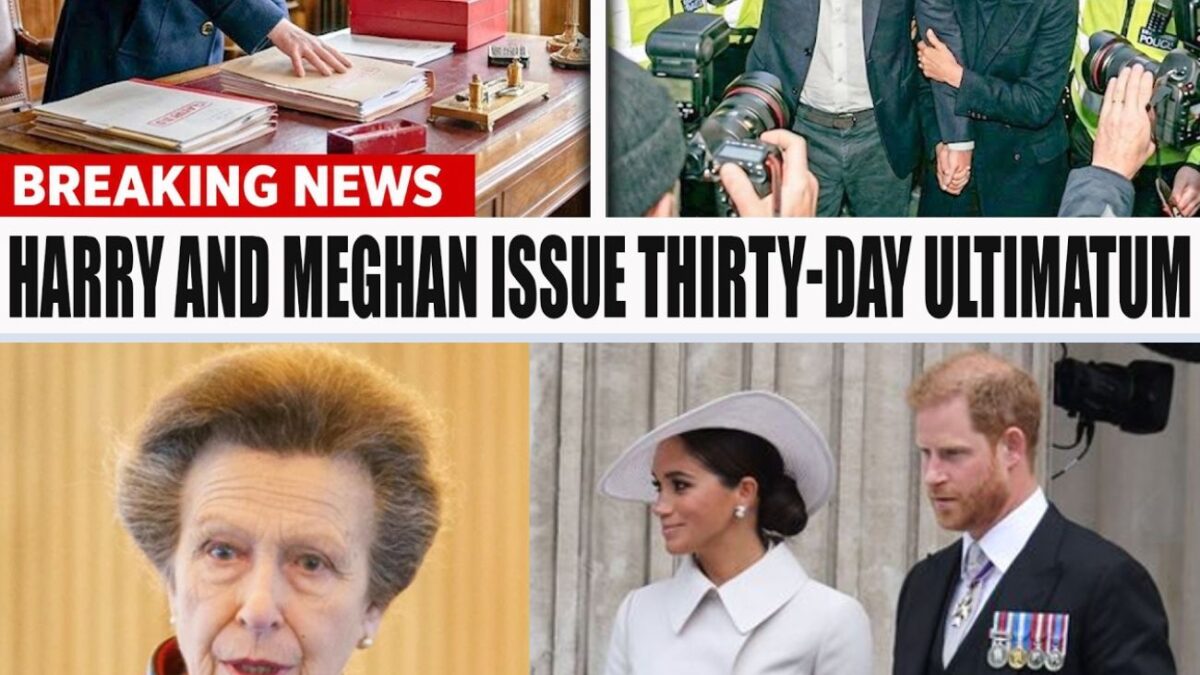
The Secret Vault Memo That Just Destroyed the Sussexes’ Royal Game Plan
In the quiet, wood-panelled study at High Grove, King Charles sat behind a mahogany desk stacked high with red dispatch boxes. He looked visibly exhausted, still navigating his ongoing cancer treatments while attempting to wrestle with the relentless press cycle outside. Spread out directly in front of him were the front pages of nearly every major British newspaper. For forty-eight hours, headlines had shrieked with a coordinated narrative: the camp of Prince Harry and Meghan Markle had launched an aggressive, synchronized press briefing across London, claiming the late Queen’s historic Sandringham agreement had been forced upon them against their will. They insisted that the phrase “working royals” was a lazy, degrading label, and that being designated as private citizens was a deliberate insult orchestrated by palace officials.
While the King’s private secretaries were busy drafting cautious, polite responses designed to avoid a public war with California, Princess Anne walked straight into the room. She did not knock, she did not ask for an appointment, and she offered no gentle sympathy. Instead, she dropped a classified intelligence dossier squarely onto the desk and informed her brother in no uncertain terms that his hesitation was actively destroying the institution from within.
To understand the sheer magnitude of that confrontation, one must look past the superficial veneer of celebrity drama. This was not a petty dispute over nicknames or wounded pride. It was a cold, calculated, constitutional crisis that had flared into the open just twenty-four hours earlier on British soil.
Prince Harry and Meghan had suddenly appeared in Nottingham, orchestrating a public engagement that bore every single hallmark of an official state-sanctioned royal tour. There were private close-protection officers clearing public sidewalks, camera crews tracking every step, carefully orchestrated walkabouts, and speeches addressing public causes. To any ordinary observer watching the evening news, it looked identical to crown service.
Anne was not reacting to idle tabloid gossip; she was responding to an existential threat. She pointed out to Charles that the couple was attempting to execute the exact “half-in, half-out” arrangement that Queen Elizabeth had spent her final years explicitly forbidding. They wanted the absolute freedom of commercial contracts in America, yet they still demanded the ceremonial prestige of royal status whenever it suited their brand visibility back in Britain.
Without pausing, Anne demanded that Charles issue an immediate, permanent ruling stripping the couple of any institutional ambiguity once and for all. Either they were working royals bound by constitutional rules, or they were private citizens who possessed zero claim to state prestige. But as the King stared down at his fountain pen, neither of them fully realized that the Nottingham appearance was merely the opening salvo of an aggressive, legally binding trap.
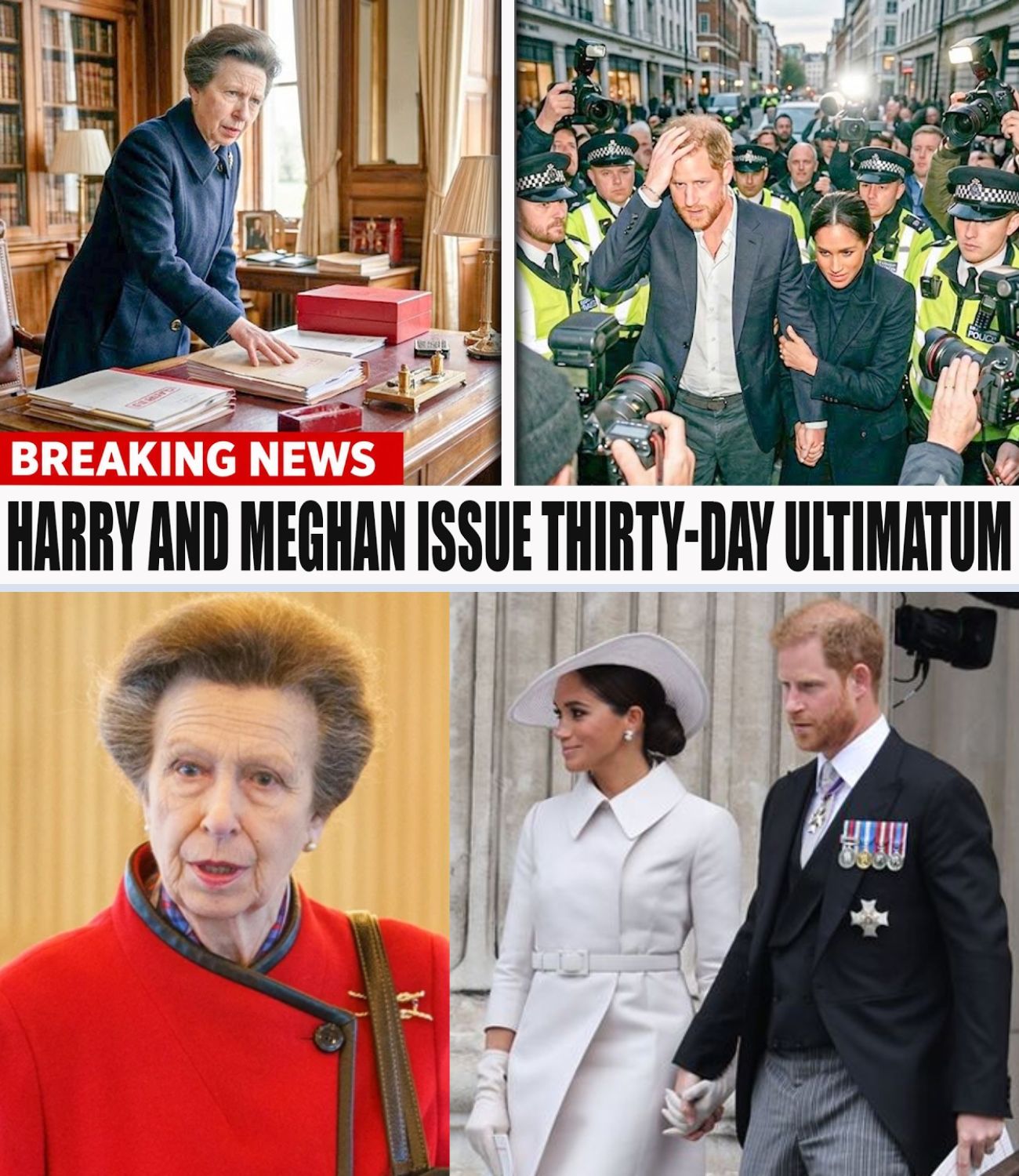
The Five Directives of the Crown
To fully grasp why Princess Anne took such an uncompromising stance in that study, one must examine the hard reality of how royal power actually operates behind closed doors. This was governed by five concrete institutional directives that King Charles had laid down to define the Sussexes’ position in the modern world.
Out of five major mandates, the couple had actively resisted four of them while grudgingly complying with only a single one.
The First Directive: An absolute ban on official representation. Charles made it crystal clear that Harry and Meghan could no longer perform official duties on behalf of the crown, and their names were permanently excluded from the Court Circular, the official historic record of royal service. Yet in Nottingham, they ignored that boundary entirely, orchestrating an appearance designed to convince foreign media that they were still operating as royal emissaries.
The Second Directive: The formal designation of their public status as private citizens. The palace established that whenever they set foot in Britain for personal endeavors, they were to be treated as private individuals, not constitutional figures. Yet their camp briefed journalists that calling them private citizens was an offensive demotion.
The Third Directive: State-funded security. The sovereign ruling determined that British taxpayers would no longer pay millions of pounds for armed Metropolitan Police protection for people living as private commercial figures in California. Harry had spent years fighting this in British courtrooms, demanding state protection while refusing the constitutional duties that fund it.
The Fourth Directive: The prohibition of commercial monetization of royal titles. The agreement explicitly stated that royal status could not be leveraged to secure multi-million-dollar entertainment deals, corporate endorsements, or lifestyle brands. Yet their entire American venture was built on commercializing the very royal aura they claimed to escape.
The Fifth Directive: The surrender of Frogmore Cottage and the removal of honorary military appointments. This single directive was the only one the Sussexes actually complied with—solely because the law left them zero room to fight back, as royal properties and military patronages belong exclusively to the reigning monarch.
When tallying the score, four directives were actively challenged or publicly condemned, while only one was accepted under strict legal duress. Anne reminded her brother that if two members of the family could relocate to California, sign lucrative streaming deals, return to Britain to stage imitation royal tours, and then demand taxpayer-funded police guards, the moral authority of the British crown would collapse overnight.
The Secret Strategy Memo
Up until that exact moment in High Grove, it would have been easy to write off the dispute as another exhausting chapter in a long-running family feud. What Princess Anne discovered in that confidential dossier, however, completely shattered that comforting narrative.
The document laid out before the King was not a collection of leaked text messages or media gossip. It was a formal legal strategy memo drafted by senior solicitors and crisis management strategists working directly for the Sussex camp. That document revealed the shocking hidden objective behind both the Nottingham walkabout and the furious press campaign over the term “private citizens.”
The entire operation had almost nothing to do with charity. It was intimately tied to Prince Harry’s ongoing, multi-million-pound judicial review against the British Home Office at the High Court in London.
To understand why this was so explosive, one must look at RAVEC—the Executive Committee for the Protection of Royalty and Public Figures. Operating under the strict statutory guidelines of the Home Office alongside senior Metropolitan Police commanders, RAVEC does not grant taxpayer-funded armed protection because of someone’s royal bloodline or family tree. It is granted strictly based on whether an individual is actively undertaking authorized constitutional duties on behalf of the British state.
When Harry stepped down as a working royal in 2020, his security status was downgraded. Furious, he launched aggressive legal challenges against the government, arguing in court that his public engagements carry such intense public interest that the line between private life and official service has effectively ceased to exist.
The secret memo revealed a high-stakes legal strategy: the Sussex team sought to artificially manufacture evidence of official royal activity on British soil. By staging the Nottingham walkabout with motorcades, street closures, and heavy media coverage, and then aggressively challenging the term “private citizens” through synchronized press briefings, their explicit goal was to trick the High Court into ruling that Harry’s public presence commanded such royal weight that denying him state-funded police protection was irrational and unlawful. They were attempting to use public confusion to force the British government into a legal settlement.
When Anne read that memo, any remaining trace of family sympathy vanished. She realized Harry was not simply asking his father for understanding; he was attempting to weaponize public perception to force the monarch into an impossible constitutional corner.
The Sovereign’s Unchallengeable Prerogative
King Charles did not make an angry speech, nor did he authorize a public television interview. Instead, he unscrewed the cap of his fountain pen and looked down at the formal administrative instrument Princess Anne had placed before him. With quiet resolve, he signed his sovereign cipher.
Under British constitutional law, the reigning monarch possesses the absolute, unchallengeable prerogative to define who represents the crown. No court of law, government department, and no high-priced legal team in California can overrule the sovereign on the question of royal agency.
With that single signature, Charles activated a quiet executive protocol through the Lord Chamberlain’s office and the Private Secretary’s office. A formal administrative notification was transmitted directly to the Home Office, New Scotland Yard, and RAVEC. The directive stated in unambiguous bureaucratic language that the Duke and Duchess of Sussex were private citizens residing abroad, and their presence in Nottingham was an entirely private commercial endeavor undertaken without crown authorization or official standing.
Furthermore, the directive explicitly ordered that the Nottingham appearance be excluded from the Court Circular. In the eyes of the British state, the event simply did not exist.
When government attorneys representing the Home Office subsequently placed the sovereign’s written ruling directly onto the judge’s bench in the High Court, Harry’s entire legal strategy collapsed overnight. The argument of artificial royal service was dead before it could even be heard.
The Unbreakable Iron Rule
The public fallout was swift and devastating. When the morning edition of the Court Circular dropped in The Times and The Daily Telegraph, detailing every single working engagement of the royal family, there was total silence regarding Nottingham. Not a single paragraph or footnote acknowledged the event.
That afternoon, King Charles appeared at Horse Guards Parade to inspect the Household Division, with Princess Anne standing proudly at his right shoulder in the full ceremonial uniform of the Blues and Royals. The visual message sent to foreign embassies and domestic courts alike was unmistakable: the core leadership of the crown was unified, disciplined, and entirely unbothered by external noise.
Meanwhile, aerial footage leaking from Nottingham exposed the stark reality of the Sussexes’ pseudo-tour. Despite the private motorcade and heavy media production, the crowd gathered on the pavement numbered fewer than one hundred curious onlookers—mostly office workers on their lunch break wondering why the street had been blocked off. A comprehensive national tracking poll published by YouGov shortly afterward revealed that the couple’s net favorability ratings in the United Kingdom had plunged to their lowest levels in history, with over seventy percent of British adults expressing a negative view.
Corporate boardrooms in California took immediate note. Streaming executives and studio heads, who had poured tens of millions into Sussex-branded production deals based on the assumption of unhindered access to royal prestige, watched the palace officially cut them loose. Without the constitutional backing of the British crown, production contract renewal talks quietly stalled, and high-level development meetings were indefinitely postponed.
The final institutional hammer fell on a quiet Tuesday morning at Windsor Castle. Under the direct counsel of Princess Anne, the King signed final warrants formally reallocating every remaining military patronage and charitable protectorate once held by the Duke of Sussex. The Royal Marines, Royal Air Force Honington, and Royal Navy small ships were permanently transferred to working members of the family who actually put on the uniform. Princess Anne assumed direct oversight of key military charities, Prince William took over historic regimental commands, and Prince Edward was handed the remaining cultural trusts.
With a single entry in the London Gazette, Harry’s institutional footprint inside the British military was erased forever.
Alongside that reallocation came the enforcement of what insiders now call Anne’s “iron rule”—the absolute wall of silence. The palace adopted a permanent policy of total non-engagement. No matter what briefings or complaints emerged from California, unless Buckingham Palace acknowledged the accusation, those grievances remained on the far side of an unyielding stone wall.
When the official royal family website was quietly updated late that evening, Harry and Meghan’s individual biography pages were permanently removed from the senior roster, consolidated instead into a brief shared summary placed at the very bottom of the directory beneath minor working royals.
The door was not just closed; it was locked, bolted, and the key handed securely to the next generation. For the British monarchy, the message echoing through the stone corridors of Buckingham Palace and Windsor Castle is settled permanently: the crown may be patient with wandering sons, but history has never forgiven those who try to trade the sacred duty of a thousand years for the fleeting glamour of a commercial contract.
You Might Also Enjoy

“We Thought They Would Negotiate”—What Argentine Soldiers Said When The British Attacked Goose Green

“You’ll Never Finish My Ruck March, Limey” — US Sergeant Who Challenged the SAS, Then Fell Out First






