At 78, Ken Wharfe Finally Reveals Why He Left Diana’s Protection Detail in 1993

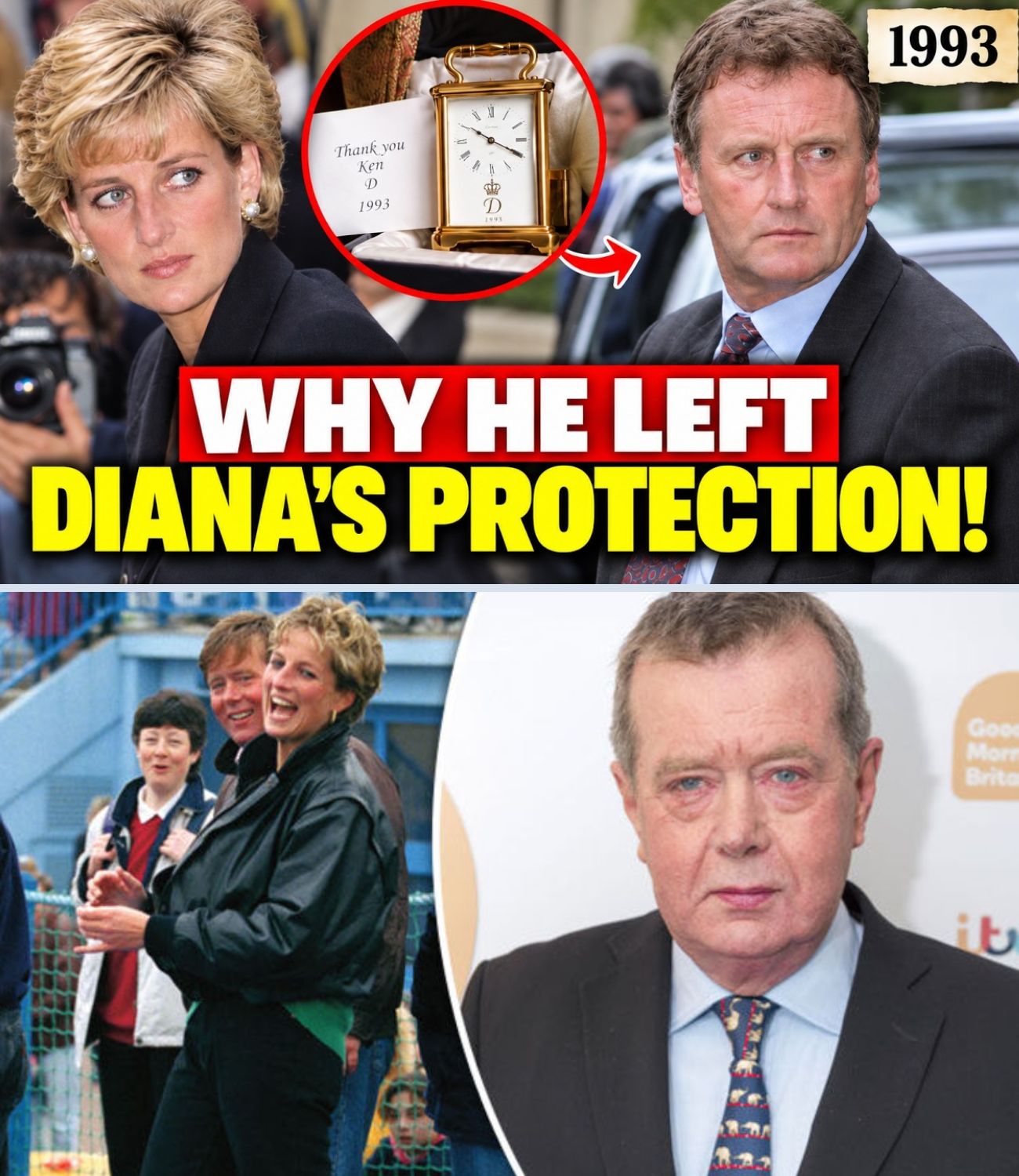
By the time Ken Wharfe held the small carriage clock Diana had chosen for him, the decision had already been made. The clock carried her initial beneath a coronet. It was graceful, formal, unmistakably royal. But it marked something painfully personal, the end of a working relationship that had carried them through family holidays, hostile photographers, a failing marriage, and some of the most private moments of Diana’s life.
Wharfe had spent years standing close enough to hear what the cameras couldn’t. He’d watch Diana laugh with William and Harry, watch her test every boundary placed around her, and watch protection become entangled with trust. Then, in 1993, he walked away from the most famous woman in the world. Why? At 78, Wharfe’s own accounts make one thing clear.
It wasn’t one argument. It wasn’t one bad day. And it wasn’t simply the pressure of guarding a princess. The real break came when Diana began to see the man protecting her as part of the institution she was trying to escape. By then, the danger wasn’t only outside the gates. It was inside the relationship between protector and protected.
And once that trust cracked, neither of them could pretend the job still worked.
Now, let’s go back to the moment Ken Wharfe first entered Diana’s world, because the reason he left was already hiding in the way that relationship began. Wharfe wasn’t brought into royal protection as a courtier. He was a Metropolitan Police Officer. He joined the force as a teenager, and eventually moved into royalty protection, a world where discretion mattered as much as physical courage.
An officer assigned to a senior royal wasn’t merely a man in a suit checking doors. He planned routes, read crowds, assessed buildings, coordinated with local police, and remained close without becoming visible. The best protection officer could be beside his principal all day while allowing the public to feel that no barrier existed at all.
That balance was especially difficult with Princess Diana. She didn’t want to be treated like a piece of state property. She wanted spontaneity. She wanted contact. She wanted William and Harry to know something of ordinary life, and she had an instinctive dislike of walls that separated her from other people. Wharfe’s first meeting with her at Sandringham revealed that family world immediately. William was at a piano.
Harry arrived carrying lilies and placed them in his mother’s hands. Diana was warm, playful, and direct. She wasn’t interviewing a uniform. She was judging the man who might enter her children’s lives. The boys were central to everything. Wharfe’s early responsibility included helping protect them, and Diana quickly saw that he could be firm without being stiff. That mattered.
She wanted the princes to understand protocol, but she also wanted them to laugh, make mistakes, queue, shop, eat in ordinary restaurants, and meet people who didn’t bow. She took them into Marks & Spencer. They went to places such as Sticky Fingers. They used buses and taxis on carefully managed outings. Behind every apparently casual trip sat planning that the public never saw.
Wharfe entered this work in stages. He joined the royalty protection department in 1986, spent time around the young princes, and became Diana’s personal protection officer the following year. That sequence mattered. He wasn’t dropped beside her as an unknown man carrying authority. Diana had watched how he behaved around William and Harry before accepting him into the closer position.
For the police, that familiarity was useful. A child who trusts an officer is more likely to follow an instruction during a sudden change. For Diana, it was a test of character. She could forgive a man for not understanding royal etiquette. She was less likely to forgive him for speaking down to her sons or turning every family moment into a security drill.
Wharfe learned to make readiness look relaxed. He could join the laughter while tracking exits. He could let a prince believe an outing was spontaneous even when vehicles, local officers, and contingencies had been arranged in advance. That ability is easy to overlook because successful protection leaves no dramatic scene behind.
The evidence is the uneventful return home. This was the first paradox of Wharfe’s job. Diana wanted the freedom to create normal memories. Yet those memories were possible only because trained officers quietly built a safe space around them. Protection didn’t always restrict her. Often, it made her freedom possible. For a while, the arrangement worked beautifully.
There were trips where the family could behave with a looseness rarely seen at public engagements. On Necker Island, the boys played tricks and water fights replaced ceremony. Wharfe could become the target of a joke one minute and return to scanning the horizon the next. Diana liked people who could move between those two worlds.
She distrusted pomposity. She responded to plain speaking. And Wharfe, unlike many around her, didn’t appear dazzled by rank. But closeness creates its own hazard. A protection officer hears conversations because he must remain nearby. He sees moods before a room full of guests does. He knows when a principal has changed plans, when a telephone call has disturbed them, and when a smile is for the cameras.
He must absorb all of it without using it. The information belongs to the job, not to the officer. Diana didn’t always keep that boundary intact. She drew people into her confidence. Sometimes that helped her feel less alone. Sometimes it placed an impossible emotional weight on the very people whose duty required distance. Wharfe later acknowledged how hard it was to keep security and friendship separate.
Diana included officers in family occasions and spoke to them with unusual openness. That closeness could make protection more effective because trust encouraged cooperation. But it could also make a professional disagreement feel like a personal betrayal. The turning point in their bond came during a royal holiday in Mallorca.
Diana asked Wharfe whether he knew about Camilla Parker Bowles. He did. By then, the strain in the Wales marriage wasn’t an abstract rumor to those working nearby. Diana gave him her account. Wharfe also knew of her relationship with James Hewitt. What mattered wasn’t gossip. It was that the princess had placed her marriage inside the protective relationship.
From that point forward, he wasn’t only guarding a public figure. He was guarding a woman who believed her marriage contained a rival, and who increasingly suspected that the royal structure around her knew more than it admitted. That changed every silence. At Highgrove, the Prince and Princess of Wales could inhabit the same house while living in different emotional climates.
Staff members sensed the tension. Family visits sometimes prevented the atmosphere from freezing completely. Diana’s mother, Frances Shand Kydd, could help restart conversation when husband and wife had retreated into silence. The house was secure, the marriage wasn’t. Wharfe could protect the perimeter, check routes, and keep photographers at a distance.
He couldn’t resolve the question eating away at Diana. Was everyone around her protecting Charles’s position while expecting her to endure the humiliation quietly? That question became more dangerous after public appearances. Diana could be radiant in a hospital ward, instinctively reaching for someone others avoided, then returned to a private life defined by distrust.
The contrast was severe. The more confident she became in her public work, the less willing she was to accept being managed at home. She told Wharfe that the family had to change if it wanted to survive. It was the sort of statement that could sound dramatic from somebody else. From Diana, it was an early warning.
She was learning that public affection gave her power, and she was beginning to use that power to claim a life of her own. Wharfe respected her ability to connect with people. He also understood something she sometimes resisted. Popularity couldn’t suspend risk. A crowd that adored her could still surge. A photographer seeking a picture could still trigger chaos.
A secret outing could still leave security blind. The more Diana wanted to move without the machinery of the palace, the more the officer beside her had to insist on information, timing, and cooperation. At first, their frankness allowed those disagreements to be resolved. She might object, he would explain, she might test him, he would hold the line.
They could joke afterward. That pattern depended on one belief. Even when Wharfe said no, Diana had to believe he was saying it for her safety, not for the convenience of the palace. Then the marriage moved into open collapse. In December 1992, Prime Minister John Major announced in the House of Commons that the Prince and Princess of Wales had separated.
The statement said there were no plans for divorce and that their constitutional positions were unchanged. On paper, it sounded orderly. In practice, almost nothing about Diana’s new position felt orderly. She was still the Princess of Wales. She was still the mother of the future king. She still carried out public duties.
Yet the household, the marriage, and the chain of loyalty around her were being reorganized. Every protection decision could now feel political. Who received her schedule? Who knew where she was going? Who reported changes? Was the officer beside her serving her? The police, the sovereign, or the institution from which she felt increasingly alienated? For Wharfe, the answer was professional.
He served as a police officer charged with keeping her safe. For Diana, the answer was no longer that simple. The physical presence of protection began to represent something larger. A detective at the door meant a route had been recorded. A planned movement meant somebody else knew. An officer asking where she intended to go could sound, in a wounded marriage, less like protection and more like surveillance.
That didn’t make Diana careless in every situation. She understood real threats. She had lived with intrusive attention for years. But she also wanted control over the few parts of life that still felt private. The collision between those two needs, safety and secrecy, would eventually make Wharfe’s position impossible.
One episode away from London showed how far the tension had gone. In March 1993, Diana and her party were in Lech, Austria. Snow lay deep around the chalet. Photographers remained a constant irritation. An incident involving a paparazzo left Diana furious and distressed. Yet the more serious event came later when Wharfe discovered that she had slipped away without her protection team knowing.
She returned in the early morning. Wharfe was stunned. A senior royal had left a guarded building in a foreign country and moved without the officer responsible for her safety. This wasn’t a disagreement over where to eat. It was a direct breach of the working trust on which protection depended. Then, he examined the snow beneath a first-floor balcony.
There was an impression where somebody had landed. Diana admitted that she had climbed out. Her explanation was simple. She needed air. But, for Wharfe, the method mattered more than the reason. If the officer responsible for her life didn’t know she had left the building, he couldn’t protect her. If she believed secrecy from him was necessary to feel free, the relationship had already entered dangerous territory.
He treated it as an abuse of trust. Diana saw his anger as proof of the very control she wanted to escape. Both reactions came from a place each believed was legitimate. That’s what made the rupture so hard to repair. The snow beneath that balcony became a warning. The princess was no longer merely pushing against protocol.
She was testing whether she could disappear from the people assigned to keep her alive. And the next stage of the story would show that this wasn’t an isolated act. Soon afterward, Diana took William and Harry to Thorpe Park. It was the kind of day she treasured. Rides, noise, the boys’ excitement, and a chance to be a mother rather than a symbol.
Photographs from such outings fed the public image of Diana as the parent who wanted her sons to encounter ordinary fun. Wharfe’s work made those moments possible, and he could see how much they meant to her. That is why their break can’t be reduced to a cold battle between a rebellious princess and an inflexible policeman.
They had shared good days. They had built successful operations around her instincts. Wharfe had seen her at her funniest and most tender. Diana had trusted him near the two people she loved most, but even happy outings exposed the basic conflict. Diana experienced protection as successful when she barely felt it. Wharfe experienced protection as successful only when he knew enough to prepare.
She wanted the result without always accepting the process. On a discreet trip to Paris, she could enjoy the thrill of moving with less attention. Then, an apparently chance encounter with a photographer reminded everyone how fragile anonymity was. Diana’s face was one of the most recognizable in the world. A cap, a side entrance, or a changed car could lower visibility.
None could erase it. Her public duties added another layer. In May 1993, she traveled alone to Zimbabwe on an official visit after the necessary security arrangements had been made. She could still work with protection when the purpose felt hers. She met people, fulfilled the engagement, and demonstrated the independence she wanted the public to see.
So, the problem wasn’t that she rejected every officer or every plan. The problem was selective trust. She cooperated when protection helped her do what she believed mattered. She resisted when it blocked private choices she didn’t want explained. That distinction moved Wharfe closer to the edge. By then, Diana had begun assembling a looser circle of advisers and confidants outside the old palace structure.
Some offered friendship. Some offered access. Some understood the press. Others believed they could help her shape the next chapter of her public life. To Diana, these relationships promised independence. To a protection officer, they created more moving parts, more private arrangements, and more opportunities for a plan to change without warning.
Wharfe wasn’t entitled to approve her friendships. He was required to assess the consequences. That difference was easy to state and increasingly difficult to live. On a visit to Nevis, he helped manage a delicate understanding with members of the press. Diana wanted room. Photographers wanted pictures. A controlled arrangement could lower the temperature and reduce dangerous chasing.
Such deals required credibility on both sides. The photographers had to believe they would get something. Diana had to honor the boundary once it was set. And the palace and Scotland Yard had to accept that an officer on the ground sometimes needed a practical solution rather than a rigid display of authority.
The arrangement worked in the immediate sense, but it drew criticism. To Wharfe, that criticism carried a message. Even when he used his judgment to deliver safety and privacy, the institution might still view him as having grown too close to Diana’s way of doing things. He was now caught between two forms of suspicion.
Diana could suspect him of serving the palace. The palace could suspect him of serving Diana too personally. The carriage clock had not yet been placed in his hands, but the time on their partnership was already running down. Another dispute revealed how personal the security question had become. In the spring of 1993, Diana considered establishing a home at Althorp, the Spencer family estate, where she had spent part of her childhood.
The idea carried emotional weight. A house there might offer distance from Kensington Palace and a place that belonged to her family rather than to the monarchy. But a former princess-in-waiting couldn’t simply move into a cottage and become invisible. Her police protection required accommodation, communications, access control, and a physical presence.
According to Wharfe’s account, Diana’s brother initially appeared willing to help, then withdrew the offer in part because of the security arrangements that would follow her. To Diana, that must have felt like another door closing. To Wharfe, it proved a hard truth. Wherever she went, her status came with her. Protection wasn’t a coat she could hang in the hall when it became inconvenient.
Yet, the failed plan strengthened her determination to get rid of it. This was the hidden pressure behind many arguments that looked trivial from the outside. A route, a vehicle, an officer at a gate. Each one touched the larger question of who owned Diana’s life after separation.
The press made that question even sharper. Diana understood the camera better than almost anyone. She knew a picture could show warmth, loneliness, confidence, or rebellion without a single spoken sentence. She also knew that photographers could turn a private movement into tomorrow’s front page. Sometimes she cooperated with selected journalists or photographers to create breathing room.
Sometimes she fought them. Sometimes she wanted the public to see her. Sometimes she wanted to pass unseen. Those shifts were human. Operationally, they were difficult. A protection officer can plan for a hostile crowd. It is far harder to plan when the protected person’s relationship with publicity changes from hour to hour. Diana could regard one photographer as intrusive and another as useful.
She could feel violated by a long lens, then recognize that a carefully chosen picture might correct a hostile story. The boundary between press management and security became dangerously thin. The gym photographs of 1993 were a brutal example of that vulnerability. Pictures of Diana exercising were taken without the consent she expected and became the subject of legal action.
The episode reinforced her belief that privacy could be stolen even in a place where she should have felt secure. It also showed that an officer couldn’t prevent every betrayal. Sometimes the danger entered through somebody else’s commercial decision, a hidden camera, or a broken promise. For Diana, that invasion could confirm that the system around her had failed.
For Wharfe, it confirmed that she needed experienced protection more than ever. They looked at the same event and reached opposite conclusions.
Before that street, however, came a quieter withdrawal. Wharfe sensed that other voices were gaining influence. One of them was art dealer Oliver Hoare, a family friend whose relationship with Diana became the subject of intense later reporting. Wharfe’s concern wasn’t to pass judgment on Diana’s private emotions. It was that secrecy was becoming a method. If she arranged calls, visits, or movements through people outside the protection chain, he would be responsible for risks he hadn’t been allowed to assess.
There is a line every protection officer knows, even if it is never written on a palace wall. Confidence is necessary, but complicity is dangerous. An officer can guard privacy. He can’t allow privacy to erase the information required to do the job. Diana’s circle was changing, and so was the meaning of loyalty. She valued people who didn’t challenge her plans. Wharfe’s duty was often to challenge them.
The quality that had once made him useful, his plain speaking, now made him an obstacle. He began to believe that Diana wanted a different kind of companion beside her. Someone less likely to caution her and less tied to official procedure. That didn’t mean she wanted to be harmed. It meant that she had come to define freedom as the absence of the very questions that kept her protected.
The emotional cost of the job rose in smaller scenes. At one of William’s football matches, the normality Diana prized sat beside the scrutiny she could never escape. Parents watched the game. Her son needed his mother to be present as a mother, not as a front page figure. Yet every arrival and departure had to account for the fact that Diana’s presence changed the environment.
Wharfe was not there to spoil the afternoon. He was there because a school sideline could become a press event the moment she appeared. That was the strange intimacy of royal protection. The officer saw childhood at close range while remaining answerable to adult dangers. He might know which prince was nervous, which route avoided a crowd, and which joke would calm the mood.
But he could never forget that one lapse would be judged not as a human mistake, but as a national failure. Wharfe had carried that weight for years. By 1993, he no longer believed Diana was willing to carry her part of it.
Then came Kensington High Street. The immediate dispute was mundane. A car, an illegal parking position, a decision about stopping where Diana wanted rather than where the officer believed it was safe and lawful. On another day, the disagreement might have ended with irritation. In the autumn of 1993, it carried the weight of everything that had come before. Diana wanted control over a simple movement in her own city. Wharfe saw yet another situation in which she expected protection to bend after the plan had been made.
Words were exchanged. The temperature rose. Neither was truly arguing only about parking. She was arguing against years of being told where to stand, when to leave, and which door to use. He was arguing for the principle that protection fails when the protected person decides that every inconvenient rule is optional.
The street argument became the final spark because the ground beneath them was already dry. Wharfe decided to resign from Diana’s detail. When he informed her at Kensington Palace, the scene wasn’t theatrical. There was no public accusation, no grand farewell. His own account remembers Diana entering with her head lowered.
Whatever anger had passed between them, she understood what his departure meant. A man who had been woven into the daily life of her family had decided he could no longer remain responsible for her under the conditions she was creating. The formal resignation followed. By November, newspapers reported that Diana had lost her senior protection officer.
Headlines made it sound as though one of them had defeated the other. That framing missed the sadness of it. Wharfe didn’t leave because he had stopped caring whether Diana was safe. He left because caring was no longer enough to make the job possible. Diana didn’t push against him because she wanted danger.
She pushed because his presence had become inseparable in her mind from a structure she believed had controlled and failed her. Both could feel wounded. Both could believe the other had broken faith. And both could still understand, somewhere beneath the anger, that the relationship had reached its natural end.
The clock came during the handover. It was not an extravagant royal treasure. Its power lay in what it represented. The initial beneath the coronet belonged to the public Diana. The gift belonged to the private one. She could recognize service even as the partnership ended. Wharfe handed responsibility to another officer and voiced his concern about the direction Diana was taking.
Without cooperation, no replacement could build a durable shield around her. The name on the duty roster could change. The central problem would remain. Soon afterward, he encountered Diana by chance near Cadogan Place. The bitterness had cooled. Their exchange confirmed that the timing had been right.
This wasn’t a friendship that could simply continue over lunch. The intimacy had existed inside a specific professional relationship. Once the duty ended, both needed distance. That is one of the least understood facts about protection work. A principal and an officer may spend more waking hours together than many relatives do. They may share jokes, fears, airports, funerals, school runs, and sudden crises.
Yet the bond has an end point built into it. When the assignment ends, ordinary friendship can feel impossible because nothing about the relationship was ever ordinary. Wharfe returned to police work. Diana moved further toward independence. In December 1993, only weeks after his departure became public, she announced that she intended to reduce her public role.
The speech surprised the country. She spoke of the overwhelming attention surrounding her life and her wish to create more space for William and Harry. At roughly the same time, she ended continuous Scotland Yard protection, keeping police coverage for official engagements, but living much of her private life without the permanent team that had once surrounded her.
For Wharfe, this was the outcome he had feared. He later described a meeting over tea and biscuits after his departure. Diana apologized for the difficult final year. He urged her not to abandon police protection. His warning was not based on a desire to control her. It came from years of watching how quickly a quiet plan could turn chaotic when the world’s most photographed woman appeared.
She made the choice anyway. That decision has often been folded into the tragedy that followed 4 years later. It must be handled carefully. Diana did retain protection for official duties and later private security arrangements varied. The circumstances of the Paris crash in August 1997 involved a chain of failures and reckless choices.
A later inquest jury found that grossly negligent driving by Henri Paul and the pursuing paparazzi caused the unlawful killing with alcohol, speed, and the lack of seat belts contributing. No single staffing decision explains that night. Wharfe has nevertheless remained clear about his professional view. Permanent Scotland Yard protection offered planning, coordination, intelligence, and communication that an improvised private arrangement could not easily reproduce.
In his judgment, removing that structure increased Diana’s exposure. That is not the same as saying one officer could have guaranteed her survival. It is a reminder that close protection is a system. Drivers, routes, advanced teams, local police, vehicles, communications, and the cooperation of the protected person all matter.
When any part collapses, the others carry more risk. Years later, Wharfe would oversee internal security connected with Diana’s funeral. The assignment closed a circle no officer would have wanted. He had once walked beside her through crowded streets and family holidays. Now the country was grieving behind barriers and security planning was being used not to protect her life, but to manage the public response to her death.
The carriage clock survived. So did the question, why did he leave? At 78, Wharfe has answered it in pieces across his memoir and interviews. His wording has varied, but the shape of the truth is consistent. By autumn 1993, he believed Diana’s life was moving in a direction he could no longer support professionally.
She wanted autonomy that excluded the cautioning voice of an official protection officer. He saw a duty that could not be performed without trust. The palace questioned whether he had become too close. Diana questioned whether he belonged to the palace. The position between them disappeared.
To understand how unusual that conclusion was, consider what Wharfe had already endured without leaving. He had managed overseas holidays where photographers tracked every movement. He had worked through public engagements in which Diana’s instinct was to move toward the very people a conventional security plan might keep at a distance.
He had helped create childhood excursions for two princes whose faces were known across the world. He had heard confidences about both sides of a broken marriage and continued reporting for duty without turning private knowledge into public currency. Pressure alone didn’t drive him away. Pressure was the job.
What changed was the usefulness of his presence. Take the uneasy bargain with royal photographers. In the 1980s and early 1990s, a family holiday could become a siege. Camera crews and freelance photographers knew that a relaxed image of Diana or the young princes could travel around the world.
Keeping everyone behind a distant barrier didn’t always solve the problem. It could encourage pursuit. Wharfe sometimes favored a negotiated opportunity. Allow pictures at a controlled moment, then ask for private space. That approach required Diana to trust his judgment and the press to keep its side of the bargain. It also demanded that officials in London tolerate a practical arrangement that might look too informal from behind a desk. Wharfe occupied the middle.
When it worked, the family gained breathing room, and photographers gained usable images. When it failed, he could be criticized from every direction. The arrangement on Nevis showed his strength as an officer. He understood that security isn’t always created by pushing people farther away. Sometimes it comes from lowering the incentive to chase.
But it also showed why Diana valued him personally. He was prepared to see the situation in front of him, rather than hide behind procedure. By 1993, even that shared pragmatism was fading. Diana was no longer asking only for space from photographers. She wanted space from the chain of knowledge itself. A negotiated photo opportunity could be planned. A hidden departure could not.
One represented flexible protection, the other removed protection from the scene. That distinction is the hinge of the entire story. Wharfe could bend a method. He couldn’t abandon the duty. There was also the matter of the boys. A senior protection officer doesn’t serve a family in neat emotional compartments.
William and Harry knew Wharfe. He had been present during holidays, outings, jokes, and tense family days. Leaving Diana’s detail meant stepping away from a familiar rhythm that included them. That made the decision heavier, but it also made the stakes clearer. Protection couldn’t become a performance maintained because departure would feel sad.
The boys’ familiarity with an officer was valuable only if the adult system behind him still functioned. Wharfe had learned this across a long police career. He joined the Metropolitan Police young, served in royalty protection, rose through the ranks, and eventually received recognition for royal service. He wasn’t an outsider who failed to understand the demands of duty, nor was he a court favorite trying to discipline a rebellious princess.
He was an experienced officer identifying the point at which personal access no longer produced operational control. That is why his age matters to the title, but not as a theatrical countdown to a secret. Born in April 1948, Wharfe is 78 in 2026. Decades have given him distance from the arguments of 1993. His recent reflections don’t replace the record, they clarify it.
He now describes the central difficulty as drawing a line between security and friendship, a line Diana’s warmth could blur and her resistance could suddenly expose. In other words, he didn’t wake one morning and discover that Diana was difficult. He gradually understood that the relationship which had once made him effective was now preventing both of them from seeing the professional boundary clearly.
The officer who could joke with her children was still the officer who had to ask where she was going. The confidant who had heard her pain was still the officer who had to challenge a secret plan. The man she trusted to protect her privacy was still accountable to Scotland Yard for her safety. When Diana wanted only one half of each equation, Wharfe could no longer supply the other.
His later career also helps explain why he kept returning to the security issue. He didn’t leave policing when he left Diana. He remained within a professional culture that studies failure, builds contingencies, and treats missing information as risk. After retiring from the Metropolitan Police in 2002, he continued discussing royal security publicly.
Some listeners hear those comments as hindsight, but the warning itself wasn’t created after Paris. He had given it to Diana directly in 1993. That timing matters. It prevents the story from becoming a man attaching himself to tragedy after the event. Wharfe had already concluded, while Diana was alive, that her move away from permanent police protection was dangerous.
He had already said it to her face. She had already decided that the personal cost of keeping that system was too high. Neither could know what August 1997 would bring. Both understood the choice they were making in 1993. But there is another part of the answer, and it matters. Wharfe had become emotionally invested. Not romantically, not improperly.
Invested as a man who had spent years protecting a family, watching two boys grow, and witnessing a woman oscillate between dazzling public confidence and private distress. That attachment could deepen judgment, but it could also complicate it. When Diana ignored him, the breach carried more force because he wasn’t a stranger issuing instructions.
He was somebody she had trusted. The Lech escape hurt because it said, without words, that she preferred danger to telling him where she was going. The arguments over cars and routes hurt because they reduced years of experience to an inconvenience. The changing advisers hurt because they showed that Diana wanted affirmation while his duty required resistance.
And the resignation hurt because both knew what they were losing. This is why the simple versions fail. One simple version says, “Wharfe abandoned Diana when she was vulnerable.” The record shows that he repeatedly warned her about abandoning professional protection and remained concerned for her safety after leaving.
Another says, “Diana recklessly rejected the only people who cared for her.” That ignores the context of separation, intrusion, distrust, and her reasonable desire to control her private life after years of being managed. A third says the palace ordered the break. Wharfe’s own account points instead to a personal professional decision driven by a relationship that had stopped functioning.
The fuller truth is more painful. Diana and Wharfe each possessed part of the right answer. She was entitled to privacy. He needed information. She was entitled to choose her companions. He needed plans he could assess. She was entitled to resist being treated as a problem to be contained. He was entitled to refuse responsibility for movements deliberately hidden from him.
Their needs could coexist only while trust translated between them. In 1993, that translation failed. Look back at the early years and the contrast is sharp. Diana could arrange ordinary experiences for William and Harry because she trusted officers to make them safe. Wharfe could give the family room because he trusted Diana to tell him what she intended.
The arrangement wasn’t effortless, but it worked. Then the private and institutional worlds began collapsing into each other. A security question sounded like a palace demand. A secret plan looked like a personal rejection. A policeman’s caution felt like judgment. A princess’s resistance looked like irresponsibility. Once every instruction carried emotional meaning, there was no such thing as a small disagreement.
Even the phrase personal protection officer contains the contradiction. The protection must be professional. The access is intensely personal. Wharfe could not guard Diana by treating her as a file number. Yet the more human their bond became, the more painful it was when professional authority had to be used. That is why his departure says so much about Diana’s final years.
She wasn’t simply casting off security. She was dismantling the visible links between herself and a royal system she no longer trusted. The officer at her side was one of those links, even if he personally cared for her. And Wharfe wasn’t simply leaving a difficult assignment. He was acknowledging that protection without cooperation becomes theater.
The suit remains, the car remains, the radio remains, but if the principal can slip through a balcony, conceal a destination, or reject the plan at the curb, the appearance of safety hides a dangerous absence. There was dignity in recognizing that limit, even though the recognition came painfully late.
Wharfe’s later comments about Diana often combined admiration with frustration. He remembers her humor, her ability to disarm people, and the emotional intelligence that transformed encounters with strangers. He also remembers impulsiveness, distrust, and a tendency to test those closest to her.
The two portraits belong to the same woman. The public sometimes wants witnesses to choose between sainthood and blame. Real memory rarely behaves that way. A credible witness can love someone’s gifts and still describe the damage they caused. He can question a decision without reducing the person to that decision.
Wharfe’s account has value because he doesn’t need Diana to be perfect in order for her to matter. He saw the work behind the image. He knew that the famous warmth was not merely an act because he watched her carry it into places where there was no obvious advantage. He saw her determination to widen her sons’ lives. He understood why people who felt ignored by the establishment recognized something in her.
He also saw how loneliness could distort judgment. Diana had been betrayed in her marriage and harried by the press. She was living inside a system that often communicated through advisers, secretaries, and carefully worded statements. It isn’t difficult to understand why she began protecting her private choices with secrecy, but secrecy can feel like freedom while quietly removing safeguards.
That was Wharfe’s warning then. It remains the center of his answer now. The most revealing moment may not be the resignation itself. It may be Diana’s apology afterward. By acknowledging that the final year had been difficult, she showed that she understood the conflict had wounded him, too. Her decision on protection didn’t change, but the apology stripped away the public drama and exposed two people who knew their relationship had gone wrong.
There is no evidence that either left that table believing the other was an enemy. Wharfe continued to speak of Diana with directness. Diana continued building a life beyond the old household. The world saw a liberated woman in glamorous rooms, visiting hospitals, supporting causes, and trying to define her role on her own terms.
Behind that independence was a quieter reality. Every layer of freedom she gained also required her to replace systems she had rejected. Some replacements worked, others were fragile. The police protection team had institutional memory. It understood her habits, her children, her public pull, the rhythm of royal engagements, and the behavior of the press.
A private bodyguard hired for a trip might possess skill, but not that accumulated knowledge or the same access to national police networks. Wharfe knew the difference because he had lived inside the stronger system. Diana knew its cost because she had lived under its gaze. Neither perspective cancels the other. That is the lesson hidden in the carriage clock.
A clock measures time with perfect indifference. Human relationships don’t. For Wharfe, each year beside Diana created loyalty, memory, and responsibility. For Diana, those same years accumulated rules, observation, and reminders that her life never fully belonged to her. The gift thanked him for the years.
The farewell admitted they couldn’t continue. And the hands kept moving. That quiet finality is more revealing than any sensational feud. It shows two people capable of gratitude even after confidence had broken down. And it explains why Wharfe’s memory still carries concern alongside frustration, rather than the bitterness of a man seeking revenge.
If we return to that snow beneath the balcony in Lech, the whole story becomes visible in one mark. Diana had escaped a guarded room because she wanted air and privacy. Wharfe stood beneath the balcony, seeing not liberation, but the point at which he had lost the ability to protect her. She saw a way out.
He saw a failure of trust. Both were looking at the same snow. Months later, a disagreement on Kensington High Street finished what that escape had begun. Not because parking was important, but because every unresolved question was now inside it. Was Diana free to act without explanation? Could Wharfe remain responsible without authority? Was he her protector or her keeper? Was she trusting him or merely tolerating him? There was no answer that preserved the old relationship, so he left.
Not because Diana had become unworthy of protection. Because the conditions required to protect her no longer existed between them. Not because he had stopped respecting her. Because respect couldn’t replace cooperation. Not because one argument broke everything. Because years of closeness had made the final break unavoidable once trust failed.
That is what the headline couldn’t explain. That is what the clock still says. And perhaps the fairest final image is not a palace corridor or a resignation letter. It is Diana with William and Harry on one of those carefully planned ordinary days, laughing as the boys forgot for a few hours that they were royal. Wharfe is nearby, present but not imposing, doing the work that allows the moment to feel unguarded.
For a time, that was the partnership at its best. Diana created the life she wanted her sons to touch. Wharfe made enough of it safe for them to enjoy. The fact that it ended painfully doesn’t erase what it achieved.
You Might Also Enjoy

“We Thought They Would Negotiate”—What Argentine Soldiers Said When The British Attacked Goose Green

“You’ll Never Finish My Ruck March, Limey” — US Sergeant Who Challenged the SAS, Then Fell Out First






