Billionaire’s Wife Kicked Meghan Out Of Cotswolds Estate As Catching MEGHAN Bathing On The Terrace
The Chelsea Luncheon: When Silence Finally Broke
In the discreet, wood-panelled dining rooms of Chelsea, where crisp linen napkins catch the afternoon light and silver cutlery murmurs against bone china, secrets are rarely shouted; they are measured out in discreet sips of fine white burgundy. On a Tuesday afternoon that would send seismic tremors through both British high society and the transatlantic media machine, eight women sat around a corner table. Every single person in that room possessed a surname that could open doors in Whitehall, Mayfair, or Manhattan without a moment’s hesitation. Yet, when Saffron Aldridge set her wine glass down with a quiet, definitive clink, the table plunged into absolute, breathless silence.
For eight long years, Aldridge had maintained an ironclad vow of silence. Whenever opportunistic interviewers or society acquaintances fished for titbits regarding Prince Harry and Meghan Markle’s turbulent orbit, she had politely steered the conversation towards safer domestic waters. She had never leaked an anecdote, never sold a photograph, and never courted tabloid validation. But on this particular afternoon, listening to table chatter about the Sussexes’ grand return to the English countryside, Aldridge reached breaking point.
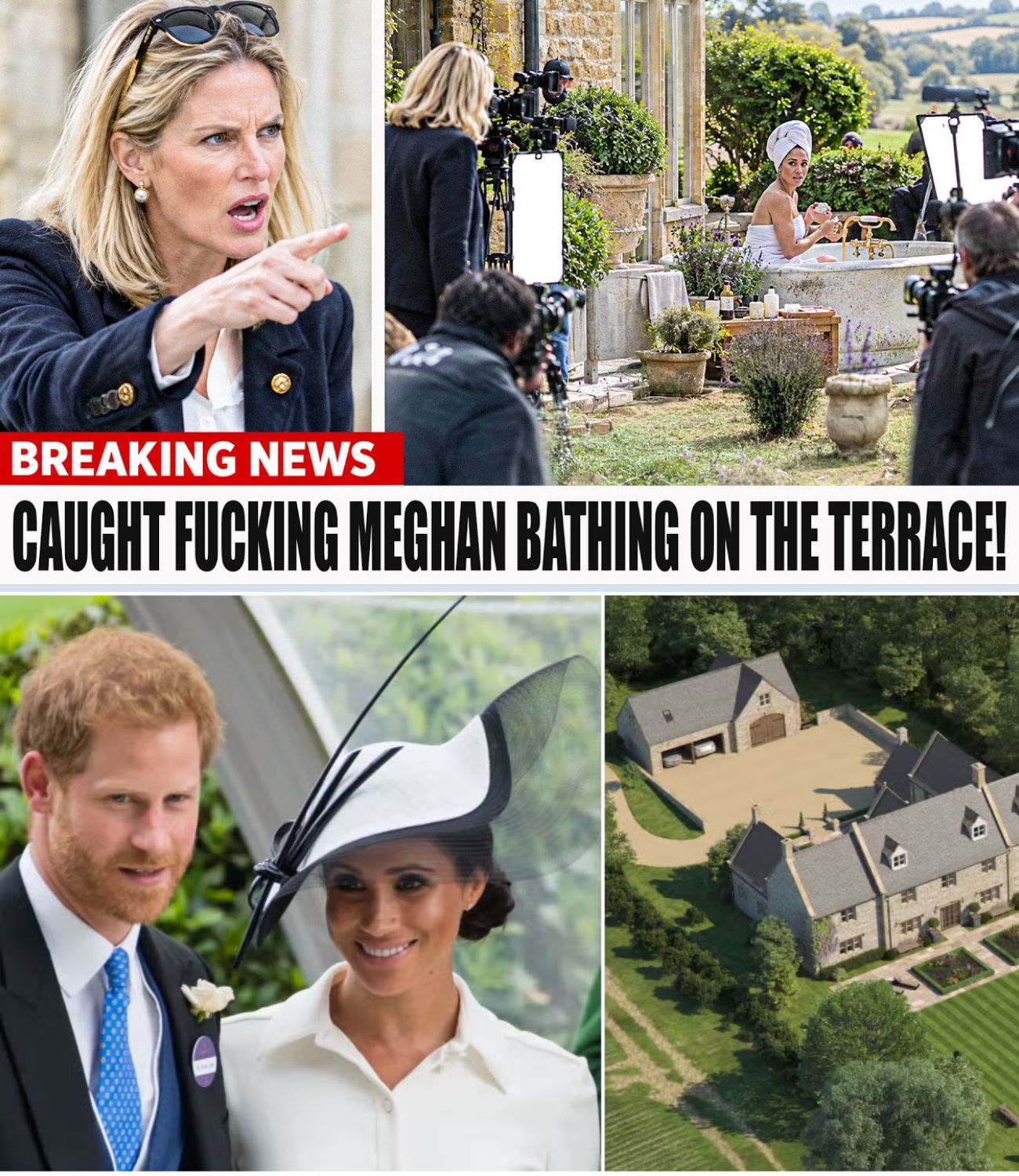
Looking around the table at her seven companions, she delivered a statement that no publicist in California could ever soften or spin. “Everyone thinks this return is about reconciliation and family,” Aldridge announced, her voice steady and chillingly calm. “But I knew the truth the second I walked into my private rooftop sanctuary and caught Meghan Markle standing there in my bath towel filming a commercial.”
It was not polite palace gossip; it was eyewitness testimony of an extraordinary boundary breach. It revealed that what the public had been fed as a sentimental family holiday was, in reality, a meticulously planned commercial takeover.
The Billionaire’s Estate and a Shared Shadow of Grief
To comprehend the sheer audacity of what unfolded behind the stone walls of the Cotswolds, one must first examine the stage upon which this drama played out. When Prince Harry and Meghan Markle touched down at Birmingham airport aboard a private charter flight—racking up an estimated £120,000 bill for a single journey—they did not check into a modest country B&B. They moved directly into an 83-acre private estate nestled deep within the rolling Gloucestershire countryside.
This was no ordinary rustic cottage with a picket fence. The estate boasts sweeping private farmland completely free of public footpaths, rights of way, or inquisitive sightlines from any public highway. Maintaining a property of that scale demands tens of thousands of pounds monthly in upkeep alone, whilst outright purchase runs comfortably into tens of millions. Add in round-the-clock private security patrols, elite local private schooling costing up to £50,000 per child annually, and the lingering overheads of properties in Montecito and Portugal, and an unavoidable question hung in the air: who was footing the astronomical bill?
It certainly was not Prince Harry. Ever since the Sussexes officially stepped back from front-line royal duties in January 2020, the terms of the Sandringham summit had stripped them of Sovereign Grant funding, forced the repayment of £2.4 million in taxpayer renovations for Frogmore Cottage, and—most crucially—revoked their automatic entitlement to taxpayer-funded armed police protection via the RAVEC committee. Having exhausted millions of pounds fighting the Home Office in the High Court and losing every legal appeal to regain taxpayer-funded security as private citizens, Harry relied entirely on external benefactors.
The man bankrolling their English homecoming was Ian Wace, co-founder of Marshall Wace, one of the world’s most secretive and powerful hedge funds, with a personal fortune estimated at £1.2 billion. Wace is a man who fiercely guards his privacy, eschews media profiles, and treats flashbulbs like anathema. Why would a reclusive billionaire open his private estate, his private aircraft, and his Scottish island of Tanera Mòr to a couple radioactive with controversy?
The answer lay in a hidden bond forged long before Meghan Markle ever set foot on British soil: a shared geography of unspeakable tragedy. In 1994, Ian Wace was sitting in the passenger seat of a car in Hampshire when a catastrophic road crash instantly killed his first wife, Joanna, and their two young children. He survived the ultimate human nightmare, carrying that profound, quiet grief for decades. Three years later, in August 1997, a 12-year-old Prince Harry walked behind his mother’s coffin through the weeping streets of London.
When Wace and Harry crossed paths in elite social circles, Wace did not see a pampered royal or a commercial brand; he saw a fellow survivor who understood the suffocating, violent weight of sudden bereavement. That shared vulnerability opened the doors to Wace’s private world. But Wace’s wife, Saffron Aldridge, watched the arrangement with growing, silent dread.
The Bespoke Sanctuary: Built from Devotion, Not for Cameras
Saffron Aldridge is no stranger to the upper echelons of public life. Throughout the 1990s, she was the iconic, luminous face of Ralph Lauren, daughter of the celebrated artist who illustrated iconic album covers for the Beatles. Having spent her entire life surrounded by ambitious individuals seeking proximity to fame, she possessed an infallible radar for opportunism. Yet her initial reservations were rooted not in social snobbery, but in physical survival.
In the autumn of 1996, at the absolute zenith of her international modelling career, Aldridge was rehearsing for a major Vivienne Westwood runway show during London Fashion Week. Torrential rain had seeped onto the temporary backstage flooring, causing her to take a devastating fall that shattered her ankle joint and severely tore the deep ligaments in her lower leg. Despite intensive surgeries, the injury left her with chronic nerve inflammation and acute circulatory agony whenever the damp British winter took hold.
For years, her sole respite was an exhaustive nightly therapeutic routine involving warm herbal hydrotherapy, specialized lymphatic massage, and targeted foot soaks. Devoted to his wife and unable to bear watching her suffer, Ian Wace commissioned a masterpiece of architectural devotion. On the topmost floor of their Cotswolds manor, beneath the open sky, he constructed a bespoke wellness solarium.
Master craftsmen installed immense glass skylights flooding the space with natural daylight, complemented by rough-hewn natural stone and aromatic cedar paneling. At the centre sat a deep soaking tub hand-carved from solid English limestone, equipped with calibrated hydrotherapy jets designed to stimulate damaged nerve tissue. Wall shelving groaned under custom-formulated essential oils, organic mineral salts imported directly from Brittany, and specialized salves blended by herbalists.
It was an open-air sanctuary shielded completely from the outside world—built exclusively for medical recovery and quiet marital devotion, never for guests, and certainly never for social media. When Ian Wace permitted the Sussexes to use the sprawling manor house below during their transition, he laid down an unshakeable law: the top-floor solarium was strictly off-limits.
The Bathroom Obsession and the California Call Sheet
To understand why Meghan Markle chose to violate that sacred boundary, one must examine a documented architectural pattern that has followed her across every property she has ever inhabited. To most individuals, a bathroom is a functional, utilitarian space. In the Duchess’s world, however, bathrooms are theatrical stages—curated sensory chambers designed to project an image of hyper-refined holistic luxury.
Consider the official records from 2019, when she and Harry oversaw the lavish renovations of Frogmore Cottage on the Windsor estate, a project costing British taxpayers over £2.4 million before public outcry forced repayment. Contractors gutted historic floor plans to install four separate ultra-luxury spa bathrooms featuring acoustic soundproofing, non-toxic vegan paint infused with eucalyptus oils, and a freestanding hammered copper soaking tub imported at astronomical expense. Years later, when King Charles III evicted the couple and Crown Estate staff surveyed the wreckage, workers were instructed to strip back those modifications because they resembled an upscale Beverly Hills clinic rather than an English heritage cottage.
Similarly, the listing for their sprawling Montecito estate revealed an astonishing ratio: nine bedrooms paired with sixteen bathrooms—nearly two bathrooms for every single bedroom in the house. These spaces functioned as private production studios where she curated skincare lines and tested luxury body oils.
By 2026, this obsession collided with an acute commercial crisis. With lucrative podcast contracts evaporating, tell-all memoirs fading from memory, and streaming giants demanding tangible lifestyle content, Meghan was desperate to launch her wholesome, rustic domestic brand (With Love, Meghan). She needed visuals of effortless English country gentility: sun-drenched cedarwood, hand-carved limestone, rising steam, and botanical jars.
Where on earth could she find such a ready-made set on short notice? Saffron Aldridge’s private rooftop solarium possessed every single visual element a lifestyle producer could dream of.
What makes this intrusion genuinely chilling is that it was never spontaneous. When Saffron eventually stepped into the room, she discovered a thick black production binder resting on the limestone tub edge. Inside lay a laminated call sheet from a California production company, stamped with a date three weeks before Harry and Megan had even boarded their private jet in Los Angeles. The title printed in bold lettering read: The Duchess in the Cotswolds: Episode 3 – The Sacred Solarium.
The Sussexes had scouted Ian Wace’s private medical sanctuary months in advance, pitching it to commercial executives in Los Angeles as their personal lifestyle studio before ever receiving the keys.
The Spiral Staircase Discovery
The collision occurred on a biting Tuesday afternoon. Saffron Aldridge, returning early from a children’s charity meeting in Oxfordshire with a throbbing ankle from the damp autumn chill, sought thirty quiet minutes to soak her feet in her private bath before driving into central London.
The house felt eerily silent. Yet as she ascended the back spiral staircase toward the top floor, a pungent, unfamiliar aroma assaulted her senses—not the soothing fragrance of French lavender and aged cedar, but a sharp, medicinal blast of cajeput, concentrated tea tree, and lemongrass.
Reaching the landing, she found the heavy oak door propped wide open. Power cables snaked across antique floorboards, heavy aluminium tripod stands wedged against the limestone bath. And right in the middle stood the Duchess of Sussex, her hair wrapped in a custom white waffle towel embroidered with Saffron’s own initials, wearing an open ecru linen robe, dusting botanical powders over artisanal wooden soap molds.
Production crew members adjusted portable lighting reflectors whilst a cinema camera hummed on a motorized gimbal. Saffron’s private ceramic jars of expensive Brittany mineral salts—formulated specifically for her nerve inflammation—lined the ledge as rustic decorative props.
Meghan did not gasp, scramble, or apologise. Instead, she flashed a radiant Hollywood red-carpet smile and offered a greeting of astonishing psychological audacity: “Oh, Saffron, you are just in time. The afternoon light pouring through these glass skylights is simply magical. Ian never mentioned to us that anyone used this attic, but it is just breathtaking for our creative project.”
Saffron turned on her heel without a single word, descended the stairs, got into her car, and drove straight to her husband’s private office in central London.
Biometric Locks and the Ultimatum
When Saffron laid that laminated call sheet across Ian Wace’s mahogany desk, the atmosphere in the room shifted instantly. Initially attempting diplomacy, Ian leaned back and urged calm, citing the crushing global media pressure facing the couple.
That was when Saffron delivered the verdict that shattered his illusion. “That is not just a room, Ian,” she told her billionaire husband with absolute, unflinching clarity. “That room was built for my shattered ankle. It was built out of your love and your care for my pain. It is our private marriage sanctuary, not a free soundstage for a manipulative woman to hawk mosquito soap to American housewives. If you allow her to commercialize my healing ground, you are telling me that Prince Harry’s grief matters more to you than your wife’s dignity.”
She gave him a stark ultimatum: shut down the operation immediately, or she would personally hand the production call sheet to the British press. Eight years of polite protection ended in that single afternoon.
The administrative response was swift and surgical. By 8:00 PM that same evening, an unmarked commercial security van arrived at the manor. Master locksmiths dismantled the traditional brass handles on the top-floor door, installing a state-of-the-art biometric keypad lock whilst wiping all physical master keys from the digital registry. Access now required Saffron’s personal thumbprint.
Simultaneously, estate solicitors hand-delivered a formal legal notice citing strict local planning regulations and private agricultural covenants prohibiting commercial broadcasting or unauthorized film production. The production crew was given precisely 48 hours to strip every light and clear out every box of chemical soap ingredients. No royal title could override a property deed.
Seven Words in Amsterdam and the High Society Freeze
The shockwaves of this Cotswolds betrayal rippled rapidly through London’s drawing rooms. At that fateful Chelsea lunch table, Saffron Aldridge provided the social context that connected the dots for her peers. She reminded them of September 2018—just four months after the royal wedding—when they were flying across the North Sea on a private jet bound for an exclusive Soho House launch in Amsterdam.
A massive bolt of lightning had struck the aircraft, causing cabin lights to flicker and the fuselage to shudder violently. As passengers braced for disaster, Ian Wace checked on survivors whilst Harry gripped his armrest in shock. Across the aisle, Meghan Markle looked at Saffron, smiled with strange, brittle brightness, and delivered a chilling seven-word prediction: “I will give England 2 years.”
The official announcement of their departure came in January 2020—exactly 20 months later. It had never been a desperate escape from palace cruelty, but a scheduled corporate pivot with an expiration date.
As Saffron’s testimony circulated through elite circles, Buckingham Palace delivered a masterclass in silent devastation. Prince William and Catherine carried on with official engagements without a single glance in Harry’s direction. King Charles, managing medical treatments, refused all requests for private meetings, communicating solely through formal intermediaries. Throughout their seven-week UK stay, not a single royal door opened; Harry’s name was entirely omitted from the Court Circular.
Across the Atlantic, Hollywood took note. Powerful alliances evaporated overnight: Tyler Perry, Serena Williams, Beyoncé, and wellness entrepreneurs quietly vanished from the Sussex orbit. High-society party planners confirmed what London already knew: the Sussexes were simply no longer worth the trouble.
On a grey Thursday morning in late September, Ian Wace’s property trust delivered a final, impeccably polite letter of lease termination, instructing that the estate be entirely vacated before the first of October due to scheduled structural conservation. Within 72 hours, local villagers watched as a fleet of unmarked removal vans hauled shipping crates away toward Birmingham airport.
When Saffron Aldridge pressed her thumb against the sleek digital scanner later that week, the biometric lock disengaged with a clean, satisfying click. Stepping into her quiet solarium, she lit a cedar candle, placed her foot into the warm limestone bath, and looked across the peaceful autumn fields. The sanctuary was finally hers again—a permanent monument to boundaries restored and a stark reminder that in the upper echelons of British life, you can borrow the jewellery, but you can never borrow the halo.
You Might Also Enjoy

“We Thought They Would Negotiate”—What Argentine Soldiers Said When The British Attacked Goose Green

“You’ll Never Finish My Ruck March, Limey” — US Sergeant Who Challenged the SAS, Then Fell Out First






