BREAKING NEWS! PRINCESS ANNE REVEALS THE TRUTH ABOUT ARCHIE & LILIBET! A SHOCK FOR HARRY & MEGHAN!
THE RED FILE REVELATION: Inside Princess Anne’s Uncompromising Showdown and the Final Slamming of the Royal Door
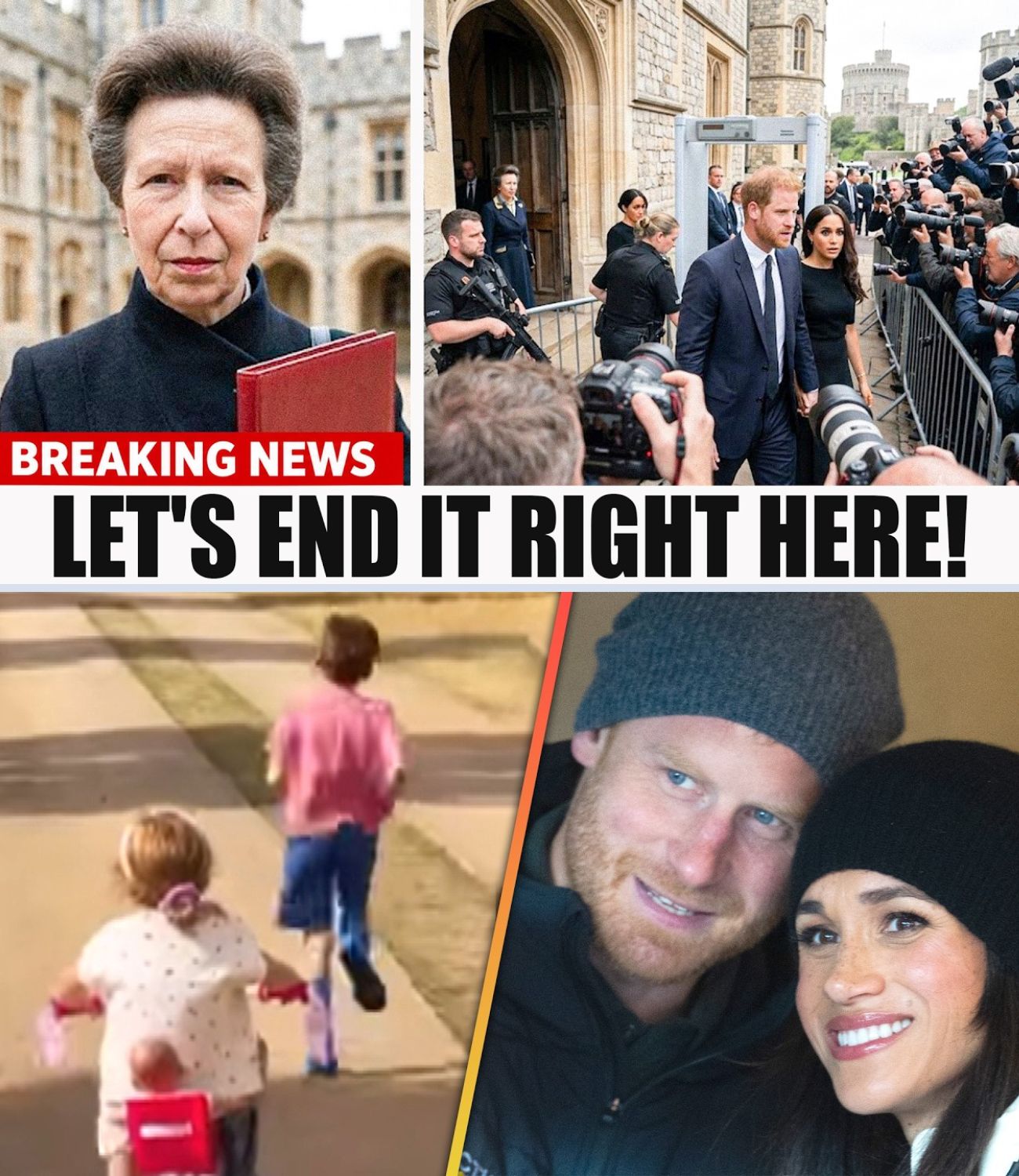
There is a distinct brand of silence that settles over the ancient corridors of Windsor Castle when an institutional boundary is crossed beyond all possible recall. For years, the protracted saga of the Duke and Duchess of Sussex played out across international media channels like a slow-motion collision between modern celebrity culture and centuries-old constitutional architecture. Yet, beneath the Hollywood soundbites, the tell-all memoirs, and the transatlantic grievances, a far more rigorous mechanism was quietly grinding away behind closed doors.
That mechanism finally reached its definitive crescendo when Prince Harry’s camp issued a stunning public declaration: the Sussexes no longer considered themselves bound by the historic Sandringham Agreement brokered by the late Queen Elizabeth II in January 2020. Grounded in the premise that the withdrawal of taxpayer-funded armed police protection constituted a unilateral breach of contract, the statement was intended as a calculated pressure tactic. It was a clear warning shot aimed at forcing the royal household into a long-term settlement for Prince Archie and Princess Lilibet before the constitutional landscape shifted permanently.
Unfortunately for the Duke of Sussex, the person waiting on the other side of that table was not a weary monarch inclined to compromise, but the most formidable operational strategist in the House of Windsor: The Princess Royal.
The Ticking Clock and the Fear of William’s Reign
To understand the frantic urgency driving Harry’s recent overtures, one must examine the stark reality of the constitutional clock. King Charles III continues to navigate ongoing medical treatments for cancer, casting a long shadow over the future of the monarchy. Within the inner sanctum of the royal household, it is an open secret that the accession of Prince William will usher in an era of ruthless institutional efficiency and unyielding protection of the British taxpayer.
Harry and his advisors understood that once William ascends the throne, any remaining window for a negotiated compromise would slam shut forever. A single administrative stroke of the new king’s pen could permanently disentangle overseas relatives from the active machinery of the state. Consequently, Harry launched an eleventh-hour diplomatic mission to secure three non-negotiable guarantees:
Constitutional Entrenchment: An ironclad legal codification of the titles of prince and princess for Archie and Lilibet, locked tightly enough that no future sovereign could strip them.
The Part-Time Return Clause: A formal institutional guarantee that upon reaching adulthood, his children could seamlessly re-enter the United Kingdom as funded working royals on a flexible basis.
The Sovereign Security Detail: An automatic, taxpayer-funded diplomatic security apparatus to escort the family whenever they crossed British soil.
It was the exact same comprehensive package that Queen Elizabeth, Charles, and William had firmly rejected during the original Sandringham Summit. Believing he could bypass his brother and play upon family sentiment, Harry sought to corner Princess Anne during a brief window in London. He anticipated a negotiation; instead, he walked straight into an ambush forged from five decades of institutional memory.
The Red Leather Folder from May 2019
When Princess Anne sat down across from her nephew, she did not raise her voice or engage in emotional recriminations. Instead, she unzipped a weathered red leather portfolio—a confidential memorandum sealed and archived since the turbulent weeks surrounding Archie’s birth at London’s Portland Hospital in May 2019.
The documents contained within that file dismantled the entire foundation of the Sussex grievance narrative. For generations, the British monarchy maintained an unbroken constitutional ritual: the posting of an ornate golden easel outside Buckingham Palace bearing an official medical bulletin signed by the sovereign’s appointed obstetricians and physicians. This was never mere theatrical pomp; it was essential constitutional transparency. Because the British public funds the institution, the law demands unquestionable verification regarding the lineage of succession.
In May 2019, however, Harry and Meghan discarded that protocol entirely, issuing chaotic, conflicting statements regarding the birth and refusing to publish the names or legal signatures of the attending medical team. This unprecedented departure from tradition created an immediate information vacuum, feeding a toxic ecosystem of online rumors and conspiracy theories about the children’s official status.
What the public never knew—until Anne placed the papers on the table—was the elegant solution senior palace officials and the Privy Council had offered at the time. The institution had proposed a confidential verification protocol overseen by an independent panel of senior Privy Council medical advisors. They would review the hospital paperwork in absolute secrecy, certify the constitutional legitimacy within forty-eight hours, and issue a single binding declaration without a single drop of invasive media coverage or public exposure.
Harry and Meghan had flatly rejected the offer. They chose instead to lock the medical ledgers away, pursuing bitter legal battles against newspapers while simultaneously complaining on global television that the institution had failed to protect their family.
Placing that written rejection before him, Anne delivered the inevitable conclusion: the crown had offered an ironclad shield, and the parents had deliberately thrown it away. How could an individual demand extraordinary, state-funded privileges for children whose official constitutional verification had been withheld from the sovereign’s own advisors?
Two Philosophies of Royal Parenting
The philosophical chasm between Anne’s approach to royal lineage and Harry’s frantic pursuit of titles becomes even starker when viewed through the lens of history. Nearly fifty years earlier, when Princess Anne gave birth to her firstborn son, Peter Phillips, followed four years later by Zara, Queen Elizabeth II stood ready to bestow grand hereditary peerages and princely titles upon both children.
Anne’s response was immediate and uncompromising. She declined every royal styling, every ancient prefix, and every taxpayer-funded security detail. Raising her children at Gatcombe Park in Gloucestershire, they grew up with muddy riding boots, farm chores, and normal, unshielded social interactions.
The fruits of that decision are written across the decades. Zara carved out an elite athletic career, winning an Olympic silver medal entirely on her own merit, while Peter built a thriving international sports management enterprise. Neither sibling ever demanded a penny from the public purse, nor did they ever sit before an international camera to whine that the crown held them back. Queen Elizabeth frequently cited Anne’s choice as one of the wisest family decisions of her seventy-year reign, proving that true dignity stems from character rather than letters patent.
In stark contrast, William and Catherine have quietly mirrored this philosophy at Lambrook School, where Prince George, Princess Charlotte, and Prince Lewis are enrolled simply as the Wales children—shedding their Royal Highness styles at the school gate to ensure they grow up grounded in reality. Harry’s relentless obsession with securing foreign princely prefixes for children raised beneath the California sun stood exposed as a hollow pursuit of status symbols, designed less to protect his offspring and more to validate his own commercial relevance in Hollywood.
The Montecito Exodus and Commercial Collapse
While Harry was attempting to maneuver behind palace walls in London, investigative reporting from the Santa Barbara coast was busy exposing the true state of their American sanctuary. Local residents, speaking on the record to prominent journalists, painted a picture not of an idyllic royal retreat, but of a hasty midnight departure.
Penny Bianke, a prominent seventy-nine-year-old interior designer whose estate neighbors Oprah Winfrey’s compound, revealed that the local community—and even the teachers at Archie’s private school—were kept entirely in the dark. Parents were astonished to discover that the Sussexes had simply pulled their children out overnight without a word of farewell, leaving behind an administrative sigh of relief among staff exhausted by the heavy-handed security details that frequently disrupted morning drop-offs.
Longtime Montecito resident Beach Boys icon Bruce Johnston offered an even blunter assessment, noting that the heavy-handed security presence had rubbed local residents the wrong way in a town populated by multi-billionaires who managed to live without cordoning off grocery aisles.
This local friction was merely a symptom of a much deeper financial rot. The dazzling Hollywood mirage had evaporated with brutal speed:
The Spotify Collapse: Their exclusive twenty-million-dollar audio partnership was unceremoniously cancelled, with senior corporate insiders publicly writing them off as unproductive.
The Streaming Stalemate: Netflix quietly shelved their expensive vanity projects as viewership figures plummeted into insignificance.
The Lifestyle Stumble: Commercial ventures struggled against bureaucratic trademark delays, forcing marketing campaigns to lean awkwardly into slogans like “savor the royal touch”—a far cry from the Nolan principles promised to the late Queen.
With their American commercial empire contracting on all fronts, the couple’s attempt to engineer a triumphant return through British high society—such as seeking invitations to West End anniversary galas connected to King Charles’s inner circle—met with immediate frostiness. Furthermore, a nationwide YouGov poll revealed that ninety-eight percent of British respondents decisively rejected the notion of funding police protection for an absentee prince.
The Final Administrative Lockout
When the dust settled, the House of Windsor did not engage in public screaming matches or retaliatory leaks. Instead, it activated the cold, silent machinery of the British state.
The official working roster published in the court circular for the coming year delivered the definitive answer. The names carrying the constitutional weight of the United Kingdom—King Charles, Queen Camilla, the Prince and Princess of Wales, the Princess Royal, and the Duke and Duchess of Edinburgh—were printed in crisp black and white. Prince Harry’s name was absent entirely. No state budget line was authorized, no security contingency was established, and no palace secretariat was assigned to manage his affairs.
On the official royal family website, Archie and Lilibet remain cataloged under their technical legal styles in accordance with the 1917 decree, but their profiles carry zero patronages, zero constitutional duties, and zero claim on the sovereign purse. They occupy the exact same administrative space as Princess Beatrice and Princess Eugenie: beloved blood relatives, yet entirely private citizens in the eyes of the realm.
As Harry prepared to board his flight back across the Atlantic, there was no royal car waiting on the tarmac, no private family summit at Balmoral, and no bedside invitation from a king focused firmly on affairs of state. The working monarchy stepped around him with absolute, unbothered grace.
The door to the family home remains open for private visits as beloved kin, but the heavy oak doors of state power have been locked from the inside with the quiet finality of a key turning in an ancient lock. The institution has proven, once again, that it will always outlive any individual ego, leaving behind a timeless truth: royal privilege is never an entitlement; it is the sacred reciprocal reward for lifelong, unglamorous service to the people.
You Might Also Enjoy

“We Thought They Would Negotiate”—What Argentine Soldiers Said When The British Attacked Goose Green

“You’ll Never Finish My Ruck March, Limey” — US Sergeant Who Challenged the SAS, Then Fell Out First






