Camilla Could Have Been Called Princess of Wales, But Because of Diana, That Title Was Never Hers
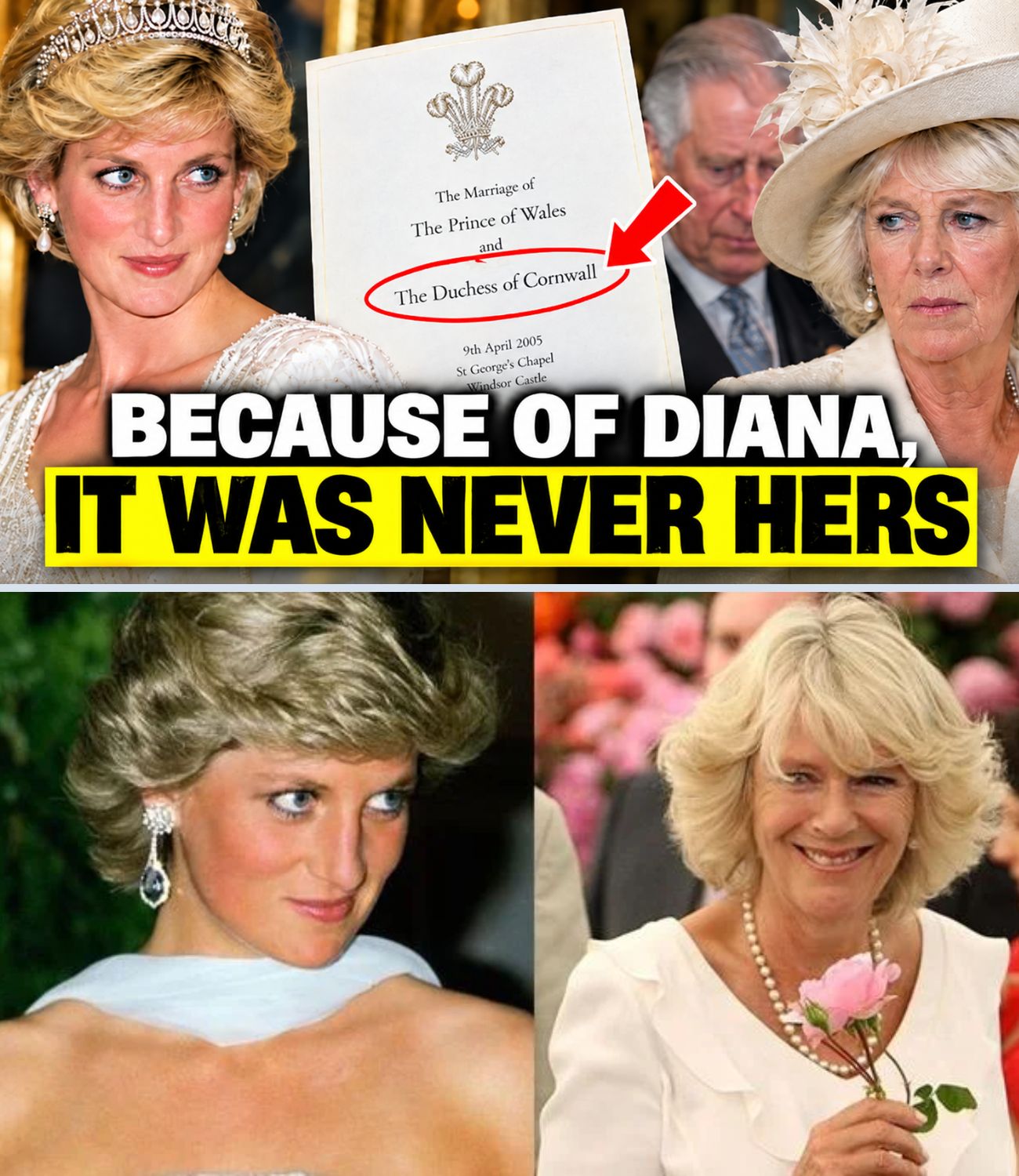
On April 9, 2005, at Windsor Castle, there was a piece of paper that almost nobody looked at twice. It was the printed program for a religious ceremony, the wedding ceremony the world had suspected for over 30 years, which the Queen had taken decades to accept and which even had to be delayed by a day because the original date coincided with the funeral of Pope John Paul II in Rome. Two names appeared on the cover. The first was the usual one, the Prince of Wales. But the second one was the one millions of people expected to read. It didn’t say Princess of Wales, it said Duchess of Cornwall. It seems like a simple printing detail. It is not. Because Camilla had the right to that title. No law forbade it, no rule prevented it. By marrying the Prince of Wales, by tradition, she became the Princess of Wales. And yet, for 17 years, no one introduced her by that name, not at an official event, not on a plaque, not on a single invitation. Why? Who made that decision? And what was it about those three words that no one in the palace dared to touch them? The answer has a woman’s name and it is not Camilla. It is the story of how a 20-year-old girl turned a protocol title into something that no longer belonged entirely to the Crown, but to the people. And how, many years later, Queen Elizabeth herself wrote a sentence that once again avoided that same name for a second time.
Now, to understand that 2005 paper, we have to go back to a July morning in 1981, to a time when that title was not yet a wound, it was a promise. On July 29, 1981, Lady Diana Spencer stepped out of a glass carriage in front of St. Paul’s Cathedral in London. She was 20 years old. 5 months earlier, when the engagement was announced, she was 19. Until very recently, she had worked as an assistant at a nursery school. Now she was walking toward the altar in front of hundreds of millions of people. According to estimates at the time, some 750 million viewers followed that wedding on television around the world. Her dress was ivory silk taffeta with a train of almost 8 meters. As she stepped out of the carriage, the fabric was wrinkled from the trip. She held it as best she could, and the whole world held its breath with her. And then, in the middle of the most watched ceremony of the century, something small and very human happened. When saying her vows, Diana got the order of her fiancé’s names wrong. Instead of saying Charles Philip Arthur George, she said Philip Charles Arthur George. A moment later, Charles also stumbled over his own words. No one forgot it. But that stumble, far from bothering people, brought her even closer to them. She didn’t look like a marble figure; she looked like a nervous girl, as surprised as everyone else to be there. Upon leaving the cathedral, she was no longer Lady Diana Spencer; she was Her Royal Highness, the Princess of Wales.
And here is a fact that almost no one remembers. Before Diana, Great Britain had gone 71 years without a Princess of Wales. The last one had been Mary of Teck, who stopped using the title in 1910, when her husband took the throne. For seven decades, that role had been almost a museum piece, a name in history books. Diana took it out of the museum and, in a few years, turned it into something else. There were other Princesses of Wales before her. Some admired, others forgotten. Some, like Caroline of Brunswick, lived through such a disastrous marriage that her own husband barred her from the abbey on his coronation day, but none of them lived under a gaze like the one that surrounded Diana. Television, magazines around the world, and the speed of photographs made her story different from all the previous ones. Officially, Diana held many titles. She was the Duchess of Cornwall. In Scotland, she was the Duchess of Rothesay. She was also the Countess of Chester, Countess of Carrick, and Baroness of Renfrew. Remember the first one on that list well, Duchess of Cornwall, because it will be very important later on. But the world did not know her by any of those titles. It knew her by only one: Princess of Wales. And that didn’t happen because an office decreed it. It happened because of what she did afterward.
In March of 1983, Charles and Diana traveled to Australia and New Zealand on an official tour, and Diana did something that broke with family custom. She took her baby with her. William was barely 9 months old. She didn’t want to spend weeks away from him. What happened on that tour surprised everyone, including the royal family itself. Crowds flocked toward her. When the car stopped, people would crowd the side where Diana was getting out; she would stop with the children and talk to the elderly. She would stay a minute longer where protocol only called for a few seconds. On many of those trips, people began to talk about the princess as if the title had a face, and that face was hers, but behind those images was something the public did not yet see. That popularity did not make life easier for Charles, nor did it make Diana any freer. The people’s affection was accompanied by fierce scrutiny and tension within a marriage that was already more fragile than anyone imagined. Diana learned very soon that every dress, every gesture, and every time she got out of a car could become a message that others would interpret for her. Sometimes she let insecurity show, sometimes humor, sometimes exhaustion. Instead of hiding every emotion behind a perfect phrase, it was visible. That made many people feel close to her and made some people within the institution feel uncomfortable.
In 1982 William had been born. In 1984 Harry arrived. Photographs of Diana leaving the Lindo Wing of St. Mary’s Hospital with her babies in her arms, the children holding their mother’s hand, the first days of school. All of that formed an image that the public absorbed almost without realizing it. For millions of people, Princess of Wales ceased to mean only the wife of the heir. It began to mean Diana with her children, and then a day came that many still remember. In April 1987, Diana inaugurated the first unit in the United Kingdom dedicated to HIV patients at the Middlesex Hospital in London. At that time, many people believed that the virus could be transmitted through simple contact. There were people who did not dare to touch a sick person. Diana approached a patient and shook his hand without gloves — a single photograph, a single gesture. And for many people at that moment, the title of Princess of Wales ceased to be just a formality. It became a helping hand. We saw her in hospitals leaning down to talk to a child at eye level. We saw her sitting next to patients in those brightly colored outfits that seemed to bring light to rooms that were too white. The press could put those photos on the front page. What they could not do was manufacture the moment. She did that herself, and the people cherished it.
Meanwhile, far from those cameras was another woman, a woman whose name did not appear in any of Diana’s events, nor on official family postcards, nor in the images sent out to the world. Camilla Parker Bowles had married officer Andrew Parker Bowles in 1973. She had two children, Tom and Laura. She led her own life in the countryside, far from the palace balconies. But the story that would end up weighing on everyone already existed silently in the background of Charles’s life. And very soon that silence was going to be broken. In June 1992, a book was published that shook Great Britain. Its author was the journalist Andrew Morton, and it told from within of Diana’s loneliness in her marriage. At that time, no one knew where so much information had come from. Only after her death was it confirmed that Diana herself had collaborated in secret, recording her memories on tapes that were sent to the author. 6 months later, on December 9, 1992, Prime Minister John Major stood up in the House of Commons and announced that the Prince and Princess of Wales were separating. He did not speak of divorce; he spoke of a personal decision, an amicable arrangement that would not affect their constitutional duties. It sounded cold, it sounded administrative, but for Diana, for Charles, and above all for two children, there was nothing administrative about it. William was 10 years old, Harry was eight. Suddenly, the two children who had appeared on so many balconies and in so many photographs were also the children of a separated couple. They traveled between two homes. They saw every gesture of their parents turned into a headline. The image of the perfect family had been broken in front of the whole country.
And in the midst of all that, Diana remained the Princess of Wales. In official statements, on her travels, in charitable invitations, in the names of hospitals and foundations. The title accompanied a woman who was ceasing to be part of a couple, but not of the life of her children, and much less of the affection she had earned outside the palace. What came next were two interviews that changed the history of the monarchy. In June 1994, Charles spoke in a television documentary by journalist Jonathan Dimbleby. Before millions of viewers, he acknowledged that he had been unfaithful, although he specified that it was when the marriage had already broken down irreversibly. Diana responded a year and a half later, in November 1995, on the BBC’s Panorama program, and she uttered the phrase that no one has forgotten. She said that there were three people in her marriage and that it made it a bit crowded. They were brief words. She didn’t present them as a theory or an attack. She said them like someone describing a reality she had lived with for years. In that same interview, she said something else. She said she didn’t believe she would ever be Queen of England, but that she would like to be a queen in people’s hearts.
Years later, something very serious came to light. An independent investigation concluded in 2021 that the journalist who secured that interview, Martin Bashir, had used forged documents to gain Diana’s trust. The BBC eventually apologized. William publicly stated that the lie had contributed to his mother’s fear and isolation in her final years, but Diana’s words remained her own, and what she said that night changed the way the world looked back forever. The wedding photos, the tours, the official smiles, the family portraits — it was all still there, but it could no longer be seen in the same way. The title of Princess of Wales hadn’t created that wound, but from that night on, it was trapped within it, and what happened in the following weeks showed just how little room the palace had left. Shortly after the interview, in December 1995, Queen Elizabeth did something she rarely did. She wrote personally to her son and daughter-in-law. She asked them to divorce as soon as possible. A long and difficult negotiation then began. They talked about money, housing, offices, and security, but there was one issue that, for a woman whose face was known in every corner of the planet, weighed more than everything else. Her name.
On August 21, 1996, the palace issued letters patent, the document by which the crown establishes titles. They established that the ex-wives of certain members of the royal family would lose the style of Royal Highness after the divorce. Seven days later, on August 28, the divorce was finalized. Diana lost those three letters. HRH. Her Royal Highness, but she kept something. From that day on, she would be known as Diana, Princess of Wales. It seems like a technical difference; it is not. Before, the title came first and she came after: the Princess of Wales. Now, her name, Diana, came first. Her formal tie to the institution had changed. Her place in people’s memory had not. And maintaining that form meant something very specific. She would remain recognizable as the mother of the future king, as the woman the public had known throughout her married life.
There is a story that circulated widely in those years and still touches a very deep chord. Several people close to Diana recounted that a 14-year-old William, seeing his mother hurt by the loss of her title, told her not to worry, that he would give it back to her one day when he was king. It has never been confirmed word for word, but there is no need to embellish the story. The documented reality is enough because Diana had very little time left. In an era when every letter and every bow had meaning, losing the style of Her Royal Highness could feel immense. Even so, Diana did not hide. She did exactly the opposite. In January 1997 she traveled to Angola. Wearing a protective vest and a transparent visor, she walked through a minefield that had just been cleared so the world could see what those weapons did to people. The images went around the planet. In August of that same year, she went to Bosnia. She sat with survivors who had lost legs, husbands, children. She listened more than she spoke. She had less institutional protection than ever, but she also had more freedom to choose her causes. Both things were true at the same time, and for the first time, her role no longer depended on a wedding; it depended on what she decided to do.
At Kensington Palace, she was trying to build a new life among rooms she knew by heart and a schedule no longer marked by being Charles’s wife. She spent time with William and Harry. She took them to places that looked nothing like a palace. Homeless shelters, hospitals, simple restaurants, parks, queues like those of any other family. She wanted her children to know that the world didn’t end at the window of an official car. Her title kept telling the world where she came from. Her work was beginning to say where she wanted to go. And then came the early morning of August 31, 1997, Paris. Diana died at 36, just a year and three days after her divorce was finalized. What happened in Great Britain in the following days was unprecedented. A sea of flowers formed in front of the gates of Kensington Palace. It is estimated that people left more than a million bouquets in London. The cards did not say the heir’s ex-wife, they did not say Her Royal Highness, they simply said Diana. The people crying in those streets were not responding to a protocol rule. They were responding to a relationship that had formed over 16 years. Many women who had lived through separations, mothers who had felt the weight of judgmental stares, people who knew the pain of a marriage that could not hold. had found in her something of their own. That is why her death was felt as a personal loss.
On September 6th, during the funeral, two boys walked behind their mother’s coffin through the streets of London. William was 15 years old. Harry 12. On the coffin, a wreath of white roses, and among the flowers, a small handwritten card. It said only one word:
"Mummy,"
and this is where you have to understand something. From that day on, the title of Princess of Wales was linked not only to Diana’s public life, it was linked to those two boys behind the coffin. For many people, the protection around that name never had to do with a dispute between two adult women. It had to do with protecting something that also belonged to William and Harry. And that is exactly what Charles and Camilla were going to face when they wanted to marry years later.
After Diana’s death, Camilla did not suddenly appear as a figure integrated into the family. It would have been impossible. The country was still in mourning and any gesture would have been read as a provocation. The process was slow. Calculated to the millimeter. The first time Charles and Camilla let themselves be photographed together in public was in January 1999 leaving the Ritz hotel in London. After Camilla’s sister’s birthday, the photographers had been waiting for days. That image lasted just a few seconds, but it was designed for the public to start getting used to it. A year later, in June of the year 2000, Queen Elizabeth met Camilla at a party at Highgrove, Charles’s country house. It was a brief meeting, but in the language of the royal family, the Queen being in the same room as her was already a message. In 2002, during the celebrations of Elizabeth II’s Golden Jubilee, Camilla’s presence next to Charles became more visible. It did not mean that all the resistance had disappeared. It meant that the family was starting to show in public a reality they had kept out of official events for years. Those who organized Charles’s life knew one thing very clearly. Announcing a relationship was not enough. They had to let the country gradually learn to see her by his side.
And on February 10, 2005, the announcement finally came. Charles and Camilla were going to get married. Great Britain was no longer the same that had seen the 1981 wedding. Diana had been dead for almost 8 years. William and Harry were young adults. But the question everyone was asking wasn’t about the dress or the date, it was about a name. What would Camilla be called? The response from Clarence House, Charles’s office, was very precise. After the wedding, Camilla would be Her Royal Highness, the Duchess of Cornwall, and in Scotland, Duchess of Rothesay. And when Charles reached the throne, she would not be called queen, she would be known as princess consort. And the title of Princess of Wales. Here is the heart of this whole story. It was explained that as the wife of the Prince of Wales, Camilla had the right to that title, but she had decided not to use it. Look closely at what that sentence says. It does not say that the title was forbidden. It does not say that a law had reserved it forever for Diana. It says something much more delicate: that it existed, that it belonged to her, and that it would not be used.
Do you remember the first title on that list that Diana had? Duchess of Cornwall, the same name that Diana had borne throughout her marriage, even though almost no one called her that. That was the name that was now being offered to Camilla. It was perfect continuity on paper and at the same time an enormous emotional distance, because it allowed Camilla to be described with a royal, ancient, and solid title, without placing her under the three words the world associated with Diana. But before reaching the altar, that wedding stumbled time and again. First, it was the location. The initial idea was to get married at Windsor Castle, but it was discovered that to hold a civil wedding there, the castle would have to obtain a license that would force it to open its doors to any other couple who wanted to marry there. The ceremony was moved to the Windsor Guildhall, a municipal building a few steps from the castle. Then came the announcement that Queen Elizabeth would not attend the civil wedding. She would be there later for the religious ceremony at St. George’s Chapel, but not at the registry, for the family, for the church, and for how the day would be presented to the world. That distinction was very important. And finally, at the beginning of April, Pope John Paul II died. His funeral was set for April 8, the same day as the wedding. Charles had to represent the Queen in Rome. The wedding was delayed by 24 hours. It was as if even the calendar was resisting.
On April 9, 2005, finally, Charles and Camilla were married at the Windsor Guildhall. She wore a cream-colored silk dress and coat with a wide-brimmed hat. A brief ceremony. Sober, almost discreet. In the afternoon came the service of prayer and dedication at St. George’s Chapel. The Queen and Prince Philip were indeed there. Camilla changed her outfit, a long porcelain-blue coat with gold embroidery and a gold feathered headdress. The cameras captured William and Harry, as well as Tom Parker Bowles and Laura, Camilla’s children; two families who had lived through divorces, losses, and years of public exposure, gathered in the same pew, united in a new way, but very aware of what the world was watching. And then came the most unexpected moment of the day. The service included an act of penance taken from the ancient Book of Common Prayer of the Church of England. Before the Archbishop of Canterbury, Charles and Camilla acknowledged aloud their many sins and shortcomings and asked for forgiveness. It was not a phrase written for Diana, it was a centuries-old prayer. It was not a public apology directed at a single person, but on a day like that, with Diana’s sons sitting a few meters away, those words of repentance resonated far beyond the chapel walls. And on the pews, in the guests’ hands, was that printed program with the Prince of Wales and the Duchess of Cornwall. Every camera that showed that cover confirmed the decision to the entire world.
That same afternoon, at the castle reception, Queen Elizabeth gave a short speech. That day the Grand National had been run, the most famous horse race in the country. The Queen, a great horse enthusiast, compared the couple’s journey to that race full of terrible obstacles and said that her son had finally reached the finish line with the woman he loved. It was her way of saying,
"This has been hard, and it's finally done."
But there was something not even the Queen could end with a speech: the shadow of a name, because this is where memory tends to oversimplify. Many people tell this story as a competition between two women, as if Camilla had won a place and Diana had lost one. But that is not what happened. For years, Camilla bore the full weight of a system that also belonged to Charles, the monarchy, his advisors, the press, and decades of public expectation. Saying that doesn’t erase Diana’s pain; on the contrary, it forces us to look at it more honestly.
The title wasn’t a punishment for Camilla, nor was it a legal relic of Diana. It was the exact place where the consequences of a shared past became impossible to hide. Charles knew this better than anyone. He had seen Diana become a global figure. He had seen what happened after her death and knew his own children lived within that memory. For those who loved Diana, hearing the words "Camilla, Princess of Wales" would have been too jarring, too soon, perhaps forever. The choice of Cornwall didn’t eliminate that tension, but it avoided putting it in front of Camilla’s name every single day. And the most interesting thing is what happened next, because that decision, intended as a prudent exit, ended up lasting 17 years. After the wedding, Camilla began building an official life as the Duchess of Cornwall, and she did it with something no one could dispute. Work. She threw herself into literacy. She visited schools and libraries. She talked about books and championed the importance of reading to children. Later, she even created her own book club. She supported organizations that helped survivors of domestic and sexual violence. And she sat down to listen to stories that often remain hidden. She championed the fight against osteoporosis, the disease that her own mother had suffered from. It was a type of public work very different from Diana’s, and precisely for that reason, it allowed her to occupy a space of her own.
Over time, her way of speaking at those events became less rigid. Even those who felt no closeness to her could recognize that she was fulfilling a public role consistently. Charles continued with his own causes: the environment, agriculture, architecture, the youth. Together they appeared at inaugurations, state visits, and Commonwealth tours. The photos from those years lack the electricity of Diana’s photographs, and that is not a criticism; it is a clue. Charles and Camilla’s public life was built with patience, with small acts, and with a much less theatrical presence. The title of Duchess of Cornwall fit that method. It was respectable, ancient, solid, and didn’t ask her to compete with a memory that was still alive. Little by little, Duchess of Cornwall stopped sounding like a temporary solution. It appeared on plaques, on programs, in speeches, on invitations, in every headline of every tour. The repetition created familiarity; it didn’t change everyone’s opinion, but it allowed Camilla to be known for her daily work and not just for a past that had already been told thousands of times.
But while that name became commonplace, the other remained present through its absence. Every time a newspaper had to explain why Camilla wasn’t called Princess of Wales, it went back to Diana. Every anniversary of her death, every documentary, every new photograph of William or Harry brought her name back to the center of the conversation. The decision not to use those three words hadn’t made them disappear; it had left them floating over every act of the family. And the passage of time did not turn Diana into a blurry figure. It did just the opposite. It made her be remembered with more layers. The nervous young wife, the mother, the woman who touched those no one else wanted to touch, the woman who sought a voice of her own. And then, in 2011, the story took another turn that many people didn’t expect. On April 29, 2011, William married Catherine Middleton at Westminster Abbey. Millions of people around the world looked back at London just as they had 30 years before, and many noticed Catherine’s engagement ring, the same blue sapphire surrounded by diamonds that Charles had given Diana in 1981.
But that morning, the Queen did not give them the title of Prince and Princess of Wales. She couldn’t. That title belonged to Charles as long as he was the heir. William and Catherine became Duke and Duchess of Cambridge; in Scotland, Earl and Countess of Strathearn; in Northern Ireland, Baron and Lady Carrickfergus — an identity of their own to begin their own story. So, for more than a decade, something curious happened. Great Britain had a Prince of Wales, but had no Princess of Wales in public. Neither Camilla, who had chosen not to use it, nor Catherine, who couldn’t yet. The title remained linked to another era, another woman, and that woman’s children. No one needed to say it out loud. Everyone knew it. And at the center of it all was another question that no one had resolved. Someday, Charles would be king. What would happen to Camilla then? In 2005, it had been promised that she would be Princess Consort and not Queen. Many thought that promise was impossible to keep. Others considered it a debt to Diana’s memory.
Queen Elizabeth had an extraordinary sense of timing. She rarely answered difficult questions with long speeches. She let time do some of the work, and for Camilla, those years were decisive. The 2005 wedding had not been presented as a fairy tale. It was presented as a late, sober, and carefully placed union, and Camilla’s continued work had changed the context, even if acceptance didn’t come at the same pace everywhere. For years, the Queen remained silent about her daughter-in-law’s future until she decided to break it. On February 5, 2022, on the eve of the 70th anniversary of her accession to the throne, Queen Elizabeth released a message for her Platinum Jubilee. It was a brief text signed in her own name, and at the end, almost like a quiet note, she added a sentence no one expected. She said it was her sincere wish that when the time came, Camilla would be known as Queen Consort. It was a small revolution. The 2005 promise of “Princess Consort” was annulled by the sovereign herself. It was the clearest endorsement Elizabeth could give to Camilla. An institutional blessing after 17 years of work.
But now, look at what happened and what didn’t. Camilla never used the title of Princess of Wales. And when it was time to receive an even higher title, the Queen didn’t go back to that word; she skipped over it and went straight to Queen Consort. Elizabeth did not mention Diana in that message. She didn’t need to. Those who lived through those decades understood perfectly what it meant. The Queen was looking ahead while leaving Diana’s story exactly where it was, in the memory of her grandsons and the people. It was the second time the royal family had dodged those three words. Seven months later, everything changed in a single day. On September 8, 2022, Queen Elizabeth II died at Balmoral Castle in Scotland. She was 96 years old. At that very instant, Charles became King, and the succession, which the British Constitution does not allow to stop, set in motion with astonishing speed. The next day, September 9, the new King Charles III addressed the nation for the first time. He spoke of his mother, his beloved wife Camilla, and his confidence that she would be a great Queen Consort. And in that same speech, he said something more. He announced that his eldest son William would from that moment be Prince of Wales and that Catherine would be Princess of Wales.
After 17 years of silence, those three words were spoken in public again, but not alongside Charles. Alongside Diana’s son. For official records, it was a simple succession of titles. Palace websites were updated, names on plaques changed, but people’s feelings take much longer than a page refresh. For the public, the emotion was much more complex. Diana was the mother of the new Prince of Wales. Catherine was his wife. Camilla was the new Queen. Three women, three different places in a story that for years had been unfairly reduced to a simple rivalry. 10 days later, at Elizabeth II’s funeral, there was an image many could not look at without thinking of another day, a family walking behind a coffin and among them, William, now Prince of Wales. A few steps from his brother, many people inevitably saw in him the 15-year-old boy who had walked behind his mother’s coffin in 1997.
For Catherine, the title came accompanied by a very different responsibility. She did not need to imitate Diana. It would have been impossible and also unfair to ask that of her. Her character, her marriage, and her era were different, but there is one difference that changed everything. Catherine did not arrive at that title as Charles’s wife, occupying the place Diana had held. She arrived as the wife of Diana’s son. In another generation, the title was not replaced, it was inherited. Diana remained the mother of William. Catherine was the mother of William’s children. And in that difference lies much of the calm with which the public accepted that the title be used again. Even so, the palace and the couple themselves knew that name would stir memories. The presentation was sober. There was no attempt to say that nothing had changed. Everything had changed and at the same time something remained intact. The people’s affection for Diana. William has spoken on many occasions of carrying his mother’s memory with him. He does not need to turn every act into a tribute for that bond to be seen. It is in the causes he supports, in his words on mental health, in his work with the homeless. The same cause that Diana took him to by the hand when he was a child. And it is also in the delicacy with which everything bearing the name of Wales is received.
And now perhaps you better understand that story of the boy who promised to give something back to his mother. No one can give back a past. But the title the world associated with Diana had returned, after all, to Diana’s direct line, through her son. A few months later came the final step. Before the coronation held on May 6, 2023, at Westminster Abbey, the official invitations no longer spoke of Queen Consort. They simply said Queen Camilla. From that 2005 program until that 2023 invitation, 18 years passed, and in all that time Camilla was Duchess, Consort, and Queen, but never publicly Princess of Wales. So, let’s return to the question from the beginning. Why was an available, legal, and traditional title left out of use for so many years? The most honest way to say it is this. Camilla could have been Princess of Wales. In terms of protocol, she was, but in public life, that title was never hers. The royal family chose not to place it before her name, not to deny that Diana had died, not to turn a word into an untouchable shrine, but because they understood that those three words carried too many lives within them.
Something must also be said to be fair to history. A title is not a prize or a sentimental possession; it is a function within an institution. Diana had no legal rights over a word after her death. Titles are not private property, but institutions cannot fully control what people love, miss, or protect. And Diana had made that title speak of closeness, of a hand without a glove, of a mother crouching to the height of her children. That is why it became so difficult to place it next to Charles again. The press often described that decision as if Camilla had renounced an invisible crown. That image is too simple. She did not renounce her marriage or her role. She married the Prince of Wales, received the style of Her Royal Highness, and fulfilled a full life of duties for almost two decades. What she did was use another title that already belonged to Charles’s tradition, the same one Diana had held without anyone calling her by it. Viewed this way, one can see both women with more fairness. Diana does not have to be a memory that prevents any future. Camilla does not have to be someone who occupied a place that wasn’t hers.
The truth is more difficult and more human. One woman made a title become deeply personal for millions of people. And years later, another woman accepted that this title would not be the name with which she would go out into the world. In the United Kingdom, titles always seem like ancient things from another century until they change. Then you discover everything that still matters. A name change can alter an invitation, the way someone is announced in a room, the name of a foundation, or the opening line of a newscast. It seems like a detail of protocol until it touches a story that millions of people have lived closely. And the word Wales carried a different weight for each of the protagonists. For Charles, being Prince of Wales was a very long wait, over 60 years preparing for a crown. For Diana, being Princess of Wales meant entering a life she couldn’t truly know before the wedding. For William, the title arrived after decades of being watched as Diana’s son. For Catherine, it meant accompanying the heir of a new generation, and Camilla remained in the middle of that chain without ever using that name in public.
It was an unusual solution because it admitted something monarchies almost never acknowledge: that continuity does not require repeating every symbol in the same way. A palace can be very resistant to change, but it also knows when it needs a different word to avoid opening an unnecessary wound. Monarchies survive in part because they master formulas, but their formulas touch real people, and then every word acquires a weight no manual can foresee. That is why that 2005 program says so much, not because the paper had something magical, but because it left a record of a conscious choice. Camilla would not appear before the country with the title that millions of people immediately associated with Diana. It was not a battle won, nor a door closed forever. It was the recognition that in a family governed by traditions, sometimes the only way to move forward is to carefully choose the words that remain unsaid. And that prudence allowed each woman in this story to keep a distinct place, without forcing the public to pretend that memories didn’t matter, or that the affection of a whole country could be ordered from a desk.
Come back with me one last time to that paper on a table in Windsor. Formal letters, a sober ceremony, the Prince of Wales and the Duchess of Cornwall. There was no dramatic announcement, no explanation in capital letters, no invitation to forget, just a quiet phrase that held everything no one dared to say out loud. And on the other side of that phrase is Diana, not as a frozen photograph of sadness, but alive, in a hospital ward one April afternoon, leaning toward someone who had gone too long without being touched. Her hands were not busy with a crown; they were busy with another hand. That was what the world kept of her. Not the protocol, not the silk, not the names printed on paper, just the gesture of reaching out. And perhaps that is why for 17 years no one dared to bear her name.
You Might Also Enjoy

“We Thought They Would Negotiate”—What Argentine Soldiers Said When The British Attacked Goose Green

“You’ll Never Finish My Ruck March, Limey” — US Sergeant Who Challenged the SAS, Then Fell Out First






