CHARLES Firmly Rejects Harry’s Demands; Buckingham Just Declared ARCHIE & LILIBETH Private Citizens
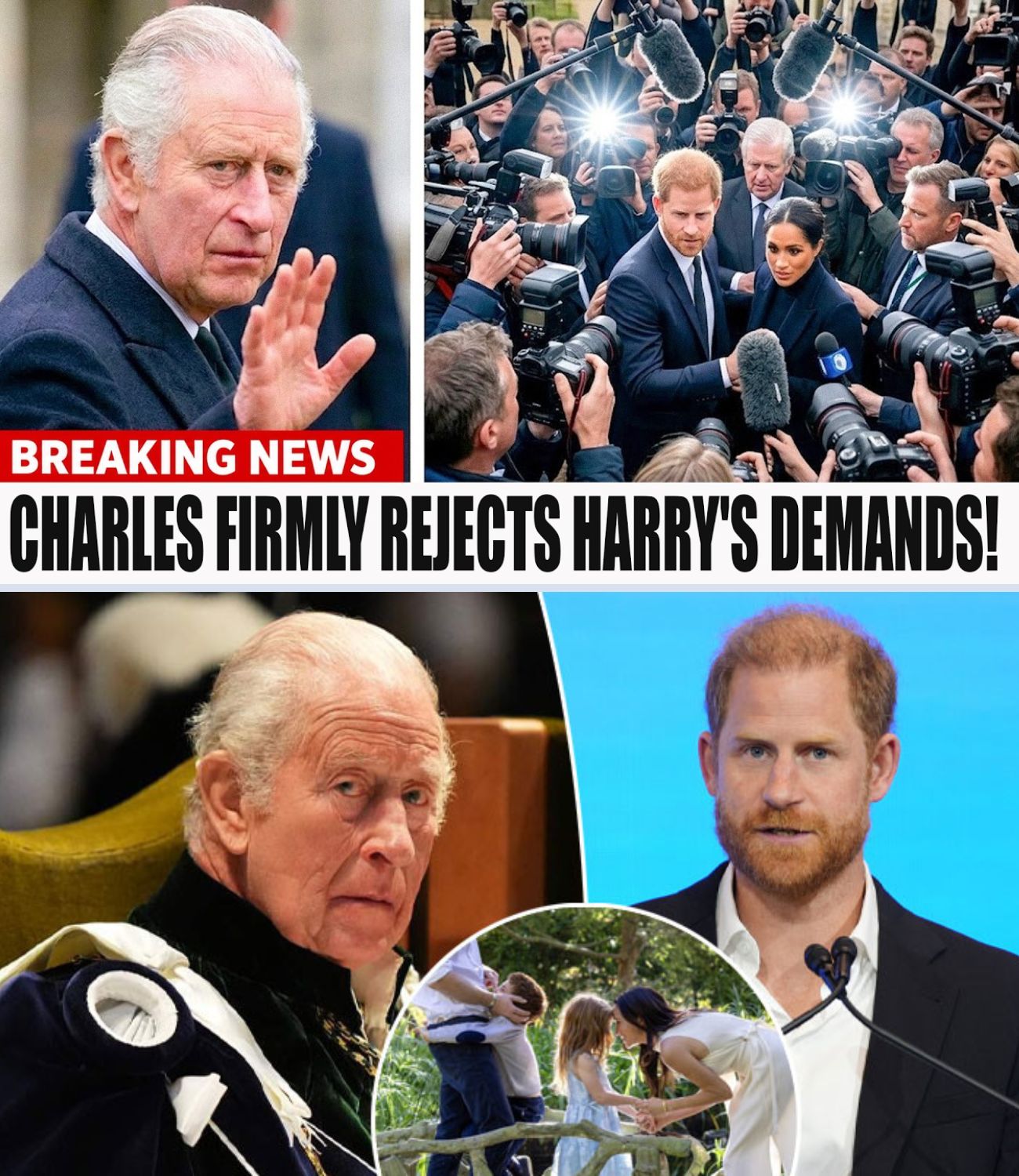
THE ULTIMATE PALACE LOCKOUT: How a Secret Six-Paragraph Circular Stripped Harry, Meghan, Archie, and Lilibet of Crown Protection Forever!
There are moments in the centuries-old history of the British monarchy when the velvet curtain parts, revealing the cold, unyielding steel machinery that actually keeps the crown afloat. For years, the global public watched a televised drama unfold across two continents—a modern soap opera starring a rebellious prince and his Hollywood-adjacent duchess. But beneath the flashing cameras of Montecito and the televised tell-all interviews, a quiet, methodical war was being waged behind the ancient stone walls of St. James’s Palace and Buckingham Palace.
That war reached its brutal, irreversible climax on a quiet Tuesday afternoon in London when Lord Andrew Parker, the Lord Chamberlain and the most senior executive officer in the Royal Household, picked up a pen and signed a six-paragraph administrative circular. Without warning, without a press conference, and without a drop of sentimentality, the House of Windsor delivered the most devastating institutional blow dealt in half a century. In dry, bureaucratic English, the document dismantled six years of posturing, reclassifying Prince Harry, Meghan Markle, Archie, and Lilibet not as working royals or protected state assets, but as plain private citizens with charitable interests.
For Harry, who was sitting inside an executive boardroom in London when the news broke on his private phone just three minutes after public release, the reality check was absolute. This was not a routine status update or an accidental bureaucratic glitch; it was a calculated, perfectly timed execution designed to strip away every remaining illusion of half-in, half-out royal privilege.
The Three-Minute Blindside in London
To understand the sheer scale of the panic that engulfed the Sussex camp that afternoon, one must examine the timeline of the ambush. Days prior to the circular’s drop, Harry’s London office had nervously reached out to royal officials, probing to see if any new protocols were being drafted regarding their status. The palace replied with a polite, non-committal negative. Lulled into a false sense of security, Harry’s team assumed negotiations were still crawling along through diplomatic channels.
They had miscalculated entirely. King Charles and Prince William had already reviewed the final dossier, signed off on the directive, and intentionally held its release until Harry was physically in London—completely cut off from his West Coast public relations advisers and isolated from the echo chamber of Montecito.
When the Lord Chamberlain’s circular hit the national news wires at precisely three minutes past three, the notification pinged on Harry’s phone before his own aides could brief him. In the ruthless theater of royal administration, three minutes is an eternity; it was enough time for the entire world to read the headline before Harry could even draft a defensive statement. Government ministries, the Metropolitan Police, and regional civic leaders across the United Kingdom received the memo simultaneously. The message sent to the British state was unambiguous: the Sussexes held zero claim to taxpayer-funded security, royal accommodation, or diplomatic courtesies.
The York Blueprint and the Rule of Non-Working Royals
Outraged commentators in California immediately decried the move as an act of petty, personalized family cruelty. Yet, a look at the modern history of the House of Windsor reveals that this ironclad standard was forged long before Meghan Markle ever stepped foot on British soil.
The blueprint for this entire conflict was drawn up fifteen years earlier during a bitter financial war involving Prince Andrew and his daughters, Princess Beatrice and Princess Eugenie. As blood princesses born with the style of Her Royal Highness, Beatrice and Eugenie pursued private careers and lived independent lives. Yet, for years, they traveled the globe—from Swiss ski chalets to Mediterranean yacht parties—flanked by full teams of armed Metropolitan Police bodyguards. That taxpayer-funded protection drained upwards of five hundred thousand pounds annually, sparking fierce public outrage during a bruising economic downturn.
Then-Prince Charles stepped in, telling Queen Elizabeth plainly that the non-working royal security detail had to end. Andrew fought tooth and nail, writing furious letters and demanding palace interventions, but Charles held the line. The security was stripped.
Prince William watched that battle closely. He understood a fundamental truth of modern survival: an institution that prioritises luxury over public accountability during a cost-of-living crisis will inevitably collapse. When Harry and Meghan demanded police motorcades and state protection for living an ocean away, they were attempting to rewrite a rule that had already been brutally enforced against William’s own uncle and cousins. The monarchy could not—and would not—maintain two sets of rules.
Tiara Gate and the Greville Emerald Conflict
While security and police protection formed the financial battleground, a parallel conflict raged over the physical vaults of the British crown. The tension had been simmering since the weeks leading up to the May 2018 royal wedding, a saga staff still whisper about as “Tiara Gate.”
Invited to Buckingham Palace to select a wedding diadem, Meghan’s eyes reportedly locked instantly upon the magnificent Greville Emerald Kokoshnik Tiara. Crafted in 1919 by Boucheron for society dame Margaret Greville and bequeathed to the Queen Mother in 1942, its centerpiece is a breathtaking 93-carat cushion-cut emerald set in platinum. It is a masterpiece held in sacred trust for the British nation.
When Meghan asked for it, the late Queen Elizabeth delivered an ice-cold reality check: “Meghan cannot have whatever she wants. She gets what tiara she is given by me.” That refusal sparked a three-pronged institutional panic. Palace advisers were terrified of commercial exploitation, deeply fearing that historic state jewels loaned to someone building an American lifestyle brand would end up featured on streaming specials or magazine covers. Furthermore, Prince William took it intensely personally, having made a sacred promise to protect his mother Diana’s private collection and crown heritage for his wife Catherine and young daughter Charlotte.
Behind closed doors, however, inquiries from the Sussex camp continued to probe about future inheritances—specifically asking which historic pieces Archie and Lilibet might claim as grandchildren of the sovereign, floating long-term overseas loans to California vaults.
The Confidential Annex and the Ultimate Overreach
The boiling point arrived early in 2026, during preliminary discussions regarding whether the Sussex family might return to London for major state commemorations. Royal solicitors intercepted a formal legal memorandum attached to correspondence from Harry’s transatlantic legal advisers. It was not a plea for family reconciliation; it was an institutional shakedown.
The document laid out two non-negotiable preconditions for Harry’s physical attendance at British state events:
An ironclad executive order from King Charles overriding the RAVEC committee to grant permanent, taxpayer-funded armed police details for Archie and Lilibet whenever they set foot on British soil.
A legally binding pre-distribution agreement guaranteeing Princess Lilibet access to designated historic family jewellery from the royal vaults, complete with special security waivers allowing these priceless crown assets to travel to California without the supervision of Royal Collection Trust curators.
When Prince William read that secret annex inside his study at Adelaide Cottage, aides noted his reaction was not fiery rage, but a chilling, absolute stillness. For years, he had endured the televised interviews and public grievances. But the moment the Sussex team attempted to use the Crown’s physical heritage and British police officers as bargaining chips, William drew a permanent, unbreakable line. He wrote a single sentence on the cover page—“This institutional blackmail ends now”—and immediately forwarded the dossier to the King’s private secretary and Princess Anne.
Princess Anne, the Iron Enforcer
If William provided the resolve, Princess Anne supplied the execution. As the most formidable strategist in the House of Windsor—a woman who famously chose not to give royal titles to her own children, Peter and Zara, to ensure their independence—Anne saw through the emotional language instantly.
She presented King Charles with three unarguable arguments for an immediate counter-offensive:
First, her own children proved that titles are irrelevant to raising grounded, successful human beings. Work ethic and character protect children; royal styles do not.
Second, she expressed sheer disgust at the entitlement of using the title prince while simultaneously attacking the institution that bestowed it, all while demanding impoverished British taxpayers fund private motorcades.
Third, she warned that capitulating during a national economic squeeze would spark public fury and demands for a parliamentary audit of royal finances.
Collaborating with the Lord Chamberlain’s office, Anne and William executed a masterstroke. Rather than triggering a messy, headline-grabbing act of Parliament to strip Archie and Lilibet of their hereditary titles—which would invite endless accusations of malice—they simply altered the operational reality. They left the titles untouched on paper as decorative labels, but classified the entire household as private citizens in administrative law. In British constitutional protocol, private citizens cannot command police protection, claim state funding, or access sovereign vaults. Done. File closed.
The Six-Hour Meltdown
The immediate aftermath inside the Sussex communication offices in California was nothing short of a psychological collapse. Over the course of just six hours, as the reality of their legal dead-end set in, the press office released three wildly contradictory public statements:
Statement One (Defiance): Fourteen sharp sentences insisting that King Charles had confirmed the children’s titles in September 2022 and arguing that no bureaucratic guidance could alter letters patent.
Statement Two (Concession): Released several hours later, adopting a much softer tone, conceding that government institutions were entitled to seek protocol clarification and noting the Lord Chamberlain’s letter simply reflected independent operating models.
Statement Three (Capitulation): Dropping late into the night, a brief seven-sentence white flag admitting that the financial independence and private status described in the letter was merely an accurate reflection of the choices Harry and Meghan made back in 2020.
You do not issue three contradictory statements in six hours unless your bluff has been called so forcefully that recovery is impossible. Legal exposure, financial exhaustion, corporate partners fleeing from potential litigation, and an icy silence from King Charles forced a total surrender.
Locking the Vaults Forever
With the administrative war won, Prince William quietly oversaw the final, permanent securing of the Crown’s heritage. A new unbending legal covenant was registered for the Royal Collection Trust: from that afternoon forward, no piece of sovereign regalia, historic artefact, or item from Princess Diana’s personal collection—including her iconic sapphire choker and Spencer tiara—could leave the physical borders of the United Kingdom without the joint written countersignature of both the reigning sovereign and the reigning Prince of Wales.
The heavy vault door swung shut, the combination was locked, and overseas transfers to California were extinguished forever.
The contrast between this locked vault and the reality of the next generation could not be starker. In Berkshire, Prince George of Wales grows up immersed in the rhythm of constitutional duty, school gates, and public service, his daily life matching his official records. Across the Atlantic, Archie and Lilibet grow up on a sun-drenched estate in Montecito, following American school routines, speaking with California accents, and living as total strangers to the kingdom whose titles they bear.
Harry fought for six years to shield his children from the cold machinery of the British monarchy, only to leave them stranded in the most peculiar limbo imaginable: holding decorative titles from a grandfather who wears a crown, while being officially classified as private citizens by the very institution they once sought to monetize.
As the sun sets over the Pacific, the lesson remains written in stone. The British monarchy is not a fragile family gathering; it is a thousand-year-old constitutional institution that does not bend to personal feelings. William didn’t invent that rule, but by locking the vault and walking away, he ensured it will survive for generations to come.
You Might Also Enjoy

“We Thought They Would Negotiate”—What Argentine Soldiers Said When The British Attacked Goose Green

“You’ll Never Finish My Ruck March, Limey” — US Sergeant Who Challenged the SAS, Then Fell Out First






