CIA Officers Could Not Believe What British SAS Did in Afghan Mountains
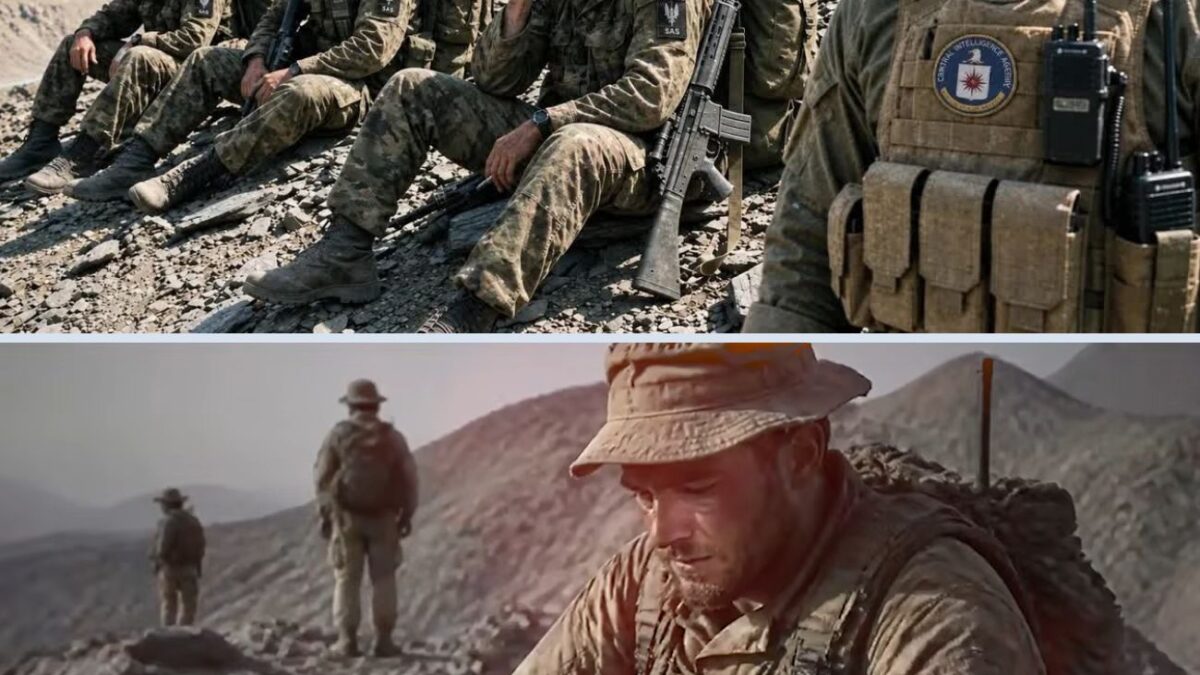
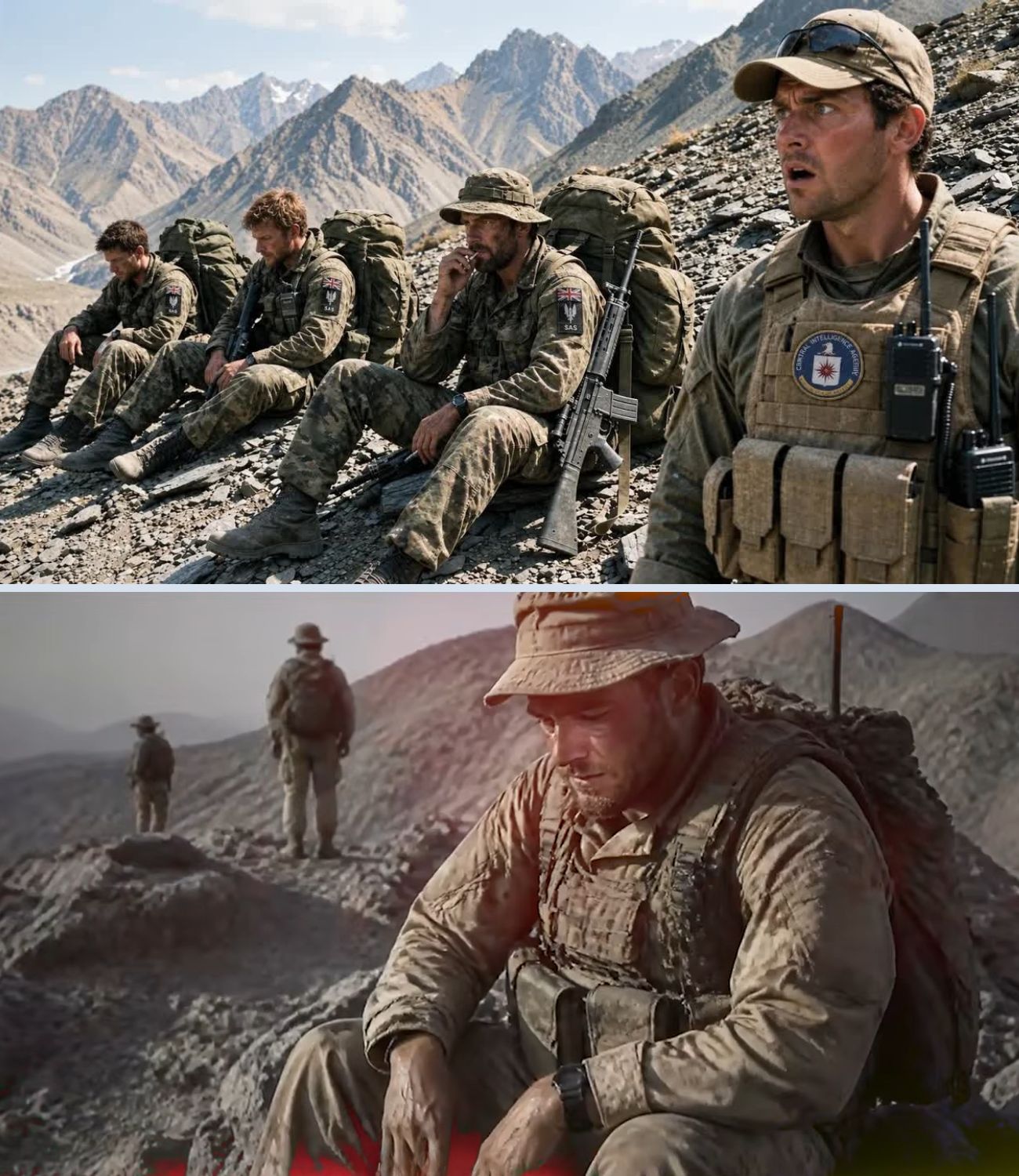
You are Elliot Vance, and it is not yet 6:00 in the morning at 4,000 and something metres in the Hindu Kush, and the three men sitting on the rock shelf in front of you have just done, in the dark, in one night, what your team took two and a half days to do in daylight two weeks ago.
The one in the middle is rolling a cigarette. That is the first detail you can process. Not the rifles laid across their bergens, not the boonie hats crusted white with salt, not the small Union Jack half turned to the wall of stone at their backs. The cigarette.
He has taken a pinch of tobacco from a tin, put it into a paper, closed it with one hand while the other cradles a brew mug, and he does it the way another man might tie a shoe without thinking about it, without watching it, without stopping the low murmured conversation with the one on his left about whether the wind on the ridge is going to lift by 10:00.
Behind them, the valley is still black. In front of them, the eastern sky is doing that thin apricot thing it does at this altitude, where the light arrives before the warmth by about 40 minutes. Your radio is hissing in your chest rig. Bull is 100 metres below you on the switchback, coming up, and you have not answered him because you do not yet know what to say.
You have been in this business 17 years. Marine reconnaissance, then the agency, then ground branch, then paramilitary work on three continents. You have run with people who are supposed to be the best in the world at moving quietly through bad ground. You have carried the patch on your chest that is supposed to mean you already know the answer, and you are standing on a shelf of rock in Kunar province watching a Welshman roll a cigarette, and you have no idea what you just witnessed.
The question you cannot answer yet, the one that will keep you awake in the safe house in Kabul for the next three nights, and in a quieter way for the rest of your career, is this: How did they get here before you?
Elliot Vance grew up in a small town on the flat industrial rim of eastern Ohio, the kind of place where the horizon is a smoke stack and the closest mountain is a rumour. He joined the Marines at 19 because his father had, and he ended up in reconnaissance because he found, on his second attempt at the pipeline, that he was very good at three specific things: reading a map in bad light, staying still for longer than the person watching him, and putting one foot in front of the other for further than the man next to him wanted to go.
Two tours in Iraq taught him what fire feels like inside a building. A third rotation out at the edge of Anbar taught him what it feels like to be the man who has to stay behind and hold a rooftop while other people leave. He was 30 when the agency came to talk to him at the officers club at Camp Pendleton, and 31 when he signed the papers that ended his Marine career and started his second one.
The Central Intelligence Agency’s Special Activities Center, the paramilitary side of the house, ground branch, put him through a selection he is still, by policy, careful about. What he will tell his wife’s brother at Thanksgiving is that it was long and cold and involved a great deal of swimming. What he will not tell his wife’s brother is that at the end of it he was one of 11 remaining from an intake of forty-something, and that a very tired man in a cheap suit told him, in a rented conference room, that he now belonged to a different kind of army.
By the time he steps off the C-100 at Bagram in the winter of what he privately calls his good years, he has worked in Colombia against the FARC, in the Sahel against people who did not yet have a group name, and in two other places he will not name at all. He has been shot at twice cleanly and once badly.
He has an assessed altitude tolerance in the top decile of ground branch, a real number tested at the agency’s mountain facility in Colorado, a number he is quietly proud of. He carries a small green field notebook because his controller in Kabul has told him to keep private impressions, and he writes in pencil because ink freezes.
The belief he brings with him onto the tarmac at Bagram, the belief the mountains are going to take apart in small pieces over three weeks, is this: Above roughly 3,000 metres, he thinks, the human body is the great leveller. Doctrine flattens, kit flattens, money flattens. What is left above the tree line is lungs and legs and the willingness to keep moving when the willingness is the only thing you have. And on that curve, Elliot Vance believes, without arrogance and without saying it aloud, that he is very close to the top.
He is not wrong to believe it. That is important. He is one of the best-conditioned paramilitary officers the agency has in country that season. His resting heart rate is 44. He has done the Manaslu circuit on his own leave unassisted because he wanted to. The mountains he is about to walk are not going to embarrass him. They are going to embarrass his idea that the curve has a top. And the men who will do the embarrassing are at this exact moment drinking tea from a battered kettle in a plywood hut 91 km to the north-east, and none of them have heard his name.
The operation, as Kersten Vogel lays it out for him in the back room of the Kabul station on a Tuesday afternoon in early November, is neither large nor complicated on paper. A mid-tier target, a man the agency has been tracking through phones and cousins for 11 months is believed to be attending a shura, a leadership gathering in a compound in a side valley southeast of Asadabad in Kunar.
The compound sits at roughly 2,300 metres. The approaches on all sides rise steeply to ridges that top out well above 4,000. The valley itself is narrow enough that helicopters cannot land closer than about 12 km and every one of those 12 km is watched or watched enough that a fast insertion is not going to work. What Vogel needs is a small element on the high ground for 4 to 6 days. Eyes on the compound. Confirmation by face or by pattern that the target is present. And then, if the window opens, a call for fires or a handoff to a strike element.
She is German-American, careful about paperwork, and she keeps the log of this one in a locked drawer rather than on any server. She tells Vance without emphasis that the agency’s own ground team will not be doing this alone. She tells him that a four-man patrol from D Squadron 22 of the Special Air Service currently attached to the Joint Task Force out of Bagram will be the primary movement element. Vance and his partner, Warren Ostrowski, will accompany them as the agency’s eyes and if it comes to it, as the men holding the radio to the men holding the money.
Vance nods. He asks the professional questions. He asks about ratlines and about the Pashto speakers. He asks about the weather window. He does not, out of professional courtesy, ask the question he is thinking, which is why we need them at all.
That question, unspoken in the station, becomes a spoken one two days later in the Bagram briefing tent when Bull Ostrowski, Warren Bull Ostrowski, ex-Delta selection dropout, 6 ft 3, from a suburb outside Detroit, a man who does not talk about the selection he did not finish, leans over during a coffee break and says quietly, “You met these guys yet?”
Vance shakes his head. Bull grins. Bull says, “Wool caps and moustaches, like it’s still 1982.”
Vance smiles because he is meant to. And then he says the sentence he will replay in the small green notebook and in the quiet at the back of his head for a long time afterwards, “I’ve walked Iraq. I’ve walked Colombia. I’ve walked the Manaslu circuit on my own leave. How different can four blokes in wool caps really be?”
Bull laughs. They both drink their coffee. The tent is warm. Outside the tarmac is white with a hard brittle frost.
91 km to the southeast at the joint task force’s forward compound in a plywood room with a diesel stove and a kettle. Four men from D Squadron are looking at the same map. They came out of Credenhill, Stirling Lines, at the edge of the village of Credenhill, just outside Hereford, in the flat English county land that everyone who has not been there imagines is Welsh 6 weeks ago. They have spent four of those weeks in these valleys already. They know, in the peculiar way that regiment men come to know a piece of ground, which ridge holds the wind after dusk and which does not.
Major Nicholas Holloway is with them. Wool watch cap pulled low even though the stove is on, speaking to Reese in a quiet level Pashto that Reese does not understand and does not need to. Holloway is their squadron officer commanding. He speaks four languages that matter in this country, and he does not correct the men who say only two of them are useful.
The thesis of the next 21 days, though nobody in the tent will say it out loud, is a simple one, and it is the thesis of this entire account: elite is not what a unit possesses, elite is what a unit is willing to leave behind. Vance is about to learn the difference between those two sentences the hard way.
They meet, the six of them, in a shipping container that has been converted into a planning room on the eastern edge of Bagram. There is a plywood table screwed to the floor, a map pinned to one wall, a kettle on a milk crate, and a smell that is one part diesel heater, and one part the ghost of every man who has ever slept on that floor while waiting for weather.
Vance walks in expecting a version of a scene he has done twice in his career already: the handshake, the last name introductions, the gentle scent marking of two units figuring out whose plan will win. He walks in with his notebook in a chest pocket, and Bull half a step behind him. There are three men in the container already. The fourth they will meet on the ground. None of the three stand up. None of them offer a hand across the table.
The one at the head of it, forty-ish, dark stubble, boonie hat on the plywood in front of him, looks up, nods once at each of them in turn, and says, “Reese, this is Oz, and this is Ash. You’ll be Vance, and you’ll be Ostrowski.”
His accent is Welsh, not the stage version, the real one, softer than an outsider expects, the vowels doing something quiet at the back of the mouth. He does not offer a surname. He goes back to the map. Staff Sergeant Reese Pritchard, out of a mining village near Merthyr Tydfil, rolls his own cigarettes, and when he is counting off a bearing or a distance in his head, does it in Welsh under his breath. Vance will learn that later.
Vance sits down. He waits. He is used to being talked at first by other units, an assertion of framework, a walk-through of assumptions, a laying out of concept. Reese does not do this. Reese pushes the map across, points with the blunt end of a pencil at three ridgelines, and says, “We were thinking this one, this one, or this one. We’ve been on the middle one. It’s got the arc of view you want, but it’s a bastard to get off if it goes bad. Your shout.”
Bull looks at Vance. Vance looks at the map. It is, he realises, a genuine question. There is no framework being asserted. There is no ceremony. There is a map and three ridges and a Welshman waiting patiently to be told what the agency’s men need. He points at the middle ridge and says he wants the arc of view.
Reese nods, folds the map, puts it in a leg pocket, and says, “Right. Kit check at 1500, brief at 1800, wheels at 0200.”
That is the meeting. Outside, walking back to their own container, Bull says very quietly, “Was that it?”
Vance says, “I think so.”
At 1500 in the equipment bay, Vance sees the four men’s bergens laid out on a tarp. He has been in enough bays to read a loadout the way other men read a resume. The kit is old, not neglected. The opposite, in fact, everything is oiled, taped, adjusted. The wear on the shoulder straps of Reese’s bergen showing the exact place where it has ridden the same shoulder for what looks like a decade. The rifles are Diemaco L119s, the regiment variant of the C8, well-used and well-kept. Suppressors indexed with a marker line so a man in the dark can seat one by feel. The Glock 17s are plain. The stoves are battered. One of them has been repaired with wire.
Behind him, in the agency’s own row, Bull is laying out his own kit. New Arc’teryx shells, still stiff at the cuffs. A titanium stove that cost more than a month of a British corporal’s pay. Vance registers the gap between the two rows in a single quiet thought that they brought a catalogue and the four men brought a habit. And then he lets the thought go because it is not the point and never will be. And he does not write it down.
What he does write down in pencil in the small green notebook at 17:45 is one sentence. They did not perform for us. He underlines it once. He does not know yet why it matters. He knows only that at every other unit handover of his career, someone had performed something. An anecdote, a piece of kit, a rank, a name drop, a laugh at another unit’s expense. Reese had performed nothing. Reese had shown him a map and asked him where he wanted the view.
At 1800, the fourth man walks into the brief. Trooper Dominic Ash, 27, the youngest of the patrol, light brown hair, missing the tip of his left little finger. He nods at Vance the way the other three did. One nod, no words, and takes a seat at the back with a mug of tea in his good hand.
At 0200, they load into two vehicles and drive southeast into the dark. They day-bivvy in a wadi at a little after 0400 at an elevation Vance’s watch reads as 1,911 metres. The plan, as Reese laid it out in the brief and as Vance has annotated in his notebook, is to move on foot up the eastern flank to a lay up point at 3,200, wait out the daylight in a shell scrape, and then push over the shoulder to the observation ridge in the second night. Two nights of movement, one day of hide, standard patrol tempo. Vance has done this before. Vance is looking forward to it.
The first hour is fine. They move in a loose file, Reese at point, Oz second, then Bull, then Vance, then Ash, with the fourth man, Corporal Ewan Brody, the patrol medic, bringing up rear. Vance’s bergen is 38 kilos. His breathing settles into the rhythm he trusts. He has been at altitude for eight days already, acclimatising in Kabul and on a nothing day up at Bagram’s eastern perimeter, and his lungs are good.
The second hour is when the mountain starts talking. The ground steepens without warning at about 2,300, which he knows from the map, and turns to scree, which he did not expect, and which the map did not show. The scree is the loose, ball bearing kind, the kind that punishes anyone who leans into it. Vance leans into it out of habit and slips. He does not fall. He recovers. He is annoyed mildly at himself.
In front of him, Reese does not lean in. Reese walks up the scree the way a man walks up a wet slate roof. Heels down, weight back, shoulders quiet, no wasted vertical motion. Oz does the same thing without watching Reese do it. Bull, behind Oz, is doing what Vance is doing, which is fighting. The gap opens between Bull and Oz by 1 metre in the first quarter hour of the scree, then by five, then at the top of the scree, at a false crest, Vance’s watch reads as 2,700 by 20.
Vance closes the gap to Bull. Bull is breathing hard and swearing quietly in a pattern that Vance recognises as embarrassment. Ahead, Reese and Oz are standing on the false crest waiting, not looking back, not making a show of it, drinking from their bladders with the calm of men at a bus stop.
The third hour is when Vance starts, for the first time in 5 years, to worry about his own body. It is not the lungs. His lungs are fine. It is the feet, the way, at this altitude, on this particular ground, every step has to be placed rather than taken, and the men in front of him are placing every step without appearing to think about it. And he is placing every third one and taking the other two. Every taken step, he now understands, is costing him 20% more than the placed ones. He has been reading terrain his whole professional life. He has not been reading it like this.
At the second rest halt, at 3,000 and change, Sergeant O’Wayne Fenwick, whom everyone calls Oz, sits down next to him. Oz is thirty-something, sandy-haired, with a small paperback Western folded open and shoved into a chest pocket, and when he takes his helmet off to wipe his forehead, Vance sees, taped to the inside of the band, a laminated photograph of a small dark-haired girl on a beach.
Oz sees him seeing it, smiles without embarrassment, and says, “That’s Fian. She’s four. Mind if I ask, you all right?”
Vance says he is fine.
Oz nods and says, mildly, “You’re placing your feet a bit late. The scree told you it was coming and you didn’t listen.”
He does not say it is a rebuke. He says it the way a man says your shoelace is undone. He takes a bite of a Yorkie bar and offers Vance a piece. Vance takes it.
They move again at 07:15. The sun is up. The eastern faces are golden. The world is silent except for the sound of six men breathing at different rhythms and the small precise crunch of boots on ground.
By the lay up point at 3,200 at 10:00 in the morning, Vance is not broken. Vance is by any reasonable measure doing well. He is the fifth of six into the hide. Bull is the sixth. Ash, the youngest who has been at the back with the medic, comes into the hide having offered twice, quietly, which Vance overheard, to carry a portion of Bull’s water. Bull refused. Ash did not press.
Inside the hide, in the dry cold of a shell scrape lined with a bivvy bag and covered with a scrim, Vance opens his notebook. He is expecting to write about the ground. He writes instead one sentence. I have been thinking about altitude wrong.
He looks at it. He thinks about the Brecon Beacons, which he has never walked, but which he has heard about at every joint course he has attended. He thinks about his own Manaslu circuit, unassisted, which is at higher elevation than anything the four Britons in the hide with him have probably done for pleasure. He thinks about his tested altitude tolerance in the Colorado facility and about the top decile.
And then he understands, sitting in a shell scrape at 3,200 metres with his knees pulled up to his chest, that the top decile was measured against the wrong thing. It was measured against consumption, how much oxygen his body could pull, how fast he could climb, how long he could go. The men lying in the scrape either side of him are not, he suspects, higher on that curve than he is. They are on a different curve entirely. The curve they are on is not about how much they can spend, it is about how little.
He writes a second sentence under the first. They don’t spend anything they don’t need to. Then he closes the notebook and for the first time in 29 hours, sleeps.
He wakes in the hide at 15:20. The light through the scrim is the flat, thin gold of a mountain afternoon. Somebody, without waking anyone else, has laid a spare fleece over his legs. He does not know who. He lies still for a while and does the thing men do when their pride has taken a small, private hit. He argues with himself. He argues that the morning was a first day, that first days at altitude are always ugly, that the men in front of him have four weeks in these valleys and he has eight days in country.
He argues that the tab up the eastern flank was navigation and foot placement and that navigation and foot placement are, in the great division of soldiering skills, only one column of the ledger. He argues, most importantly and most quietly, that the other column, the one with a rifle in it, the one with a door and a room and a decision at the end of it, is the column he has always been better in than the men who out-tab him. Iraq was that column, Colombia was that column, ground branch is that column. Fine, he thinks. Fine. Let’s see them shoot.
It is a small thought and a slightly ugly one and he knows it. He also knows, from having watched a number of officers older than himself run this exact play in their own heads at various points in their careers, that the thought is what the ego does when the first assumption cracks. It retreats to the next room and locks the door.
He rolls onto his side. Across the scrape, Ash is awake, sitting up against his bergen, cleaning the working parts of his rifle with a rag and a thin bottle of oil. Ash is the youngest of the patrol, 27 by the file Vance read at Bagram, and he has the quiet of a man who has not yet acquired the confidence to be loud.
When Vance sits up, Ash nods at him and without speaking, slides a mug of tea across the mat. Vance takes it. It is builder’s tea, strong enough to stand a spoon in, made with powdered milk and the last of somebody’s sugar sachet. It is the best thing he has drunk in a week.
They sit for a while. Ash finishes the working parts, reassembles the rifle, function checks it with the sort of muscle memory that comes from doing a thing several thousand times. Then he flexes his left hand, and Vance sees again the missing tip of the little finger.
Ash catches him looking.
“Cairngorms,” Ash says. “Winter, 3 years ago, own fault. Wasn’t paying attention on a traverse and the rope went where my hand was.”
Vance nods.
Ash says, “First one always hurts. It gets easier.”
Vance thinks for a second that Ash is talking about the finger. Then he understands that Ash is talking about the morning. Ash says it without any smile at all, without any of the top note that would have made it a dig. And he goes back to his rifle. He is being kind. That is the thing Vance registers, lying in a hole in the ground at 3,200 metres in Kunar Province. The youngest man in the patrol is being kind to him. Vance drinks his tea. He decides not to write anything in the notebook. Not yet.
The second night’s movement goes better for him because he has spent the afternoon watching in the hide how the other men repack their bergens and he has changed the way he is loading the top compartment. This is a small thing. It saves him, he estimates, 4% of his effort. He is grateful and he does not say so.
By 0340, they are on the observation ridge, a long broken shelf of rock at 3,900 metres running north to south with a shallow reverse slope that hides the observation post from the compound below and an arc of view that opens onto the target valley like a theatre. Reese in the last hour has done something Vance has not seen a point man do before. Reese has changed the patrol’s line of approach twice, not for the ground, which was fine, but for the wind, which was carrying west to east and would have pushed their scent and the small mineral smell of six men and their oil and their tea down into a gully that a shepherd might use at dawn. Vance did not think about the wind. Vance has not thought about the wind at scent level in the whole of his career.
They dig in. Two shell scrapes, one at each end of the arc, scrim over the top, camouflaging under. Reese and Oz take the north scrape with the spotting scope. Vance and Bull take the south with the agency’s own optic and the satellite radio. Ash and the medic take the middle and act as the link. Corporal Ewan Brody is the quiet one Vance has spoken to least. He is ex-Royal Marines transferred across after selection at some point in his late 20s and he drinks his tea from an enamel brew kit mug with a dent in the rim that he does not explain. He is the medic. He has laid out his kit inside the hide the way a chef lays out a station and it is the neatest thing Vance has seen since Colorado.
Dawn arrives. The compound comes into view. It is exactly as the imagery predicted. A walled square of three buildings around a courtyard. One gate to the north, a goat pen to the east, smoke from one chimney at 06:15. Vance settles in and starts to log. The day is quiet. They rotate on the scope. They eat cold. They piss into bottles because scent discipline out here is a kind of religion. Vance logs 11 adult males through the gate between 08:00 and 11:30. Three of them possibly of interest. None of them the target. He is happy with his logging. It is his column.
At 16:40, a shepherd boy comes up the shoulder below their ridge with a switch and a small herd of five goats. He is perhaps 9 years old. He is not looking for anything. He is doing his job. The wind, which has been kind all day, shifts by about 10 degrees at 16:42. And the boy, without breaking stride, stops.
The boy is 180 metres below the observation post. He is looking at the goats. He is not looking at the ridge. Nobody in the hide breathes for a period of time Vance does not measure. Vance’s hand goes out of some very old reflex to the pistol grip of his rifle.
Across the middle scrape, without turning his head, without any word at all, Reese catches Vance’s eye and with the small of his palm presses the air down. Stay. It is not a command with any threat in it. It is the gesture a man uses to keep a dog still. Vance stays.
The boy calls to the goats in Pashto. Two of the goats have wandered. He walks up the shoulder another 20 metres, still not looking at the ridge, still doing his job. He is now 160 metres below the observation post. Every man in the two scrapes could put a round through him inside 3 seconds. Nobody moves. Reese is watching the wind. Vance sees this. Reese is watching a small tuft of dry grass on a rock in front of the boy’s line, and the tuft has stopped moving, which means the wind has died at ground level, which means their scent is going up, not down. Reese’s shoulders drop half an inch.
The boy calls the goats. The goats come. The boy turns and walks back down the shoulder the way he came, still not looking at the ridge, still not knowing what he has been a metre and a half of wind away from. The boy is gone at 16:51. Nobody says anything for perhaps 10 minutes.
Then Oz, in the north scrape, without turning his head, says, so softly that Vance can only just hear it, “Good lad. Go home to your mum.”
Later, much later, back in the safe house in Kabul, with a whiskey he did not want and a headache he did, Vance will write in the small green notebook the sentence that for him is the true breaking of the second assumption: “They never made it a shooting problem. I was ready to. They weren’t.”
He will underline it twice. He will understand, sitting there with the whiskey, that his whole professional life has been arranged around the moment the finger goes to the trigger, and that the four men on the ridge with him had arranged their whole professional lives around the moment before that, the moment of the wind, the moment of the tuft of grass, the moment of the boy who could be allowed to go home to his mother. He will understand that the shooting column, the column he was going to show them, is a column those men enter only when every other column has failed, and that most of the skill of the trade is the skill of not entering it.
In the hide, at 17:15, Reese rolls a cigarette without lighting it, puts it behind his ear for later, and turns back to the scope.
Reese says, to no one in particular, “Right. Let’s find out if he’s home tomorrow.”
The wind has shifted back. The boy is now a small figure on the valley floor. The sun is dropping. Vance closes the notebook without writing in it.
It is Reese who sees him first through the spotting scope from the north scrape. And Reese does not react in any of the ways Vance has seen other men react to the arrival of a target. He does not stiffen. He does not exhale. He watches for a full 90 seconds, and then he says quietly across the ridge, “That’s him. Green kameez, brown vest, right-hand vehicle, second man out.”
Vance is on the satellite radio inside the second breath. Vogel is on the other end at Kabul Station within 4 minutes. The strike element, a fast jet pair on a station orbit 60 miles out, is on the net inside seven. The target is inside the compound. The target has embraced two men in the courtyard and gone inside the westernmost of the three buildings.
Vogel says, “You have positive identification.”
Vance says, “Positive identification.”
Reese confirmed. Reese, without looking up from the scope, says, “Confirmed. That’s our man.”
There is a pause on the radio.
Vogel says, “Stand by for authority.”
The standby lasts 11 minutes. In those 11 minutes, the wind picks up from the southwest, which is a problem because it will push a burst of dust from any hit toward the northern gate. And Reese, without being asked, is already sketching a new line off the ridge to their exfiltration that avoids the northern gate. Oz is doing something Vance has not seen a soldier do in the middle of an operation. Oz is drinking a mouthful of water. Just a mouthful, the way a runner does at kilometre 30 of a marathon, because Oz knows in the way that men who have been in these valleys for weeks know that in 11 minutes there will not be another chance to drink for 6 hours.
Authority arrives at 10:14. Vance calls the fires. He calls them the way he has been trained. Code word, grid. Description, restrictions. Reese next to him has one hand on the scope and one hand on the map with his thumb on the exfiltration route. Ash at the middle scrape has the second radio up and is speaking to the vehicles down at the pickup, telling them in a voice that has not risen a single note across 4 days that they will be needed in 3 hours and 30 minutes and where.
At 10:17 there is a sound Vance has heard before, the far dry crack of a piece of the sky arriving faster than the sky knows what to do with and the westernmost building of the compound is no longer a building. It is an idea about a building. A grey pillar of it goes up in the still valley air and then a second one and then the sound reaches them across 3,000 metres and shakes the small stones on the ridge.
Reese, without moving his eye from the scope, says, “Good effect.”
That is all he says. The exfiltration starts at 10:22. They collapse the observation post in six and a half minutes. Every man knows his job. Nobody speaks. The scrim comes down. The camnet comes down. The shell scrapes are dressed back to look like the ground never held them. Vance, moving faster than he has moved in 4 days, is doing the agency’s small share of it, his own kit, his own radio, his own bergen and Ash, without asking, is doing Vance’s netting for him and Bull’s for Bull. They are off the ridge in 11 minutes.
The wind holds long enough for them to descend the first 800 metres of the shoulder. The valley below the compound is already coming alive. Men on the road, horns, dust, but they are going the other way. Up over the northwest lip and down into a parallel valley that the imagery said was empty and that Reese says, without explanation, will be empty. It is empty.
They move for 4 hours. Vance keeps up. He does not do well. He does not do badly. He does what he has learned to do in 4 days, which is place his feet and not spend. At one point on the descent, at a very steep section of shale, Reese turns and, without a word, holds out a hand for the buttstock of Vance’s rifle so Vance can free both hands for the down climb. And Vance gives it to him. And neither of them speaks about it before or after.
At 1500, the weather closes in. The snow that will, in 3 hours, become the moment that breaks him. But he does not know that yet. In the present tense, at 1500, he is still standing, still moving, still contributing. He is not being carried. He is being allowed to keep up. He understands the distinction now.
At 1600 on the shelf they have been traversing, before he drops to his knee, he catches Reese’s eye across a rock. Reese nods once. It is not a congratulation. It is an acknowledgement. You are here and you have been useful and I am recording it. That nod is worth, in Vance’s private accounting, more than any commendation he has ever been given.
The strike, the fires, the good effect, the operational result of 21 days of work, is what the agency will write up in the report Vogel will lock in her drawer. It is the reason the operation existed. It is not, in the long run, the thing Vance will remember. The thing Vance will remember, and the thing he will try to describe to a room full of ground branch officers in a conference in Virginia 4 years later, is the nod on the shelf and the 11-minute collapse of the observation post, and the four men who never, in 91 hours of contact, raised their voices or their pulse or their patch above the ground they were standing on.
What breaks him is not the operation. What breaks him is what happens afterwards, on the exfiltration.
The plan for the exfiltration is to come off the ridge to the northwest, drop into a parallel valley, and be picked up by vehicles at a point 16 km from the observation post. 16 km downhill for the first eight, then a valley floor for the second. On the map, it is nothing. In Vance’s Colorado file, it is nothing.
The weather closes in at 1400. It is not a storm. It is worse than a storm. It is a snow that starts as nothing, as a few flakes, and by 1530 is the kind of thick, wet, silent snow that erases the ground 5 metres in front of the man in front of you. The wind, which has been kind for 4 days, is no longer kind. The temperature, at their elevation, drops 11 degrees in 90 minutes.
Vance is not, at this point, unfit. Vance is empty. He has been running on ration bars and adrenaline for 4 days on a body that had been at real altitude only long enough to know it was there. His stomach starts to turn at about 1600. He hides it. He hides it for 20 minutes.
At 16:22 on a rock shelf that they are traversing in a single file with a 10-metre spacing, he drops to one knee and vomits quietly, professionally into his own scarf. And then again, and then again, and by the third time he cannot stand up. He is at 3,400 metres. The snow is coming sideways. He cannot feel his fingers inside the gloves he paid a small fortune for at an outdoor shop in Colorado Springs.
Ash is next to him. Vance did not hear Ash arrive. Ash is squatting on his heels with the same expression he had when he was cleaning his rifle in the hide, mild, patient, entirely unhurried.
Ash says, “Right. Give me your bergen.”
Vance says, “No.”
Ash says, “Give me your bergen.”
Vance says, “No.” again. He says it more sharply than he meant to.
He is a ground branch officer. He is 37 years old. He is one of the best-conditioned paramilitary officers the agency has in country. He does not need a 27-year-old British trooper to carry his kit off a mountain.
Ash waits. Ash does not argue. Ash waits the way a man waits for a fever to break. And after about 40 seconds, in which Vance vomits a fourth time into the snow this time, Ash reaches without asking and takes the top compartment of Vance’s bergen, the radio, the spare batteries, the water, and clips it onto his own, and stands and says, “Come on now. Up you get. We’re going home.”
Ash carries the compartment for the next 4 km. Ash does not mention it. Ash does not on the way down say a single word to Vance that is not necessary. When Vance falls again at 17:10, Ash puts a hand under Vance’s arm and lifts him without comment.
When Vance sits down in the snow at 17:40 and cannot remember for a full 3 seconds where he is, Brody, the medic, is suddenly there taking Vance’s pulse with the flat of two fingers saying, “You’re all right. You’re all right, mate. Keep walking. We’re not stopping.”
They do not stop. They do not stop for 6 more hours. They reach the vehicles at 23:50. Vance is put into the back of a Land Rover with a foil blanket around him and a mug of tea in his hand that he cannot feel. The notebook is in his chest pocket. It has been there for 4 days. He does not take it out. He has stopped writing in it. He will not open it again for 11 days.
That is the breaking point, not the vomit, not the fall. The moment he understood in the back of a Land Rover in Kunar that he had been carried down a mountain by a man 10 years younger than him who had not at any point made him feel it.
They spend the night in a forward compound halfway back to Bagram. There is a diesel stove and a plywood floor and six camp beds along one wall. And by 01:30, Vance is warm again and can feel his hands and his stomach has stopped turning. And the whole patrol is asleep except for Reese who is sitting on the step of the container with the door half open and a mug in one hand and a rolled cigarette in the other watching the snow that is still coming down outside.
Vance gets up. He puts a fleece on. He sits down on the step next to Reese without asking. Reese does not turn his head. Reese hands him the mug. It is tea, black, cooling, and rolls a second cigarette from the tin in his lap. They sip for a while.
Reese speaks first. He speaks in the low-level way he has spoken for 4 days. “You did all right up there,” he says.
Vance says, “I was carried off a mountain.”
Reese says, “Aye, so was I once. Different mountain, different lads, same weather.”
He lights the cigarette with a Zippo that has been rewound with electrical tape at the hinge. “Ash got carried off Ben Alder in ’99 by the fella who had his own bergen doubled up on his back for the last kilometre. That fella was me.”
Vance looks at him.
Reese says, “The mountain doesn’t care what patch you’ve got on your chest. It’s the oldest thing in the room, and it’s going to be there when we’re gone. All you can do is be quiet and be honest with it. Everything else, the doctrine, the kit, the training, the money, is the noise you bring with you.”
He takes a long pull on the cigarette. “The trick is knowing what to leave in the truck.”
Vance says nothing.
Reese says, “You lobbed that lad on the shoulder yesterday, the boy with the goats.”
Vance nods.
Reese says, “Your hand went to your rifle.”
Vance says, “I know.”
Reese says, “It’s fine. Mine did, too, the first time. It’s a habit. You unlearn it.”
He turns his head finally and looks at Vance. His face is not unfriendly. It is not friendly, either. It is the face of a man who is telling another man something he wants him to hear once and never again. “That’s what this is. It’s not what you can do. It’s what you’ve unlearned doing. Some of your lads back home have unlearned it. Some haven’t.”
He turns back to the snow.
Vance sits there for a long time. He thinks about the sentence in his notebook that he wrote in the hide on the first day. They don’t spend anything they don’t need to. He thinks about the sentence he wrote in Kabul after the boy on the shoulder. He thinks about Ash’s face at the moment Ash took his bergen, the total unadorned absence of any smugness in it. The total absence of any smugness in any of them, from the map on the first day to the tea in his hand tonight.
He understands finally that what he has been calling quiet for four days is not quiet at all. It is discipline. It is the sound of four men who have been asked over and over across a career to leave things in the truck and who have done so. He drinks his tea. He does not write in the notebook. He goes to bed.
Somewhere in the small hours without asking himself when it happened, he stops being an agency officer visiting the regiment and becomes an agency officer who has been shown something and knows he will spend the rest of his career trying to describe it to people who were not there.
Elliot Vance stays in the agency for another 14 years after Kunar. He does two more Afghanistan tours. One in the northwest of Pakistan, one long rotation to a place he still will not name. He is decorated twice for things the citations describe in the flat chosen language of the citation writer. He never works with the four men from D Squadron again.
He hears through the informal channels the paramilitary community keeps that Reese leaves the regiment in the late part of the following decade and goes to work for a while in the private sector and then goes home to the mining village near Merthyr Tydfil and by one account keeps bees. He hears that Oz is still in. He hears about Ash once at a joint course and it is a story he does not repeat.
In the winter of what he later calls his last good year, Vance is asked to speak at a closed session at a facility in northern Virginia. The audience is ground branch officers, thirty-something of them. Most of them younger than he was when he flew into Bagram that November. The session is unclassified in its framing. Vance can speak about anything he wants that a reasonable man would judge to be safe to speak about.
He is asked specifically by the officer running the session, a woman he has known for years, whose judgment he respects, to tell the room the story he told her once in a bar in Rosslyn about the British and the mountains.
He says he will. He stands up. He does not use notes. He is a good speaker in the way that men who have been careful with words for a career are good speakers, flat, deliberate, without ornament. He tells them about the container at Bagram and the map with three ridges and the Welsh staff sergeant who did not offer a hand. He tells them about the boy on the shoulder. He tells them about the 11-minute collapse of the observation post. He does not tell them about being carried off the mountain. That part of the story he keeps.
At the end of the account, one of the younger officers in the room, a man in his early 30s, well-regarded, ambitious in the way the younger ones now are, puts up a hand and asks the question the session was designed to ask.
He says, “Sir, with respect, what did they actually do that we couldn’t have done?”
Vance is quiet for a moment. Then he gives the room the answer that has been the private answer he has been giving himself in various forms for 4 years. He says, “You have to understand, we thought we were the standard. We had the money. We had the aircraft. We had the doctrine written down. We had a facility in Colorado where a man in a lab coat could tell you your altitude tolerance to the second decimal place. Those four men had a brew kit and a map that was older than my career. And a Zippo one of them had rewound with tape, and a paperback western in the middle man’s chest pocket that he read at the halts. And when the ground turned bad, they moved like it was theirs. And we moved like tourists.
“I want to be careful about how I say this next part because I have been in this room, and I know how it can be heard. I am not telling you the British are better than us. I am telling you that I have never, in 21 years of this work, seen human beings make less noise on a mountain than those four did. I do not mean noise with their boots. I mean noise with their bodies, noise with their kit, noise with their voices, noise with their pulse, noise with the way a man’s fear or his pride or his tiredness leaks out of him into a patrol. They did not leak any of it for four days.
“I stopped writing in my notebook on the third night. There was nothing to write. They were doing something my language did not have words for. And the thing I want you to leave this room with, the thing I wish somebody had told me at your age, is that everything I had thought was the top of my trade up to that November was about how much I could bring to a mountain. Every day I spent with those four men was about how little they could. That is the whole difference. That is the only difference, and it is a bigger difference than you think it is.”
He sits down. The room is quiet for what a man in the back row later says was a very long five seconds. The officer who asked the question does not ask a second one.
The operation itself, the one in Kunar in that November, the target, the fires, the good effect, appears in one paragraph of a classified after-action report that is now, by the calendar, close enough to declassification that a version of it may one day be readable in a reading room in Maryland. The paragraph does not mention names. It does not mention the boy on the shoulder. It does not mention the 11-minute collapse of the observation post or the descent through the snow or the 27-year-old trooper who carried another man’s radio for 4 km without a word. That is the way the trade works. The paperwork gets the outline. The men get the rest.
Vance retires from the agency at the start of what he calls his second life. He teaches for a while at a facility outside Washington. He is careful in his classes not to name units or countries. He is not careful when the students ask the right question about what he learned in Kunar. He tells the story. He tells it the same way each time. It is the only story of his career he tells straight through.
He keeps the small green notebook in a drawer in the study of the house he shares with his wife. The pencil marks have faded. The two underlined sentences from the hide and the double underlined sentences from Kabul are still legible. He does not open the notebook often. He does not need to. He knows what it says.
He never sees Reese again. In the summer of a year he does not want to name he hears through a friend of a friend in the way these things travel that Reese is well and is keeping bees and that his hives are doing better than his neighbours.
Vance writes a short letter care of an address he is given by a man in the informal channels and sends it and never knows if it arrives. In the letter he does not say very much.
He says, “I was on the ridge with you in Kunar. I have been trying to say thank you for 21 years and I have not managed it and I am not going to manage it in this letter either. But I wanted to try.”
He does not sign it with his rank.
The three men on the rock shelf at dawn, in the image from that first morning, the one with the rolled cigarette, the one looking down at his boots, the one behind them with his face turned to the stone, never knew, and probably will never know, that a paramilitary officer stood 20 metres above them and understood, in that moment, that he had spent his life reading the wrong book.
He had asked himself, standing in a warm tent in Bagram, how different four blokes in wool caps could really be. He had his answer.
If there is a lesson in it, and Vance, when he tells the story now, is careful about this, it is not the lesson the American mind wants to hear. The lesson is this: Elite is not what you can do. Elite is what you have unlearned doing. Elite is what you have left in the truck. And the men who have left the most in the truck, in Vance’s experience of a long career, are more often than not sitting on a rock shelf at dawn, rolling a cigarette, and waiting for the wind to change.
You Might Also Enjoy

“We Thought They Would Negotiate”—What Argentine Soldiers Said When The British Attacked Goose Green

“You’ll Never Finish My Ruck March, Limey” — US Sergeant Who Challenged the SAS, Then Fell Out First






