“Clean This Vehicle Or It Stays In The Motor Pool” — Why The SAS Laughed At A US Officer
“Wash this car or it will stay in the fleet.”
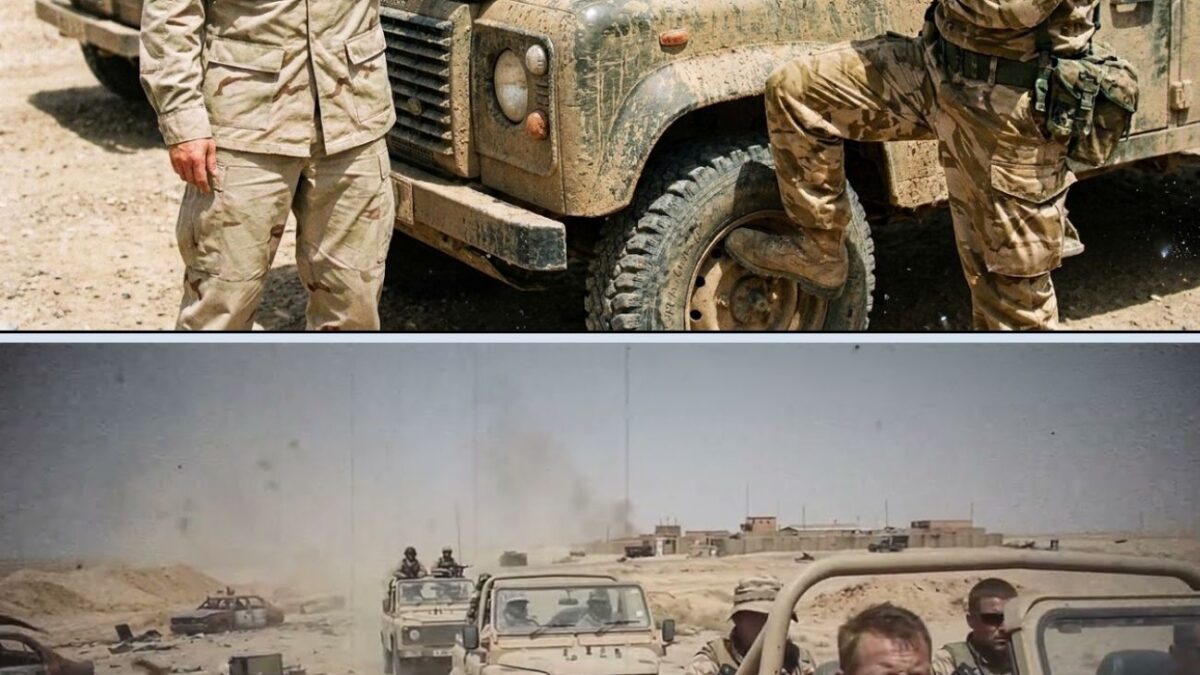
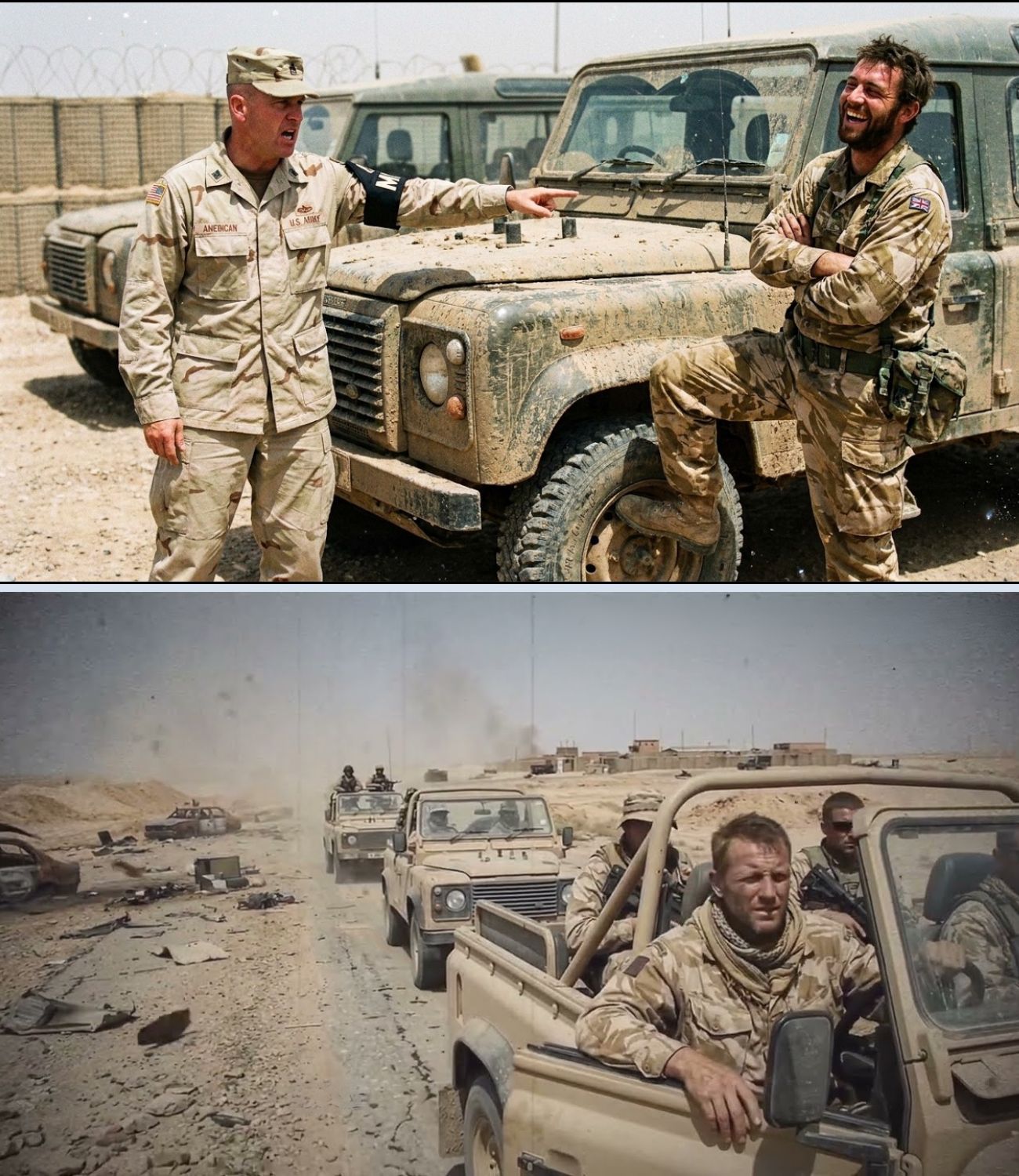
Lieutenant Colonel Marcus Webb had his hand on the hood as he said this. The dirt didn’t move. Like the man standing next to him. It was the last week of March 2003, FOB Raven, a coalition base in the western Iraqi desert near the Syrian border, 10 days after the ground invasion began.
Webb was 48 years old, a base security officer, and he personally took responsibility for every vehicle check at the gate that morning after a security bulletin went out overnight warning of a camouflaged vehicle attack on coalition positions elsewhere in the region. He wasn’t in the mood to let anything go without looking it over properly that morning.
At 06:40, three long-range patrol cars pulled up to his gate, a thick layer of dirt on every visible surface, no unit markings, no coalition identification panels, nothing to identify them as anything other than three battered trucks that had come from somewhere no one had given permission to enter. Webb himself stopped the car in front of him, walked the full length of it once, and delivered the ultimatum, still holding his hand on the hood, close enough to feel the residual heat of the engine through the layer of dried dirt.
Major Ian Pemberton, 39, stood by the open car door, 12 hours before a mission he had no intention of summarizing to check the base gate. He listened to Webb’s entire ultimatum without interrupting, and when it was over, he laughed, quietly and heartily, as did the 11 men behind him, seconds after they heard it themselves.
Webb didn’t think it was funny. He repeated the order, this time more flattering, and Pemberton gave him nothing in return except a short nod that might have meant agreement, or nothing at all. What Webb couldn’t have known, standing at the gate with his hand on the hood he had just threatened to leave parked indefinitely, was that the very thing he demanded had already been launched the moment those three cars crossed the wire strip again.
It just hasn’t happened yet, because Webb stopped them about 9 minutes before it was supposed to happen. The coalition ground invasion moved into Iraq on March 20, 2003. The bulk of the offensive moved north from Kuwait to Baghdad along the eastern and central axis of the country. The Western Desert fought a very different type of war.
There were few conventional forces and many small special operations groups whose work had nothing to do with the race to the capital, but was entirely tied to a patch of empty land that mattered for reasons the wider campaign rarely discussed publicly. This desert bordered Syria for hundreds of kilometers, an open, largely undefended terrain that regime loyalists and irregular fighters could theoretically use to move reinforcements, weapons, and fighters across the border faster than any conventional forces could intercept them. The abandonment of this route was the sole reason for the existence of the task force in the region.
Scattered small mobile patrols operated over an area too large for any single unit to cover completely, relying on speed, local knowledge gained over days, not months, and a willingness to move quickly toward anything that looked like it might threaten the corridor. 10 days after the invasion began, the corridor’s inner supply line, a stretch of desert road that the task force designated as the “Falcon Route,” itself became a target.
Abu Sattar’s cell, a loose group of 12-15 irregular fighters operating two armed pickup trucks equipped with light mortars and a heavy machine gun mounted on a hinged mount in the back of one truck, had attacked three separate supply convoys along the Falcon the previous week, quickly charging from a patch of rough terrain that overlooked the road and disappearing back into the countryside.
The task force patrols did not yet have a map detailed enough to predict where they would appear next. Each attack cost time, cost vehicles, and cost the broader effort the very assurance of supply that the task force, operating so far from its usual support, could not afford to continually lose. Fuel and ammunition were already so limited that a fourth successful strike risked forcing patrols to curtail operations rather than simply reroute around the problem.
Webb built 25 years of military service around exactly the kind of problem that three dirty unmarked vehicles presented at such a moment. He was drafted into the army in 1978, serving as an infantry lieutenant in the early 1980s before finally moving on to work in the military police. He perfected this specialty until the end of his career.
He served in the Gulf War in 1991, managing convoy security in a logistics brigade, coordinating checkpoints on supply lines, which taught him how quickly an unremarkable vehicle could turn into a serious problem if no one along the route bothered to take a closer look. Five years later, standing nearby when a truck bomb ripped through a residential compound in Saudi Arabia and killed 19 American airmen, several of whom he had shared a mess hall with just a few weeks earlier.
He spent the following weeks helping to rewrite the force protection protocols that the entire theater of operations had adopted over the months, protocols built around the very question that had brought him to Ravens Gate that morning. How can you quickly enough distinguish a vehicle that belongs in a certain area from a vehicle that is made to look like it belongs there? This question has never left him in all the years since then.
Over the next 7 years, tours of duty in the Balkans and two tours of duty in the United States to train military police units in force protection doctrine, Webb gained a reputation as an officer who took entrance security more seriously than almost anyone else in his rank. Not because he liked the friction it created with units that were uncomfortable with his standards, and there had been plenty of such friction over the years, but because he had personally experienced the consequences of what happened when the base’s own people decided that vehicle inspections were more of a nuisance than a discipline worth upholding without exception, every time, for every vehicle, no matter how routine the morning seemed.
The bulletin that arrived at FOB Raven that night did nothing to soften that instinct. A coalition position approximately 200 km to the east reported, just a few hours ago, an attempted attack using a vehicle disguised as a coalition vehicle; stopped short of its target, but close enough to remind every theater force protection officer of what was still possible after 10 days of war that had already created enough chaos on the roads: abandoned vehicles, scattered columns, entire units still searching for ground in unfamiliar terrain, making camouflage difficult for anyone determined enough to try.
Webb read the full report before dawn, personally briefed his staff at the gate at 5:00 PM, and shortly thereafter, standing in his operations tent, decided that he would inspect every machine himself that morning, rather than rely on the standard rotation to discover what the bulletin warned about.
What arrived at 6:40 a.m. at first glance fit the profile described in the bulletin exactly, accurately enough to matter. Vehicles that looked nothing like anything recorded in the base’s own logbook arrived without warning, without visible markings, without anything that would allow a weary sentry to see at a glance that they belonged to someone friendly, and had not been specially dressed up to appear friendly.
Webb could not have guessed in the 90 seconds it took him to walk the entire length of the lead vehicle that the men standing nearby belonged to a unit whose entire mission depended on looking exactly like the thing that worried him most. He knew only what 25 years of war and bombing, which had killed people he knew personally, had taught him to look for.
And what he was looking at, on paper and at first glance, was so consistent with that that laughing at it at that moment seemed to him the completely wrong reaction of anyone who sincerely understood what was really at stake for a base like this, at such an early stage in a war that had barely begun.
The mud webs that needed to be washed away and the missing markings he wanted to restore were not signs of neglect, nor were they, as his own training taught him 25 years later, evidence of a security threat waiting to be caught at the gate. They were the deliberate result of a decision Pemberton made before each patrol of his squad along the Falcon Highway, a deliberate response to the very threat posed by Abu Sattar’s camera and the problem the terrain itself had created during 10 days of continuous, grueling fighting.
By the last week of March, the desert around Falcon looked nothing like the empty land described on the task force’s own maps 3 weeks earlier, before the invasion crossed the border. Burnt-out cars stood abandoned along the roadside in half a dozen places. Debris from ambushes, breakdowns, and at least one confirmed airstrike was strewn across a landscape that had absorbed 10 days of war moving through it at high speed.
Civilian transport, the small amount that was still moving, rushed through this wreckage in vehicles as battered as anything the war itself had created. Families and traders moved around with what they could carry, instead of staying in one place. And the irregular fighters operating in this area learned over the same 10 days to monitor this road in search of precisely one target worth the risk of attack. Anything that looked organized, equipped, and valuable enough to justify its presence.
A clean vehicle, properly marked with coalition identification plates and visible unit insignia, was just such a target from any distance from which an observer on high ground could observe. The signal, which could be read at a glance, was supposedly: “Unmistakably, here is something worth risking a mortar shell and a quick retreat for.”
The vehicle, covered in the same dirt and dust as all the other wreckage along this stretch of road, devoid of any identifying markings that would otherwise indicate exactly what it was and what it was carrying, read instead as just another piece of the same battered landscape, unremarkable, not worth the risk.
The type of vehicle that the observer’s eye would pass without a second thought on the way to something that really looked important, just as it did with the three convoys that week that made the mistake of looking too well-groomed for the road they were traveling on.
Pemberton’s squad had been meticulously calculating every mission since the invasion began, taking down markers before setting off and allowing the vehicles to accumulate the same layer of dirt and dust that any heavy use in this area would naturally produce within hours, regardless of anyone’s specific intentions. This was not a deception designed to survive scrutiny. No one expected the disguise to withstand a vehicle stop by a patrol for a direct search. This was a calculated reduction in the chances of being seen as a target worth the risk. The same logic that kept a soldier’s head under the parapet, rather than simply relying on his helmet to stop anyone who came looking for him.
None of these disguises were to last longer than the mission actually required. The task force’s standard operating procedure, agreed months before the invasion and formally revised as recently as last week, required each patrol to restore full markings and clear identification panels as soon as it crossed coalition-controlled territory.
A process that usually took between 15 and 20 minutes, given the equipment that each machine had specifically for this purpose. Magnetic identification panels, a set of stencils, and enough water, taken specifically for this task, to wash the worst dirt off the panels themselves before reinstalling them.
The process began the moment the patrol decided it was safely back in friendly lines, not a minute earlier, because starting it too soon meant running the last dangerous stretch of road, looking exactly like the target the camouflage had spent hours trying to avoid.
Pemberton’s three vehicles returned to the FOB Raven perimeter at 06:31 AM. Webb stopped them at the gate at 06:40, 9 minutes before one magnetic panel was removed from where it had been traveling, carefully hidden in the back of each car. No one on Pemberton’s team found this gap unusual or worrisome.
That was how long the process was designed to take, and that was why Webb’s ultimatum, delivered in the middle of that normal 9-minute window, struck the men standing by those machines as something closer to comedy than confrontation.
Webb had no idea about any of this, not because the procedure was deliberately hidden from him, but because the protection of the forces at the gate and the tactics of troop mobility in the field belonged to two completely separate planning chains that had never before been allowed to intersect at FOB Raven. His own duties ended right at the wire, not extending to what the patrol deemed necessary for survival on the ground behind him.
Pemberton was 27 in February 1991, 2 years after his enlistment, and was the second man in a four-vehicle mobile patrol under Captain Reese Owen Smith that operated deep into western Iraq in the early days of the ground offensive, tasked with cutting off supply traffic along a network of secondary roads far behind the advanced Iraqi positions through which the main coalition offensive was still advancing.
Like every patrol on such missions that week, the four vehicles left their assembly area with their identification panels removed and their unit markings camouflaged, relying on distance, speed, and the chaos of the desert to ensure that no one watching from the ground could identify them as anything specific. Discipline that was instilled in each fighter before the operation began, but which had never yet been tested for the specific danger it would ultimately create.
The patrol spent 3 days in its assigned sector, staging a short, effective ambush on a supply convoy on the first night that destroyed two trucks and scattered the rest before an organized response could form, and the next two days moving between observation positions, gathering mission-critical intelligence, before returning to friendly lines on the fourth morning.
By the standards of that week’s operations in the wider theatre of operations, it was flawless, with no serious contact except for the initial ambush, no casualties, nothing that would make it into any published information about the war other than the regiment’s own internal records. A kind of quietly successful mission that didn’t bring any headlines or medals, but did exactly what it was sent to do, without attracting any external attention.
The return leg carried a separate danger, which the patrol understood in principle but had never personally tested. Coalition aircraft, which were constantly flying reconnaissance and strike sorties over the same stretch of desert that the patrol had to cross to reach friendly lines, had no reliable way to distinguish the camouflaged coalition patrol from Iraqi military equipment at any distance beyond the closest visual range, and the patrol’s own vehicles, still covered in dust and devoid of any markings that could identify them, looked exactly like the target those same aircraft were supposed to have assumed was hostile from 3,000 feet away.
At 09:40 on the morning of the fourth, approximately 11 km from the front line held by coalition ground units, the patrol’s radio operator, Private Malcolm Fenner, picked up a conversation on the coalition’s strike frequency describing an unidentified formation of four vehicles moving south through the same grid square that the patrol was currently occupying.
The formation with which the attack helicopter was rotating was cleared to attack pending final visual confirmation. Fenner passed the grid to Owen Smith within seconds of hearing it. Close enough to their own reported position that neither of them needed to check the map to know exactly what was being described.
Owen Smith ordered an immediate halt and ordered all the men to dismount and place visible identification panels on the roofs of their vehicles. The same panels that should have been in place since returning to friendly territory an hour ago, but had not yet been installed because the patrol, still moving quickly and technically still within disputed territory at the time of the return, did not consider the moment safe enough to slow down and do so.
The helicopter crew, working through their own targeting sequence with the four patrol vehicles already on target, confirmed the newly installed panels at the last possible moment before engaging in combat, punctuated by what the patrol’s own radio log later recorded as less than 90 seconds of margin between the initial targeting signal and what would have been an irreversible decision made by men who had every reason, based on what they could see, to believe they were doing exactly what their own orders required them to do.
No one on either side ever officially determined how close the margin actually was, because no one wanted that number to be recorded in a report that would then have to be explained to people who weren’t there.
But every man in Pemberton’s car understood, without need for double explanation, exactly what part of that morning had been decided by time, and not by anything that either party had actually done wrong.
An after-action reconstruction, conducted quietly within the squadron, rather than through any official investigation that might have attracted the attention neither side particularly wanted, identified the very breakaway that nearly claimed the lives of four men as an error in timing rather than prudence.
Owen Smith’s decision to keep the vehicles camouflaged early in the return leg was the right one, given how far they still were from confirmed friendly control when the return began that morning.
The reconstruction revealed the lack of any fixed trigger point, any specific line on the map or specific moment of return that would automatically require the re-establishment of markings, regardless of how the patrol commander felt about the tactical picture at the time, a decision left open at the very moment of the operation when the decision was most likely clouded by exhaustion, inertia and a simple, understandable desire to keep moving rather than stop and spend 15 minutes on administrative matters so close to the safety of friendly lines.
Pemberton, the second-youngest man in the vehicle that morning, said nothing about it to anyone above him at the time, not because he disagreed with Owen Smith’s handling of a truly difficult decision, but because he understood, even at 27, that criticizing a decision that really cost no one anything would sound like hindsight disguised as wisdom, rather than the fair observation it actually was.
Instead, he carried the lesson with him in secret, retelling it throughout the rest of the war and the years that followed, eventually reaching a conclusion far harsher than anything his own review of the squadron’s actions had recommended at the time.
That the impetus for restoring the insignia could never be left to the commander’s discretion at the moment, since discretion was the very resource that the reverse phase consumed most quickly, and that the only reliable solution was a fixed rule tied to a specific, unambiguous point. Crossing confirmed friendly-controlled territory was applied the same way every time, regardless of how safe the moment seemed to the person giving the order.
He first officially broached the idea in 1994, 3 years after Iraq, when he had enough rank in the regiment’s mobile troops to advocate for a permanent procedure, rather than just applying the lesson to his own patrols privately and hoping others learned it as bitterly as he had. It took two years of gradual implementation.
Resistance from a few experienced patrol commanders who trusted their own judgment rather than a fixed rule imposed from outside their own vehicle. Before this rule became standard practice in mobile squadrons, rather than a personal preference of one officer. Restoration of identification marks at the moment the patrol crossed the designated line of control of friendly forces. Without discretion.
There was no exception for the commander who believed the moment was still too dangerous to slow down, for Pemberton had learned exactly what such discretion, exercised by a truly competent officer, could cost in February 1991, when the margin was reduced to 90 seconds, for which no one had ever budgeted.
By the time he took command of his own mobile squadron years later, this rule had become so deeply ingrained in the way his troops operated that none of the 11 men who rode with him to the Braven rest area that March morning ever knew it was any different. Crossing the perimeter wire and starting the inspection process as an automatic reflex, not as a decision that someone had to consciously make.
12 years and one full-scale war after 90 seconds taught Pemberton exactly why. That reflex mattered more than anything a gate check could threaten to take away from him.
Pemberton’s detachment departed from the Raven Recreation Area at 05:10 on March 28. The three cars were already stripped of their identification marks and beginning to accumulate dust and dirt, which by the time they returned would make Webb’s ultimatum as absurd as it ultimately was.
12 men, three long-range patrol cars, tasked with finding what four previous reconnaissance efforts along the Falcon route had failed to pinpoint accurately enough for action. The exact position from which Abu Sattar’s cell launched its attacks and disappeared before any response could reach them in time.
Each of these four previous attempts came back with the same disappointing conclusion: activity confirmed somewhere within a broad swath of terrain, but never narrowed down to anything specific enough to plan an attack.
Available intelligence indicated that the cell was located somewhere within a 6-kilometer stretch of rugged terrain overlooking the midpoint of Sokila, an area that had been hinted at by previous attacks, timing, and angle of approach, but not confirmed by direct observation.
Pemberton divided his squad into two parts for the search: a northern one under his command and a southern one under Sergeant Grant Aldis. Each covered 3 km of suspicious territory on a parallel track running behind the main road, moving at the same leisurely pace as the scattered traffic, still using the Falcon itself. Another broken or battered car among the dozens already scattered across this stretch of desert, indistinguishable at any real distance from the wreckage that the war itself had already scattered across the same area over the previous 10 days.
By 11:00 AM, the search had yielded nothing but the same inconclusive terrain indicators that every previous patrol had already registered. A landscape of dry wadis and low hills that offered a dozen plausible firing positions, and no way to distinguish which of them, if any, the cell was actually using, rather than simply being able to use.
Radio communications between the two elements every 45 minutes confirmed nothing but constant negative coverage. The same result was repeated on six separate cartographic grids, for which neither Pemberton nor Aldis had yet found reason to give priority over any other.
Pemberton called a halt at 11:30 a.m. to give both elements a break during the worst of the midday heat. Vehicles pulled into whatever shade the terrain offered. A routine pause that had less to do with comfort than with simple tactical reality: moving during the smoothest, brightest hours of the day cost more in visibility risk than it brought in the distance traveled. The sun was so strong at that time that even briefly being outside the shadow of the vehicle made it really uncomfortable.
The break revealed details that were missing during the morning search. Patrolman Daniel Okafor, who was in charge of the rear guard position of the northern element and was not resting with the rest of the group, noticed a single vehicle trail crossing open terrain approximately 400 m from their resting position.
Fresh enough that the wind from the previous night had not yet worn away its edges. A detail that would mean nothing to anyone not specially trained to notice the difference between a two-year-old trail and one much fresher than the one leading to a shallow wadi that answered nothing in the 6-kilometer area that any element had already searched that morning, as it was just outside the boundaries defined by the initial reconnaissance assessment.
Close enough to the edge to be ruled out, and far enough inside the truth to explain why the four previous patrols had missed it entirely. Pemberton moved both units towards the wadi from separate approaches as soon as the heat began to subside after 3:00 p.m., closing the distance slowly enough to avoid raising dust that would spread across the open terrain and signal their approach before they got close enough to confirm anything.
Each car kept to the low ground that the terrain offered, rather than crossing directly the highest visible ridge lines. By 4:40 p.m., the northern section had taken up a position on high ground overlooking the northern edge of the wadi, close enough through field binoculars to confirm what four previous patrols had spent a week failing to find.
Two technical vehicles, both with mortars visible in their channels, were parked under camouflage netting stretched between the steep walls of the wadi, and about a dozen men were moving according to a routine that involved training, not rest, checking weapons, and moving boxes of ammunition between vehicles. The unmistakable rhythm of a cell that was preparing for another strike, not just waiting in the shadows until evening.
Pemberton recorded the position, number of vehicles, and weapons configuration without approaching his unit. Radioed a brief situation report to the southern unit, which was still closing in on him about 2 km to the west, and calmed down, waiting for complete darkness before doing anything more than observation. The 12 men, now perched above the target they had been searching for all day, and with no intention of losing it again through caution or impatience in the final hours before darkness, provided them with the cover the assault itself required.
Aldous’s southern unit reached its observation position on the opposite side of the wadi at 17:55, confirming the same location from a different angle and adding one detail that the North could not see: a third, smaller vehicle parked further in the shadow of the wadi, likely serving as its own means of resupply or reinforcement for the unit, rather than a third attack platform.
The two units held their positions for the last hour of daylight, watching the routine below turn into something closer to evening training. Fires were being lit in the depths of the wadi, a handful of men taking turns between what looked like sentry positions near the mouth, never rising high enough to spot anyone watching from above.
Neither Pemberton nor Aldous moved a single vehicle or person during this last hour. The entire troop froze in patient stillness as the light around them slowly faded and the wadi below settled into the special rhythm of men who believed, and rightly so for 11 days straight, that no one who watched them from afar had ever come close enough to matter.
Darkness descended over the wadi so slowly that Pemberton could watch the last visible edges of the terrain disappear one by one. By the time the last streak of light had disappeared from the western horizon, both elements had already moved from observation to preparation, without uttering a word more than a whisper.
North will descend from the northern edge and secure the cell in place. Aldous would lead the south from the opposite side, cutting off the only practical way out of the wadi before Abu Sattar’s men realized anyone was close enough to matter. The plan relied on the same thing that had allowed them to get this far unnoticed.
The three cars parked above the wadi didn’t look important enough to attract attention. Covered in dust, devoid of markings, and situated amidst land already littered with abandoned cars and debris, they spent the last hour of daylight as part of the landscape, not as an obvious coalition patrol. No sentinel below rose high enough to dispute this assumption.
At 19:38 Pemberton gave the signal. North moved first on foot, four men descending through a narrow gap in the slope, while the remaining two held their ground higher, keeping a direct line of sight into the wadi. Pemberton kept the technicians in sight throughout the descent. One sat under camouflage netting, with a light mortar tube still mounted on the rear.
The second, further east, carried a heavy machine gun, the presence of which Aldous confirmed from the opposite side. The third, smaller one, remained deeper in the shadows, its engine cold. For the first 200 m, nothing changed below. Then one of the sentries at the mouth of the wadi stood up. Pemberton froze in the elements, clenching his fist.
The men remained motionless for several seconds, looking not to the North but to the open country behind them, apparently distracted by the noise beyond the wadi. He returned, spoke to someone by the nearest fire, and sat down again. The patrol continued moving. A few minutes later, the South reported its position with a single coded click on the radio.
Aldis reached the western retreat line without warning anyone. The cell was now locked, although none of the men below knew it yet. Pemberton waited for two more of Abu Sattar’s men to approach the technicians. The action plan downstairs changed from evening to preparation. They opened boxes of ammunition. One man climbed into the car with a machine gun, another took out a mortar shell from under the net.
Whatever attack they intended to launch next was already beginning to take shape. This eliminated the last reason for waiting. Pemberton gave the signal for the assault.
The first seconds were quick and deliberately focused. The North took up armed positions around the two technicians, while the South struck from the opposite side, forcing the camera to react in two directions simultaneously.
The sentry at the mouth of the wadi was thrown back before he could reach the smaller vehicle. The man in the machine gun outfit never aimed his weapon at the approaching group. Within minutes, both assault vehicles were neutralized on the spot. The surprise lasted longer than Pemberton expected. Abu Sattar’s men spent several days choosing a position that would protect them from observation along the Falcon Route and give them several concealed approaches for their own attacks.
They did not set up a position to defend against the forces that were already inside these approaches. The men, who had rehearsed a rapid retreat to the western end of the wadi, discovered that Aldous’s group was already there. Others attempted to move east and encountered blocking fire from North from above. Pemberton saw a figure emerge from the central shelter and head toward the smaller vehicle.
He matched the description they had been given of Abu Sattar: medium height, thick beard, dark jacket over traditional clothing, moving with the confidence of a man who expects others to follow him. Two men got engaged. The car wouldn’t start. Whether the engine was already unreliable or the driver was simply in too much of a hurry, Pemberton never knew.
The starter spun once, then again, loud enough in the tight space to make it clear where the group was trying to escape from. Aldis headed south, in the direction of the sound. That’s when the battle ended as a mobile threat. With both of their assets destroyed, the western exit closed, and the smaller vehicle rendered unusable, the cell had nowhere to move and no way to recreate the hit-and-run pattern that had initially made it so difficult to catch.
The resistance collapsed piecemeal, not immediately. Short volleys from isolated positions, followed by silence as each was cleared or abandoned. Pemberton only crossed the wadi after both elements had reported the security of their sectors. The nearest technical system was still under the remnants of camouflage netting. One rear wheel was destroyed, and the mortar installation was damaged to the point that it could not be used immediately.
The second stood at an angle to the wadi wall. Heavy weapons were no longer operational. Ammunition crates, spare fuel, maps, food, and the usual clutter of a semi-permanent fighting position were scattered around the shelters. Aldis met him at the smaller car and said, “There she is,” pointing to the man detained near the back.
Pemberton compared the face to a photo that was in the patrol briefing packet. “Abu Sattar”. For 11 days, the cell managed to attack the Falcon Highway and disappear before coalition forces could pinpoint its location accurately enough to respond. Now the position, the vehicles, and the commander responsible for these attacks were all in one place, because the patrol had reached the wadi without announcing what it was.
Pemberton looked back at the ridge, where their own unrecognized vehicles remained almost invisible against the ruined landscape. These cars would look wrong at the gates of Raven Base. Here they looked absolutely right. The squad reached the Raven base, and all three vehicles still had the same dust, dirt, and shabby appearance that had helped them disappear onto the Falcon track.
Webb was back at the gate when the first car drove by, still working under the heavy security that had kept him there since the warning of a disguised vehicle attack had gone out the previous night. He recognized Pemberton immediately, and for a moment the two men simply exchanged glances over the hood of the lead patrol car.
This time Webb didn’t stop them. The patrol moved straight into the designated car zone, and the sequence that Pemberton’s men had observed for years began without the need for orders. Identification panels appeared. Closed designations have been restored. Dirt and dust were cleaned from areas where identification would be visible.
What looked like neglect at the gate began to transform into an unmistakably coalition vehicle within minutes of arrival. Webb watched the process from a distance of several meters. The irony was hard to miss. Everything he had demanded that morning was already happening. Not because he was pushing the issue, but because Pemberton’s squad had returned to controlled territory and initiated a procedure that had existed long before Webb had ever seen these vehicles.
The full report reached him later. Abu Sattar’s position was confirmed along the Falcon Route. The squad approached without attracting attention, hit the camera before it could move, destroyed both pieces of equipment, and eliminated the immediate threat to the supply route. In the following weeks, the hit-and-run attack pattern that had consumed the task force’s time and security did not return.
Webb wasn’t most interested in the attack itself. Explanation related to vehicles. Their unrecognizable, dirty appearance was never intended to continue inside the base. It belonged on the enemy side of the border, where an organized, clean appearance and a clearly unified force could make a vehicle stand out against a landscape already littered with abandoned and damaged equipment.
Once the patrol returned to friendly control, the logic changed. The same camouflage that reduced risk externally could increase it internally, which is why Pemberton’s own rule demanded immediate attention. Webb found Pemberton near the parking lot after the last identification plate was restored. He looked at the three vehicles, then back at the major, and asked, “So you cleaned them?”
Pemberton nodded wearily and replied, “We always do that, sir.”
Webb glanced again at the vehicles, now marked clearly enough that no sentry, plane crew, or nervous gate guard could mistake what they were. There was nothing more to argue about. Webb was right about the danger. Pemberton was right about the timing. And the system between these two truths had already been built years before either of them met at the gate.
You Might Also Enjoy

“We Thought They Would Negotiate”—What Argentine Soldiers Said When The British Attacked Goose Green

“You’ll Never Finish My Ruck March, Limey” — US Sergeant Who Challenged the SAS, Then Fell Out First






