COTSWOLDS OWNER Changes Door Code & Kicks HARRY & MEGHAN Out After Friend Sides With WILLIAM
THE ULTIMATE LOCKOUT: Inside Princess Anne and Prince William’s Midnight Palace Showdown That Permanently Shattered Harry and Meghan’s Royal Endgame
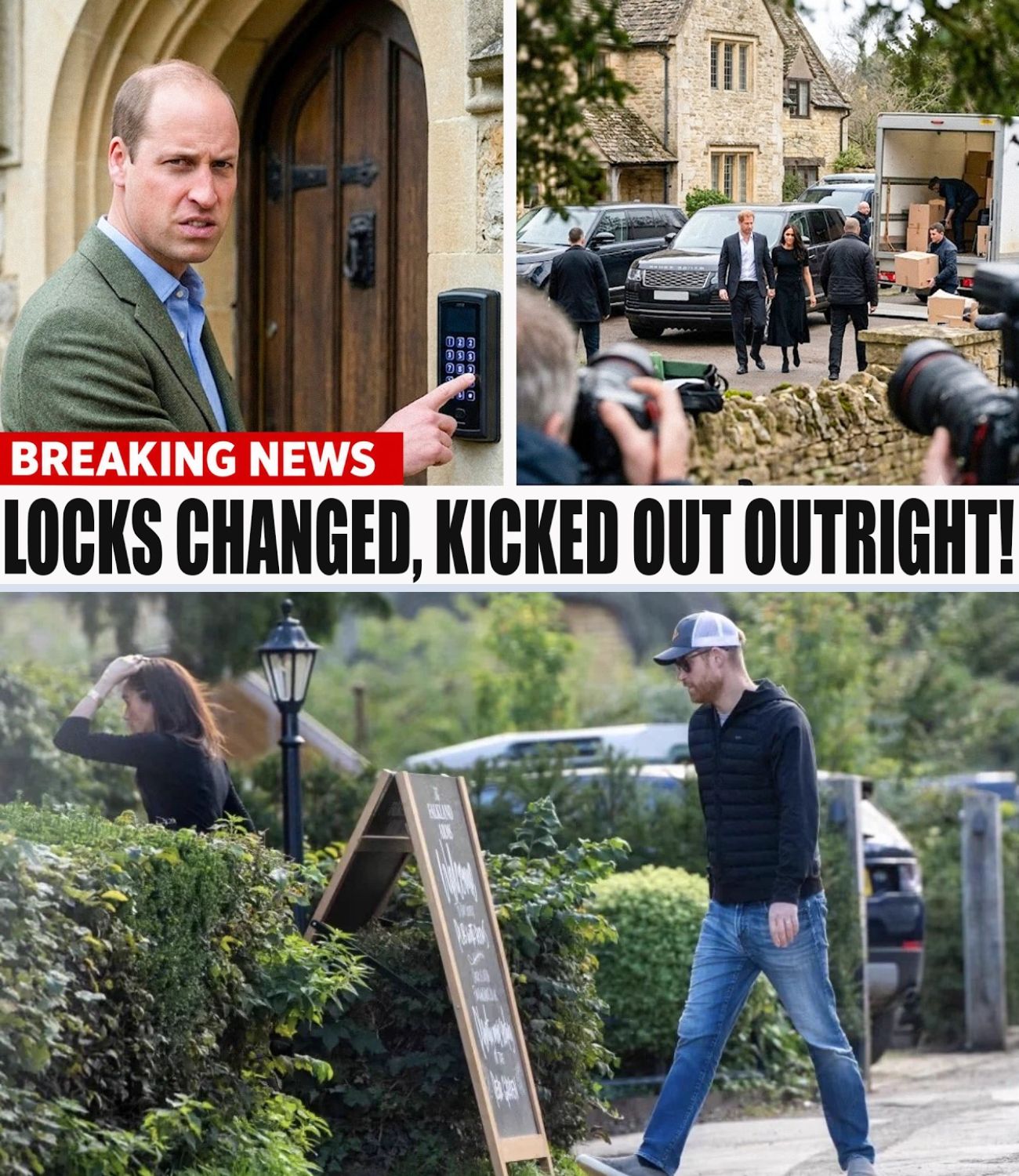
The Cotswolds Revolt: When Hollywood Met the English Countryside
There is an unwritten law governing the rolling, emerald hills of the Cotswolds: wealth buys privacy, and discretion is the absolute currency of the realm. It is a tranquil sanctuary favoured by retired judges, senior barristers, old-money aristocracy, and high-profile figures who pay small fortunes precisely so they can walk their dogs, dine in country pubs, and send their children to local schools without a whisper of public interference. When Prince Harry and Meghan Markle quietly secured a lease on a sprawling 83-acre private estate in the region, they apparently laboured under the delusion that they were stepping into an idyllic pastoral playground where they could host international celebrities, shoot high-end lifestyle content, and project an aura of effortless British nobility.
Instead, their tenure in the Cotswolds descended into a localized civil war that ended with commercial removal vans rumbling down narrow rural lanes under heavy black tarpaulins and village residents celebrating their departure. Within forty-eight hours of taking up residence, the Sussexes transformed a peaceful community into an armed fortress. Heavy-duty sports utility vehicles began barrelling down single-track country lanes where children rode ponies. Private bodyguards—hired muscle accustomed to the aggressive choreography of Los Angeles—clashed with local dog walkers, shined high-powered flashlights into private cottage gardens, and blocked historic public bridleways.
The parish council was inundated with furious complaints from homeowners whose daily lives were upended by the constant security circus. Matters reached a boiling point when legal representatives for the estate owners found themselves facing coordinated threats of multi-thousand-pound lawsuits over planning violations and public nuisance bylaws. The landowner, who had initially extended a private tenancy, was issued a blunt, uncompromised ultimatum by the community: get the Sussexes off the property immediately, or prepare for years of financially catastrophic litigation in county court.
With their lease unceremoniously terminated and a strict thirty-day notice to vacate slapped on their front door, the couple found themselves staring into an abyss. No commercial landlord in southern England was willing to touch them, burdened as they were by impossible security liabilities, unpaid local council fees, and a reputation for treating private homes like entitled royal hotels. But the true tragedy of this chaotic rural eviction did not fall upon the adults who manufactured the crisis; it fell squarely upon their two young children.
The School Gate Heartbreak and the Ellen Ambush
For five-year-old Prince Archie and three-year-old Princess Lilibet, the sudden collapse of the Cotswolds arrangement triggered a heartbreaking upheaval. According to shaken staff members at their Oxfordshire prep school, the children were pushed into their third school transfer in less than thirty consecutive days—a staggering level of instability for toddlers navigating formative years.
Witnesses at the school gates described a devastating scene as the final morning arrived. Little Archie, who had finally begun settling into a routine of painting airplanes with classmates, gripped the wooden playground fence with both white-knuckled hands, sobbing uncontrollably as a private nanny attempted to collect his belongings. He begged not to be pulled away from his new friends, while Lilibet sat quietly on the gravel path near the administrative office, bewildered by the constant packing and moving. Bundled back into tinted-window SUVs, the children were whisked away toward a sterile, temporary corporate rental in central London, stripped of green lawns, open classrooms, and neighborhood stability.
Desperate to salvage their crumbling British footprint, Meghan reportedly attempted a high-stakes social pivot that backfired spectacularly. Observing that comedian Ellen DeGeneres and her wife, Portia de Rossi, had also relocated to the Oxfordshire countryside to escape the Hollywood circus, Meghan seemingly viewed the fellow expatriates not as private neighbours seeking peace, but as a golden commercial lifeline.
Eyewitnesses at the historic Three Horseshoes pub in the tiny hamlet of Asthall watched in stunned silence as Meghan and her security detail cornered Ellen during a quiet afternoon lunch. Not only did Meghan push for neighborly camaraderie, but she reportedly floated an audacious business pitch: leasing a private wing of Ellen’s compound to serve as a dual residence and active production studio, complete with requests to borrow Ellen’s private vehicle fleet to bypass local transport costs.
According to patrons inside the pub, Ellen’s reaction was one of unvarnished, icy disgust. Keeping her body angled completely away and offering monosyllabic, freezing responses, the comedian made it unmistakably clear that the answer was an absolute, non-negotiable no. Within twenty minutes of the ambush, freelance photographers conveniently materialized outside the pub windows, capturing the cringeworthy encounter. The local community took one look at the resulting headlines and recognized it for what it was: proof that the Sussexes brought nothing wherever they went except manufactured chaos.
The Emergency Letter to Windsor Castle
With their British operations in freefall, their California bank accounts draining rapidly under the weight of astronomical security and legal overheads, and binding commercial production contracts requiring their physical presence in the UK, Harry and Meghan realized they were legally and financially trapped. Every door in British high society had slammed shut. No friends would host them; no landlords would lease to them.
Running out of options, Harry reached instinctively for the ultimate royal panic button.
An emergency courier dispatched a leather-bound folio directly to the private secretary’s office at Windsor Castle, addressed in high-stakes urgency to King Charles. Inside the package was a formal, calculated proposal that royal insiders quickly dubbed the “private apology maneuver.” Wrapped in the language of familial reconciliation, the document was actually an aggressive, four-point tactical shakedown:
Crown Sanctuary: Immediate allocation of a gated, fortified royal property within an existing security perimeter—specifically demanding either a private apartment inside Kensington Palace or temporary residence at Royal Lodge in Windsor Great Park.
State Police Intervention: An explicit demand that King Charles personally intervene with the Home Secretary to overturn previous security rulings and reinstate taxpayer-funded, elite Metropolitan Police armed protection for the family.
Educational Fast-Track: An order for the Crown Estate’s educational liaison to bypass standard waiting lists and secure immediate private school placements for Archie and Lilibet without local security reviews.
The Concession: In exchange for tens of millions of pounds worth of state assets, Harry offered to whisper a private, unrecorded apology behind closed doors to William and Charles, alongside a temporary pause on media interviews while physically present in Britain.
To ensure the king felt maximum emotional leverage, the package included several glossy, unvarnished photographs of Archie and Lilibet sitting alone on classroom chairs with tear-stained cheeks. A handwritten note scrawled by Harry implored his father: “My children are suffering because of decisions they never made. Look at their faces, Papa, and tell them they do not belong in your home.”
Harry was banking on the profound grandfatherly guilt of a monarch undergoing grueling cancer treatments. He calculated that the sight of weeping grandchildren would cause the king to break down, overrule government protocols, and hand over the keys to a palace property just to stop the domestic bleeding.
He entirely failed to account for who was standing in the room when that dispatch arrived.
The Windsor Castle Showdown and the Red Dispatch Box
The scene inside the high-ceilinged Oak Drawing Room at Windsor Castle was suffocatingly tense. King Charles had barely finished reading the letter and gazing upon the photographs when the heavy oak doors swung open. Prince William, Princess Anne, and Prince Edward stepped inside with the unyielding resolve of a military tribunal.
Before the sovereign could express paternal sympathy, Princess Anne stepped forward, snatched Harry’s letter from the mahogany table, and tossed it aside with surgical precision. Looking directly at her brother, she delivered a verdict that left the room in stunned silence: “Over one million copies of Spare were sold across the globe, accusing this family of racism, cruelty, and violence. You do not get to slander the crown in thirty languages for thirty million dollars and then whisper an apology behind a closed curtain simply because you cannot find a landlord in Oxfordshire.”
It was Prince William, however, who delivered the definitive blow. Moving calmly to the center of the table, the Prince of Wales set down an official red leather government dispatch box containing unredacted archival records dating back to October 2018. For years, the world had accepted Harry’s sensationalized version of the infamous “Nottingham Cottage kitchen fight” as detailed in his memoir—the narrative that William had flown into an unprovoked rage over Meghan’s personality, grabbed him by the collar, ripped his necklace, and shoved him onto a dog bowl.
The official documentation in William’s red box completely dismantled that fabrication. Contemporaneous internal memos submitted by former communications secretary Jason Knauf revealed that William had visited the cottage carrying a formal written dossier detailing severe, systematic bullying and psychological abuse directed at three junior female palace staffers. Those young women had broken down in tears at their desks, terrified of coming to work. When William confronted Harry with witness statements and urged him to protect the staff, Harry erupted, screamed in defense of his wife, and physically lunged at his older brother first. William had merely pushed him back in a defensive reflex, causing Harry to lose his footing.
Furthermore, William laid out documented proof regarding other historical falsehoods: how Meghan had made Catherine, Princess of Wales, cry over Princess Charlotte’s ill-fitting bridesmaid dress mere weeks after Catherine gave birth to Prince Louis—only to flip the narrative on American television—and how Harry had attempted to blame William and Kate for his infamous 2005 Nazi costume scandal, even though contemporaneous shop records proved Harry had chosen the outfit entirely by himself in Brook Green.
William looked across the table at his ailing father and delivered an unmistakable ultimatum. If the king chose to overrule institutional protocol, grant Harry crown property, or reinstate police protection, the Prince and Princess of Wales would immediately step back from all public royal duties for the remainder of the reign.
Prince Edward reinforced the stance with administrative precision, confirming that zero vacant residential properties existed across the Crown Estate that could accommodate the Sussexes’ security footprint without evicting active working staff. Princess Anne delivered the final legalistic consensus: the royal family was an arm of state service, not an emergency concierge service for celebrity expatriates.
The council was entirely unanimous. The door was bolted from the inside.
The Administrative Masterstroke and Catherine’s Grace
Predictably, the moment the Windsor summit concluded, a synchronized wave of commentary flooded the British press. Self-righteous pundits and partisan commentators began lecturing Prince William on Christian duty, urging him to forgive his brother and play happy families for the cameras.
The future king did not issue defensive press statements. Instead, the response was delivered through a dual masterclass of personal serenity and ruthless administrative precision.
While the media storm raged, Catherine stepped out into public view for a scheduled community engagement in Berkshire. Looking radiant, poised, and entirely centred, she carried out her duties with absolute professional calm. Her public composure sent a silent, powerful message: our lives, our work, and our family are moving forward, and manufactured chaos will not disrupt our peace.
Concurrently, the palace released a dry, clinical administrative circular regarding the long-term management of Crown Estate residential properties. The statement formally prioritized residential leases exclusively for individuals performing active official constitutional service to the crown. Not a single mention was made of the Duke and Duchess of Sussex. By tying Harry’s residential status directly to the precedent established with Prince Andrew at Royal Lodge, the palace ensured that royal blood conferred no domestic immunity, no taxpayer-funded housing, and no special dispensations.
The Final Seal: The Lord Chamberlain’s Dispatch
Realizing that the emotional blackmail had utterly failed, the Sussex public relations machine attempted to spin their Cotswolds eviction as a voluntary relocation closer to London for professional reasons. Local residents, however, quickly shattered the illusion on regional community forums, confirming the noise complaints, the pub confrontations, and the frantic midnight packing.
The final, definitive nail in the coffin arrived via a formal black leather folder delivered by a liveried royal courier to Harry’s temporary rental in central London. Issued directly from the Lord Chamberlain’s office, the document addressed Harry with cold, clinical precision as a private citizen residing abroad.
It dismantled every single demand point-by-point:
Housing: Formally confirmed that zero properties within the Crown Estate or private royal portfolio would ever be made available to them.
Security: Stated unequivocally that the sovereign holds zero constitutional remit to interfere with independent Home Office risk assessments.
Education: Rebuffed attempts to influence private school admissions, noting that royal influence cannot bypass institutional standards.
The document closed with the finality of a Supreme Court ruling. Less than twenty-four hours later, a lone photographer captured Prince Harry walking through a subterranean parking garage beneath a commercial office building in central London. There were no police outriders, no flashing lights, and no Scotland Yard detail—just two hired private contractors trailing an exhausted, visibly aged prince clutching a dark leather folder to his chest.
The illusion of the half-in, half-out era is dead. The gates of Windsor Castle are locked, bolted, and sealed for eternity, reminding the world that an ancient institution survives not by bending to celebrity noise, but by standing firm on duty, discipline, and uncompromising constitutional integrity.
You Might Also Enjoy

“We Thought They Would Negotiate”—What Argentine Soldiers Said When The British Attacked Goose Green

“You’ll Never Finish My Ruck March, Limey” — US Sergeant Who Challenged the SAS, Then Fell Out First






