Diana Took William and Harry Aboard Al-Fayed’s Yacht in July — What Happened Was Never Told
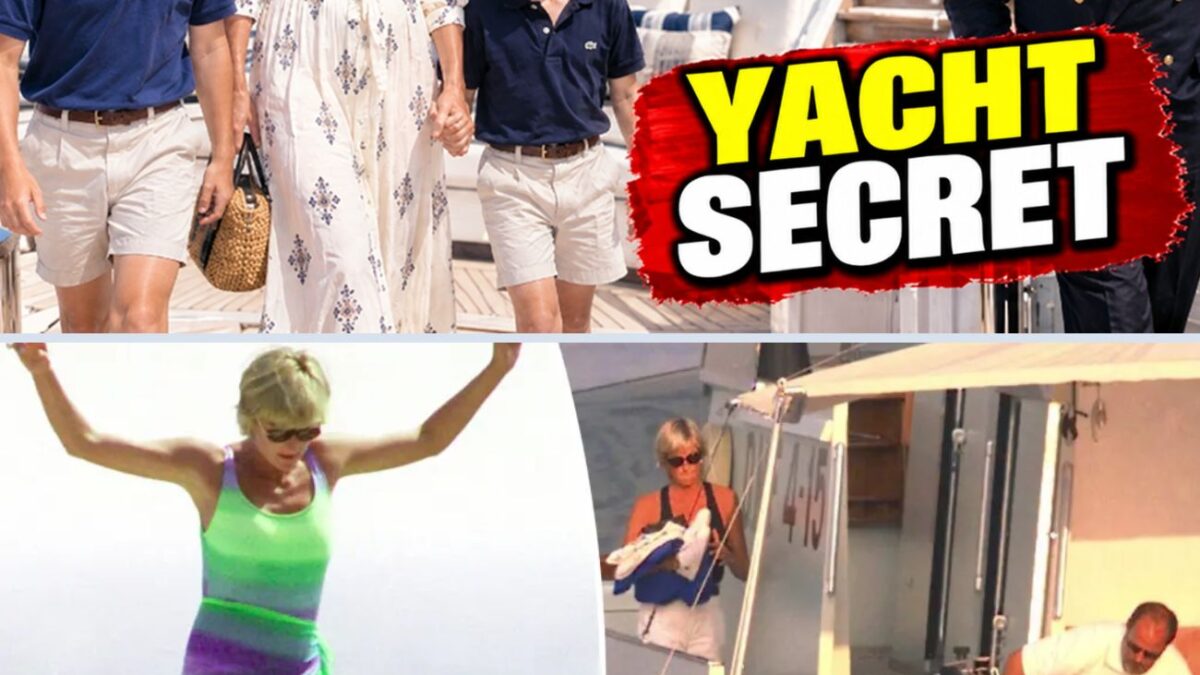
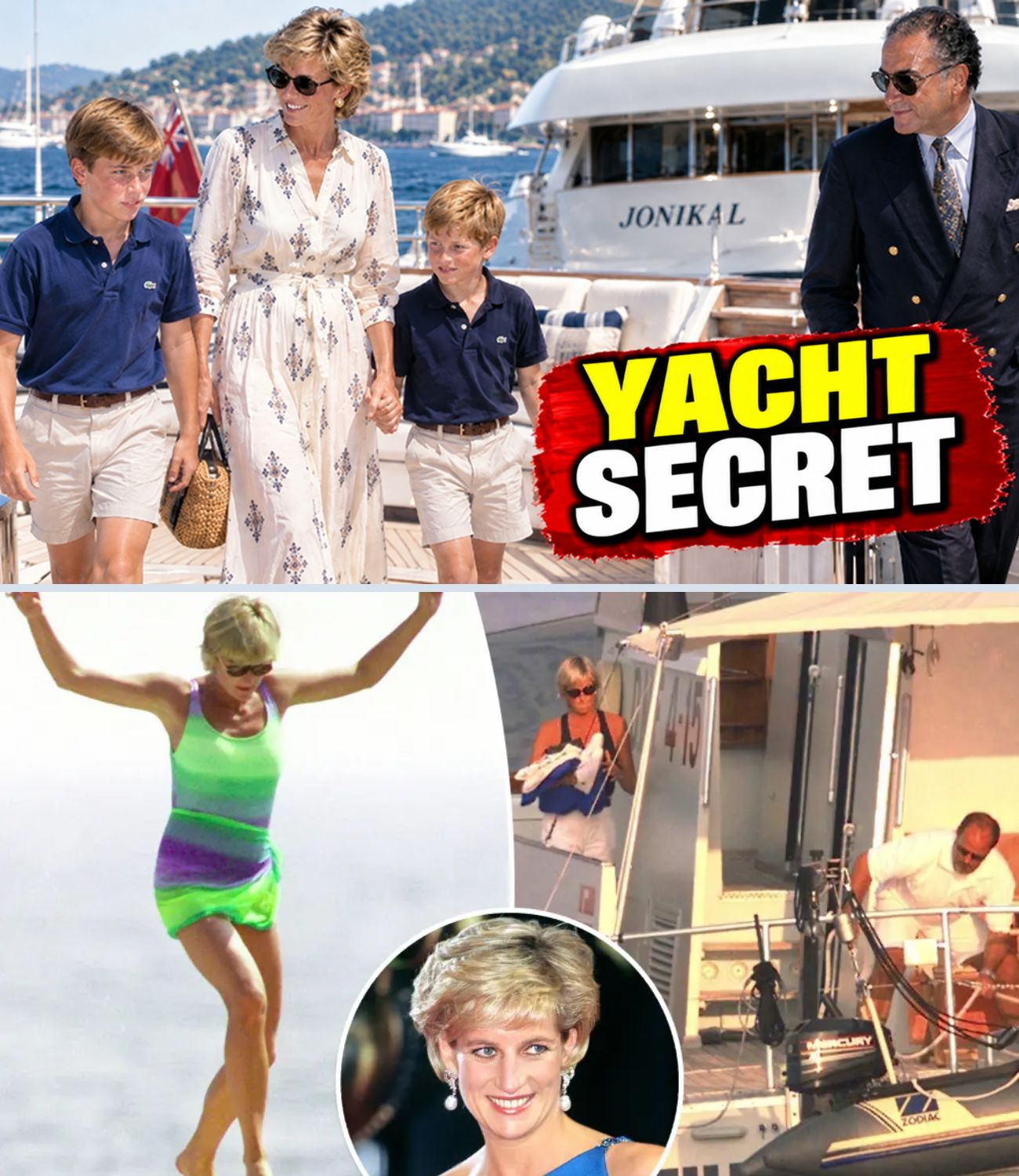
On July 14, 1997, a motorboat became detached from a huge yacht anchored off Saint-Tropez. She was heading straight for a group of journalists who had been watching from the water for days. The photographers couldn’t believe what they were seeing. The woman sitting in that boat was Diana, Princess of Wales.
She approached them, looked at them, and according to the reporters themselves, told them something that no one would forget: “That they were very soon going to be in for a big surprise with what she did next.” That same day, a man arrived at the yacht. His name was Dodi Al-Fayed. Seven weeks later, both would be dead.
But this story doesn’t begin with Dodi, and it doesn’t begin in Paris either. It begins three days earlier with two boys, aged 15 and 12, jumping into the water from the deck. William and Harry were on that yacht. They were there from day one, and what they experienced that week is the part of the summer of 1997 that almost no one talks about.
Today you’re going to find out why a millionaire bought a luxury yacht in a matter of days just to receive them, what Prince Charles was celebrating in England while photos of Diana filled the front pages, and what was the last phone call that Harry could never forgive himself for.
To understand why Diana said yes to that trip, you have to look at where her life was at that time. On August 28, 1996, her divorce from Prince Charles became final. With it, she lost the title of Her Royal Highness, though she remained Princess of Wales. She was still living in Kensington Palace, and she remained the most photographed woman on the planet, but the royal machinery that once surrounded her was gone. She no longer had the same official protection or the same shield. She had more freedom than ever before, and at the same time she was more exposed than ever before.
And in that new phase, Diana began to clear out her past. In June 1997 in New York, Christie’s auction house sold 79 of her dresses—dresses that the world had seen at state dinners, galas, and on magazine covers. The auction raised more than three million dollars for charities, and the idea, as has been recounted many times, did not come from an adviser or a banker, but from William.
Her son suggested to her that those dresses, symbols of her former life, could be used to help others. Think about it for a moment. A 15-year-old boy tells his mother to let go of the past, and she listens to him. On July 1st, Diana turned 36. That night she attended a gala at the Tate Gallery in London.
She smiled for the cameras as always, but those close to her knew that inside she was exhausted. Her relationship with Pakistani surgeon Hasnat Khan, the man many friends considered her great love of those years, was fading away. He was reserved and hated being in the spotlight. She couldn’t stand the idea of living under the camera flashes, and Diana was beginning to understand that she might never be able to offer her a quiet life.
She was tired of every relationship being interpreted and judged, tired of a simple trip becoming world news before she had even unpacked her suitcase. And right at that moment an invitation arrived. Mohamed Al-Fayed was not an unknown figure; he was the owner of Harrods and the Hôtel Ritz Paris, but there was something more. Mohamed had ties to Diana’s own family.
He had been a friend of her father, Earl Spencer, and Raine Spencer, Diana’s stepmother, was on the board of Harrods International. For Diana, Mohamed was not a stranger; he was a familiar figure, almost like part of the extended family. The proposal was simple: spend a few days in the south of France, at his villa in Saint-Tropez, with his children, with private security, with the sea and with space, far from London, far from the palace walls.
Diana accepted in mid-June, and what Mohamed did next says a lot about him. As was later reported, shortly after receiving Diana’s yes, Mohamed bought a yacht—not just any yacht, but one 60 metres long, with luxury cabins and a full crew. It was called the Jonikal and it was said to have cost around £15 million. According to the same reports, he acquired it precisely with those holidays in mind.
Why would anyone do something like that? To understand it, one must know about a wound that Mohamed had been carrying for years. He had bought Harrods, the temple of British luxury. He had bought the Ritz. He had surrounded himself with all the symbols of prestige. And yet, in 1995, the British government denied him citizenship.
The aristocracy never fully accepted him. For many, he was still an intruder. Welcoming the Princess of Wales and the two sons of the future king into his home was not just hospitality; it was the door that England had never opened to him. Diana knew it. She knew what the Al-Fayed surname meant and she knew that any closeness would be observed, but she weighed both things on the scale. On one side, controversy; on the other, her children, and she chose her children.
On July 11, 1997, Diana arrived in Saint-Tropez with William and Harry. They stayed at a place called Castel Saint-Térèse, on the coast with gardens, a swimming pool, and private access to the sea. There they were met by Mohamed, his wife Heini, a former Finnish model, and the couple’s young children.
The house was full of noise, children, and long meals. And for a few days something happened that had almost never happened to that family: nobody gave them a schedule. In Windsor, every meal had its protocol. In Balmoral, every walk had its order. In Kensington, every gate had a guard. In Saint-Tropez, William and Harry could ride jet skis, run around the deck, jump into the sea, and return soaking wet to the table.
People in swimsuits, music at night, boats coming and going. For two boys who had grown up among uniforms and balconies, that was an adventure. For Diana it was something even stranger: the possibility of watching her children laugh without anyone orchestrating the scene. Years later, Harry would remember that place as paradise.
And this wasn’t said by an adult evaluating a trip. It was remembered by a 12-year-old boy whom nobody treated like a prince, but rather like a child on vacation. This was not by chance. Diana had spent years trying to give her children a childhood outside the walls. She had taken them to visit homeless shelters in London like The Passage.
She had taken them to hospitals. She wanted them to know that the real world existed beyond the palaces, and she also wanted them to know how to have fun like any other kid—amusement parks, hamburgers, queues like everyone else. Saint-Tropez was another version of the same thing, a few days where they could be teenagers, not future headliners.
But the calm lasted exactly three days because the photographers had already found the yacht from the shore with telephoto lenses, and from the water in rented boats. Every time Diana went out covered up, someone shot. Every time the boys jumped into the water, someone fired a shot. The sea gave her distance, but it didn’t make her invisible.
And that brings us back to that boat on July 14th. Diana did not approach the journalists to pose for photos. According to reporters present, she spoke about her children. She said that William was having a hard time with so much pressure, and that her children were urging her to move away from England. And then she uttered that phrase that for years has been read in a thousand ways: “That very soon they were going to be in for a big surprise with what she did next.”
She never explained what she meant. Some thought she was talking about a new love, others about moving abroad, others about her humanitarian work. The truth is that nobody knows and she never had time to clarify it. But that same day, while the phrase was travelling to newsrooms around the world, someone was getting on board the Jonikal.
Dodi Al-Fayed was 42 years old. He was Mohamed’s eldest son from his first marriage. He had worked in film as a producer; his name was linked to Chariots of Fire, the film that won the Oscar for Best Picture, and Hook by Steven Spielberg. He lived between London, Paris, and Los Angeles, surrounded by luxury, cars, and famous people.
But those who knew him described a different man: a kind, generous, somewhat shy man, sometimes indecisive and marked by the shadow of a domineering father whose fortune could open any door for him, but not give him a place of his own. Diana and Dodi had crossed paths before at social events, but meeting at a reception is not the same as living together on a boat. In the Mediterranean, far from London and with the boys around, Diana saw him in a different environment.
And here appears a detail that many biographers have mentioned. When Dodi arrived in Saint-Tropez, he didn’t arrive alone; he was in a relationship with an American model, Kelly Fisher. She would tell her side later in a tearful press conference, revealing that Dodi had promised to marry her and that during those days she was close by on another family boat while he spent his time on the Jonikal.
Dodi never publicly responded to those accusations, but the detail reveals something important: nothing that summer was as simple as the headlines wanted people to believe. What we do know is how Dodi behaved. He organised disco nights for them, with music, lights, and fun. The press later reported it as a millionaire’s extravagance, but for William and Harry it was probably just that—a holiday night that no palace bodyguard would have allowed them.
And while the boys were dancing in the south of France, something else was happening in England. On July 18, 1997, Prince Charles celebrated Camilla Parker Bowles’s 50th birthday at Highgrove, his country residence. It was a huge step for him, a way of gradually introducing Camilla to British society.
But during those same days the front pages weren’t talking about Camilla; they were talking about Diana. Diana in a swimsuit on the deck of the Jonikal. Diana laughing in the Mediterranean. Diana free under the sun. Was it a coincidence? Was this something Diana sought out? Biographers still debate it. What is certain is that the image the world remembered from that week was not the Highgrove party, but the yacht deck.
And here lies the great contradiction of her life. Diana knew better than anyone the power of a photograph. Since she began dating Charles when she was 19, she had lived with one goal in mind. She had learned that the press could be her best ally in focusing attention on a cause, and her worst enemy when it approached her private life.
She could use a camera to help landmine victims, but she couldn’t turn it off when she wanted to be alone with her children. That’s why Dodi entered a story that was already loaded. He wasn’t just a man getting on a boat; he was someone who appeared next to the most watched woman in the world—a woman legally free, but without real freedom from the media.
And while all that was happening, William and Harry were still there, in the most vulnerable place of all: that of two sons who just wanted their mother to be okay. There were moments of true lightness, and the photos show it. Diana smiles. The boys are near her. A single image doesn’t explain an entire week, but it does remind us of something we sometimes forget: happiness doesn’t become a lie just because the story ends in tragedy. A person can be happy one day and vulnerable the next; both things are true.
On July 20, Diana and her sons returned to London. The holidays ended sooner than anyone expected, and not because of Dodi. Five days earlier, on July 15, in Miami, designer Gianni Versace had been shot dead at the door of his home. Diana found out while she was on the trip. Versace was not just a designer to her; he was a friend, someone who understood her public life without treating her like an institution.
And behind that friendship was a wound that almost no one knew about. A few months earlier, Versace had prepared a book of photographs, and Diana had agreed to write the foreword, but when she saw that it included images that could offend the royal family, she withdrew from the project. Her friend Elton John, who was also involved with the book, was hurt, and the two stopped speaking to each other.
On July 22, at Milan Cathedral, Diana attended the mass in memory of Versace. Alongside Elton John and in the middle of the funeral, when Elton broke down crying, Diana turned to him, put a hand on him, and comforted him. The photo went around the world: two friends who hadn’t spoken to each other for months reconciled in front of a coffin. Nobody could have imagined that a few weeks later Elton John would sing at a funeral again—hers.
That trip to Milan reveals something that the front pages of the time preferred to ignore. Diana was not locked away in a romance isolated from the world; she remained a mother, a friend, a public figure, and a defender of humanitarian causes. She was caught between responsibilities, losses, and the desire to find a new life.
But a new life had already begun to knock on her door. Back at Kensington Palace, gifts, flowers, tokens, and calls started arriving from Dodi that week. At the end of July, Diana secretly travelled with him to Paris to spend a weekend together for the first time—without the boys, without Mohamed’s family, without anyone else.
And here is the difference that almost all stories erase: Diana and Dodi’s summer had two halves. The first one, in July, was a mother-and-children holiday with a host family around, where Dodi was simply the host’s eldest son. The second half was a different story: two adults who were just getting to know each other. William and Harry were only part of the first one.
On July 31, Diana climbed the Jonikal again, this time without her children. The boys were with their father preparing for the summer with the royal family, which, as every year, would end in Balmoral, Scotland. The yacht sailed along the French coast and continued towards Corsica and Sardinia. Just Diana, Dodi, the crew, the bodyguards, and an Italian photographer who had been following them for days, whose name was Mario Brenna.
In early August, from a great distance, using a telephoto lens, he captured Diana and Dodi embracing on the deck. The image was blurry, almost grainy, but it didn’t need sharpening. On August 10, a British tabloid published it on its front page, calling it “The Kiss”.
That photo was sold worldwide for a fortune, and within hours the press decided they already knew the end of the story. Some spoke of a wedding, others of rebellion against the royal family, others of a summer romance. Everyone had a theory; nobody had the truth. Because while the front pages were talking about love, Diana was preparing for a trip that was anything but romantic.
On August 8, just two days after returning from the yacht, Diana landed in Bosnia. The country was still full of scars from the war. She was travelling with the Landmine Survivors Network, an organisation founded by two men who had lost a leg to landmines, Jerry White and Ken Rutherford. For three days, Diana travelled through villages, visited homes, and sat with families who had lost legs, arms, and children to buried explosives.
Jerry White would later recount the scene of a mother visiting her son’s grave and how Diana approached her without cameras around, just to hug her. It wasn’t the first time. In January of that same year, in Huambo, Angola, Diana had walked wearing explosive protection along a road that had recently been cleared of mines. That image forced the world to look at a cause that many governments preferred to avoid.
A few months after her death, more than 100 countries would sign the treaty in Ottawa that banned anti-personnel landmines. That was the other target of the summer of 1997, the one that the front pages left out. It wasn’t just Dodi’s summer; it was the summer of a woman who was deciding which causes would fill her future.
And there was still one question that the press repeated every day: was she going to marry him? From August 15 to 20, Diana took another trip, this time with a close friend, Rosa Monckton, on a small boat around the Greek islands—without Dodi, just two friends talking for days on end. Years later, Rosa Monckton said that she did not believe Diana intended to marry Dodi, that she saw her enjoying herself, regaining her joy, but not preparing a wedding.
Other friends said different things. Mohamed Al-Fayed assured everyone until the end that they were going to get engaged. Who was right? Probably no one had the whole truth, because the relationship lasted weeks, not years, and the most honest thing you can say is that it was just starting out.
On August 21, Diana returned to the Jonikal for the last time. They sailed again along the Riviera and through Sardinia—more photographers, more boats, more front pages. And on August 30th they arrived in Paris. They passed by Windsor Villa, the former home of the Duke and Duchess of Windsor, which Mohamed had rented. Another king who gave up everything for love; another story that the world never stopped watching.
That same afternoon, as was later learned, Dodi picked up a ring at the Repossi jewellery store. It is still debated what it meant today. Nobody ever found out because Diana never saw it on her hand. That night, from the Ritz, Diana called Balmoral to talk to her children. William and Harry were playing with their cousins; they were in a hurry. The conversation was short, like so many calls between a mother and two boys who want to play again, and they said goodbye quickly.
Twenty years later, in a documentary, the two princes spoke about that call. Harry said that if he had known it was the last time he was going to speak to his mother, he would have said many other things, and that he would have to live with that for the rest of his life.
A few hours later, in the early hours of August 31, 1997, the Mercedes in which Diana and Dodi were travelling crashed into a pillar of the Alma tunnel in Paris. Dodi died instantly, along with the driver, Henri Paul. Diana was taken to the Pitié-Salpêtrière Hospital, where she died hours later. Only the bodyguard, Trevor Rees-Jones, survived with serious injuries.
The official investigations took years. In 2008, a British jury concluded that the death was due to the grossly negligent driving of Henri Paul, who had been drinking and was speeding, alongside the pursuit by vehicles of photographers who were chasing them. It also weighed in that neither Diana nor Dodi were wearing seat belts.
Seven weeks earlier, in Saint-Tropez, two boys were running on a deck, knowing that their mother was just a few metres away. On September 6, those same boys walked behind her coffin through the streets of London, in front of millions of people. On the coffin was a wreath of white roses, and among the flowers, a card with a single word written by hand: Mummy.
That distance between the July sun and the morning of the funeral is what makes every memory of Saint-Tropez seem so fragile, but it would be unfair to turn the joy of those days into a dark sign. Nobody on that ship knew what was going to happen. Diana didn’t look at her children thinking about a tunnel in Paris. She looked at her children and thought about holidays, freedom, affection, and perhaps the possibility that her life would begin to hurt a little less.
After Diana’s death, the world needed answers. It wanted to know how she felt, if she thought about getting married, if she had been happy. That need produced dozens of books, hundreds of theories, and thousands of covers. Every detail of the summer became a symbol: the private nightclub became a sign, the swimsuit photos became a statement, Dodi’s arrival became a plot.
But for their children, no research could answer the question that really mattered: how do you go on living when your mother has disappeared and the whole world is still talking about her last weeks? William and Harry grew up surrounded by photos of the yacht, articles about Dodi, theories about Paris, discussions that no other family would have to endure in public.
And yet, when they spoke of their mother years later, they didn’t talk about headlines; they spoke of a warm, funny, mischievous woman who showered them with hugs and was determined to protect them. There’s a reason why that week in July weighs so heavily on their memory. They were not on board in August; they did not see the photo of the kiss from the deck; they did not live through the adult part of the story.
His memory of the Jonikal belongs to another summer: the summer when his mother was with them, the summer before the adult story took all the light away. And that week lives on in what they do today. William became a patron of Centrepoint, an organisation for homeless youth that his mother had supported. Years later, he slept on the streets one night in the middle of a London winter to understand what those people experience—exactly what Diana wanted when she took him to shelters as a child.
Harry, for his part, travelled through Angola following in his mother’s footsteps through the minefields and has dedicated a good part of his life to wounded veterans and mental health. Neither of them is a copy of Diana, but they both carry within them some of the education she insisted on giving them: that the world is much bigger than a palace.
The week of Saint-Tropez fits in there. It wasn’t just a postcard of wealth; it was one of those moments when Diana managed to take them out of their routine and let them feel that life could also be free. Dodi deserves to be remembered with respect. He died alongside Diana, and that is why he has often been trapped in a few seconds of images and headlines.
He was a son who lived in the shadow of his father, a film producer, a man with his own conflicts and his own affections. The relationship was brief, but brief doesn’t mean unimportant; it simply means that no one has access to everything they felt. Mohamed Al-Fayed spent the rest of his life convinced that the accident had not been an accident; he never accepted the official conclusions. He lost his son that night, and although the investigations did not prove him right, his pain was real.
In the photos from that summer, Diana appears free. Perhaps at times she was, perhaps at times she was exhausted; both things fit with what we know about her. A woman with an enormous capacity for joy and with wounds that did not disappear when the cameras moved away. Her smile did not show that everything was resolved; it was the smile of a mother on vacation with her children. And that image doesn’t need any secrets to be powerful. You only need to know three things: that William was 15, that Harry was 12, and that they would never have another summer with her.
Saint-Tropez was not a hiding place; it was one of the most visible places in Europe, full of tourists, boats, sun, and photographers, almost impossible to protect. And yet, Diana did what she could to carve out a small space for her children within all that visibility. She brought them closer to the water, surrounded them with people who treated them like children, not like princes. That effort defines the story much more than any cover.
So what happened in July that was never properly explained? It happened that Diana chose to be a mother rather than a character. It so happened that William and Harry were at the center of the first part of that trip. It so happened that the story that later filled the headlines was born during a vacation planned for them, and it so happened that the luxury of the yacht was never as important as seeing her children laugh with her.
After a broken marriage and a divorce lived in front of the whole world, Diana still wanted life to have moments of beauty. She wasn’t asking for the past to disappear; she knew she couldn’t. She just wanted her children to remember a mother who took them to the sea, who looked at the horizon with them, and who gave them a summer they could fondly remember.
That’s what’s left when newspapers close: two boys on a deck, Diana nearby, the open sea. A week that began as a vacation and that over the years became filled with a sadness that no one on that ship could have imagined. Remembering them with tenderness is perhaps the fairest way to give them back some of the peace that summer tried to give them.
You Might Also Enjoy

“We Thought They Would Negotiate”—What Argentine Soldiers Said When The British Attacked Goose Green

“You’ll Never Finish My Ruck March, Limey” — US Sergeant Who Challenged the SAS, Then Fell Out First






