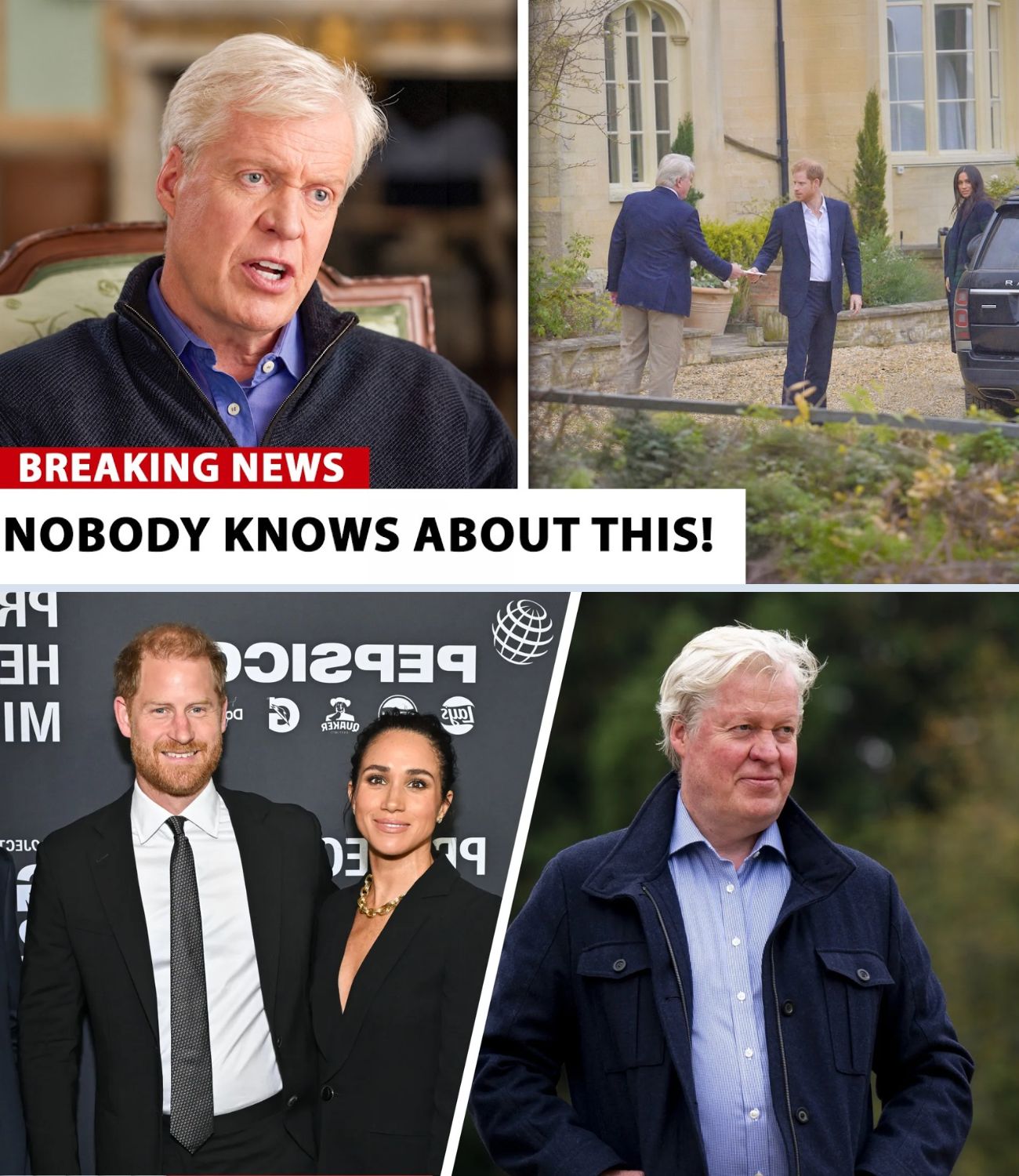
Diana’s Brother DROPS BOMBSHELL On Meghan! Harry COMPLETELY BLINDSIDED By Shocking Reveal!

THE ALTHORP SHUTOUT: Inside the Brutal Four-Word Rejection That Just Shattered Harry and Meghan’s Ultimate Netflix Gamble
The Guardian of the Vault
Meghan Markle is learning the hard way that you can borrow the jewelry, but you cannot borrow the halo. And the man who just reminded her of that distinction is the one person Prince Harry never expected to turn against him: Charles Spencer, the ninth Earl Spencer.
For nearly thirty years, Charles Spencer has stood as the uncompromising guardian of his late sister’s legacy. In September 1997, standing in Westminster Abbey before a global audience of two billion people, he delivered a eulogy that fundamentally challenged the British establishment to its core. Pledging to shield William and Harry from the cold rigidity that hounded Diana to her final hours in a Paris tunnel, he ensured she was laid to rest not in a royal vault, but on a secluded island at Althorp, the Spencer family estate in Northamptonshire.
Strip away the soft sentimentality of public grief, and the reality is stark: her brother refused to let the institution have her. While the royal family received the state funeral, the Spencers kept Diana. From that day forward, anyone seeking the private, unvarnished Diana—her handwritten journals, her childhood rooms, her unedited home movies—had to pass through one man.
And that gatekeeper just slammed the door shut.
When a confidential documentary proposal carrying the names Netflix, Prince Harry, and Meghan Markle crossed his desk in early 2026, Charles Spencer reportedly reviewed the scope of the project and responded with four words that instantly detonated the Sussex media strategy:
“Is this a joke?”
Four words. Unfiltered, absolute, and entirely devoid of diplomatic polish. To understand why those four words carry more weight than anything King Charles or Prince William could ever state publicly, one must understand that Charles Spencer is bound by zero palace protocols and troubled by no constitutional optics. He is the keeper of the archive and the sole curator of Diana’s true memory. And his devastating rebuff signals a complete breakdown of the Sussexes’ most ambitious narrative play yet.
The Anatomy of an Unauthorized Withdrawal
To grasp why the proposal provoked such blistering contempt, one must trace the escalating pattern of what royal insiders privately describe as “brand licensing” against the Diana account.
It began subtly, as these things always do, with small, gleaming tokens of remembrance. At the evening wedding reception in May 2018, Meghan Markle arrived adorned in Diana’s iconic emerald-cut aquamarine ring. To an observer standing on the outside, it felt like a touching familial tribute. But soon came the butterfly earrings, followed closely by the Cartier tank watch and inherited gold bracelets. Piece by piece, item by item, every major public appearance by the Duchess seemed accompanied by a distinct piece of Diana’s historic jewelry—timed with mathematical precision for maximum photographic impact.
While grief manifests in complex ways, public patterns quickly hardened into strategy. Every major moment for the Montecito camp arrived stamped with a Diana hallmark.
Then came the seismic shock of the March 2021 Oprah Winfrey interview. Watched by Charles Spencer from the quiet expanse of Althorp, the broadcast bore an eerie, unmistakable structural resemblance to Diana’s infamous 1995 Panorama interview with Martin Bashir. The low, golden lighting, the intimate confessional framing, the narrative of a young woman isolated and systematically crushed by a faceless, hostile institution—the grammar of victimhood was identical.
The core difference lay in the context: Diana spoke while trapped inside the system with zero exits in sight, whereas the 2021 broadcast was transmitted from a California villa backed by a multi-million-dollar production apparatus. For a brother who watched his sister’s real anguish harvested by media opportunists, the performance felt less like a tribute and more like a calculated repetition.
By the time the subsequent Netflix docuseries painted their exit as a heroic continuation of Diana’s martyrdom, the warm feelings had completely curdled. The Sussexes had been trading on a priceless cultural brand without acquiring a license from its rightful owner. Every ring worn, every interview framed around hunted victimhood, was an unauthorized withdrawal from an account managed by a 62-year-old aristocrat in Northamptonshire who had never been consulted.
The Desperate Pitch for the Vault
By early 2026, the Montecito media empire was facing an acute financial and existential crisis. The high-profile Spotify partnership had collapsed into public humiliation, the lifestyle venture American Riviera Orchard was struggling for traction, and their flagship five-year, $100 million Netflix contract was hurtling toward its expiration date.
Amidst this commercial contraction, a grand rescue plan was drafted for a major anniversary documentary slated for 2027—marking thirty years since the tragedy in the Paris tunnel. On paper, the concept was cinematic gold: a definitive, emotional film fronted by Diana’s own son, exploring her legacy three decades on.
Yet, the pitch contained a deeply calculated structural element designed to anchor the entire narrative. The producers and publicists wanted to draw a straight, explicit line connecting Diana’s historical war with the establishment to Meghan’s modern struggles with the same forces. They sought to formally position Meghan Markle as the 21st-century continuation of Diana—the new iteration of the woman who refused to be silenced, executing a literal transfer of the royal halo.
To execute this ambitious script, however, they required access to assets that money alone could not purchase. The production schedule demanded:
Althorp Estate: Exclusive utilization of the childhood home, the parkland, and the waters surrounding the private island grave.
The Personal Archives: Unfettered access to Diana’s private, handwritten journals.
Unseen Home Movies: Complete licensing rights to unguarded, private film reels showing Diana as a girl on the lawns of Northamptonshire.
Without those exclusive primary sources, the project would remain merely another recycling of familiar news clips. With them, it would become the definitive cultural event of the streaming calendar.
There was only one living human being who controlled every single item on that inventory. And when Netflix and the Sussex team submitted the proposal to Charles Spencer, they apparently operated under the naive assumption that a devoted brother would readily endorse a cinematic tribute to his sister.
They fundamentally misjudged their man.
When Charles Spencer read the treatment, he did not see an artistic homage. He saw the transparent mechanics of the script—the positioning of Meghan as Diana’s rightful heir, the monetization of family trauma, and the extraction of private grief for commercial survival. His four-word rejection stripped the project of its foundational pillars before it could even clear pre-production. With a single stroke, the vault at Althorp remained bolted shut.
The Ghost of 1995 and the Burden of Atonement
To comprehend why Charles Spencer’s refusal is so absolute, one must confront the profound, deeply personal guilt that has governed his life for nearly three decades.
Accounts long circulating within British upper-class circles point to a haunting truth: it was Charles Spencer who originally introduced his vulnerable sister to Martin Bashir, the disgraced journalist who secured the 1995 Panorama interview using forged bank statements and systematic psychological manipulation. Diana, isolated and frightened in the mid-1990s, was fed elaborate fabrications suggesting those closest to her were betraying her confidences. Her genuine vulnerability was weaponized to convince her that her only sanctuary lay in speaking directly to a national television audience.
When the full, sordid details of Bashir’s deception finally came to light years later, the revelation struck Charles Spencer with the force of an avalanche. He realized he had unwittingly held the door open for one of the most destructive exploitations of his sister’s life.
Every year since has functioned as an act of quiet, unyielding penance. By sealing the diaries, locking away the home movies, and repeatedly rebuffing publishers, networks, and opportunistic relatives, the Earl has maintained a single-minded dedication to ensuring Diana’s memory can never be harvested or monetized again. He has successfully preserved her true mystery because he refuses to let the gate be left unlocked a second time.
The Fallout and the Future of the Crown
The rejection of the Althorp pitch lands at a perilous moment for the Sussexes. Critical reception for their media projects has been remarkably harsh. Even publications traditionally sympathetic to their grievances against the monarchy, such as The Guardian, panned recent content as unlovable and derivative, reinforcing the uncomfortable reality that the global audience is largely indifferent to lifestyle branding while remaining intensely fascinated by royal wounds.
Yet, the ripple effects of Charles Spencer’s intervention extend far beyond Hollywood boardrooms, reaching deep into the constitutional future of the British monarchy.
Behind the scenes, reports indicate that a profound alignment has quietly formed between Diana’s brother and Diana’s eldest son, Prince William. While William—as the future King—is constitutionally constrained from blocking his brother’s media ventures without igniting a global storm about palace censorship, Charles Spencer faces no such institutional shackles. He can utter the blunt rejections that protect family dignity without implicating the Crown.
In a stunning tactical development, insiders suggest the Earl recently communicated directly with Prince William, urging the future sovereign to break his silence and aggressively defend the institution’s global standing. The reported message was stark: by maintaining total indifference, the royal family risks ceding the global narrative entirely to an unchecked, external microphone.
The parallel is striking. Decades ago, Diana was exploited by a man brandishing forged documents. Her brother has firmly ensured she will not be exploited once more by a production team wielding a streaming contract. The archive at Althorp remains sealed in darkness, guarded by a man who learned the hard price of misplaced trust. The vault is locked, the gate is barred, and the halo remains securely out of reach.
You Might Also Enjoy

“We Thought They Would Negotiate”—What Argentine Soldiers Said When The British Attacked Goose Green

“You’ll Never Finish My Ruck March, Limey” — US Sergeant Who Challenged the SAS, Then Fell Out First






