Diana’s Final Wish — What King Charles Just Did With Her Ring Left Palace In Tears
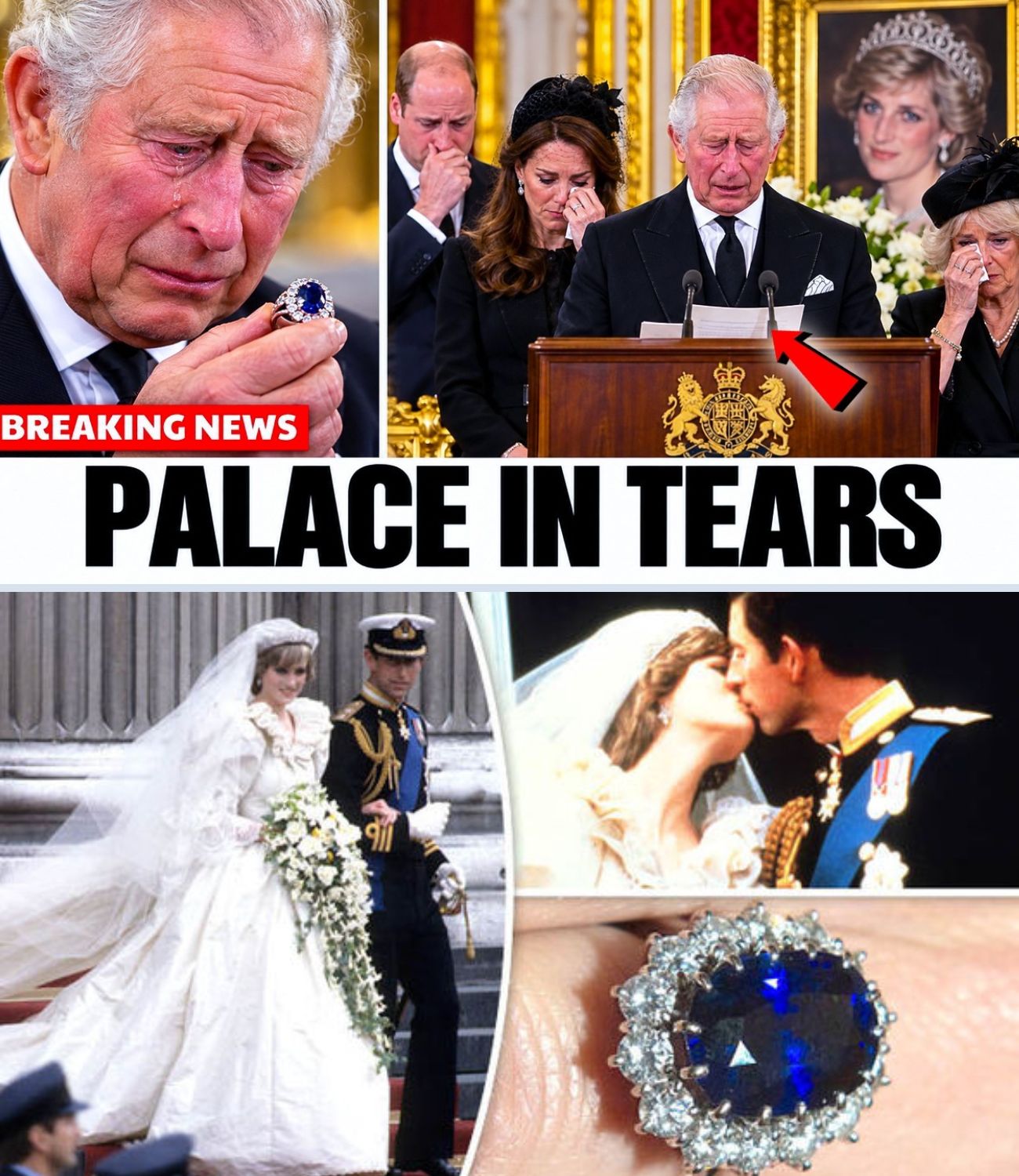
The Velvet Case at Windsor: How a Forgotten Archival Note Forced King Charles to Honor Princess Diana’s Final Secret Wish
There is a particular kind of silence that settles over the private quarters of Windsor Castle when centuries of institutional habit collide with raw, unvarnished human grief. It is not the hushed reverence of a chapel, nor is it the calculated stillness of a state banquet. It is the heavy, suffocating vacuum left behind when a secret kept safely buried in the archives for decades suddenly breaks free, demanding to be settled by men who thought they had finally outrun the ghost of their past.
On a damp morning that felt entirely out of step with the orderly rhythms of royal life, King Charles III sat before a polished mahogany table in a secure private room, staring down at a small velvet-lined case. Just feet away stood his eldest son, Prince William. Neither man spoke. For decades, the object resting inside that case had carried a quiet, persistent memory that the royal household rarely dared to confront directly—a deeply private connection to Diana, Princess of Wales, and a final, handwritten instruction that had been quietly sidelined, filed away, and left unresolved by generations of cautious courtiers.
Yet, history has a way of calling due debts. With a slow, deliberate movement that seemed to cost him more than anyone in the room could possibly fathom, the King reached for a pen. In signing the papers before him, Charles did not merely transfer a piece of jewellery; he ignited an institutional earthquake that would ripple far beyond the palace gates, exposing how deeply the ghosts of 1997 still haunt the House of Windsor.
The Archivist’s Discovery: The Note That Broke the Silence
To understand the magnitude of the moment, one must trace the trail back to what should have been a routine archival inventory—a formal administrative review of personal items and records preserved following a royal death. Eleanor Hart, a senior archivist tasked with cataloguing miscellaneous memorial files from the late 1990s, had no inkling that her morning would shatter the status quo.
Working within the secure collection rooms, Hart unfolded a narrow, yellowing sheet of vellum bearing familiar, sweeping handwriting. At first glance, it appeared to be a standard domestic instruction regarding personal effects. But as her eyes scanned the lines, Hart froze. The note referred directly to Diana’s personal ring, setting out a clear, unambiguous wish that the piece should eventually pass down through the female line of the family to a granddaughter when the time was deemed right.
Beside Diana’s original handwriting sat an older, discreet palace annotation—a dated note added by senior household officials years earlier, proving beyond a shadow of a doubt that the instruction had been reviewed, recognized, and deliberately left unresolved. In the cautious climate of the late nineties and early noughties, choices connected to Diana felt volatile, politically sensitive, and dangerous to institutional stability. Officials had chosen the path of least resistance: they had tucked the note into a secure archival folder, closed the drawer, and let time blur the boundaries between ceremonial crown property and private family inheritance.
When Hart reported her discovery up the chain of command, the reaction was immediate and severe. When the authenticated record reached Prince William, his response was not born of anger at bureaucratic incompetence, but of a profound, cutting wound. The future king was not furious that procedures had existed; he was devastated that something so intimately personal to his mother could be quietly swallowed and erased by the very machine that had watched over her in life and death.
“If the wish had been known,” William reportedly demanded of the assembled officials, “why did no one act?”
No one in the room had an answer. But King Charles did. Refusing to let the matter linger in committee rooms or become fodder for bureaucratic prevarication, the King requested the original page, dismissed the surrounding advisors, and read Diana’s words in absolute silence. He placed the note flat on the mahogany desk and delivered a verdict that stunned his staff: the family would not postpone the matter another day.
Two Men, One Object: The Private Standoff
The decision to transfer the ring into a protected family trust for Princess Charlotte was swift on paper, but the emotional fallout within the royal family proved far more complex. By the following evening, Charles and William found themselves alone in a private sitting room, confronting what truly honouring Diana required of them both. No aides remained in the corridor; no courtiers stood guard outside the door.
For Charles, the ring represented a labyrinth of painful history—a reminder of a marriage defined by intense public scrutiny, bitter private wounds, and a tragic conclusion that neither man had ever fully escaped. For William, the ring did not represent history at all; it represented his mother. Every surviving possession of Diana’s felt to him like a fragile fragment of a voice that the world had spent decades interpreting, debating, and judging after she was no longer here to answer for herself.
As the King placed the archival folder on the table between them, the tension boiled over. Charles, speaking with a voice tight with long-held caution, warned that once the transfer became public knowledge, the ring would instantly cease to be treated as a private family token. It would become a symbol dissected by millions, weaponized by commentators, and scrutinized by a press corps that never tired of the Diana narrative.
William pushed the folder back across the table with unyielding firmness. Fear of public reaction, he argued, could not be allowed to override a written, explicit wish from his mother. His frustration broke through the polished veneer of royal restraint as he declared that he could no longer accept another generation of officials treating Diana primarily as a historical problem to be managed and filed away. He was not asking the palace to erase the complexity of the past; he was asking them to stop turning his mother’s personal choices into bureaucratic hurdles that required endless institutional permission.
Charles absorbed the accusation in silence. He did not defend the marriage, nor did he offer excuses for the decades of silence that had followed her death. Instead, he revealed something that fundamentally shifted the dynamic in the room: he had personally ordered the ring removed from any inventory that could ever classify it as a ceremonial royal asset. He was not merely lending Charlotte the ring or placing it under temporary custodial care; he was permanently surrendering palace control over its future.
The monarch picked up a silver pen, crossed out the cold institutional word recipient in the draft trust papers, and substituted language that firmly established the jewellery as a protected family inheritance. In doing so, he removed all future discretion from officials who might otherwise have attempted to reclaim or reinterpret its status years down the line.
The Empty Drawer and the Weight of Memory
The administrative work was clinical, executed with dry legal terminology, but its physical reality struck home the very next morning. Margaret Ellis, a longtime staff member responsible for the secure collection rooms, opened the reinforced cabinet where Diana’s ring had rested in velvet darkness for years.
She found only an updated inventory card. The ring was gone, transferred quietly out of institutional custody and into the private family line.
For Ellis, who remembered Diana dropping by during a relaxed family weekend years earlier—laughing, turning the ring around her finger without a second thought—the empty space was almost shocking. It stripped away every layer of paperwork, appraisal forms, and archival security protocols. For a brief, poignant moment, the ring was no longer a high-stakes inheritance or a constitutional talking point; it belonged once more to a living, breathing woman whose presence had once filled ordinary rooms with warmth.
When the sealed velvet case finally arrived at William and Catherine’s home, the Prince of Wales did not immediately open it. He placed the box gently beside a framed photograph of his mother and stepped away, unable to treat the long-delayed transfer as a simple victory. Catherine, understanding the heavy grief coursing beneath his calm exterior, offered him silence rather than questions.
Later that evening, Charles summoned William back to his study for a final, deeply private conversation. There were no red boxes on the table, no briefing notes, and no waiting secretaries. Speaking not as a sovereign addressing his heir, but as a father who had shared a turbulent, profoundly complicated life with Diana, Charles explained why he had acted.
Keeping Diana’s belongings trapped inside formal palace systems, the King admitted, had begun to feel less like preserving history and more like preserving pain—freezing memory into a rigid artifact rather than letting it live. He confessed that he did not want his own royal authority placed at the centre of Charlotte’s inheritance story. He wanted his granddaughter to understand that the ring reached her because her grandmother had asked for it, not because a reigning monarch had magnanimously granted permission.
Passing the Torch to a New Generation
Away from the blinding glare of television cameras and the surging crowds laying white roses outside the iron gates of Kensington Palace, the true meaning of the transfer unfolded in absolute simplicity.
William and Catherine did not present the ring to Princess Charlotte beneath chandeliers or during a formal ceremony. They showed it to her quietly at home, resting the small velvet case between them on a family table.
William spoke gently, explaining that the piece had belonged to the grandmother she knew mostly through faded photographs, framed portraits, and whispered stories. He made it crystal clear that this was neither a royal duty nor a ceremonial burden. Catherine assured their daughter that she never had to wear the ring publicly, lend it out for exhibitions, or allow anyone else to dictate what it should mean to her.
Charlotte studied the velvet interior in silence before looking up with a disarming, childhood innocence that caught her father completely off-guard. She asked William whether Diana had worn the ring when she was happy.
The question struck William with the force of a physical blow. His voice tightening, he answered that the ring should remind her first of a person—of a warm, vibrant human being—rather than a royal symbol. Charlotte closed the lid carefully, remarking simply that she would rather keep it safe for now.
When William later phoned his father to report how the moment had passed, Charles listened in silence for several long seconds. He asked only whether the young princess understood why the ring had come to her.
“Yes,” William replied quietly.
“Then that is enough,” Charles whispered back.
With those final words, the King’s active role in the drama came to a close. His decision could not rewrite the painful history of the past, nor could it erase old wounds that had scarred an entire nation. But by stepping out of the way and letting Diana’s final, long-ignored wish find its rightful home, he had allowed a mother’s enduring love to finally break free from the cold stone walls of the palace—passing safely from the shadows of yesterday into the hopeful hands of tomorrow.
You Might Also Enjoy

“We Thought They Would Negotiate”—What Argentine Soldiers Said When The British Attacked Goose Green

“You’ll Never Finish My Ruck March, Limey” — US Sergeant Who Challenged the SAS, Then Fell Out First






