Diana’s Greatest Love Died in a Crash – And She Said He Was Bumped Off
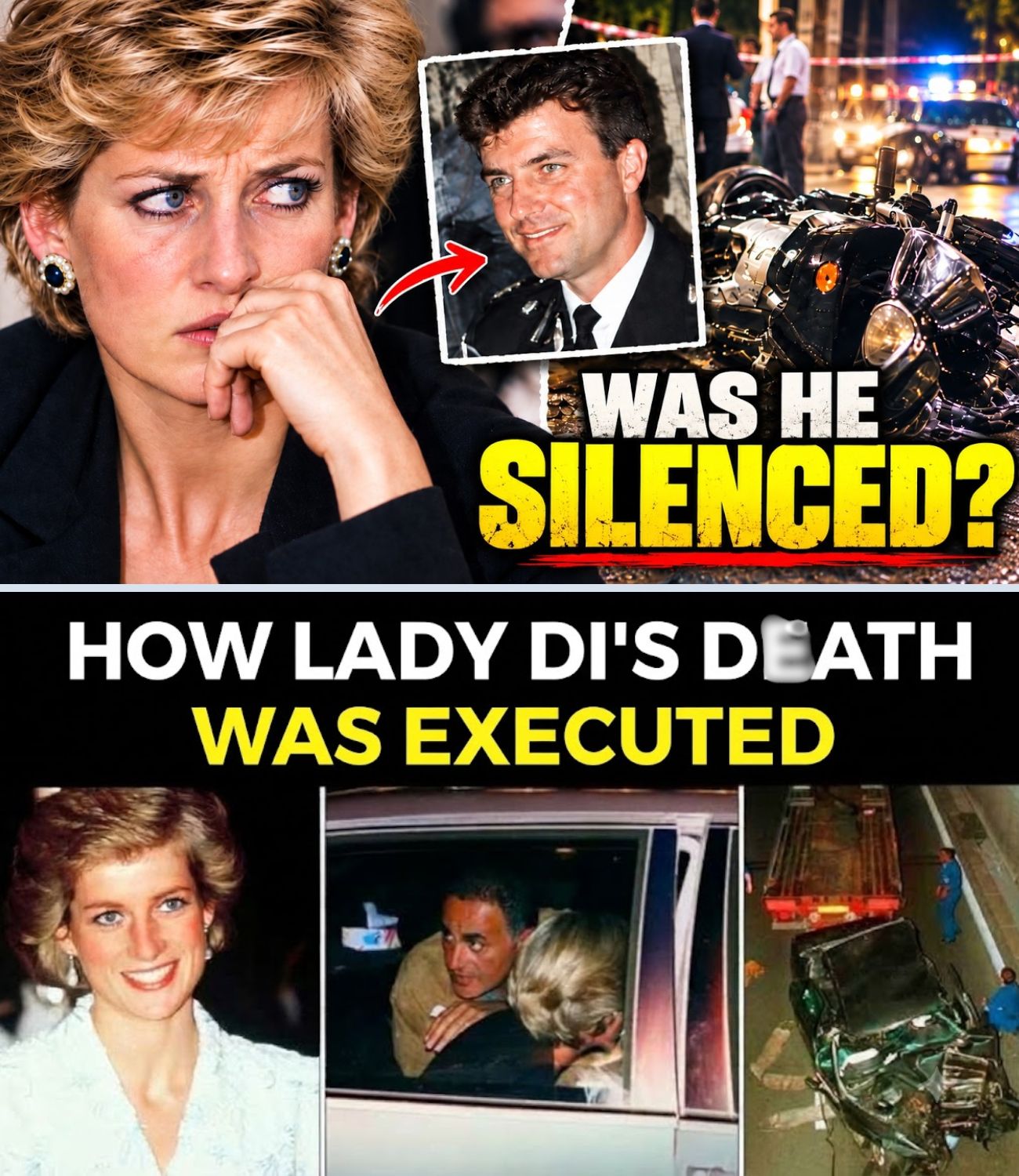
She never says his name. Not once, not on the tape, not in the room, not even when the memory is clearly too painful to hold back.
It is 1992, or perhaps early 1993. The Princess of Wales is sitting indoors in front of a video camera with a voice coach a few feet away. There is no balcony, no crowd, and no clicking cameras. There is just a woman, a chair, and a tape that keeps running. Somewhere in that session, her voice changes. It drops. It slows. She starts talking about a man who worked inside her world. A man whose job was to keep her safe. She says she was deeply in love with him. She says she was only happy when he was around. Then she gives him a title that has followed this story ever since. She calls him:
“The greatest love I’ve ever had.”
And then she says something that would make headlines on two continents more than a decade later. She says this man was taken away from her. Then he was killed. And she says she believes he was:
“Bumped off.”
The man was a Metropolitan police officer named Barry Mannakee. In May of 1987, he died on a road in northeast London. Within a few years, the most famous woman on earth sat in front of a camera and said in effect that his death was no accident. So who was he? Why was he suddenly removed from her side? What really happened on that road on a Friday night in May? And when inquests, investigators, and the officer who took his place finally looked at her claim, what did they find? That is the file we are opening today. The tapes, the transfer, the crash, the investigations, and one witness who knew Diana better than almost anyone and who gave the answer she never wanted to hear. Stay with me to the end because the truth here is quieter than the headline and in many ways it is far more heartbreaking.
Now, let’s start with the tapes themselves. The most important piece of evidence in this story is not a love letter. It is not a photograph, and it is not a palace diary. It is a stack of small plastic video cassettes recorded in 1992 and 1993. Diana had started working with a man named Peter Settelen. He was an actor and a voice coach. She hired him for a simple reason. She wanted to feel more confident when she stood up in front of an audience. She wanted to stop rushing her words. She wanted to stop dropping her eyes. She wanted to learn how to breathe before she spoke.
The camera was supposed to be a tool. Settelen would record her. They would play it back. And together they would study her delivery, her posture, and the nervous habits that crept in when she felt watched. But that is not what the tapes became. Because in the privacy of that room, with no courtier listening and no newspaper waiting, Diana started to talk. She talked about her childhood. She talked about her marriage. She talked about motherhood, about disappointment, and about the few people who had made her feel truly seen. And all the while, the camera kept running.
Now, these are not the tapes most people think of. They are not the recordings Diana secretly made for Andrew Morton’s 1992 book, Diana: Her True Story. Those were audio tapes smuggled in and out of Kensington Palace by a friend, Dr. James Colthurst, who carried Morton’s questions in and Diana’s answers out. Those tapes were built for a book. They were Diana helping to shape her public story. The Settelen tapes were different. They were face-to-face and they were on video. They captured not just her words but her pauses, her glances away from the lens, the half-laughs and the moments when a sentence started strong and then faded.
With Morton, she was building a case. With Settelen, she seemed to be finding her own voice, and in the middle of that search, she opened a door to a memory she had been carrying for years. To understand why that door opened, then you have to see where Diana was standing. By the time these sessions were happening, her marriage was in its final act. Morton’s book had come out in June of 1992 and shattered the fairy tale. Then on the 9th of December 1992, Prime Minister John Major stood up in the House of Commons and announced that the Prince and Princess of Wales were separating. The official statement was polished. There were no plans to divorce. Their constitutional positions were unchanged. It all sounded very neat. The truth behind it was anything but.
For more than a decade, Diana had been learning a hard lesson. A palace can have hundreds of rooms and still leave you nowhere safe to speak. Every conversation could be overheard. Every tear could be reported. Every friendship could be questioned. What that camera offered her was something the institution almost never had. A room where she could talk without being interrupted, corrected, or managed.
Many of you remember Diana as she was in those years. She was poised on the steps, bending down to a child, smiling because the public needed her to smile. This story is for those of you who also sensed something behind that smile, a loneliness that never quite made it into the official photographs, because on these tapes, that loneliness has a face and it has a name, even if she never says it out loud.
So, let’s meet him properly. To see Barry Mannakee clearly, we have to strip away the romantic haze that settled over him after Diana’s death. He was not a mysterious stranger who appeared out of nowhere. He was a working police officer from the Metropolitan Police, born in 1947. He was married and he was a father. He served in Royal Protection, which is one of the most disciplined branches of British policing.
Think about what that job really is. A royal protection officer stands just a few feet from moments the rest of the world only sees from behind barriers. He notices moods. He notices entrances and exits. He notices when plans suddenly change. He might hear raised voices through a door. He might see tears wiped away seconds before a public appearance. And yet the entire job rests on one rule: Be present but stay separate. See everything and say nothing. Protect the person and never become part of their life. With Diana, that rule was about to be tested.
In the mid-1980s, she was still astonishingly young for the weight she was carrying. She had entered royal life at 19. She was married at 20. She gave birth to William before her 21st birthday, and Harry arrived in September of 1984. To the public, it was a perfect family portrait. A future king, two little boys, and a princess whose warmth seemed to soften every cold, formal room she walked into.
Inside the marriage, Diana would later describe a completely different picture. She knew about Charles’s deep emotional attachment to Camilla Parker Bowles. She was struggling with bulimia, and she felt that the machine around her wanted beautiful photographs while treating her pain as an inconvenience to be managed. The official biographies of that era skipped over the hours in between. The car journeys, the waiting rooms, the long drives between Kensington Palace and Highgrove, the hospital visits, the school visits, the engagements that could fill an entire day.
Protection officers were there for all of it. Their work was practical. Check the route, watch the crowd, keep the car ready, get the principal safely from one controlled space to the next. But spend enough hours that close to someone and something happens. When a person is being watched for their safety, the watcher sometimes becomes the only one who notices what everyone else has quietly agreed to ignore. That is exactly what Diana said Barry Mannakee did. She said he understood when she was unhappy. She described herself as someone who wore her heart on her sleeve. And she said very simply that she was only happy when he was around.
Sit with that sentence for a second because it explains more than a hundred tabloid pages ever did. It doesn’t tell us exactly what happened between them, but it tells us what he gave her. In a life ruled by rank, he spoke to her like a person. In a household trained to hide emotional trouble, he was willing to see it around him. For the first time in a long while, she felt less alone.
To understand how much that meant, you need to see one particular night. It is December of 1985. A private royal ballet gala is underway at the Royal Opera House in Covent Garden. Charles is in the audience expecting an elegant evening. And then without warning, his wife slips away from her seat. Moments later, she appears on stage. Diana had been rehearsing in secret with the dancer Wayne Sleep. The music starts and it is Billy Joel’s Uptown Girl. Already the audience is smiling because the princess is noticeably taller than her dance partner, and the contrast is part of the joke.
But this is no shy young woman being led politely around the floor. Diana is bold. She kicks high. She has comic timing. And you can see on her face the pure pleasure of doing something nobody expected her to do. The audience goes wild. There are curtain call after curtain call. For a few minutes, Diana isn’t trapped inside a moment someone else arranged for her. She has created the surprise herself. But people close to that evening later remembered that the reaction she wanted most never came. Her ballet teacher, Anne Allan, believed Diana had done it for Charles. She wanted his approval and his delight. Instead, she felt his coolness. The performance that brought a whole theatre to its feet became, in private, another measure of the distance inside her marriage.
That is the emotional world Barry Mannakee walked into. He couldn’t give Diana a stage. He couldn’t give her a title or a standing ovation. What he seemed to give her was something rarer, the sense that someone understood why the ovation wasn’t enough. When the man at home couldn’t meet the longing behind the performance, the officer standing nearby seemed to recognise it. That doesn’t excuse a crossed professional line, but it explains why that line became so fragile.
Dance itself was one of Diana’s few refuges. Anne Allan later spoke about lessons that became a kind of escape. In the studio, there was discipline, but no palace protocol. The music started, the body moved, and for an hour, Diana could think about nothing but balance, timing, and breath. Allan’s memories placed the grief Diana carried in those years, including her feelings about Mannakee, inside that room. Dancing couldn’t fix a marriage. It couldn’t bring anyone back, but it gave her sorrow somewhere to go. It was one of the few places where she got to act instead of simply being watched.
Her other shelter was her boys. William and Harry were tiny when Mannakee served around the family. Diana fought for moments that felt like ordinary childhood. School runs when she could manage them, trips outside the royal calendar, queues, shops, and laughter that would never appear in the Court Circular. The protection officers were there for all of it. They watched her switch in a heartbeat from princess to mother. She would crouch down to a child’s height, fix a little coat, and turn a boring delay into a game.
So Mannakee wasn’t only the man Diana had feelings for. He was part of the security circle around the people she loved most in the world. That made him trusted, and it made what was happening between them far more dangerous because other people were starting to notice. Ken Wharfe, who would later become Diana’s own protection officer, had a phrase for what can go wrong in that job. He spoke about the divide between:
“The grey carpet and the red.”
The grey carpet is the working side where the staff and officers stand. The red carpet is the ceremonial side where the royal walks. A good protection officer never crosses from one to the other. In Wharfe’s judgement, Barry Mannakee crossed it. He became too emotionally involved with the woman he was there to protect. And Wharfe was clear that this was a professional problem, whatever the exact nature of the relationship, whether it was romantic, physical, or simply a closeness the chain of command would never accept.
So, was it an affair? Newspapers have printed that word for years as if there were a sealed file that settled it. There isn’t one. What we do have is Diana’s own voice. On the tape, she leaves no doubt about her feelings. She says she fell deeply in love. She says she would have been willing to give everything up to go off and live with him. But the exact nature of the relationship was never established in any court. And Barry Mannakee never left a matching account of his own. We only ever hear one side. So the honest answer is also the most human one. Diana experienced it as love, and the people around her in the palace and in the police saw a closeness serious enough to act on, and there was an imbalance at the heart of it that’s easy to forget.
Mannakee was older and experienced, and he was assigned to protect a woman in her mid-twenties who felt emotionally abandoned. Diana had rank and fame, and she had some power over who accompanied her. Mannakee had professional authority and with it the duty to hold the line. Neither of them was free. She was inside a marriage that was turning into a public performance. He had a wife, children, and a career governed by strict rules. Whatever they felt for each other existed inside two sets of promises, and every private moment carried the risk of being seen.
That is why Diana didn’t describe it on the tape as a fun romance or a daring adventure. She described it as the memory of feeling alive during years when most of her life felt numb. And from the very beginning, that feeling was tangled up with danger. She believed they could never simply choose each other and walk away. Everything was overshadowed by his duties, her marriage, and the families on both sides. And remember, the woman telling this story on tape was looking back across six or seven years. She already knew how it ended. Every happy memory she described had already been coloured by the news that Barry would never come back.
The first blow came in 1986. That year, Barry Mannakee was suddenly removed from Diana’s protection team and transferred to the Diplomatic Protection Group, the unit that guards embassies and diplomats. What triggered it? Here, the stories split. Some accounts talk about growing suspicions among the staff. Others repeat a far more colourful tale about the two of them being found in a compromising situation. But be careful with those versions. They have grown bigger with every retelling, and none of them is a documented finding.
What we can say for certain is this: The professional relationship ended. The officer was moved, and Diana saw it as a punishment for their closeness. For her, it carried a message she already knew too well. Nobody sat down with her to help her make sense of feelings formed inside an unhappy marriage. Nobody asked what she needed. The institution’s answer was simple: Distance. From the police side, it may have been ordinary risk management, a routine move to protect everyone involved. But to Diana, it felt as if someone had reached into the one small private space where she could breathe and quietly shut the door.
And the timing made it worse. In 1986, Charles’s relationship with Camilla was again part of Diana’s private reality, years before Charles would admit adultery in public. Her duties carried on regardless. She opened hospitals. She attended ceremonies. She visited communities. Then she went home to the tension waiting at Highgrove and Kensington Palace. The public saw a princess growing more confident with bolder clothes and an instinctive gift for connecting with people. What they didn’t see was a young woman looking for emotional shelter wherever she could find it. In her sons, in dance, in a few trusted friends, and for a while in the calm attention of a protection officer who was now gone. And within a year he would be gone for good.
But before we reach that night, there’s one more date you need to know. It shows exactly who Diana was becoming in the very same season. Thursday the 9th of April, 1987. Diana arrives at Middlesex Hospital in London to open the Broderip Ward. It is Britain’s first dedicated unit for patients with HIV and AIDS. You have to understand the fear around that illness at the time. Many people genuinely believed you could catch it from a handshake, a hug, or a shared cup. Patients were being left physically isolated at the very moment they most needed human contact. And Diana walked in and shook a patient’s hand without wearing gloves.
Today, that gesture looks simple. It looks simple because she made it simple. At the time, it was a direct challenge to a stigma that was leaving sick people untouched and alone. The patients’ identities were protected and there was no grand speech and no staged drama. The power of the moment was a hand held out and a hand accepted. That was Diana’s instinct. She found the person a room had pushed to the edge. She sat close. She touched. She looked directly at the people everyone else avoided. That instinct wasn’t separate from her private life. It came from it. A woman starved of simple, uncomplicated affection understood exactly how cruel it is to withhold touch.
So this is Diana in the spring of 1987. In public, she is discovering how to use royal visibility in a brave new way. In private, she is carrying a love she can never admit. On the 9th of April, she shows the world that fear should not stop human contact. Five weeks later, a collision would take away the man whose contact had helped her through her own fear. Those two dates aren’t secretly connected. But side by side, they show the cruel contrast of that season. Her public courage was growing at the very moment her private world was about to collapse.
Friday, the 15th of May, 1987. It’s just after 10:00 at night in northeast London. Barry Mannakee is on his way home. He isn’t in a royal car. He isn’t on a secret assignment. He isn’t on duty at all. He’s riding pillion on the back of a Suzuki motorcycle driven by a fellow police officer, Sergeant Steven Peat. It’s an ordinary ride on an ordinary road at the end of an ordinary day. They’re travelling along the A11 at Woodford.
Up ahead, a Ford Fiesta begins to turn across their path. Peat sees it. He tries to swerve. There is a fraction of a second, no more, and it isn’t enough. The motorcycle hits the car. Barry Mannakee is thrown into it and suffers fatal injuries. Steven Peat survives. The young driver of the Fiesta survives. The one man who doesn’t is the officer whose entire career had been built on anticipating danger. He died not guarding a princess or facing a threat, but as a passenger on the way home. And notice how painfully unglamorous the details are. A junction, a turning car, a motorcycle with almost nothing to protect the people on it. A decision measured in seconds.
The death went to an inquest and it was treated as a road accident. The rider who survived said it was an accident. Mannakee’s widow accepted that it was an accident. To everyone officially involved, the case was closed. But to one woman in Kensington Palace, it was never closed at all because Diana didn’t hear the news as a traffic report. She heard it as the violent end of a relationship that had already been taken from her once. On the tape years later, she describes his death as the deepest blow of her life.
When you place that beside everything else Diana went through, the collapsed marriage, the public humiliations, the illness, the endless intrusion, it might sound surprising, but grief doesn’t rank losses on a public scale. Barry Mannakee stood for a short stretch of time when she felt understood. His death didn’t only take a person away. It sealed off any chance that the relationship could ever be explained, repaired, or even remembered together with him.
On the tape, the older Diana tries to make sense of the younger one. She says she had been ready to give everything up to live with him. But listen carefully, and you notice what’s missing. There’s no plan on that tape. There’s no address, no date, no arrangement. It sounds less like a plan and more like a private daydream of escape. The thought that somewhere beyond the palace gates, a different life might be waiting. For a woman whose marriage, home, staff, transport, and entire public identity were all bound together, even imagining walking away was enormous.
And that dream is part of why the crash was so hard for her to accept. An accident gives you no one to blame. There’s no face to confront and no intention to uncover. It’s sudden. It’s senseless. And it’s final. Diana’s mind reached for a cause big enough to match the size of her grief. Look at the sequence the way she saw it. First, she watched Mannakee get removed because their closeness had drawn attention. Then, less than a year later, he was dead. In her heart, those two events formed a straight line, one leading directly to the other. The question is whether the evidence on that road drew the same line. We’ll come to that piece by piece.
First, there’s something important about how she carried this grief, because for years she carried it completely alone. There was no national mourning for Barry Mannakee. The papers reported the death of a former royal protection officer and then they moved on. Diana couldn’t stand in front of the cameras and say what he had meant to her. If she had, she would have exposed the relationship, hurt his family, and brought a fresh storm down on her marriage. So, she kept going. She smiled, opened buildings, and shook hands, all while carrying a grief she could neither name in public nor resolve in private.
That kind of grief changes shape over time. A relationship that ends suddenly gets frozen. Ordinary life never gets the chance to test it. In Diana’s memory, Barry would never grow older. He would never disappoint her. He would never tell his own version. He would never have to face with her the real cost of breaking up two families and walking out of the royal system. So when she called him her greatest love, she may not have been naming the longest relationship of her life. She may have been naming the intensity of being understood at the exact moment she needed it most.
That matters when you place him next to the other men later linked to Diana. James Hewitt was a real relationship that lasted years and it later became a source of pain once letters and paid storytelling entered the picture. Hasnat Khan offered privacy and a dream of ordinary home life, but their two worlds proved almost impossible to join. Dodi Fayed arrived in her final summer in bright sunlight and relentless camera flashes. Barry Mannakee was different from all of them. He belonged to the beginning before Diana had learned how quickly anything intimate around her could be turned into somebody else’s headline.
And that is exactly what the tapes captured. When Settelen pressed record in 1992 and 1993, Diana wasn’t just recalling an old bodyguard. She was measuring the distance between two women. The young one who had waited for love to rescue her and the older one who had learned that love could be transferred, exposed, sold, or taken away. You can hear both of them in her voice, the longing and the knowledge, and you can see the memory physically working on her. A sentence starts firmly, then slows. She refers to someone who worked within her environment. She describes the transfer. She describes the motorcycle crash. Anyone familiar with her security history knows exactly who she means. But she never says the name. Even years later, even in a private room, his name seemed to stay behind a line she couldn’t cross. Those tapes were about to begin a second secret life. That second life would carry her words and her accusation to millions of people she never intended to hear them.
The tapes were private. They were never meant for broadcast. But after Diana’s death in 1997, they became tangled up in a fight over ownership, privacy, and public interest. In 2001, police raided the home of Diana’s former butler, Paul Burrell. Among the items they recovered were the Settelen videotapes. Peter Settelen insisted the tapes were his. He had made them, and they were his professional recordings. Diana’s family, the Spencers, fought their return. Lawyers examined the case and in 2004 the tapes were handed back to Settelen.
Within months, the world was watching them. In late 2004, the American network NBC broadcast excerpts. For the first time, viewers heard Diana’s own voice describing the man believed to be Barry Mannakee. They heard her call him her greatest love, and they heard her say she believed he’d been killed deliberately. Think about that timeline. A private voice coaching exercise recorded in 1992 and 1993 became international news in 2004. That was seven years after Diana’s death and 17 years after Barry Mannakee’s, and her words reached American living rooms before most British viewers ever saw them.
The timing could hardly have been more explosive. At that very moment, Britain was already confronting the biggest question of all, how Diana herself had died. The official inquests into her death had opened in January of 2004. The Metropolitan Police was running a huge investigation called Operation Paget, examining every claim that the crash in Paris had been no accident. And now into that storm came Diana’s own voice describing an earlier road death in almost the same terms. To some listeners, it sounded like a pattern, as though the princess had been warning everyone all along. To investigators, it was something very different. One unproven belief could never be used as proof of another.
To understand why Diana believed what she believed, you have to understand the world she was living in. By the early 1990s, her fear did not grow in an empty room. In 1992, a private phone call between Diana and a friend was secretly recorded and splashed across the papers. It became known as “Squidgygate”. In 1993, an intimate late-night phone call between Charles and Camilla was published word for word. Photographers tracked her car. Newspapers paid for scraps of her private life. People inside her circle sometimes had loyalties that pulled in other directions.
And later in 1995, the journalist Martin Bashir fed her suspicions directly. He used forged bank statements and false stories about people close to her being paid to spy on her, all to secure his Panorama interview. In May of 2021, Lord Dyson’s investigation established that deception plainly. So Diana had very real reasons to believe her privacy was fragile and that people around her could not be trusted. Some people really were watching her. Some people really were betraying her. And that is precisely what made an unsupported explanation feel so believable.
Her fear about Barry Mannakee wasn’t a one-off sentence either. In October of 1995, her solicitor, Lord Mishcon, recorded in a note that Diana had told him she feared she might be killed in a staged accident. A separate note, later produced by Paul Burrell, described a similar fear. Operation Paget examined those claims in detail and found no evidence that any plan to murder her had ever existed. Those later notes don’t prove anything about Mannakee. What they show is a pattern in Diana’s thinking. By the 1990s, fear had become one of the ways she made sense of danger. When something terrible happened near her, part of her looked for a hand behind it.
So, now we come to the central question of this entire file. Was she right? Let’s lay out the evidence piece by piece. The first piece is the journey itself. Barry Mannakee wasn’t on duty and wasn’t in any special vehicle. He was a passenger on a colleague’s motorcycle going home. There was no schedule anyone would have needed to secretly track. The second piece is the crash. A car turned across the motorcycle’s path. The rider tried to avoid it. For two people on a motorbike, the danger was immediate and brutal. Nothing in that sequence needs an unseen hand to explain it.
The third piece is the survivors. Sergeant Steven Peat, the man at the controls, the person closest to what happened, described it as an accident. The fourth piece is the family. Barry Mannakee’s widow did not support a murder theory. The fifth piece is the official record. The police investigated and an inquest ruled on the death. Neither found any evidence of sabotage, interference, or a staged collision.
And over the years, as the story grew, so did the rumours. There was talk of a mystery car and of something hidden at the scene. In 2017, reporting by The Independent traced one of the cars that had been pulled into one version of the theory. Its driver had been known to the authorities from the very beginning. Nobody had hidden him, and there was no secret plot behind him.
Then there is the biggest investigation of all. In December of 2006, Operation Paget published its report into the allegations surrounding Diana’s own death. It ran to hundreds of pages. It traced witnesses, records, and every institutional claim it could find, and it found no conspiracy to murder her. After the NBC broadcast, police had also considered whether Diana’s remarks about Mannakee needed fresh attention. Nothing emerged that overturned the original conclusion. No document has ever surfaced showing an order. No operative has ever been identified. No motive has been shown to have turned into action. No evidence of mechanical tampering has ever been found.
But the most powerful voice in this file isn’t a report. It’s a man. Remember Ken Wharfe, the officer with the phrase about the grey carpet and the red? He came into the royal protection team around Diana’s household after Barry Mannakee was gone. He became her personal protection officer and he stayed until 1993. He went on the school runs, the foreign tours and the ski holidays. He shared private jokes with her and he had blazing arguments with her about security. He lived every day inside the tug-of-war between her longing for freedom and his duty to keep her alive. He saw her courage with strangers. He saw her volatility in private. He knew she could read people brilliantly. And he knew fear could take hold of her.
And Diana told him what she believed. She told him she thought the security services had killed Barry Mannakee. Now, think about who Ken Wharfe is in this story. He isn’t a palace spokesman trying to tidy up her memory. He’s a man who openly criticised Mannakee for getting too close to her. He’s a man who later defended her right to be heard in her own voice. If anyone had reason to take her fear seriously and the knowledge to test it, it was him. So what did he say? He said he didn’t believe Mannakee had been killed. He said there was simply no reason for anyone to kill him. And his conclusion was plain: Barry Mannakee died in a tragic road traffic accident.
Notice what he didn’t do. He didn’t mock her. He didn’t offer some rival conspiracy with a different villain. He had no dramatic twist to sell. He had something far less exciting and far more solid. He had years of knowing exactly how royal protection worked. The shift patterns, the route planning, the chain of command, and the ordinary paperwork behind movements that looked mysterious from the outside. He had the findings of the collision investigation, and he had his understanding of the woman herself.
He even gave the transfer its proper context. In his telling, Mannakee got too close to the person he was protecting and crossed the line the job demands. That sounds harsh, but it actually protects everyone. A vulnerable person under protection needs an officer who won’t turn her dependence into intimacy. An officer needs boundaries that protect his judgement, his career, and his family. Moving him was an understandable, professional response. It didn’t require a later act of violence.
And this is what real loyalty looks like. A loyal witness isn’t someone who agrees with everything Diana believed. A loyal witness protects her humanity while refusing to exploit her fear. Wharfe’s disagreement gives her that respect. It lets Diana be wounded and loving, suspicious and brilliant, and still mistaken all at the same time. Real people hold contradictions like that. Only legends are forced to be perfectly consistent.
So here is the verdict of this file, and I’ll say it plainly once. Diana’s love was real. Her grief was real. Her fear was real. All of it is confirmed by her own voice. The murder was not. It was never supported by the inquest, by the rider, by the family, by the investigators, or by the officer who knew her best. Every credible piece of evidence leads back to the same place. A junction in Woodford, a turning car, and a fraction of a second that couldn’t be undone. Holding both of those truths at once isn’t disloyal to her. It’s the most honest way to hear her.
So, if the claim wasn’t true, why does that one sentence on the tape matter so much? Because “bumped off” isn’t important for what it tells us about the crash. It’s important for what it tells us about her. She had reached a point where a simple accident felt less believable than an organised plot against someone she loved. Think about how isolated a person has to be for that to feel more likely. And you can trace exactly how she got there. When she went to the family for help about Charles and Camilla, she later said she got little real comfort. When she tried to show how much she was suffering, courtiers read it as instability or disloyalty. When she made friends outside the palace, their access was watched. When her private calls leaked, she learned that not even a telephone was safe.
None of that proves anyone killed Barry Mannakee. Put together, it shows why she could believe it. One question belongs to a biographer: Why did she suspect a plot? The answer is her history of betrayal and fear. The other question belongs to the police: Did the plot exist? That one is answered by physical evidence, witnesses, and findings. On that question, the record never supported her.
And that verdict shouldn’t sound cold because the crash was not a small thing just because it was an accident. Barry Mannakee still died. His wife still lost her husband. His children still lost their father. Steven Peat still had to carry the memory of being at the controls that night. The young driver still had to live with a turn made on an ordinary road. And Diana still lost the person she connected with safety and rescue. An accident can wound many lives without anyone secretly writing the ending.
His family deserves something else, too. Public fascination has turned Barry Mannakee into a supporting character in Diana’s story that forgets he had a whole home life beyond the palace gates. When the tapes revived everything in 2004, his widow asked for privacy. Any honest telling of this story should honour that. Diana’s feelings were hers to share. Barry wasn’t alive to share his, and his family never chose to become permanent figures in royal mythology.
So, watch how the meaning of the tapes keeps shifting. At first, they look like a key that unlocks Diana’s secret romance. Then they look like evidence of her fear. And finally, they become a lesson about the limits of what any recording can give us. A camera can preserve someone’s words perfectly and still not give us the whole relationship. We can hear Diana’s certainty, but we can’t cross-examine a memory. We can’t recover Barry’s private thoughts, and we can’t replay that junction until her grief gets a different ending.
And the battle over the tapes wasn’t finished. In 2017, 20 years after Diana’s death, Channel 4 prepared to broadcast the Settelen footage in Britain for the first time. The fight over her privacy erupted all over again. Her brother Earl Spencer objected. Her close friend Rosa Monckton opposed it too, but others, including Ken Wharfe, argued that Diana would have wanted to be heard in her own voice.
Both sides were asking a fair question. Did showing the tapes give Diana back her voice, or did it expose a confidence she never meant to share with millions? The broadcast drew a huge audience because her voice had a power no reconstruction can match. An actress can copy the tilt of her head, the soft vowels, and the clothes of the era. What she can’t copy is the moment Diana searches for the right words and finds ones that reveal more than she planned. The tapes put us uncomfortably close. That closeness can bring understanding, but it also puts a duty on us as listeners. We shouldn’t take someone’s private pain and sharpen it into a claim the evidence won’t carry.
Diana herself knew how easily her story could be twisted. In her 1995 Panorama interview, she spoke openly about her marriage, her bulimia, her self-harm, and the crushing pressure of royal life. Today that interview has to be seen alongside Lord Dyson’s finding that Bashir used deception to get it. Her words are still her words. The way he won her trust was still wrong. The Settelen tapes deserve the same layered thinking. Her feelings on them are historically important. Their broadcast is still ethically debated and her suspicion is part of the record, but it is not a verdict.
By the early 1990s, her grief for Barry had become part of a much larger pattern of loss. She had lost faith in her marriage. She had lost any chance of private anonymous life. Friendships could become press stories. Staff could turn. Her separation went public in 1992. In December of 1993, she announced she was stepping back from much of public life, saying she hoped for a quieter future. Through all of that upheaval, the memory of Barry Mannakee stayed fixed. It reminded her of a time when someone had seen her clearly before the battles hardened around her.
That may explain why her words were so absolute. “Greatest love” sounds like a final ranking, but people often speak in absolutes about the dead. The dead can’t compete with the living. Their flaws fade, and the moment of connection only grows brighter. Her later relationship with Hasnat Khan was longer and more grounded with everyday meetings, family questions, and serious talk of a future. And yet, Barry stayed tied to something no one else could replace. The first discovery that someone inside the palace walls could make her feel emotionally protected.
And that word “protection” is the thread running through this entire story. Barry Mannakee’s job was to protect Diana’s body. What she treasured was that he seemed to protect her feelings. His transfer showed how the second could threaten the first. His death convinced her that neither her body nor her heart was safe from forces she couldn’t control.
Years later, after her separation, Diana gave up regular police protection. It would become one of the most consequential decisions of her life. Ken Wharfe has said he believed proper Scotland Yard protection might have prevented the chaotic security arrangements in Paris in 1997. We have to be careful not to draw a straight line of blame, but the irony is hard to miss. The protection system Diana came to distrust was the very system that had once placed beside her the man she remembered with the greatest tenderness.
So let’s close the file and say exactly what we found. Barry Mannakee was a police officer assigned to protect the Princess of Wales. He became her confidant at a time when her marriage was deeply unhappy. By her own account she fell in love with him. Their closeness alarmed the people responsible for her security and he was transferred. On Friday the 15th of May 1987, he died riding pillion in a motorcycle crash on the way home.
Diana saw his death through the pain of his removal and her growing distrust of palace life. Years later on tape she said she believed someone had arranged it. The evidence never supported her. The answer is less sensational than the headline and far more moving. Diana wasn’t revealing a solved assassination. She was revealing how unsafe her world had come to feel. She believed the one man who made the palace bearable had been taken from her life and then taken from life itself. In her memory, the crash became proof that happiness near her was dangerous. That belief tells us nothing proven about a crime, but it tells us everything about her loneliness.
And yet, she didn’t stop. She raised William and Harry with an openness and physical affection the royal family had rarely shown in public. The young woman, who had once held an AIDS patient’s hand without gloves, kept walking into rooms others avoided. In January of 1997, she walked through a live minefield in Angola wearing protective gear so the world would finally look at the civilians living among buried weapons. She learned to speak, not just more clearly, but with real moral authority.
That’s the twist hidden inside these tapes. The voice Peter Settelen was hired to strengthen went on to carry causes far beyond the palace walls. That’s why these tapes should never be reduced to one romance. They show a woman building a public voice out of private fractures. She talked about the experiences that had once left her silent, and in telling them, she started to take control of what they meant. The Mannakee passage hurts precisely because that control is incomplete. She can name the love and she can name the loss, but she can’t accept that the ending was random, so she gives it an intention.
All these years later, we can offer her the acceptance she couldn’t find herself. The crash was investigated as an accident. No evidence of foul play was ever found. The officer who knew her best rejected the theory, and none of that erases a single tender thing she felt. Barry’s death can remain one of the deepest wounds of her life without becoming a state killing. Her fear can remain historically important without becoming historical fact.
The cassette reaches its end. The tape slows. The room goes quiet, but Diana is still there on the screen. She is alive, choosing her words, sometimes glancing away as she reaches back into memory. She isn’t a marble statue or a legend. She’s a woman in her early 30s trying to understand why one brief stretch of comfort ended in permanent grief. The tape doesn’t solve what happened on that road. What it preserves is the ache that was left behind.
And maybe the fairest final image isn’t the junction at Woodford or the headlines of 2004. Maybe it’s this. Years after Barry’s death, Diana steps out of a car at an engagement. She starts to move on and then she stops because there’s a little child at the barrier who is too small to see. She turns back. She bends down for a few seconds. The whole security line has to adjust around her while she listens to that child at eye level. The officers watch the crowd. Diana watches one small face. She knew exactly what it felt like to go unseen, and she refused to let anyone else feel that way.
You Might Also Enjoy

“We Thought They Would Negotiate”—What Argentine Soldiers Said When The British Attacked Goose Green

“You’ll Never Finish My Ruck March, Limey” — US Sergeant Who Challenged the SAS, Then Fell Out First






