“DO NOT DISRESPECT MY MOTHER!” George CONFRONTS Camilla In Front Of Charles At State Dinner!
“DON’T DISRESPECT MY MOTHER!” Inside Prince George’s Terrifying Buckingham Palace Showdown With Queen Camilla That Left King Charles And William Stunned
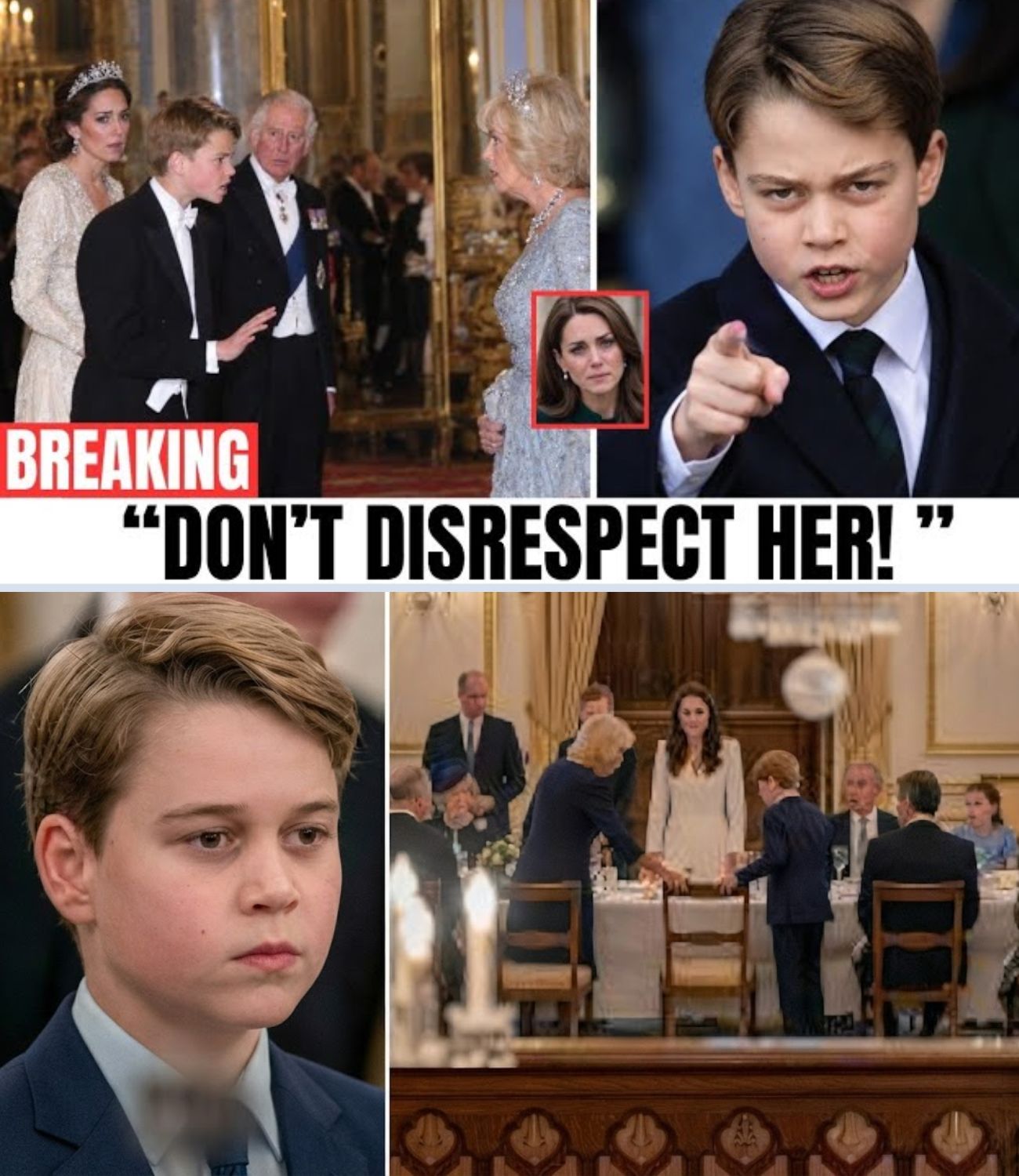
Beneath the soaring, gilded vaulted ceiling of the State Ballroom at Buckingham Palace, six colossal crystal chandeliers cast a brilliant, diamond-like glow upon the assembled diplomatic corps, foreign heads of state, and the highest ranks of the British aristocracy. It was an evening meticulously designed to showcase the crown’s supreme majesty. Yet, just yards away from the historic gilt silver service commissioned by King George IV, behind the velvet-draped doors of the private state antechamber, that very evening transformed into an arena of unadorned internal warfare.
This was a white-tie state banquet of the highest constitutional significance. It marked the triumphant, radiant return of Catherine, Princess of Wales, to full sovereign duties following months of grueling, courageous health struggles that had captured the prayers of millions across the globe. But in the quiet sanctuary where senior royals gathered to form the official procession, a toxic, calculated act of psychological cruelty threatened to unravel months of careful healing.
What followed next was a moment that shattered decades of hardened palace etiquette, leaving the entire royal establishment reeling and forever shifting the balance of power within the House of Windsor.
The Looming Shadow of Jealousy and the Clarence House Memos
To truly understand why the events of that evening landed with the force of an institutional earthquake, one must examine the monumental emotional stakes hanging over the gathering. For almost a year, the British public watched with profound anxiety as Princess Catherine navigated the darkest chapter of her adult life—a painful battle for survival balanced against the relentless pressure of public duty and an unwavering desire to shield her three children from predatory speculation.
Her appearance at the state banquet was a resurrection of the monarchy’s greatest moral legacy. Draped in a breathtaking ivory floor-length gown adorned with delicate silver embroidery, Catherine chose to crown her dark hair with the iconic “Lovers’ Knot” tiara—a diamond and pearl masterpiece intimately associated with both the late Princess Diana and Queen Elizabeth II. To millions watching worldwide, she embodied indomitable grace.
However, behind the palace’s glittering facade, that very moral authority had become an unbearable psychological friction point for Queen Camilla and her ambitious personal secretariat. For months, courtiers loyal to Clarence House had watched with growing panic as public adoration gravitated overwhelmingly toward the Princess of Wales, while the joint reign of King Charles and Queen Camilla continued to battle stagnant poll numbers and public indifference.
In the weeks leading up to the banquet, a group of private communications strategists attached to the Queen Consort’s household drafted confidential operational directives. Under the guise of medical paternalism and artificial concern for Catherine’s stamina, Camilla’s office secretly suggested that the Princess of Wales ditch historic family tiaras to avoid visual competition, even proposing she be seated at a secondary diplomatic table to minimise her presence. When those bureaucratic maneuvers failed to sideline her, a more direct, face-to-face ambush was deployed.
The Ambush in the Antechamber
The poisoned confrontation unfolded less than ten minutes before the royal heralds were scheduled to sound the brass fanfares opening the ceremonial procession. Prince William had briefly retreated to the far corner of the hall to coordinate a last-minute security briefing with the King’s equerry and foreign security commanders.
Catherine stood near the carved marble fireplace, accompanied by 13-year-old Prince George, who stood tall beside his mother, radiating quiet youthful pride after hours of honing his formal diplomatic posture. Ruthlessly exploiting Prince William’s momentary absence, Queen Camilla walked across the antique Persian carpet, flanked by two chief private secretaries. Her gaze swept over Catherine’s ivory gown and the shimmering pearls of the Lovers’ Knot tiara with cold, diagnostic disdain.
In a series of caustic, passive-aggressive remarks disguised as matriarchal advice, the Queen Consort launched her attack. Speaking in a sharp, carrying register, Camilla remarked with biting sarcasm that it was remarkable how Catherine found the theatrical energy to wear such ostentatious diamonds after months of avoiding full-fledged royal duties. She audibly sneered that some people seemed to treat the monarchy as a part-time red-carpet fashion show rather than an exhausting burden of state, adding with icy malice that the over-reliance on Diana’s historic jewels was a desperate attempt to overshadow the King.
A petrified silence fell over the room. Senior diplomats froze mid-conversation, and attendants stood paralyzed. For Catherine, who had poured every ounce of her hard-earned physical strength into preparing for this evening, the unprovoked cruelty was a visceral blow. A momentary flash of pain crossed her features, her knuckles turning white as she clutched her small satin evening bag. True to the stoic discipline learned from Queen Elizabeth II, she lowered her chin, preparing to swallow the insult to preserve the sacred order of the state dinner.
The Lion Cub Steps Forward
Neither Queen Camilla nor her sycophantic courtiers had calculated for one pivotal factor: 13-year-old Prince George.
No longer a small child content to remain in the shadows of palace politics, George was a young man who had spent the past year silently watching his mother suffer, holding her hand through sleepless nights, and carrying the protective instincts of his generation. Hearing every syllable of Camilla’s attack and seeing the painful shudder on his mother’s face, the polite mask of childhood melted away in a single blinding second.
Moving with the athletic precision of a defender blocking a goal line, the young prince took two fierce strides across the Persian rug. He positioned himself squarely between Queen Camilla and his mother, his broad shoulders physically shoving the Queen Consort’s principal private secretary aside with such force that the grown man tripped over a gilded console table, sending an antique china bowl clattering against the marble.
Planting his polished patent leather shoes firmly on the floor, George puffed out his chest, clenched his fists, and straightened his posture into an impenetrable fortress. His face was a mask of absolute sovereign fury, his eyes blazing with an intensity that made Queen Camilla physically recoil.
Leaning forward half an inch, George’s voice cut through the vaulted hallway with the crushing resonance of an artillery shell:
“Don’t disrespect my mother.”
The raw, majestic power of the young prince’s command echoed off the heavy silk wallpaper and antique mirrors. Pointing a steady finger straight into the face of a trembling, paralyzed Queen Consort, George delivered an unedited truth that had long festered in palace corridors. He informed Camilla that she was speaking to the future Queen of the United Kingdom—a woman who possessed more courage, dignity, and genuine love for the British people in her little finger than Camilla’s entire advisory circle could ever muster. He warned her that if she ever dared utter another disrespectful word, she would answer directly to the House of Wales, and they would never bow to cruelty.
Royal Retribution and Generational Justice
The immediate consequences were volcanic. Prince William crossed the room at lightning speed, his 193-centimetre frame approaching like an unmovable mountain of royal fury. Placing a heavy, protective hand on his son’s shoulder, William didn’t look at the trembling aides; he stared at Queen Camilla with an expression of savage, absolute retribution.
“My son spoke for me,” William declared in an arctic, deadly whisper that reached the farthest corners of the room. “And if you ever question my wife’s presence, her jewels, or her dignity again, I will personally escort our family out of this palace tonight, and I guarantee the world will know exactly what you said to a woman who just survived cancer.”
Before Camilla could muster a protest, the heavy double doors of the private corridor swung wide open, revealing the Princess Royal. Anne, the 76-year-old royal matriarch, had heard the confrontation unfolding from the doorstep. Moving with the unyielding inertia of a field marshal, she walked straight past Queen Camilla without granting a millisecond of eye contact, stopping beside Prince George and Catherine.
Placing a comforting hand on young George’s back, Princess Anne turned her steel-gray diagnostic gaze onto the Queen Consort. With brutal aristocratic clarity, Anne reminded everyone present that when they looked at Catherine and George, they looked at the direct sacred bloodline of Queen Elizabeth II and the unbreakable future of the British Empire. She declared fiercely that Catherine wore Diana’s tiara because she was worthy of it, and that no cosmetic grab for titles would ever elevate an insecure wife above the legitimate mother of kings.
The final, decisive blow came from King Charles. Standing near the threshold of the ballroom, his hands trembling on his silver-tipped cane, the monarch stepped forward. The lifelong desire to appease his wife and avoid confrontation was instantly incinerated by a wave of paternal guilt, ancestral shame, and unbridled sovereign rage. Charles saw the toxic reality of the courtiers who had operated in his name, realising his throne could never stand if he allowed his wife to destroy the woman carrying the dynasty’s future.
Without glancing at Camilla, King Charles raised his cane and struck it hard against the wooden floor. In a voice trembling with majestic emotion, he issued a non-negotiable executive order that redrew the evening’s architecture.
The chief private secretary responsible for Camilla’s protocols was permanently stripped of his security credentials and escorted from the palace grounds by Scotland Yard before the first course was served.
The official order of the state procession was instantly restructured, decreeing that Queen Camilla would walk in a humiliating second row, while Princess Catherine and Prince George walked immediately beside the monarch at the very head of the United Kingdom.
A New Dawn for the House of Windsor
When the heavy gilded doors of the State Ballroom finally swung open to the majestic sound of cavalry trumpets, the scene that greeted the international diplomatic corps was an unforgettable masterclass in generational justice.
King Charles walked down the grand central aisle with his head held high. To his right walked Catherine, looking utterly majestic and serene beneath the diamond brilliance of the Lovers’ Knot Tiara. Right beside her strode 13-year-old Prince George, his chin raised, chest square, occasionally brushing his mother’s hand to reassure the world that the future of the British crown was safeguarded by an impenetrable fortress of love and steel.
Queen Camilla trailed a few paces behind in tense, isolated humiliation, acutely aware that her attempt to assert dominance had been permanently shattered before the eyes of global leaders.
Later that evening, as the vast halls of Buckingham Palace fell into quiet stillness, William and Catherine stood with their eldest son in the private marble sanctuary of the Belgian Suite. William pulled George into a tight, lingering embrace, whispering that he had never been prouder. Catherine cradled her son’s face in her hands, her eyes shining with tears of boundless maternal love, thanking him for the fierce, unwavering courage that protected her when she needed it most.
The history of the British Crown has long been carved into ancient stones and celebrated in grand military triumphs. But on that historic evening, the true eternal soul of the monarchy was preserved not by an army or a royal proclamation, but by a 13-year-old prince who stepped into the path of cruelty, looked an all-powerful court in the eye, and proved once and for all that a son’s love for his mother is an untouchable sovereign power no palace intrigue can ever defeat.
You Might Also Enjoy

“We Thought They Would Negotiate”—What Argentine Soldiers Said When The British Attacked Goose Green

“You’ll Never Finish My Ruck March, Limey” — US Sergeant Who Challenged the SAS, Then Fell Out First






