“DO NOT DISRESPECT MY MOTHER!” George CONFRONTS Camilla In Front Of Charles At State Dinner!
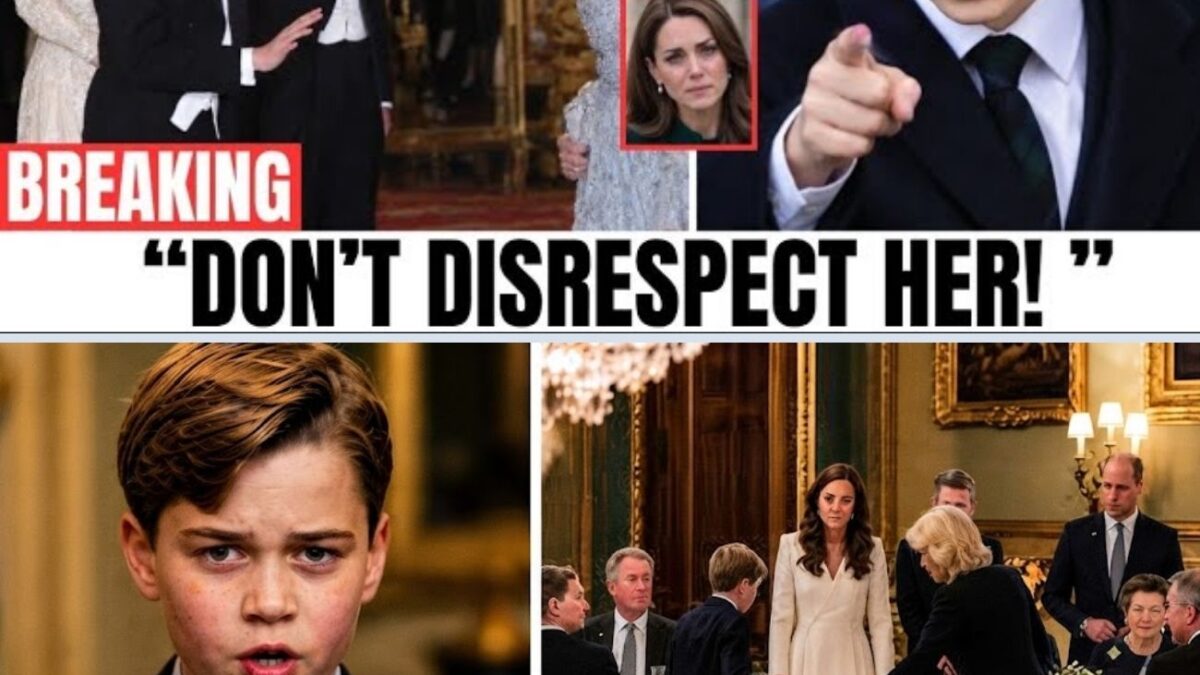
PALACE REVOLT: How 13-Year-Old Prince George Shattered Royal Protocol to Protect His Mother from Camilla’s Venomous Ambush!
Beneath the towering, gilded, barrel-vaulted ceiling of the state ballroom at Buckingham Palace, six colossal cut-crystal chandeliers cast an incandescent, diamond-bright glow over the assembled diplomatic corps, foreign heads of state, and the senior ranks of the British aristocracy. It was an evening meticulously designed to project the supreme, untouchable majesty of the Crown. Across the polished mahogany tables, gleaming with thousands of pieces of the historic silver-gilt grand service commissioned by King George IV, liveried footmen in scarlet and gold poured vintage champagne while the quiet murmur of international statecraft filled the vast, historic hall.
This was a white-tie state banquet of the highest constitutional importance—a momentous diplomatic evening marking the triumphant, radiant return of Catherine, Princess of Wales, to full sovereign duties following months of grueling, courageous health battles that had gripped the hearts of millions across the globe.
Yet, within the private, velvet-draped confines of the state antechamber, where the senior members of the royal family had gathered moments earlier to form the official sovereign procession, a toxic, calculated act of psychological cruelty was unleashed from behind a polite, courtly smile. Queen Camilla, flanked by her personal ladies-in-waiting and senior private secretaries, seized upon a fleeting moment away from public television cameras to launch a venomous, unprovoked verbal slight aimed squarely at Catherine’s delicate stamina, her historic jewels, and her rightful place within the royal hierarchy.
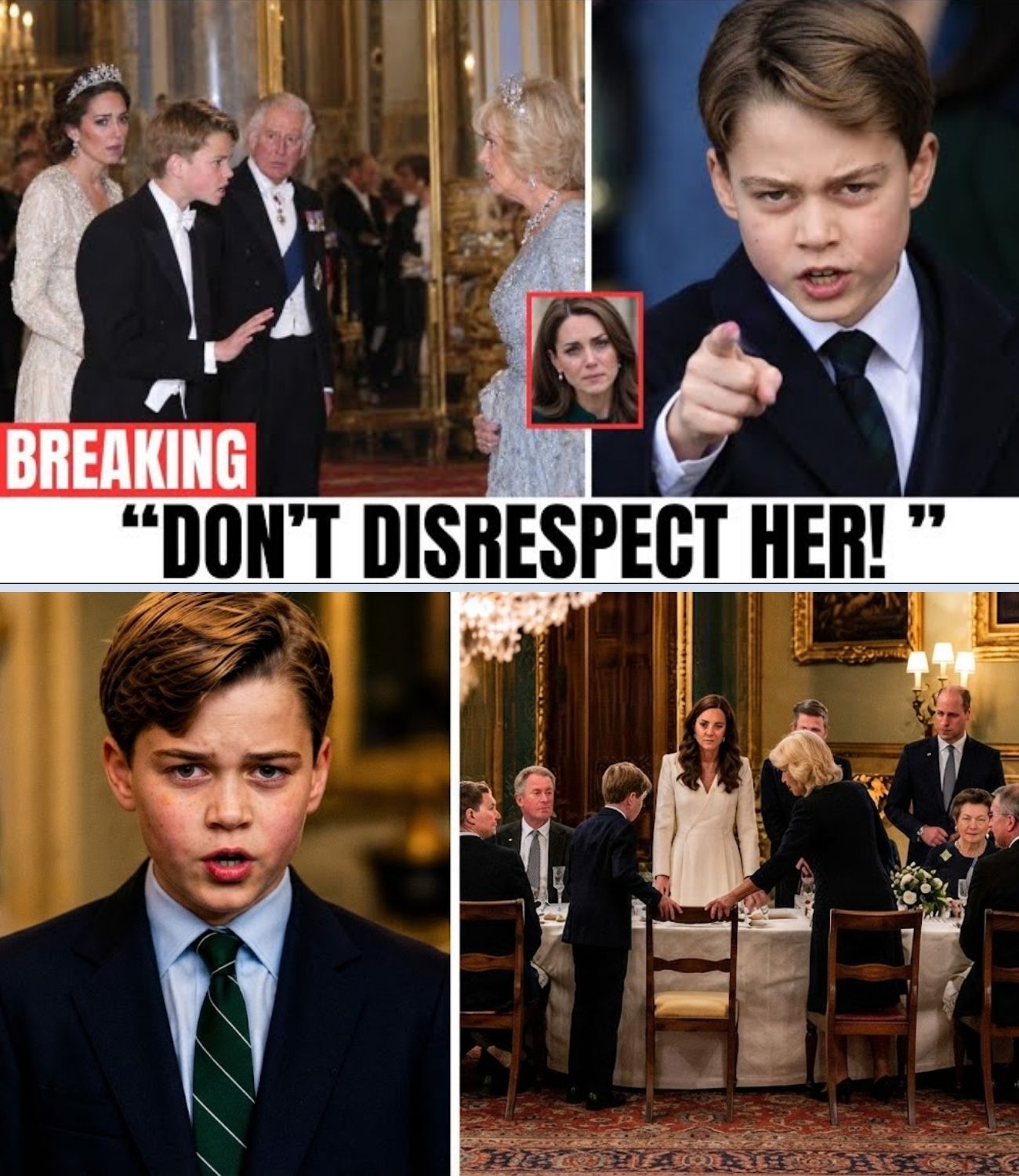
Before the Princess of Wales could even draw breath to respond, however, thirteen-year-old Prince George—attending his very first formal state banquet in the dignified black-tie attire of an heir apparent—shattered decades of calcified palace etiquette. He lunged forward with the terrifying, protective fury of an ancient warrior prince, physically positioning his athletic frame between his mother and the Queen Consort, and detonated the suffocating silence of the room with an explosive, razor-sharp command that brought King Charles III and the entire assembly to an absolute, paralysed standstill: “Do not disrespect my mother.”
The Weight of the Crown: Catherine’s Triumphant Return
To truly understand why the young prince’s seven words landed with the concussive force of an institutional earthquake, one must comprehend the monumental emotional stakes hanging over this particular state banquet. For nearly a year, the British public and the global Commonwealth had watched with profound anxiety and deep, prayerful reverence as Princess Catherine navigated the darkest, most terrifying chapter of her adult life.
Her journey had not been fought behind impenetrable palace gates in self-indulgent luxury. It had been an excruciating, deeply personal battle for survival, balanced delicately against the unrelenting pressures of public duty and the fierce, unyielding desire to protect her three young children from the predatory glare of international speculation. Her appearance at this state banquet was not merely another line item on the royal court circular; it was a triumphant, deeply emotional resurrection of the monarchy’s greatest moral asset.
Dressed in a breathtaking, floor-length ivory gown adorned with delicate silver embroidery, Catherine had chosen to crown her dark hair with the iconic Lover’s Knot tiara—the diamond and pearl masterpiece deeply associated with both the late Princess Diana and Queen Elizabeth II. To the millions watching the broadcast outside, Catherine looked like a vision of ethereal, unbroken majesty: a future queen who had walked through the valley of the shadow of death and emerged with her grace, her dignity, and her moral authority entirely intact.
Yet, behind the glittering facade of the palace, that exact moral authority had become an intolerable psychological torment for Queen Camilla and her ambitious private secretariat.
For months, courtiers loyal to Clarence House had watched with rising panic as public adoration overwhelmingly gravitated toward the Princess of Wales, while the joint reign of King Charles and Queen Camilla continued to battle stagnant polling numbers, public indifference, and persistent criticism regarding their advanced age and lack of cultural resonance. With the King bravely enduring his own continuous rounds of medical treatments, Camilla’s inner circle had grown increasingly desperate to manufacture an aura of unchallenged supremacy. A faction of private communications strategists brought into the Queen Consort’s private household had spent the weeks leading up to the banquet drafting confidential operational directives intended to diminish Catherine’s visual and constitutional primacy under the guise of medical paternalism and synthetic concern for her stamina.
Camilla’s office had covertly suggested that Catherine should forego historic family tiaras to avoid visual competition with the Queen, proposing instead that the Princess of Wales be seated at a secondary diplomatic table to protect her from physical exhaustion. When those administrative memos were firmly rebuffed by Kensington Palace, the resentment curdled into active hostility—culminating in the toxic confrontation that unfolded in the shadows of the state antechamber.
The Antechamber Ambush
The poisonous ambush unfolded less than ten minutes before the royal heralds were scheduled to sound the opening brass fanfare for the grand processional entrance. Prince William had briefly stepped aside to the far corner of the chamber to coordinate a critical last-minute security briefing with the King’s equerry and visiting foreign security commanders. Catherine stood near the centre of the carved marble hearth, accompanied only by thirteen-year-old Prince George, who stood tall at his mother’s side, radiating quiet, youthful pride. George had spent hours practising his formal diplomatic posture, determined to honour his family and support his mother on one of the most high-stakes evenings of her life.
Taking ruthless advantage of Prince William’s momentary physical absence, Queen Camilla swept across the antique Persian rug, flanked by her two lead private secretaries. Her countenance was a study in brittle, condescending superiority, her eyes raking over Catherine’s ivory gown and the glittering pearls of the Lover’s Knot tiara with a cold, diagnostic disdain that instantly chilled the surrounding air.
Without extending the customary warmth due to a recovering family member, Camilla leaned in until her voice—though pitched in a polite aristocratic register—carried clearly to the ears of senior courtiers and foreign aides standing within earshot.
In a series of cutting, passive-aggressive barbs masquerading as matriarchal advice, the Queen Consort openly attacked Catherine’s presence. Camilla commented with sharp, vitriolic sarcasm that it was astonishing Catherine had found the theatrical energy to put on such ostentatious diamonds after months of avoiding full-time royal schedules, remarking audibly that some people seemed to treat the monarchy like a part-time red-carpet fashion show rather than a relentless, exhausting burden of state. Camilla went on to sneer that true sovereigns understand duty without demanding public pity, whispering with ice-cold malice that Catherine’s excessive reliance on Diana’s historic jewellery was an insecure, desperate attempt to steal the spotlight from the King on a night dedicated strictly to the sovereign couple.
The deliberate, cruel humiliation was designed to land like a razor blade against Catherine’s heart. The room fell into an excruciating, petrified hush. Senior diplomats froze mid-conversation; equaries averted their eyes in profound embarrassment; and the chambermaids standing by the heavy oak doors seemingly stopped breathing.
For Catherine, who had poured every remaining ounce of her hard-won physical strength into preparing for this evening, the unprovoked cruelty was a visceral, suffocating blow. A momentary flicker of pain and profound shock crossed her refined features; her breath hitched in her throat, and she instinctively gripped the small satin evening purse in her hands, her knuckles whitening beneath the fragile, pale skin. Yet, true to the unbreakable, stoic discipline she had learned from Queen Elizabeth II, Catherine refused to scream or cause an undignified scene. She lowered her chin slightly, preparing to endure the unearned insult in silent, suffering dignity—choosing to swallow the venom rather than compromise the sacred decorum of the impending state dinner.
Prince George’s Seven-Word Defiance
What Queen Camilla and her sycophantic courtiers had utterly failed to calculate, however, was that thirteen-year-old Prince George is no longer a small, malleable child who can be pushed into the dark corners of palace politics. He is a young man who has spent the last year watching his mother suffer in silence, who has held her hand through the sleepless nights of her treatments, and who carries within his veins the incandescent warrior bloodline of thirty British monarchs.
George had heard every single syllable of Camilla’s vile attack. He had seen the subtle, agonising flinch across his mother’s face. And he recognised with crystalline, terrifying clarity that the woman who had spent decades clawing her way to social acceptance was now attempting to crush the spirit of the mother he adored.
In a single, blinding fraction of a second, the polite veneer of childhood deference was violently incinerated. Prince George did not glance back to seek the diplomatic guidance of his father, nor did he look for an equerry to lodge a formal complaint. Moving with the blinding speed, physical mass, and unyielding aggression of an athlete defending the goal line, the thirteen-year-old prince took two ferocious, concussive strides across the antique carpet.
George thrust himself directly between Queen Camilla and his mother, his broad shoulders physically shoving the Queen Consort’s lead private secretary aside with such momentum that the grown man stumbled into a gilded console table, sending an antique porcelain bowl rattling against the marble surface. Planting his polished patent-leather shoes firmly upon the floorboards, George threw his chest out, clenched his fists at his sides, and squared his frame like an impenetrable fortress of iron and bone. His youthful face was an incandescent mask of sovereign fury, his eyes blazing with an arctic, generational retribution that made Queen Camilla physically recoil, her breath catching in her throat as she realised she was suddenly staring down the future king of England.
George leaned forward by half an inch, his voice detonating through the vaulted antechamber with the concussive power of an artillery shell:
“Do not disrespect my mother.”
The raw, majestic authority in the young prince’s command reverberated against the heavy silk wall-coverings and antique mirrors, shattering centuries of stifling court decorum in an instant. George did not yell with petulant childish hysteria; he spoke with the deep, vibrating, terrifying resonance of an anointed sovereign, delivering an unsparing sentence of absolute judgment. Pointing a single, trembling finger directly into the face of Queen Camilla—who stood pale, trembling, and utterly paralysed—George unleashed the unredacted truth that had been whispered in palace corridors for months.
He informed the Queen Consort that she was speaking to the future queen of the United Kingdom: a woman who possessed more courage, more dignity, and more genuine love from the people of this country in her little finger than Camilla’s entire advisory circle could ever dream of commanding. George declared that his mother had fought for her life while Camilla’s aides had plotted in the dark, warning the Queen Consort with unbending, chilling finality that if she ever dared to utter another disrespectful word to his mother, she would answer to him—and she would find that the House of Wales would never bow to cruelty.
The Sovereign Wrath: William and Anne Strike
The immediate aftermath was nothing short of volcanic. Prince William, having crossed the room the second the concussive sound of his son’s voice split the air, arrived at George’s side like an unassailable mountain of royal fury. The towering six-foot-three Prince of Wales placed a massive, protective hand upon his son’s shoulder, his jaw clenched so tightly that the tendons along his neck strained violently against his white-tie collar. William did not look at the cowering aides; he fixed Queen Camilla with a gaze of such feral, absolute retribution that the Queen Consort instinctively backed herself into the arms of her trembling ladies-in-waiting.
William’s voice was an arctic, lethal whisper that penetrated the farthest corners of the room: “My son spoke for me. And if you ever question my wife’s presence, her jewellery, or her dignity again, I will personally pull our household from this palace tonight, and I will ensure the world knows exactly what you said to a woman who just survived cancer.”
Before Camilla could muster a stammered, indignant defence, the heavy double doors connecting the private sovereign corridor were thrust wide open, and the Princess Royal strode into the antechamber. Dressed in her full state evening dress, with the wide blue sash of the Order of the Garter blazing across her chest and her historic diamond tiara gleaming like a crown of thorns, Princess Anne did not hesitate for a microsecond. The seventy-six-year-old royal matriarch had heard the entire confrontation from the threshold.
Moving with the unyielding, terrifying momentum of a field marshal entering a breached redoubt, Anne walked straight past Queen Camilla without granting her a single millisecond of eye contact, coming to a halt directly beside Prince George and Catherine. Anne placed her hand upon young George’s back, her disciplined, weathered countenance softening into an expression of fierce, boundless sovereign vindication.
Turning her steel-grey, diagnostic gaze upon Camilla, the Princess Royal’s voice cut through the suffocating tension like a diamond-tipped scalpel. Anne reminded the Queen Consort in the presence of the entire assembled retinue that when she looked upon Catherine and George, she was looking upon the direct, sacred bloodline of Queen Elizabeth II and the unbroken future of the British Empire. Anne stated with brutal aristocratic clarity that the only person in the room who had ever demeaned the dignity of the Crown was the woman who had spent her life operating in the shadows of other people’s marriages, declaring fiercely that Catherine wore Diana’s tiara because she was worthy of it, and that no amount of cosmetic title-grabbing would ever elevate an insecure consort above the rightful mother of kings.
King Charles Slams His Cane
The final, devastating blow fell from the centre of the room. King Charles III, who had stood frozen near the threshold of the ballroom with his hands trembling upon his silver-topped walking cane, slowly stepped forward into the circle.
The monarch, carrying the immense physical weariness of his ongoing illness, looked at his grandson standing like an iron sentinel before his mother; he looked at Catherine, whose quiet tears of relief were now falling softly onto her ivory gown; and finally, he looked at Queen Camilla, whose face was flushed with the horrifying, unvarnished realisation of her total exposure.
The King’s customary passivity—the lifelong, defensive desire to appease his wife and avoid confrontation—was incinerated by a sudden, overwhelming wave of paternal guilt, ancestral shame, and unbridled sovereign fury. Charles saw clearly the sickening reality of the toxic courters he had permitted to operate in his name, and he realised with absolute clarity that his throne would not survive if he allowed his wife to destroy the woman who carried the future of his dynasty.
Without looking at Queen Camilla—whose breathing had hitched into a silent, desperate panic—King Charles raised his walking cane and brought it down upon the hardwood floorboards with a sharp, concussive crack that signalled the end of Carian passivity. With a voice trembling with genuine, majestic emotion, the King looked directly at the Lord Chamberlain and the Master of the Household, delivering an immediate, non-negotiable executive command that permanently altered the architecture of the evening.
The official state processional order and banquet seating charts were declared null and void on the spot. Charles commanded that the lead private secretary who had advanced Camilla’s poisonous protocols be permanently stripped of his security accreditation and escorted off palace grounds by Scotland Yard before the first course was served. Furthermore, the King decreed in a voice that rang with absolute sovereign authority that for the grand processional entrance into the state ballroom, Queen Camilla would walk in a secondary, demoted rank, while Princess Catherine and Prince George would walk immediately beside the sovereign at the head of the United Kingdom.
Triumph in the Grand Ballroom
The scene that unfolded minutes later, as the heavy gilded doors of the state ballroom swung open and the brass trumpets of the Household Cavalry sounded the magnificent opening fanfare, was an unforgettable masterclass in generational justice.
Walking down the grand central aisle beneath the blazing chandeliers, King Charles III held his head high. But he did not walk alone. On his right walked Catherine, the Princess of Wales, looking breathtakingly regal, her face serene with the diamonds of Diana’s Lover’s Knot tiara flashing like a beacon of dynastic triumph. Flanking her side with the commanding athletic poise of an ancient knight was thirteen-year-old Prince George, his chin lifted, his chest squared, his hand occasionally reaching down to lightly touch his mother’s arm, projecting to the assembled ambassadors of the world that the future of the Crown was defended by an unbreakable fortress of love and steel.
Queen Camilla walked several paces behind in strained, humiliated isolation, acutely aware that her bid to assert dominance had been permanently obliterated before the eyes of the global diplomatic corps.
Throughout the grand banquet, as foreign heads of state delivered formal toasts to the longevity of the British monarchy, cameras repeatedly captured the magnificent tableau at the head table. King Charles sat with his grandson on his right, leaning in frequently to whisper words of deep grandfatherly pride and shared laughter, while Catherine conversed with prime ministers and presidents with effortless, radiant grace. The poisonous shadows of the antechamber had been completely banished by the blinding, unassailable light of a family united in duty and honour.
There was no victory speech given and no public statement issued. But every courtier in the palace, every diplomat in the room, and every citizen watching the broadcast understood the profound, irreversible shift that had taken place. The era of shadow manipulation was dead, and the direct heirs had assumed absolute command of their house.
Hours later, when the glittering guests had departed and the vast halls of Buckingham Palace settled into quiet darkness, Prince William and Catherine stood with their eldest son in the private marble sanctuary of the Belgian suite. William pulled George into a powerful, lingering embrace, his voice thick with emotion as he whispered that he had never been prouder of him in his entire life. Catherine held her son’s face in her hands, her eyes shining with tears of boundless maternal love, thanking him for the fierce, unyielding courage that had shielded her when she needed it most. Prince George looked into his mother’s eyes and simply smiled—a warm, steadying smile that proved he was ready for his sacred destiny.
The history of the British Crown is carved into the ancient stones of Westminster Abbey, recorded in centuries of treaties, and celebrated in grand military triumphs. But on that historic evening in the state ballroom, the true, eternal soul of the monarchy was preserved not by an army or a royal proclamation, but by a thirteen-year-old prince who stepped into the path of cruelty, looked into the eyes of an overreaching court, and proved to the world that some bloodlines will never bow—and that a son’s love for his mother is an untouchable sovereign power that no palace intrigue will ever conquer.
You Might Also Enjoy

“We Thought They Would Negotiate”—What Argentine Soldiers Said When The British Attacked Goose Green

“You’ll Never Finish My Ruck March, Limey” — US Sergeant Who Challenged the SAS, Then Fell Out First






