“Do Not Try to Outdrink the British” The Official Warning Sent to US Marines Before Joint Deployment
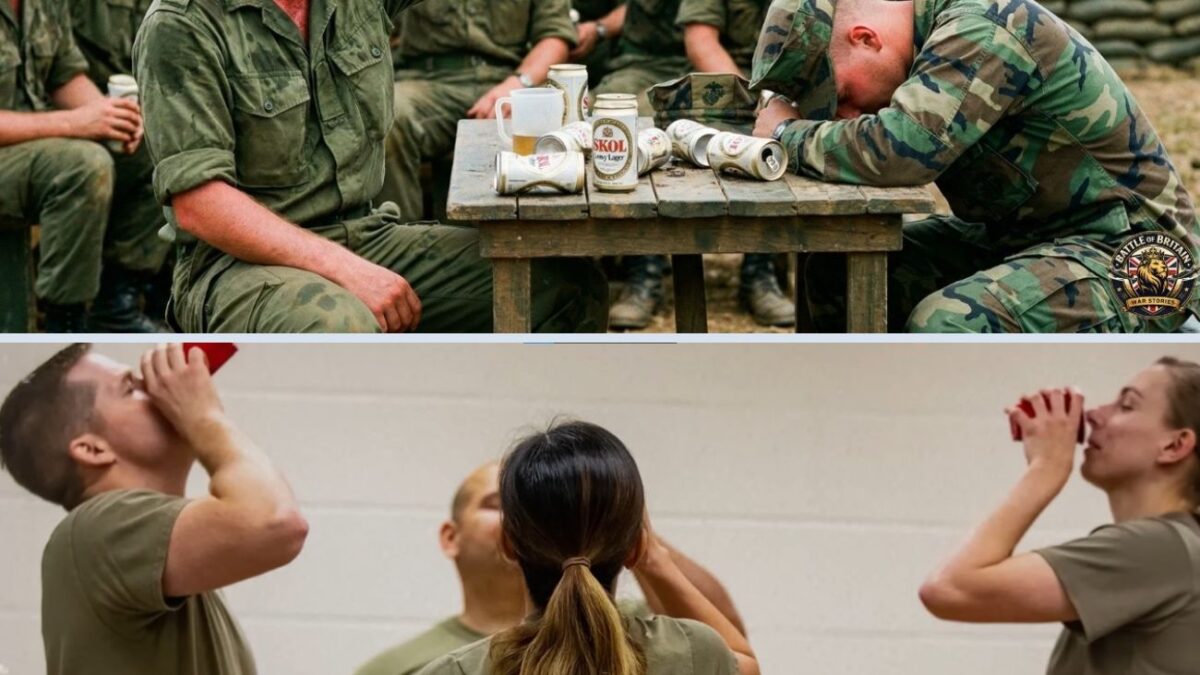
The document arrived on a desk at Camp Lejeune in the spring of 2004. It was not long. Two pages, standard formatting. The kind of pre-deployment medical readiness brief that crossed a thousand desks a year and was read by almost nobody. This one was different. The logistics coordinator who received it read it once, then he read it again. Then he walked down the corridor to his superior’s office and placed it on the desk without saying a word. His superior read it. He looked up. He looked back down at the page. Then he said the only thing that made any sense.
“Who signed off on this?”
The answer was everyone. The unit medical officer, the bilateral liaison coordinator, a representative from the joint training command. Every relevant signature was present. Every relevant authority had reviewed the document, agreed with its contents, and approved its distribution. Everyone had decided that this particular sentence needed to be printed on official paper, circulated through official channels, and placed in the hands of United States Marines before they deployed alongside British forces in Oman. The sentence read, “Personnel are advised not to attempt to match the alcohol consumption rates of British counterparts during social engagements.” Not a rumor passed between sergeants, not a scroll on a whiteboard that someone photographed and circulated, not the kind of quiet word a gunnery sergeant might lean across and deliver to his juniors over a cigarette before lights out. This was a printed, signed, medically endorsed, officially distributed advisory telling the United States Marine Corps, arguably the most physically demanding branch of the most powerful military on Earth, that they could not keep up with the British, and that they should not try.
The Marines who read it laughed. That is the predictable response from a man who has spent his career being told he is capable of anything and who has spent years proving it. They laughed the way men laugh when they feel certain they are being underestimated. They had drunk with South Koreans and with Canadians. They had closed bars from Okinawa to Camp Pendleton to the backstreets of every city a Marine Corps deployment had ever taken them. Nobody had ever felt the need to put a warning label on their allies before.
They stopped laughing in the sergeants’ mess. The advisory did not appear from nothing. Behind it were reports, incident logs, medical after-action summaries, and a pattern of documented events that had moved steadily up the chain of command from unit level anecdote to bilateral command problem over the course of several years. There was a pattern. The same pattern repeated with near perfect consistency across every joint exercise, every combined deployment, every social function where British and American soldiers found themselves in the same room with the same drinks and completely different ideas about what the evening was actually for. The drinking was not the point. It was never the point. But to understand what the point actually was, you first need to understand what the Americans walked into.
You need to understand where the British relationship with alcohol came from, how deep it ran, and why no two-page document distributed at an American base in North Carolina was ever going to prepare a United States Marine for what was waiting for him in a British sergeants’ mess on a Tuesday night in Oman. The British military’s relationship with alcohol is not a modern habit, a regimental affectation, or the cultural residue of a less disciplined era. It is an institution as formally constructed and as deliberately maintained as the rank structure itself. It predates every living soldier. It predates most of the regiments. In several meaningful ways, it predates the British Army as anything a modern soldier would recognize.
The Duke of Marlborough issued beer rations to his troops in the early 18th century, not because he was a generous man by nature, but because beer was demonstrably safer than the water available in the low countries, and a dead infantryman was of no practical use to anyone. The logic was operational, not sentimental. Wellington fed his army on rum through the Peninsular campaigns. The men who survived Badajoz and Salamanca, and the long grinding marches across Spain, understood, without anyone needing to explain it, that the drink waiting at the end of a day’s march was not a treat. It was part of the rhythm of soldiering. It was the full stop at the end of the sentence.
By the First World War, that rhythm had been formally written into military practice. The rum ration was official policy. The field canteen was an institutional fixture. The understanding that soldiers were owed a drink after doing what soldiers were asked to do was so deeply embedded in British military culture by that point, that removing it would have required demolishing something far larger than a supply chain or a distribution policy. It would have required dismantling a set of assumptions about what military service meant, and what a man was owed in exchange for it.
The NAAFI, the Navy, Army, and Air Force Institutes gave permanent formal shape to what had always existed informally in some version or another. A bar, a canteen, a social space on every British base on every continent where the British flag had ever been raised. Not hidden behind policy. Not grudgingly tolerated by commanders who privately disapproved. Officially sanctioned, institutionally funded, and understood by every soldier, sailor, and airman who ever passed through a British base to be as much a part of service life as the morning parade or the weekly inspection.
The NAAFI bar was where British military culture happened after the working day ended. The sticky carpet that had absorbed a generation of spilled drinks, the plastic chairs arranged around tables that had hosted a thousand arguments and a thousand reconciliations. The same jukebox playing the same rotation of songs since approximately 1987 and nobody willing to change it. It was not glamorous. It was never intended to be. It was the place where rank stepped quietly into the background, where a private could tell a corporal plainly that he had been an idiot in the training area without anyone filing a complaint, and where the real business of a unit, the business that never appeared in any operations order or training program, the business of figuring out who could actually be trusted, was conducted every night of the working week.
Alongside the NAAFI was the mess. Officers had theirs. Sergeants and warrant officers had theirs. Both were considered sacred ground in a way that no amount of cynicism about military tradition entirely dissolved. The mess held regimental silver that had been carried across three centuries and four continents. It held portraits of dead officers who had served in wars that most living soldiers could only read about. It held traditions that in the oldest regiments stretched back so far that their origins had been lost and only the practice remained.
Mess nights were formal occasions, port after dinner, toast to the monarch, toasts to the regiment’s fallen, and games and rituals that looked completely impenetrable to any outsider, and were entirely legible to anyone who had spent enough time inside the institution to understand what they were actually for. The Americans had none of this. Their institutional culture had moved in the opposite direction for several decades by the time joint bilateral operations brought the two militaries together with any regularity. Dry bases, zero tolerance policies, mandatory alcohol awareness training programs that treated drinking as a direct threat to operational readiness rather than as a component of it.
The intention behind those policies was reasonable and defensible. The execution was thorough and largely effective. And the result was that by the early 2000s, when American and British forces began operating alongside each other on a consistent basis, the two militaries were separated not just by accent and the spelling of certain words, but by a fundamental and largely unexamined disagreement about what a soldier was owed at the end of the day. The British believed he was owed a drink. The Americans believed he was owed a debrief and 8 hours of sleep. Both approaches were genuinely trying to produce effective soldiers. One of them had been doing it for 300 years.
The first joint social function of Exercise Saif Sareea 2 took place at a British field camp in Oman in October 2001. The dust from the day’s training had barely settled. The temperature was only beginning its slow retreat from a midday high of 42 degrees. The British had erected what they referred to without ceremony as the beer tent. A canvas structure with folding tables, Arctic coolers stocked with Stella, and approximately 40 soldiers from a battalion of the Royal Regiment of Fusiliers who had spent 14 consecutive hours in the field and showed absolutely no indication of slowing down.
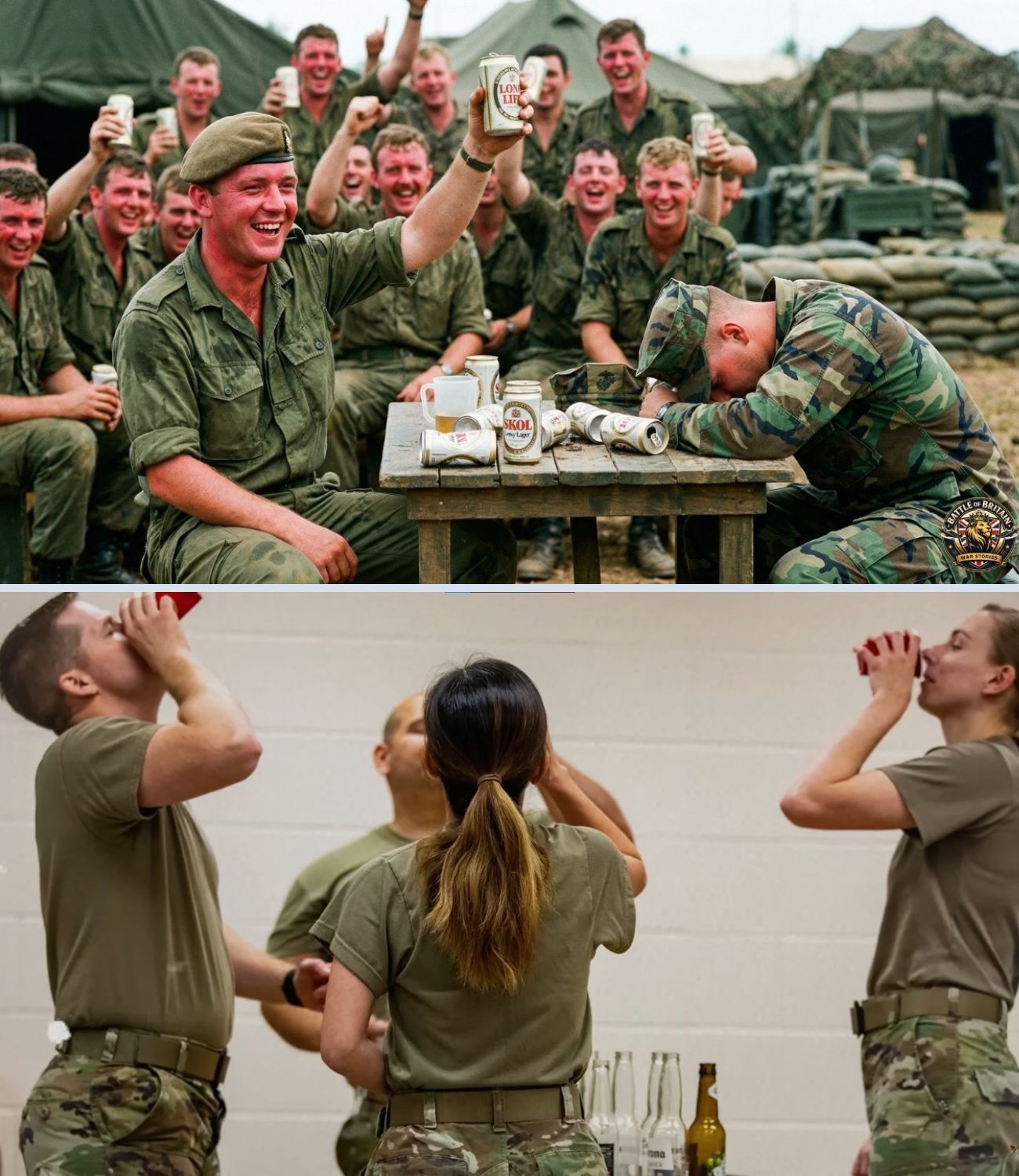
A Marine Staff Sergeant named Clayton Merritt walked through the entrance expecting something broadly similar to the wet messes he had encountered at other coalition exercises. Controlled, time-limited. One or two drinks before everyone dispersed sensibly to their sleeping arrangements. What he found inside was something he did not have an immediate framework for. The British were not drinking to decompress from the day. They were not drinking to mark an occasion or celebrate a milestone. They were drinking the way they breathed, steadily, continuously. With a quality of social ease that Merritt found difficult to account for. Officers and enlisted soldiers occupied the same space without apparent tension. The company sergeant major had his arm around the company commander. A corporal was engaged in a cheerful and apparently unresolvable argument with his platoon sergeant over a hand of cards. Nobody in the room appeared nervous. Nobody was performing composure or monitoring themselves against an invisible standard of appropriate behavior. The rank structure had not been abolished for the evening. It had simply and by mutual unspoken agreement agreed to wait outside until morning.
Merritt described the scene to his section the following morning, choosing his words with the care of a man trying to convey something that resisted straightforward description.
“Their colonel was at the bar,” he said. “Not standing in the vicinity of the bar. Not positioned near the bar in a way that implied accessibility. At the bar. Buying rounds. One of his privates was giving him a hard time about a tactical call he had made during the afternoon’s training and the colonel was laughing about it.”
He paused for a moment.
“Nobody in that tent seemed to think any of that was unusual. It was not unusual. It was Tuesday.”
The Marines processed this environment and arrived at the conclusion that nearly every American force arrived at on first genuine contact with British military drinking culture. This is a competition and we are going to win it. They were fit, experienced, extensively deployed, and proud of every one of those things. They were looking at a collection of British infantry soldiers who, stated with genuine respect, did not present as physical specimens obviously capable of outperforming United States Marines in any measurable category. They were wrong in a manner that would ultimately require medical documentation to fully capture.
A Marine Corporal named Derek Foss, 24 years old, two combat rotations behind him, described himself without hesitation as a man who had never lost a drinking contest in his life and had no intention of starting. He began matching drinks with a British private named Lee Hargreaves. Hargreaves was 20 years old, weighed 11 and a half stone, and had been drinking at the regimental NAAFI on a regular basis since the week he completed basic training approximately 18 months earlier. Foss lasted roughly 2 hours. Hargreaves reported for morning parade at 5:30 the following day with no visible effects whatsoever. Foss spent the following day in the medical tent receiving rehydration treatment.
When the incident was raised with Hargreaves the following afternoon, his response carried more genuine cultural intelligence per word than the entire two-page advisory would manage.
“I wasn’t trying to beat him,” he said. “I was just having a drink. Seemed like a decent lad, actually.”
There is a simpler version of this story. It ends with physiology. With tolerance built through years of regular drinking, with bodies conditioned by institutional culture to process alcohol at a rate that bodies without that conditioning simply cannot match. That version is accurate as far as it goes. But British soldiers did develop measurably higher functional tolerance than their American counterparts. The bilateral medical reviews documented it consistently from 2001 onwards. It was real and it was a factor. But it was not the point. The British military did not maintain its drinking culture across three centuries because alcohol made its soldiers physically harder to knock down. It maintained that culture because of what the drinking built around itself. And what it built was something no formal military process had ever managed to engineer deliberately. It was the most efficient system of human assessment any military institution had ever accidentally created.
When a soldier arrived at a British unit, the first real evaluation he faced came not during physical training or weapons handling assessments or any of the formal processes that filled the official record. It came at the NAAFI. This was not informal or incidental. It was the first genuine test and it had nothing to do with his capacity for alcohol. The evaluation was of something considerably more important than that. How did a man carry himself when the edges of his control began to soften? Did he become loud, aggressive, sentimental, boastful? Did he look for arguments or retreat from the room when things got lively? Did he go quiet in a specific way that suggested something worth monitoring? Did his stories remain consistent across the evening or did they quietly shift to accommodate whatever impression he was trying to create? And could he absorb a joke directed at him and return one without escalating? Did he know where his own limits were and respect them? Or did he push past them in an attempt to perform for a room that was not watching him as a competitor but assessing him as a potential colleague?
A British warrant officer named Gary Pallister, 23 years served, tours in Northern Ireland and Bosnia, and two rotations in Helmand, described the process without sentiment or apology.
“You learn more about a man in a single night at the NAAFI than you learn in a full month in the field,” he said. “The field lets a man perform the version of himself he wants you to see. The NAAFI lets him be who he actually is. I need to know who he actually is before I trust him anywhere that matters.”
Every mess night, every NAAFI session, senior NCOs were reading the room with a precision that no formal assessment tool could replicate. Nothing was recorded in writing, but the information was retained and circulated through the informal channels that run beneath every military unit, through late conversations between sergeants after the bar closed, through the RSM’s mental ledger of who was steady and who was not, through the quiet adjustments a section commander made to roles and responsibilities months before any formal review process would have surfaced the same information.
The Americans present at these functions did not know they were being assessed. They believed they were attending a social event. They treated the evening as a competition in the only terms that seemed to apply, volume consumed and time remained standing. The British were conducting something else entirely and doing it with the practiced efficiency of an institution that had been running the same assessment process in one form or another for the better part of a century.
A senior NCO from the 1st Battalion Royal Welsh, reflecting on a joint exercise conducted on Salisbury Plain in 2006, was entirely direct about what his regiment was doing when it extended an invitation to the attached Marine unit to join the sergeants’ mess function.
“We wanted to understand who we were actually working with,” he said. “Not their formal qualifications, not their physical fitness scores, or their weapons proficiency ratings, but who they were as men. The mess is how we find that out. It has always been how we find that out.”
The information moved in both directions through that process. The new arrival sitting in the NAAFI for the first time was simultaneously learning which NCOs were the real article and which were maintaining a performance, which officers had genuine authority in the unit and which had only formal rank, who would stand beside you when circumstances deteriorated and who would locate somewhere else to be. The mess stripped away the entire architecture of military bearing and professional presentation and left every man in the room visible as exactly what he was. The Americans moved through this process without understanding what it was. They thought the evening was about the drink. The British understood it was about everything else.
The advisory did not become a formally printed and distributed document because the British consumed large quantities of alcohol. It became a formally printed and distributed document because of what happened with near perfect consistency every single time American personnel attempted to keep pace with them. The incidents began accumulating from the earliest bilateral exercises of any meaningful scale and they followed a pattern so repetitive that the officers eventually responsible for documenting it ran out of new ways to describe what they were seeing. American personnel enter a British social function. American personnel observe the pace at which British personnel are drinking. American personnel interpret that pace as a direct challenge to their own capability and reputation. American personnel attempt to match it. American personnel require medical intervention.
During a joint training rotation at the British Army Training Unit Suffield in Alberta in 2003, seven Marines from a single company attended a mess function hosted by a battalion of the Green Howards alongside their attached British training staff. Four of the seven required medical evaluation before midnight. Two of those four received intravenous fluids to treat dehydration. The British training staff present at the same function reported zero medical incidents across the same period.
A Marine battalion surgeon named Dr. Patricia Hollis documented the outcome in her after-action report with the measured tone of someone who had stopped registering surprise but had not stopped registering concern.
“This is the third rotation in which we have documented this specific pattern,” she wrote. “American personnel are presenting for medical treatment at a rate approximately eight times higher than their British counterparts following joint social functions. The British counterparts in several documented cases subsequently performed physical training at full operational capacity the following morning.”
She added a final observation that the standard report format did not require and that she included regardless:
“I do not currently have a satisfactory explanation for this pattern. I have, however, now observed it with sufficient frequency to be confident that a satisfactory explanation exists.”
Beyond the medical incidents, there were disciplinary ones. When American personnel consumed alcohol beyond their functional threshold in the company of British soldiers, the informal social mechanisms that ordinarily kept behavior within acceptable boundaries failed in ways that were becoming predictable. Men who felt they were losing a drinking contest would sometimes redirect their competitive energy toward a contest with different rules. British soldiers who had been navigating the full spectrum of drunk male behavior since their first week of service were not easily destabilized by this.
A bar incident during a NATO exercise in Germany in 2005 produced two Marines with facial lacerations and one British corporal who emerged entirely uninjured and appeared to find the sequence of events genuinely confusing. He provided his account the following morning with authentic bewilderment.
“The large American sergeant told me I was watering the drinks,” he said. “I offered to open a sealed can directly from the cooler in front of him and begin again from that point. He accepted the offer. He did not enjoy the results.”
The incidents moved upward through the command structure from unit level logs to company level reports to bilateral command assessments that arrived at the same conclusions every rotation with the reliability of a recurring administrative problem that nobody had yet located the correct solution for. Every exercise, the same pattern, the same medical outcomes, the same asymmetry between forces that by every other operational measure were performing at broadly comparable levels.
A Marine Lieutenant Colonel named Philip Reardon, who served as bilateral training coordinator between 2003 and 2007, eventually committed the problem to paper in language designed to be read clearly at every level of the chain.
“The issue is not alcohol abuse in the conventional sense,” he wrote. “The issue is a fundamental cultural mismatch. British forces integrate alcohol into their professional and social culture in a manner that has no direct American equivalent and that our personnel are not equipped by training or experience to contextualize. Our personnel, lacking that context, interpret British social drinking as a competitive challenge. It is not a competitive challenge. It is their established baseline. And our established baseline cannot be elevated to match theirs without producing consistent and documentable medical consequences.”
That memorandum went up the chain. The medical staff reviewed it against the accumulated incident data. Then the advisory was formalized. The sentence was printed. Personnel are advised not to attempt to match the alcohol consumption rates of British counterparts during social engagements. It was the American military’s most formal and direct way of communicating a straightforward fact. You will lose this. Do not begin it.
The American doctors reviewing the data could not produce a satisfactory explanation for what the numbers were showing them. The Marine commanders experienced the particular discomfort of men who have encountered a problem that their professional formation has not given them the tools to name. The advisory itself could not state in plain language what the accumulated evidence was actually demonstrating. Because stating it plainly would have required the American military to formally acknowledge something that sat in direct contradiction to several decades of institutional policy.
The British soldiers who drank in this way were the best soldiers in every exercise, without exception, not on selected metrics. On all of them. Not in spite of the drinking culture, alongside it. The same men who were occupying the bar at midnight were at the assembly point before first light. The same NCOs who had rendered an entire Marine platoon operationally ineffective through the straightforward mechanism of drinking at their normal pace were the most tactically precise and situationally aware small unit leaders in the training area by the following afternoon. The same officers who were standing at the bar buying rounds for their younger soldiers were commanding the most cohesive, most responsive, most practically effective companies on the exercise.
A Marine battalion surgeon named Dr. James Holick reviewed accumulated medical and operational performance data from four consecutive bilateral rotations conducted between 2003 and 2007. The pattern he identified was consistent enough across all four rotations that he could not account for it as statistical variation. The British units with the most deeply embedded mess culture, the units where social drinking was the most thoroughly integrated into the rhythm of daily service life, consistently produced superior performance outcomes against every available operational metric. Reaction time assessments, patrol performance evaluations, decision-making quality under simulated pressure, unit cohesion scoring, casualty evacuation drill results, every category, every rotation.
“That is not something I can explain with anything I was taught,” he wrote in his summary. “But it occurred with sufficient consistency across sufficient rotations that the consistency itself demands explanation.”
A British major named David Sherborne, serving as liaison officer during a bilateral exercise in 2008, had observed the same cycle of American confusion repeating itself for long enough that he had largely stopped performing surprise at it.
“Every rotation produces the same conversation,” he said. “An American colonel identifies a quiet moment, positions himself beside me, and asks in a tone that suggests he is raising the subject for the first time, how it is that British soldiers perform the way they do given the way they drink. And I give him the same answer I have given every American colonel who has asked me that question. They do not perform in spite of the drinking, sir. They perform because of everything that the drinking has built between them. The trust, the genuine knowledge of each other, the kind of mutual understanding that cannot be produced in a formal training environment, regardless of how well that environment is designed.”
He added:
“The American colonel nods in a way that suggests comprehension. He does not comprehend.”
This was the central paradox that the advisory had no mechanism to resolve and no institutional willingness to directly confront. The American military had committed several decades of consistent policy effort to treating alcohol as a direct and manageable threat to operational readiness. By every available rational and institutional standard, that policy was defensible and largely correct. Alcohol degraded judgment. It produced measurable decrements in physical performance. It generated disciplinary failures, training losses, and medical costs. Every prediction the American approach made about the consequences of institutional drinking was supported by documented evidence from the bilateral exercises themselves. And the British produced better soldiers anyway.
What the Americans never entirely grasped across the early exercises and the bilateral reviews and the carefully worded command memoranda that eventually produced the printed advisory was that the British were not, in any functionally meaningful sense, simply drinking. They were operating a social technology. The alcohol was the delivery mechanism. What it was delivering was something the American military had spent an extended period and considerable institutional resources attempting to produce through formal means, through structured team cohesion programs and leadership development curricula and mandatory resilience training frameworks, and had never managed to produce with comparable results. What it was delivering was trust. The specific and irreplaceable variety of trust that only forms between men who have seen each other operate without the protective architecture of rank, professional presentation, and military bearing. The kind of trust that equips a section commander without reference to personnel files or performance reviews to know with genuine certainty which of his soldiers will hold his position when the situation deteriorates beyond what the plan accounted for and which one will need management at that moment rather than reliance.
A Marine captain named Rachel Fogerty completed a 6-month exchange attachment with a battalion of the Rifles in 2009. She arrived carrying a professional expectation that she would identify and document a significant readiness vulnerability. The assessment she left with was substantially different.
“In 6 months, I did not once observe a British soldier fail to meet his operational obligations as a consequence of the previous night at the NAAFI,” she stated. “I observed on multiple occasions where British soldiers performed at a level that exceeded reasonable expectation because of the quality of the relationships they had constructed through exactly that environment. They possessed genuine knowledge of each other. Not the formal professional knowledge that personnel files and assessment records provide. Personal knowledge. They knew which soldier was managing a difficult period. Who was dealing with something at home. Who was reliably steady in the moments that tested steadiness and who needed additional support in those moments. They held this knowledge because the NAAFI provided the conditions under which it could be acquired honestly.”
She paused before continuing:
“We didn’t have an equivalent space. We had mandatory resilience program sessions and scheduled chaplain’s office availability. They had the NAAFI. Their approach produced better outcomes. I’m stating that as someone who does not personally consume alcohol.”
What the British had preserved through institutional inertia and regimental stubbornness and the simple resistance of serving soldiers to any proposal that their post exercise drink be removed from them was something the American military had dismantled with the best available intentions and had not replaced with anything that performed an equivalent function. The NAAFI was a decompression environment, a space for honesty, an informal assessment mechanism, a leadership development instrument operating continuously under cover of a social occasion. And the regimental identity that surrounded it gave every element of it a depth and continuity that no purpose-designed team cohesion program could approach.
A British regiment is not, in the experience of the soldiers who serve in it, primarily an administrative designation. It is an identity that precedes and will outlast the individual soldier’s service within it. A soldier in the Parachute Regiment does not work for the Parachute Regiment in the way an employee works for an organization. He is Para. That is a different relationship entirely. And it means the mess is not a facility or a benefit. It is the physical location where the thing he belongs to makes itself tangible. The regimental silver is not decorative. It is continuity across time. The portraits are not commemorative. They are the faces of men who held the same identity in circumstances that tested what that identity required of a person.
A retired regimental sergeant major named Keith Osborne, 31 years of service, put the operational philosophy into language that required no translation and no elaboration:
“We continued drinking because the substantial majority of our soldiers could manage it appropriately. And the soldier who could not manage it appropriately, we identified in the NAAFI before we discovered it in a contact situation. That is not a problem with the system. That is the system operating as intended.”
The subsequent rotations confirmed the established pattern with the mechanical regularity of a process that had found its equilibrium and saw no reason to depart from it. Marines who disregarded the advisory and attempted to match the British pace ended up requiring medical attention. Marines who followed the advisory and abstained from drinking spent the evening positioned on the outside of something they could identify but not quite name. A quality of ease and mutual knowledge in the room around them that their presence had not been admitted to. The British registered both outcomes. They always registered them.
A British lance corporal named Mick Jennings, Royal Anglian Regiment, three deployments to Afghanistan across his service, described the resulting dynamic without diplomatic softening:
“The Americans who tried to drink with us at our pace ended up on the floor or close to it. The Americans who chose not to drink stayed on the outside of the evening entirely. We didn’t extend trust to the ones who ended up on the floor because they had demonstrated they couldn’t manage themselves. We didn’t extend trust to the sober ones because we had no basis for knowing them. Either way, the outcome was identical. We didn’t know them.”
This was the unresolvable position the advisory had created for every Marine who read it and for which it offered no practical exit. Attempt to match the British and fail physically. Decline to participate and fail socially. The document addressed the physical risk with medical precision and appropriate institutional authority. It said nothing at all about the social cost because the American military had not developed a framework within which social exclusion from a British mess night registered as an operationally relevant problem requiring formal address.
A Marine Master Gunnery Sergeant named Lawrence Hubbard, 24 years of service in the Corps, made an admission to a British counterpart during a bilateral exercise in 2013 that came closer to the actual nature of the problem than anything the official reporting had managed to articulate.
“I have 38 Marines in my platoon,” he said. “I can tell you the fitness score of every one of them. I can tell you their marksmanship qualifications. I can tell you their proficiency ratings against every assessed standard. And I will be honest with you. I don’t genuinely know half of them. Not the way you know your soldiers.”
The British Sergeant Major he was speaking with, a man named Darren Whitfield, received this without visible surprise. He had 32 soldiers under him. He knew every one of them in the way Hubbard was describing and in ways that extended considerably beyond it. What they drank and the pace at which they drank it and the specific subjects that occupied them after their fourth drink of the evening. Who became quiet and in what particular quality of quietness. Who became animated. Who made the phone call home and who systematically avoided making it and the reasons behind each. Whitfield had not assembled this knowledge through any formal process. He had assembled it through years of evenings at the NAAFI. One conversation at a time across the full span of his service.
“And that knowledge makes your platoon more effective?” Hubbard asked.
“That knowledge,” Whitfield said, “is my platoon.”
No formally worded two-page medical advisory was ever going to contain what was actually being described in that exchange. The Americans had not arrived in Oman or Suffield or on Salisbury Plain facing a challenge about alcohol. They had arrived facing a culture. A culture shaped at the Somme where the rum ration was the only warmth available on a November morning in standing water. Refined in the Western Desert where a tin of beer at the end of a day of tank fighting was the small and sufficient confirmation that the day had been survived, tested in the jungle campaigns of the Far East and the streets of Belfast and the mountains of the Falklands where soldiers sailing 8,000 miles to recover a group of islands in the South Atlantic stopped at Ascension Island and took one final drink together before crossing into the exclusion zone.
That culture had been accumulating its weight and depth for several centuries before the first United States Marine encountered it across a bar in a British field camp in Oman. It was not going to be redirected or substantially modified by a two-page pre-deployment advisory issued at Camp Lejeune in the spring of 2004.
The last formal statement on the advisory before its revision in 2017 came from a Marine Colonel named Vincent Tran who had commanded a battalion through a bilateral rotation the previous year. His assessment was the most direct and honest public statement any American commander had produced on the subject across the entire period the document had been in circulation.
“The advisory is correct in what it recommends,” he said. “Our Marines should not attempt to match the British not because our Marines are in any sense less capable but because the British are not engaged in the activity our Marines believe they are engaged in. Our Marines walk into a British mess function and see a drinking contest that they can apply their competitive instincts to. The British walk into the same room and see a Monday night. We are competing in an event that the other side is not aware is taking place. And you cannot win a competition that your opponent doesn’t know is happening because from their perspective, it is simply how they live.”
That was the observation the advisory had been circling for its entire operational life without quite arriving at. The British were not outdrinking the Americans. They were, in the most straightforward and literal sense available, outliving them. Living in a way that drew no meaningful distinction between the soldier on exercise and the man at the bar. Between the discipline required before first light and the honesty permitted after last orders. Between the formal structure of the working day and the informal truth-telling of the evening.
The Americans had separated those things from each other deliberately and for considered reasons. The result was a military that was neater, more formally consistent, more measurably compliant with its own stated standards. But when the two approaches were placed beside each other in the same desert camp in Oman, in the same training area in Alberta, on the same plane in Wiltshire, the British fabric held together in a way the American fabric could not entirely match. The advisory was a stitch. Practically necessary. Medically responsible. And entirely reasonable given the evidence that had accumulated to support it. It never reached the thing it was actually trying to address.
“Personnel are advised not to attempt to match the alcohol consumption rates of British counterparts during social engagements.”
Read it once more. Now you understand what it actually meant.
You Might Also Enjoy

“We Thought They Would Negotiate”—What Argentine Soldiers Said When The British Attacked Goose Green

“You’ll Never Finish My Ruck March, Limey” — US Sergeant Who Challenged the SAS, Then Fell Out First






