Duke Of Kent ABSOLUTELY Despised His Brother Prince Michael, Here’s Why
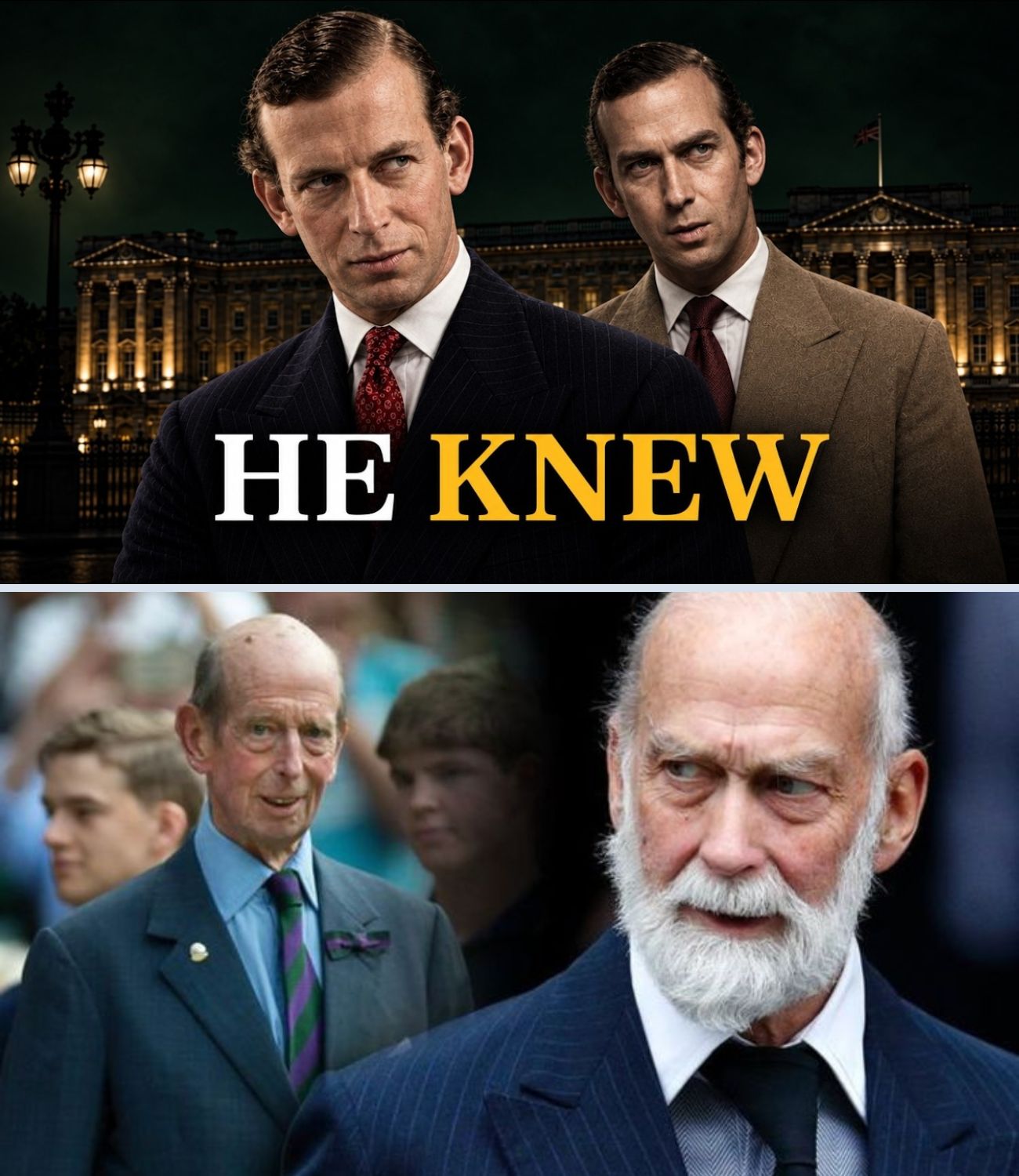
Two brothers lived inside the same palace wall. One paid rent. The familiar version says the Duke of Kent was dutiful and his younger brother was awkward, married to a difficult woman, and that they didn’t speak. The documents say something much colder. In 1978, Prince Michael married a Catholic and lost his place in the line of succession. In 1994, the Duke’s own wife became Catholic, and he lost nothing. Michael bought a manor house in Gloucestershire because he had no palace to inherit. He was never on the civil list.
The answer begins on a Scottish hillside in 1942. Before we get there, I want you to sit with the address for a minute because the address is the whole story in miniature. Kensington Palace is not one house. It’s a compound, a walled village of apartments and grace-and-favour cottages where the British royal family stores the relatives it needs nearby, but not central. For decades, two Kent households lived inside that wall. The Duke of Kent, Prince Edward, the elder brother, the one who inherited the title at six years old, occupied an apartment there and later moved into Wren House in the grounds. His younger brother, Prince Michael, lived with his wife in apartment 10, one of the larger sets, same surname, same parents, same perimeter, different billing status.
For years, Prince and Princess Michael of Kent paid a rent widely reported at around £69 a week. Not a typo, £69 a week for a substantial apartment in central London at a time when ordinary Londoners were paying that much for a room in a shared flat in zone 3. In 2002, the Commons Public Accounts Committee took an interest, as committees do when they discover that the state is housing minor royals for the price of a weekly shop. The arrangement was examined. The conclusion was awkward. And the solution, when it came, told you more about this family than any interview ever has. The Queen paid it privately from her own funds, a market rent reported at around £120,000 a year on behalf of her cousin. That arrangement ran until 2010 when it was reported that Prince and Princess Michael would take over the payments themselves.
So here is the situation in one sentence. The elder Kent brother lived in his home because of who he was. The younger Kent brother lived in his because the monarch personally wrote a check and then stopped. That’s not a feud. That’s a ledger. And now the part people actually clicked for. In May 2021, the Sunday Times and Channel 4’s Dispatches published an undercover investigation. Reporters posing as representatives of a South Korean gold investment company had approached Prince Michael through an associate, the Marquess of Reading. On a video call, Reading described Michael as being able to open doors in Moscow and discussed what access to the Kremlin might be worth. Michael himself on camera spoke about the possibility of making a recommendation and of traveling to Russia. A fee in the region of $200,000 was discussed for a speech and endorsement. His office responded that no payment was ever made, that no agreement was reached, and that Prince Michael had no special relationship with Vladimir Putin, pointing out that the two had last met in 2003. That response matters, and I’ll come back to it, because the defense was true and also beside the point. The question was never whether Michael had a line to Putin. The question was why a 78-year-old grandson of King George V was on a video call with strangers at all, selling the one asset the family had given him and then refused to fund.
Compare the same decade for his brother. In 2021, the Duke of Kent stepped down as president of the All England Lawn Tennis Club, a position he had held since 1969. 52 years of handing the Wimbledon trophies over, of standing in the royal box, of being the most photographed man in British sport who nobody could name. He handed it to the Duchess of Cambridge. No scandal, no statement, no interview. He had also been Grandmaster of the United Grand Lodge of England since 1967, which made him, in a strange and very English way, one of the most institutionally powerful private men in the country. And in all those decades, he said almost nothing on the record about anything. Two exits from public life within a few years of each other. One was a sting, one was a handover.
So the question that drives everything that follows isn’t did they hate each other. It’s this. Why did only one Kent brother ever need money from strangers? The answer is not personality. I want to be very direct about that because the internet version of this story and the tabloid version going back 40 years is built on anonymous palace sources saying the brothers were cool, distant, that the Duke couldn’t stand his sister-in-law, that invitations stopped. I’ve looked for the hard version of that. There isn’t one. No letter, no diary entry, no named witness on the record, no statement from either man. Everything we have about personal animosity between Edward and Michael is unsourced press allegation repeated so often it calcified into fact. What’s documented is much more interesting and considerably bleaker. These two men were sorted before either of them could speak in full sentences into owner and dependent by birth order, by statute, by a set of rules nobody in the family wrote, and nobody in the family was willing to change for either of them.
Which brings us to Scotland. On 25 August 1942, a short Sunderland flying boat took off from Invergordon carrying their father, Prince George, Duke of Kent, on a flight to Iceland. 30 minutes in, in bad visibility, it hit high ground at Eagle’s Rock near Dunbeath in Caithness. 14 of the 15 men aboard were killed. The rear gunner, Andrew Jack, survived and crawled away from the wreckage. Prince George was 39. He was the first member of the royal family to die on active service in centuries and the circumstances have attracted conspiracy theories ever since. Most of them unsupported.
The crash itself is not the story here. The arithmetic afterwards is Edward was six years old. He had been born in October 1935 and on that afternoon in August he became the second Duke of Kent. Everything attached to the title, the precedents, the property, the position in the household, the future funding moved to him in a single legal instant. Michael was seven weeks old, born on 4 July 1942. His father was dead before he could form a memory of him, and his American birthday had already been noticed. He was christened Michael George Charles Franklin with Franklin D. Roosevelt as a godfather standing by proxy. A seven-week-old baby was already being used to signal something to Washington.
That’s the Kent family habit in its purest form. Proximity converted into prestige applied to an infant. Michael inherited the christening. Edward inherited the estate. Their sister Alexandra, born in 1936, sat between them in age and would end up with her own long career of public duty. The sharp divide was between the two boys, and it was financial before it was anything else. Their mother, Princess Marina, was widowed at 35. She had been born a princess of Greece and Denmark into a family that had already lost one throne, and she arrived in Britain in 1934 with style, taste, and comparatively little money. George’s death left her with three small children, a house at Coppins in Buckinghamshire that the family had inherited from an aunt, and an income problem that was discussed in Parliament.
In March 1947, a quantity of the late Duke of Kent’s effects went to Christie’s. Pictures, silver, objects. It was presented in the press as a routine clearing of an estate. In practice, the widow of the King’s brother was raising cash at auction four and a half years after his death. I keep returning to that sale because of what it taught the house. Everybody inside Coppins learned the same lesson at the same time and they learned it differently depending on what they were going to inherit. Edward learned that the family position was something you protected by never making noise. Michael growing up in a household where the money was finite and the name was infinite learned the other half of the equation that the name itself was the only liquid asset anybody in that family actually had. One of them would spend 60 years refusing to monetize it. The other would spend 60 years having no alternative.
Marina died at Kensington Palace on 27 August 1968 of a brain tumor. She was 61. Michael was 26, Edward 32. And in 1972, four years later, the Duke of Kent sold Coppins. That was his to sell. It had come with the title, it was expensive to run, and plenty of aristocratic families were offloading country houses in exactly that period for exactly those reasons. Nobody suggested at the time that it was an act of hostility. And I’m not going to suggest it now, but look at what it did. The last physical place the three Kent children had shared, the house their mother had held on to through widowhood, the house she had kept going while selling the contents of her husband’s life left the family. It left because the brother who owned it decided it should. The younger brother had no vote because the younger brother had no stake.
Michael was 30. He had been commissioned into the 11th Hussars. He had taught himself fluent Russian to the standard of a qualified interpreter. And he had, as a grandson of a king, a diary full of nothing. There was no job for him. There was no apartment for him yet. There was no annuity for him, and there never would be. What there was, waiting quietly in the statute book, was a law from 1701 that neither brother had ever had reason to read.
Six years later, Michael read it. The Act of Settlement was written in 1701 to solve a dynastic problem that had nothing to do with anybody in this story. Parliament, having spent a century fighting over whether England would be Protestant, decided to settle the matter permanently by writing it into the rules of inheritance. Anyone in the line of succession who married a Roman Catholic was out, not demoted out. The clause didn’t care about faith, belief, or practice. It cared about one legal act, the marriage. Sitting beside it was the Royal Marriages Act of 1772, which required descendants of George II to obtain the sovereign’s consent before marrying at all. Put those two laws together and you get the trap that defined Prince Michael’s adult life. He needed the Queen’s permission to marry. He got it, and the permission came with no protection whatsoever from the other statute which was waiting to charge him for exactly the thing he’d just been allowed to do.
The family said yes. The law said you’ll pay for it. Nobody in the family offered to intervene between the two. To understand how differently that could go, you only have to look at what happened when the elder brother got married. Edward met Catherine Worsley through his regiment. He had gone through Eton and Sandhurst and been commissioned into the Royal Scots Greys in 1955, and in the late 50s he was stationed at Catterick in North Yorkshire. Catherine was the daughter of Sir William Worsley, fourth baronet of Hovingham Hall, old Yorkshire gentry, Anglican county, impeccable. She was nearly three years older than him. Contemporary reporting described a courtship that was quietly discouraged for a while, and several accounts suggest the family wanted them to wait and be certain, which is the polite institutional way of saying the matter was under review.
The review ended well on 8 June 1961, and they married at York Minster, the first royal wedding held there in centuries in a cathedral rather than a London church because the bride’s family belonged to that county and the match was secure enough to be celebrated on her ground. The Queen attended. Princess Anne, aged 10, was a bridesmaid. The BBC broadcast it. Audience estimates ran to around 20 million people in a country of 53 million. Nothing about that wedding cost Edward anything; it added. He married a Protestant English woman of good family with the sovereign’s enthusiastic consent in a ceremony the state broadcaster carried live, and the whole event functioned as a public advertisement for the stability of the junior branch.
Their three children, George Earl of St. Andrews, born in 1962, Lady Helen, born in 1964, Lord Nicholas, born in 1970, arrived into the line of succession without a lawyer needing to check anything. Hold on to Nicholas. He matters later in a way nobody could have predicted in 1970. Edward stayed in the army for 21 years. He served in Hong Kong, Germany, Cyprus, and Northern Ireland, and he resigned his commission in 1976 as a major to take on full-time royal duties. That’s a sentence worth slowing down on because it’s the whole difference between the brothers, compressed into one career decision. Edward could resign a paying job and move into unpaid public duty because unpaid public duty wasn’t unpaid for him.
He held a civil list annuity, the parliamentary grant that covered the official expenses of working members of the family. By the early 90s, it stood at around £236,000 a year. And from 1993, the Queen reimbursed the Treasury for it out of her own income, which changed the source of the money and not the existence of it. Michael’s annuity was nothing. There was no annuity. There never had been and there never would be. That wasn’t malice. It was arithmetic. The civil list funded a set of people who performed the monarchy’s work, and the list had to stop somewhere.
Michael was a grandson of George V, a first cousin of the Queen, a man who would be expected to show up in uniform at Remembrance Sunday and accept patronages and represent the family abroad. And he was also the second son of a dead younger brother, which in this system is a category of person the money runs out just before reaching. So he worked. He was commissioned into the 11th Hussars in 1963, served in Germany, Hong Kong, and Cyprus, and he did something unusual for a royal officer. He qualified as a Russian interpreter. That’s not a party trick. The British Army’s Russian course was serious Cold War work, and he passed it to interpreter standard. Through his mother, he was also a direct descendant of Tsar Nicholas I and a great-great-grandson of Alexander II, and he grew a beard in middle age that made the resemblance to the murdered Tsar Nicholas II close enough that Russians commented on it for the rest of his life.
Keep that combination in mind. Fluent Russian, Romanov blood, a face from a famous photograph, and no income. 30 years later, somebody was going to put a price on it. He met Marie Christine von Reibnitz in the early 1970s. She had been born in Carlsbad in January 1945 in the last months of the war to Baron Gunther von Reibnitz and the Hungarian countess Marianne Szapáry. Her parents separated. She was raised largely in Australia, came to London, worked in interior design, and in 1971 married a banker named Thomas Troubridge. That marriage separated in 1973. She was Catholic, foreign, divorced, and in 1977 when the relationship with Michael became serious, she was still married in the eyes of her own church.
The clearing of that obstacle took two separate legal systems. The civil divorce came through in 1977. The Catholic annulment of the Troubridge marriage came in May 1978. Only then could a Catholic wedding be contemplated at all. And only then did the Vatican question arrive. The one that actually decided how this marriage would look. Rome’s permission for a mixed marriage carried a condition, an undertaking that the children would be raised Catholic. Michael would not give it. Contemporary reporting at the time and the accounts since agree that the permission for a nuptial mass was withdrawn over precisely that point.
Think about what that refusal cost him and what it bought. It cost him a church wedding and years of irregular standing with his wife’s religion. It bought him nothing at all in London because the Act of Settlement didn’t offer part credit. The children of the marriage, Lord Frederick Windsor, born 1979, and Lady Gabriella, born 1981, were raised Anglican and therefore kept their places in the line of succession. Their father lost his. He gave up the Catholic ceremony to protect his children’s position, and the law took his position anyway.
The family said yes. The law said you’ll pay for it. The wedding happened on 30 June 1978 at the Rathaus in Vienna, a civil ceremony in a municipal building in a foreign capital with a registrar. The Queen had given her formal consent under the Royal Marriages Act at a meeting of the Privy Council earlier that month. She did not attend the wedding. Contemporary coverage described a turnout of relatives rather than the state occasion Edward had been given 17 years earlier at York Minster. No minster, no broadcast, no 20 million people. Accounts of exactly which royals were in the room vary in the retellings, which is itself revealing. Nobody considered the guest list important enough to record with the care they’d given the seating plan in York.
That’s the comparison. Same family, two weddings. One was televised nationally as a statement of continuity. The other was a civil formality in Austria approved in writing and attended without ceremony. And on the day the registrar finished, Prince Michael of Kent ceased to be in the line of succession to the British throne. He was 15th or 16th in line, depending on how you counted the arrivals of that decade. Nobody seriously believed he was going to be king. But the line of succession in that family isn’t a lottery ticket. It’s a membership card. It’s the formal statement that you are inside the institution rather than adjacent to it.
He had been born into it and he was removed from it by a document signed in Vienna. The family consented and then let the statute do the punishing. There’s one more detail from that wedding that tells you how the system filed her. Marie Christine became Her Royal Highness, Princess Michael of Kent, not Princess Marie Christine. She took her husband’s first name as her own title because British royal convention gives no independent style to a woman who marries in. She was a baroness in her own right by birth and became by marriage a woman legally named after her husband. She had opinions about that and she expressed them, and the British press spent the next four decades making her pay for it. The nickname Princess Pushy appeared early and stuck for life. It was funny the first hundred times somebody printed it, and it was still being printed in her 70s.
Three years into the marriage, Michael made the decision that separated him permanently from his brother’s version of royal life. In 1981, he resigned his army commission. He was 38, a major with a wife, a toddler son, a daughter on the way, a grace-and-favour apartment at Kensington Palace, and no salary from the state. He went into business, consultancy in the loosest and most elastic sense of that word, trade advisory work, corporate relationships, directorships, a vehicle later trading as Kent Services. He also took on royal engagements, hundreds of them over the years, often representing the Queen abroad, unpaid, unfunded, and performed in the same weeks he was earning his own living.
That’s the arrangement fully assembled by about 1982. The elder brother performs royal duties and is funded to do it in a house that comes with his rank. The younger brother performs royal duties, pays for his own suits, and goes to meetings in the afternoon. Nobody wrote that down as a policy. Nobody had to. And for 30 years, nobody outside the family had much reason to examine it until a newspaper started asking questions about the father-in-law.
The story broke in the Daily Mirror in April 1985. Baron Gunther von Reibnitz, Princess Michael’s father, dead since 1983, had been a member of the Nazi Party, joining in 1930, and had held rank in the SS. The documents were real. The research had been done in German archives by a historian working with the paper. There was no plausible denial available, and she didn’t attempt one. What she did was call a press conference.
That response is worth noticing because it establishes something about her that the Princess Pushy caricature was designed to erase. She was not passive and she did not wait for the palace to handle it. She said she had not known, that the news was a shock, and that she had believed her father’s war record to be something else entirely. Her mother, the Countess Szapáry, gave supporting accounts. Several historians and journalists over the years have noted that von Reibnitz’s party membership was early, but that his SS rank appears to have been honorary rather than operational, and that he was expelled from the party in 1944 after marrying a woman with Jewish ancestry in her family line, his wife’s grandmother. Others have pointed out that an honorary SS title was still an SS title. That dispute has never been fully settled, and it is not the point here.
The point is what the story did to two households inside one wall. For the Michaels, it was permanent. From 1985 onward, every profile of Princess Michael of Kent in the British press carried the same paragraph. It attached to her, then to him, and it gave the tabloids a license they used for the rest of her public life. The plagiarism allegations over her books came later. The hostile briefings about her spending came later. The incident in a New York restaurant in 2004 and the 2017 Buckingham Palace lunch where she wore a piece of jewelry whose history she apologized for. All of that arrived afterwards onto a surface already prepared.
For the Duke of Kent, the same story did something else. It made distance valuable. I want to be careful here because this is exactly the point where the estrangement rumors take over and start presenting themselves as evidence. There is no documented confrontation. No letter from Edward, no recorded remark. What there is is a pattern of institutional behavior that anybody can check. As the junior Kent household became a reliable source of negative coverage, the senior Kent household became conspicuously harder to photograph, harder to quote, and harder to attach to anything. Edward had been doing that since the 60s, so it wasn’t a new strategy. It was an old strategy that suddenly had an obvious payoff. Silence protects you most when the person next door is making noise.
And now the property, because this is where the inequality stops being abstract. In 1981, Prince and Princess Michael bought Nether Lypiatt Manor near Stroud in Gloucestershire. A grade I listed house, early 18th century, small by stately standards with wrought iron gates and a reputation locally as a haunted house. She restored it. She wrote about it. It became the place they were photographed in Wellington boots, the country address that made them look like what everybody assumed they already were. They bought it with their own money. They bought it because there was nothing to inherit.
Compare that with what Edward had: the apartment at Kensington Palace, and from 1979, the use of Anmer Hall on the Sandringham estate held on a long lease from the Queen. The Duke of Kent did not need to purchase a country house because the family’s property system supplied one. His brother went to a Gloucestershire estate agent. Nether Lypiatt is the object I’d ask you to hold on to. A house bought instead of inherited. It looks in every photograph like old money. It was the exact opposite. It was a purchase made by a man with a royal title and a mortgageable name, and the mortgage eventually came due.
While the Michaels were restoring a manor house, the other Kent household was going through something it has never publicly discussed in detail. And I’m going to treat it with the restraint the family has asked for. In 1977, the Duchess of Kent lost a baby, a stillborn son. He was named Patrick. She had contracted rubella during the pregnancy, and the loss was followed by a long period of illness that was reported at the time in general terms and described more fully much later. She had a miscarriage in 1975. Through the early 80s, she withdrew repeatedly from engagements. Contemporary reporting referred to nervous strain and to treatment. In interviews given decades afterwards, she spoke about depression and about a period she described as the worst of her life.
That is the private chronology running underneath the most famous image of her husband’s public career. Those are the years when the Duke of Kent was on the Centre Court balcony every July handing a trophy to Björn Borg, then to John McEnroe, in front of a global television audience as the human symbol of British continuity and good manners. He did that for 52 years. Some of those summers he did it while his wife was unwell at home.
In 1994, Catherine was received into the Roman Catholic Church. She had been going to mass for some time, and she said afterwards that she valued the structure and certainty of it. She asked for and received the Queen’s blessing before taking the step, and she made a point of saying the Queen had been supportive. The Archbishop of Westminster, Cardinal Basil Hume, received her at Archbishop’s House. She was the first member of the royal family in modern times to convert publicly. Her husband lost nothing, not a title, not a place in the succession, not a penny. He remained where he had always been, somewhere in the 20s of the line, a working royal with a civil list annuity and a cathedral wedding behind him.
The reason is a piece of legal drafting from 1701 that is almost comic when you lay it flat. The act disqualified a person who married a Catholic. It said nothing about a person whose Protestant wife later became one. Edward had married an Anglican in 1961 in an Anglican cathedral and the law had already finished with him. What she believed 33 years afterwards was legally irrelevant. Michael had married a Catholic on a Friday in Vienna and been struck out the same day. Same family, same faith, opposite price. The difference between them wasn’t piety, loyalty, or conduct. It was the sequence of events relative to a wedding date.
I don’t think there’s a scrap of evidence that Edward enjoyed that or that Michael resented it out loud. Neither man has ever said a public word about it. What I’d put to you is that a rule which rewards one brother for timing and punishes the other for honesty does not need either of them to feel anything in particular. It does the damage on its own every day for 40 years without a raised voice.
Which brings us back to the rent and to the moment the arrangement stopped being a family matter and became a parliamentary one. The grace-and-favour system had always worked on an understanding rather than a contract. The sovereign housed relatives who performed public duties. Nobody audited it because the civil list accounts weren’t published in a form that made auditing easy. That changed through the 90s and into the 2000s as royal finances came under sustained scrutiny. And in 2002, the Public Accounts Committee examined the use of royal palaces, including the occupation of apartments by members of the family who were not funded for official duties.
The Michael’s apartment at Kensington Palace came up. The £69 a week came up. So did the uncomfortable structural fact underneath it. Prince Michael received no public money for the royal engagements he performed and simultaneously received a substantial benefit in kind that he didn’t pay for. The state was not paying him. The state was housing him. Members of the committee were not impressed by the elegance of the distinction.
The Queen’s solution was personal. She paid a market rent on his behalf reported at around £120,000 a year out of her own funds so that no public subsidy could be alleged. It was reported as generosity, and in one sense it was. It was also the most precise statement of hierarchy available. A man in his 60s, a grandson of a king living in a palace because his cousin was covering him.
Scrutiny returned around 2008 and 2009. In 2010, it was announced that the Michaels would pay the market rent themselves. They were 68 and 65 years old. He had no annuity, no inheritance, and no army pension worth the name after resigning at 38. He had a consultancy business, directorships, a wife who earned from her books and lecture tours, and an apartment that now cost six figures a year.
In 2006, in the middle of that pressure, between the first round of scrutiny and the second, Nether Lypiatt Manor was sold. Reported price around £5.75 million. They had owned it for 25 years. Princess Michael gave interviews at the time describing the house as too much to maintain and the couple as wanting to simplify, which is what everyone says when they sell a house and may well have been true. Look at the sequence, anyway. The committee asks questions in 2002. The country house goes in 2006. The rent transfers to them in 2010.
I’m not going to tell you the sale was caused by the rent because no document establishes that, and the house was genuinely expensive to run. What I’ll say is narrower and harder to dodge. The only piece of real property this branch of the family ever owned outright was bought because nothing was inherited and was gone before the brothers were 70. 34 years after their mother sold her husband’s belongings at Christie’s to keep a household running, her younger son sold the house he’d bought to replace the one his brother had sold.
And here’s the part that closes the escape route. By 2006, Michael could not have left. Not realistically. He could not resign his royal status. There’s no mechanism for it and no precedent short of abdication-level crisis. He could not take ordinary employment because no ordinary employer hires a prince for his skills. His name was the asset, and the name belonged to an institution that had declined to pay him for carrying it. Every option available to him involved selling access to a family that gave him no money and retained the right to be embarrassed by how he raised his own. His brother never faced a single one of those choices.
In 2001, though, the 1701 statute finally reached across the wall and took something from the elder household, too. And it took it from the child nobody had thought to worry about. Lord Nicholas Windsor was Edward and Catherine’s youngest, born in 1970, the son who had grown up in the years his mother was unwell. In 2001, he was received into the Roman Catholic Church. Under the Act of Settlement, he lost his place in the line of succession on the spot, not for marrying anyone, but for the belief itself, because the statute also barred any person who was or became a Catholic. That’s the second half of the clause, and it’s why the law looks so arbitrary once you see it operating on one family.
It punished Michael for a wedding. It left Edward untouched after his wife’s conversion. It then removed Edward’s son Nicholas for a personal act of faith that involved no wedding at all. Three outcomes, three different mechanisms inside one surname.
Nicholas married Paola Doimi de Frankopan in 2006 in a Catholic ceremony in the Vatican gardens. The first member of the British royal family to be married inside Vatican City. His parents attended. His father, the Grandmaster of English Freemasonry, a body the Catholic Church has formally opposed for centuries, sat in the congregation at his son’s Catholic wedding.
Five years earlier, his mother had already done something no serving royal had done in living memory. In 2002, the Duchess of Kent asked to stop. She gave up the use of her title in everyday life and asked to be known simply as Catherine Kent. She withdrew from the public rota of engagements, the ribbon cuttings and the hospital visits and the standing in the second row. And then she went to work. She taught music in a primary school in Hull under the name Mrs. Kent for around 13 years. Most of the children did not know who she was. She co-founded a charity, Future Talent, to find and fund musically gifted children from low-income families.
She kept appearing at Wimbledon occasionally, including the 1993 final where she comforted Jana Novotná on the balcony, an image that ran on front pages everywhere and is probably the most human photograph the royal family produced in that decade. She was the one person in this story who found a way out of the arrangement. She didn’t leave her husband and she didn’t leave the family. She withdrew from the part of it that had nearly destroyed her, kept the marriage, and built something of her own in a city nobody in her circle would have chosen.
When she died in September 2025 at 92, she was the first member of the royal family in centuries to receive a Catholic funeral, a requiem mass at Westminster Cathedral with the King and Queen present. Her husband was by then the oldest living member of the royal family. He had been a working royal for 64 years.
Hold that against what the younger brother was doing in exactly the same period because the two strategies could not be further apart. Through the 1990s and 2000s, both Kent men were genuinely useful. This is the part the feud narrative leaves out, and leaving it out makes the story stupider than it is. Edward served as vice chairman of British Trade International, traveling on trade promotion for years, and he ran the United Grand Lodge for over half a century before stepping down in 2024 at 88. Michael represented the Queen abroad repeatedly and became in practice the family’s Russia specialist. He was patron of the British-Russian Chamber of Commerce. He spoke the language without an interpreter. He attended the 1998 burial of the remains of Nicholas II and his family at the Peter and Paul Cathedral in St. Petersburg 80 years after the murders. A Romanov descendant with a Romanov face standing in the room where they were finally interred. That was real. He had built something out of the one inheritance nobody could take from him, which was his mother’s bloodline and a Cold War language course.
The problem was that he had to bill for it. The structure of Michael’s working life was a permanent conflict of interest that nobody in the family resolved. He did unpaid royal engagements that raised his profile. He then sold consultancy and introductions in markets where that profile was the product. Both activities were legitimate on their own. Together, they meant that every commercial meeting he took was in some part of the room’s understanding a meeting with the Queen’s cousin.
There were earlier warnings. In 2012, the Independent reported his association with a Russian businessman and raised questions about his role. His office consistently maintained that he conducted private business privately and royal duties separately, and no regulator found otherwise. The line held for years. It stopped holding in May 2021. The Dispatches and Sunday Times investigation put the arrangement on camera. Reporters posing as a South Korean gold firm. A video call. The Marquess of Reading describing what Michael could offer, the discussion of a fee for speaking and endorsement, the talk of a possible trip to Moscow.
Reading apologized afterwards, saying he had made exaggerated claims, and that they did not reflect reality. Michael’s office said no fee was paid, no arrangement concluded, and that the prince had no special relationship with Putin, having last met him in 2003. Both statements were almost certainly accurate. Neither of them touched the actual exposure, which was that a 78-year-old prince was taking the call in the first place.
In the week that story ran, the Duke of Kent said nothing because the Duke of Kent has said nothing for 60 years. His office issued no comment because there was nothing to comment on. The two households had been structurally separate for decades, and the separation now paid for itself. That is what Edward’s silence actually was. Not coldness and not on the available evidence dislike. It was an operating method. No memoir, no authorized biography, no long interview, no diaries announced for posthumous publication, no friendly journalist with access, no foundation publishing his papers. 64 years of marriage to a woman who went through illness, loss, conversion, and a public withdrawal from royal life, and not one word of explanation from him about any of it. He outlasted every rumor by refusing to engage with a single one of them. And the result is that the most senior surviving royal of his generation will enter history as a silhouette on the Wimbledon balcony.
Michael’s record is the opposite, and it is not his. It exists in other people’s hands: in a Channel 4 undercover tape, in Companies House filings, in a Public Accounts Committee transcript, in 40 years of tabloid stories about his wife, in the Vienna registry entry, in the line of succession tables where his name disappeared in 1978 and reappeared in 2015. He produced almost no account of himself. He was accounted for by others constantly and almost always unsympathetically.
Marie Christine is the only person in either household who ever tried to write her own version in her books, in her interviews, in her stubborn insistence that they were working royals who had never been paid. She was called pushy for it until she was in her late 70s. She was the one telling the truth, and the fact that she was unpopular was the most useful thing about her. As long as she was the problem, nobody had to ask why a grandson of George V needed a consultancy.
By the early 2020s, both households were running out of road for the same reason, from opposite directions. The Queen died on 8 September 2022, and with her went the last person who had any personal reason to keep paying for either of them. Elizabeth II had been the Kent brothers’ first cousin. She had known them since they were children, had stood as a godmother inside that family, had paid Michael’s rent out of her own pocket for most of a decade, and had attended the York Minster wedding in 1961, and signed the Privy Council consent for the Vienna one in 1978. Whatever the two men had or hadn’t said to each other over 60 years, she was the common wall they both leaned on.
Two months before she died, Prince Michael retired. He turned 80 on 4 July 2022 and announced that he would step back from public duties. No farewell tour, no interview, no valedictory. He simply stopped. His brother had already begun doing the same thing in installments: Wimbledon in 2021, the Grand Master’s chair at Freemasons’ Hall in 2024 after 57 years, the longest tenure in the history of the office. He kept the Garter and the odd regimental appearance and the standing at the back of state occasions. And in October 2025, he turned 90.
Charles III’s slimmed-down monarchy wasn’t aimed at them. It didn’t have to be. A family that funds 11 people instead of 25 does not need to make a decision about two men in their 80s. It just stops replacing what they used to do. Catherine died on 4 September 2025. The requiem at Westminster Cathedral was the first Catholic funeral for a member of the royal family in modern British history, and the sheer ordinariness with which it passed is the measure of how much had shifted since 1994. The King and Queen attended a Catholic mass for an English royal, and no statute touched anybody.
The Duke of Kent, widowed at 89, after 64 years of marriage, said nothing publicly. His office released the facts and the dates. That was all. So, what was this in the end? Not hatred. I’ve looked for the evidence and it is not there. And I’d rather tell you that than sell you a feud that exists only in unnamed palace sources. There is no letter, no diary, no named witness, no recorded word between Edward and Michael that establishes personal contempt in either direction. Both men gave 60 years of public life without once discussing each other. That is either extraordinary discretion or extraordinary distance. And the honest answer is that from the outside they look identical.
What is documented is an inequality so total that it made ordinary brotherhood structurally impossible. One brother inherited a dukedom at six, a house, a seat in the funded part of the institution, a cathedral wedding broadcast to 20 million people, a country house on the Sandringham estate held from the Queen, and a lifetime of public positions that required nothing of him but attendance and silence. He protected all of it by never saying a word. And the method worked so well that the most photographed man in British sport for half a century has no quotable opinion on record about anything.
The other brother inherited a christening, a courtesy title, an American godfather, and a bill. He paid for his own house, lost his place in the succession to a law from 1701 on the day the family permitted him to marry, resigned his commission at 38 because royal duty doesn’t come with a salary unless somebody puts you on a list, performed hundreds of engagements for a monarchy that never paid him a penny for them, and then sold the only thing anyone had ever actually given him.
Nobody chose that. That’s what makes it worse. If Edward had cut his brother off, there would be a decision to point at. A moment where a man did something cruel. There isn’t one. The hierarchy arrived fully formed in August 1942 on a hillside in Caithness before either boy could read, and from then on it operated by itself. The resentment in this story doesn’t belong to the brothers. It belongs to the arrangement between them.
You Might Also Enjoy

“We Thought They Would Negotiate”—What Argentine Soldiers Said When The British Attacked Goose Green

“You’ll Never Finish My Ruck March, Limey” — US Sergeant Who Challenged the SAS, Then Fell Out First






