“EVERY ITEM COMES BACK!” Charles ORDERS Camilla’s Kids to RETURN 2 Homes & 4 Cars as Anne SIGNS
Title: EXCLUSIVE: The Brutal Reality of ‘Schedule 3’—Why King Charles Just Stripped Camilla’s Children of £4 Million in Secret Royal Assets
King Charles has reportedly signed a set of separation papers, but the detail that has genuinely sent shockwaves through the royal establishment comes at the very end of the document. Palace insiders have revealed that a schedule attached to these highly sensitive papers names fourteen distinct assets that Queen Camilla’s son and daughter have been ordered to return. Two homes, four cars, eight fully funded accounts. Every single line is said to carry a strict return date, and tellingly, not one of them carries Camilla’s signature.
Those closest to the royal household describe a marriage currently stretched to breaking point. Yet, ironically, the marriage itself is not what has frightened her family. What has left them reeling is a list, written in the flat, uncompromising language of a seasoned solicitor, detailing everything they were given but never truly owned.
Why would a monarch, who has fiercely shielded these two individuals from public scrutiny for the better part of twenty years, suddenly demand that every ounce of his private generosity be returned? To properly understand that schedule—and the chillingly blank box on its final page—we have to begin with the morning it was read aloud.
By every reliable account, it was read on a Tuesday in the first week of August, inside a small, stiflingly quiet sitting room at Clarence House. The veteran solicitor who read it had not been instructed to soften the blow. The document was bluntly headed ‘Schedule 3’. It is said to run to four pages and fourteen numbered lines. Each line specifically names an asset, the person currently using it, and the non-negotiable date by which it must be returned to the Sovereign’s private estate. Queen Camilla is reported to have been sitting in the room, her private secretary by her side. Her son and daughter were notably absent—a crucial detail, because the schedule concerned only them.
Line one, insiders reveal, was a highly desirable mews house in West London. It was held on a lease paid directly from the King’s private income and occupied full-time by Camilla’s son. Line two was a picturesque cottage on the Sandringham estate, kept exclusively for her daughter’s use at weekends and throughout the summer. Lines three to six accounted for four luxury cars from the royal household fleet, each provided on what the paperwork politely termed a ‘long loan’. Lines seven to fourteen were a staggering array of accounts: a travel account, a fuel account, two household charge accounts, a bespoke tailoring account, a retainer for a private driver, a housekeeping account, and a quarterly cash allowance that had reportedly been paid without a single interruption since the spring of 2023.
Fourteen lines. Those who have seen the working papers put the combined value of these assets at a little over £4 million, with running costs bleeding roughly £340,000 a year from the King’s private purse.
The rumours of a separation have been circling London high society for weeks, consistently whispered by unnamed sources in oak-panelled clubs. We cannot confirm that a formal separation has been legally agreed, and frankly, neither can anyone who is being honest with you. What several highly placed people do describe with perfect consistency, however, is the schedule. And the schedule is where the true, irreversible loss sits, because absolutely nothing on those four pages legally belongs to Camilla. Her title remains untouched. Her own home is untouched. Her place beside the King at state occasions is, for now, exactly where it always was. What the schedule reaches for is everything that flowed outward from her elevated position to the two people she cares about most in the world.
The solicitor reportedly read each line in the exact same level voice, pausing only to clearly state the return date: thirty days for the cars, forty-five days for the accounts, sixty days for the two homes.
At the foot of the fourth page, there was reportedly a signature block with three spaces. One was for the King. One was for a witness. The third, according to a source intimately familiar with the draft, was for the Queen—placed there merely as a courtesy to acknowledge that she had been informed. She did not pick up the pen. People who know her well say she asked a single, piercing question instead. She wanted to know whether her husband had read every line himself, or whether some grey-suited official had simply placed it in front of him to sign blindly.
The solicitor’s reply, we are told, was just four words long: “He wrote it, Ma’am.”
That answer instantly changed the shape and temperature of the room. A list drawn up by faceless palace officials is a bureaucratic hurdle that can be argued with, lobbied against, or quietly dismantled over time. A list drawn up by a husband is something else entirely. And what nobody at that table could yet explain was what Charles had seen that made him sit down and write it.
To feel the true weight of that list, you have to remember who these two people are. Camilla’s son was born in December 1974, and the then-Prince of Wales stood proudly as his godfather. Her daughter followed in 1978. When their mother eventually married Charles at the Windsor Guildhall on the 9th of April 2005, neither of them received a royal title. Neither has received one since. They built ordinary, respectable careers—one in food writing and one in the art world. For years, the official Palace line was delightfully simple: they are private citizens. They cost the British public absolutely nothing.
That line is precisely the reason the schedule stings so bitterly. Because if the reports are accurate, the luxurious comfort wrapping around them was never public money, but it was never truly theirs either. It was Charles’s private generosity, extended quietly, line by line, year by year, and recorded in a secret ledger most of the Royal Family had never even seen.
Those close to Camilla’s son say he learned of the schedule by telephone that same Tuesday evening. He is said to have listened completely silently, without interrupting once, and then asked his mother one devastating question: “Was the house on the list?”
She told him it was line one. Friends describe a long, suffocating silence on the call—the exact sort of silence that follows when a man realises that the address on his letters was never truly his address.
Her daughter, by these accounts, reacted quite differently. She is reported to have demanded the exact page numbers. She wanted to know specifically which accounts were named, because two of them—the housekeeping account and the private driver’s retainer—had been woven into her family’s daily routine for so long that she had entirely stopped thinking of them as gifts.
And Camilla herself? The woman who waited decades in the shadows to stand exactly where she stands now is said to have spent that Tuesday evening doing something very unlike her: she panicked. She made calls. She reportedly rang two senior courtiers and one old, trusted family friend. She asked each of them whether there was any conceivable way to have the schedule separated from the rest of the papers and looked at again. Each of them, we are told, gave her a polite variation of the exact same dead-end answer: it was the King’s private estate. It was the King’s sole decision. There was no committee to appeal to.
This is the part the British public has been waiting years to hear. Taxpayers have asked over and over: who pays for the hangers-on? Who covers the cars and the cottages for relatives who carry out no official duties and cut no ribbons? The honest answer, until now, was that nobody outside a very small, fiercely loyal office knew.
Charles, for his part, is said to have retreated to Highgrove that night and categorically taken no calls from Clarence House. A man who once rearranged his entire public and private life around this woman reportedly let her telephone ring out. He did not explain the schedule. He did not defend it. He did not, according to anyone we can find, say a single word to protect the two people named on it.
So, was Charles protecting her from a brewing scandal, or was he finally stepping out from under her influence? For twenty years, that question had only one assumed answer. On that Tuesday night, it seemed to acquire a completely new one.
None of them yet understood how this avalanche had really begun. It had started weeks earlier with a routine, mundane check of a single bill. The check, insiders say, took place in late June, and it initially had nothing to do with Camilla at all. Every year, the King’s private finances are rigorously reviewed by a small team before the accounts are closed. This is money that comes to him personally, derived from his private estates, rather than through the public Sovereign Grant. This year, the audit was reportedly overseen by a veteran family solicitor—a man who has advised the royal household on private matters for more than thirty years, and who is famously known not to belong to anyone’s ‘camp’.
That last point deserves a moment of reflection. He is not Prince William’s man. He is most certainly not Camilla’s man. By every account, he served the late Queen Elizabeth II first and foremost, and his only true loyalty is to the paperwork being utterly correct.
What he is said to have found was a fuel bill. One vehicle from the household fleet had been filled, serviced, and comprehensively insured for three years. Yet, the mileage did not match any official royal diary. When he asked the transport office who was driving it, the answer came back with a surname he immediately recognised. It was one of Camilla’s children.
The veteran solicitor is reported to have done exactly what careful, unyielding people do. He pulled the thread. He formally requested documentation for every arrangement of any kind—anything where the King’s private estate was paying for something used by a person who was neither a working royal nor a member of staff.
The first answer he received was a single page. The second, a week later, was eleven pages. By the middle of July, those familiar with the exhaustive review say he held a thick folder containing fourteen separate arrangements. Some of them stretched back to the dizzying months immediately following the Coronation in May 2023, and every single one of them led directly back to the same two names.
Here is the damning detail that turned a tidy financial audit into something far more serious. According to people who have seen the working papers, not one of the fourteen arrangements carried the King’s own signature. They had been approved, one at a time, strictly through Clarence House. The administrative notes used intentionally vague phrases like “as discussed with His Majesty” and “with the King’s agreement.” A car for a few months. A cottage for the summer. A charge account opened merely to “save time.”
Nobody is suggesting a crime took place, and it is vital to state that plainly. Nothing here was stolen. But the question the solicitor is said to have written neatly in the margin of the report was quieter than an accusation of theft, and in many ways, it was far worse. He wrote: “Did the King know?”
He immediately asked for an audience. It was granted, reportedly on a Thursday morning at Highgrove, with no private secretary present. He brought the thick folder and a single summary sheet detailing the fourteen arrangements in one column, with a staggering financial figure at the bottom. Those who know how that tense meeting went say Charles read the summary sheet twice. Then he asked for the folder and went through every single note himself, slowly, with his reading glasses in his hand.
He is said to have stopped abruptly at the Sandringham cottage. Sandringham is not Crown property. It is his own, inherited directly from his mother, who inherited it from her father. A promise made about a property at Sandringham is a promise made about his family’s deeply personal home. He closed the folder, the story goes, and told the solicitor he remembered agreeing to perhaps two of the fourteen items. But what happened afterward, when he carried that heavy folder back to London, changed the landscape of his marriage forever.
The defining conversation is said to have taken place at Clarence House, in the Queen’s own private study, on the last Sunday of July. Charles reportedly asked that absolutely no staff remain on that floor. He carried the folder in himself and set it down on the table between them. He did not sit down straight away.
No one outside that room can give you a verbatim transcript. What follows comes from people who were briefed about it afterward and whose versions perfectly align on the essentials. Charles began, they say, with the summary sheet. He turned it to face her and bluntly asked her to read the figure at the bottom. Then he asked how many of the fourteen arrangements she honestly believed he had approved.
Camilla is reported to have answered that he had approved all of them “in spirit.” That he had always sworn her children were to be looked after. And that, insiders say, is the staggering revelation at the heart of this whole affair—because Charles did not deny it. He is said to have agreed that he had indeed used those very words years ago, in reference to a single car and a single summer holiday. What he had never imagined was that one loose, affectionate sentence would be weaponised as a standing permission, renewed quietly fourteen times in his name.
For years, the audience watching this blended family has assumed one of two things: either the King was too weak to say no to his wife, or he was happily, blindly paying for all of it. The folder suggests a third, far more uncomfortable possibility. He simply did not know the sheer scale of it, and the courtiers around him had learned that the easiest way to get a ‘yes’ was to never officially ask the question.
Camilla, by these accounts, defended her son and daughter fiercely. She reportedly told Charles they had asked for nothing, that every arrangement had been her own idea, offered because she knew exactly how quickly a family without titles can be pushed to the harsh edges of this ancient institution. She said she had spent thirty years being told by the establishment that she did not belong, and she was not going to let the exact same thing happen to her flesh and blood.
Charles is said to have listened quietly to the very end. Then, he opened the folder to the page for the Sandringham cottage, laying one finger heavily on the handwritten line that read ‘with the King’s agreement’. He asked her directly who had written it. She did not answer.
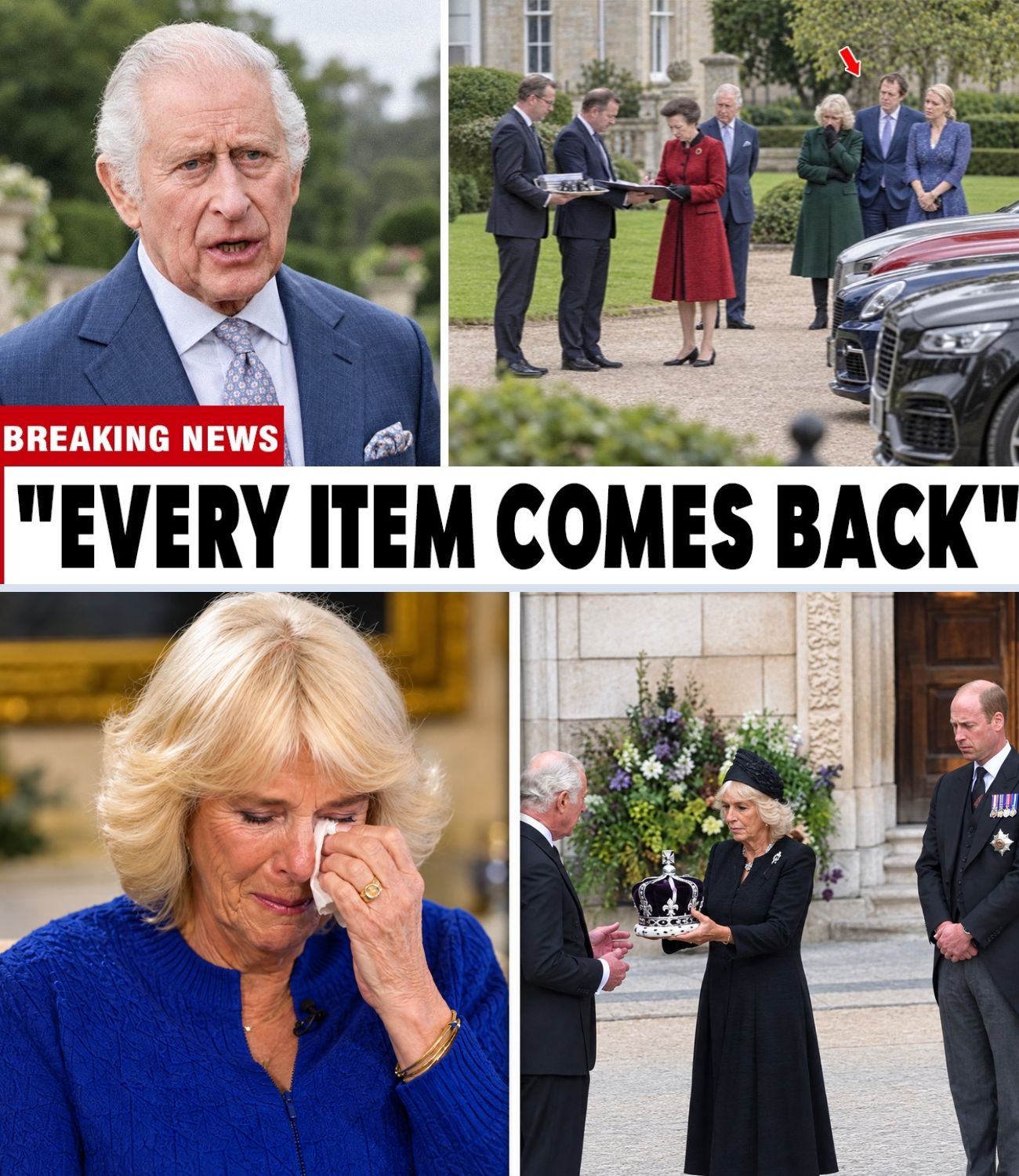
What he said next has been repeated to us by two separate, highly placed sources in almost the exact same words. He told her he was not going to argue about the past, and he was not going to punish anyone. He was going to have a schedule drawn up properly by the solicitor, with strict dates. And then he delivered the sentence that has since travelled like a shockwave through every corridor of the royal household: “Every item comes back. Not some. Not the cars alone. Every item to the estate it came from, with a receipt.”
Camilla reportedly asked, her voice tight, whether that included the London house her son was living in. Charles picked up the folder. “It is line one,” he replied, and left the study without once raising his voice.
Yet, a firm decision spoken in a private room is only a wish. What Charles did on Monday morning turned it into an iron-clad reality that no one could talk him out of. He instructed the Keeper of the Privy Purse—the official who fiercely guards the Sovereign’s private money—to immediately freeze any new arrangement of this kind. Then, he asked the solicitor to draft the paperwork. A king’s word can be softened by a wife’s tears; a legal document cannot.
The solicitor reportedly prepared what lawyers term a ‘Deed of Arrangement’—a private agreement setting out exactly how two households will be run apart. He attached three schedules to it. The first dealt with staff. The second dealt with diaries and residences. The third was the list.
We must be exceptionally precise about what this document is, and what it is not. It is not a divorce decree. No court has been petitioned, and no judge has ruled on anything. Those who describe the papers call them a “private framework”—the sort of aristocratic safety net that can sit quietly in a safe for years. Whether Charles and Camilla ever formally part ways is a question nobody can confidently answer today. Schedule 3, however, does not depend on that answer. It was written to take absolute effect upon signature, regardless of whatever happens to the marriage.
The drafting reportedly took nine painstaking days. Each of the fourteen lines had to be meticulously matched to an original note, a property lease, a vehicle registration, or a bank account number. When the solicitor finished, the four pages carried fourteen lines, fourteen uncompromising return dates, and a crushing financial total at the foot.
Then came the delicate question of the witness. A deed requires one, and Charles is said to have wanted someone whose name alone would instantly kill any palace gossip suggesting he had been bullied or pushed into this. He asked his sister.
Princess Anne reportedly arrived at Clarence House on the first Monday of August, squeezed between two official engagements, still wearing her coat. She read the third schedule standing up. Those present say she asked her brother only one question: whether the figures had been checked twice. When he confirmed they had, she swiftly signed beneath his name, dated the page, and handed the pen back to the solicitor. She is said to have added just one withering remark on her way out the door: “It should never have needed writing down.”
The Princess Royal has spent a lifetime paying her own way, famously declining titles for her own children so they could live independently. Her signature on that page communicated more than any official palace statement ever could.
Notice what did not happen in those nine days. Charles did not ask the Prince of Wales for his opinion. He did not ask his communications team for a spin strategy. People close to the King insist this was his own, deeply personal decision about his own money, and that is exactly why it could not be undone by anyone else. Copies were dispatched. One went to the Privy Purse office. One went to the estate office at Sandringham. One went to the Royal Mews. The cold machinery had already begun moving.
The first place it showed was the security gate at the Royal Mews, which keeps a meticulous log. Every vehicle from the household fleet that leaves or returns is written into it with a time, a registration plate, and a driver’s name. According to people who have seen the relevant pages, the very first entry connected to Schedule 3 was made nine days after the signing. An estate car, on loan for a little over three years, was driven in at eight minutes past ten in the morning. The entry notes the mileage and records that two keys were handed in. Under ‘remarks’, someone is said to have written three devastatingly bureaucratic words: Returned per schedule.
A second luxury car followed that week. Then a third. The fourth, insiders say, came back on the twenty-ninth day—just one single day inside the deadline. That small, petty detail, they say, perfectly reveals the bitter mood within Camilla’s family. Nobody was actively fighting the list; they knew they couldn’t. They were simply holding on to every item for as long as the dates legally allowed.
The accounts were closed far more quietly, with no fanfare. The fuel account was cancelled first, followed by the travel account, then the two household charge accounts. The quarterly allowance, paid faithfully since the spring of 2023, simply did not arrive when the next quarter rolled around. There was no apologetic letter. Just a missing line on a bank statement. For the first time in three years, a prestigious tailor’s bill was sent directly to a private address instead of a Palace office.
This is exactly where the story stops being about abstract paperwork and begins to show harsh, everyday consequences. A private driver on a royal retainer was bluntly told his arrangement would end at the close of the month. A housekeeper was offered a post elsewhere in the household. Each of them marked a distinct place where Camilla’s son and daughter would now be forced to pay their own way, just like everybody else.
And then, the two homes. A surveyor visited the Sandringham cottage in the third week of August to prepare what the estate office chillingly calls an “inventory of condition.” He reportedly counted 61 items that were strictly ordered to stay, right down to a set of antique fire irons and a grandfather clock in the hall.
The London Mews house was infinitely more delicate, because a man actually lived there. By these accounts, nobody from the Palace arrived to aggressively change the locks. A letter was hand-delivered instead, formally stating that the Privy Purse would cease paying the lease on the exact return date stipulated in the schedule. Camilla’s son is reported to have signed for it himself at the door.
Throughout all of this, the Queen was kept informed. Each time a line was completed, a short, clinical note went to her private secretary. Item three, returned. Item nine, closed. She had declined to sign the schedule, so she was being shown, one humiliating note at a time, that the machinery did not require her signature to operate. Those around her describe a proud woman who read every single note and replied to none of them. She could ask no official to stop it, because there was no official with the power to ask.
By the end of September, eleven of the fourteen lines had been ticked off. Three remained, and they were the three that mattered most.
Camilla asked for one final meeting before those doors closed forever. She reportedly sent a handwritten note to Highgrove in the last days of September, just four lines long, asking for half an hour of his time and promising not to raise the subject of the marriage. Charles agreed, but on one brutal condition: the solicitor would wait in the adjoining room with the schedule, in case anything needed to be legally verified.
They met in the garden room late in the afternoon. She did not come to arrogantly overturn the list; by then, she understood that she couldn’t. She came, insiders say, to beg for just one line. Line one. The house in London where her son was living.
Her argument, as described to us, was careful and deeply dignified. She did not claim he was entitled to it. She argued that he had built his entire working life around that specific address, that the lease had less than a year left to run anyway, and that allowing it to finish naturally would cost the vast royal estate very little. She asked her husband to let that single line lapse on its own date, and to accept the other thirteen exactly as written.
Charles is reported to have answered gently, but without leaving her a single inch of room. He told her that every one of the fourteen assets had begun as “one reasonable exception.” If he made an exception to the list now, the list would mean absolutely nothing. In a year’s time, there would simply be another folder.
Then he said something that those close to him believe he had been carrying like a stone for a very long time. He told his wife that he had spent his entire adult life being accused of letting the people around him freely spend money that wasn’t theirs. He noted that his mother had kept a notoriously tight household where every loaf of bread was accounted for, and that he had embarrassingly allowed his own to drift into excess. He was not going to hand his son a messy set of private financial promises to either honour or break.
Camilla, we are told, looked at him and asked if this was really about Prince William. Charles answered that it was about the day after him. It was about whoever opened the ledger next and found fourteen expensive lines that nobody could justify or explain.
She tried once more, and this time her plea wasn’t about the house. She asked him if he understood what it would look like to her children—that their mother was the Queen of England, yet could not even keep a roof over their heads. Sources say her voice didn’t quite break, but it came dangerously close.
He did not offer her comfort. He is said to have told her that her son and daughter were highly capable adults with successful careers and good names, that they would be perfectly well, and that “being well was not the same as being kept.”
Then, he rang a bell for the solicitor. The schedule was brought in. Charles turned to the fourth page and physically showed her that the return date for line one had not moved by a single day. He did not ask her again to sign the empty space. He simply closed the cover. Camilla left by the garden door. She had asked for one line out of fourteen, and she had been utterly refused.
Yet, the walls of that garden room were not as thick as either of them believed. Within a week, the list was no longer a private palace secret. It began the way these scandals always begin: with one unnamed source and one carefully planted sentence. In the first days of October, a royal commentator mentioned on-air that she had been told of a “private financial review” touching the Queen’s family. By evening, the word everyone in London was using was schedule. Within two days, the outline was everywhere: a set of separation papers, and at the back, a list of what Camilla’s children would be forced to return.
No newspaper published the document, and the Palace predictably confirmed nothing. Asked directly, a spokesman offered the oldest, most tired answer in the building: “We do not comment on private matters.”
But the public had been asking a version of this question for years, and now it had a concrete number attached: fourteen. The television panels divided almost instantly. One former courtier aggressively argued that the King was perfectly entitled to be generous with his own money, stating that going through a family’s cars and cottages line by line was beneath a monarch. A constitutional historian shot back, arguing that private money is exactly where discipline matters most, because nobody else is watching it.
A veteran royal biographer made the point that landed the hardest. She noted that the late Queen never had to draw up a list like this, because in her impeccably run household, nobody would have ever dared to ask.
Then the comment sections of the British press opened, and the tone there was not divided in the slightest. Finally. About time. One reader noted she had paid for her own car every month of her working life and failed to see why a Queen’s grown children couldn’t do the exact same. Another wrote a single, blistering line that was shared tens of thousands of times: “Diana’s boys were told to stand on their own two feet. Why not these two?”
The harsher words flowed freely: Freeloaders. Hangers-on. Entitled. It is worth saying that those words are not entirely fair to two people who, by every account, never formally asked for a title and have indeed worked for a living. But fairness is not what drives a public mood. What drives it is a long, bitter memory. The British public remembers exactly who was pushed aside to make room for this marriage. They have been waiting a very long time to see a bill finally presented.
And notice where the public anger did not go. Almost none of it was aimed at Charles for acting. It was aimed at him for waiting. Caller after caller on the radio said the same thing: Why did it take him twenty years? Was he being loyal, or was he simply unwilling to face a difficult evening at home?
Inside Clarence House, we are told the brutal media coverage was watched in absolute silence. Camilla is said to have asked her staff for one thing only: she demanded that nobody respond to the press on behalf of her son or daughter. Those who admire her call that stoic dignity. Those who do not say she had finally, painfully understood that there was absolutely nothing left to say.
By the first weekend of October, the three open lines on the schedule were still open, and every telephoto lens in London wanted to know the same thing: when the last of it went back, would anyone be allowed to see?
The answer came on a miserably grey Wednesday morning. It came without a single word being spoken in public. Charles had a long-standing engagement that day—a service of thanksgiving at a London church for a charity he has championed since his youth. Camilla was officially listed to attend with him.
The cars arrived three minutes apart. That was the first thing the eagle-eyed press pack noticed. The King stepped out of the first car alone and greeted the clergy at the grand doors. The Queen arrived in the second with a lady-in-waiting. They entered the church separately, sat in the exact same pew with an order of service placed deliberately between them, and by every account, did not exchange a single word that a lip-reader could catch. He stared fixedly at the altar. She stared down at her gloves.
But the real, defining picture of the day was taken two miles away, and no press photographer was there to capture it. At about the exact same hour, insiders say a young clerk from the solicitor’s firm stood on the pavement outside a mews house in West London, holding a clipboard.
Line one.
Camilla’s son had reportedly chosen not to wait for the final, humiliating day of the deadline. He had quietly moved his belongings out over the previous weekend with the help of discreet friends, and he met the clerk at the door himself. He handed over two sets of keys and a resident’s parking permit. The clerk checked each item against the list, noted the time, and asked him to sign the release. He signed it.
Those who were told about it afterwards say he then did something nobody expected. He thanked the clerk. He politely asked him to pass on a message to the estate that the house’s boiler needed servicing before the winter set in. Whatever the vicious comment sections choose to call him, the man who handed back that house did it with vastly more grace than the murky arrangement that put him there in the first place.
That exact same morning, the estate office at Sandringham logged the formal return of the cottage. Camilla’s daughter had sent the keys by recorded delivery with a short, polite covering note. The inventory was meticulously checked against the surveyor’s count. 61 items. All present. Line two.
And the last of the eight accounts, the housekeeping account, was permanently closed at the bank at noon. Line fourteen.
Inside the church, the thanksgiving service ran for fifty minutes. When it ended, the King and Queen walked down the long aisle, a deliberate pace apart. At the church door, an equerry is said to have stepped forward and handed Charles a folded note. He opened and read it on the steps, in full view of the flashing cameras, and slipped it into his inside pocket. Nobody outside the household knew what it said. People close to the solicitor say it was exactly three lines long: One, received. Two, received. Fourteen, closed.
Camilla was standing barely an arm’s length away. Those who have analysed the footage frame-by-frame say she saw the note, saw him read it, and understood exactly what it signified. She turned to speak to the vicar, and her public smile held firm. Her hand, for a fleeting moment, tightened white-knuckled on the strap of her handbag, and then let go. The two cars left in completely different directions. The whole exchange took less than a minute, but it told the watching country everything the Palace had point-blank declined to say.
Every line had now come back. Yet one final thing was still missing from the fourth page, and Charles intended to deal with it before the sun went down.
So, who lost and who gained when that final line was mercilessly ticked? Camilla’s son lost a premium address, and by every account, kept his dignity intact. Her daughter lost a beautiful country cottage she had come to think of as part of her family’s fabric, along with the quiet, expensive conveniences that had always surrounded it. Between them, if the leaked figures are right, they surrendered a little over £4 million in homes, cars, and accounts that had never legally been theirs. They are not ruined. They are simply, for the first time in a very long while, entirely on their own.
Camilla lost something far harder to quantify. She kept her crown, her title, and her exalted place in the line of carriages. What she lost was the quiet, unchecked ability to look after her own from inside the fortress walls. And the marriage? We still cannot tell you. The rumours of a breaking point remain just that—rumours. The deed, if it exists exactly as described, may sit locked in a safe for the rest of both their lives. What we can say definitively is that Schedule 3 never actually needed the marriage to end to be executed. It only needed a signature, and it has one.
Charles gained what he has been loudly accused of lacking for most of his reign: a completely clean ledger. When the private royal accounts eventually pass to the next generation, there will be no hidden folder of unexplained favours waiting inside them. For the British public who have spent years asking whether he would ever find the spine to stand up in his own household, this was, at last, an answer written in ink.
Which brings us back to that grey Wednesday afternoon. The solicitor reportedly arrived at Clarence House a little after four o’clock. He was carrying the original, master deed and the three final receipts. Charles met him alone in the library. One by one, the King initialled each of the fourteen lines in the margin. He wrote the word ‘Returned’ beside each and dated the page.
Then, the two men turned to the blank space at the foot of the fourth sheet—the space originally left for the Queen’s acknowledgement. It was not going to be filled. Charles is reported to have drawn a single, firm ruled line through it. Beneath that line, he wrote in his own hand: Not required. He signed again. The solicitor countersigned, placed the historic deed in a leather document case, and locked it. By five o’clock, insiders say the case had been securely lodged in the Privy Purse strongroom and entered into the master register under its own number. That evening, the locks at the Sandringham cottage were changed, and the new keys were hung on a board in the estate office. There is no procedure for taking them back out.
Yet, the people who have actually seen the schedule mention one last, chilling detail almost in passing. There is, they say, a fifth page. It carries a single, ominous heading: Further arrangements under review. And beneath that heading, there is a single ruled box for a name.
The box is currently empty. Nobody will say whose name was meant to go there.
So, here is the question we leave you with: Was King Charles right to ruthlessly take back every single item from Camilla’s children? Or should a monarch’s private generosity, once extended to family, be left well alone? Tell us which side of history you are on in the comments below. Because a man who took twenty years to write one list would not leave a box empty by accident.
You Might Also Enjoy

“We Thought They Would Negotiate”—What Argentine Soldiers Said When The British Attacked Goose Green

“You’ll Never Finish My Ruck March, Limey” — US Sergeant Who Challenged the SAS, Then Fell Out First






