Five Children, a Husband, a Throne. She Left Them All at 32.
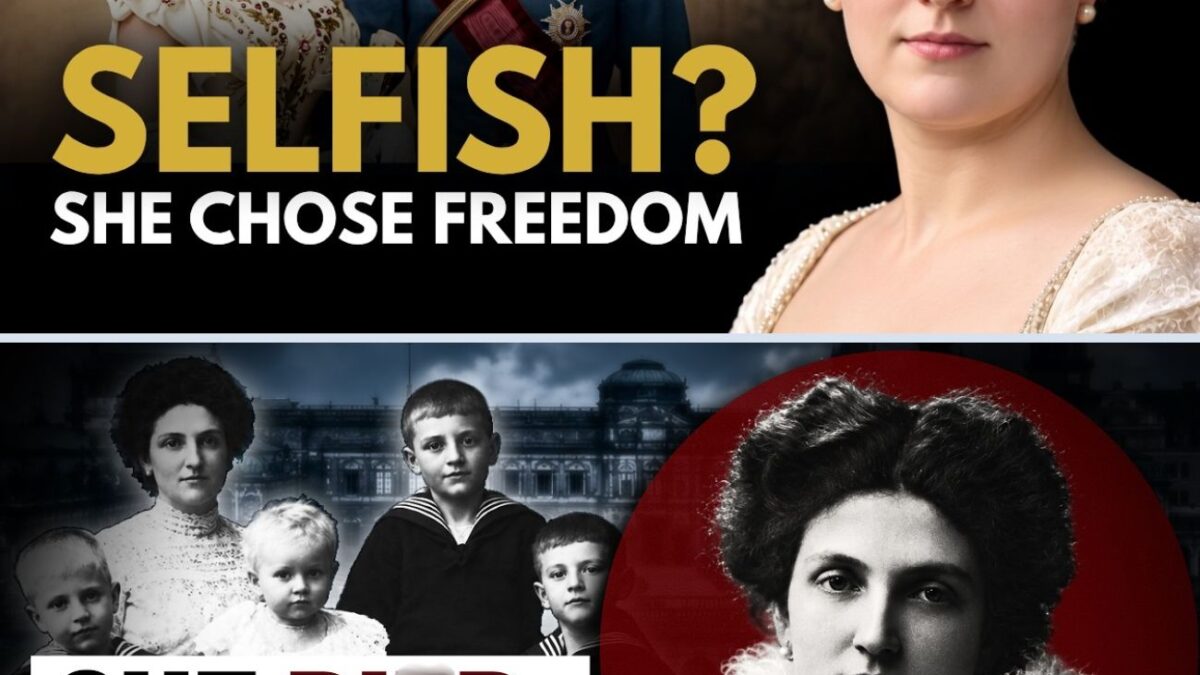
In 1904, a small postcard was passing from hand to hand across Saxony. Printed on it was a song about a woman who was no longer allowed to live there. The song called her the pearl of Saxony, and its third verse made a quiet, defiant promise: even though her crown and throne were gone forever, she was, and would always remain, a queen.
Only two years earlier, she had been exactly that: the future queen, the wife of the heir to the throne, the mother of five royal children. Then, in the dark weeks before Christmas 1902, she vanished, and within days her face was staring out of newspapers across Europe. The court wanted her forgotten. The people of Dresden refused to forget.
How did the most beloved princess in Saxony become the woman its royal family tried to erase, and what did her freedom finally cost her? Louise Antoinette Maria, Archduchess of Austria and Princess of Tuscany, was born in Salzburg on the second of September, 1870, in a city of church bells and mountains, and in a family that had already lost almost everything a royal family can lose.
Her father was Ferdinand the Fourth, the last Grand Duke of Tuscany. About a decade before Louise was born, Tuscany had been swept into the new Kingdom of Italy, and Florence, with its palaces and golden hills, had slipped out of his hands for good. He kept the title. He never got back the country. The family lived on in Austria as exiles inside the vast Habsburg world.
Her mother was Princess Alice of Bourbon-Parma, her father’s second wife. Biographers describe both parents as pious, distant and often absent. Louise grew up with a looser, more informal upbringing than most archduchesses of her time, and the person she trusted most was not a parent at all.
It was her brother Leopold, just under two years older, who shared her restlessness and her impatience with rules that nobody ever bothered to explain. Many years later, looking back on that childhood, she wrote a sentence that could hang over her entire life like a portrait over a fireplace:
“We were not educated for ourselves, but merely to live in the eyes of the world; our young lives were sacrificed to position, and we were not supposed to possess any individuality or display any emotion.”
Louise possessed a great deal of individuality. She never learned to hide it. In the summer of 1887, at Pillnitz Palace, the royal summer residence on the banks of the Elbe just outside Dresden, the teenage archduchess met a young Saxon prince. His name was Friedrich August.
He was the eldest son of Prince George of Saxony and a nephew of the reigning king, Albert, who had no children of his own. One day, after his uncle and his father, he would wear the crown of Saxony. He was about five years older than Louise. The match suited both families perfectly. The Saxon royal house was Catholic in an overwhelmingly Protestant land, and a Habsburg archduchess was exactly the kind of bride it hoped for.
They were married in Vienna on the twenty-first of November, 1891. Two days later, the new princess made her ceremonial entry into Dresden, the city people liked to call the Florence on the Elbe. For a daughter of lost Tuscany, the name must have sounded almost like a welcome. She was twenty-one. She was stepping into one of the stiffest courts in Europe.
And she had no intention of becoming stiff. At first, Louise gave the dynasty everything it asked of her. In January 1893, she gave birth to a son, Georg, the heir after his father. On the very last day of that same year, a second boy arrived, Friedrich Christian. Two princes in one calendar year. Ernst Heinrich followed in 1896.
In 1898, a daughter was stillborn. Then came two more girls, Margarete and Maria Alix. Outside the palace walls, Dresden fell in love with her. She was warm, spontaneous and quick to laugh, and she did not keep ordinary people at arm’s length the way royal ladies were taught to. The city answered in its own affectionate way.
An inn high above the Elbe was named the Luisenhof in 1895, and a café near the Blue Wonder bridge became the Café Toscana in 1899. Inside the palace, the air was colder. Her easy manners offended her father-in-law, Prince George, and her sister-in-law, Princess Mathilde, and the quarrels behind closed doors were remembered as ugly scenes.
Dresden tradition even holds that she was forbidden to ride a bicycle, as if a woman on two wheels might carry the whole monarchy off with her. Her husband, often away, offered her little shelter from the storm. The more the people loved her, the less the court forgave her.
In June 1902, King Albert died after almost thirty years on the throne. Louise’s stern father-in-law became King George of Saxony, and her husband became crown prince. Louise was now the future queen, and from that moment every word, every smile and every letter seemed to be watched. The hostility of the king and his interior minister, Georg von Metzsch-Reichenbach, no longer bothered to hide itself.
Whispers began to travel through the corridors. Some linked her name to a dentist. Others linked it to a young Belgian named André Giron, who taught languages to her sons. The whispers about Giron were true. By 1902, the crown princess and her children’s tutor had fallen in love. According to accounts of the affair, a telegram she sent him was intercepted by the secret police.
Then came the fear that would haunt her for the rest of her life. Louise became convinced that the king meant to have her declared insane and locked away in the asylum at Sonnenstein, above the little town of Pirna. Real plan or cruel threat, she believed it with her whole heart. And she was carrying another child.
In early December 1902, Louise left Dresden and travelled to her parents in Salzburg, back to the city of her childhood. She would never again return to the Saxon court as its crown princess. From Salzburg she slipped across the Swiss border at Buchs and on to Zurich with her brother Leopold, who was fleeing a life of his own.
He had fallen in love with a woman named Wilhelmine Adamovic, whom the imperial family would never have accepted. Giron joined them, and to throw their pursuers off the scent, he laid a false trail pointing towards Brussels. It did not work for long. On the fifteenth of December, the little party checked into the Hôtel d’Angleterre in Geneva, on the shore of the lake.
The Saxon police found them within days. Instead of hiding, Louise and Giron gave interviews and posed for photographers, as if daring the old world to look at them. She told the press that her love for him was “much too deep” to give up. On the twenty-second of December, the Saxon court issued its bulletin announcing that the crown princess had left Salzburg and gone abroad.
In Vienna, the Neue Freie Presse wrote that never before had the rift between passion and tradition played out so radically and so brazenly. In Berlin, the diarist Baroness Hildegard von Spitzemberg was aghast: five children, a husband, a throne, all abandoned at thirty-two, for the tutor. Saxony struck back hard. The court even accused the fugitives of taking crown jewels.
Leopold, meanwhile, asked the emperor to release him from his rank altogether, and soon became a private citizen called Leopold Wölfling. The Habsburg siblings had not simply run away. They had walked out of royalty itself.
The punishment came swiftly. On the eleventh of February, 1903, a special court of the House of Wettin dissolved the marriage. It was a civil divorce only. In the eyes of the Catholic Church, Louise remained Friedrich August’s wife, bound to a man she could never go back to. She was barred from Germany and from Austria-Hungary. She was forbidden any contact with the five children she had left behind in Dresden.
By then, the romance that had cost her everything was already over. Louise and Giron parted even before the divorce was pronounced. On the fourth of May, 1903, in Lindau on the shores of Lake Constance, she gave birth to a daughter, Anna Monika Pia. All of Europe asked the same question: who was the father? The Saxon court sent a physician, who looked at the newborn and declared that she resembled the crown prince.
On the strength of a doctor’s glance, the child was recognised as a princess of Saxony. The truth has never been settled. That summer, Louise was given a new name: Countess of Montignoso, borrowed from a small place in her lost Tuscany. With the title came an allowance, and with the allowance came a quiet, relentless pressure. Dresden wanted the baby. Louise refused to let her go.
On the fifteenth of October, 1904, King George died. Friedrich August became King of Saxony. The man who had divorced her now wore the crown she had once been meant to share. In the city, many people had never taken the court’s side. A circle of loyal supporters had formed around the exiled princess, and it was now that the little postcards with the song about the pearl of Saxony were travelling from hand to hand.
Louise decided to test her fate. In the winter of 1904, she came to Dresden without permission and went to the Taschenberg Palace, hoping for nothing more than to see her children. She never reached them. The police removed her from the city, as one account put it, like a vagrant. According to local tradition, townspeople gathered around her in the street and begged her to stay.
The scene caused outrage far beyond Saxony. But the palace doors stayed shut. The mother of the future king could not get through the front door.
In December 1906, in Florence, the city her family had lost, Louise met Enrico Toselli, a young Italian pianist and composer. He was about twelve years younger than she was, and the author of a sweet, melancholy Serenata that was drifting through the salons and dance halls of Europe. Its Italian title was Rimpianto. In English, regret. They married in 1907.
For Louise, it felt like a second spring. For Dresden, it was the moment to take the child. Soon after the wedding, little Pia was handed over to the Saxon court to be raised with her brothers and sisters. According to the story told afterwards, the little girl asked her mother when she would see her again, and Louise could not find an answer.
In 1908, Louise gave birth to her last child, a son, Carlo Emanuele. The marriage faded almost as quickly as it had flared. The couple separated, and in 1912 they divorced. The boy stayed with his father. Toselli then did something startlingly modern. He published a book in Paris about his four years of marriage to the former crown princess.
Louise had already told her side. In 1911, her memoir appeared in London under the title My Own Story. She laid the blame for her fall on her late father-in-law and on the Saxon politicians who, she believed, had feared her influence once she became queen. It was a story she would go on telling, in one way or another, for the rest of her life.
From 1911, Louise made her home in Belgium, in Ixelles, a quiet district of Brussels. She would stay there for more than thirty-five years, far from the Elbe and far from the children she had lost.
In November 1918, the court that had cast her out simply ceased to exist. As revolution swept across Germany, her former husband, King Friedrich August the Third, gave up the throne of Saxony. The monarchy that had judged her ended long before she did.
In 1924, her grown children began to find their way back to her. Her sons Friedrich Christian and Ernst Heinrich helped support her when inflation ate away at her money. Her eldest, Georg, the heir who would never inherit, had become a Jesuit priest. Her brother Leopold, the companion of her flight, fared no better. As plain Leopold Wölfling he drifted from job to job, from a Vienna delicatessen to Berlin cabarets, and died poor in 1935.
Friedrich August died in 1932. He never married again. Louise never stopped loving Saxony. Over the years, she wrote more than two hundred letters and postcards to one Dresden family, the Herrmanns of Wachwitz, and her friendship with Clara Herrmann, once her lady’s maid, lasted until the end.
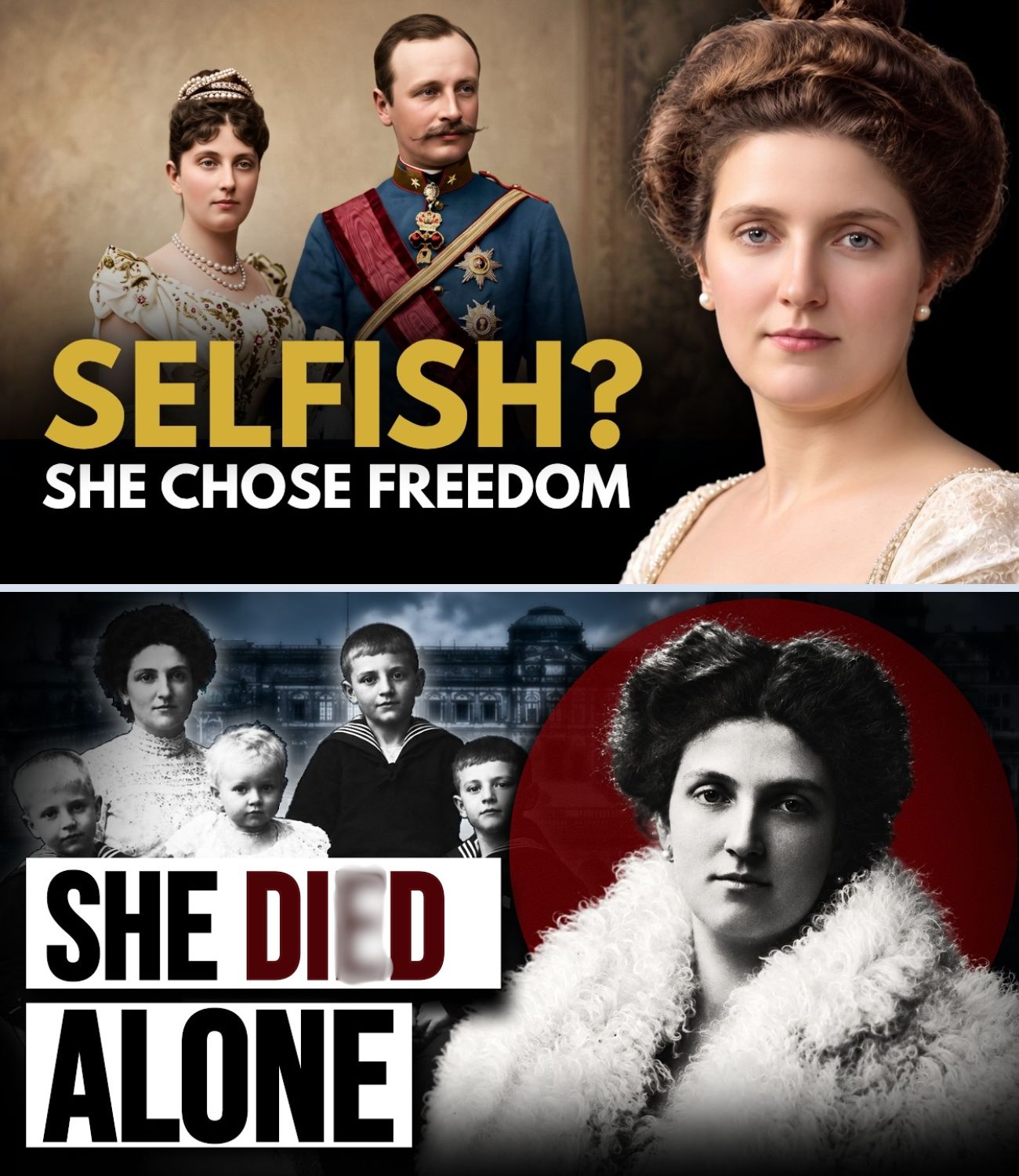
Her last years were spent in growing poverty. Her allowance from Germany was stopped in 1939, resumed under the occupation, and ended for good when Brussels was liberated in 1944. On the twenty-third of March, 1947, Louise died in Ixelles. She was seventy-six. A story often told about her is that she spent her final days selling flowers on the streets of Brussels. It cannot be confirmed, but it has become part of her legend.
She was first buried in Ixelles. In 1953, her remains were moved to the monastery of Hedingen in Sigmaringen, the resting place of the Hohenzollerns, where some of her children now lie near her. In 2017, seventy years after her death, Pillnitz Palace, the same summer palace on the Elbe where a teenage archduchess had first met her prince, opened an exhibition about her. It was called Scandal at Court. The Flight of Louise of Tuscany.
In her lifetime, the scandal had filled more than fifteen hundred newspaper articles. Conservative papers called her a woman without character who betrayed her children. Liberal papers saw a modern woman crushed by an old and narrow court. Perhaps both were a little bit true. She loved freely, and she paid for it in full. She lost a throne, two husbands, and years with children she never stopped missing.
But the people she had once lived among never quite let her go. The café by the Blue Wonder still carries the name Toscana. Her papers are kept in the state archive in Dresden. And a song once promised that, crown or no crown, she would always remain a queen. In Dresden, in a way, she still is.
You Might Also Enjoy

“We Thought They Would Negotiate”—What Argentine Soldiers Said When The British Attacked Goose Green

“You’ll Never Finish My Ruck March, Limey” — US Sergeant Who Challenged the SAS, Then Fell Out First






