German Child Soldiers Braced for Execution — British Soldiers Brought Them Cheese Instead
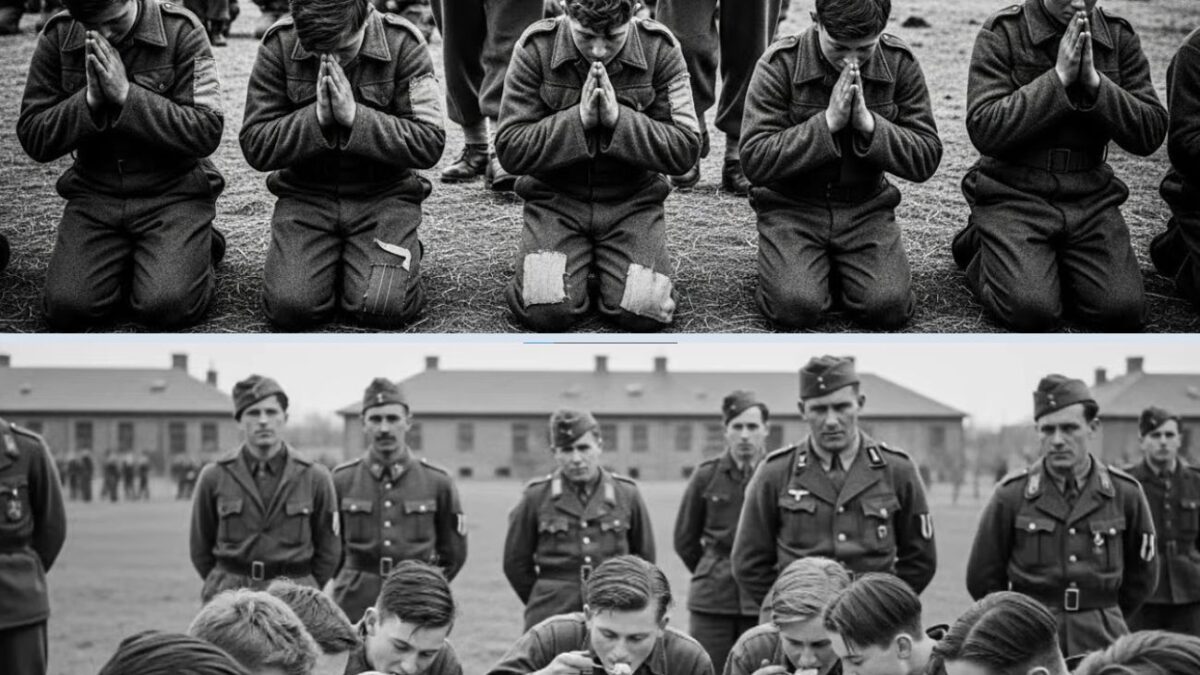
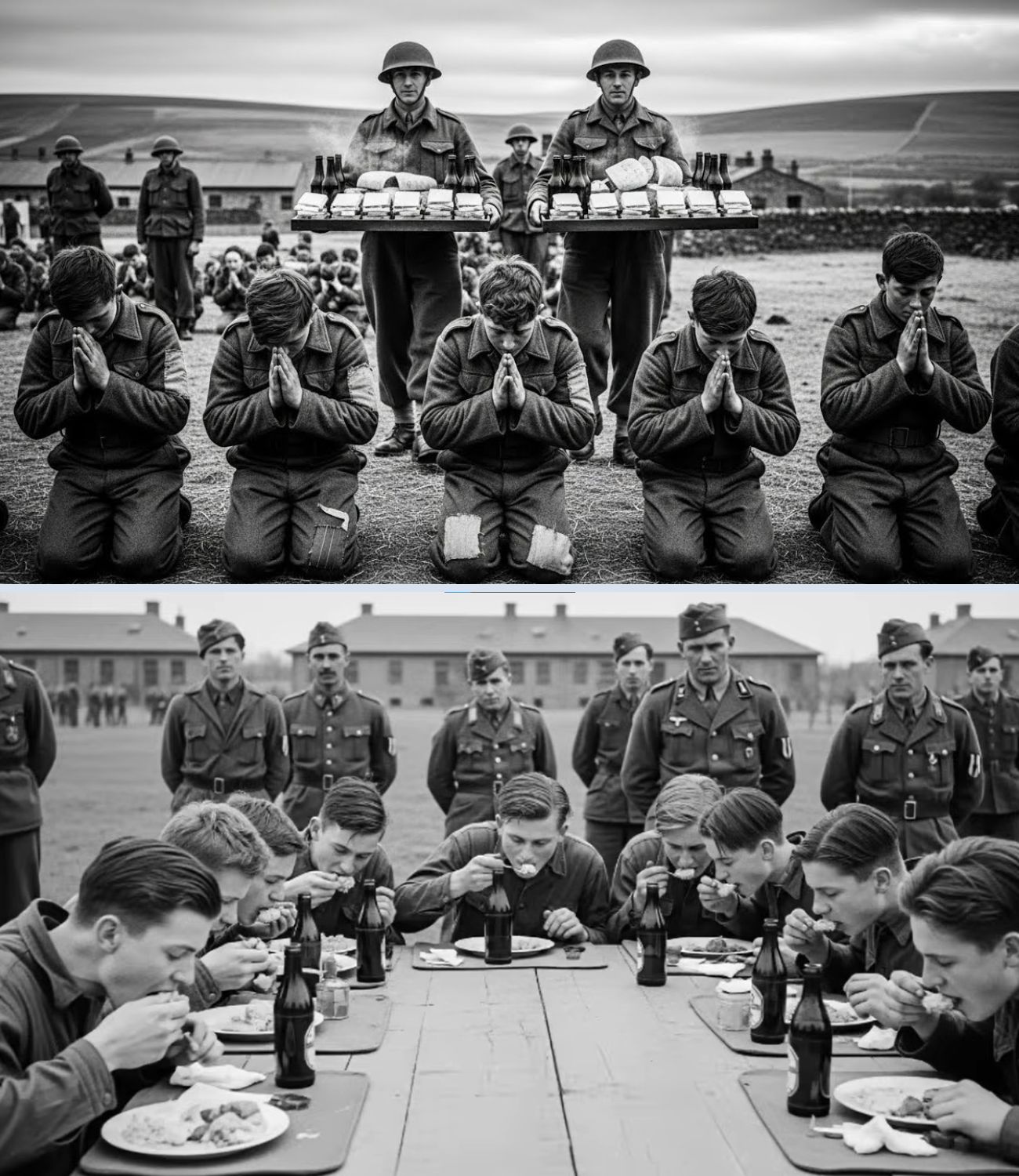
May 17th, 1945. Camp 18, Featherston Park, Northland. The morning mist clung to the hills like a shroud, heavy and cold against skin already numb from fear. 17 German boys stood in an uneven line beside the transport shed, their breath visible in the damp air, their hands shaking not from the chill of the English countryside, but from the absolute certainty that they would not see another dawn.
They wore patched British-issue uniforms, the fabric stiff and unfamiliar on frames hollowed by months of retreat and starvation. The silence pressed against them like a physical weight, broken only by the distant cry of marsh birds. Guards emerged from the administration building, expressions carved from stone, movements measured and deliberate.
The boys exchanged glances, each searching for courage they could not find. Then came the command to form up. And in that moment, 13-year-old Klaus Müller understood with absolute clarity that his war had ended in the worst way imaginable.
The march began without explanation. Boots struck gravel in irregular rhythm, the sound swallowed by the vast emptiness of the northern English landscape. Klaus walked near the front of the column, his eyes fixed on the back of the guard ahead. He tried to control his breathing, tried to quiet the hammering in his chest that seemed loud enough to echo across the hills.
Around him, the others maintained their composure through sheer force of will. They had been soldiers once, or told they were. Now they were prisoners, children in a foreign land, awaiting judgment they did not understand, but had been taught to expect.
Camp 18 at Featherston Park was one of the largest prisoner of war facilities in Northern England, sprawling across the Northumberland land with capacity for over 4,000 German prisoners. By May 1945, as the Third Reich collapsed into rubble and surrender, British camps held more than 42,000 German POWs across the United Kingdom. Most were Wehrmacht regulars captured in France or Italy, soldiers who had fought conventionally and surrendered according to military protocol.
But scattered among them were the remnants of something far more disturbing. Boys pulled from the wreckage of Germany’s final desperation: Volkssturm militia, Hitler Youth conscripts, children given rifles and told they were defending the Fatherland.
Klaus had been taken near Bremen in late April, part of a disintegrated unit that barely qualified as a military formation. He had carried a Panzerfaust he did not know how to operate. He had worn a uniform two sizes too large. He had fired at British tanks exactly once before his commander, a 62-year-old man with a missing leg, told them to throw down their weapons and raise their hands.
The British soldiers who accepted their surrender looked more exhausted than angry, more bewildered than victorious at finding teenagers among the prisoners. The journey to Northland had been a blur of lorries, holding facilities, and bureaucratic processing that ground forward with mechanical efficiency.
The older prisoners had told the boys they would be treated according to international law, that Britain respected the Geneva Convention, that they would be safe. But fear did not operate on logic. Klaus remembered the propaganda films shown in his school basement. He remembered the warnings about British cruelty, about colonial brutality, about what happened to German soldiers who surrendered.
He remembered the cold certainty in his Hitler Youth leader’s voice when he said that capture meant death. And now marching toward an unknown destination on a gray May morning, those warnings felt prophetic.
The column turned past the vehicle maintenance sheds away from the main compound where barbed wire gleamed dull silver in the weak sunlight. The terrain opened into a wide rectangular yard bordered by low stone walls, remnants of sheep pens from when this land had been farmland. Wooden benches sat in the center, weathered and dark with moisture.
Metal drums rested beside a storage hut. The guards directed them forward with curt gestures. The boys sat without protest, their bodies rigid, their minds racing through terrible possibilities. Klaus’s stomach clenched. This was not a work assignment. This was not a relocation. The isolation of the location, the stillness of the morning, the presence of three senior guards instead of the usual two—it all pointed towards something final.
Minutes stretched. The sun climbed higher, burning away the mist, revealing the vast sweep of land that rolled toward distant hills. A few boys whispered prayers in German, voices barely audible. Others stared at the landscape, committing the view to memory as if beauty might be armor against what was coming.
Klaus thought of his mother in Hamburg, wondered if she had survived the firestorm bombing, wondered if she knew where he was. He thought of his older brother, killed at Kursk 2 years earlier. He thought of all the ordinary moments he had taken for granted, before the world collapsed into ash and ideology, before childhood became something that could be weaponized.
Then the guards returned, carrying wooden crates stacked too high. The boys watched as the crates were set beside the drums. One guard pried open a lid with a crowbar. The wood splintered with a sharp crack that made several boys flinch.
Inside were not weapons or rope or the instruments of execution, but provisions. Burlap sacks, waxed paper packages, containers marked in English with labels they did not recognize. Another guard wheeled forward a portable brazier, the kind used for field cooking, black iron weathered by use. Metal grates appeared, tongs, a folding table that creaked as it was unfolded.
The boys exchanged confused glances. None of this aligned with what they expected. None of this matched the scenarios that had played through their minds during the long, sleepless night. Yet, they remained tense, unwilling to release the fear until they understood what was happening, unable to trust that the world might contain surprises other than violence.
More crates arrived, carried by two guards working in practiced silence. Glass bottles clinked together, a sound oddly domestic and jarring in its normality. A guard lifted one into the weak sunlight. The liquid inside caught the light: pale golden amber.
Another crate opened. This one releasing a smell that cut through the damp morning air: sharp, pungent, unmistakable cheese. The scent was so strong, so unexpected that Klaus felt his stomach clench with sudden, overwhelming hunger.
The guards ignited the brazier. Coals glowed red beneath the grate, heat rising in visible waves. One guard unwrapped a large wheel of cheese from its waxed cloth covering, the rind dark and aged, the interior pale. He began cutting thick slices with a long knife, each stroke deliberate and practiced.
The cheese was firm, crumbling slightly at the edges. He arranged the slices on the grate. Within moments, the cheese began to soften, edges bubbling, releasing an aroma so rich and savory that it made Klaus dizzy.
By May 1945, British food production had become a weapon of strategic importance, a demonstration of resilience that contrasted sharply with Axis collapse. Despite U-boat campaigns and rationing that stretched civilian endurance, Britain produced enough to feed its population, its military, and increasingly its prisoners. Cheese production, particularly cheddar, had been standardized and scaled with the government establishing the cheese allowance scheme to ensure consistent quality and availability.
Each week, British civilians received their rations, carefully measured portions that represented sacrifice, but not starvation. Meanwhile, Germany’s agricultural system had disintegrated under Allied bombing and the collapse of supply lines. Caloric intake in German cities averaged under 1,000 per day by war’s end, well below survival thresholds.
Prisoners in British camps, by contrast, received approximately 2,500 calories daily, better nourishment than many German civilians. And now these boys who had been raised on propaganda about British weakness, about an empire in decline, about a nation brought to its knees by German might were about to experience that resilience firsthand.
The cheese sizzled against the hot grate, fat rendering, crust forming. The guards added bread to toast on the cooler edges, thick slices that darkened and crisped. Butter appeared—real butter, not the Ersatz substitutes Klaus had eaten for years. The guards spread it on the toasted bread with casual efficiency, then topped each slice with melted cheese, the mixture stringy and golden.
They worked with the precision of men who had done this many times, assembling portions with care, wrapping each in paper. Beside the brazier, another guard opened a crate and began pulling out glass bottles filled with dark liquid. He pried the caps off with a tool that hissed as pressure released. Steam rose from the bottles mixing with the cheese-scented air.
Klaus recognized the bottles now: the shape, the color. Beer. British beer. Amber and cloudy traditional ale that smelled of malt and hops. Klaus stared. His mind struggled to reconcile what he was seeing with the conclusions he had drawn an hour earlier. This was not punishment. This was not discipline. This was food. Real food, prepared with attention and offered without explanation.
He glanced at the boy beside him, Franz, a 15-year-old from Munich who had been conscripted into the Volkssturm 3 months before the surrender. Franz’s eyes were wide, disbelief written across his thin face. Around them, the other boys remained frozen, caught between relief and confusion, unable to fully trust what their senses reported.
A guard approached the benches, his expression neutral, and gestured for them to stand. The boys rose slowly, movements careful, as if sudden motion might shatter the illusion. They formed a ragged line at the folding table. One by one they received a portion: warm cheese toast wrapped in paper and a bottle of beer cooled from storage but not cold, temperature-controlled in the way only careful planning could achieve.
Klaus accepted his portion with both hands. The warmth of the toast seeped through the thin paper. The bottle felt solid, weighty, real. He returned to his seat, staring at the items as if they might transform into something else, as if this might be an elaborate cruelty he could not yet perceive.
When the signal came to eat, given by a simple nod from the senior guard, he bit into the cheese toast cautiously. The first taste overwhelmed him. The cheese was sharp, aged, complex in ways his memory could barely process. The bread was dense, real wheat bread, not the sawdust-mixed substitutes of the past 2 years.
The butter added richness that coated his tongue. The cheese was still hot, stretching as he pulled the toast away, stringing and golden. He chewed slowly, trying to make the experience last, trying to memorize every flavor, every texture, every sensation.
Around him, the other boys did the same. Some ate quickly, hunger overtaking caution, finishing their portions in desperate bites. Others savored each mouthful, eyes closed, faces unguarded in a way that would have been dangerous only days earlier.
Klaus ate his cheese toast in measured bites, alternating with sips of beer. The ale was bitter, stronger than anything he had tasted before, with a yeasty complexity that made him cough slightly on the first swallow. But the second sip was easier, and the third brought warmth that spread through his chest, cutting through months of cold fear and emptiness.
He looked at the bottle in his hand, at the embossed label, at the condensation beginning to form on the glass as his hands warmed it. This was Britain distilled into tangible form. This was resilience, abundance, even in rationing offered to boys who had been told Britain was broken, defeated, unable to feed its own people. The cognitive dissonance was almost painful. Everything he had been taught, every certainty he had carried cracked and shifted with each bite.
The yard grew quiet except for the sounds of eating and the distant cries of marsh birds. Shoulders relaxed, breathing slowed. The tension that had gripped them since dawn dissolved with each mouthful. The guards maintained their positions at the perimeter, watching, but not intruding. They did not smile or speak. They simply stood, present, but not oppressive, allowing the boys space to process what was happening.
Klaus finished his cheese toast at a measured pace, sipped his beer between bites, unwilling to let the moment end too quickly. When only the empty paper and half-finished bottle remained, he held them loosely, feeling the warmth fade from his hands, but not from his memory.
He understood something now that he had not understood an hour earlier. He did not have the words for it yet, could not articulate the shift that had occurred, but he felt it. The absolute certainty of death had been replaced by something more complex: confusion, relief, and the tentative beginning of a realization that the world operated on rules he did not fully understand, rules that sometimes bent toward mercy instead of cruelty.
In the decades that followed, historians would study the treatment of German prisoners in British camps. They would document the educational programs, the work details, the gradual reintegration into civilian life. They would note how Britain, despite its own struggles, maintained standards of treatment that often exceeded Geneva Convention requirements.
But on that May morning, there were no studies, no theories, only 17 boys who had believed they were marching to execution, and instead found themselves eating cheese toast and drinking beer under a clearing Northland sky.
The impact was immediate and profound. Fear, once absolute, cracked and fell away. In its place came something more nuanced: the slow, careful realization that their captives were not the monsters they had been warned about, that surrender did not automatically mean death, that humanity could persist even between enemies.
The guards began clearing the table. Crates were repacked. The brazier was doused, coals hissing as water quenched them. The bottles were collected, clinking together as they were placed back into their crate. The boys remained seated, processing what had happened in the silence that followed.
Klaus stared at the distant hills, at the way the sunlight now broke through the clouds in shafts that illuminated patches of land in brilliant green. He thought about the morning’s fear, about how certain he had been of his fate, about the propaganda that had shaped every assumption. He thought about the cheese toast, the beer, the simple act of being fed well when he had expected nothing.
And he understood in a way that transcended language or ideology that the British had given him more than a meal. They had given him a reason to believe he might survive this war. More than that, they had given him the first evidence that everything he had been taught might be wrong.
Eventually, the guards signaled for them to stand. The march back began, retracing the path they had taken hours earlier, but everything had changed. The boys walked with lighter steps, their bodies no longer braced against invisible violence.
The camp buildings came into view, unchanged in structure, but transformed in meaning. The fences, the barracks, the guard towers, all remained as they had been, but the boys saw them through different eyes. They had crossed a threshold. They had encountered an enemy who fed them instead of harming them. And that single act redefined their understanding of captivity, of war, of the narratives they had been given about who was good and who was evil.
Back inside the compound, the guards dismissed them to their barracks with the same turf efficiency they used for everything. The boys dispersed quietly. Some lay on their bunks, staring at the ceiling, replaying the morning in their minds, trying to make sense of what had happened.
Others sat outside on the steps, letting the sun warm their faces, savoring the lingering taste of cheese and beer. Klaus found a spot near the perimeter fence and sat with his back against a post. He closed his eyes and breathed. The smell of the cheese clung faintly to his uniform, to his hands. He did not want to wash it away yet. It was evidence, proof that the morning had been real.
In the days that followed, word of the meal spread through the younger prisoners like a careful secret told in quiet voices during work details and evening hours. It became a reference point, a story that contrasted sharply with everything they had expected.
For Klaus, it became an anchor, something he returned to whenever the uncertainty of his situation threatened to overwhelm him again, whenever he wondered what would happen next. The war had officially ended 9 days earlier. Hitler was dead. The Reich had surrendered unconditionally. Berlin lay in ruins.
But news traveled slowly through the prisoner grapevine, filtered and delayed, arriving in fragments that had to be assembled into coherent narrative. The boys did not know the full scope of Germany’s collapse, did not yet understand the extent of the devastation, the millions dead, the cities reduced to rubble. They knew only that they were prisoners, that they were alive, and that their captives had chosen kindness over vengeance.
Repatriation came in stages throughout 1946 and 1947, a massive logistical undertaking complicated by the chaos of occupied Germany. Klaus was processed in August 1946, part of a group designated for return to the British occupation zone. The journey home was long and disorienting, crossing the channel by ship, then by train through a Germany he barely recognized.
Cities that had been familiar landmarks were now moonscapes of rubble. Infrastructure had collapsed. Millions of displaced persons moved through the landscape like ghosts. When he finally reached Hamburg, he found his mother alive, living in the basement of a bombed-out building. His father had not returned from the Eastern Front.
His younger sister had died in the firestorm. Their apartment was gone, vaporized in the bombing campaign that had turned Hamburg into hell on earth. The reunion was quiet, marked more by relief than joy. Too much had been lost to celebrate openly, but they were together, and in the context of what so many had lost, that was a form of victory.
Klaus rarely spoke of his time as a prisoner. The experience felt too small, too personal against the backdrop of continental devastation. When asked, he mentioned the camp, the work details helping repair local farms, the boredom and waiting. He did not mention the morning in the yard, the cheese toast, the beer.
Those details belonged to a memory he guarded carefully, a private moment that complicated the narratives of hatred and suffering that dominated post-war conversations. In a world that wanted simple stories of villain and victimhood, his experience offered something more complex: evidence that even in war, individual choices mattered.
He rebuilt his life slowly. He completed his education delayed by years but eventually achieved. He found work as a clerk, then as an accountant, steady employment in the reconstruction economy. He married in 1952 a woman named Greta who had survived the Hamburg firestorm. They had three children.
He did not tell them about the war until they were older, until they asked directly, and even then he spoke only in generalities. The morning at Featherston Park remained unspoken, a private treasure too fragile to risk diminishing through repetition.
Decades passed. Klaus grew old in a Germany transformed beyond recognition. The ruins were cleared. Cities were rebuilt with modern efficiency. The economic miracle restored prosperity. The Federal Republic integrated into Western Europe. NATO and the structures redefined what Germany meant in the world. Britain, once the enemy, became the ally. British culture flowed into Germany through music, through television, through the growing interconnection of European life.
Cheddar cheese became commonplace in German supermarkets, just another option among many. But for Klaus, it never became ordinary. In his 60s, shopping in a Hamburg market, he passed the cheese counter and caught the scent of aged cheddar. The smell stopped him midstep. He turned and stared at the display, wheels and blocks of cheese arranged in neat rows, prices marked, ordinary as bread.
The memory surged back with startling intensity: the cold morning, the fear, the guards with their crates, the taste of hot cheese and butter on real bread, the beer, the overwhelming relief. He stood there for a long moment, caught between past and present, between the boy he had been and the man he had become.
Then he stepped forward and asked for a half kilo of aged cheddar. The clerk wrapped it in paper with efficient movements. Klaus paid, took the package, and walked home through streets busy with ordinary life, people going about their day, unaware that he was carrying more than cheese. He was carrying memory, evidence of a moment when the world had bent toward mercy instead of cruelty.
That evening he made cheese toast for his grandchildren, melting thick slices on bread in his modern kitchen while they played in the next room. The smell filled the apartment, rich and comforting. When it was ready, he called them to the table and served the toast on simple plates. They ate eagerly, complaining it was too hot, laughing, ordinary children in an ordinary moment.
Klaus watched them and said nothing about why he had made this particular food, why his hands shook slightly as he cut the bread, why his eyes grew distant as they ate. Some memories were too layered, too complex to translate into simple stories for children. But he thought about the British guards who had made that meal 70 odd years earlier.
He wondered if they understood the impact of what they had done. He wondered if they knew that a gesture meant to ease tension had for at least one boy redefined the boundaries of humanity. They had not saved his life in the literal sense; he had never been in mortal danger that morning, though he had believed he was. But they had saved something else, something perhaps more important in the long term.
They had saved his capacity to believe in human decency, in the possibility that even enemies could choose compassion. And in a world emerging from total war, in a generation trying to rebuild not just buildings but moral frameworks, that belief was a fragile, necessary thing. It was evidence that the world contained possibilities beyond the ones propaganda had defined.
That individuals could choose kindness even when systems promoted cruelty, that humanity persisted in small acts, in meals shared, in moments of unexpected mercy.
Klaus Müller died in 1998 at the age of 66, his body finally succumbing to emphysema, brought on by years of smoking and residual damage from wartime malnutrition. His family gathered for a quiet funeral in Hamburg.
His children spoke of his kindness, his patience, his love for his grandchildren. They mentioned the war only briefly: his conscription, his capture, his time in England. They knew he had been a prisoner, but little more. The details had remained locked inside him, too personal to risk diminishing through casual telling.
Yet the story survived in fragments. In a letter Klaus had written to a historian in the 1980s responding to a general inquiry about POW experiences, he had mentioned the meal in a single paragraph, describing it as unexpected and kind. The letter sat in archives for years before being rediscovered, becoming part of the quiet record of how wars end, how enemies become something else, how small gestures ripple through time.
That morning in May 1945 lasted only a few hours. The cheese toast was eaten, the bottles collected, the boys sent back to their routine of waiting and uncertainty. But the moment reshaped them in ways they would only understand much later. It taught them that history is written not only by generals and politicians, but by guards and cooks who choose compassion when cruelty would be easier.
That even in systems designed for violence, individual humanity can break through in the smallest of acts. The lesson of boys expecting death receiving kindness instead stayed with Klaus Müller all his life and remains with us now across the decades, a reminder that even in war, especially in war, the choices we make about how we treat those in our power define us more surely than the battles we win or lose.
It reminds us that mercy is not weakness, that kindness is not naivety, that choosing humanity when faced with the dehumanized is perhaps the most courageous act available to us. In an era when propaganda sought to reduce enemies to caricatures, when ideology demanded absolute hatred, when total war threatened to erase the possibility of compassion, a group of British guards made cheese toast for German boys and in doing so proved that humanity persists.
That even in the darkest chapters of human conflict, light breaks through in unexpected ways, that sometimes the most powerful weapon against hatred is a simple meal offered without conditions given freely to those who expected nothing but death. And perhaps that is the story we need most now.
Not tales of heroic violence or glorious victory, but quiet evidence that we can choose differently. That we can see the humanity in those we are told to hate. That we can offer kindness when cruelty would be justified, that we can break cycles of vengeance through simple acts of decency.
The cheese toast at Featherston Park lasted only minutes, but the impact echoes still across generations, a small light in the darkness.
You Might Also Enjoy

“We Thought They Would Negotiate”—What Argentine Soldiers Said When The British Attacked Goose Green

“You’ll Never Finish My Ruck March, Limey” — US Sergeant Who Challenged the SAS, Then Fell Out First






