German POWs in America Were Ordered to Watch One Film. 1,000 Burned Their Uniforms.
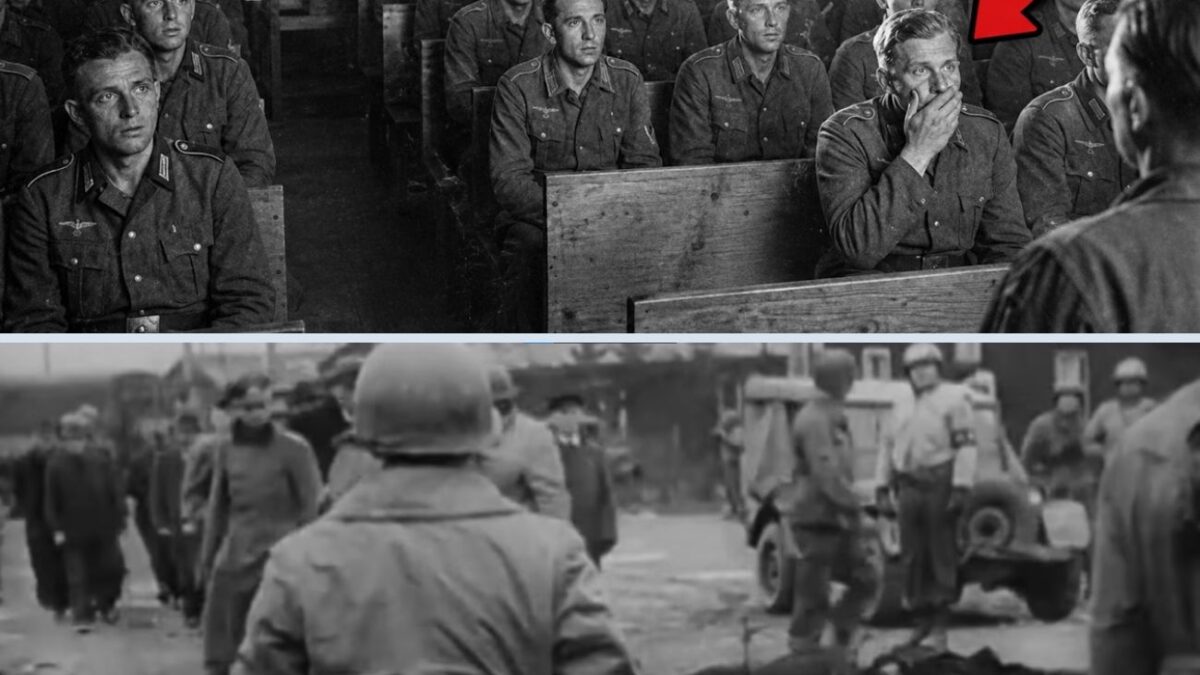
Picture a German sergeant captured in Tunisia two years earlier. It is the summer of 1945 and he is sitting on a wooden bench in a mess hall in the American South. The war in Europe is over. He has been told there is a film tonight. He has not been asked if he wants to see it. American guards stand by the doors and the projector is already threaded. The film runs 20 minutes. The same evening in camps across the country, thousands of other prisoners are watching the same footage. What happened next depends on which room you were in.
In some men laughed, and some said it was all staged. In a camp in Florida, a company of prisoners wrote a letter and collected money for the German Red Cross. And in North Carolina, the historian Judith Gansburg recorded that a thousand men burned their own uniforms. The United States Army then did something unusual. It asked more than 20,000 of these men what they actually believed. So, what was on that screen? Who ordered it? And did it change a single mind?
The idea did not start in Washington. It started in Germany on April 12th, 1945. General Eisenhower drove to a camp called Ohrdruf, a subcamp of Buchenwald, freshly liberated by American troops. What he saw there shook him. In a letter a few days later, he said he had made the visit on purpose so that he could give firsthand testimony if anyone ever tried to dismiss these reports as propaganda. That was the fear behind everything that followed.
Eisenhower ordered American soldiers near the camps to tour them. Local German civilians were marched through and congressmen and editors were invited to come and look. The logic was simple. Words could be denied. Cameras at the gates could not. And the army’s cameramen were everywhere that spring. Thousands of feet of film piled up. At some point in April, someone at the War Department asked a practical question. There were several hundred thousand German soldiers sitting in American camps, fed and guarded and cut off from the truth of what their own government had done. Why not show them?
By the spring of 1945, the United States held more than 370,000 German prisoners. Camps stretched across nearly every state from Florida swamps to the plains of Nebraska. Many of the men had been captured in North Africa and Italy, and the later arrivals came out of France. They were treated by the book. The United States had signed the Geneva Convention and the army meant to follow it. Prisoners were fed, housed, and paid for their labor, about 80 cents a day, mostly in canteen coupons that could be spent at the camp store.
But being safe did not mean being free of the war. Inside the wire, diehard Nazis often ran a quiet system of their own. A prisoner who spoke against Hitler could be threatened and at worst beaten at night in the barracks. Some men were killed by their own comrades. Seven German prisoners were later hanged at Fort Leavenworth for murdering fellow prisoners. The army knew all this. Since 1944, it had been running a small re-education effort with German language newspapers and reading material. But the men who read them knew who had printed them. A film made from the Army’s own cameras and stamped with real place names and dates was something different. It would at least be hard to argue with.
The War Department wrote the instructions in April 1945, and they were specific. The film would be two reels, about 20 minutes. It would use the worst footage the cameramen had recorded and a German narrator would name the place and date of every scene so that no prisoner could say this was Russia or that it was somebody else’s war. There was one more line and it tells you a lot about American intentions. The narration had to remind the prisoners that in America they had been treated according to the Geneva Convention. The army was not only showing them what the Nazi system had done, it was showing them the contrast.
A finished film would take months. The army did not want to wait. On May 8th, the day the war in Europe ended, a telegram went to every service command in the country. German prisoners were to be shown films of German atrocities. Army newsreels of the camps could run in post theaters at no cost. And one rule was written out plainly. No entertainment pictures on the same program. No comedy to soften it and no cartoon afterward.
So through that summer, camp by camp, the lights went down. The film most of them saw was called KZ, the German shorthand for concentration camp. There were no actors and no reconstructions, just footage shot by Allied cameramen. As the camps were opened, American guards stood at the back. When it ended, prisoners were asked to write down their reactions or their own German camp leaders questioned them and passed summaries up to the American commander. These summaries are the reason we know anything at all about what the men thought. And what they reveal is not one reaction, but many.
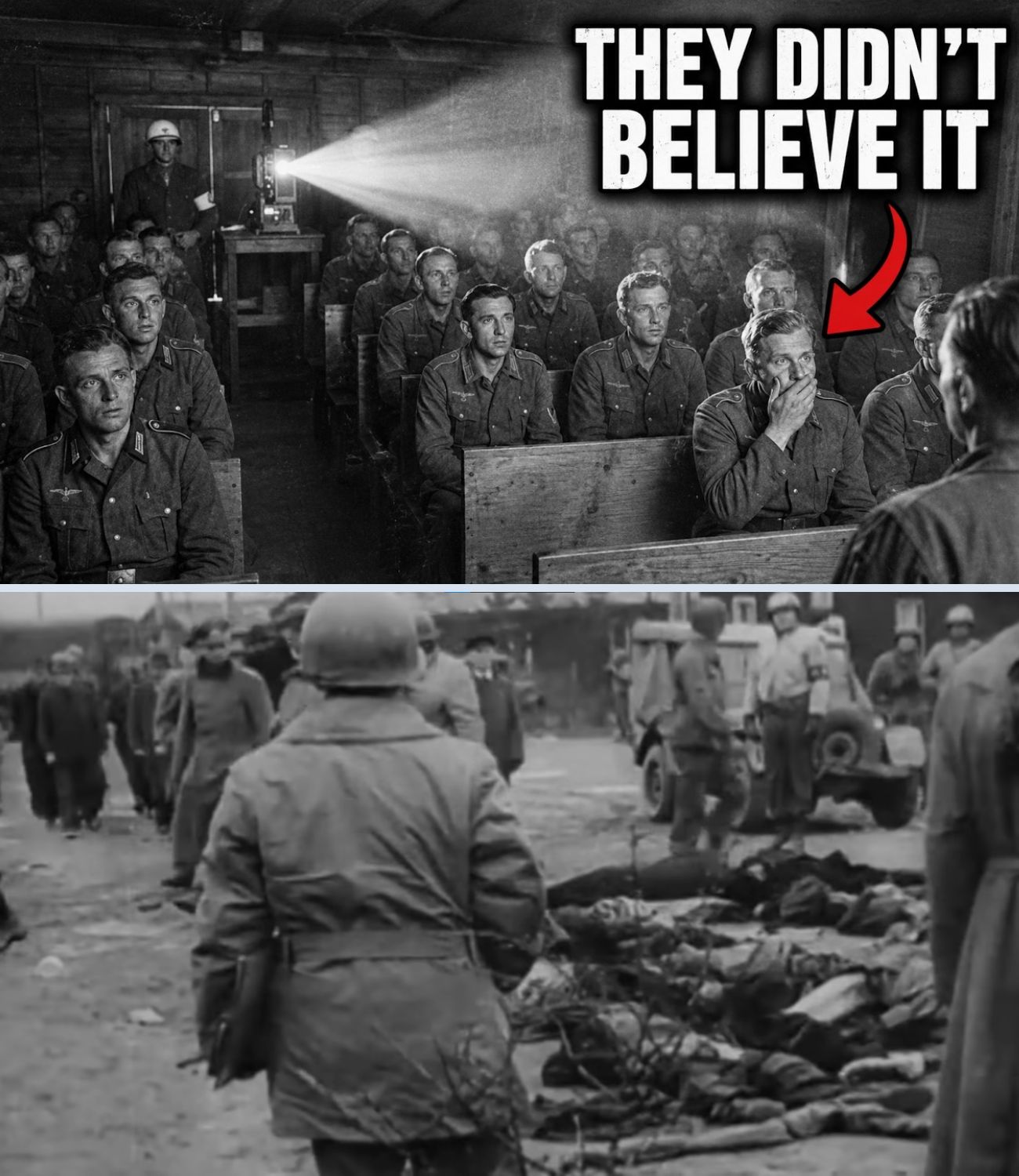
At Camp Shelby, Mississippi, a prisoner named Joseph Kay remembered it decades later. He said it was the first time he had known of these things, that Americans found it hard to believe, but that the soldiers truly had not known. Not everyone was ready to hear it. At Fort Robinson in the northwest corner of Nebraska, every prisoner had to attend. The anti-Nazis in that camp had been waiting for this moment. They wanted proof to hold up to the others. The hardliners had their answers ready. The bodies, some said, were not victims of the camps at all. They were Indians massacred by the British. In other camps, men claimed the dead were Germans killed in Allied bombing or Germans tortured by the Russians. When the narrator said there had been around 300 camps, some men laughed out loud.
It is easy to read this and think the film failed. But consider what denial means for someone who has spent 12 years hearing one story. A man in that room was not only being shown footage. He was being asked to accept that the country he had fought for and the comrades he had eaten beside had been part of it. Some did not laugh.
At Camp Blanding in northern Florida, a whole company of prisoners watched the film on June 10th, 1945. Afterward, their German spokesman wrote a note and sent it up to the American command.
“The company has seen how the German government tortured and killed citizens, foreigners, and prisoners of war,” he wrote.
Then he described what the men had chosen to do on their own:
“Send $411 to the German Red Cross for anyone who had suffered most, regardless of religion.”
His last line asked:
“That every guilty man, whatever his party or unit, receive a just punishment.”
It is worth pausing on that number. A working prisoner earned 80 cents a day. $411 was weeks and months of pay for many men given up in a room where nobody could force them. Blanding was not alone. At Eglin Field on the Florida panhandle, prisoners who had seen the atrocity films gave $2,371 to American war charities. And the New York Times carried the story. By November 1945, German prisoners had given almost a million dollars from their camp pay to the International Red Cross for Europeans who had suffered in the war.
Then there is Camp Butner in the Pine Woods north of Durham, North Carolina. It was built for about 5,000 men. In 1977, Judith Gansberg wrote in a single sentence that a thousand men at Butner voluntarily burned their German uniforms. For a prisoner, this was no small gesture. A uniform was often the only clothing he had carried out of the war. But who were those thousand men? Butner also held a separate compound of prisoners who had been forced into the German army against their will. By June 1945, it held 792 of them, 332 Czechs, 150 Poles, 147 Dutchmen, 117 Frenchmen, and a few dozen others. Some of the men in that camp had never chosen that uniform at all.
No one wrote down the names of the men at the fire, so we cannot say how many were Germans and how many were not. A German historian who read the prisoners’ own reports camp by camp concluded that burning a uniform was rare. She argued it may have been the one unmistakable sign that a man had broken with the regime. That is exactly why the story has lasted. It is unusual and it is hard to verify.
The army wanted a measure of its work. Before the prisoners were shipped home, it surveyed more than 20,000 of them. The result was sobering. Only 36% of the men questioned accepted what they had been shown about the camps as true. The army did not press the question harder. Its view was that it had given them the evidence and reminded them how they had been treated. When the Provost Marshal General’s office wrote its history of the program in 1946, it said the prisoners had been influenced by truth rather than propaganda, so that they felt they were making the new decisions themselves.
The historian Ulrike Weckel gave her study of these reactions a telling title, Disappointed hopes for spontaneous mass conversions. The army had hoped at some level for a sudden change of heart in a room. What it got was slower and messier. A few deniers, a larger group that said little, and a minority who acted, who donated, wrote letters, broke with their past. And remember Arnold Krammer’s warning in his classic history of the camps. Prisoners had reasons to tell Americans what they wanted to hear. Letters and donations from prisoners in a guarded camp can be sincere. They can also be smart.
By the summer of 1946, the last German prisoners had left the American camps. Many did not see Germany for another year or two. Some were sent on to work in Britain or France before going home. Back in Germany, their families would soon be shown the same kind of pictures. The Americans produced their own film for German civilians called Death Mills, and it was shown in occupied Germany in 1946. Some of the men who sat through it had already seen the footage in a dark room in Mississippi, Nebraska, Florida, or North Carolina with an American guard at the door.
That is the strangest part of this story. The film did not make converts of most of the men who watched it. But it gave them something they could never say afterward that they did not have the knowledge. Whatever they chose to believe, the evidence had been placed in front of them by the army that held them. And that same army had treated them by the rules.
So, did it work? If you need a yes or a no, the answer is for some. For a minority, it changed what they said and did in ways we can still find in an archive. For most, it did not, at least not on the night. The real test came later in the years in Germany when these men had to decide what to tell their children.
You Might Also Enjoy

“We Thought They Would Negotiate”—What Argentine Soldiers Said When The British Attacked Goose Green

“You’ll Never Finish My Ruck March, Limey” — US Sergeant Who Challenged the SAS, Then Fell Out First






