“Get Rid of That Kettle”: Why the British SAS Laughed at a US General’s Base Rules
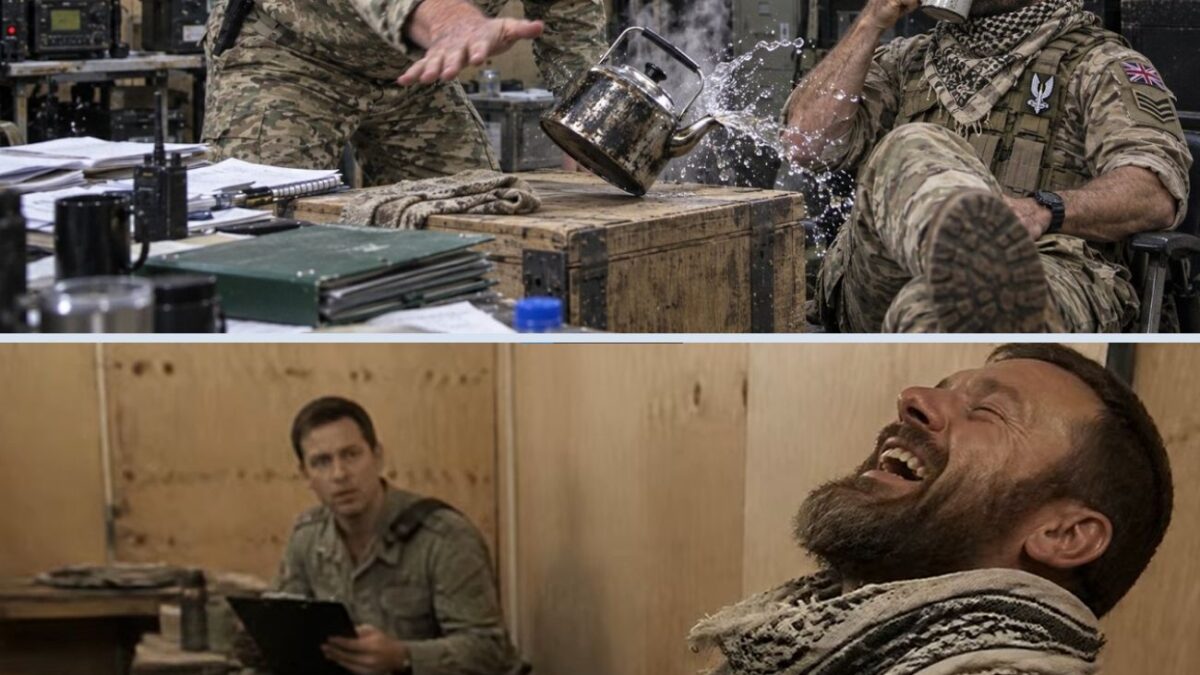
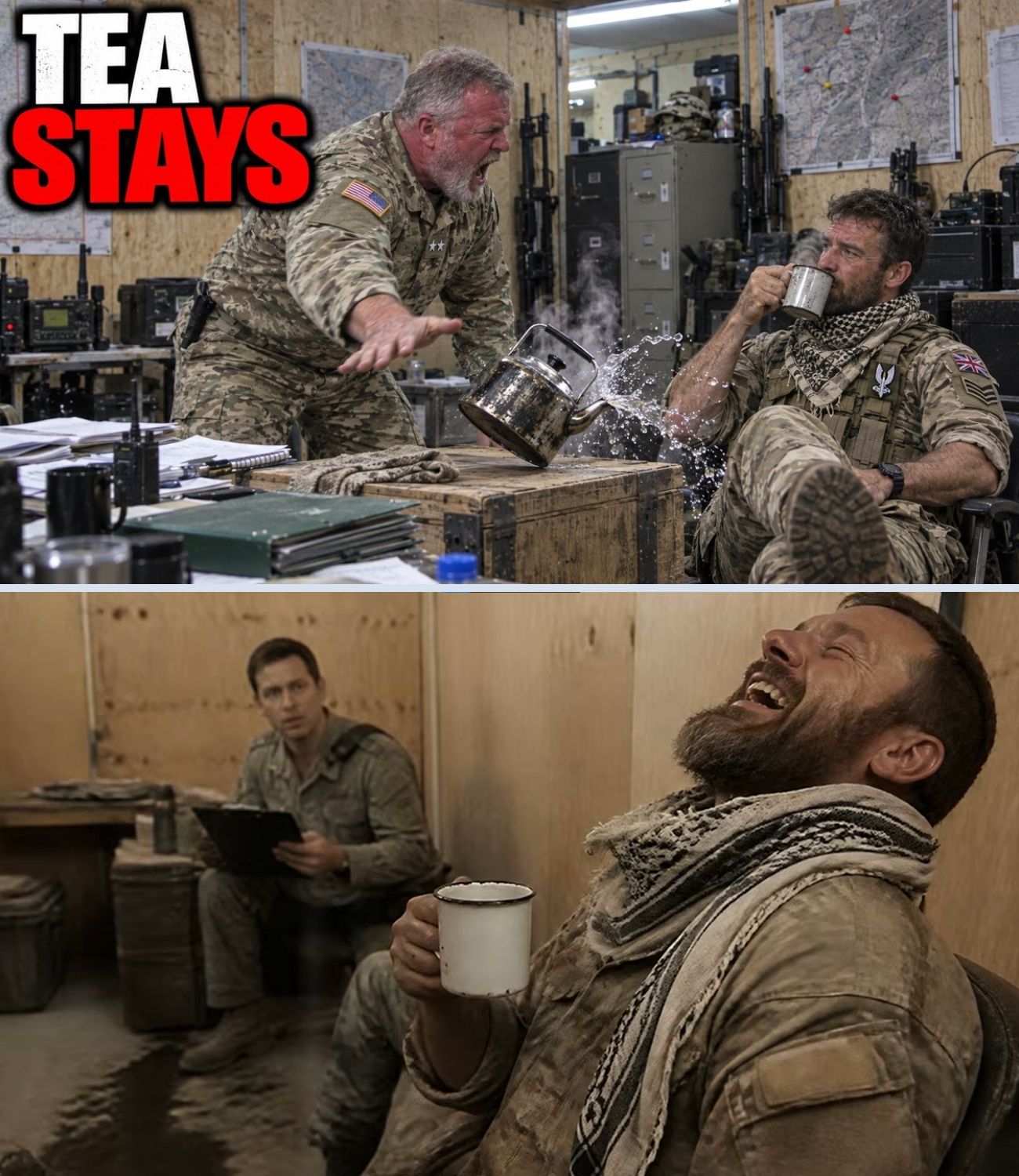
There is a dented metal kettle on the plywood floor of a joint operations room in a forward compound, and the water from it is spreading in a dark half-moon under a filing cabinet, and the man who knocked it off the crate is a two-star general of the United States Army, and the man watching him do it is drinking from a white enamel mug and has not moved. Picture that for a second because this is where the story lives. The general’s face is the color of a brick in July. His right hand is still out, flat, the way a man’s hand stays out after he has struck something and committed to the gesture. He is shouting. The words are the kind of words a major general uses when he has decided that the problem in front of him is a discipline problem, and discipline problems have a solution he already knows.
“Get rid of that kettle. I don’t want to see it on this base again. I don’t want to smell tea on this base again. Am I understood?”
The British sergeant across the crate has a black and white scarf around his neck and a beard a garrison barber would have reached for scissors over. And he is holding the mug in the loose, two-fingered grip of a man who has held a hot mug in a cold place for most of his adult life. He takes a sip. He does not blink. He waits for the general to finish the way you wait for a weather front to pass. And when the general does finish, the sergeant tilts his head about half an inch and says something very quiet. Whatever he says, the general goes still.
Six weeks later, that same general will stand in front of a bank of monitors in that same room and watch six men clear a two-story building in the dark in a town he will never be allowed to name on paper. And when it is over, he will turn to the Delta officer beside him, a man who had agreed with him completely about the kettle, and he will say the sentence this hour is about. The Delta officer wrote it down.
Major Elias Roark was not a man you dismissed. If you want to understand what happens in this story, you have to understand him first because the whole shape of it depends on him being right about most things. He was 41 years old. He had come out of West Point in the top 10 of his class and he had come out of Ranger School with a tab he never spoke about. And he had come out of the operator training course at Fort Bragg, a Delta Force Squadron assaulter who, by the time this story begins, had done three tours he could discuss in a bar and two he could not. He had put rounds through doors in Mosul and in a mountain village in Paktika he does not name. He was now the operations officer of a Delta Squadron, which means he was the man who read the plans before anyone else read them and found the hole in them before the hole found anyone else.
He kept a small leather notebook in his left breast pocket and he filled it in pencil because a Delta instructor had told him once that ink runs when you bleed on it and pencil does not and he had never seen a reason to change. He had been a competitive triathlete at the academy and at 41 he still ran like a man who was being timed by someone he respected. He believed, with the quiet certainty of a man who had been proved right by his own career, in a single idea. Elite performance was the visible product of invisible standards. You did not get to the top by being clever about the top. You got there by being correct about the bottom. The hand salute. The side arm carried in the issued holster. The boots that were the correct boots and the uniform that was the correct uniform and the haircut that was the correct haircut because every one of those small correct things was a small daily vote for the kind of man you were deciding to be. And over 20 years, those votes added up to a soldier who could be trusted with a locked room and a pistol and a bad choice.
He had seen men go sloppy on the small things, and he had seen those same men go sloppy on the big things. And he had, on one occasion in a dust-blown house south of Baghdad, buried a friend who had gone sloppy on both. So, when the task force list came through, and he was named as the senior Delta liaison attached to a two-star American headquarters in a joint compound overseas, and when he read the second paragraph and found that the task force included a troop from a British Special Air Service squadron, he was not displeased. He had worked with the regiment before, briefly, in a planning cell in Qatar, and he had liked them. He respected them, he had told his wife over a glass of wine the night before he flew out, that they were serious men. But he had also added, because he was an honest man, and he said the thing he thought,
“They’re a little loose for my taste.”
He did not know yet which of those two sentences was going to matter. He was about to spend six weeks on a forward compound with Major General Dwight Hollenbeck, who had very clear views on looseness and no views at all on tea. He was about to watch a staff sergeant called Tam Buchan smile at a two-star general and not put his mug down. He wrote the date in his notebook on the plane in pencil.
The compound sat on the gravel floor of a wadi that someone had widened with earthmovers in 2004, and that no one had properly tidied since. There was a landing strip, a vehicle park, a mess tent, three rows of hard-wall huts for the senior staff, two rows of soft-wall tents for everyone else, and a windowless plywood operations room that had been built by American engineers in a week, and was now the beating heart of a joint task force whose remit extended across two provinces, and whose name has been changed in the public record more than once. The British called it, affectionately and without variation, the shed.
Major General Dwight Hollenbeck ran it. He was 58, a stocky, gray-headed field artilleryman who had come up through the Gulf and Kosovo and two tours in Iraq. And he had, in the division he had commanded before this one, instituted a policy he called the clean boot rule. The clean boot rule was simple. If a soldier came through the door of a divisional building with mud on his boots, that soldier turned around and cleaned his boots and came in again. And on the second entry, he was welcome. It had become a joke that officers who served under Hollenbeck traveled with a brush. It had also, and this is why the joke was only ever a joke, produced three of the best-performing brigade combat teams in the United States Army in that decade. Hollenbeck believed in what he believed in because it had worked.
Roark’s first morning on the compound, he stood at Hollenbeck’s shoulder in the operations room while Hollenbeck did a walk-through. The general’s eye traveled over the maps and the radio bank and the rifles racked against the plywood wall. And it traveled over the knot of American staff officers who had come to attention. And it traveled onwards. And it stopped. Three men were sitting on the floor in the far corner. They were in British disruptive pattern trousers and sand-colored T-shirts. No body armor, no head dress. One of them was reading a map on his knee. One of them was cleaning a Glock 17 with the slow, unbothered patience of a man cleaning something he had cleaned a thousand times. One of them was pouring hot water from a dented, battered metal kettle into three white enamel mugs that were lined up on a wooden ammunition crate. And the smell of the water was not coffee.
Hollenbeck looked at them for a long second. He turned to his adjutant, Chief Warrant Officer Danny Vogel, a lean 28-year man whose uniform looked ironed even in a wadi. And he said, loud enough for the room to hear him and loud enough for the men in the corner to hear him,
“Who the hell authorized a tea service in my operations room?”
“The British, sir,” Vogel said.
“The British are on my base,” Hollenbeck said.
Roark, standing behind the general’s left shoulder with his notebook open and a pencil in his hand, watched the three men in the corner. None of them looked up. The one with the map turned a page. The one with the Glock laid the slide down on a cloth. The one with the kettle finished pouring and set the kettle on the crate. And he did it carefully because the kettle had a dent in it that meant you had to set it a particular way or the water puddled on the lid and he knew that. He picked up a mug and he passed it to the man with the map and the man with the map took it without looking up and said quietly,
“Ta.”
Hollenbeck turned on his heel and walked out and in the corridor he said to Roark in that same unlowered voice,
“Six weeks, major. Six weeks and I’ll have them squared away or I’ll have them off my compound. There’s an army here and there’s a bunch of hikers with a kettle and I’m going to teach them which one they’re attached to.”
Roark wrote it down in pencil. He was not at that moment inclined to disagree.
Lieutenant Colonel Giles Ashworth was waiting for him in the corridor outside the senior mess. Ashworth was the regiment’s liaison officer at Task Force Headquarters, a slim, polite, gray-templed man in his 40s who used a fountain pen because he found biros dishonest in some way he could never explain. He apologized mildly for intercepting Roark. He said he thought it would be helpful if the Delta liaison and the regiment’s troop met before anything was asked of either of them. Roark, who had not been apologized to by a British officer before, said that would be very helpful indeed.
Ashworth walked him through the shed and out the back door and across a strip of gravel and in through the back door of a lower hut. And he knocked once on an open storeroom door and he said,
“Tam. Major Roark from across the way.”
And then he stepped out and shut the door behind himself so quietly it did not click. Roark had expected, because he had done a lot of these over the years, a certain kind of first meeting. He had expected the troop staff to assemble in the operations room in some order of seniority in some version of their working uniform and to stand when he came in. He had expected an officer to introduce them. He had expected a short briefing on their capabilities delivered with the mild chest puffing that was universal to units who thought well of themselves. He had expected, in short, a performance.
He got instead three men sitting on the floor of a storeroom at the back of the shed around a map laid out on a pallet with the dented kettle on the pallet beside the map and three empty mugs beside the kettle and a fourth full waiting for him. The man kneeling at the top of the map stood up and offered a hand. He was mid-30s, lean, dark blond with a close-cropped beard that would have offended Vogel on sight. He said,
“Tam Buchan, staff sergeant. I run the troop day-to-day. That’s Paddy. That’s Imran. Help yourself to a brew, sir. You’ve had a journey.”
Roark, who had expected to be briefed, found himself holding a mug of extremely hot, extremely strong tea. Buchan had a soft, flat Fife accent that Roark had never heard in a soldier before. And he carried himself in the way certain senior non-commissioned officers do when they have been in uniform since they were 16 and have long since stopped performing any of it. He drank his tea black and no sugar, he said when Roark asked, that this was the way God intended. He said it without smiling so that Roark was not sure for a second whether he was serious. And then Pardue looked up from the map and said flatly,
“He is serious.”
And Roark understood that the two of them had been having that particular exchange about the staff sergeant’s tea for approximately a decade. Peter Pardue, called Paddy, was Buchan’s team leader, a sergeant, late 30s, taller than Buchan and quieter even than Buchan, with the sort of long still face that gave nothing away in a bar and gave less away over a map. He spoke, Roark noticed within the first 10 minutes, only when he had something to say. The rest of the time he listened, and the listening was active in a way Roark found slightly unnerving, because it was the listening of a man who was already two steps into the planning while Roark was still describing the problem.
Buchan talked Roark through the troop in 6 minutes. He did not use a slide. He did not use rank except where it was necessary. He did not list capabilities. He pointed at the map and said,
“In order, we can go there. We can get in that way. We have been in that town twice before, and the second time it did not go the way we expected, and here is what we learned. We have four Pinzgauers, and we don’t trust the one with the red fuel cap. Our interpreter is called Nabeel, and he’s a good lad, but he gets carsick, and you don’t want him in the lead vehicle. We don’t do an awful lot of standing about, sir. So, if there’s a thing we’re meant to be doing with your general staff, best tell us now, because otherwise we’ll get on with what we were going to do anyway.”
Roark, holding his tea, felt the first small thing shift. It was nothing dramatic. It was simply that he had not been in a briefing like this before, and he was not quite sure what to do with it. There was no slide. There was no posture. There was no attempt to impress him. The three men on the floor were absolutely, visibly, entirely uninterested in whether Major Roark of Delta Force was impressed, and the thing that unsettled him was that they were not being rude about it. They had just forgotten to be interested, because they were interested in the map. He wrote one word in his notebook in pencil, “economical.” Then he underlined it.
On his fourth day in country, Roark went out on a three-day job. Buchan had mentioned it in passing on the first afternoon.
“We’ve got a wee walk coming up, sir. You’re welcome to come if you fancy stretching your legs.”
And Roark, who read the ground sign himself and understood that the invitation was both genuine and a test, had said yes before Buchan had finished the sentence. He had packed his bergen that night by the yellow light of a stand lamp in his quarters, laying everything out on the camp bed first and photographing it with his phone, which was a habit he had kept since his first long patrol in Afghanistan. He weighed the bergen on a luggage scale he carried for the purpose, 41 kilos. He was pleased with that. 41 kilos was lean for a three-day job with water.
They left the compound at 3:00 in the morning in two of the Pinzgauers, not the one with the red fuel cap, and they drove for two hours in the dark with headlights off and night vision down, and they stopped at a dry riverbed, and they walked. Roark had been on long patrols before. He had done the Delta long range workup. He had done a two-week stalk through pinewoods in Georgia, and he had done an endurance patrol in the Chocolate Mountains that he still 9 years later considered the hardest thing he had ever willingly done. He knew what good looked like. What he saw on the first night was not what good looked like. It was something else.
Buchan led. Pardue walked in the three slot. Qureshi was tail end Charlie. Roark was in the four slot behind Pardue, which was the correct place to put a guest, and he noticed that it had been given to him without being discussed. The pace was fast enough that Roark was working to hold it, which he had not expected, and the thing that was eating him was not the pace itself, but the shape of it. Buchan did not navigate by map. Roark watched him for the first hour, waiting for the pause, the compass check, the quick squint at a folded sheet. It did not come. Buchan went up a dry wash and over a saddle and across a stone plateau and down into a second wash on the far side of it. And he did it without stopping. And when they came to a halt in the first dawn in a hide below a broken ridge, Roark eased his bergen off and looked at the map in his sleeve pocket and understood that they had crossed six grid squares of broken ground in the dark, in silence, without a map coming out once.
He asked Pardue about it quietly in the hide.
“Tam’s been in and out of this valley 11 times,” Pardue said.
“Since when?” Roark asked.
“2003,” Pardue said.
That was the first thing. The second thing was the hide itself. Roark had built hides. He had built a hide in a bramble thicket in the Carolinas that his instructors had walked past twice without seeing. He watched Buchan and Qureshi build the observation post on the broken ridge in 40 minutes using the back of a rock fall and three strips of Hessian and a square of scrim and the natural line of a thorn bush that had grown out of a crack in the rock. And when they were done, the hide was invisible from 6 m and it had three sight lines, two of them covering the valley road and one of them covering their own back trail. And it had been built without a single word spoken between the two men. They had not conferred. They had simply arrived at the ridge and done it in the way two men who had built 400 hides together build the 401st.
The third thing was Qureshi. Roark had been told Corporal Imran Qureshi was the troop’s demolitions man and he had assumed, because he was tired and because he was carrying the quiet weight of a certain kind of assumption, that this meant Qureshi was the muscle. He corrected himself in the hide at 7:00 in the morning when Qureshi, sitting cross-legged with a notebook on his knee, began to draw from memory a sketch of the compound they had passed in the dark 3 hours earlier. The position of a generator, the pattern of the aerials on the roof, the location of a water tank, a count of vehicles. He drew it in the detail of a man who had been looking at it in the pitch dark through a passive night sight while walking.
Roark watched him for 10 minutes and then asked him very quietly where he had learned to draw like that, and Qureshi, without looking up, said that he had been an engineer at Cambridge before he joined up, and that he had left in his second year of a doctorate because he wanted to do something that mattered more.
“Does it?” Roark asked.
“Most days,” Qureshi said.
They lay in the hide for 31 hours. Roark had done 31-hour observation posts before. He had not done one in which no one spoke above a breath, no one broke silhouette, no one ate anything that crackled. No one shifted weight for cramp without first telegraphing the shift to the man next to him with a small movement of two fingers, and no one, in all 31 hours, looked bored. Pardue read when he was not on the glass. He had a paperback in a plastic sleeve. When he was not on the glass, he slept the deliberate sleep of a man who had taught himself to sleep in 40-minute pieces and wake without a watch. Qureshi, when he was not on the glass, drew. Roark, when he was not on the glass, counted his own breathing and tried not to think about the fact that he had, for the first time in his career, understood that he was with people who were not better than him, but were different from him in a specific way. And he did not yet have the word for the way.
On the walk back, 40 hours later, Buchan dropped back next to him in the last 2 miles and said, companionably,
“Not a bad wee stretch, that, was it, sir?”
“No,” Roark said.
He wrote three sentences in his notebook that night. The last one said, Fitness is not the test. Fitness is the ticket to the test. He did not yet understand that he had just failed the easy part.
Back at the compound, Roark slept for 10 hours and woke at 4:00 in the morning and lay on his back in the dark and did what he always did after a hard patrol, which was to argue with himself. The argument went like this. Yes, Buchan navigated without a map, and yes, that was impressive, but Buchan had been in that valley for most of a decade, and anyone in that valley for most of a decade would know it that well. Yes, the hide was good, but his own hide in the Carolinas had been good, and his instructors had walked past it twice. Yes, Qureshi could draw a compound from memory, but Delta had men who could do that, too. He had served with one of them, a quiet Oklahoman called Haggerty, who could tell you the make of every vehicle in a car park he had walked past at a glance. He was comparing a troop to a troop. He was not comparing one of them to the other.
He also thought briefly about the kit. He had noticed on the patrol that the L119A2 carbines the regiment carried were close cousins of his own weapon, and the Glock on Buchan’s hip was the Glock on his own hip, and the night vision on their helmets was the night vision on his, give or take. There was no secret American advantage of equipment and no secret British disadvantage. They had the same tools—he had been expecting somewhere in the back of his mind to find a reason in the kit, and the kit had refused to give him one, and he closed that line of thinking off because it was not going to help him, and he was a serious man who did not waste time on comforts.
He got up at 5:00. He went for a run inside the wire along the inside line of the perimeter. He ran 6 miles. He felt better. At the mess tent at breakfast, he sat opposite Pardue, who was eating porridge with a long, slow efficiency and reading his paperback, and Roark, who was by profession curious, tipped the cover of the book up with one finger to see what it was. It was Patrick Leigh Fermor’s A Time of Gifts.
“You walked across Europe lately, Sergeant?” Roark said.
Pardue looked up. “There was a lad in my old troop used to read it on observation posts. Said it slowed him down the right amount. I took it off him when he got out, and I never gave it back.”
“Is he all right, the lad?” Roark asked.
“He’s a farmer in Herefordshire. Doesn’t miss it,” Pardue said.
They ate in silence for a minute. Then Pardue said, without looking up,
“You were steady on the walk, sir. Tam said you were steady.”
Roark, who had received a great many compliments in his career from a great many serious people, found that the one from a British sergeant whose first name he had only just learned was going to stay with him longer than most of them.
“Tell him thank you,” Roark said.
Pardue turned a page.
In 6 days, there would be a rehearsal in the shoot house, and Roark would discover that fitness and fieldcraft were not actually the hard part. The hard part was what happened inside a room in the time it took a door to swing on its hinges, and Delta Force prided itself on being the best in the world at exactly that. He was looking forward to it.
The compound they were going to assault was a two-story breeze block building with an inner courtyard, a flat roof, two staircases, a wellhead in the courtyard that someone had put a car battery on top of, and seven rooms whose layout had been drawn from memory by Qureshi after a drive past and refined over three nights by a drone whose feed only certain people on the compound were cleared to see. The British Royal Engineers at Task Force Headquarters had built a one-to-one plywood mock-up of it, roofless, inside a wire pen a hundred meters from the shed. The mock-up had been there for six days. The troop had been in and out of it since the morning it was finished.
On the morning, Roark watched them rehearse. He carried a stopwatch and his notebook, and he leaned on the plywood wall at the top of a short tower that the engineers had bolted to the mock-up, and he looked down into the roofless building, and he said nothing at all for 45 minutes. They ran it 11 times. The first run was slow. Buchan called it slow himself, over the net, in his flat voice.
“Slow, slow, slow. We’re sloppy on the first landing. Go again.”
They went again. The second run was tighter. The third run introduced a stoppage. Qureshi’s weapon jammed on the breach of a specific interior door, and Roark watched Qureshi transition to his Glock 17 in a movement so smooth he nearly missed it. And the Glock cleared the doorway, and the room was taken. And then they went back and ran it again, and this time Qureshi’s L119A2 did not jam, because the engineer in Qureshi had, between runs, taken the carbine apart on an ammunition crate in the yard, and done something to it that stopped the problem happening, and he had done it in four minutes.
What Roark was watching for, as a Delta operations officer, was decision speed. The time between a man seeing a thing he had not expected, and that man doing the correct thing about it. He had, in a career, got used to measuring this in his own operators. The best of them lived in that interval the way a swimmer lives in water.
He watched Pardue in the fourth run break the pattern on the first landing. The plan had the number one man taking the near room, but Pardue heard something in the far room and reassigned, with one word on the net, mid-stride, and the number two man took the near room, and Pardue took the far room, and the rooms were cleared in a time that Roark, pencil in hand, timed to the nearest second, and when he looked at the stopwatch his own hand had, without his noticing, drawn a small vertical line in his notebook. He stared at the line for a moment. He understood that it meant faster than my own best squadron. He wrote the number next to the line. He did not underline it.
They were on the eighth run when Hollenbeck walked into the yard. The general had come down from the shed because he had been told the regiment was running a rehearsal and he wanted to see it. He stood at the base of the tower in his pressed uniform and his signet ring and Vogel stood at his shoulder with a clipboard and the two of them watched run nine and run 10 in silence. On run 11, Buchan called the rehearsal done and the troop broke out of the mock-up and walked across the yard to the ammunition crate they had set up on the far side of the wire pen and on the ammunition crate was the kettle.
The kettle was already on. Qureshi had put it on before run eight. It had been coming to the boil through runs eight, nine, 10 and 11 because that was how long it took the troop to run that rehearsal. Four times and when they reached the crate the water was ready and Buchan reached for it. Hollenbeck crossed the yard in six long strides. He did not shout, not yet. He walked up to the crate and he looked at the kettle and he looked at Buchan and he said in the loud flat voice of a man who has decided that a line has been crossed,
“Staff Sergeant, this is a tactical rehearsal area. I have told you people before I don’t want to see this on my compound.”
And he swept the kettle off the crate with the back of his hand. The water went up in a sheet and came down on the gravel and the kettle hit the ground and rolled and Buchan, who had in the time it took the kettle to leave the crate, done nothing at all, picked up a white enamel mug from the crate which still had an inch of this morning’s tea in it and took a sip and said something very quiet. Roark, from the top of the tower, could not hear it. What he could hear was Hollenbeck afterwards in a voice that climbed with each sentence.
“Get rid of that kettle. I don’t want to see it on this base again. I don’t want to smell tea on this base again. Am I understood?”
“Understood, sir,” Buchan said politely.
Hollenbeck walked out of the yard. Buchan bent down and picked up the kettle. It had taken a new dent on the lip over the top of the three old dents, and he turned it in his hand once, and he nodded at it the way a man nods at a dog that has been kicked and has not bitten anyone, and he set it back on the crate. Then, without a word, he refilled it from a jerrycan, and he put it back on the burner.
Roark, on the tower, understood two things at the same time. The first was that Buchan was not going to get rid of the kettle. He was not going to argue about the kettle. He was not going to raise his voice about the kettle. He was going to boil the kettle because the kettle was not a protest, and it had never been a protest. And that was precisely why the general’s rule about it could not touch it. The second was that the troop he had just watched clear a two-story mock-up at a speed his own squadron could not quite match had, at no point in the 11 runs, raised their voices, either. He wrote one sentence in his notebook: They do not shout. Then, below it: Not at the door, not at each other, not at a general. Then, he closed the notebook and put the pencil back in his pocket.
That night, Roark could not sleep. He lay on the camp bed in his hard-wall hut with the stand lamp off and the ceiling fan going at the low speed that did not quite move the air, and he listened to the compound settle, and he thought about the kettle on the gravel, and the water going up in a sheet, and he thought about Pardue on the first landing reassigning the number one man mid-stride with one word. And he thought about the general’s hand coming across the crate, and he thought about Buchan taking a sip from a mug that had cold tea in it, and he could not get the pieces to sit in the shape they used to sit in.
He got up at some hour that was not morning and not night, and he opened the notebook on the small folding table under the window. And he turned the pages back and he read what he had written in pencil since the plane. He read, “Economical.” He read, “Fitness is the ticket to the test.” He read, “Faster than my own best squadron.” He read, “They do not shout.” He put the pencil down. He folded his hands over the notebook. He looked out of the window at a strip of compound floodlit in the color of weak tea, and he said in the privacy of his own hut, out loud, the one word he had been trying not to say for a week,
“Why?”
Why did they not shout? Why was Buchan’s beard not shaved? Why did a corporal with a Cambridge doctorate he had never finished carry a dented kettle on a three-day stalk and boil it in a hide at 7:00 in the morning with Hessian between him and the valley road? Why did Pardue carry a paperback? Why did Ashworth, the colonel, use a fountain pen and apologize mildly every time he had to sign something in a hurry? Why did the men who had, in the mock-up, done a thing he could not fault, not look like soldiers he recognized?
He understood, sitting there at 4:00 in the morning in a hut on a compound in a country he could not name on paper, that the question was the wrong way round. The question was not why these men did not look like the soldiers he recognized. The question was why he had for 23 years in uniform believed that the look and the thing were connected. He had believed it because in his life it had been true. He had believed it because every man he had buried for being sloppy on the small things had also been sloppy on the big things, and so the correlation had locked in his mind, and he had never had cause to break the lock.
The troop in the mock-up had broken it. They were, by any measure he could put a pencil to, extremely good at the thing they did. They were also, by any measure Hollenbeck could put a pencil to, uniformly sloppy on the small things. The beard, the posture, the seated map briefing, the kettle, the absence of visible rank in the room, the quietness. Both of those things could not be true at the same time, and both of them were, which meant one of two possibilities. Either the small things were, in fact, correlated with the big things, and the troop was going to fail at the big thing when the big thing came, and Roark, having watched Run 11, did not believe this. Or the small things had never, in truth, been causing the big things. The small things had been a signal of something else. Of care, of seriousness, of the voted-for kind of man. And this unit had the thing itself in a different form, in a form that did not need the signal, because they had, somewhere along the line, decided that the signal was for the people watching, and the thing was for the people doing.
He wrote one sentence in the notebook in pencil at 4:15 in the morning: The uniform is a tell. It is not the hand. He read it twice. He closed the notebook. He did not open it again until after the proving operation three nights later.
Before the operation, he had to walk down to the mock-up one more time. And that was where it happened. He went down because he had been invited. The British were doing a last walk-through, not a run, just a walk. The slow talk-through that every assault element does before a live job, in which each man stands on his mark and recites what he is going to do when the door opens. And Buchan had, in his flat way, said,
“You’re welcome to come, sir, if it’s useful.”
It was useful. Roark had done 40 of these in his career, and the one thing he had learned about them was that they were the moment when the plan became a thing, not a document. He stood in the courtyard of the mock-up, and he watched Buchan walk the troop around the inside of it. Buchan did not talk much. He pointed. He said,
“You.”
And then he said a verb, and then he said,
“There.”
And then he moved on. He said each man’s job once, and he did not say it again. He asked each man, when the job had been said, whether that was clear. Each man said,
“Yes.”
Buchan moved to the next mark. He came to Qureshi last. Qureshi had the breaching role on the main courtyard door, and the main courtyard door was going to be the first serious noise of the operation. And the main courtyard door, in Qureshi’s judgment, had a hinge configuration that the drone footage had underrepresented. Qureshi had worked out overnight that he was going to need to adjust his charge. He had, overnight, cut a new charge. He had, overnight, run the figures. He explained all of this to Buchan in six sentences. Buchan listened without interrupting. When Qureshi was done, Buchan said,
“You happy with it, Imran?”
“Yes,” Qureshi said.
“Good lad. Carry on,” Buchan said.
And walked on. That was the moment. Roark, standing in the courtyard with his notebook not in his hand for the first time in 2 weeks, understood that he had just watched a staff sergeant delegate a potentially mission-ending technical decision to a corporal in the field, 40 hours before the live job, on the strength of one word.
In Delta, they would have done the same thing. He wanted to be honest about that. Delta would have trusted the technical expert in the technical role, but Delta would have, in his own experience, also talked about it longer. A second check, a back brief, a confirmation up the chain. Buchan had not done any of that. Buchan had asked one question. Qureshi had given one answer. The decision had been made. It had been made at the lowest competent level by the man who knew the thing best, and it had been made without ceremony. And the ceremony had been absent because the ceremony was not what made the decision correct. What made the decision correct was that Buchan had for 10 years worked with Qureshi, and he knew precisely what Qureshi knew, and precisely what Qureshi did not know, and he trusted the one and he caught the other. And he did not need a form for that trust.
Roark, who had respected the regiment at a distance his whole career, understood for the first time what they were respected for. Not that they were tougher—they were not. Not that they were better shots—they might be marginally in some conditions, but it was not the thing. They had, somewhere in the long institutional memory of a very old unit, worked out that command flows downwards through competence, and not through standards. And they had built a troop in that shape, and they had taken the costume off because the costume was for watchers. He wrote nothing. He walked back up to the shed.
The operation goes on a Thursday night in the first week of October. The target is a two-story breeze block building with an inner courtyard in a town whose name is in no document Roark will ever write. There are, by the latest intelligence, four men inside the building, and in a room on the first floor there are two aid workers who have been inside the building for 11 days. One is a doctor. One is a logistician. They are both still alive at the last confirmed sighting, and the last confirmed sighting is 16 hours old.
Roark is in the back of the command Chinook with Hollenbeck. The back of the Chinook is red-lit and loud, and it smells of hydraulic fluid and the heat of 30 bodies in body armor. And the Chinook is sitting over a landing site 12 km from the target, with its ramp down and its rotors turning and the troop is already gone. They went in from a separate aircraft on an infiltration line that Roark has read and does not entirely understand because it was Pardue’s and Pardue’s lines are drawn by a man who has walked them.
The troop is on foot now moving through the back gardens of a block of houses and Roark in the Chinook is watching their progress on a small screen that is being fed by orbiting at an altitude he can hear through his headset. Hollenbeck is beside him. The general has his helmet in his lap and his face is set and he has not spoken for 40 minutes and Roark knows the look. It is the look of a commander whose plan is now entirely in the hands of men he does not fully trust and who understands that this is the condition of command.
On the screen the troop reaches the compound wall. Qureshi’s charge goes at 23:41. Roark hears it in the Chinook. 3 seconds later a flat soft thump that is quieter than he expected and on the screen the courtyard door is open and four small infrared signatures move through it in the pattern he has watched 11 times in the mock-up and the pattern this time is not quite the pattern he watched because at the point where the number one man was going to break left Pardue’s voice comes on the net,
“Contact front upper landing.”
And the number one man breaks right instead. And Buchan, who is the number three man, breaks left to cover the room the number one man was going to take and the thing happens in a configuration none of them has rehearsed and all of them have rehearsed for because they have rehearsed the principle and not the shape.
The first floor landing takes 9 seconds. Roark knows it is 9 seconds because he looks at his watch when Pardue calls contact and he looks at his watch again when Buchan calls,
“Rooms clear. Four down, hostages secure.”
And the gap on the watch is 9 seconds, and he looks at Hollenbeck, and Hollenbeck is looking at the screen, and Hollenbeck’s mouth is slightly open, in the way the mouth of a man who had an argument about a kettle is slightly open when the kettle’s owners have, in 9 seconds, done the thing he was afraid they could not do.
The exfiltration is slower. The exfiltration is always slower. They walk the doctor and the logistician out of the building and through the courtyard and over the compound wall by a short ladder that Qureshi has set, and the Chinook lifts off its landing site and comes forward and sets down in a dusty field 400 m from the compound. And the troop puts the two aid workers on the ramp first and then boards itself. And the last man on is Buchan. And Buchan has, Roark notices with a small jolt that is almost funny, the dented kettle clipped by its handle to the webbing of his bergen.
The Chinook lifts. In the red light, Buchan sits down on the floor opposite Roark, and Roark, over the noise of the rotors, looks at the kettle on the bergen, and he looks at Buchan, and he does not say anything. And Buchan, after a second, grins. It is the first time in 6 weeks Roark has seen him smile.
The doctor is cradling the logistician’s head in her lap. The logistician is conscious but badly dehydrated. Qureshi has an intravenous line in him before the Chinook is 5 minutes into the flight. And Qureshi does it with the same practiced quiet he brought to the charge on the courtyard door. And Roark understands, watching him, that the engineer who left Cambridge is also a medic, and that in this unit the thing a man can do is counted in the end and not the number of jobs he has a title for.
Hollenbeck does not speak on the flight back. He sits in his seat, and he looks at the floor of the Chinook. And once, halfway back, he looks up and he looks at Buchan across the red-lit cargo bay. And Buchan, who is drinking from a water bottle, not a mug, because the kettle on his bergen is cold and empty, meets his look and nods once politely, the way a staff sergeant nods at a general officer when a job has gone the way it was meant to go. Hollenbeck nods back.
They land at the compound at 02:17. The two aid workers go off first, onto the medical team’s stretchers, and the troop goes off second, and Hollenbeck goes off last with Roark behind him. And in the dust under the rotors, the general turns to Roark and says something that Roark does not quite catch, and asks him to repeat.
“Sir?” Roark says.
Hollenbeck says it again.
Roark takes the notebook out of his pocket. He writes it down in pencil.
Years later, Elias Roark left Delta Force a lieutenant colonel, and he taught at a staff college for 2 years, and he retired, and he did some consulting work he does not discuss. And sometimes, when a certain kind of audience asked him a certain kind of question, he would tell them about the kettle. By his account—and he was careful always to say by his account, because the operation itself was in files he was not permitted to open, and he respected the files—the 6 weeks on that compound were the 6 weeks that changed how he thought about soldiering.
He said this to a room of Army captains at Leavenworth in 2017. He said it again, in a shorter form, to a journalist he trusted, on the condition that nothing he said be published for a decade. He said it most completely to his son, who had, at the age of 24, come home in a tabbed uniform of his own, and asked his father what the difference was, in truth, between a good unit and a great one.
Roark told his son the story. He told him about the Fife accent on an American compound, and the three men on the floor of an operations room with a kettle on a wooden crate. He told him about the stalk and the mock-up, and the courtyard door and the 9 seconds on the first floor landing and the dented kettle clipped to a bergen on the ramp of a Chinook at 2:00 in the morning. He told him about Qureshi and the intravenous line and he told him about Pardue’s one word on the net and he told him about Buchan not putting the mug down when a general shouted at him.
And then he told his son what Hollenbeck had said to him in the dust under the rotors at 02:17 on a Thursday night in October when the two aid workers were on their stretchers and the troop was walking off the ramp in the red light. Hollenbeck had turned to him and he had said this:
“Elias, I was wrong about those men. I thought I was going to teach them an army and it turns out they were already in one. Keep the damned kettle. Keep the beards. Keep the scarf. I don’t ever want to hear another officer of mine confuse the uniform of a soldier with the soldier because I just confused them. And tonight two people are alive because the men I called hikers knew the difference better than I did. If I had any sense, I’d put that kettle on a plinth in the operations room. If I had any decency, I’d apologize to the staff sergeant. I’ll do one of those tomorrow. Guess which one.”
Roark, in his own account, said that he wrote it down there and then on the apron in pencil with his thumb shielding the page from the rotor wash. He said he showed it to Buchan the next morning in the mess tent because he thought Buchan should see it. Buchan read it. Buchan handed it back. Buchan said, in the flat Fife voice that had by then become one of the voices Roark heard in his head when he was weighing a hard decision,
“That’s a decent man, sir. Your general. Don’t tell him I said so.”
Roark said he had asked Buchan which of the two Hollenbeck would do. Buchan said,
“Neither. He’ll do both. He’s that kind.”
He was that kind. The next day the general did two things. He walked down to the mock-up at 7:00 in the morning with Ashworth beside him, Ashworth with his fountain pen in his breast pocket as always, and he found Buchan by the ammunition crate. And he said, in front of the troop in a voice that was not loud and was not quiet,
“Staff Sergeant Buchan, I was out of line with the kettle. I apologize.”
“Noted, sir. Thank you,” Buchan said.
He did not say it was all right because it had not been all right, and he was not in the habit of lying about small things. The other thing the general did that same afternoon was to put the kettle in the operations room on top of a filing cabinet with a brass plate under it, and on the brass plate, by his order, in engraved capitals, it said, T. A. S. T. A. S.
Roark saw the plate 3 days later. He stood in front of it for a long minute. Then he laughed, which was the first time he had laughed in 6 weeks, and he laughed hard enough that Vogel in the corner looked up from a clipboard and did not know what to do with his face.
Roark said, by his own account, that he thought the plate was the best piece of command he had ever seen a two-star officer perform. He also said, if you asked him, that it was the day he stopped being certain he knew what good looked like. He said it was the day he started being better.
Dwight Hollenbeck retired a lieutenant general 3 years after that night. In his farewell address at Fort Carson, he told a story about a kettle he did not quite finish, and most of the room did not understand what he was saying, and three officers in the second row did because they had been there. And one of them was the Delta major with the leather notebook. Hollenbeck died in 2019 of a cause the family did not share, and in his will he left the brass plate from the operations room to the regiment. And the regiment has it still in a glass case in a corridor at Credenhill that is not open to visitors.
Tam Buchan did another 6 years in uniform, left as a warrant officer class two, and bought a small holding on the Welsh borders with his wife, where he keeps three dogs and a Jersey cow, and by all accounts drinks his tea the way God intended.
Peter Pardue left on the same day Buchan did, which was a Tuesday, and the two of them had a pint together in a pub in Hereford that is no longer there, and Pardue finished his Leigh Fermor on the train home and started it again from the beginning the next week. He teaches now on a course the public is not told the name of.
Imran Qureshi went back to Cambridge and finished the doctorate. He is a lecturer there. His students do not know what he used to do, and he prefers it that way. And when his old troop visits him in college for a dinner once a year, the porters, by now, know not to ask.
Giles Ashworth made full colonel, retired, and writes a column under a pen name in a quarterly magazine with a very small circulation in a hand that is still always in fountain pen ink.
Elias Roark keeps the notebook in a drawer in his study. The page from the apron is still in it in pencil, and the pencil has not run, and under the general’s words he has written in the same hand in the years since three more lines. They are not identical to the lines above them. They are the three lines, he says, that he thinks a young officer should carry if he is going to be worth his pay:
The uniform is a tell. It is not the hand.
Command flows downwards through competence.
The kettle stays.
If you have sat with him through the stalk and the mock-up and the Chinook and the brass plate, you already know why that last line is the whole story. The kettle was never a kettle. It was the question the general asked and could not answer. It was the signal a very old unit stopped sending because they had stopped needing to send it. It was the small dented, battered token of a troop that had, somewhere in the long institutional memory of a very old unit, decided that soldiers were made by what they could do when it mattered, and by nothing else. A general of the United States Army learned that in 6 weeks. It is on the plate.
T. A. S. stays.
You Might Also Enjoy

“We Thought They Would Negotiate”—What Argentine Soldiers Said When The British Attacked Goose Green

“You’ll Never Finish My Ruck March, Limey” — US Sergeant Who Challenged the SAS, Then Fell Out First






