Grace Kelly’s FUNERAL Was Much More Tragic Than You Thought
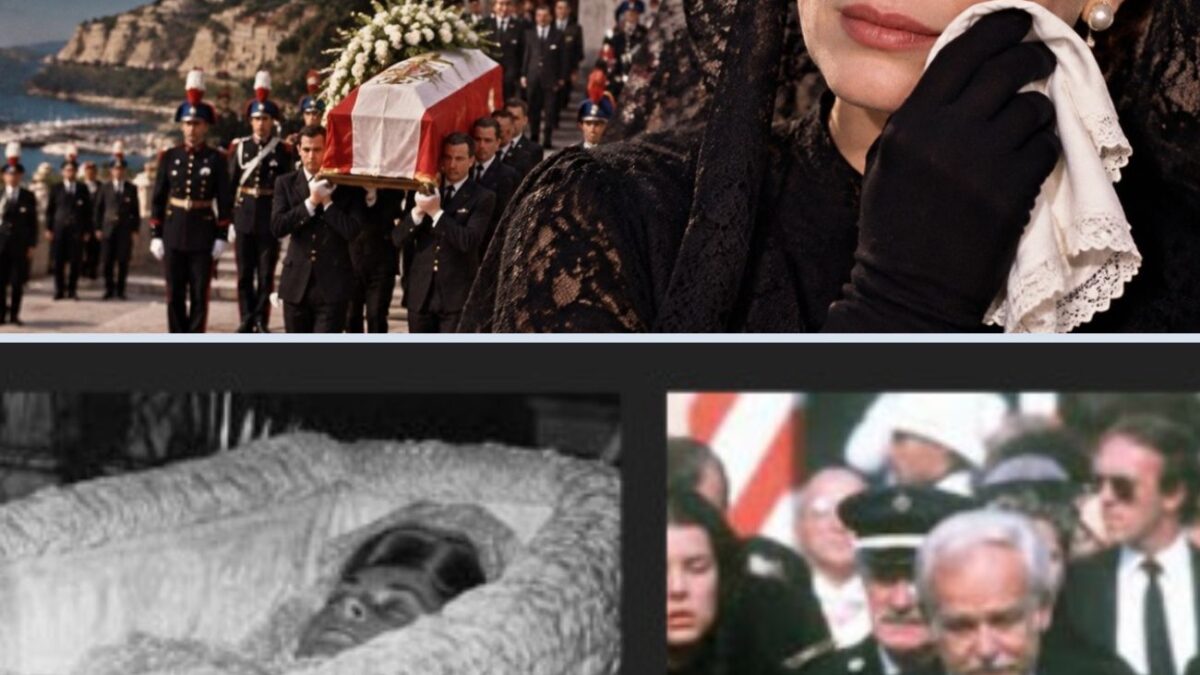
There is a cathedral in Monaco built from white Lurby stone that seats roughly 500 people. On the 19th of April 1956, a woman walked through its doors in a gown stitched from 25 yds of silk taffeta and 30 million people watched her become a princess. 26 years later on the 18th of September 1982, she was carried back through those same doors in a coffin. Her 17-year-old daughter was not there. She was still in the hospital recovering from injuries sustained in the same crash that killed her mother. A 100 million people watched the funeral. Nobody fully understood what they were mourning.
The Cathedral NRAAM Immacula is a Roman-esque revival structure completed in 1903. Perched on a rocky outcrop above Monte Carlo’s harbor, built from stone quarried in the hills nearby, it holds about 500 seats. That is not a grand number. Most European cathedrals dwarf it several times over. But this particular church punches above its architectural weight because of what happened inside it twice.
The first ceremony in April of 1956 was called the wedding of the century by every major newspaper that covered it. The second ceremony in September of 1982 was a funeral broadcast to a global audience more than three times the size of the weddings. Same altar, same Grimaldi family occupying the front pews, same family crypt beneath the cold stone floor waiting. The only meaningful difference between those two days was that now the woman at the center of both was lying down.
To understand how Grace Patricia Kelly ended up sealed inside that crypt, you have to understand what she was before Monaco claimed her entirely. She was born on the 12th of November 1929 in Philadelphia, Pennsylvania. The third of four children. Her father, John Brendan Kelly, known universally as Jack, was a self-made brick contractor who had built a considerable fortune from nothing. A three-time Olympic gold medalist in rowing, who won two golds in single and double skulls at the 1920 Antwerp Games, and another in double skulls at the 1924 Paris games, and a man who by many biographical accounts was more openly proud of his son’s rowing accomplishments than of anything his daughter ever achieved on a movie screen.
Grace was educated at the Raven Hill Academy, a Catholic girls school before enrolling at the American Academy of Dramatic Arts in New York City to study acting. She moved into theater work then quickly into film and within 5 years she had worked alongside some of the most important directors in Hollywood. She made three films with Alfred Hitchcock alone. Dilemm for Murder in 1954, Rear Window that same year and To Catch a Thief in 1955. She starred opposite Bing Crosby, Jimmy Stewart, Clark Gable, William Holden and Carrie Grant.
In 1955, at the age of 25, she won the Academy Award for best actress for her performance in The Country Girl, beating out Judy Garland, who had been widely expected to win for A Star Is Born. This was not a socialite dabbling in the arts. This was a disciplined, rigorously trained actress at the very peak of a legitimate and growing career, holding a gold statueette to prove it. That statueette would follow her across the Atlantic to Monaco. The career that produced it would not.
The man who took her away from all of that was Raineia Louie Honri Maxon Bertrren Grimaldi, the sovereign prince of Monaco since 1949 when he had succeeded his grandfather Louis II. Their first meeting was arranged in May of 1955 at the canned film festival. Set up partly as a photo opportunity by the French magazine Paris Match. Raineia was 31 years old and ruling a principality of approximately 0.78 square miles, a country smaller than Central Park. With a population hovering around 27,000 residents, Monaco’s economy depended almost entirely on the Monte Carlo Casino, tourism revenues, and its increasingly attractive reputation as a tax haven for the wealthy.
The principality’s international image was glamorous in a narrow way, but lacked serious cultural depth. What Raineia needed was not merely a wife to share his life with. He needed someone who could fundamentally transform Monaco’s brand from a gambling backwater with a royal title into a legitimate cultural destination worthy of global attention and respect.
But underneath the romance, there was a harder constitutional pressure driving the courtship. Under the terms of the Franco Monagas Treaty of 1918, if the reigning Grimmaldi line failed to produce a legitimate heir, sovereignty over Monaco would revert entirely to France. The principality would simply cease to exist as an independent state. Raineia needed a wife who was Catholic, internationally famous, of childbearing age, and willing to spend the rest of her life inside a country smaller than many city parks. Grace Kelly met every single requirement.
The courtship was genuine by all accounts, but so was the underlying negotiation. Grace’s family reportedly paid a dowy of approximately $2 million to the Grimaldi family, half drawn from Grace’s own acting earnings, half from the family inheritance, a transaction far more typical of old European aristocratic marriage markets than of Philadelphia’s Irish Catholic industrialist families. The exact figure is widely cited across multiple biographies, but remains difficult to verify against primary financial documentation. What is not disputed is that a substantial sum changed hands to make the marriage happen. The fairy tale had a price tag attached to it and the bride’s side covered the entire bill.
The wedding was engineered as a public spectacle stretched across 2 days. The civil ceremony took place on the 18th of April 1956 inside the ornate throne room of the prince’s palace, the ancient Grimaldi seat overlooking Monaco’s harbor. The religious ceremony followed the next morning, the 19th of April, inside the cathedral. The bride’s dress was designed by Helen Rose, a two-time Academy Award-winning costume designer on contract at Metro Goldwin Mayor. The studio treated the gown essentially as a production piece. 25 yards of silk taffeta for the skirt. 100 yards of silk net for the veil. Thousands of tiny handsewn seed pearls and antique Brussels rose point lace reportedly dating back well over a century.
MGM cameras filmed the ceremony for distribution through the studios channels. Approximately 30 million television viewers watched the broadcast live across multiple countries, a staggering audience for the mid 1950s. It was in every measurable way a piece of cinematic production. The bride was a movie star at the height of her fame. The gown was designed by a studio costumeumer. The cameras were rolling under professional direction, and it was the last time any of them would ever capture Grace Kelly performing on any kind of stage. She walked into that 500 seat cathedral as an actress, and she walked out as her Serene Highness, the Princess of Monaco. The Oscar remained among her private possessions. The career that earned it was finished.
The children arrived with what can only be described as constitutional precision. Caroline Louise Margarite was born on the 23rd of January 1957, barely 9 months after the wedding. Albert Alexander Louie Pierre followed on the 14th of March 1958. Stephanie Marie Elizabeth came later on the 1st of February 1965. Each birth was simultaneously a private family celebration and a public political event for the principality.
Albert was especially critical. As the only male heir, his existence was the state’s insurance policy against the 1918 treaties reversion clause. Without a male Grimmaldi in the line of succession, France could legally absorb Monaco back into its own territory. These three children were not merely Raineia and Grace’s private family. They belonged in a constitutional and existential sense to the survival and independence of the sovereign state itself. Monaco’s continued existence as an independent nation depended on the reproductive decisions of one woman who had grown up in Philadelphia, Pennsylvania. That is not a detail the wedding photographers ever included in the fairy tale narrative they were selling to the world.
And Grace worked for Monaco with a discipline that rivaled anything she had brought to a film set. She founded the Monaco Arts Festival, establishing the tiny principality as a genuine destination for serious cultural programming and performance. She created the Princess Grace Foundation, dedicated to funding and supporting emerging artists in theater, dance, and film, the very creative disciplines she could no longer practice herself. She served as patron of the Red Cross Ball, one of Monaco’s most prestigious and visible annual charity events, and the Rose Ball. And she oversaw a packed calendar of gala, receptions, and patronage engagements that she managed, attended, hosted, and performed at year after year after year.
Before Grace arrived, Monaco was a casino town with an old royal title. After her, it was a cultural brand with genuine international weight and credibility. She personally attracted artists, musicians, dancers, and filmmakers to a country that could barely fit a proper concert hall within its borders. She remade the principality’s identity through sheer presence, discipline, taste, patronage, and relentless public scheduling. The harbor sparkled under new development. The charity dinners glittered with international celebrities. The Formula 1 Grand Prix brought global media cameras. Newspapers across Europe and the United States carried her photograph almost constantly. Grace Kelly had single-handedly transformed a Mediterranean tax haven the size of a small neighborhood into a globally recognized name.
The problem was that the brand she had built was steadily consuming the woman who had created it. Monaco is not Versailles. There were no vast palace wings to retreat into, no labyrinthine corridors to vanish down, no distant estates where the family could disappear from view for months. The palace staff was modest by the standards of European royalty. In a country of 27,000 people contained within less than a single square mile, the princess could not walk to the shops, drive through town, attend a school function, visit a local restaurant, or sit quietly in a cafe without being immediately recognized and observed by virtually every person she passed.
There was no meaningful separation between her official public role and her private emotional life. The same families, diplomats, casino executives, and wealthy foreign residents appeared at every single social event in an endlessly recycling loop. There were no strangers in Monaco. There was no anonymity. And increasingly as the years accumulated, there was no credible possibility of a second act.
The moment the cage became fully and irreversibly visible was 1964. Alfred Hitchcock, the legendary director who had shaped three of Grace’s most critically celebrated performances, offered her the lead role in his upcoming psychological thriller, Manne. It was exactly the kind of complex, challenging material that had built her professional reputation and earned her the Oscar. Raineia reportedly agreed to let her accept the part. For one brief shimmering window, Grace Kelly, the actress, flickered back into existence, and then the principality extinguished it.
When news of her potential return to filmmaking became public, Monaco’s citizens and its local press reacted with open hostility and vocal opposition. They did not want their princess appearing on cinema screens, playing fictional characters, kissing actors, inhabiting someone else’s identity. Grace withdrew from the film entirely. She would never act professionally again. The decision was not hers to make. A country of 27,000 people had more practical authority over Grace Kelly’s professional life and creative identity than Grace Kelly herself possessed. Hitchcock was reportedly devastated by the loss of his leading lady. Grace, according to people who knew her well, internalized something far worse than professional disappointment. She accepted the verdict. The cage door did not slam dramatically shut. It simply never opened again, and eventually she stopped looking at it.
What she did instead was quieter and immeasurably smaller. She took up arranging dried flowers, pressing them carefully into decorative collages that she worked on with enough seriousness and skill to exhibit them publicly at cultural events in Monaco and beyond. She read poetry at formal occasions. She continued her charity patronage with the same relentless discipline that had always defined her public performance as princess, attending every scheduled gala, hosting every planned dinner, managing every foundation commitment, appearing at every ceremony with the same composed photogenic grace that had once commanded Hollywood’s soundstages.
But the press had shifted its tone. By the late 1970s and early 80s, tabloid photographers were running distinctly unkind images. Grace had gained weight over the years, and the same media establishment that had celebrated the fairy tale bride with breathless adoration now mocked the middle-aged woman, living quietly inside the fairy tale’s long aftermath. She reportedly confided to close friends that she felt profoundly lonely in Monaco, that she missed acting with a deep and persistent ache, that the life she had entered so confidently at 26 was nothing like the life she had imagined for herself at 50.
A former Academy Award winner, one of the most celebrated and gifted screen actresses of her entire generation, was pressing dried flowers into art collages inside the private apartments of a palace because the tiny principality that worshipped her public image would not permit her to exercise the creative talent that had made that image possible. The dried flower collages were not a charming royal hobby. They were what remained when everything else had been methodically removed.
By the early 1980s, the Grimaldi family presented a stable surface to the world. But behind palace doors, fractures were already spreading. Caroline had married Philip Juno, a Parisian socialite and nightlife figure in 1978. Both Grace and Rainier had reportedly opposed the match vocally and privately. The marriage lasted barely 2 years before ending in divorce in 1980. A public embarrassment of exactly the sort that Grace had spent a quarter of a century trying to prevent through carefully controlled royal presentation.
Albert, the heir, was 24 and still unmarried, carrying the full constitutional weight of being the only male Grimmaldi in his generation without having yet taken any step toward producing the next. Stephanie was 17, still living at home, still very much a teenager, navigating adolescence under the constant scrutiny that came with being the youngest child of the world’s most photographed princess.
On the morning of the 13th of September 1982, Grace and Stephanie left Rockagel together. Rock Agel was the Grimaldi family’s private country estate, a retreat perched high above Monaco on the mountain side above the coast. They were heading back down to the principality. Grace was driving. The car was a Rover P6 3500, not a royal limousine, not a chauffeur diplomatic vehicle with security glass, but an ordinary British family sedan. There was no chauffeur that day, no escort, no advanced team. Grace took the D37, a narrow, sharply winding mountain road notorious among locals for its tight hairpin turns and steep, unguarded, precipitous drop offs. The same road she had driven many times before during ordinary family routines.
What happened next remains partly uncertain, even decades later. Medical reports later indicated that Grace likely suffered a cerebrovascular event, a minor stroke, while driving. Some accounts describe a sudden complete loss of vehicle control. The car missed a hairpin turn and left the road entirely, plunging more than 100 ft down the mountain side. Stephanie, 17 years old and sitting in the passenger seat beside her mother, reportedly tried to regain control of the vehicle. She could not.
Both mother and daughter were pulled from the wreckage of the rover alive. Grace was transported by ambulance to the nearest hospital. That hospital was the Princess Grace Hospital Center. It had been founded in 1902 as Monaco Hospital and renamed in Grace’s honor in 1958 when the facility was expanded. The building carried her name above its entrance on its official signage in every published reference. And now she was lying inside it on a ventilator connected to life support equipment in a medical facility that bore her own name on the exterior wall.
Raineia rushed to her bedside. Caroline and Albert followed immediately. The family gathered in the hospital corridors. The medical reality they were presented with was devastating and final. Grace had suffered a massive irreversible brain hemorrhage. There was no prospect of meaningful recovery. On the 14th of September 1982, one day after the crash, Grace Patricia Kelly, her Serene Highness, the Princess of Monaco, was removed from life support. She was 52 years old. Her life had divided itself with almost unbearable symmetry. 26 years as Grace Kelly of Philadelphia and Hollywood. 26 years as Princess Grace of Monaco. Neither half had allowed her to be fully herself.
The flag above the prince’s palace was lowered to half staff over the harbor. And inside the Cathedral NRAAM Immacula, the same white stone cathedral that had hosted the wedding of the century 26 years earlier, staff quietly began preparations for a ceremony no one had imagined holding there.
Stephanie survived. She had sustained a fracture of her cervical vertebra and significant bruising across her body. Physically, the doctors said she would heal, but the weight she carried out of the wreckage of that rover could not be measured by any medical instrument or captured in any hospital chart. She had been sitting in the passenger seat when the car missed the turn. She had tried to stop it. She had failed. Her mother had died. And according to palace sources, Stephanie was not even told about her mother’s death until 2 days after the accident. She remained hospitalized, unable to attend the funeral. The front pew of the cathedral would hold only three of the four members of the immediate family. The empty space beside Raineia, Caroline, and Albert would be its own kind of evidence.
The funeral was held on the 18th of September 1982, a Saturday morning. The cathedral with its modest capacity was not designed for an event of this combined diplomatic, cultural, and emotional magnitude. But Monaco is not a country that offers larger alternatives. Approximately 400 guests attended. The guest list reflected the strange duality of Grace Kelly’s life. Nancy Reagan attended, representing the United States government and implicitly acknowledging that Grace had remained in a technical and deeply cultural sense an American citizen throughout her entire tenure as Monaco’s princess.
Diana, Princess of Wales, attended as well. It was her first solo public engagement on behalf of the British royal family. Years later, recorded tapes revealed that Diana had pushed to attend despite Prince Charles’s reluctance, telling him:
“Grace was an outsider who married into a big family, and I’ve done the same.”
Former Hollywood colleagues and industry figures traveled from across the world. Carrie Grant, Grace’s co-star in To Catch a Thief, the very film shot on the French Riviera near the Principality where she would spend her life, sat in the same cathedral where his former leading lady had once traded her film career for a crown. Outside the narrow streets of Monaco filled with grieving citizens. An estimated 26,000 people had filled past Grace’s open coffin as she lay in state at the Palatine Chapel in the Prince’s Palace in the days before the funeral. This was not the remote abstract mourning of a vast nation losing a distant figurehead whose face appeared only on postage stamps and currency. This was a country of roughly 27,000 people physically losing someone they had personally encountered and spoken with. Grace had walked through their streets for 26 years. She had attended their children’s school functions, sat at their charity dinner tables, greeted them by name at public ceremonies, and inhabited their daily routines. In a nation this small, contained within less than a single square mile, the death of the princess was not a headline to be read and absorbed from a distance. It was an intimate neighborhood loss. Felt on every block and inside every household.
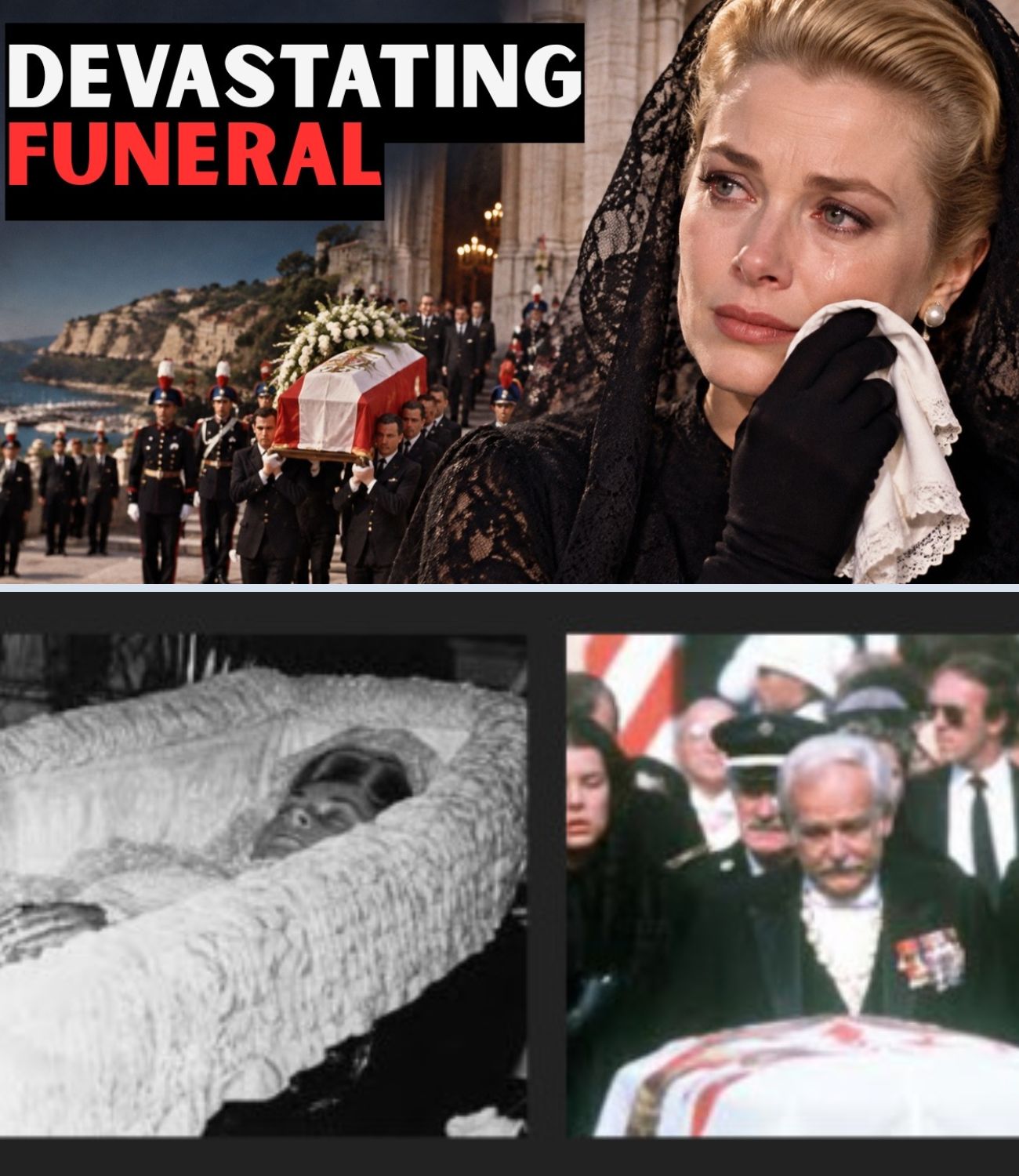
Inside the cathedral, the coffin was covered with a white banner bearing the Grimmaldi coat of arms. Arrangements of white flowers filled the nave and altar area sent from heads of state and personal friends around the world. The reququum mass lasted approximately 75 minutes. Raineia sat in the front pew and wept openly without restraint without any trace of the composed royal bearing that the Grimaldi Institution had always demanded from its sovereign. A contemporary United Press International report described him weeping openly and touching his wife’s coffin one last time. The man who had courted Grace Kelly as both a genuine romantic partner and a strategic asset for his struggling principality, who had structured a marriage around a constitutional treaty clause, who had prevented her from returning to the film career she loved because his subjects objected, and who had built 26 years of international sovereign legitimacy and cultural credibility on her presence, her name, and her image, was now watching her funeral unfold in the same room where the entire arrangement had been consecrated.
The marriage had saved Monaco. It had produced the three constitutionally necessary heirs. The 1918 treaties reversion clause had been effectively neutralized. Everything Raineia had planned and needed had worked. And the woman who had made all of it possible was dead at 52 because she had been driving herself down a familiar mountain road in an ordinary car without a chauffeur on an unremarkable September morning because even a princess occasionally needed to leave the palace without an entourage and simply drive.
Caroline sat rigid beside her father, 25 years old, holding herself together with visible effort. Within weeks, she would formally assume Grace’s ceremonial duties, hosting the gallas, managing the patronage calendar, presenting Monaco’s public feminine face to the world. She had not asked for this inheritance. She had not been prepared for it the way Grace had been prepared by a lifetime of professional performance. She received it the way royal families always transfer burdens through sudden loss, institutional default and the absence of alternatives.
Albert sat nearby, the air apparent, the constitutional necessity. The son, whose birth in 1958, had prevented Monaco from being absorbed into France. He was 24. He would not marry until 2011 at the age of 53.
And Stephanie was not there. She was in a hospital bed less than a mile away wearing a neck brace, having only recently been told that her mother was dead. 100 million television viewers watched the ceremony broadcast live across the globe. That audience was more than three times the size of the one that had watched the wedding. Grace Kelly drew more eyes in death than she ever had in marriage. And nobody watching the front pew could have missed the gap, the visible absence of the 17-year-old daughter who had been in the car who had survived and who was not permitted by her own broken body to sit in the cathedral where her parents had once exchanged vows.
The interment took place in the Grimaldi family crypt located directly beneath the cathedral floor. Grace was sealed into the stone below the same altar where she had stood as a bride in white silk and antique lace. The wedding literally stood on top of the grave. The ceremony concluded. The dignitaries filed out through narrow Monagas streets. The cameras powered down. And the Grimaldi family returned in private to the prince’s palace above the harbor, where Raineia began the longest, quietest, and most solitary chapter of his entire life.
He never remarried. For 23 years from 1982 until his death on the 6th of April 2005, Raineia III governed Monaco alone. He withdrew significantly from public life, made fewer appearances, granted fewer interviews, and retreated into the private administrative work of running a principality that his dead wife had made internationally relevant. His health deteriorated steadily through the later years. The man who had built a fairy tale around a diplomatic calculation spent more than two decades inhabiting the aftermath of its abrupt and violent conclusion. When Raineia died at 81, he was buried beside Grace in the cathedral crypt. In the same small stone chamber beneath the same altar, two coffins side by side directly below the spot where 30 million people had once watched them promise each other forever.
The children did not escape the gravitational pull of that cathedral. Caroline assumed her mother’s role and carried it with visible reluctance but genuine competence. Then in 1990, just 8 years after the funeral, her second husband Stefano Kazaragi was killed in a powerboat racing accident off the coast of Monaco during a competition. He was 30 years old. She was 33. She had now lost her mother and her husband within the same decade.
Stephanie became a persistent fixture in European tabloid journalism throughout the late 80s and the 1990s. She briefly attempted a pop music career. She was romantically linked to a bodyguard and later to a circus performer. She married and divorced. The press treated her relentlessly as reckless, unstable, a royal embarrassment to the Grimaldi name. What those tabloid editors rarely paused to acknowledge was that this was a woman who had been 17 years old in the passenger seat of a car that plunged down a mountainside, who had tried to stop it and failed, and who had then spent her mother’s funeral in a hospital bed with a fractured vertebra, unable to be present for the goodbye, carrying a weight that no public ceremony could have absorbed even if she had been there. The tabloids printed the word scandal. A more accurate word would have been trauma.
The institutions Grace built outlived her. The Princess Grace Foundation still funds emerging talent in theater, dance, and film. The hospital still operates, still treats patients daily, and the building where Grace Kelly was removed from life support still carries her name in large letters above the main entrance.
The accident site on the D37, that narrow winding mountain road between Rock Agel and the coast is marked by a small roadside memorial. Tourists stop there. They stand at the edge and look down. They photographed the drop and try to comprehend how a fall down that mountainside separated a princess from the country she spent 26 years serving, financing, decorating, and hosting without ever quite being permitted to leave it on her own terms.
The wedding dress is in Philadelphia, not in Monaco, not in the palace, not in the cathedral. It sits in the Philadelphia Museum of Art roughly 5,000 mi from the altar where it was worn. Donated by Grace herself just 2 months after the ceremony. The gown that Helen Rose designed at the MGM costume studio stitched from 25 yds of silk taffeta and century old Brussels lace. The production piece that turned a movie star into a princess on live global television ended up back in the city Grace Kelly left behind. Monaco kept the woman. Philadelphia kept the dress. Neither place held both.
The cathedral remains. Visitors walk through the nave, past the altar, and stand above the crypt where Grace and Raineia lie together without fully understanding what this single room has contained. Two ceremonies 26 years apart. A bride and a coffin on the same altar. A wedding watched by 30 million and a funeral watched by a 100 million. A husband weeping. A daughter absent from the pew where she belonged. Lying in a hospital bed with a broken neck. Learning that her mother was gone. An eldest child quietly inheriting a role she never wanted. A son carrying a constitutional burden he never chose. And beneath the stone floor in the silence of the Grimaldi crypt, a woman who spent exactly half her life as one of the finest actresses in American cinema and exactly half as a princess who was never permitted to act again, resting under a title that told the world precisely what she became. And nothing at all about what it cost her.
You Might Also Enjoy

“We Thought They Would Negotiate”—What Argentine Soldiers Said When The British Attacked Goose Green

“You’ll Never Finish My Ruck March, Limey” — US Sergeant Who Challenged the SAS, Then Fell Out First






