“Hands on the Hood, Brit” — The US Military Police Who Tried to Arrest the SAS at the Gate.
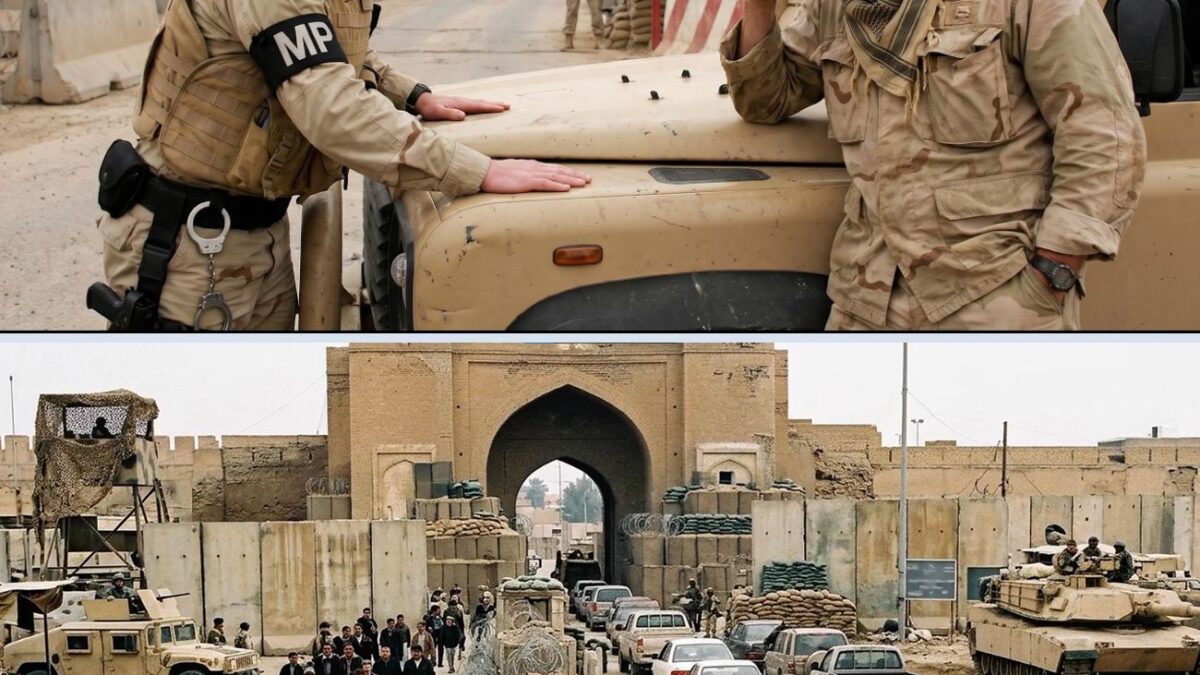
At 10:05 on the evening of Friday, 28th of January, 2005, four unmarked vehicles stopped nose-to-tail in the search lane at the main entrance to Baghdad’s Green Zone, just past the 14 July Bridge, with the sun sliding behind the palms on the far bank of the Tigris. Eight men from a British Sabre Squadron sat inside them in civilian clothes, carbines between their knees, and a ninth man, hooded and cuffed, lay across the rear seat of the third vehicle. In less than 2 hours, the evening vehicle ban would shut the city’s roads. Then, a staff sergeant of the United States military police stepped out from behind a concrete barrier, rifle at his shoulder, and shouted at the lead driver.
"Hands on the hood, Brit. Now."
Those words would hold eight of the most capable men in Baghdad in place for 2 hours and 40 minutes, with a prisoner they would not surrender, and a queue of civilian cars building behind them in the one place where a stationary queue was the most dangerous thing there was. To understand why a sergeant who had never heard the name of the unit in front of him was prepared to arrest it, you have to start with the gate itself, because by that January, the gate had killed more people than most battles in the war.
The Green Zone was a 10-square-kilometer slab of central Baghdad, a little under 4 square miles on the west bank of the Tigris, built around the old presidential palaces, and ringed by blast walls, T-walls, and coils of wire. The Tigris covered it on the south and east. Everything else was concrete, and the people who lived and worked inside it, the interim Iraqi government, the American and British embassies, the contractors, the staffs, reached it through a handful of controlled entrances manned by coalition troops. The busiest was the one beside the old Assassin’s Gate, a name that predated the occupation by a matter of days.
It came from Assassin’s Company, the call sign of A Company, 4th Battalion, 64th Armor, 3rd Infantry Division, whose tanks had fought their way into the palace district on 7th April 2003, and then beaten back a pre-dawn counterattack through that very archway the next morning. Soldiers who guarded the approach later simply called the main control point by a number, three.
Three had a record. On 17th of May 2004, the rotating president of the Iraqi Governing Council, Ezzedine Salim, was sitting in a convoy waiting to be waved through when a suicide car bomb went off beside it, and he died along with several others, the highest-ranking Iraqi official killed in the occupation to that date. On 14th July 2004, a little over 2 weeks after sovereignty had formally passed to an interim Iraqi government, a vehicle rolled into the search lane at about a quarter past nine in the morning and detonated. The American officer who described it afterward said only that it had pulled in and tried to get into the control point. Estimates of the dead ran from around seven to 15, depending on who counted and when, and most of those killed were Iraqis who had come to work or to petition the government.
And on 14th October 2004, two bombers had walked into the souvenir bazaar and the Green Zone Cafe, places where the people inside the walls went to feel they were not inside walls, and killed around 10 people at lunchtime, among them several Americans. Zarqawi’s network claimed the third attack, and American commanders had blamed it for the first. So, the men on three in January 2005 did not stand in that lane to be polite. They stood in it because every person who had ever died there had been standing in a line, and the line was the weapon.
The reasoning, repeated in every briefing, was simple and bleak. Anything that stopped, waited, or argued was a target, and anything moving toward the barrier faster than the drivers around it was a threat to be settled in the few seconds the geometry allowed. On the road before the barrier, signs in English and Arabic marked the distances. A vehicle that ignored the first got a shouted warning. A vehicle that ignored the second got a flare or a warning shot. A vehicle that ignored the third got what the brief called the full measure.
The staff sergeant who shouted the order had been on that lane for most of a tour, and for the purposes of this account, his name was Dwayne Pruitt, an Army military policeman from a small town in Kentucky, 31 years old, with a wedding ring he had taped over so it would not catch on a door handle. His squad was a detachment of military police attached to the guard force at the entrance. Six soldiers, two armored Humvees with turret guns, a pair of Iraqi soldiers in the search lane, and an Iraqi interpreter named Fadil.
They answered to a captain who ran the entrance, and that evening the captain, whose name for the purposes of this account was Wes Halverson, was in a plywood office 40 m behind the barrier reading the day’s warnings for the fourth time. There were a lot of warnings that week. On 21st December, a month earlier, a suicide bomber had walked into the crowded dining facility at Forward Operating Base Marez outside Mosul at the noon meal and killed 22 people, among them 14 American servicemen, and wounded around 66 more. The bomber, the claimants said, had slipped in during a guard change, and the story ran through every guard force in the country like cold water.
On Sunday, 23rd of January, a voice that sounded like Abu Musab al-Zarqawi’s was posted on the internet declaring a bitter war on democracy and on everyone who sought to enact it a week before Iraqis were due to vote for a transitional national assembly. The Interior Ministry had announced the measures that followed. Borders and the airport shut on the eve of the poll. Travel between provinces halted. Civilian vehicles banned in Baghdad from 7:00 in the evening until 6:00 in the morning from the Friday night. And on election day itself, no civilian vehicle traffic at all.
Halverson had told the squad before their shift that anyone approaching in the last hours before the ban was either exactly what he looked like or the worst thing that would happen to them that year. The four vehicles that arrived at 10:05 did not look like exactly what they were. Two were dusty civilian pattern 4x4s of the kind that filled every road in Baghdad. A third was a pickup with a canvas cover over the bed, and the fourth was a saloon with Iraqi plates and a dent in the rear door. None carried a flag, a unit marking, or a coalition identification panel.
The men in them wore the beards and loose civilian jackets of people who had spent months not looking like soldiers, and every one of them carried a rifle within reach and a pistol on the hip. A man designing the profile of a hostile convoy for a guard force primed by Mosul could hardly have done better. The one thing in their favor was that they had come over the bridge in a tight, disciplined file, and stopped exactly where the signs told them to.
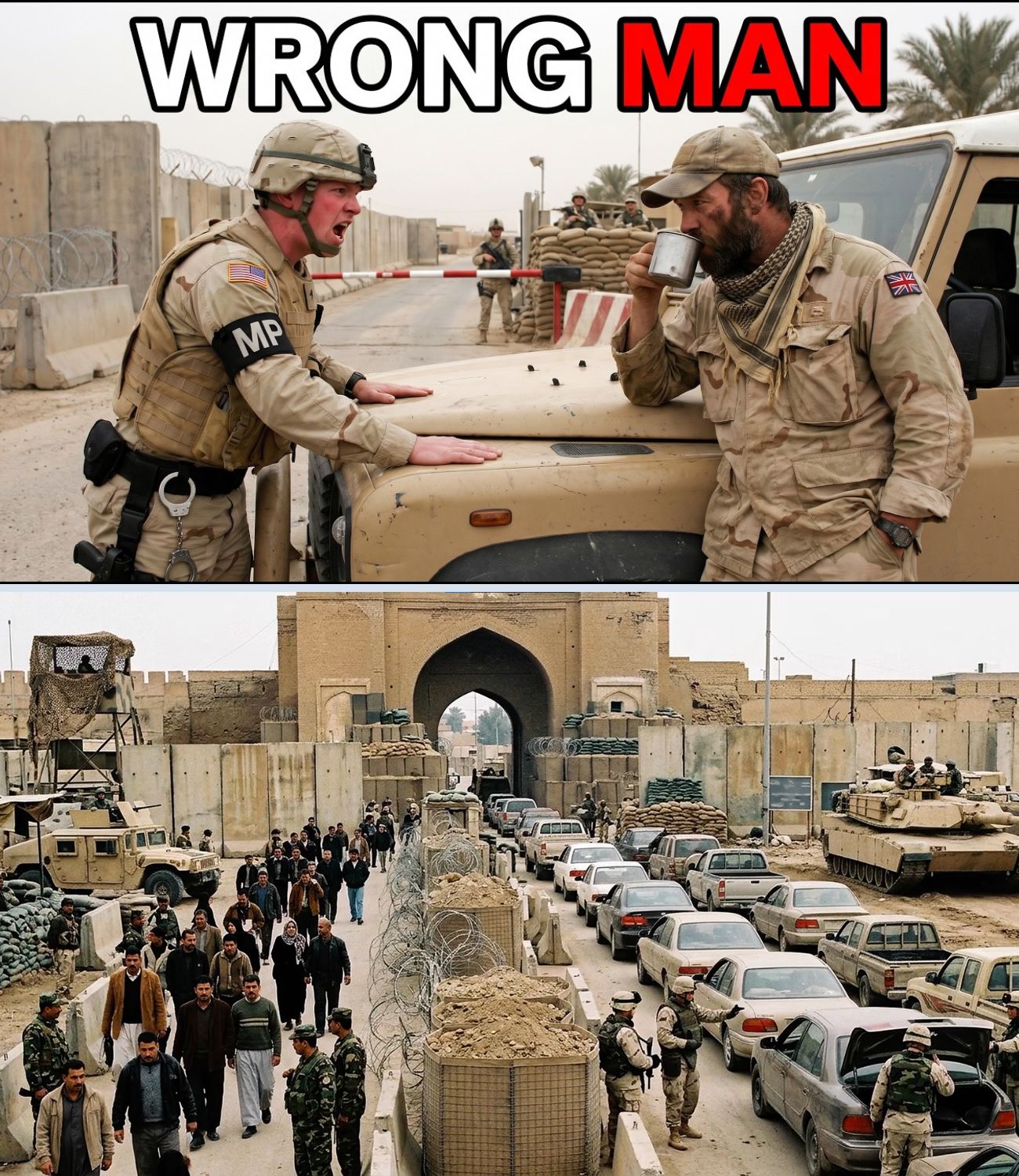
The men inside belonged to a unit that most of the American soldiers around the entrance had never been briefed on, and that Pruitt’s chain of command did not formally know existed. In the early months of 2004, headquarters had been established at a compound in Baghdad known to its occupants as the station, and officially as main support site Fernandez, named for a dead American soldier.
It housed, among other things, Task Force Black, a British formation built around a saber squadron of the Special Air Service, with detachments from the Special Boat Service, the Special Reconnaissance Regiment, and 18 Signal Regiment working under the United States Joint Special Operations Command, which in Iraq was commanded by Stanley McChrystal. In practice, that meant a small group of men who answered to London and to a colonel at Fernandez who went almost anywhere in the city, and who had a standing arrangement with very few people at checkpoints other than those who had been told in advance.
The man at the wheel of the lead vehicle, a staff sergeant whose name, for the purposes of this account, was Gareth, had 22 years in the army, 11 of them in the regiment, and a face that had given up registering surprise somewhere around the first Gulf War. Next to him sat a signaler named Pete, in his late 20s, whose only visible vice was that he never stopped chewing gum, and in the back were two more men, one with a rifle across his knees pointed carefully at the floor. They had left a house in the east of the city at a quarter to four.
In the third vehicle was a man who had told them, two hours earlier, something worth much more than he understood. The prisoner was a courier. He was perhaps 30, a thin man with a pitted face and a gold tooth, and the squadron’s file called him by cover name Abu Samir. He worked for a cell that built vehicle bombs in a garage in the Baladiyat district of East Baghdad, and had been arrested that afternoon with a mobile phone, two SIM cards, and a folded sheet of paper in his sock.
The phone was the point. Within an hour of his capture, Pete had worked out from the call log that the phone was getting calls from a single number at regular intervals. Someone was waiting for the courier to answer. The time written on the sheet of paper in his sock was 7:00 in the evening, the hour the vehicle band began, and that was not a coincidence. A car that moved before the band would be remembered, while a car already parked would be one more car at the curb when the roads emptied. If the courier could be questioned that night, the squadron believed he would give them the garage, the vehicle, and the polling station it was meant for. It was a question of hours.
That arithmetic had put four vehicles in the lane because the only place in Baghdad where British officers had a room, an interpreter, and a legal adviser to sit in on an interview lay inside the wire in a villa near the British Embassy compound. It was not a glamorous room. It had a table, four chairs, a window with the blinds down, and a notice taped inside the door listing in English what a detainee was entitled to ask for.
The reason that room had to be a British room is the part of the story that the sergeant at the barrier knew nothing about, and it begins with a colonel who had gone looking for something and found more than he wanted. In late 2003, Colonel Stuart Harrington, a veteran Army interrogator, was sent to inspect the secret American detention facility that the special mission task force operated in Baghdad, an irregular site known inside the task force as Camp Nama. He came away alarmed enough by what he saw there, signs of mistreatment of detainees, to report it to the senior American intelligence officer in Baghdad. Inquiries that took years to complete upheld five of 29 formal complaints and led to disciplinary action against 34 soldiers.
By the middle of 2004, McChrystal had shut Camp Nama down and moved the task force’s screening and interrogation to Balad, 40-odd miles to the north, where it was working by the summer. The British had heard enough of it through the informal channels that run between officers who share a compound and a mess to draw their own line. In October 2004, London gave an instruction to every SAS soldier in the country, Task Force Black included, no prisoner was to be handed to the American system if the prisoner was going to end up in a facility with that kind of reputation.
It was not a protest. It was not published. It was a rule written down that a staff sergeant at the wheel of a vehicle on the evening of 28th of January 2005 could not, as a matter of law and conscience and his own career, break. The courier had to stay in British hands until he could be moved to a British-run holding arrangement. That meant a British room, and the British room was inside the wire.
It was not the first time the partnership had run on carefully maintained arrangements. When American Marines and soldiers went into Fallujah in November 2004, the SAS and its American counterpart were both kept out of the city, a decision published accounts attribute to political pressure over the war’s unpopularity. By that winter, arrangements were the only thing between a British patrol and an American sergeant who had not been told patrol was coming.
Pruitt was not thinking about any of that. He had come out from behind the barrier because the lead vehicle had stopped on the line and then done nothing, and doing nothing in that lane was the first mark against a driver. Over the next 90 seconds, he moved his squad through the sequence every man in it had rehearsed on a mock-up built from shipping containers in Kuwait. His gunner, a specialist named Lena Akofor in the turret of the nearer Humvee swung the muzzle of her .50 caliber machine gun onto the lead vehicle’s windscreen. Two soldiers with carbines came out from the barrier on either side of the lane. The interpreter shouted in Arabic from behind the cover of an armored door, and the driver of the lead vehicle, who had every reason to know exactly what all of it meant, put both his hands on top of the steering wheel and waited.
That, in the end, was what saved the next 2 hours from being much worse. Gareth had spent two decades learning that the way to survive a nervous young man with a rifle was to be the least interesting person he had met that day. He did not reach for the card. He did not reach for his pistol. He kept his hands where Pruitt could count them and said, in a voice pitched to carry without sounding like a plea, that he was a British soldier, that he had a pass, and that he needed to speak to an officer.
Pruitt, who had not been taught that such a sentence could be true, heard a man with a northern English accent claiming to be a British soldier in a car with Iraqi plates, no unit marking, and a rifle on the seat. He ordered the men out of the vehicle. They got out, one at a time, hands visible, and laid those hands flat on the bonnet of the 4×4, exactly as ordered. Eight bearded men in civilian clothes spread along a line of dusty vehicles, a grim young woman in a turret behind a .50 caliber, a staff sergeant from Kentucky walking down the row with his weapon low and his eyes high. One of the men, the youngest, had a smile on his face that Pruitt did not like at all.
What the man was thinking, as he said much later, was that in 11 years of service, he had never been told to put his hands on a bonnet by someone who was not a policeman. Then Pruitt asked for their identification, and that was when the evening really went wrong. Every person who lived or worked in the green zone carried a badge issued under the coalition’s access system, and every vehicle that crossed the line was supposed to be on a roster. The men from the station had neither. Their passes, the ones that existed, carried a photograph, a name that was not their own, and a line of text that said they were members of a coalition liaison staff, and that line meant something only to the handful of officers at the entrance who had been specifically told what to do when they saw it. On the afternoon of 28th of January, none of those officers was on shift.
The roster the guard force held that evening, a three-page list on a clipboard, had been updated on Wednesday for the election security plan. It did not mention an unmarked convoy. It did not mention the station. It listed, in careful capital letters, the vehicle registration numbers of every authorized convoy expected in the last 2 hours before the ban, and the four vehicles at the barrier were on none of it. The sergeant had every right to be unmoved. The rule he was applying existed because of Mosul, because a man who looked as though he belonged had once walked through a gap in a guard change. Every hour of his training had been built on a premise he now saw playing out in front of him, that the most dangerous person in a queue is the one with a good reason and no paper.
Gareth explained that he was part of a coalition task force, and that his colonel could confirm it by telephone. Pruitt asked which task force. Gareth told him that was not something he was able to say at an open barrier in front of an Iraqi interpreter and two Iraqi soldiers. It was the right answer by his rule book and the worst answer by Pruitt’s. The sergeant took it the way any sensible man would, as a refusal to identify. He asked for the rifles. He asked for the men in the other vehicles to step out. He asked, with a slight change in his voice that told his own squad what was coming, for the occupant of the third vehicle to be shown to him.
That was the second problem. The prisoner could not be shown to anyone. He could not be seen by an Iraqi interpreter or an Iraqi soldier because a hooded man in a British car would be gossiped across the whole of Baghdad before midnight and it would reach the garage in Balad Diat before the bomb maker’s courier had missed his second phone call. And he could not be handed to the Americans because of an instruction that had gone out in October. Gareth told Pruitt politely and without a trace of a smile that there was a person in the third vehicle who was in British custody, that his custody was not transferable and that the sergeant would be best served by telephoning a colonel at the station who was expecting the call.
Pruitt had no number for the station. Very few people in the zone did. He had a radio, a captain 40 m away, a battalion operations center beyond that and a line of command that stretched above them to the multinational core. At no point on that line was there a person who had been told that British special forces might arrive at the main entrance 10 minutes before the vehicle ban with a prisoner. The general who commanded the task force the SAS worked under was not someone a staff sergeant could call.
Pruitt keyed his radio and reported what he had. Four unmarked vehicles, eight armed men claiming to be British soldiers, one concealed passenger, no identification on the roster. He asked for the captain. It was 25 minutes to six. The sun had gone and the light over the palm tops had turned the color of a bruise. On the far side of the bridge the last vehicles of the evening were coming over in a ragged line, headlights on, drivers who knew how little time they had left. Behind the four unmarked cars the search lane was filling with civilian traffic, two buses of Iraqi government staff, a truck of bottled water, a handful of contractors pickups, a taxi. Every driver in that queue could see the guns and Pruitt knew exactly what a stopped lane meant.
The next hour was a series of small practical squeezes, none of which would have mattered on its own. The first was the water. The courier had been hooded since shortly after 3:00 and by half past 5:00 he had begun to cough and to ask quietly in Arabic for something to drink. The squadron’s medic, a soft-spoken Scott, asked for permission to give him a bottle from the cooler. Pruitt said no one was to move. The medic said it was a bottle of water. Pruitt said he understood that. They stood for perhaps a minute and then the sergeant nodded at Okafor who lowered the muzzle of her machine gun a few inches and the medic crossed the road with his hands open and gave the man the bottle. In the report Pruitt wrote that night, it took up one line.
The second was the telephone. The courier’s mobile, which Pete had placed on the dashboard of the lead car, began to vibrate at 10:00 to 6:00. It rang for a long time. It stopped, then it rang again and the number on the screen was the same one that had been calling since the afternoon. Pete said something quiet to Gareth that was not a profanity, which in that unit was the highest form of alarm. The man on the other end had begun to wonder. That was the real clock and it was shorter than the interior ministry’s. If the phone went unanswered at 7:00, the cell would assume its courier was captured and move the car and it would do so in the last chaotic hour before the ban while the roads were still full. The squadron would have a prisoner and a phone and no garage.
The third was the radio. At about 10:00 past 6:00, Gareth was finally allowed to use his own in the open under the eye of Pruitt’s gunner and he called the station. The duty officer who answered knew precisely who he was and where he was and said, with a calm that made things worse, that he would raise it with the Americans at once. He had no direct line to the guard force at three, because the two organizations were not supposed to need one.
In the 60 minutes that followed, a British major rang an American lieutenant colonel in the liaison cell, who rang a duty captain in the multinational core operations center, who rang the battalion that ran the guard force, who rang Halverson, who then walked out of his plywood office into the lane, and looked for a long moment at his own sergeant. Halverson was 34, a former enlisted man commissioned from the ranks. He had seen the Mosul photographs. He had spoken in the days after the July bombing to a woman whose husband had been waiting in a taxi. What he saw in the lane was a situation no regulation had written a rule for. Eight men with every sign of being what they said they were, and no way of proving it, standing next to a prisoner the army was not being allowed to see in a lane 20 minutes from becoming the most dangerous place in Baghdad.
He did what a good captain would do. He asked questions. He asked Gareth for the name of his commanding officer, and Gareth gave him a call sign, which was the most he was permitted to say. He asked Pruitt whether any of the men had resisted, and Pruitt, who was an honest man, said,
"No, sir, they've been better behaved than my own squad."
He asked Pete, who was still chewing what he did, and Pete said he was a signaler, and that he would be grateful if somebody could stop the phone ringing. Halverson’s face did not change. Then he ordered everyone’s rifles to be cleared, collected, and stacked in the rear of the second Humvee, with the pistols to follow. And he told the interpreter, who was standing against the barrier looking at the ground, to go and have a cup of tea.
Fadil did not go. He had worked the barrier since the previous summer, and he had stood beside it in July, and he stayed where he was, against the concrete, watching the bearded men on the bonnet. He told Pruitt afterward, in careful English, that he had learned to read a lane the way a farmer reads weather, and that what bothered him was not the guns, it was the buses. Behind the convoy, the driver of one of the government buses had switched off his engine and put both hands in plain view on the wheel and 40 passengers sat without moving in the half-dark. Every one of them aware that a stopped lane was a target. Nobody had told them what to do. They had worked it out for themselves. It was the right order and it nearly broke the evening.
To Gareth, disarming his men in a lane where the single most feared event was an attack meant leaving them with their hands empty at the very moment he was most likely to need them. He had a loaded phone on a dashboard, a prisoner in a hood, a queue of civilian vehicles within 10 m of his back bumper and every instinct in his body told him that if a car drove into the lane at that moment at speed, the people standing in the road with their hands on a bonnet and nothing in them would be the first to die. He said so with extraordinary mildness to Halverson. He said that he would give his word that his men would not point their weapons at an American, but that he could not agree to be unarmed.
The captain looked at him for a long second and said in a flat Midwestern voice that he understood that and that it did not change the order. Both of them were right. That was the trouble.
What broke the deadlock was not a general or a telephone call, it was a car. At 25 minutes to 7:00, a white saloon, a battered Opel of the kind that every second family in Baghdad seemed to drive, turned off the bridge approach at a speed slightly higher than the cars around it and began to close the gap to the back of the queue. The driver did not slow at the first sign painted on the road. He did not slow at the second. Okafor, in the turret of the nearer Humvee, said in a voice that was very quiet,
"Sergeant, white Opel not slowing."
And Pruitt, who had been standing in the lane for an hour and a half with his back to the traffic, turned round. In the following eight seconds, the whole structure of the evening reorganized itself. Every American soldier in the lane lifted his weapon toward the oncoming car. The Iraqi soldiers started to shout. Al-Ghafour fired a pen flare, which burst white on the asphalt in front of the Opel. The car did not stop. And Gareth, who had not moved his feet, who had no rifle, and whose hands were still on the bonnet, said clearly in English to nobody in particular,
"He's looking at his phone."
Because that was what he could see. A driver whose head was bent over a small screen in his lap, who had not looked up at a single sign. Pruitt heard him. He did not know why he believed him, and later he could never explain it. He raised a hand. Al-Ghafour’s finger came off the trigger. The Opel stopped 11 m short of the rear bumper of the Q. The driver, a man in his 50s in a brown cardigan, was a retired schoolteacher who had been trying to find the address of a cousin’s house in a city where most of the street signs had been taken down, and who had been looking at the number he had scrawled on the back of his hand.
He did not know what he had done. He got out of the car with his hands over his head, weeping, and an Iraqi soldier led him gently to the side of the road and gave him a cigarette. Nothing had happened, and nobody in the lane said so aloud. The man with empty hands had read the situation more clearly than anyone with a gun, and the sergeant had listened. And the standoff Halverson had been presiding over had very nearly killed a retired schoolteacher in a brown cardigan with eight armed Britons standing by whose weapons he had been about to confiscate.
Halverson thought for a minute. Then he told Pruitt to leave the rifles where they were, told the British to move their vehicles forward into the holding area behind the barrier, where they would be shielded from the road by a row of concrete blocks, and told his own soldiers, in so many words, that nobody was being arrested. Gareth did not say, "Thank you." He moved the vehicles.
By the time they were in the holding area, it was 7:00 and the bridge behind them had gone silent. The ban had started. The road along the river was empty of cars and a quiet settled over the lane that Pruitt’s squad had not heard in months with a single dog barking somewhere beyond the wall. Behind the concrete, the courier’s phone began to ring again. This time, Pete answered it. He did not say anything. He held the phone to the courier’s ear and the courier, who had been coughing and shivering for half an hour and drinking from a bottle of water a medic had been permitted to give him, said two words in Arabic in a voice that Pete said afterward could have been the voice of any frightened man in any country. He said that he was fine and that he would be there. That was all. The line went dead. It bought them the night.
That was not the end of it because there was still a major. She arrived at 7:20 in a plain Humvee with no escort. A woman in her late 30s named, for the purposes of this account, Teresa Brandt, a major from the Joint Operations Center inside the zone, who had been told on the telephone that there was a British problem at 3:00 and had driven down to see it for herself. She was small, composed, and a little tired with a pencil behind one ear, and she listened for 10 minutes while Halverson briefed her and Gareth answered her questions.
Then she asked to see the prisoner and Gareth said that he would let her see him, but only at the door, only for as long as it took her to look and not within earshot of anyone who spoke Arabic. She accepted that. It was a good offer and she knew it. She looked at the man. She looked at his wrists, cuffed in front loosely with a strip of cloth under the plastic. She looked at the water bottle, half empty, at his feet. Then she did something none of the men from the station had expected.
She took the clipboard from Halverson’s hand and a pen from behind her ear and she started writing. What she wrote was not a transfer of custody. It was a log line entered on the guard force’s own sheet, the time, the vehicle numbers, the number of occupants, the custodial unit given as a British liaison element working with the task force, and at the bottom, in small upright handwriting, in transit under UK custody, not transferred. She signed it. Gareth signed it with the name on his pass.
She told Halverson the convoy was cleared to proceed to a named address in the zone under escort, that the prisoner’s status was not to be discussed outside the lane, and that the rifles could stay in the vehicles as long as they stayed pointed at the floor. It had taken 2 hours and 40 minutes, and the whole solution was a sentence on a form. The Americans had a perfectly sensible rule, the British had a perfectly sensible rule, and for nearly 3 hours the two had stood nose to nose at a barrier because nobody had ever written a line that let both be right.
Brant had not invented a compromise. She had used an existing one, a detainee in transit in British hands, under the eye of an American officer, logged and not transferred. It had been available at 10:05. Nobody in the lane had the authority to write it, and nobody who had the authority was standing in the lane.
The escort took them to the villa near the British Embassy compound a little before 8:00. The interpreter, a woman in her 50s who had worked for the British Army since 2003, sat to the courier’s right, and an officer from the legal staff sat at the end of the table with a notebook. A kettle and a plate of biscuits stood on a side table. Nobody raised a voice. At 20 to 9:00, the prisoner asked whether his family would be told that he was alive. The interpreter told him that she could not promise that, but that she could promise that he would not be harmed. He asked for another cup of tea.
The interview did not look like anything a film would have recognized. It ran for 5 hours with two breaks, one so that the courier could pray, and one near midnight at the legal advisor’s insistence, so that he could lie down for 40 minutes with a blanket over him while the interpreter sat reading a paperback by the door. Pete, who had no business in the room, sat in the corridor outside with the phone in his lap, watching the screen for a call that did not come.
The courier gave them the garage by 11. He gave them the polling station by 1. It was a primary school in the east of the city, a two-story building with a playground and a painted wall of schoolchildren that the election commission had designated as a voting center. The car, a white Daewoo saloon, was already in the street, parked at the curb 600 m from the entrance, loaded the previous Tuesday. He did not know what the explosives were. He knew who had parked it because he had driven the man there. He knew which of the cell’s three safe houses the man slept in, and he knew, because he had been told with great pride, that the plan had not been designed to kill soldiers. It had been designed so that the first picture on television on election day from the Iraqi capital would be of a school.
The squadron could not act on it alone. Driving into the east of the city in the middle of a vehicle ban meant an Iraqi police escort, the right paperwork, and ideally a platoon of American infantry. And at that hour, the people who could provide them were asleep. So, the information went to those who could use it through a channel the squadron had learned to keep quiet and fast. At 10 past 1 on the morning of 29th of January, a British signals detachment passed it to the American task force’s targeting cell, and a copy went to an Iraqi police major in the east of the city who had worked with the squadron before.
At 4, the American battalion responsible for the district put a platoon on the street. At 6:00, Iraqi police sealed the school. The car was found at 10:00 to 7:00. It was not found by a special forces team or by an American patrol, but by a policeman. The Iraqi sergeant who walked the cordon of the school that morning, a stout man with a gray mustache, saw a white saloon with a dust-covered windscreen and rear seats low on their springs, and walked back down the street to tell his lieutenant.
The bomb disposal team that arrived at 12:30 spent 2 hours on it, and when they were finished, the school was where it had been the night before. The headmaster, who had slept in his office for two nights to guard the building, opened the front door at 9:00 and began to set out the voting booths.
Roughly 8 million Iraqis voted on Sunday, 30 January 2005, in the country’s first multi-party national election in half a century. The dead that day were still numerous. Reports put them between 35 and 44, among them suicide bombers, with most of Baghdad’s attacks aimed at polling sites. But the school in the east of the city opened on time, and a line of women in black abayas formed outside its iron gate at 7:30. The first voter, according to the headmaster, was a man in a wheelchair who had been waiting since 6:00.
Almost no one outside the squadron, the Iraqi police, and the American battalion knew what had happened at that school. That was how it was supposed to work. The credit went to the Iraqi sergeant with a gray mustache, who received a commendation from the Interior Ministry and went back to his post.
What the squadron did in the weeks that followed was write it down. The first document was a short paragraph in Gareth’s patrol report. It said, "Delay at entrance. 2 hours 40 minutes. USMP conduct correct throughout. Recommend prior notification."
The second was a debrief held by the squadron’s commanding officer at Fernandez on 1st February with Gareth Peat and the medic sitting in a row. The Colonel asked Gareth whether the Americans had been rude. Gareth said,
"No, sir."
The Colonel asked whether they had been unreasonable. Gareth said,
"No, sir. He had been the one without paper."
The Colonel asked what he would have done in the sergeant’s position. Gareth said, after a long pause, that he would have asked for the rifles. Between them, the two armies that night had satellites, surveillance aircraft, a detention system, a legal framework, and a gate with a machine gun in its turret. What they had not had for the length of an afternoon was a telephone number that connected the one to the other, and a lane full of bus passengers had paid for the gap with 2 hours of sitting very still. That line went into the file.
The Colonel had expected a grievance, a story about American arrogance, and a demand for apology. And instead, he had a staff sergeant with 22 years service telling him that a specialist in a turret had been exactly right. The Colonel, an impatient man and a fair one, said that the regiment would not be sending angry letters because it had no right to. It would be sending a list.
The list went to three on 3rd February, and it was a page and a half long typed. It gave the call signs the squadron’s vehicles would use when approaching the zone, three registration numbers, and a telephone number that connected to a duty officer at Fernandez, who from that week had authority to speak to the guard force. It was not secret. It was not even interesting. It had the plain look of the kind of paper that wins wars by not being noticed.
And Halverson, who received it from a courier on a Thursday morning, read it twice, put a stamp on it, and handed it to Pruitt, who laminated it. Pruitt was not disciplined. He had expected to be and spent 3 days waiting for a summons that never came. Instead, on the following Monday, Brant called him to her office in the operations center and told him that she had read his report, that it was accurate, and that he would be recommended for a commendation medal. He asked why. She said it was because he had raised his hand when the specialist had her finger on the trigger, and because he had listened to a man with no weapon who said a driver was looking at his phone. He said he had not known why he did it. She said that was often how it worked.
He kept a carbon of the form rest of his tour. When he went home to Kentucky that summer, it was in his bag folded in four, and it went into the lid of a shoe box at the back of a closet. It was a sheet of ordinary paper with three lines of handwriting at the bottom, and he took it out maybe four times in the next 10 years to look at the signature.
The lesson traveled. A British major who had been at the station that night later used the story, without names, in a short lecture to new squadron officers on lessons from Iraq. He built it around a single slide, a photograph of a staff sergeant’s laminated list held to a plywood wall by four strips of tape, and one plain sentence: "The enemy of a good operation is rarely the other side. It is the person on your own side who has not been told."
He told the story of the white opal in about 90 seconds. He said that on the night of 28th of January 2005, in a lane in Baghdad, some of the best-trained men in the British Army had been held for the better part of 3 hours by a Kentucky sergeant with a roster, and that the correct lesson was not that the sergeant had been wrong.
Checkpoint practice was changing on the American side as well. By June 2005, Human Rights Watch and the Committee to Protect Journalists were writing to the Defense Secretary about flawed checkpoint procedures that still endangered civilians and American soldiers alike. And by the autumn, the military had redesigned the Green Zone entrance after journalists complained of being shot at by nervous soldiers who did not know them. In September 2005, after two SAS men were seized by Iraqi police in Basra and freed by British armor, the press learned of the unit and Task Force Black was renamed Task Force Night.
In January 2006, under an arrangement called Operation Traction, senior British staff officers were folded into the headquarters at Balad and the British and American elements were, in the words of one account, joined at the hip. By then, Gareth was serving with another squadron in another country. Pete had left the army for a telecommunications firm in the Midlands and the courier, according to the one document that mentions him again, had been passed to the Iraqi justice system and does not appear in the files afterward.
The old search lane is gone now, but for a long stretch of 2005, the card stayed in the guard shack at the main entrance, a page and a half of typescript laminated against the dust, taped to the plywood wall beside the radio at about the height of a man’s eyes. Along the bottom edge, someone had added a line in ballpoint in a hand Halverson’s successors recognized as Pruitt’s long after he had gone home. It said,
"Ask for the paper and then ask who forgot to send it."
You Might Also Enjoy

“We Thought They Would Negotiate”—What Argentine Soldiers Said When The British Attacked Goose Green

“You’ll Never Finish My Ruck March, Limey” — US Sergeant Who Challenged the SAS, Then Fell Out First






