HARRY: Leaving Meghan To face a storm of scandal, fleeing urgently back to London?
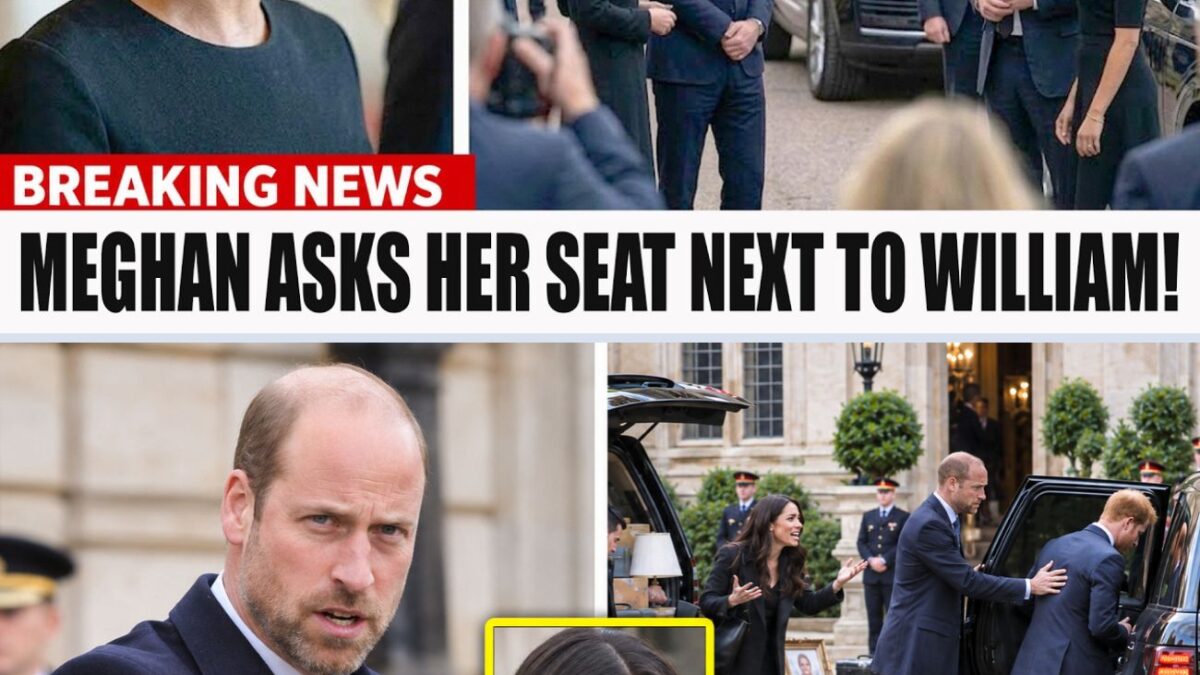
The Notice of Attendance: A Legal Ambush at Windsor Castle
There is a distinct, unyielding rhythm to the administrative machinery of Windsor Castle—a place where centuries of protocol govern everything from state banquets to the quiet passage of morning mists across the Home Park. Yet, on a Tuesday afternoon, that quiet institutional rhythm was shattered by the arrival of a courier bearing heavy legal seals dispatched directly from California. The envelope was not addressed to His Majesty the King, nor was it directed to the heir to the throne, Prince William. Instead, it landed squarely on the mahogany desk of the Master of האי—the senior palace official tasked with coordinating every private ceremony, state dinner, and sovereign guest list behind those ancient stone fortifications.
When the senior official broke the thick red wax seal, he anticipated a routine security inquiry regarding travel dates or private memorial visits. Instead, unfolding the crisp pages revealed a formal legal notice bearing a title that sent a jolt through the upper echelons of the household: Notice of Attendance. This was no ordinary grandson writing to request a quiet moment at his grandmother’s resting place. This was an explicit, unilateral legal dispatch informing the British monarchy that Prince Harry was touching down in London, that the heavy security gates of the King George VI Memorial Chapel would be unlocked for his private California security detail, and—most audaciously—that a formal place setting was to be laid for him at the annual private family remembrance dinner.
The sheer effrontery of the demand left senior aides staggered. For over half a century, the House of Windsor has maintained an absolute, unshakeable firewall between active public service and commercial enterprise. Yet here was a signed legal instruction demanding an immediate chair at an intimate family gathering reserved exclusively for the working sovereign corps. What began as a simmering domestic grievance had instantly mutated into a calculated, aggressive public relations ambush designed to trap the institution.
The Secondary Riders: Wimbledon Demands and Elizabeth Line Optics
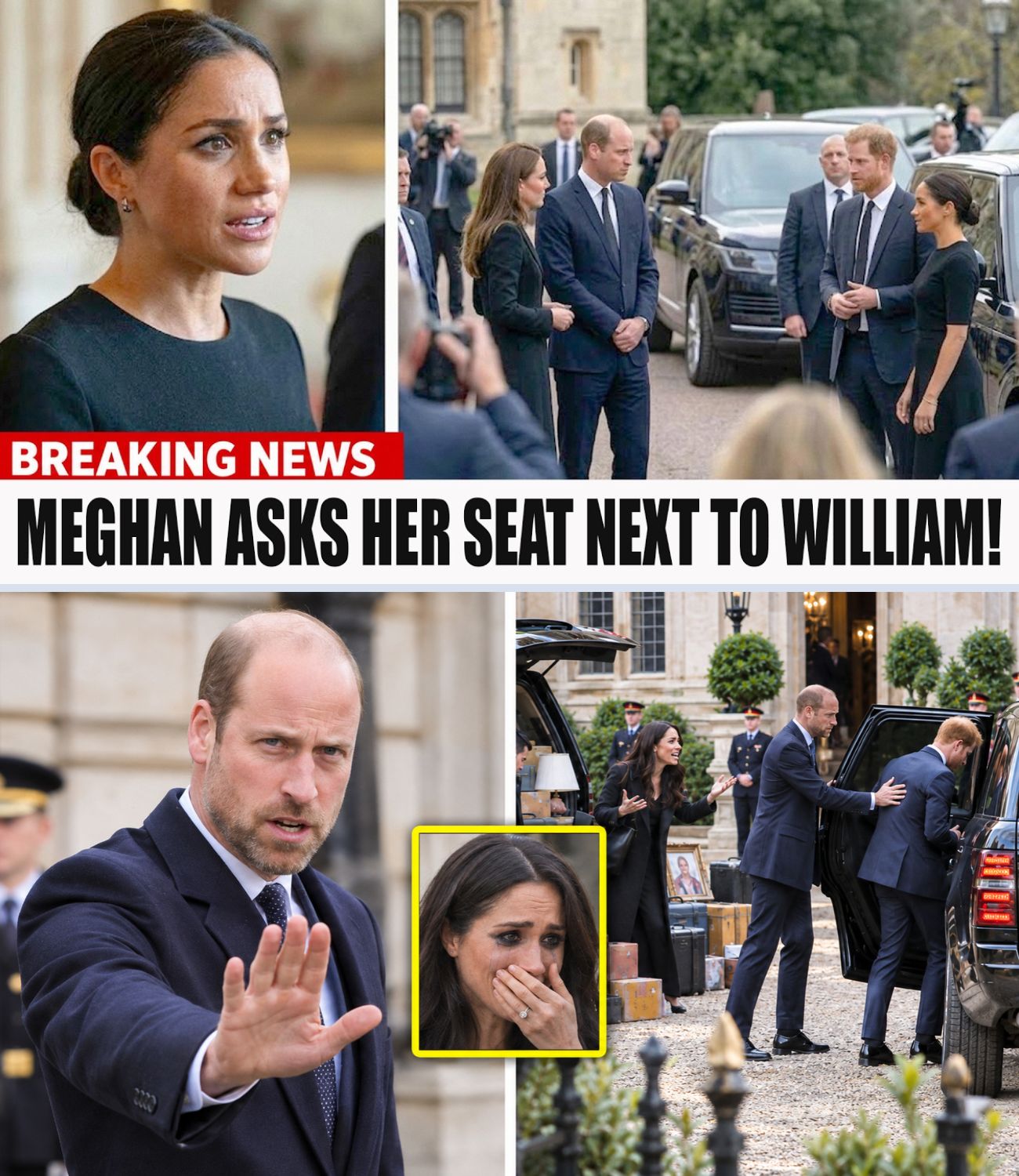
As the Master of האי read further down the multi-page document, the stipulations grew increasingly bizarre and politically radioactive. Tucked deep within the secondary riders was an extraordinary demand concerning Meghan Markle. The memo formally insisted that the Duchess of Sussex be seated directly beside Prince William during the solemn commemorative dinner, framing the jarring visual arrangement as a “necessary public symbol of family healing”.
To demand a shoulder-to-shoulder seating arrangement with the future king—after years of relentless televised attacks and published grievances—demonstrated a detachment from reality that left courtiers speechless. The timing, too, added insult to injury. This legal demand arrived mere weeks after Meghan had faced blistering mockery across the British press for staging an awkward, highly publicized photograph op on the London Elizabeth line train—widely lampooned as a transparent attempt to mimic Catherine’s effortlessly relatable parenting moments.
Worse still, the dispatch contained an extraordinary personal favor requested of the Princess of Wales. The text formally asked Catherine to personally intervene with the committee of the All England Lawn Tennis Club to secure Meghan a guaranteed, prime-viewing seat inside the coveted Royal Box at Wimbledon for the championships. This came hot on the heels of tournament officials flatly rejecting private inquiries from Sussex representatives, having already criticized their team for attempting to commandeer the precise vantage point constitutionally reserved for Catherine as the club’s royal patron.
The Master of האי stood trapped between two impossible outcomes. To reject the notice outright was to hand the Montecito publicity machine fresh ammunition to cry victimhood and cruelty before international media outlets. To approve it was to publicly humiliate Prince William and Catherine inside their own ancestral home. Clutching the heavy folder, the shaken official hurried down the vaulted stone corridors straight to the private apartments of Princess Anne.
Princess Anne and the Emergency Council Chamber Summit
Princess Anne did not raise her voice, nor did she betray a flicker of panic. She examined the legal signatures and the outrageous Wimbledon rider twice, folded the pages with clinical precision, and made a swift executive decision. She refused to shoulder the burden of a solo refusal.
Anne immediately ordered a mandatory, closed-door family summit inside the primary council chamber. Every senior working royal—from King Charles and Queen Camilla to the Duke of Edinburgh and the wider family cousins—was summoned to look one another in the eye and vote as a unified body. Anne understood that an institutional threat of this magnitude required total collective resolve.
To fully grasp why this demand caused such profound alarm within the palace walls, one must examine the strict temporal and structural architecture of the royal calendar. Public perception often assumes that the anniversary of a monarch’s passing is marked by grand state banquets. In reality, the sovereign family operates under a centuries-old distinction between formal state duty and intimate family tradition. Accession Day in early September is observed as a period of absolute quiet prayer and private contemplation, devoid of cameras or public speeches.
Instead, the true commemorative family gathering takes place during the golden stretch of early autumn weather at Windsor. Following the exact institutional logic of Trooping the Colour—where the sovereign’s official birthday is celebrated in June under clear skies rather than in rainy November—Queen Elizabeth established the tradition of an autumn family reunion. This exclusive gathering is strictly capped at forty-eight guests representing the four distinct branches descended from the late Queen and Prince Philip.
Four circular tables populate the historic Waterloo Chamber: one for the King and Queen, one for the Prince and Princess of Wales, one for the Duke and Duchess of Edinburgh, and one for the extended cousins and grandchildren. Yet at the dead center of the room sits the most emotionally charged artifact of the evening: an elevated place setting left entirely unoccupied. Draped across Queen Elizabeth’s personal mahogany dining chair is her favorite Balmoral tartan sash, with her personal equestrian riding cap resting quietly beside her napkin. That vacant chair serves as the moral compass of the House of Windsor—a silent, immovable testament that duty eternally precedes private ambition.
The Living Legacy of Prince Philip and Balmoral Storm
To understand why Princess Anne stood as an unyielding wall against her nephew’s demands, one must look back to the foundational ethos of her father, Prince Philip. Beyond his sharp-tongued public persona, Philip poured his final years of vitality into breeding an exceptional line of Fell ponies at Balmoral Castle, creating a bloodline renowned across the equestrian world.
At the center of that stable stood a majestic, coal-black pony named Balmoral Storm—affectionately known as Stormy. Sired directly from the late Queen’s champion stallion Heltonale Black Prince and the Balmoral mare Moy Reach, Stormy represented generations of living sovereign heritage. When Philip retired from public duties, carriage driving through the ancient oak forests of Windsor Home Park was his lifeline. And in April 2021, when the world watched the Duke’s funeral under strict pandemic restrictions, it was Balmoral Storm who walked quietly behind the hearse, pulling Philip’s personal four-wheeled green carriage. Resting on the empty leather seat were the Duke’s driving cap, woolen blanket, and white gloves, creating one of the most haunting images in modern history.
Following Philip’s passing, Princess Anne quietly intervened to secure Stormy’s future, relocating the pony between her private estate at Gatcombe Park and the royal paddocks at Home Park, personally overseeing his upkeep. Anne knew Stormy was not mere property; he was the living heartbeat of her father’s memory. In those quiet morning training sessions, only one person was invited to share the reins: Prince Edward’s daughter, Lady Louise Windsor. While other young royals gravitated toward celebrity circles, Louise had spent her dawn hours standing beside her grandfather, mastering the art of guiding powerful horses through complex obstacle courses.
The contrast was painfully sharp. While Lady Louise honored her grandfather’s traditions and Zara Tindall earned an Olympic silver medal through sheer dedication, Prince Harry had walked away from his military patronages to film tell-all television specials in California. In Philip’s final weeks, palace aides attempted to coordinate video calls so the dying Duke could speak with his grandson, but those calls were repeatedly delayed or declined. Philip passed away without hearing Harry’s voice, leaving Queen Elizabeth heartbroken. Tucked inside an ebony velvet box in Anne’s study sat Philip’s most cherished personal possession—a custom, silver-mounted carriage driving whip engraved with the Royal Marines insignia, originally intended for Harry’s thirty-fifth birthday. Harry’s abandonment of duty left that whip untouched, creating a silent wound that never healed.
The Council Chamber Showdown and the Streaming Bombshell
When the heavy oak doors of the council chamber swung shut, an oppressive silence settled over the mahogany table. King Charles, Queen Camilla, William, Catherine, the Edinburghs, and the extended cousins took their seats while Anne stood at the head holding the crimson leather folder.
Before Anne could open the file, Queen Camilla leaned forward and floated a diplomatic suggestion: perhaps it was time, after years of mourning, to quietly retire the late Queen’s unoccupied chair from the commemorative dinner, murmuring that an empty seat cast too heavy a shadow. The room turned arctic. Zara Tindall cut across the table with absolute bluntness, declaring that the chair was an untouchable symbol of family honor, not a decorative prop. Anne locked eyes with Camilla, stated that the late Queen’s presence was Windsor’s moral foundation, and permanently closed the subject with King Charles’s immediate concurrence.
Next came emotional tributes: Princess Beatrice presented a bespoke leather journal filled with art and poetry created by the late Queen’s great-grandchildren during their final Balmoral summer, while Princess Eugenie shared a bronze miniature carriage crafted by a visually impaired artisan. Both non-working princesses demonstrated genuine, unprompted familial love.
Then Anne opened the Sussex dossier. Reading the demands aloud—the private chapel access, the mandatory dinner seat, the requirement for Catherine to lobby Wimbledon—she laid bare the breathtaking audacity of the request. William sat frozen, his jaw clenched in incandescent fury, while Catherine placed a steadying hand upon his arm.
Yet the true devastation arrived when Anne produced a confidential briefing prepared by senior palace solicitors and security liaisons. Months prior, the Sussex commercial enterprise in California had entered negotiations for a multi-million-dollar contract extension with a major global streaming network. Production executives, growing weary of generic lifestyle programming, demanded real royal access. Tucked inside the agreement was a mandatory disbursement milestone: to release the final multi-million-dollar tranche of funding, the production company required verifiable, unscripted footage or high-resolution photographic evidence of Harry and Meghan interacting in close proximity with senior working royals on crown property. Without an unscripted image inside Windsor Castle beside Prince William, the entire commercial package would be cancelled.
The demand for a seat at the family dinner was not about grief or reconciliation; it was an executive deliverable designed to trigger a wire transfer to a California bank account.
The Late Queen’s Final Warning and Unanimous Rejection
To cap the revelation, Anne reached into her suit pocket and produced an ivory envelope sealed with purple wax, dated autumn 2022—weeks before Queen Elizabeth passed away at Balmoral. It was a private memorandum written in the late Queen’s own hand, entrusted to Anne with instructions to open it only if the crown ever faced an ultimatum regarding family access. Anne read the words aloud into the absolute stillness: Queen Elizabeth had written that while family affection would always endure in private prayer, the sovereign doors of the monarchy must remain permanently locked against anyone attempting to convert public duty into commercial leverage.
The late Queen had anticipated this exact trap from her deathbed. Hearing those words drained the color from every face in the room, leaving Eugenie and Beatrice devastated. William spoke with chilling, measured precision: if Harry and Meghan were granted seats at the table, neither he nor Catherine nor their three children would attend.
King Charles could not sacrifice the future of the monarchy for a streaming corporation. Anne called for a formal recorded ballot. From Edward and Sophie to Zara, Peter, Beatrice, and Eugenie, the result was a unanimous, 100% repudiation. For the first time in modern history, the bloodline stood as one.
The Sovereign Access Directive and the Windsor Protocol
Rather than drafting a petty letter that could be leaked to American networks, Anne and senior solicitors activated a formal institutional instrument known as the Sovereign Access and Protocol Directive. Grounded in the sovereign prerogative governing royal residences, Windsor Castle was placed under strict state security regulations.
The directive established four unyielding rules:
Prince Harry was granted permission to visit Queen Elizabeth’s resting place inside St George’s Chapel, restricted strictly to an isolated thirty-minute dawn window before family or public arrival.
Armed private security contractors from California were completely barred from the estate, with security handled exclusively by assigned Metropolitan Police officers.
A total ban was imposed on all recording devices, wireless microphones, and commercial camera crews within castle grounds.
Harry’s name was officially and permanently struck from the commemorative dinner guest list, locking the total at forty-eight working royals and faithful kin.
Princess Anne signed first, followed immediately by Prince William, and finally by King Charles, who picked up his fountain pen and inscribed Charles Rex without a single word of protest.
The Triumphant Aftermath and Permanent Codification
In the golden afternoon light that followed, the family walked out onto the private grounds of Windsor Home Park together. Lady Louise Windsor led Balmoral Storm on a braided leather lead, flanked by Zara Tindall, Prince William, and Catherine, while King Charles and Princess Anne walked closely behind. Wire services captured the scene, transmitting a silent, thunderous message across the globe: the core of the monarchy stood unbreakable.
Across the Atlantic, the Montecito publicity machine descended into panic as the reality of frozen streaming funds and rejected Wimbledon credentials set in. In the early dawn mist of the memorial weekend, a solitary black town car delivered Harry to St George’s Chapel for his thirty-minute window of solitude before he was escorted straight back to the airport.
Determined to prevent future breaches, Princess Anne drafted a permanent institutional charter titled the Windsor Memorial and Private Access Protocol. Consisting of three plain, numbered clauses, it restricted private access exclusively to working royals or petitioned relatives with 60-day advance sponsorship, criminalized hidden recording devices as automatic trespass, and prohibited standing approvals based on birthright. Signed by Charles, William, and Anne, the back door to Windsor was welded shut forever.
As forty-eight guests gathered inside the candle-lit Waterloo Chamber beneath the watchful gaze of the late Queen’s vacant Balmoral-draped chair, the generational reckoning reached its definitive conclusion. The crown had proven that ancient heritage cannot be traded for cheap Hollywood applause, and that when duty calls, the House of Windsor answers with unyielding, unbreakable strength.
You Might Also Enjoy

“We Thought They Would Negotiate”—What Argentine Soldiers Said When The British Attacked Goose Green

“You’ll Never Finish My Ruck March, Limey” — US Sergeant Who Challenged the SAS, Then Fell Out First






