Harry Wants His Kids Close to William’s — But There’s ONE BIG Problem!
THE NURSERY DRAWBRIDGE IS UP: Why Prince William Has Sealed the Palace Gates Against Harry’s Desperate Cousin Trap
In the high-stakes chess match of modern royal survival, true power is rarely measured by the noise of press releases or the frantic spin of transatlantic public relations machines. Whilst the autumn air across Britain brings crisp reminders of seasonal duty—with King Charles preparing for his upcoming Commonwealth tour to the Caribbean and Prince William walking through muddy fields in Monmouthshire to comfort flood-stricken communities—a far more intimate and fiercely guarded battle is being waged behind the locked gates of Kensington Palace.
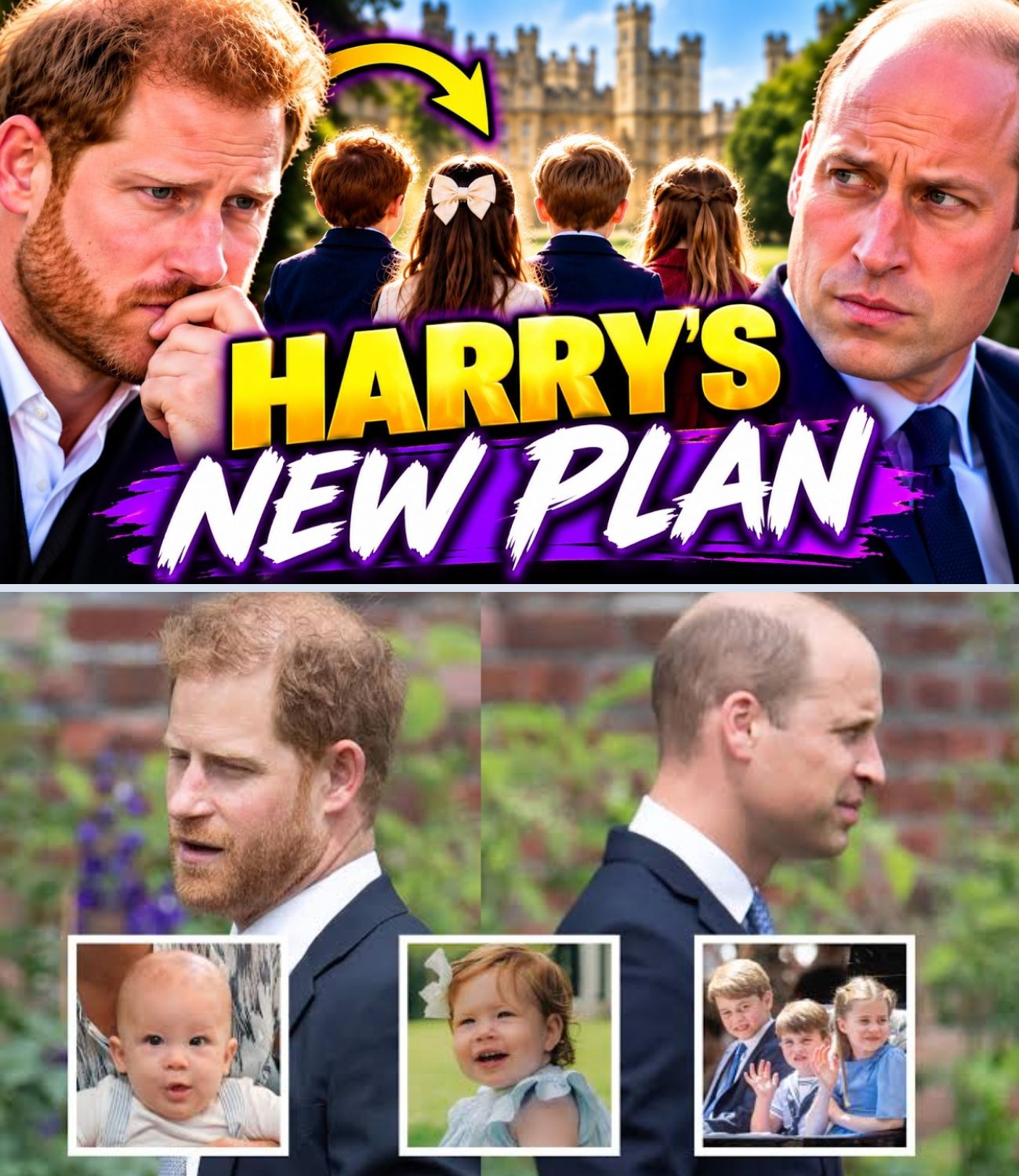
For months, whispers have circulated through elite diplomatic and social circuits regarding a new, highly calculated tactical pivot emanating from the sun-drenched enclave of Montecito. Having discovered that direct appeals to senior royals and attempts to force institutional compliance through school registration maneuvers have hit an impenetrable wall of red tape, a fresh strategy has taken shape. Prince Harry, grappling with the stark reality of his isolation and the fading lustre of his commercial ventures, has reportedly set his sights on a softer, deeply emotional target: the nursery.
Yet, as insiders close to the future king confirm, this attempted backdoor maneuver has triggered the most resolute, unyielding defense yet seen from the Prince and Princess of Wales. William and Catherine have drawn an absolute, unbreakable line in the sand. They see through the veneer of innocent childhood play, recognizing that inviting Harry’s children into the private orbit of Prince George, Princess Charlotte, and Prince Louis is not an exercise in family healing—it is an invitation for Trojan horse chaos to breach the sanctuary of the future throne.
The Shrinking Horizon: Realising the Cost of Isolation
To understand the desperation behind this latest narrative pivot, one must examine the profound psychological shift occurring across the Atlantic. For years, the narrative crafted by the Sussex camp was one of triumphant liberation—a bold, self-made couple charting a dazzling commercial course in California, entirely independent of the antiquated constraints of the British establishment. But as streaming contracts expired, podcast ventures collapsed, and the heavy, unsentimental arithmetic of multi-million-pound estate overheads set in, the glittering illusion began to fray at the edges.
In private moments, observers note a growing realization within Harry’s inner circle that the glamorous Hollywood exile has increasingly morphed into a gilded cage. Stripped of the institutional scaffolding, the administrative support, and the effortless prestige that comes with being a working member of the House of Windsor, daily life in California began to feel uncomfortably detached from the royal lineage he was born into. The stark contrast between his current standing and the dignified, impactful public service maintained by his brother in Britain became impossible to ignore.
Faced with this shrinking horizon, the need to reconnect with the motherland became paramount—not merely for financial or residential convenience, but for identity itself. Yet, the doors that once swung wide open to the spare prince had been welded shut. Direct appeals to King Charles for financial bailouts met with the unyielding constitutional directive issued through the Lord Chamberlain’s office. Attempts to establish an operational foothold in the Cotswolds through school admissions collided with strict statutory safeguarding laws and Princess Anne’s ice-cold refusal to grant executive dispensations.
With the front doors, side doors, and administrative windows firmly bolted, Harry’s strategists turned their attention to the one remaining avenue that defied political blockades: biology.
The Cousin Gambit: Weaponising the Nursery
As Prince Archie and Princess Lilibet grow past infancy, they are inevitably beginning to ask the universal questions familiar to every child raised far from extended family: Who is grandpa? Who is Uncle William? Who are my cousins?
It is a natural human curiosity, heightened by the unique circumstances of their royal heritage. According to well-placed sources, Harry seized upon this developmental milestone as an opening. The logic, from his perspective, appeared deceptively simple: children bear no malice, politics do not register on the playground, and bloodlines are immutable. By framing the request around the innocent desire for five young cousins to know one another, he believed he could disarm the palace’s defenses. After all, what strict, unyielding monarchical institution could possibly justify keeping innocent children apart?
Yet, this simplistic framing ignores the harsh reality of the past six years. You cannot dismantle an institution, monetise family grievances in best-selling memoirs, broadcast intimate bedroom arguments on global streaming platforms, and then casually expect to press a reset button when it suits your domestic convenience.
More importantly, it completely misreads the protective instincts of the Prince and Princess of Wales. William and Catherine have constructed an exceptionally stable, grounded, and fiercely protected domestic environment for George, Charlotte, and Louis. Their entire parenting philosophy is anchored in shielding their children from the toxic glare of public sensationalism, ensuring they grow up with a sense of normalcy despite their extraordinary destiny.
To permit Harry and Meghan’s children into that inner sanctuary would be to introduce an unacceptable hazard. As royal analysts have repeatedly noted, you cannot separate children from their parents. Allowing the cousins to mingle inevitably means allowing the parents back into the circle—reopening channels for covert recordings, tactical leaks, and the very brand of unpredictable drama that the Wales family has spent years purging from their lives.
The Shadow of Precedent: Learning from the Past
In assessing William’s absolute refusal to entertain this sentimental gambit, historians point to the deep institutional memory embedded within the senior ranks of the royal family. The House of Windsor has survived turbulent centuries not by yielding to emotional blackmail, but by recognizing when a rogue branch poses a structural threat to the trunk.
Comparisons are frequently drawn to the turbulent decades following the abdication crisis of 1936, when the exiled Duke of Windsor remained a perpetual, destabilising shadow over successive reigns. More recently, the collateral turbulence generated by Prince Andrew and Sarah Ferguson served as a stark reminder of what happens when boundaries are porous and financial or personal indiscretions are indulged.
Yet, Harry and Meghan’s campaign represents something fundamentally different—an aggressive, commercialised assault on the monarchy’s core reputation, weaponising personal access for financial sustenance. William, bearing the heavy, permanent scars of broken trusts—such as explosive television interviews conducted whilst his grandfather lay dying—understands the stakes better than anyone. His primary constitutional duty is not to salvage his brother’s frayed familial connections, but to safeguard the future reign of Prince George.
Allowing instability, untrustworthiness, and strategic manipulation anywhere near the perimeter of the future king is an operational failure William will simply not countenance. The children may share royal blood, but in the calculated calculus of Kensington Palace, safety and stability must always supersede romanticized notions of extended family harmony.
The Iron Gate Remains Shut
When the dust settles across the quiet, manicured lawns of Windsor and Kensington, the reality of the situation stands in stark relief. Harry’s attempt to use his children as an emotional crowbar to pry open the royal vault has failed as completely as his legal and administrative maneuvers.
There will be no televised reconciliations on palace lawns, no heartwarming photographs of five cousins playing together in the gardens, and no shared platforms designed to rehabilitate a waning celebrity brand. William’s silence on the matter is not passive; it is an active, unyielding wall of indifference. It communicates a message as old as the monarchy itself: actions have permanent consequences, and trust, once shattered by years of calculated betrayal, cannot be magically pieced back together by the innocent charm of children.
Across the Atlantic, the Montecito estate remains quiet, its high perimeter walls shielding an increasingly isolated existence. In London, the future of the crown moves forward with disciplined, unbreakable unity. The nursery drawbridge is up, the bolts are slid home, and the Sussexes are left standing outside the fortress they spent years attempting to tear down—discovering too late that no amount of strategy can bridge the chasm carved by their own hands.
You Might Also Enjoy

“We Thought They Would Negotiate”—What Argentine Soldiers Said When The British Attacked Goose Green

“You’ll Never Finish My Ruck March, Limey” — US Sergeant Who Challenged the SAS, Then Fell Out First






