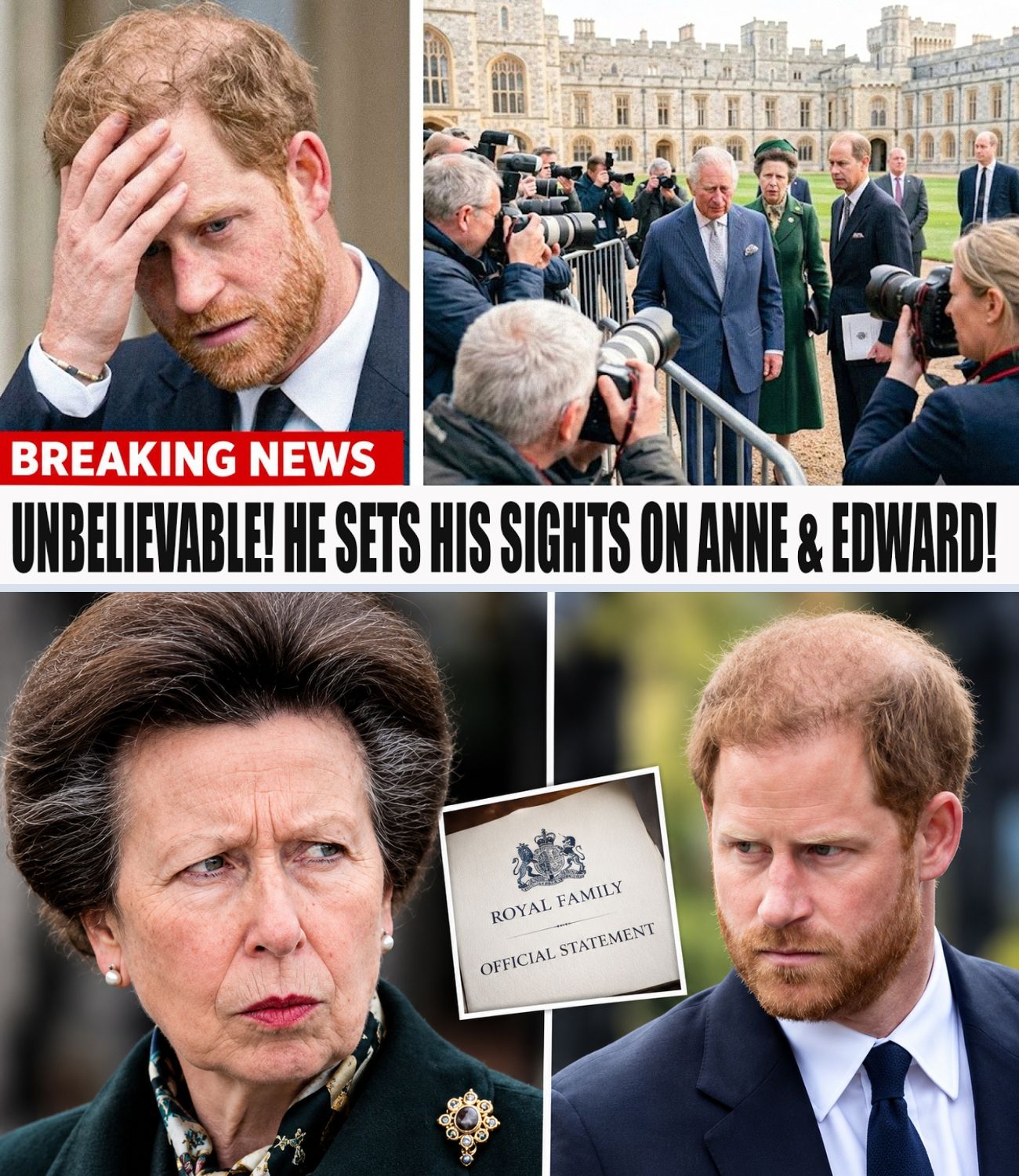
HARRY’s Brazen Statement Is ANNE’s Limit. She has bluntly declared: HARRY Must Return To The US.
The Final Straw: Inside the Palace Revolt That Shattered the Sussex Endgame
For four long years, the corridors of Buckingham Palace echoed with a heavy, cautious silence. Through explosive television interviews, transatlantic tell-all memoirs, and relentless media briefings, the institution absorbed blow after blow, often paralyzed by a mixture of familial grief, constitutional hesitation, and the lingering hope of reconciliation. But royal patience, as history repeatedly demonstrates, is not infinite. When the red lines guarding a sovereign’s legacy are crossed, the machinery of state moves with cold, unyielding precision.
The tipping point did not arrive via a casual gossip column or a whispered leak from an anonymous courtier. It dropped like a public grenade directly into the heart of Whitehall, courtesy of veteran royal reporters acting on behalf of the Duke and Duchess of Sussex. Word broke that Prince Harry and Meghan Markle no longer considered themselves bound by the historic Sandringham Summit agreement of 2020. That document, signed off by the late Queen Elizabeth II herself, was never meant to be a flexible guideline or a temporary contract subject to renegotiation when Hollywood fortunes waned. It was the sacred, permanent boundary drawn to protect the dignity, neutrality, and integrity of the British crown in the chaotic wake of the Megxit fallout.
To declare that sacred accord null and void because of personal grievances over security arrangements was not merely an act of defiance; it was an institutional shakedown. And behind the scenes, it triggered a chain reaction that brought the most formidable figures in the royal family to an absolute, unbendable breaking point.
The Anatomy of an Ambush
To truly grasp how deep this crisis runs, one must look past the glossy PR spin and examine the sequence of events that preceded the public announcement. Weeks prior to the story breaking across international headlines, Prince Harry touched down in London with a specific mission: to secure an audience with Princess Anne. In the mind of the duke, gaining his formidable aunt’s backing—or at least her tactical silence—was essential for his latest round of commercial maneuvers.
He miscalculated entirely. Princess Anne, widely recognized as the most disciplined, industrious, and unshakeable member of the royal family, flatly refused to take his call. She cleared no space in her diary, offered no polite diplomatic excuses, and kept the doors firmly locked. Realizing that his traditional pressure tactics had hit an impenetrable brick wall, Harry allegedly resorted to heavy-handed intimidation. Through intermediaries, a chilling warning was dispatched to the Princess Royal: turning him away was a monumental error, and soon the royal family would find themselves in such a desperate corner that Anne herself would be forced to plead for his return.
This was the moment the dispute crossed the threshold from a messy family feud into pure, unadulterated hubris. Broadcaster Dan Wooten did not mince words when analyzing the situation, pointing out that Harry’s conduct reflected an extraordinary detachment from reality—acting as though his grandmother’s lifetime of monumental sacrifice counted for nothing compared to his personal commercial ambitions.
Yet, what the public did not know at the exact moment those harsh words were aired on television was that Princess Anne’s private office had already intercepted something far more alarming than a petulant text message. They had secured an actual strategic dossier drafted by Harry’s legal team and commercial advisers, ominously titled The Alternative Engagement Framework.
The Blueprint of Corporate Extortion
When the physical paperwork landed on senior desks within Buckingham Palace, the illusion of a spontaneous family disagreement evaporated instantly. The leaked framework was nothing short of an explicit operational blueprint detailing how the Sussex camp planned to wage global corporate warfare against the crown.
According to the dossier, if the palace failed to restore Harry’s taxpayer-funded armed police protection and grant him a customized, part-time working royal status before the end of the year, his team was prepared to launch an aggressive commercial offensive across international markets. The document meticulously listed target markets, lucrative speaking tours, and high-profile corporate endorsements where Harry and Meghan intended to deploy their royal titles without seeking a single nod of approval from palace handlers.
The logic underpinning the strategy was chillingly cold. Harry’s advisers calculated that because the 2020 Sandringham Summit agreement was structured as a personal family declaration rather than a rigid, legally enforceable civil contract, the institution possessed zero immediate judicial leverage to stop them in an open courtroom. The memo brazenly noted that the only way King Charles could legally prevent them from commercializing the royal name would be to ask the British Parliament to strip their peerages through primary legislation—a parliamentary maneuver Harry’s camp wagered the king was far too weak, sentimental, and physically vulnerable to ever attempt.
Targeting a reigning monarch undergoing grueling cancer treatments with a calculated financial ultimatum is a strategy devoid of familial loyalty. It weaponized the memory of the late queen as an economic hostage note. Harry’s argument boiled down to a simple, audacious proposition: unless ordinary British taxpayers—many of whom were battling soaring energy bills and mortgages—forked out millions of pounds annually for elite Scotland Yard bodyguards to protect his California lifestyle, he would turn the historic royal name into a global commercial franchise.
The 98% Verdict and the California Reality Check
Unsurprisingly, the British public viewed the stunt with outright disdain. Fresh YouGov polling revealed an overwhelming 98% of citizens flatly rejected the notion of bankrolling private protection details for a millionaire prince residing in a sprawling Montecito estate. The disconnect between the Sussexes’ lifestyle and the economic realities of working families was glaring.
Behind closed doors in California, however, the grand American dream was quietly unravelling at the seams. High-profile corporate partnerships were floundering. A major Spotify arrangement had collapsed amidst blunt executive critiques regarding productivity and output, while Hollywood studios grew increasingly hesitant to take their calls. Local residents in their affluent California neighborhood had grown weary of heavy-handed private security convoys disrupting quiet community streets and school runs.
Faced with a rapidly draining bank account and diminishing social capital in the United States, Harry convinced himself that the British monarchy was faltering without his celebrity star power. He manufactured a crisis in London because his American venture had hit a brick wall, believing panic would force his father to open the royal purse strings once again.
He fundamentally misunderstood the institution he was trying to pressure.
The Echoes of History: Edward, Sophie, and the Uncompromising Rule
To understand why Princess Anne viewed Harry’s demands with such utter contempt, one must turn the clock back more than two decades to a parallel crisis that tested the late Queen Elizabeth’s resolve. Long before Meghan Markle entered the gates of Windsor Castle, Prince Edward and his wife, Sophie, navigated a similar commercial tempest.
In the early 2000s, Edward operated a television production company while Sophie ran a private public relations firm, walking a precarious tightrope between corporate enterprise and public royal service. When Edward’s production crew was caught filming Prince William at university, the backlash was swift and unforgiving.
Queen Elizabeth did not coddle her youngest son. She summoned Edward and Sophie to a private audience and laid down an uncompromising ultimatum with no room for negotiation: they could either pursue private business entirely, stepping away from royal duties to earn their own living without status, or they could dissolve their commercial firms, renounce outside profits, and dedicate every working hour to public service. There was no third option. There were no tell-all books, no bombshell television interviews complaining of mistreatment, and no public tantrums.
Edward and Sophie looked their monarch in the eye, chose humility over corporate enrichment, and dissolved their enterprises. For years, tabloid press corps mocked them relentlessly, but they endured the weather in silence—travelling to rain-soaked town halls, supporting obscure charities, and showing up year after year without demanding private jets or camera crews. Over two decades, they quietly earned their redemption, transforming into the Duke and Duchess of Edinburgh and standing today as the most dependable pillars of the modern monarchy.
Contrasting that quiet, dignified sacrifice with Harry’s trajectory highlights the gulf in character. When given that exact choice at Sandringham in 2020, Harry and Meghan demanded the glamorous international tours, military patronages, and multi-million-dollar streaming deals while expecting taxpayers to foot the security bill. Edward proved that personal ambition could be subordinated for the greater good of the country; Harry proved that his personal grievances superseded everything—including his grandmother’s dying peace.
The Financial Myth and the Duchy Receipts
Compounding the grievance was the persistent victim narrative regarding financial abandonment. During the infamous 2021 television interview, Harry painted a poignant picture of an orphaned, abandoned son cut off without a penny in the first quarter of 2020, forced to rely entirely on his late mother’s inheritance just to keep his young family secure.
The official financial ledgers of the Duchy of Cornwall told an entirely different story. When audited accounts were made public, they revealed that King Charles—then Prince of Wales—had quietly dipped into his own private financial accounts to provide Harry and Meghan with a substantial multi-million-pound cushion. He funded their transition, covered their living expenses, and paid for private security detail for nearly half a year after their departure, acting with the protective instincts of a loving father.
Instead of expressing gratitude, that financial generosity was pocketed before being followed by public accusations of neglect. It was this pattern of behavior that sealed the verdict during the emergency summit.
The Sandringham Summit: The Iron Doors Close
When Princess Anne placed the intercepted strategy memo alongside the leather-bound 2020 Sandringham charter in the centre of the high-ceilinged private library at Sandringham, the atmosphere was thick with tension. Present around the table were King Charles, Prince William, Princess Anne, Prince Edward, and senior constitutional advisers.
Anne laid out four brutal, undeniable indictments against her nephew:
He was actively desecrating the dying promise made to his grandmother.
He was attempting to extort British taxpayers who overwhelmingly despised his security demands.
His behavior was a direct insult to the British armed forces, treating military patronages as commercial trinkets.
He was deliberately exploiting the king’s physical frailty during grueling cancer treatments.
Prince William stood firmly alongside his aunt, presenting documented evidence showing that every single olive branch extended over the preceding four years had been instantly weaponized in memoirs, podcasts, and interviews. The Prince of Wales made his position crystal clear: there would be no private meetings, no negotiations, and no second chances.
The verdict reached behind those closed doors was unanimous and irreversible. The institutional drawbridge was being pulled up for good.
The Invictus Stunt and the Split-Screen Reality
The starkness of the new royal reality played out vividly on the streets of London just 48 hours later. To casual observers, Harry’s appearance at the 10th-anniversary service of the Invictus Games looked like a heartwarming tribute to wounded veterans. Within the meticulous realm of British royal protocol, however, it was a theatrical act of defiance.
Under the terms of the Sandringham Agreement, Harry had been stripped of his honorary military appointments—including his coveted role as Captain General of the Royal Marines—upon stepping down from public duties. Protocol strictly barred him from wearing a British military uniform. Yet, stepping out in a standard civilian lounge suit, Harry pinned a heavy, gleaming row of military campaign medals and jubilee honours conspicuously across his chest.
His camp offered the peculiar justification that traditional military uniforms felt too constrictive for his modern liberated identity—an unconvincing excuse for a man attempting to cosplay as a military commander while rejecting the fundamental chain of command.
The split-screen contrast delivered by British media that afternoon was devastating. On the exact same day, Princess Anne—who had formally assumed Harry’s former post as Captain General of the Royal Marines—was performing frontline duties. Dressed in an impeccably tailored ceremonial uniform, the Princess Royal stood unflinchingly in the pouring rain, inspecting lines of young service personnel without demanding private motorcades or complaining about the bitter cold. One was a veteran royal embodying seventy years of selfless public service; the other was an exile prince pinning medals to a business suit for the cameras.
The Final Administrative Lockdown
Recognizing that public mudslinging played into the Sussex playbook, the palace adopted a strategy of absolute, chilling silence. When questioned about security grievances, royal aides calmly deferred the matter entirely to the British Home Office, emphasizing that state protection is an independent governmental risk assessment rather than a negotiable family perk.
The final blow was delivered not with a dramatic public speech, but through quiet, permanent administrative and legislative mechanics:
The State Counselors Reinforcement: Working in consultation with parliamentary officials, King Charles formally reinforced the legislation governing counselors of state, ensuring that official duties during sovereign travel or incapacitation would be handled exclusively by working royals—specifically Princess Anne, Prince Edward, Queen Camilla, and Prince William. Harry’s name remained technically extant on historical rolls, but ironclad legal mechanisms ensured he would never exercise constitutional power.
The Solicitor Channel: A private royal decree permanently severed informal communications. All future correspondence from the Duke and Duchess of Sussex—whether financial pleas, personal requests, or security protocols—was redirected strictly through the monarch’s private legal solicitors. The king’s personal phone line was closed to emotional appeals and late-night disputes.
Diplomatic Zero Status: The Foreign and Commonwealth Office formally noted that the couple held zero diplomatic standing. Any political commentary issued from California regarding international affairs was categorized purely as the personal opinion of private foreign residents.
When the royal family stood shoulder-to-shoulder in immaculate ceremonial attire at the Cenotaph in London under gray autumn skies, bowing their heads in solemn silence to honor the fallen, the message was unmistakable. There were no microphones, no celebrity handlers, and no backward glances toward California.
The biological clock of the monarchy marches onward, with younger generations preparing to step into the light of public service. Harry accelerated his own irrelevance by transforming from a supportive family member into an adversary, discovering too late that a millennium-old institution survives by cutting away anything that threatens its constitutional survival. Princess Anne’s decisive intervention ensured that the crown remains a sacred, lifelong covenant with the British people—not a commercial franchise to be auctioned off to the highest bidder.
You Might Also Enjoy

“We Thought They Would Negotiate”—What Argentine Soldiers Said When The British Attacked Goose Green

“You’ll Never Finish My Ruck March, Limey” — US Sergeant Who Challenged the SAS, Then Fell Out First






