“He’s Just A Sergeant” The US Colonel Who Laughed At The SAS, Until The Night Everything Went Wrong
There is a tent in northern Iraq where a US Army lieutenant colonel mocked a British sergeant he had not even met yet, and said words that will be read to him from a green notebook by the next sunrise, and with which he will not be able to argue. The colonel’s name was Raymond Boyatt, and what he said, loud enough to make the two majors on his left laugh at the signal, and the captain on his right half a second late, was:
"He's only a sergeant. In my army, he would carry coffee. You British send sergeants to do the colonel's job and then pretend to be surprised when it turns into a tea party."
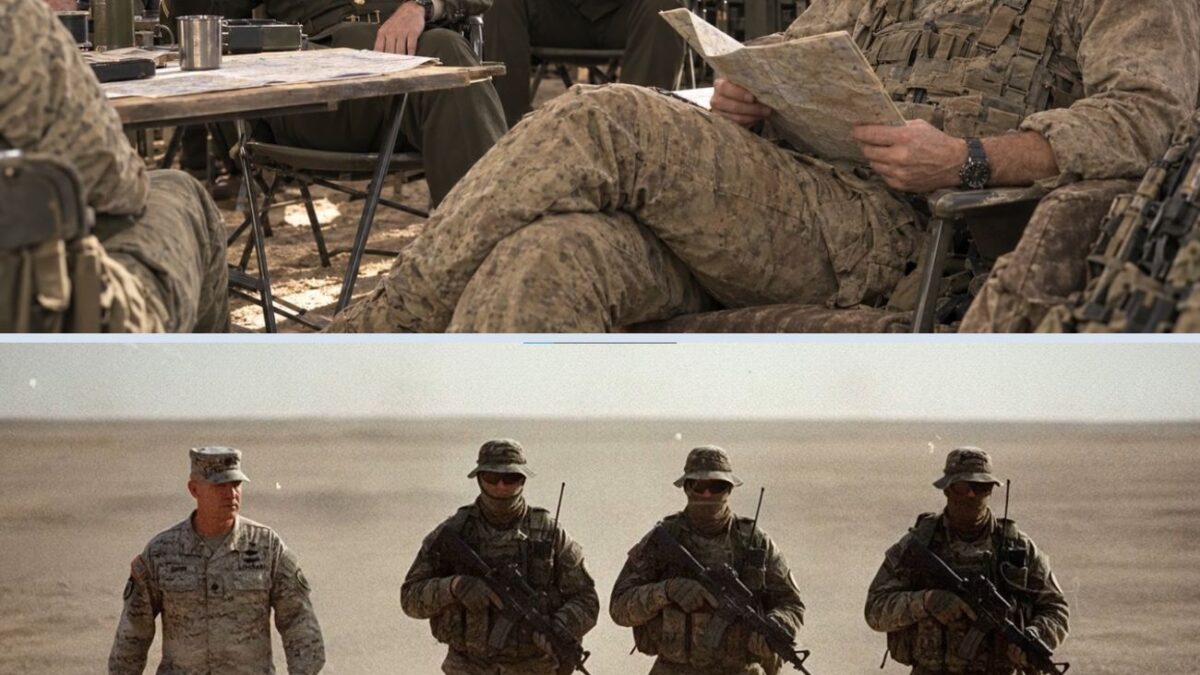
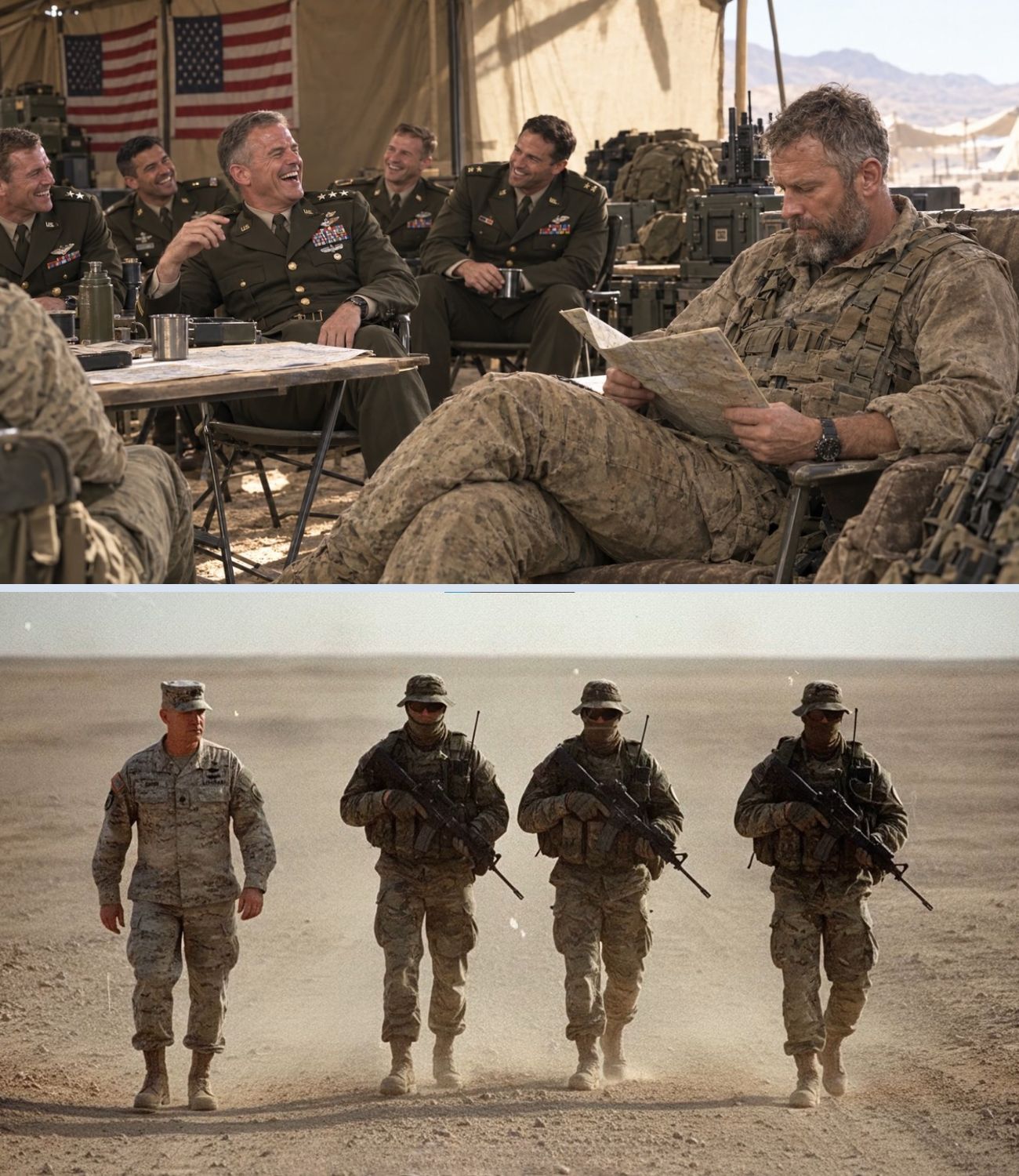
You can picture this tent: olive green, two American flags behind it, a wooden table with cards pressed down with a metal flask, three dented tin mugs, a radio station in the corner, and the morning sun breaking through in flat white light under the canopy. You can imagine the people laughing with him—a major, a captain, another major at the radios, all of them in full dress uniform, all of them confident in themselves. And at the edge of the tent, half-turned to his map, sits a man in camouflage with a gray beard and a rifle leaning against the leg of a chair, who doesn’t look up or respond.
This man is a sergeant. He heard it. Everyone in the tent heard it. The colonel wanted that. The sergeant doesn’t look up, because that’s exactly what the colonel wants, and the sergeant is already working. He studies contour lines on a 1 to 50,000 scale map. He counts riverbeds. He silently performs the first part of the work, which, as the colonel has just told those present, is beneath the dignity of a colonel.
The silence in the tent after laughter is the silence that only comes when one man refuses to play along with another’s joke, and the colonel notices it and takes note of it, and later remembers it as an audacity, not as the warning it really was. He remembers how he said it. This is something worth grabbing. He will remember each word in order, with laughter in between.
Because in less than 20 hours, a man from his own army will be standing next to him and reading these words from a notebook to him, and he will be forced, in front of witnesses, to listen to them a second time. He would be forced to watch the man he called a coffee delivery man do what the colonel, on paper and in his own voice, called impossible. And he had to answer for it. This is where it all begins: the colonel’s joke, the sergeant’s silence, and the clock that had already started ticking, although none of them in the tent had heard it yet.
Raymond Boyatt was no fool, and that’s the first thing you have to accept, because humiliating a fool is worthless. He was 53 years old, 26 of which he had spent in uniform, and if you had met him in the hallway of the Pentagon or in the dining hall of Fort Bragg, you would not have mistaken him for a staff colonel. You would perceive him as he was for most of his career—a hardened, cautious, and tough operative who had trained with the Fifth Special Operations Group in the mid-1990s.
He led A Group for two full rotations before most of his current subordinates had even gone into service, and he returned home after that short, terrible night near Mogadishu with a Bronze Star with a V and a limp that lasted three years and never fully disappeared in the cold weather. He had the distinction of a ranger. He commanded a battalion before he was drawn into staff work. His personnel file had all the items the army required of a serious officer checked off, and he checked them off in exactly the order the army liked. He won the right to his own confidence. That’s what makes his fall so noteworthy.
The reason for his disdain was not racism or chauvinism, and if you tried to tell him it was one or the other, he would be genuinely offended, because in his mind it was neither. In his mind, it was a structure. In his army, the battalion commander was planning a hostage rescue operation. The captain commanded the assault group. The senior sergeant led the department. The chain of decision-making went from the colonel through majors and captains to senior sergeants, and the sergeants carried out the plan. They didn’t create it. He had seen more than once what happened when this chain was ignored, and he had had to bury people because of it.
He had a gut feeling that planning the rescue of 11 civilians from a protected facility, limited to a time limit of dawn, was the colonel’s job. He also believed that an organization that sends a staff sergeant to the planning table and then expects the Americans to accept his plan is an organization that somewhere along the way has confused informality with professionalism.
He read about the Special Air Service. He had read about Pebble Island, Princes Gate, and the siege of the Iranian embassy, and he had come to the conclusion, in his own mind, that the regiment rode on reputation and press, and that this fame had made the men in it callous, as reputation always does. He was wrong about this, but he was wrong in a very specific, understandable, and almost justifiable way, and that’s the only kind of mistake that’s worth showing on screen.
So when he entered the planning tent at 08:40 on a bright morning, the heat already building, he saw a British staff sergeant with a graying beard and a frayed shoulder-length flak jacket sitting at the end of a wooden table studying a map, while a British major stood a step behind, silent. Boyatt did what he had done his entire adult life. He assessed the situation through the prism of his own structure. He looked at the sergeant and saw the sergeant. He looked at the silent major and saw a major who had let a sergeant run everything, and in Boyatt’s army that meant a major who had lost control of his sergeant. And he spoke. He addressed Major Voss on his left and Captain Pruitt on his right, loud enough to be heard throughout the tent. He said his line.
Voss snorted, wrote something short in his green notebook, and underlined it twice. Pruitt laughed with a half-second delay, as he always did. A major at the radio stations named Hofstat laughed at the signal. The only man in American uniform who didn’t laugh was Marcus Thiel, a Green Beret seconded as an observer from the Joint Task Force to the British unit, who had been with the regiment’s company for nine days by then and already knew, not completely, but enough that what the colonel had just said was something a man would like to take back. Thiel looked at the floor. He didn’t laugh.
Boyatt noticed that Thiel wasn’t laughing, and he also noted that as another display of insolence. Then he opened his map tablet to spread out the American tracing paper, and inside the cover, laminated and glued tightly, was the photograph he had kept there: his son in a gray uniform over a white one, his cap tilted sideways, on the steps of West Point. Boyatt stared at the photo for half a second before closing the lid, much like another person would touch a crucifix. Then he lifted his chin and began the briefing.
The forward operating base was located on a long, flat strip of scrubland, 42 km from the town, which was still called by its pre-war name on maps and by three different letters on radios, depending on the day. To the north and east, the terrain transitioned into limestone ridges and dry wadis. In the south it stretched across a plain for 20 km, then rose into a line of blue mountains that at dawn and dusk looked like a painted screen behind the tents. The base housed the American headquarters, a Kurdish communications platoon, an air force with two helicopters, a medical tent, and in a fenced-off sector behind—without any signs or markings on the gates—a British Special Air Service (SAS) unit, half of B Squadron’s mountain unit, reinforced by two snipers who had arrived here six weeks earlier to carry out a mission that, until the aid workers were captured, had remained only a likely scenario.
The Americans owned the base. The British were guests. This hierarchy mattered to Boyatt and was of no concern to the people in the rear sector. And the gap between these two facts is the space through which this story moves.
In the first 11 hours after the hostages were reported, the squad did almost nothing that anyone in the American tents would have perceived as urgent. There was no screaming. No radios were broken by the noise in the area. The two men went to the quartermaster, got a box of 7.62 match-grade ammunition and a box of 5.56, and took nothing else. One man, Corporal Finlay Haddow, a broad-shouldered Scot, went to the engineering depot and spent 40 minutes alone with a roll of detonating cord, a can of plastic explosives, and a notepad, humming a line from the hymn under his breath so softly that the depot sergeant didn’t notice the singing until he had left.
Trooper Silas Beaumont, the youngest, went into the mess hall and came out with a loaf of bread, three cans of food, and a packet of brown sauce from his knapsack, ate it all on the steps of his tent, his knapsack between his knees, and watched the mountains. The sniper pair, Sergeant Ewan Price, a Welshman with a slow tongue, and his partner, went out to the perimeter with a telescope, sat in silence for an hour, then returned and lay down in the shade.
Boyatt, passing the rear sector at 11, looked over the fence and saw people lying in the middle of the morning while the hostage situation was posted on the board, and his jaw clenched. He said to Pruitt loudly enough for him to hear:
"Tea party."
Pruitt laughed after half a second. What Boyatt didn’t see—for it wasn’t something a person trained to look for structure would notice—was that the men who were lying down weren’t resting at all. They were doing the one thing his army had never fully learned to appreciate: they were silent. Not in the voice, but in the movements of the body. Price studied the wind on the ridge where the hostages were held, lying in the shade and watching the dust roll across the hard ground behind the wire. Haddow mentally ran through the plan of the structure, comparing it with the charges he had already prepared. Beaumont ate because on his first rotation he learned that he who eats when he can will not become someone who cannot when he has to. And in the planning tent, Staff Sergeant Tam Douthwaite silently studied the map, for in his experience, discussing a plan before it was ready was the surest way to end up carrying out someone else’s.
Silence was their advantage. Silence was what the colonel’s contempt was supposed to crash into, and since the colonel perceived silence as idleness, he had to crash into it quickly and from the wrong side. Major Alistair Croom, the deputy squadron commander on site, spoke perhaps forty words during those 11 hours. He instructed the Kurdish liaison officer for six. He answered the American operations officer Voss’s question in two. At one point he said to Douthwaite, standing in the back of the tent with his hands behind his back and his eyes on the map:
"Your decision, Tam."
Three words. Douthwaite nodded without looking up. In Boyatt’s Army, a major who says three words to a sergeant and then stands behind him is a major who has resigned. In Croom’s regiment, the major who said three words to Douthwaite had said all that the situation required, and had enough sense to keep his mouth shut.
Douthwaite himself did not look like the kind of man who was going to lead a rescue. He looked like a man reading a map. He was in his early forties, with the build of a dockworker, a little out of shape in the shoulders, and a beard the color of wet sand that was turning gray on his chin. He wore a compression vest over a sand shirt that had washed to the point of losing its color clarity. Under his vest, on a shoelace around his neck, he wore his deceased brother’s wedding ring. No one at the base knew this. No one needed it based on this. He read the map, slowly running his finger along the dry riverbed, his other hand lying flat on the table. And about every 20 minutes, without looking, he would reach out and take a sip from the tin cup on his right that held tea. Because he loved tea. And the fact that there was tea in the cup would later become, in Boyatt’s mind, one of the pieces of evidence that this was exactly the tea party he had predicted. He did not prophesy it; he announced it. Advertising in this profession is a kind of debt that reality loves to collect.
With the last ray of light, the loaded pistol was already lying on the table. Map, riverbed, ridge at 620 m, wall of structure, lone sentry on north side, time of first light. The entire plan of what was to happen was in Douthwaite’s head, and almost none of it was in Boyatt’s head. The colonel laid out a plan built on his own structure. The sergeant secretly devised a plan that was actually supposed to work. And at 9:00 PM, when the sergeant finally got up from the map and spoke for the first time all day, saying only:
"I'm satisfied, sir."
To Croom, who nodded once and said:
"I understand you, Tam."
The colonel in the neighboring tent told Pruitt that if the British wanted to go first, he wouldn’t interfere with them, and it would be instructive. This was supposed to be instructive. At least he was right about that.
At 3:40 p.m., under a sun that had already passed its merciless stage and turned into the muted, languid heat of late afternoon, the two units met at a shared firing range. The shooting range was a 300m strip of hard ground laid along the inside of the eastern fence, with steel targets at 100, 200 and 300m and a paper stand at the 100m line for group shooting. Americans used it in the morning. The British asked for an hour at the end of the day, as the late afternoon light on that side of the base was exactly what they expected to shoot in. This request, like most of their requests, was made by Croom in less than ten words, and Boyatt, when told, said it was good and that he would come and watch because he liked to see the Allies train—which was true, but not the whole truth that day.
He came with Voss and Pruitt, who carried a telescope for him, and stood on the firing line, arms folded across his chest, watching Price and his second-in-command aim their rifles at 200 yards in a wind that rose from the southwest and drove the dust in long, slow wisps across the firing line. Price fired three rounds, made no adjustments, fired three more, said something in Welsh under the breath of his number two, and froze. Boyatt watched the target ring after each shot. He didn’t say anything.
Then Douthwaite walked to the 100-meter line with the C8 L119 used by the regiment, made by Diemaco, with a silencer, with the forend worn to the color of old bone where his left hand had been, and got on one knee—not lying down, not with a stop, but kneeling without support, left elbow on kneecap, right elbow in the air. This position, as any instructor in any army will tell you, is the most difficult of the four (standing, sitting, kneeling, lying down), because the human body is not adapted to holding a rifle still, resting on its own kneecap. Boyatt, without turning his head, said to Pruitt:
"Give me the telescope."
Pruitt handed him the telescope. Boyatt put it to his eye. Douthwaite fired once. Boyett saw through the lens a hole appear in the paper. He was waiting for the next one. Douthwaite fired again, then again, and again. Five shots at a pace that Boyatt’s ear, trained for 26 years, determined was slow—slower than a man would shoot under pressure, slower than he would shoot while showing off, and slower than if he were thinking about the audience. The pace of a person who thinks about nothing but the next shot.
There was a pause between the fourth and fifth shots, perhaps four seconds, which Boyett would later recall as the moment when he first realized—without admitting it to himself—that he had misjudged the situation that morning. Four seconds during which Douthwaite did not move, not a single movement of head or shoulders, and during which Boyett saw through the lens four holes that fit into a square the size of the tip of his own thumb, and knew that the fifth would hit the same spot. The fifth hit the same spot.
Price, who was looking through his scope, quietly said to his number two:
"Right there."
A phrase that was understood only by the two of them. Number two grunted in response. A soldier walked onto the shooting range with a twopence coin, a large British bronze one, already quite old and tarnished, and placed it on the group of hits. He walked back down the path, holding the target at the firing line with the coin still on top, and said nothing, because the result was obvious anyway. All five holes were under the coin. Four of them were touching each other. One of them, the first, was located right at the very edge, and if the coin had been more modern and smaller, it would still have covered four, and the edge of the fifth would have been inside its circle.
Boyatt lowered the telescope. He lowered it slowly, in two movements: first to his chest, then to his thigh. Like a person who decided in the middle of a movement that lowering it quickly would be worse than lowering it slowly. Voss, who was standing nearby, had already managed to write something down in a green notebook and underline it twice. Pruitt didn’t laugh because he was focusing on the colonel’s shoulders, and the colonel’s shoulders hadn’t given him permission yet. Thiel, standing six paces to Boyett’s right, wearing a Green Beret patch, said nothing, but he saw Boyett lower the pipe, and he saw Boyett’s jaw make the same movement it had made that morning in the tent.
And Thiel, who understood what he was looking at, took note of it. He had already seen Douthwaite shoot before at another range four days ago. He knew what was coming. He didn’t warn the colonel. He wasn’t one of those soldiers, and the colonel didn’t ask him. Douthwaite rose from his knee, shook the hard soil off his left knee with his palm, and walked to his backpack, not looking back at the firing line. He took a sip of water from his flask and said a short phrase to Haddow, which made him laugh. A short bark of laughter, and that laughter, which carried across 30 meters of solid ground to where Boyatt stood with the telescope at his hip, was the first sound all day that seemed to Boyett to be laughter not intended for him.
He walked back to the headquarters tent with Voss on his left and Pruitt on his right, not saying a word along the way. In the tent, he put the telescope on the table, opened the tablet with the map, looked at the photo in the lid for a long time, and then closed it without taking it out, and asked Voss:
"What time is the briefing?"
Voss told him the time. Boyatt nodded. That was the whole conversation. And that was just the first time that day that he had made a mistake.
The area between the base and the facility was marked on the American map with a thin red line as a recommended route for equipment; travel on foot is undesirable, rough terrain, risk of detection. Boyett himself had made this mark on the second version of the map that morning. He did it because he studied the terrain, considered the heat, looked at 26 miles, and concluded—correct for his own forces but wrong for those he was looking at—that no sane planner would send people on foot across that area in 12 hours. Douthwaite read the mark, removed his finger from the map, looked at Croom, and Croom said:
"It's up to you, Tam."
For the second time in a day, Douthwaite quietly said to the Americans at the table:
"We will walk."
The man with the Bronze Star did not laugh when he heard this. He was no longer in the mood to laugh. He said carefully:
"You will walk 42 km over rough terrain in the dark and still be able to fight at the finish line."
It was a statement, not a question. Douthwaite answered as if it were a question. He said:
"Yes, sir."
And then he returned to the map.
They left at 10:40 p.m. Eight men, no equipment, air-raid vests and backpacks, water in hydrators, L119A2 rifles with silencers, muzzle-down. They went out the back gate past Kurdish guards who nodded at them, because the Kurdish liaisons had worked with the British unit long enough to know what a British unit looked like when it went to work. They turned northeast along the bed of a dry creek, which was marked as impassable on the American map because the map was drawn by an officer who had never been there. Price went first. Haddow was closing the group. Beaumont, the youngest, was third behind Price, because that was where Douthwaite wanted to see him. Douthwaite was fourth. Croom was not with them. Croom was on base where the major was supposed to be while his staff sergeant led the assault, something Boyatt in the staff tent could never fathom.
They moved in silence, not talking softly, but without words at all. Price raised his hand at the first wadi crossing, and the column stopped. Price lowered his hand, and the column moved forward. There were no radio checks. There were only radio tone signals. Two clicks means “yes”, three means “stop”. A scheme so old in the regiment that none of those who used it remembered who came up with it first. The dust under their boots did not rise because they stood on the outer edges of their soles, as the fighters who had been selected in the Brecon Beacons did. And the outer edge of the boot raises almost nothing in the dry Iraqi dust. They covered 6 km in an hour. In 3 hours they covered 17.
At 23:10, 30 minutes after the detachment left, Boyatt ordered the American rapid response team to advance in cars. Three mine-clearing vehicles, nine people, a machine gunner on each; the route is laid out along a corridor that he marked in red. The rapid response team was not an assault team. This was support, pre-positioned in a waiting area 8 km from the facility in case of evacuation. Boyatt conducted the briefing personally. He did this partly because he wanted the Americans to get there first. He didn’t say it out loud. This was not necessary. Voss wrote it down in his green notebook anyway and underlined it twice.
The rapid response team left through the main gate 30 minutes after the squad left through the back gate. They had a 2-hour advantage, measured by the speed of cars on open terrain. They had cars. They had places. On paper, they had every advantage a planner could give a column of nine over a group of eight infantrymen. At 02:40, the rapid response team reached the waiting area and reported their arrival. The base radio operator, an American communications specialist named Ortega, recorded the report and read it aloud throughout the tent so that Boyatt, who was awake, could hear it from his chair near the main screen. Boyatt nodded.
At 02:44, 4 minutes after the report from the holding area, the squad radio station, which had been silent for 4 hours, beeped twice. Two clicks, then a pause of exactly 3 seconds, and then two clicks again. This was a pre-arranged signal that the detachment had reached the final meeting point, 400 meters from the north wall of the complex, on the ridge where Price was to lie down. 400 meters from the complex, the rapid response forces were 8,000 meters away. The foot soldiers, having covered 42 km of terrain that Boyatt had determined to be impassable for infantry, arrived in combat readiness before the men on the route that Boyatt had laid out himself had managed to cover half the distance to the support position.
Boyatt was looking at the main tablet when a second pair of clicks sounded. Thiel stood in the back of the tent with his arms crossed. Thiel saw the colonel look at the tablet, then at the watch, then at the tablet again and say nothing. Voss said quietly:
"They're in position, sir."
Boyett replied:
"I heard, Major."
Voss wrote something down in a green notebook and underlined it twice. Boyatt, sitting in his chair, did what a man with his track record and confidence would have done at that moment, which was to rationalize. He convinced himself, mentally, that the detachment had cut corners on the route, that they had chosen a line he would not have approved, that they were moving without the equipment the Americans had to carry, and that any of his A teams in the 94th could have done the same with the same freedom of action. He was not entirely wrong on any of these points. He was completely wrong on one important point: the people he called tea drinkers had silently marched through the area he had marked with a red line and were now 400 meters from the wall, which, according to his morning briefing, required an assault using equipment.
He didn’t say any of this out loud. He looked at his watch. The clock read 02:45. Dawn was supposed to come at 05:11. Here was the element that had been laid that morning and which no one in the American tent perceived as the beginning of collapse, because in the kind of battles that the regiment is fighting, the ground usually disappears quietly from under their feet.
The day before the colonel laughed in the planning tent, a Kurdish patrol operating on the eastern approaches had captured a courier from an armed group holding hostages. He was about 19, thin, wearing a sand-colored sports jacket, carrying a cell phone with three numbers and a handwritten note hidden in his shoe. The Kurds handed it over to the Americans at 11:00 AM. The Americans put him in a windowless room at the back of the headquarters tent and sent their interrogator, a staff sergeant named Rooks, a veteran of two tours, a hard-working man with a good record. Rooks worked with him for 2 hours, learning only the messenger’s name, the name of his village, and that he wanted to smoke. He did not recognize the layout of the building. He did not know the number of people behind the walls. It entered Voss’s green notebook with a line that read: “Rooks, 2 hours, nothing useful,” underlined twice.
Boyatt, when Voss read him that line, sighed and said the man would eventually speak. He didn’t consider what “eventually” meant in the limited time before dawn. At 7:30 p.m., after the range, after the exit briefing, Douthwaite asked Croom if he could pick up the messenger for 20 minutes. Croom replied:
"It's up to you, Tam."
For the third time that day, Douthwaite went to the room at the back of the headquarters tent, looked at the messenger through the open door for about four seconds, then went to the kitchen and returned with a tin cup of hot sweet tea, a cake and a small tin of apricots, went into the room and closed the door behind him.
Thiel was standing by the door. Thiel politely asked if he could observe. Douthwaite looked at him through the half-open door and said:
"If you can keep your mouth shut, I..."
Thiel nodded. Thiel kept his mouth shut. In the room, Douthwaite placed the tea on the table, a cake next to it, and apricots on the cake, sat down on a chair opposite the messenger, and for a whole minute did not say a word. He looked at the messenger’s hands. The messenger’s hands lay on the table. The messenger looked at the tea. A minute passed, and Douthwaite pushed the tea across the table with two fingers. The messenger looked at Douthwaite, this time nodded, and took the cup and began to drink.
What Douthwaite did next, over the next 19 minutes, Thiel would later describe to another officer, in another room, as the most peaceful work he had ever seen. Douthwaite didn’t scream. He did not touch the messenger. He asked him in an even, interested voice about the village. He asked him about the route from the village to the camp. He asked how long this journey would take. He asked if there was a well in the camp and on which side of the yard it was located. He asked if the generator ran all night or only while the lights in the main house were out. He asked which room the women slept in. He asked these questions in the order in which a person would ask them, making a map in their head, moving from the inside out.
And the defector, who had expected completely different questions, answered each of them before he realized he had answered the first one. By the fourteenth minute, Douthwaite already had a camp plan in his head. By the seventeenth minute, he knew the layout of the guards. At the nineteenth minute he knew of the sentry on the north side—the same man Price would stab in the throat six hours later, the very moment the assault began. He also learned that for two weeks of his stay in the camp, the defector slept in a shed near the eastern wall. This meant that there was a barn near the east wall, so Haddow didn’t need to break through the wall, because the barn roof was the way in.
Douthwaite stood up. He said in the same even voice:
"You've been very helpful. Finish your tea."
He left the room. Thiel was still standing in the hallway. Douthwaite walked past Thiel to the planning table, picked up a soft pencil, and sketched on a map the internal layout of the camp, which he had never seen before: a well on the north side of the courtyard, a generator near the east wall, hostages in two rooms on the second floor of the main building, and he also marked with dotted lines the layout of the guards around the walls.
Boyatt came to the table at 8:20 p.m. He looked at the drawing. He asked:
"Where did you get that?"
Douthwaite replied:
"A defector."
Boyatt said:
"Rooks held him for two hours."
Douthwaite replied:
"Yes, sir."
He said nothing more because there was no need, and the whole room understood everything, and Voss had already written it down in a green notebook and, for the first time all day, did not underline it, because some things do not need underlining. Boyatt stood at the table for ten seconds. Then he said:
"Continue."
After that, he left the tent. He didn’t return for an hour. Upon returning, he remained silent until the final briefing. And when he spoke at the final briefing, it was only to confirm the time. He did not make any adjustments to the plan. He did not dispute the point of entry. He had no questions for one sniper on the ridge. He signed the permit and put down his pen. The person who called it a tea party in the morning stopped arguing by 10:10 p.m.
It is 04:53. It’s quiet in the operating tent. The main board shows the base in two dimensions, and the squad is a cluster of blue chevrons 400 meters north of the north wall. Boyatt stands at the board. Warrant Officer Larkem, the squadron sergeant-major, a short, gray-haired, broad-shouldered officer whose last name no one uses, stands next to him with a stopwatch in his left hand, his thumb on the button. 10 minutes before that, Boyatt asked for his own stopwatch. He didn’t say why. Voss passed it to him from the signal desk. Boyatt holds it in his right hand. Both men look at the board.
At 04:56, the squad presses the radio button three times. Three clicks mean ready. Larkem doesn’t move. Boyatt doesn’t move. It’s so quiet in the operating tent that all you can hear is the fan on the signalman’s desk and nothing else. Thiel stands at the back of the tent with his arms crossed over his chest. Pruitt stands at the table with the map and doesn’t laugh because there’s nothing to laugh about. At 04:58, a single click is heard. One click means start. Larkem presses the button on his stopwatch. Boyatt presses his half a second later.
On a ridge, 620 meters from the base’s north wall, Price lies on his stomach behind a limestone ridge as thick as a human chest. His partner with a telescope is next to his left shoulder. The wind is blowing from the southwest at a speed of 4–5 meters per second, which Price recorded with a special pencil on the butt of his rifle. His sights are on a sentry standing in the northwest corner of the complex. The guard is a man in his thirties in a dark jacket, with a rifle slung over his shoulder on a belt. He is looking south. He has been looking south for 41 minutes because Price has been watching him for 41 minutes.
Under the ridge, near the east wall, Haddow is lying on the roof of the shed with the generator. He is lying on his stomach. In the last 90 seconds, he laid an explosive charge along a seam he found in the brickwork above the barn roof. It was a seam where a door had once been bricked in many years ago, and it had never grown together with the main wall. He softly hums a line from a church hymn. He doesn’t even notice he’s doing it. Beaumont is behind him on the roof of the barn holding an assault ladder. Douthwaite at the foot of the wall, four fighters lined up behind him. The muzzles of their L119A2s with silencers are lowered. Nobody is talking.
At 04:58 with pennies, Price takes his last breath and his finger presses the trigger. The rifle fires. The shot is silent. The sentry’s head drops forward, he falls into his own shadow, and his rifle on his belt falls with him, making no noise, for the ground inside the northwest corner is sandy. In the same split second that Price’s rifle fired, Haddow’s charge went off. It was not a roar, but a sharp, hollow crack, the sound of something being cut, not blown up, for Haddow was a master of his craft, and the charge was calculated to cut, not to thunder. The seam diverges, creating a hole the size of a man. Haddow leaps through it, even before the dust has settled. Beaumont followed him. Douthwaite, who was around the corner at the base of the wall, climbs the ladder, passes through the hole in the barn roof, and enters the east courtyard of the complex at exactly two o’clock on Larkem’s clock.
In the operating tent, Larkem doesn’t look at his watch. Larkem looks at the map. Boyatt looks at his watch. The second hand moves. Inside the complex, the cleaning takes place in a clear rhythm. Haddow and Beaumont occupy the first floor of the main house. Two rooms, three armed men, double shots from silencers, no screams, neither English nor Arabic, just the sound of double shots and the dull, heavy fall of bodies onto the carpets. Douthwaite and two others climb the stairs to the second floor. There are hostages in two rooms on the first floor. Douthwaite doesn’t knock down the first door. He opens them. Inside, 11 people are sitting on the floor against the far wall. Eight men, two women, one elderly man who the liaison said was the local personnel manager, and Douthwaite utters a single English sentence all night. He says:
"British Army, you are safe. Stay put."
He says it quietly. The hostages don’t scream. One of the women starts crying, which is not a scream. In the yard, Price, 620 meters away on the ridge, fires a second shot at the second man who came out of the generator room with a rifle in his hands, and he falls near the generator, while the generator continues to run. There are no more people standing on the territory of the complex.
In the operating tent, Larkem picks up the clock. The time on his watch is 6 minutes and 41 seconds. Boyatt picks up his watch. The time on Boyatt’s watch is 6 minutes and 41 seconds, not including the half-second difference between the crown presses at the start. Larkem says quietly to the room:
"The complex is clean."
11 packages, all of ours are lifted. Here is the number: 11 hostages were rescued. All 11 are alive. Zero deaths from our side. Zero casualties from our side, except for a scratch on Haddow’s left forearm, which he doesn’t mention until the medic notices it. In 2 hours, zero hostage deaths. 6 minutes 41 seconds from single click to command to clean up. On two stopwatches held by two men standing side by side in the operations tent, one of whom 19 hours ago had laughed in the planning tent and said that the sergeant should carry the coffee.
Boyatt holds his own stopwatch. He looks at the number. He is not moving. The second hand is still moving because he didn’t press the crown to stop it. Larkem, who has pressed his, reaches over slowly, politely, as if helping an elderly person with a watch strap, and presses the button on Boyatt’s stopwatch for him. Boyatt doesn’t react. Larkem lowers his hand back. Voss at the cartographic table writes a number in a green notebook. He doesn’t emphasize it. He writes it once in regular numbers and closes the notebook. The operating tent is completely quiet, unlike it was at 04:53. The hum of the signalman’s fan can still be heard. The clock on the main board shows 05:05. First light will be at 05:11. The job was done before dawn, just as the sergeant had said at 9:00 PM when he expressed his satisfaction, and as the colonel in the nearby tent had promised, it would be a lesson. This became a lesson.
At 06:40, an evacuation team arrived: two helicopters, American, since the aircraft had been American from the very beginning, they took the squad and the hostages from a dusty strip of hard ground 6 km south of the camp. The streak looked like a line of dust, and the sun rose behind it, the color of old brass. Boyatt was in that lane. He himself asked to be there. He had arrived in the transport with Voss, Pruitt, and Thiel and was standing at the edge of the lane, his hands behind his back and the tablet with maps under his left arm. He watched the dust rise as the first helicopter began to land. He was forced to watch. No one said it out loud. Nobody needed it. Croom suggested over the radio that the colonel might want to be present during the evacuation to receive the hostages. Croom said it in the same even, polite voice he used for Americans, and Boyatt agreed before he realized what he was agreeing to.
The first side landed on solid ground, dust rose around it in a wide, low ring, and the hostages emerged from the side doors. Eleven: eight men, two women, and an elderly man. They walked across the lane to the medical vehicles, some semi-independently, some supported. A detachment followed them. Price was first because he was the last to leave the ridge, and therefore was the last to exit and the first to enter—that’s how it works. Then his second number, then Beaumont, then Haddow with a bandage on his left forearm, two more, then Douthwaite, and lastly—Croom. They passed the colonel. They did not look at him, and not out of contempt. A regiment knows no contempt, because contempt is something you waste energy on, and a regiment doesn’t waste energy on something that’s already completed. They didn’t look at him because he wasn’t in their line of sight. He was just a man on the edge of the lane. The task was behind us, the hostages were ahead, and the colonel was neither there nor there, so the colonel was not noticed.
Boyatt watched Douthwaite walk past. He watched Douthwaite’s plate carrier’s back and the dark line of lace on the back of the sergeant’s head where it peeked out from under his shirt collar—a lace that Boyatt didn’t know about and would never know about because no one on the base ever asked. Douthwaite did not turn his head. He walked past the colonel with a pace that was neither fast nor slow, climbed into the second car at the end of the runway, sat down, took a flask from his backpack, and drank. Voss, standing at Boyatt’s right shoulder with an open green notebook in his hand, said very quietly, so that only Boyatt, Pruitt, and Thiel could hear:
"Sir, for the report."
He read from the top of the morning page in the same monotone voice he had spoken all day:
"08:40, Lieutenant Colonel Boyatt remarked during the planning: 'He's only a sergeant. In my army he'd be carrying coffee. You British send sergeants to do a colonel's job and then you're surprised when it turns into a tea party.'"
Voss did not look up from his notebook. He read the words at the pace at which a person reads a timestamp. He read them without comment. He underlined them twice that morning, and both lines were visible on the page, for Voss’s underlining was always visible, and during the day he added five lines that followed the morning remark. And he consistently underlined the first twice, the second twice, the third twice, and did not underline the fourth and fifth at all. He didn’t read any of them out loud. He didn’t need to. The first line read was all that mattered.
Boyatt didn’t answer. Boyatt didn’t turn his head. Boyatt looked at the second car at the end of the lane and the dust settling around it. Thiel, standing at Boyatt’s left shoulder with a Green Beret patch on his shoulder, spoke not to Voss, not to Pruitt, and not even to Boyatt, but to the space between the four of them, in the monotone voice of a man naming what he had seen with his own eyes:
"Sir, this was no job for a sergeant. It was a job, and he did it."
Boyatt closed his eyes for maybe two seconds. Then he flattened them. He didn’t look at Thiel. He opened the map tablet under his left hand—a reflexive movement, something a person does with their hands when there’s nothing left for their face to do. And for a brief moment he glanced at the cover, where a laminated photograph of his son on the steps of West Point was glued flat. He didn’t pull it out. He closed the lid. He closed the tablet with the maps. He didn’t say a word. Voss closed the green notebook. The second bird rose from the lane. The dust rose and settled. Pruitt didn’t laugh. There was nothing to laugh about, and for Pruitt, it will continue for a long time. And Pruitt knew this because he always understood where he was getting his tips from, and that morning on the strip in northern Iraq, they stopped coming.
The report on the operation was written in a room without flags. Voss wrote it. He laid it all out in dry numbers: 11 hostages rescued, zero casualties among our own, zero wounded among our own, not counting scratches, zero hostage casualties, 6 minutes 41 seconds according to two stopwatches recorded in the operations tent. He typed these numbers and didn’t underline anything, because by then he had stopped doing that, which in itself was noteworthy if you were the kind of person who noticed what Voss’s green notebook had stopped doing. Boyatt signed it. He signed in the same handwriting he had used at 08:40 the previous morning, and the handwriting was the same, but the human signature was no longer there. He did not add any comments to the report. There is a line on the form for the commander’s remarks, and that line is blank, and that blank line is now in the archive, and that blank line is a sentence he couldn’t write.
He was right about the tea. There was tea in a tin mug on the planning table. The tea was in Douthwaite’s hands at 9:00 p.m., when the sergeant said he was happy. The tea was in the mug that the sergeant pushed across the table to the 19-year-old signalman in the windowless room, which in 19 minutes yielded a plan of the complex that a 2-hour interrogation could not extract. The colonel was right about the tea. He was disastrously wrong about the people who drank it. That’s all. The colonel’s joke at 08:40 and 6 minutes 41 seconds the staff sergeant the next day. And in between, a day when a man with 26 years of experience and a Bronze Star on his person was calmly and without anger shown that the structure he believed in was not the only one that worked, and that the man he sent for coffee, while he watched, got the job done.
Imagine the lane at 06:50. The second bird disappeared. The dust settles. The sun rises behind the mountains, and the mountains at this hour are the color of old brass turning to gold. The colonel stands at the edge of the lane with a tablet under his left hand, and he doesn’t open it. The sergeant sits in a car at the far end of the lane, drinking from a flask. And he doesn’t think about anything in particular, because the work is done. And when the job is done, the regiment doesn’t think about anything in particular, and that’s one way they can be recognized. It happened that night when the American colonel found out why the British sergeant was needed.
You Might Also Enjoy

“We Thought They Would Negotiate”—What Argentine Soldiers Said When The British Attacked Goose Green

“You’ll Never Finish My Ruck March, Limey” — US Sergeant Who Challenged the SAS, Then Fell Out First






