“HIS KEY. HIS HOUSE!” Charles HANDS Middleton a Sandringham Home Her Kids BEGGED For – Camilla FROZE
The Secret Note That Stunned the Palace: Why King Charles Handed a Royal Estate Home to the Middletons After Rejecting Camilla’s Children Three Times
For generations, the sprawling Norfolk retreat of Sandringham has guarded its secrets behind high brick walls, towering pinewoods, and the quiet rustle of the marshlands. But in October, a single piece of office stationery sent a silent shockwave through the upper echelons of the British monarchy. It was not a grand announcement released through the official channels of Buckingham Palace, nor was it a polished press bulletin designed for the evening news. It was a one-page allocation letter printed on heavy estate paper, bearing a dark blue signature that would alter the domestic equilibrium of the Royal Family: Charles R.
The document granted Michael and Carole Middleton—the parents of the Princess of Wales—lifetime use of the Keeper’s House at Wolferton, a charming, century-old brick and carstone residence nestled on the western edge of the Sandringham estate. They would pay no rent, holding the property merely as private guests of the sovereign. On paper, it appeared to be a kind, domestic gesture from a monarch to the grandparents of future generations of kings.
Yet, tucked away in the locked steel cabinet behind the estate manager’s desk in King’s Lynn, another file tells a far more dramatic story. Beneath the allocation letter sat three earlier requests, each one originating from the Queen’s private office at Clarence House, and each one bearing the exact same crimson stamp across its header: Declined.
The house that had been requested three times by the Queen’s adult children—Tom Parker Bowles and Laura Lopes—and refused three times by the King himself, had suddenly been handed over to Catherine’s father. And as insiders soon discovered, the sovereign’s justification was committed to paper in his own distinctive, slanting handwriting.
The Edge of the Marsh: Inside Wolferton
To understand the weight of this decision, one must look at the property itself. Wolferton is a sleepy village best known to history enthusiasts for its grand old Victorian railway station, where generations of monarchs once stepped off the steam train from London ahead of their traditional Christmas celebrations at Sandringham. Though the railway line closed decades ago, the village retained its secluded, private character—a scattering of estate-owned cottages and historic red-brick dwellings hidden among the Norfolk pines.
At the very edge of the village, down a quiet lane winding toward the vast, open expanse of the Wash, stands the Keeper’s House. Built more than a hundred years ago to house the estate’s head gamekeeper, it is a modest yet substantial four-bedroom home complete with a walled vegetable garden, original timber shutters, and sweeping views across the salt marshes. For years, the property stood vacant following the retirement of its last resident, its windows shuttered while estate officials debated whether to refurbish it for staff or let it slip onto the open market.
By the autumn, however, the debate was settled by royal decree. But reaching that decision had required navigating a minefield of family politics, departmental friction, and a quiet clash of expectations between the King and his consort.
According to sources familiar with the estate archives, the first request for the Keeper’s House arrived from Clarence House in the spring of the previous year. It was a gentle enquiry, asking whether the vacant cottage might be made available to members of the Queen’s family during their visits to Norfolk. The estate manager replied politely that it was too early to commit the property to anyone.
The second request, arriving the following autumn, was far more explicit. It named Tom Parker Bowles and Laura Lopes directly, proposing that the house be set aside for their private holiday use. By this time, the Sandringham administration had resolved to reserve estate houses strictly for working royal staff or core royal household requirements. The answer was a polite, formal no.
The third and final request arrived during the summer. It was an ambitious proposal for a long-term arrangement, arguing that both Tom and Laura possessed deep personal ties to Norfolk and would treat the historic property with exemplary care. This time, the refusal was swift and unequivocal. The King’s position was communicated back through the administrative chain: His Majesty did not intend to grant any long-term residential arrangement for the Keeper’s House to members of the Queen’s family.
For months, the matter appeared closed. The Queen’s office assumed the house was simply being kept vacant as part of the monarch’s broader rationalisation of estate assets. Nobody outside a very tight circle of administrative staff had any inkling that the file would soon be reopened for an entirely different family.
Four Words in Dark Blue Ink
Why did the King repeatedly shut the door on his stepchildren while ultimately flinging it open for his daughter-in-law’s father?
People who have worked closely with Charles insist it was never personal. The King has always maintained a cordial relationship with Tom Parker Bowles and has been fond of Laura Lopes. Yet, his philosophy regarding the ancient royal estates is uncompromising. Inherited directly from his mother, Queen Elizabeth II, Sandringham is regarded not as a commercial asset or a reservoir of favors, but as the private, working heart of the monarchy. Charles has long held a firm view that estate cottages should shelter those who actually toil on the land or individuals who have demonstrated extraordinary, quiet service to the crown.
Tom and Laura, despite their warm familial ties to the Queen, had never worked a day on the Sandringham estate. They had never performed duties that warranted a lifetime grant of royal property.
Michael Middleton, however, represented something entirely unique within the modern history of the British royal household. For more than two decades, since his daughter Catherine first caught the eye of Prince William at St Andrews, Michael has walked one of the most delicate tightropes in public life. He has never held a title, never carried out a single royal engagement, never penned a sensational memoir, and never given a television interview to cash in on his proximity to the crown.
In an era where royal adjacent figures frequently court controversy or media exposure, Michael and Carole Middleton maintained absolute discretion. Behind closed doors, they quietly opened their Berkshire home to William and Catherine, providing a vital sanctuary away from the suffocating scrutiny of palace life, shielding the young family through university, early marriage, and the turbulent years of young parenthood.
The King noticed every single bit of it.
When the question of the Keeper’s House resurfaced, Charles made up his mind with characteristic swiftness. When the estate manager discreetly reminded the sovereign that the Queen’s office had formally requested the property three times, the King did not hesitate. According to household aides, he uttered just four words that have since become legendary among the staff: His key, his house.
To ensure there was never any ambiguity for future administrators opening the file, Charles picked up his pen and wrote a three-line note directly into the margin of the estate’s official copy of the allocation letter, positioned neatly beneath the conditions of occupancy:
“In 20 years, Michael has never asked this family for a single thing. He has given a great deal. This is his to keep.”
It was a staggering declaration—a rare, unfiltered glimpse into the personal loyalties of a monarch who valued quiet, uncomplaining devotion above the entitlements of marriage and title.
The Silent Lunch at Sandringham
While the administrative machinery moved with clinical precision, the human fallout was entirely unmanaged. The collision between palace protocol and personal reality occurred quite by accident during a small, private luncheon at Sandringham House in the third week of October.
The gathering was intimate, comprising a handful of estate officials, a local vicar, two elderly neighbours, and the Queen. Over coffee in the drawing room, a retired farmer who had known the royal family for decades casually mentioned how delighted everyone in Wolferton was that the Keeper’s House was finally getting a family, adding innocently that he had heard the Middletons would soon be moving in.
According to two separate eyewitnesses seated near the Queen, Camilla went completely still.
She did not drop her coffee cup, nor did her expression twist into anger. Instead, motion ceased entirely. For nearly a full minute, she sat in absolute silence while conversation drifted around her as if suspended in amber. When she finally broke the quiet, she turned her head toward the estate manager, who happened to be seated just two places away, and asked him in a low, measured voice whether the rumour was true.
The estate manager, trapped between royal discretion and the impossibility of lying directly to the Queen, confirmed that yes, the King had formally allocated the house to Mr. and Mrs. Middleton the week before.
Camilla thanked him with her customary poise, finished her coffee, and remained until the luncheon concluded. But courtiers watching her leave the dining room noted that she looked profoundly shaken. Her office had spent months pursuing that exact property for her children, only to be rebuffed at every turn, ultimately learning of its allocation to the Middletons via local village gossip over a cup of coffee.
That evening behind closed doors at Sandringham, the conversation between the King and Queen was reportedly direct, candid, and entirely devoid of raised voices. Camilla questioned why her children had been turned away three times for a house that was promptly gifted to others, and why she had been left entirely in the dark.
Charles stood his ground. He explained that the decision was not a slight against Tom or Laura, but a specific acknowledgement of Michael Middleton’s two decades of unbroken, silent loyalty. When Camilla pressed whether her own children had not also spent twenty years as part of the extended royal family, the King reportedly replied that sharing a family tree was not the same as having earned the keys through quiet sacrifice.
Insiders suggest that this moment marked a definitive turning point—a realisation that the traditional boundaries of palace favouritism were being redrawn under a new reign.
Michael’s Hesitation and the Midnight Draft
Ironically, the person least comfortable with the entire saga was Michael Middleton himself.
When the official letter of allocation arrived at the family home in Berkshire, Michael’s first instinct was not celebration, but alarm. He read the document twice at his kitchen table before passing it to Carole. A man who had spent his entire life avoiding the glaring spotlight of tabloid journalism immediately recognised the political volatility of the gift.
He feared the inevitable headlines: Commoner Parents Given Royal Estate Home. He worried that it would cast an unfair shadow over Catherine, who was already bearing the immense weight of her public duties. Furthermore, Michael held firm to his personal code—he had never accepted a single favour from the monarchy, and he refused to start now if it meant creating friction within the institution.
Drafting a polite letter of declination on his home desk, Michael resolved to sleep on the decision. The following morning, he placed a phone call to his daughter.
Catherine, who had already been briefed by her father-in-law regarding the King’s intentions, urged her father to pause. She explained that the house was not intended as payment or political leverage; it was simply a gesture of genuine gratitude from one father to another for twenty years of shared humanity, protecting the normality of their children’s lives away from the gilded cage. She warned him that the King would be genuinely, deeply hurt if the gift were refused out of an abundance of political caution.
Michael listened quietly. When he asked whether accepting the house would cause irreparable damage with the Queen, Catherine was entirely honest, acknowledging the history of the previous requests while stressing that the decision was the monarch’s alone.
After mending his thoughts for another twenty-four hours, Michael tore up the letter of declination. In its place, he wrote a second, much shorter response. It thanked the King, accepted the grace-and-favour property with profound humility, and promised that he and Carole would tend to the Wolferton estate with the utmost care. He made no mention of Clarence House, no mention of past rejections, and no mention of palace politics. It was a clean, straightforward acceptance.
When the letter landed on Charles’s desk at Highgrove, the King smiled, filed it away in his private archive, and immediately ordered the keys to be prepared.
The Secret Handover at Wolferton
The King was determined that the handover would not be delegated to estate clerks or handled through the post. On the final Saturday of October, during a quiet private weekend at Sandringham, Charles took the wheel of his car himself. Accompanied only by a single protection officer and the estate manager, he drove the short distance from the main house to the quiet lanes of Wolferton.
Michael and Carole Middleton were already waiting at the front gate of the Keeper’s House, having driven up from Berkshire quietly in their own vehicle, travelling light and avoiding any hint of fanfare.
For roughly fifteen minutes, the monarch and his daughter-in-law’s parents walked through the crisp autumn air, inspecting the newly cleared walled garden and admiring the distant view stretching across the fields toward the Wash. Inside, the rooms had been freshly painted, smelling faintly of linseed oil and clean plaster, warmed by a newly installed boiler.
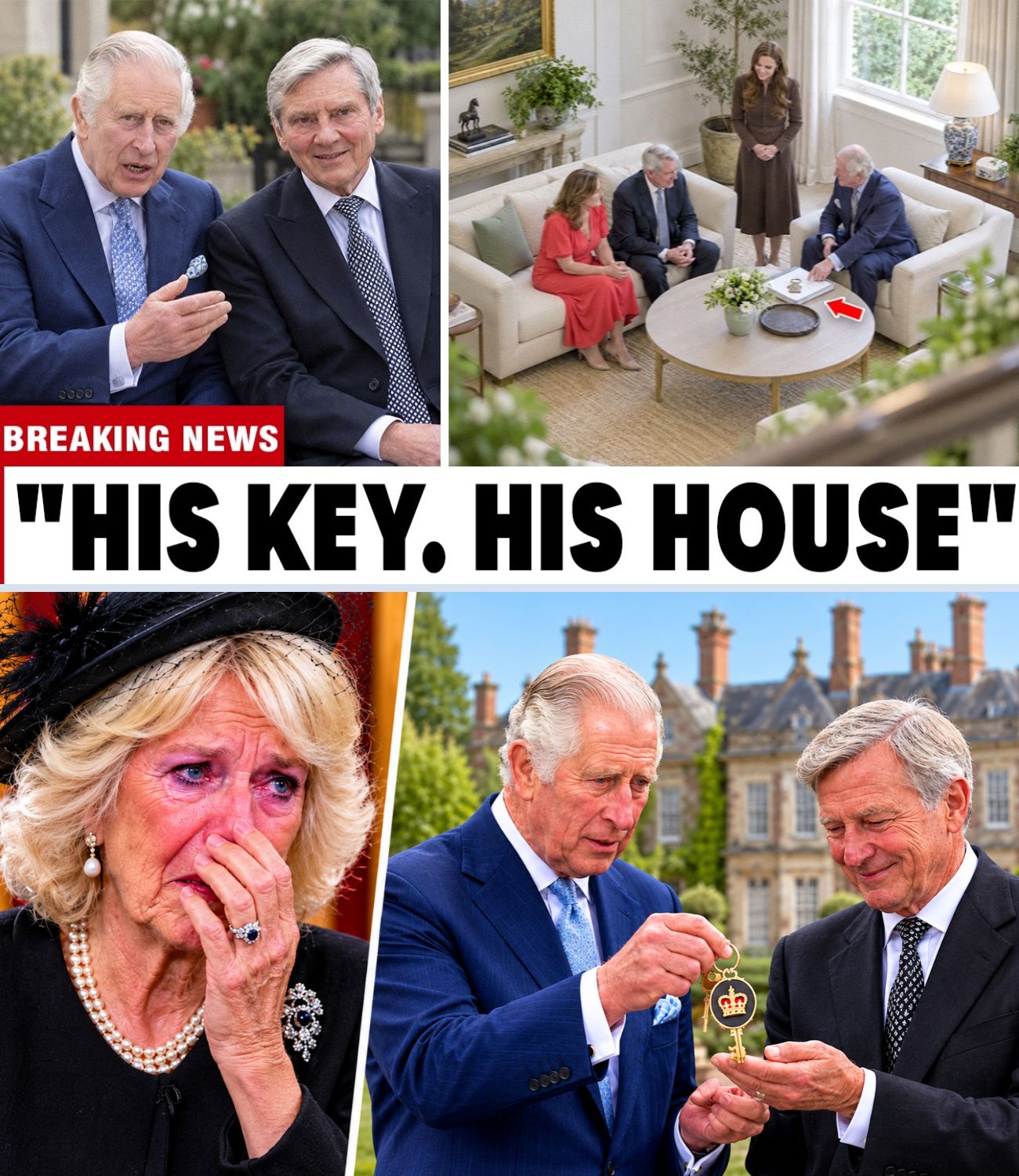
In the hallway, the King reached into his coat pocket and pulled out a single, heavy iron key attached to a plain brass tag stamped with the property’s name. He handed it directly to Michael.
According to those present, the exchange was remarkably informal. Charles thanked them both, expressed his hope that they would find peace and happiness within the Norfolk retreat, and added a warm invitation. Michael, breaking the heavy tension with characteristic understated humour, joked that he hoped the King would drop by for a cup of tea sometime soon. Charles reportedly laughed out loud, assuring him that he most certainly would.
Prince William and Catherine were deliberately absent from the handover. Both had insisted that the moment must remain entirely separate from the Wales household, ensuring nobody could spin a narrative that the future Prince and Princess had engineered a property grant for their own family. It was the King’s decision, executed by the King’s own hands.
A New Legal Precedent and the Future
In the weeks following the handover, the estate’s legal team in King’s Lynn formalised the arrangement into a strict legal document: a formal license to occupy.
The terms were crystal clear. The property was granted for the joint lifetimes of Michael and Carole Middleton, with zero rent payable. Day-to-day maintenance fell to the occupants, while major structural upkeep remained the responsibility of the estate. Crucially, at the King’s explicit insistence, an additional clause was inserted into the legal text: the license was strictly non-transferable and could not be assigned to any wider member of the Middleton family. Wolferton was for Michael and Carole alone; it would never become a hereditary family asset.
Meanwhile, the ripple effects across the royal households were immediate and permanent. Camilla’s private office issued a formal, quiet notification to the Sandringham estate administration confirming that no further housing or long-term property requests would ever be submitted on behalf of the Queen’s family. The chapter was closed. A twenty-year precedent of quiet accommodation requests was ended with the stroke of a pen.
Yet, the final twist of the administrative file lies not in the past, but far into the future.
On the master ledger of the Sandringham estate—the vast digital and physical registry tracking every cottage, farm, and manor on royal soil—every property features a field at the bottom marked Next occupant to be decided by. For almost every single building on the estate, that field reads simply Estate manager.
For the Keeper’s House at Wolferton, however, Charles ordered that field to be permanently altered. It now reads: The Sovereign personally.
This crucial amendment ensures that when the Middletons’ lifetime license eventually concludes, the property will never fall back into the routine bureaucracy of estate management, nor will it be open to lobbying from competing palace factions. The decision will rest entirely with the reigning monarch of the day.
And because the license runs for the lifetime of Michael and Carole, by the time those keys are handed back, the monarch occupying the throne will almost certainly be William.
As the buff-coloured folder rests securely in the locked cabinet behind the estate manager’s desk—containing three rejected Clarence House letters, one allocation note penned in dark blue ink, and a signed license to occupy—one final, empty line sits at the very bottom of the register page, awaiting a name that has not yet been written.
The key has found its owner. But the story of Wolferton’s future remains unwritten, waiting for the day a new King takes up the pen.
You Might Also Enjoy

“We Thought They Would Negotiate”—What Argentine Soldiers Said When The British Attacked Goose Green

“You’ll Never Finish My Ruck March, Limey” — US Sergeant Who Challenged the SAS, Then Fell Out First






