“I Don’t Need Your Permission.” — The SAS Major Who Ran the Raids US Command Refused to Approve.
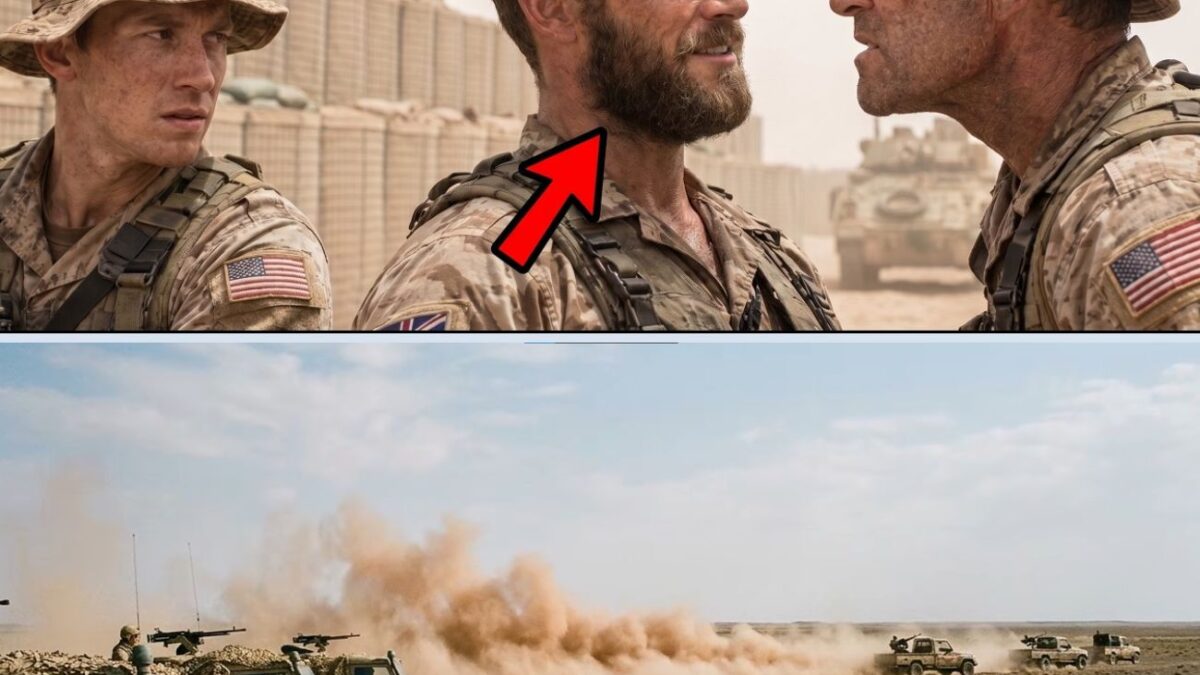
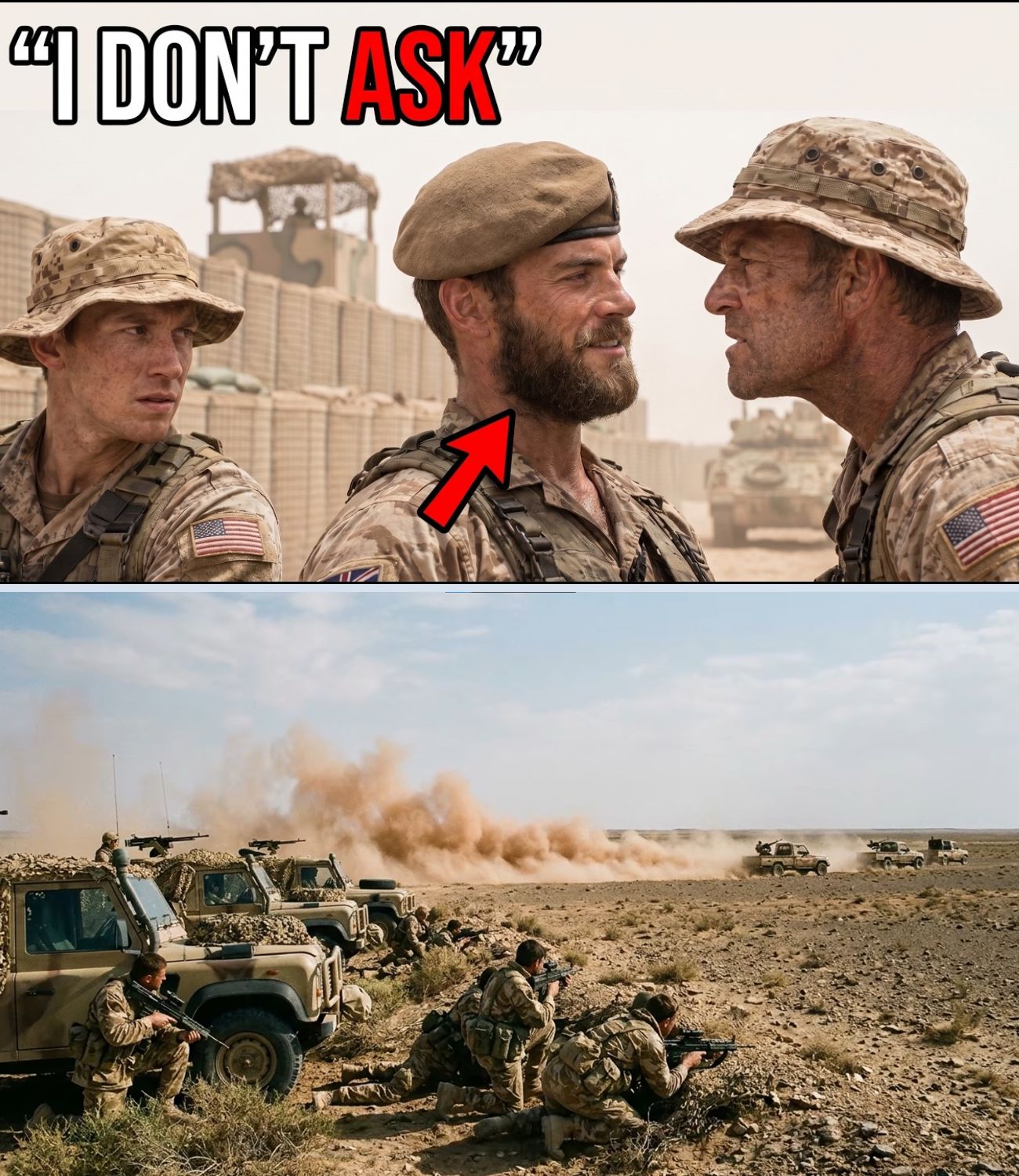
24 March 2003, a stretch of Highway 10 west of Arutba in the flat scrub land running toward the Jordanian border. Four Land Rover Wiks are parked nose totail in a shallow wadi engines off camouflage nets half thrown over the generalpurpose machine guns mounted on their rear pints. A major crouches at the lead vehicle’s open door with a gritted 1 to 250,000 map spread across his knee and a taxat handset pressed to his ear.
40 minutes earlier, his patrol tracked a mobile missile launcher and its escort vehicles into a compound 11 km north. The launcher will not sit still until morning. The handset gives him only static and a promise that clearance is still being worked.
The major’s name, for the purposes of this account, was Alistister Renwick, officer commanding a Squadron 22 Special Air Service. And by the third week of the invasion of Iraq, he had already spent 11 days deep inside the western desert with four fighting columns under his command, hunting exactly the kind of target sitting in that compound. Under him rode 16 men split across the vehicles. A troop sergeant who had served with the regiment since the late Cold War years. A young signaler barely two years into the squadron who carried the burst transmission set strapped across his chest like a second rib cage. A medic whose kit bag held more morphine auto injectors than field dressings because everyone understood what kind of wounds a desert firefight produced. And a fitter, a corporal known to the squadron only by his trade rather than any nickname preserved in the record, whose job it was to keep four vehicles running on roads that were barely roads at all.
The squadron’s mission traced its logic back to a lesson learned 12 years earlier in the winter of 1991 when SAS patrols under General Pito Deabilier’s command had gone hunting Scud launchers along these same western roads, working inside a coalition led by General Norman Schwarzoff’s headquarters in Riyad and had discovered then that the launchers moved faster than any coalition targeting cell above patrol level could authorize a strike against them.
That earlier campaign had ended with the launchers largely uncaught and the SAS’s own leadership frustrated at how often a confirmed sighting evaporated into an empty patch of desert by the time clearance came through. The frustration was real. Case file 19, page 176, covers that same 1991 hunt for mobile Scud launchers. The patrol known as Bravo 20 dropped into that same stretch of desert 2003.
The vehicles were faster, the launchers better hidden under camouflage netting improved since the previous war, and the chain of command, if anything, more layered rather than less because the coalition now fielded a joint special operations structure built specifically to prevent the fratricside incidents that had scarred the 1991 war’s closing days.
Renwick answered to his own national command, the permanent joint headquarters at Northwood and the Directorate of Special Forces in London, who had cleared British special forces for exactly this kind of deep self-directed strike role in the days before the ground invasion began, understanding that mobile targets could not wait on distant approval.
That authorization had itself been the product of weeks of argument inside the British system between officers who wanted every patrol level engagement individually sanctioned from London and officers who argued successfully in the end that a headquarters six time zones removed from a moving vehicle could never react fast enough to matter.
The compromise reached gave squadron commanders standing authority within defined categories of target, mobile missile launchers, chief among them, provided each engagement was reported promptly rather than requested in advance. A structure built specifically around the recognition that speed and formal signoff were in this kind of war frequently incompatible.
But the ground he was standing on belonged to the American coalition’s area of operations, and any strike inside it that used coalition air, coalition deconliction airspace, or coalition targeting data was supposed to run through a joint approval cell built and staffed largely by the United States. One node among several in a structure meant to keep fastmoving forces from firing on each other in the confusion of a war advancing faster than its own paperwork.
That cell sat 240 miles away at a headquarters coordinating special operations across the whole of western Iraq. And the officer who ran its targeting desk that week was an American, a Lieutenant Colonel we will call Dale Kesler for the purposes of this account. A career special operations planner who had spent the run-up to the invasion building exactly the kind of careful layered approval process his commanders had asked for.
Kesler was not a fool and not an obstructionist. He had watched fratricside reports from the first days of the ground war, watched aircraft mistakenly engage friendly vehicles in the confusion of a fast-moving front near Naseria and elsewhere. And he believed reasonably that any strike inside his sector needed his desk signoff before triggers were pulled.
The trouble was that his desk was one node in a chain that ran through three time zones worth of watch officers. And Renwick’s mobile targets did not wait for paperwork. The compound Renwick’s patrol had found was a low collection of outbuildings around a walled yard. The kind of site that could hide a launcher for 6 hours and be empty by dawn.
His patrol had first picked up the convoy’s dust trail 2 days earlier near a road junction his signaler had marked only as crossroad delta on the patrol’s own working chart. A name invented for the mission and never appearing on any published map. They had followed at a careful distance, running dry on diesel twice, patching a cracked fuel line with tape and a spare hose clamp scavenged from the second vehicle’s tool roll, losing nearly 4 hours to repairs in ground that offered no cover from anything larger than a man lying flat.
Renwick had joined the SAS in the late 1980s after service in an infantry regiment. And colleagues who served with him described, as one such account has it, a man who kept his voice low in an argument and his boots clean in barracks. A details man who nonetheless volunteered for the riskiest attachments the regiment offered.
He had spent the buildup to the invasion helping plan the squadron’s crossber insertion. Four vehicle fighting columns pushing deep into Iraqi territory ahead of the main coalition advance, refueling from cached fuel bladders, running on rationed water, and reporting back by burst radio transmission on a schedule so tight that a missed check-in triggered contingency planning at the rear headquarters within the hour.
The first hard problem had come on day three when the lead Wikk’s gearbox began slipping on the soft ground west of the highway, forcing the squadron’s fitter to strip the transfer case at night with a torch clenched in his teeth and no cover from observation but the dark itself. The repair held, but it cost 6 hours of movement time.
And 6 hours in that terrain was the difference between intercepting a convoy and losing it. The troop sergeant, watching the repair from a prone position 20 meters out with his rifle across his forearms, later told a training audience, in an account passed down rather than transcribed verbatim, that the worst part of those 6 hours was not the risk of discovery, but the stillness, the fact that a moving vehicle at least felt like progress, and a broken one felt like waiting to be found.
The second problem arrived the following day as an Iraqi Army patrol, three technical vehicles mounting heavy machine guns, crossed within 800 meters of the patrol’s harbor position. Close enough that Renwick ordered every man flat and silent for 40 minutes rather than risk a firefight that would announce four vehicles presence to every unit in the sector.
The technicals passed without stopping. Nobody moved until the dust of their passage had settled fully into the horizon.
A third problem, less discussed afterward, but recorded in the squadron’s own signals log, came on day five when a coalition strike aircraft operating well outside its assigned corridor passed low over the patrol’s position at dusk, close enough that the gunners on two vehicles instinctively swung their weapons skyward before recognizing the aircraft’s markings in the last of the light.
For perhaps four seconds, by the signaler’s own later estimate, nobody in the patrol knew whether the aircraft had seen them or whether it would circle back with cannon fire against what its own sensors might read as an unidentified armed convoy in hostile territory. No shots were fired. But the incident rattled Renwick more than he let on to his men because it demonstrated precisely the risk Kesler’s cell existed to prevent.
Coalition assets and coalition special forces occupying the same darkening sky with only a loose deconliction plan between them. Renwick radioed a report of the near miss that night. And it was that report more than any abstract policy that Kesler’s cell would later point to when explaining why the sector’s clearance procedures could not simply be waved through on request.
Overload was its own quiet danger. Each WMK carried beyond its crew and weapons roughly 400 L of fuel spread across juracans lashed to every available rail. Spare ammunition for the GPMGs stacked in crates wedged between the seats, water rations and demolition stores for a contingency the patrol hoped never to use.
The added weight pressed the vehicle’s suspension close to its working limit on ground that alternated between hardpacked gravel and soft windblown sand. And on day four, the second vehicle’s rear axle began to complain under the load. A grinding note the fitter diagnosed as a bearing working loose rather than failing outright.
Renwick ordered an immediate redistribution, shifting two fuel cans and a crate of link ammunition onto the lead vehicle, buying the axle another week of running at the cost of making the lead vehicle noticeably harder to handle on the shaml scoured tracks that followed. It was the kind of unglamorous arithmetic, weight against range against speed, that decided more of the patrol’s fate than any single firefight.
The coalition’s own internal boundaries added a further complication that had nothing to do with the enemy at all. The sector Renwick’s patrol operated in was divided on paper into blocks assigned to different friendly units to prevent exactly the kind of blue-on-blue confusion that had already scarred the war’s opening days.
And Renwick’s compound sat close enough to a boundary line that a careless approach from the wrong angle risked putting his own patrol inside another unit’s assigned block without that unit’s knowledge.
Renwick’s signaler spent close to an hour on day 9 cross-checking grid references against the boundary as briefed before the deployment, a boundary that had shifted once already days earlier without every patrol in the sector receiving the update at the same time. To make certain the compound and the approach route both sat unambiguously beyond any reasonable doubt inside ground his patrol was already cleared to operate in. Only once that was settled did the question of the coalition targeting cell’s separate clearance even become the live issue it was.
Each vehicle carried four 20 L jerkans calculated against a ration of roughly 4 L per man per day in daytime desert heat that regularly touched 40° C. And by day six, the squadron’s water state had dropped below what the resupply plan assumed, forcing Renwick to cut the ration and reroute one vehicle briefly toward a pre-arranged cache rather than press on toward the target.
A signaler’s log entry from that stretch of the operation records a single line, a request logged almost as an afterthought: “More water, next drop, if possible.” It reads now as the plainest sentence in the whole account. And at the time, it represented a genuine risk calculation about how much longer four vehicles could function before dehydration began affecting judgment and reaction time.
The medic, checking each man’s color and pulse at the evening halt, flagged two soldiers as borderline heat affected, though neither was pulled from the patrol.
Then came the dust. On day seven, a shaml blew in from the northwest, cutting visibility to under 100 meters and grounding the reconnaissance aircraft the patrol had been using for early warning of Iraqi movement.
Renwick’s column pushed on regardless, navigating by compass bearing and odometer reading in conditions where a wrong turn could put four vehicles inside a minefield nobody had mapped or inside range of an artillery battery nobody had located.
The storm lifted after 11 hours, and when it did, Renick’s patrol found itself far enough off its planned track that reestablishing exact position took another 90 minutes of careful, silent map work before movement could resume.
The signaler, who had navigated blind through the worst of the storm using dead reckoning alone, later called it the longest 90 minutes of the whole deployment, worse even than the firefight that followed days later, because at least a firefight ended quickly.
By day nine, the pattern the compound now represented had become clear enough to worry the whole regional command. Convoys matching the launcher’s signature had been cited, lost, and recited three times along a rough loop of road running past two villages Renwick’s patrol never named precisely in surviving records, referring to them instead by grid reference alone, a habit that protected the anonymity of anyone in those villages who may or may not have passed word of Iraqi troop movements to the patrol in exchange for nothing more than the promise that their name would never appear on a British radio net.
One local contact, according to one account passed down through the squadron afterward, offered directions to a safer approach track in exchange only for a promise that the patrol would not linger near his home longer than necessary. A small transaction that nonetheless carried real risk for a man who had a family sleeping under that roof.
Renwick kept that promise to the letter, moving his vehicles on within the hour rather than the half day his planners had originally allotted for the approach.
The compromise of movement grew worse as the patrol closed on the target. Twice in two days, the signaler intercepted fragments of Iraqi military radio traffic that suggested without confirming that a foreign vehicle presence had been reported somewhere in the district.
Though never with enough precision to say whether the report concerned Renwick’s own column or another patrol working a parallel sector 30 km east. Renwick treated every fragment as if it referred to him, altering his harbor position each night and varying his approach routes, even at the cost of extra fuel burn his tight diesel state could barely absorb.
The 10th day brought the problem that mattered most. A coalition intelligence cell picked up radio traffic, suggesting the launcher convoy intended to displace before first light the following morning, moving to a new site that would cost the hunting patrols another four or 5 days to relocate.
Days the campaign’s air planners did not want to spend. Renwick’s patrol was the only asset within reach with eyes on the actual compound. Every other reconnaissance or strike asset in the sector was tasked elsewhere or grounded by the storm’s aftermath. The decision facing Renwick was not whether the target mattered. It was whether he could get authorization to hit it before it moved.
This is where the command structure that had seemed like background detail for 9 days became the entire story. Renwick’s own national chain through the British special forces headquarters element attached to the coalition effort had already authorized offensive action by his patrol against targets of this category.
Understanding that the fast-moving nature of mobile missile hunting made case-by-case signoff for every engagement impractical. But Kesler’s joint targeting cell operating under the coalition’s own more cautious rules for that sector following the fratricside incidents of the war’s first days and mindful of the near miss Renwick himself had reported 5 days earlier wanted a formal clearance cycle completed before any strike.
A cycle that in practice took between 4 and 11 hours depending on how many other requests were cued ahead of it that night. Renwick radioed his request at 2140 local time. The reply, with much the same mission and far worse luck—laid through two intermediate headquarters before it reached his handset—told him only that the request was logged and under review.
He radioed again at 2310. The answer was the same. By midnight, his signaler estimated based on prior traffic patterns that a formal clearance was unlikely to arrive before 0400, by which point, if the intercepted traffic was accurate, the launcher convoy would already be moving.
Renwick’s dilemma had nothing to do with defying anyone. His national command had given him standing authority to engage targets of exactly this kind inside the parameters already set for his patrol. What Kesler’s cell was withholding was not legal permission, but coalition airspace and asset deconliction, the assurance that no other coalition aircraft or unit would mistake his patrol’s muzzle flashes for enemy fire in the dark, the very risk that had rattled him five nights before.
Renwick weighed that risk against the near certainty of losing a validated target he had spent 9 days and half his squadron’s water ration confirming, running the arithmetic the way he had been taught to run it, not as a question of what the regulations technically permitted, but as a question of what he could stand behind in writing with his own name attached if a board of inquiry asked him about it a year later.
He gathered his troop sergeant and signaler at the lead vehicle and laid out the calculation plainly. No coalition aircraft were tasked anywhere near their position that night according to the last airspace picture they held. No other coalition ground unit was within 20 km by any account they had received, and the compound itself sat isolated enough that a 6-minute engagement was unlikely to draw in anything from outside before it was finished.
The sergeant’s only question, according to an account later relayed to a training audience, was whether Renwick was certain enough to put his own name against the decision rather than simply blaming the delay afterward. Renwick said he was.
At 055 on the 11th day, Renwick made the call his own chain of command had in effect already authorized him to make. He informed his higher headquarters by burst transmission that his patrol was moving to engage, gave a 10-minute window for anyone to object, and when no order countermanding him arrived in that window, he took his four vehicles forward.
The compound’s approach was mined with the kind of luck that gets remembered for decades afterward. A single dry wadi bed offering enough cover for the WMKs to close to 400 meters before the first burst of gimpy fire tore into the parked vehicles inside the walled yard.
The engagement lasted under 6 minutes. Two escort vehicles burned. The launcher itself, according to the afteraction photography taken by Renwick’s own patrol at first light, was struck twice and rendered unusable, its crew having scattered into the dark before the second vehicle’s fire even reached them.
Inside the six minutes of the engagement itself, the medic’s role was almost entirely passive, a fact he later described, according to one account relayed to a training class, as the strangest part of the whole night. He crouched behind the third vehicle with his kit open and ready, watching tracer fire cross the yard in both directions, aware that if anyone on his side went down in that compound, the response window would be measured in seconds rather than minutes, given how far they were from any hospital.
Nobody did. The two escort vehicles that belonged to the Iraqi side alone burned, and when the patrol’s own headcount was called at the far tree line, all 16 men answered. The medic packed his kit away unopened, a detail that meant more to him afterward by his own account than almost anything else that happened that night. More than the tracer fire, more than the burning vehicles, more even than the long, watchful drive south that followed.
Extraction afterward was its own narrow margin. Renwick pushed his four vehicles south at speed for 11 km before allowing a halt, aware that any surviving escort troops might call in reinforcements from a garrison town known to sit roughly 40 minutes drive to the northeast.
The patrol’s water state, already thin before the engagement, left almost nothing in reserve for a prolonged pursuit, and Renwick’s plan for that contingency amounted to little more than running until the fuel or the light gave out, whichever came first.
Neither did. No pursuit materialized. And by 0400, the hour Kesler’s clearance had originally been projected to arrive, Renwick’s patrol was already 30 km clear of the compound, harbored up and running a headcount. No coalition aircraft strayed near the engagement. No friendly unit was within 20 km.
The clearance Kesler’s cell had been withholding turned out in the event to have protected against a risk that never materialized, because Renwick’s own reconnaissance had already established through 9 days of patient observation that the airspace and ground around that compound was clear of anything but the enemy he intended to hit. What the delay had actually risked was the target itself slipping away into open desert with a full night’s head start.
Word of the engagement reached the rear headquarters before Renwick’s patrol did, carried by the same burst transmission channel that had announced the intent to move in the first place. And by the time the four vehicles rolled into the forward assembly area 2 days later, the operation staff already had a rough shape of what had happened, even without the formal report in hand.
A watch officer on duty that night recalled logging the initial contact report at 0102, 6 minutes after the engagement began, and then waiting through the rest of his shift for the follow-up that would confirm whether the strike had succeeded, whether anyone had been hurt, and whether the coalition cell’s absent clearance was going to become a genuine problem for anyone’s career.
The follow-up came at 0640, delayed by the patrol’s own decision to run clear of the area before risking a lengthy transmission, and it read in its entirety as a single confirmation line: “Target destroyed, patrol intact, moving to harbor.”
The debrief that followed 3 days later at the rear headquarters was recorded in careful procedural language, the kind military bureaucracies use when they mean something sharper than the words on the page. Kesler’s cell noted that the engagement had proceeded outside the coalition’s established clearance window. Renwick’s own report noted with equal precision that his patrol had acted under standing national authorization, that the delay in coalition deconliction had created an unacceptable risk of losing a validated target, and that no coalition asset had in fact been endangered by the action taken.
A staff officer present at the debrief recalled, as one such account goes, that the room fell quiet for a long moment after Renwick finished reading his report aloud, the kind of quiet that comes when everyone in a room understands that a smaller organization just proved a bigger one’s caution had cost something real.
There was no reprimand. There could not easily be one since Renwick had broken no order his own command had given him. What there was instead was a quieter and more lasting shift in how the joint cell treated British patrols operating under that same dual authority for the remainder of the campaign. Deconliction requests from Renwick’s squadron began moving through the queue measurably faster in the following weeks, a change no memorandum ever formally announced, but that every signaler in the squadron noticed within days of the crossroad action, with the average turnaround falling from something close to 6 hours to well under two.
Kesler himself, according to officers who worked alongside him afterward, never spoke of the incident as a personal defeat, framing it instead in later briefings as the reason his cell adjusted its own internal priority system for mobile target requests, a change that likely saved lives in engagements neither Renwick nor Kesler were present for, and one that neither man in later years was especially eager to claim sole credit for.
A fortnight after the crossroad engagement, Renwick and Kesler met in person for the first time at a coordination conference held at a forward headquarters set up in a requisitioned airfield building south of the main advance. Accounts of the exchange vary in their exact wording, as such secondhand accounts often do, but officers present agree on its substance.
Kesler reportedly opened by asking without much warmth: “Do you intend to make a habit of moving before my cell’s clearance comes through?”
Renwick answered: “I moved only once my own national authorization and my own reconnaissance told me the ground was clear, and I would rather explain a successful engagement afterward than explain an empty compound.”
Kesler went quiet for a moment, then asked a more practical question: “How much warning in future can your patrols realistically give before acting inside a similar window?”
The conversation that followed, described by one witness as business-like rather than warm, produced an informal understanding between the two men’s staffs that lasted the remainder of the campaign, an arrangement built on exactly the kind of quiet unwritten compromise that rarely appears in any official history, but that quietly shaped how dozens of later engagements were actually conducted on the ground.
The wider campaign took note in its own way. Two further launcher sites were struck by SAS patrols in the following 10 days using the same pattern, national authorization exercised at patrol level with coalition deconliction requested but not always waited for beyond a defined window. A compromise that neither side ever wrote into formal doctrine but that both sides in practice adopted.
A brigadier overseeing the coalition’s special operations component reportedly remarked in a private conversation recalled years later by a subordinate that the arrangement was not one he would have designed on paper, but that he could not argue with what it produced on the ground, a grudging line of praise delivered without much warmth, but delivered nonetheless.
One of those two follow-on engagements struck 9 days after the crossroad action ran into almost the identical clock. Renwick’s second troop operating under a captain rather than under Renwick himself had tracked a separate launcher convoy toward a wadi crossing roughly 60 km further west. And again, the window between confirmed sighting and probable displacement ran shorter than the coalition clearance cycle could reliably match.
The captain, working from the precedent Renwick had already set and the informal understanding Renwick and Kesler had since reached, gave his own 10-minute window before acting, a habit that by then had effectively become unwritten squadron procedure rather than a one-off decision made under pressure. The engagement destroyed a second launcher and notably drew no formal comment at all from Kesler’s cell afterward, a silence that squadron officers came to read as its own kind of endorsement.
The pattern was not unique to 2003, and men who had served in the 1991 war recognized it instantly when younger soldiers described the crossroad action to them afterward. In the earlier war, SAS fighting columns operating deep inside Iraq under General Debilier’s overall direction had likewise found that a coalition structure built around caution and centralized control, however sensible in principle, moved slower than a mobile launcher engine.
Veterans of that earlier campaign, consulted informally by instructors preparing the crossroad action as a teaching case, pointed out that the tension between a small, fast-moving national force and a larger coalition’s approval machinery was not a flaw unique to any one headquarters or any one officer, but something close to a structural constant whenever a small special forces element operated inside someone else’s larger and more riskaverse chain of command.
The lesson the regiment drew from placing the two campaigns side by side was not that the Americans were wrong to be cautious, but that caution built for an army’s pace could not always be stretched to cover a four vehicle patrols pace without someone eventually choosing to act inside the gap.
Higher up the coalition’s chain, the friction registered mostly as irritation rather than alarm. A senior American general overseeing special operations across the whole theater is said in accounts that reached the regiment only secondhand and years later to have asked pointedly during one briefing why a British squadron seemed able to move faster than his own clearance architecture allowed, a question that carried more frustration than curiosity at the time it was asked.
Nobody in the room, according to the same secondhand account, offered him a clean answer because the honest one that the smaller organization was simply better positioned to accept risk on its own authority and to live with the consequences of a single wrong call was not the kind of answer any large coalition headquarters found comfortable to hear about itself.
Instructors teaching the regiment’s selection and continuation courses in the years that followed used the Rutupba engagement, referred to internally simply as the crossroad action, as a case study in the difference between insubordination and initiative exercised inside a genuinely ambiguous chain of command, a distinction the regiment’s training staff considered important enough to preserve in lecture notes still used in modified form more than a decade later long after Renwick himself had left the squadron for a staff appointment.
Junior officers working through that case study were asked a single question at the end of each session: “What would you have done with a 10-minute window and no order either way?” Few answers, instructors noted, matched the confidence of the one Renwick actually gave.
The case study’s use did not stop at the regiment’s own gates. Officers who rotated through liaison postings at the joint special operations school carried a version of the same lecture with them, stripped of names and precise dates, but keeping the essential shape of the dilemma intact and taught it as an example of the gap that will always exist between a coalition’s need for centralized control and a small unit’s need to act on a clock the center cannot always match.
One instructor addressing a mixed class of British and American officers some years after the invasion is said to have summarized the lesson in a single line that stuck with several students long enough to be repeated afterward in their own notes: “Authority tells you what you are allowed to do and the ground tells you how much time you actually have to do it and the two clocks do not always agree.”
What made the crossroad action useful as teaching material rather than merely a good story was precisely its lack of drama in the retelling. Renwick had not disobeyed an order. He had not gambled recklessly against long odds. He had exhausted the ordinary channel to the point where the channel itself had effectively run out of time to answer, and he had acted inside authority his own command had already granted him for exactly this situation, informing his superiors of his intent and giving them a real, if narrow, chance to stop him before he moved.
The instructors who taught the case afterward were careful to draw that line precisely because the same story told slightly differently with the details blurred could just as easily become an excuse for someone with far less justification to act first and explain later. Renwick’s own conduct in the weeks that followed, meticulous in his reporting and entirely unwilling to discuss the episode as anything other than a normal part of the job, reinforced rather than undercut the lesson.
The squadron’s own afteraction paperwork filed in the days following the engagement is notable mostly for how little space it gives to the command friction that later made the episode worth remembering at all. Most of the report concerns fuel consumption, ammunition expenditure, the condition of the vehicles, and a short paragraph recommending that future patrols carry an additional spare bearing for the axle assembly given the strain the loaded WMKs had shown under sustained cross-country movement.
The section addressing the clearance delay runs to barely four sentences written in the flat procedural tone standard to such reports, stating simply that national authorization had been exercised, that coalition deconliction had been requested but not received within an operationally useful window, and that the squadron recommended the sector’s clearance procedures be reviewed for engagements involving time-sensitive mobile targets.
It was a request rather than a complaint, and it was in the following months at least partially acted upon.
Renwick’s own troop sergeant, asked years afterward by a junior officer compiling material for the regiment’s internal training archive what he remembered most clearly about that night, did not describe the firefight at all. He described instead the 10 minutes after Renwick sent the burst transmission announcing the patrol’s intent to move, the 10 minutes during which any of several headquarters up the chain could have sent a single word back countermanding the decision and did not.
He remembered watching Renwick check his watch twice in that long quiet window, not with any visible anxiety, but with the flat attentiveness of a man doing arithmetic that mattered. When the 10 minutes ended without a countermand, Renwick folded the map back along its existing creases, tucked it into the map case on his chest rig, and gave the order to mount up, in a voice, the sergeant recalled, no different from the one he used to call a routine halt.
Renwick himself gave almost nothing away in the years afterward, declining, according to colleagues, to discuss the specific engagement in any public setting, in keeping with a service culture that treats operational detail as something owed to the men who were there and to nobody else.
What survives instead is procedural. The map fragment from that night, later handed to the regimental archive, still creased along the fold line where it sat on a major’s knee, while a radio handset delivered nothing but static and a promise that clearance was still being worked. The launcher itself was later confirmed destroyed beyond recovery, its wreckage photographed and left where it lay, a single scorched hull in a walled yard 11 km north of a crossroads that never had an official name.
Years later, when a defense journalist working on a wider history of the campaign asked a former officer who had served alongside Renwick what the crossroad action actually proved, the officer reportedly gave an answer shorter than the question deserved: “It proved nothing about who was right. Only that two different organizations built for two different clocks had been asked to share the same 6 minutes of darkness and that the one built to move faster had moved.”
The map fragment, the burst transmission log, and the four sentence paragraph buried inside an otherwise unremarkable afteraction report remain in the regimental archive, the only official record that anything unusual happened that night at all, three ordinary-looking documents standing in for six minutes that neither headquarters in the end ever managed to fully explain.
You Might Also Enjoy

“We Thought They Would Negotiate”—What Argentine Soldiers Said When The British Attacked Goose Green

“You’ll Never Finish My Ruck March, Limey” — US Sergeant Who Challenged the SAS, Then Fell Out First






