“It’s Already Done” — The SAS Raid That Made a $100M US Assault Plan Look Stupid.
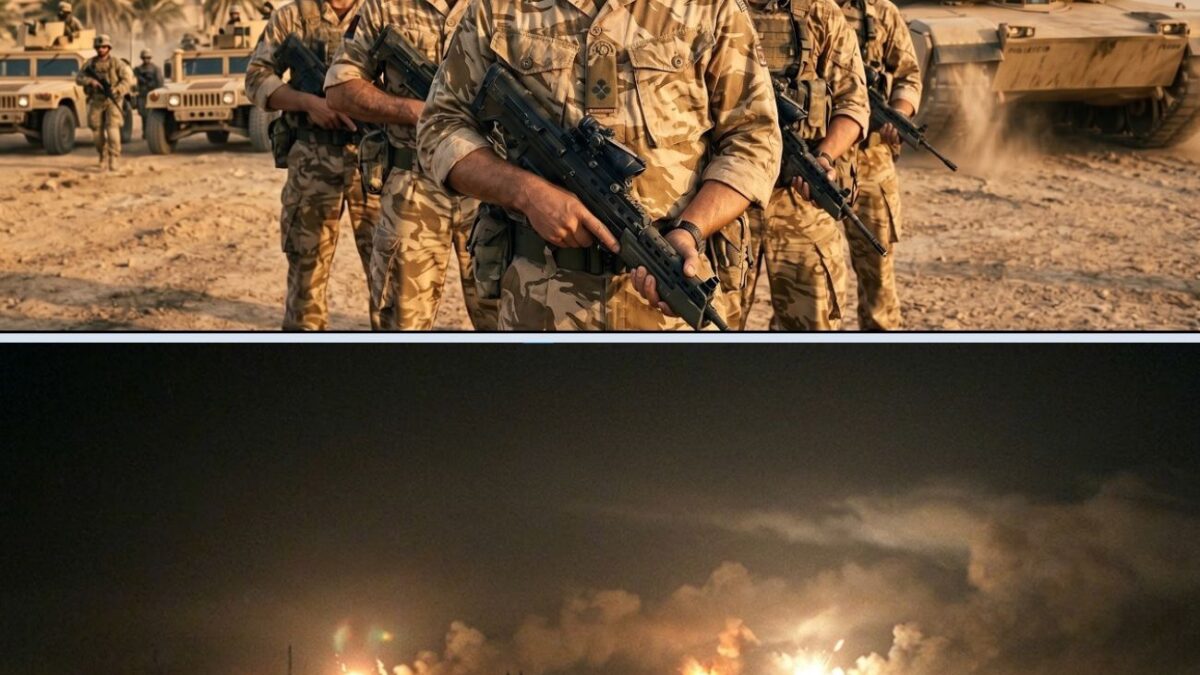
Western Iraq. A little after 4 in the morning on the 23rd of March, 2003, a stony plain 40 kilometres from the Syrian border, no moon, and a wind that had been rising for an hour.
Four Land Rovers sit in a line with their engines off. 13 men lie in the grit beside them.
Three kilometres ahead, a red aviation light blinks on top of a steel mast, and under it is a radar and communications compound with a fuel depot and a dirt strip cut straight across the hard pan.
The signaller, a corporal whose name for the purposes of this account was Price, has the handset pressed to his ear and a notebook open on his knee.
More than a thousand kilometres behind them, in a tented operations room, American planners are finishing a briefing slide. The slide describes how this exact compound will be taken in three days with strike aircraft, gunships, helicopters, and a company of Rangers.
Nobody in that room knows the 13 men are lying in front of the mast. Price writes down the time. Beside it, in pencil, he writes a single short sentence to be sent only when there is something to send. The sentence was not in any procedure. It was the one that would empty a room in Qatar.
To understand how it got there, you have to go back nine days to a squadron lines at Credenhill in Herefordshire where a major with a bad cough was handed a problem that nobody else wanted. His name, for the purposes of this account, was Major Ashworth, and he commanded a Sabre squadron of 22 Special Air Service Regiment.
In the first week of March, the regiment had been told what everyone had expected since the autumn. When the invasion of Iraq began, British special forces would take a piece of the western desert.
It was an enormous wedge of nothing between the Jordanian border, the Syrian border, and the long ribbon of Highway 10 that ran east from the border post at Trebil toward Baghdad.
On a map, it looked empty. It was not empty. It was the one place from which Saddam Hussein could still launch Scud-type missiles at Israel and the road through which Iraqi units might slip toward Jordan or Syria.
Coalition aircraft would fly over it for weeks, but aircraft cannot tell you what a man in a Toyota truck is carrying under a tarpaulin.
The memory of 1991 hung over all of it. 12 years earlier in the first Gulf conflict, the Scud hunt in this same desert had been one of the most stubborn and politically sensitive problems of the air campaign.
The missiles kept coming. The coalition flew well over a thousand sorties against them, and Israeli families sat in sealed rooms and gas masks. Many later credited the small groups of men on the ground who lay in the sand and looked with doing what the aircraft could not.
Ashworth knew that history. He had been a young officer in the regiment then when Bravo Two Zero and the other patrols went into that same country, and he had come back with two firm opinions.
One was that small parties could do things large formations could not. The other was that large formations, given the choice, would always rather plan than ask.
That was exactly what was about to happen. The planning was being done in Qatar in a sprawling headquarters of air-conditioned tents and shipping containers where hundreds of officers worked in shifts around the clock.
The western desert had been broken into numbered objectives, and one of them, a radar and relay site on the Highway 10 corridor, had come to the front of the queue.
Signals intelligence said the compound was a node in the Iraqi air defence network and a possible staging post for mobile missile launchers. Overhead imagery showed a steel mast, a perimeter berm, 11 buildings, a fuel dump, and a dirt strip that a Hercules could use in a pinch.
In the plan, it was called Objective Anvil. The man who owned that plan was a US Air Force colonel. For the purposes of this account, he was Colonel Mayhew, and he was not a fool.
He had a staff of 40. He answered to generals who would be furious if anything went wrong, and merely quiet if nothing happened at all. And he had been told in unambiguous terms that a compound of this size was not to be approached lightly.
So he built something proportionate to the fear. The Anvil package, as it stood on the 13th of March, called for a strike by heavy aircraft, a second wave of fighter aircraft to suppress anything that moved, an AC-130 gunship overhead, a pair of Apache attack helicopters, and a company of Rangers lifted in by Chinook after a 36-hour weather and intelligence window.
It needed tanker tracks, a forward fuel point, medical evacuation cover, and a combat search and rescue alert.
Mayhew’s logistics officer, a lieutenant colonel who kept a calculator on his desk and used it, added up the aircraft hours, the munitions, the fuel, and the crews, and arrived at a figure that one staff officer later described with a casual exaggeration of tired men as a hundred million for a radio site in the desert.
Nobody ever produced an invoice. By one informal account, that was the figure on the whiteboard, and the number stuck because it sounded about right and because it was the kind of number that made people careful.
Ashworth was shown the plan on the 14th by a liaison officer, an American major whom we can call Major Callaway. She had flown in the night before. She was polite, and she had the look of someone who had been told to be diplomatic.
“We’d like to deconflict your patrols from the Anvil strike box,” she told him. “Colonel Mayhew’s concern is that if your people are anywhere near the objective when the first wave goes in, they will not be near it.”
“They will be in it,” Ashworth said.
She waited. He did not elaborate. She wrote something down.
Later that night, Ashworth sat on an ammunition box with his troop commander and unfolded the map. The troop commander was a captain, 34 years old, a former Royal Engineer with a slow way of speaking. For the purposes of this account, he was Captain Hollis.
He read the objective grid twice. He looked at the date on the American slide, which was the 26th. He looked at the map again.
“Is there a reason why it can’t be done sooner?” Hollis asked.
“Several,” Ashworth said. “All of them are in Qatar.”
That was how the reasons stacked up. The plan needed air assets, and the air assets were tied up with the opening of the campaign. It needed a Ranger company, and the Rangers were committed to other airfields. It needed a clean political green light because the objective sat close enough to the Syrian border that a stray explosive would be a diplomatic disaster. And it needed a general to sign it, and the general would not sign until every box was ticked.
The reasons were not stupid. They were prudent. That was the problem with them.
What Hollis saw on the map, and what he said after a long silence, was that the approach from the south did not appear to be guarded at all.
The Iraqi garrison looked from the overhead photographs like a company of perhaps 80 men, many of them conscripts. The vehicle tracks leading to the berm were sparse. The mast was lit at night, which meant someone expected company, but only the kind that arrived by air.
Hollis’s finger traced a shallow wadi running up from the south, a dry watercourse that would hide a Land Rover from the compound until it was nearly at the wire.
“They built a plan for a conflict,” he said. “We could be there by Saturday.”
“Saturday,” Ashworth said. “That is the 22nd.”
“Yes, sir.”
“What do you need?”
Hollis told him. It was a short list. Four vehicles, 13 men, a signaller, a medic, and enough water and fuel to be wrong for several days. He did not ask for air cover. He did not ask for a Ranger company. He asked for the right to go first and to say nothing on the radio until he had something to say.
Ashworth looked at him for a while and then at the map. Then he did something that, in the language of large institutions, was almost indecent in its simplicity. He said yes.
The four vehicles were Land Rovers that the men called Pinkies, long-wheelbase desert patrol vehicles, a nickname older than the sand-coloured paint they now wore. Each carried a driver, a gunner, and a navigator.
Each wore its armament on a mount, a general-purpose machine armament or a heavy .50 calibre, and one carried a grenade launcher. Each carried fuel in jerrycans and water in plastic cans, enough to be abandoned in the sand without much regret.
They were not armoured. They were not comfortable. They were exactly as fast as a man willing to drive them was.
The troop sergeant was a lean man from the Welsh borders. And for the purposes of this account, he was Staff Sergeant Keen. He had been given the job of making sure the Pinkies could do what they were asked. And he did it the way he did everything, by checking it twice and telling nobody.
On the night of the 19th, in a hangar at the Jordanian base at Muwaffaq Salti, where American and British aircraft were queuing on the apron, Keen found a cracked fuel line on the second vehicle and replaced it with a spare he had carried since Oman.
He did not mention it to Hollis. He mentioned it afterwards to nobody at all, which was how the men learned to trust him.
On the night of the 20th, the operation began officially. The first strikes on Baghdad came that morning, local time.
But the Western Desert had not waited for any announcement. Squadrons of the SAS and their Australian counterparts had crossed the border from Jordan some hours earlier. And in the cold dark, they were already lying up and watching the highway.
They were not supposed to be there. In a very narrow sense, they were not. Price spent that night in a shallow scrape near the border, listening.
His set was a lightweight satellite radio that could send compressed bursts to Hereford and to Qatar. And he had a second high-frequency set whose antenna he had strung along the ground like a laundry line.
For six hours, the only thing that came through was the sound of aircraft, transports high above, fast jets lower. Once a truck convoy rolled along the highway three kilometres to the north with its headlights on. He counted 22 vehicles. He wrote the number down and sent nothing.
By dawn on the 21st, the troop was inside Iraq. Other British and Australian patrols were already reporting that the empty airfields further along the road, the ones the planners called H2 and H3, were lightly guarded, and Royal Marines from 45 Commando were coming to make them useful.
The reality was moving faster than the paper.
On the morning of the 21st, Hollis took the troop north. The first thing that went wrong was the ground.
The map showed a firm gravel plain. And in the southern half of the route, that was true. In the northern half, the plain turned to a crust of dried clay laid over soft silt, a surface that bears the weight of a man, and then when a two-tonne vehicle breaks through, it takes the whole wheel to the axle.
The lead Pinky went in up to its sills 20 minutes after the troop left the last firm track.
The driver, a trooper whose name for the purposes of this account was Baines, did not rev the engine. He got out, walked around the vehicle, and said, “Sand ladders.”
It took 45 minutes to dig the Pinky out. In that time, the troop sat in an open depression with the sun overhead and a pair of jets going over very high. Nobody spoke.
Hollis wrote the time in his notebook, looked at his watch, and did a sum he did not like.
The second thing was fuel. The Pinkies drank more in soft going than the planners had assumed, and Keane, doing his own sums at the next halt, found they were burning nearly a third more than the table said. He put the number in front of Hollis without comment.
That was how Hollis learned that the original plan, a slow night approach with a clean standoff, would have to be replaced with something tighter.
There was a fourth pressure, and it did not come from the desert. The objective sat 40 kilometres from the Syrian frontier. Every officer who had seen the map knew that a stray round across that line would become a diplomatic problem in Washington and London before anyone in the field could explain it.
Ashworth had said as much on the radio before the troop left. No fire toward the border, no pursuit across it, no excuses.
Hollis wrote the three rules on the inside cover of his notebook in block capitals and made each navigator read them back to him. It was the sort of restriction that made large forces slow. For a troop of 13, it simply meant that the only direction left to go was straight at the mast.
The afternoon of the 21st brought a third problem, and it had a face.
The troop was crossing a shallow plain in a loose line of four, 100 metres between vehicles, when the gunner on the third Pinky said quietly over the intercom that there was a man on the skyline. Not a soldier. A boy, perhaps 15, in a brown robe with a stick and 11 sheep.
He had stopped and was looking at them.
Hollis halted the troop in a shallow dip. Everyone had been briefed on this. In that desert, a herdsman who sees a column of strange vehicles will tell someone, and the someone may or may not be loyal to Baghdad.
The Bedouin of the Western Desert had every reason to be careful. The regime had spent decades buying and bullying them in equal measure. Their sympathies were none of anyone’s business and every soldier’s problem.
The medic was a trooper whose name, for the purposes of this account, was Lennox. He was the youngest man in the troop and the only one who spoke any Arabic. A few hundred words learned from a teacher in Amman.
Hollis sent him walking toward the boy with his armament slung, and the others watched from behind theirs.
The conversation lasted six minutes. Lennox came back with the information that the boy’s father had a tent at a well four kilometres east, that Iraqi soldiers from the radar compound had been through the previous week buying sheep and had paid with a promissory note, and that the soldiers had not been paid themselves for two months.
Then, as a courtesy that Hollis had not requested, the boy told Lennox that the officer at the compound had sent half his men to Rutba on a truck the day before and that those men had not returned.
Lennox gave him a packet of boiled sweets, a tin of sardines, and a plastic can of water. The boy took the sweets and the sardines and left the water. He said he had water.
Lennox reported that was a human detail Hollis kept. He wrote in his notebook later that night, “Boy sheep would not take water.”
He did not know what it meant. He thought it might mean the boy would not be telling anyone, or that he would not be telling them at once, and that either way, the clock had just got shorter. The troop moved on.
By dusk, the dry wadi that Hollis had marked on the map appeared out of the evening, exactly where the overhead imagery had put it, a shallow channel with banks the height of a man’s chest.
It ran north for 11 kilometres and ended at the base of the perimeter berm. In daylight, it would have been a trap. In darkness, with the engines throttled back to a growl and no lights at all, it was a corridor.
The night of the 22nd was the longest of the operation. They drove in the wadi for six hours with night vision goggles on at an average speed Keen later estimated at 9 kilometres an hour on a surface of loose stone that rang under the tyres like a drop tray.
Twice the lead vehicle stopped, and the men dismounted to walk a stretch of the bed on foot, looking for the ditches that flash floods cut across such channels.
Once the third Pinky lost a wheel bearing, and Keen and Baines changed it in the dark by feel in under half an hour without light, with the others forming a ring around them and a high-frequency set whispering static in the cab.
Somewhere past midnight, Lennox, the medic, asked in a whisper whether anyone had a spare pair of dry socks. Nobody did.
Keane passed back a pair from his own bag without a word and gestured to keep them off until the halt. It was the only conversation in the wadi that lasted more than three sentences.
At 1:00 in the morning, the wind began to rise. It started as an irregular tug on the camouflage nets. By two, it was a steady push from the southwest, carrying a fine dust that settled on the lenses and made the goggles useless at anything over 100 metres.
Hollis called a halt in a bend of the wadi, and the men lay in the lee of the vehicles. Price unfolded his notebook and recorded that the temperature had dropped by 11 degrees in 40 minutes.
In Qatar, a weather officer was looking at a satellite image and drawing a blunt conclusion. A shamal, a hard northwesterly or southwesterly wind of the sort that blows for days across Mesopotamia, was coming. Not yet a full storm, a preview.
It would reduce visibility across the western desert to a few hundred metres within 36 hours. Helicopters would not fly. Gunships would be blind.
The weather officer wrote this on a sheet and handed it to Major Callaway, who read it, went pale, and took it to Colonel Mayhew.
There was nothing wrong with Mayhew’s reaction. It was what a careful colonel does. Anvil needed a clear window, and the window was about to close.
If the compound was to be taken at all, the choice was between moving the strike forward to the evening of the 23rd or waiting for the weather to pass, which might mean a week. A week was not something the campaign had.
Highway 10 was a corridor the Iraqis might still use, and the Scud question was as urgent as ever.
Mayhew signed the amended order at 0215 local time. The package was brought forward by two days. Heavy aircraft were retasked. The gunship was alerted.
The Chinooks that would carry the Ranger company were rescheduled for a wave at dusk, and the Apaches were told to be ready to launch.
Callaway with her cup of cold coffee then did the thing that would turn out to matter. She sent a message to the SAS liaison cell asking that all British patrols clear the Anvil box by 1600 hours on the 23rd.
The message reached Price’s set at 0338 in the wadi in the dust. He read it twice. Then he took it to Hollis.
The narrowing was complete now. The troop could not go back because the wadi behind them would be too slow, and the wind was worsening. They could not stay because the box was being cleared for strike aircraft.
They could not warn Qatar of their position without breaking radio silence and, with it, any chance of surprise. And they could not do the one thing the message asked, which was to withdraw, because withdrawal meant dragging four heavy vehicles back the way they had come in a rising storm with fuel they no longer had to spare.
Hollis folded the message and put it in his breast pocket. Then he lay down on the gravel beside Keen.
“We’re going to take it before they can tell us not to,” he said in the flat voice of a man ordering a sandwich.
“Early light now. It’s three kilometres,” Keen considered this.
“Yes.”
At 0405, Hollis led the troop out of the wadi onto the open plain.
They came up beside the berm in two groups, a pair of Pinkies on each side with a red aviation light on the mast burning above them like a lantern at a wedding.
They had no illumination. They had no fire support. They had 13 men and a signaller who, a few minutes earlier, had written a short message in pencil in a notebook and closed it on his knee.
The compound was quiet in the way of a place that has been left alone too long. Floodlights burned over the main gate and over the fuel dump. A generator droned.
A sentry in a greatcoat was asleep on a folding chair in the lee of a concrete hut with a rifle on his knee. Another stood by the mast, smoking, looking east.
They were conscripts, men who had been told that the Americans would come from the sky because that is what everyone had been told.
The Americans had planned exactly for that. What they had not planned for was the wind. It was blowing grit into the faces of anyone who looked upwind. And everyone in the Iraqi garrison who was awake was looking toward the gate and the sky.
Nobody looked south. Nobody saw the four Land Rovers come out of the wadi and cross the last 400 metres at the speed of a man jogging with their engines throttled down.
“Sentry sees us,” the lead Pinky’s gunner called quietly across the intercom.
It was 0410.
The next 90 seconds were short and physical, and they did not go as a plan would have had them go.
The sentry by the mast dropped his cigarette and shouted. A burst of rifle shots from the guardhouse went high.
The lead Pinky’s heavy machine armament fired a short controlled burst into the berm above the gate, and the grenade launcher on the third vehicle put four rounds through the roof of the single building with a light on.
Keen and two others went over the low wall on the west side on foot.
The Iraqi garrison, which had been woken by their own sentries shouting and the sound of heavy armaments, did what conscripts do when their officers are away, and the sky is not delivering what was promised.
Some ran, some fired wildly. The majority put their rifles on the ground and their hands in the air.
By 0440, the compound was in British hands. The mast light was still burning.
In the time it took Hollis to walk the berm and count his men, there was a single moment he later remembered. It was not the clash. It was the sound of the generator, which went on droning in the cold as if nothing had happened, and the realisation that for the first time in 30 hours, he had no need to be quiet.
The count was 41 prisoners, among them a captain of the Iraqi Air Defence Service, who had been left in command, and who emerged from the signals hut with a clipboard and a bottle of tea.
“Have the Americans arrived?” he asked in careful English.
He had a pressed uniform and a pen in his pocket, and he said with a faint air of apology that he had been told for a month they would come by air.
“They will be along shortly,” Hollis told him.
The captain accepted this with a slight bow and offered him the tea.
Nobody on the British side had been hit. Two Iraqi soldiers had fallen in the exchange at the gate and three were injured.
Lennox took the injured to the guardhouse and worked on them in the light of a head torch, as he had been taught, while the prisoners sat in a row against the wall under the watch of the fourth vehicle.
By 0530, the troop had searched all 11 buildings, found two truck-mounted launchers’ worth of fuel, but no launchers, a chest of unpaid payroll envelopes, and a map table with a very large map of the western desert on it with the Anvil objective circled in red grease pencil.
Whoever had circled it had been expecting the Americans, too.
Price, meanwhile, had set up the satellite set on the roof of the signals hut. He waited for the net. At 0552, it came alive.
He keyed the handset and spoke four words. They were the four words that Hollis had told him to send, and they were the ones Price had written down in the wadi in pencil with the time.
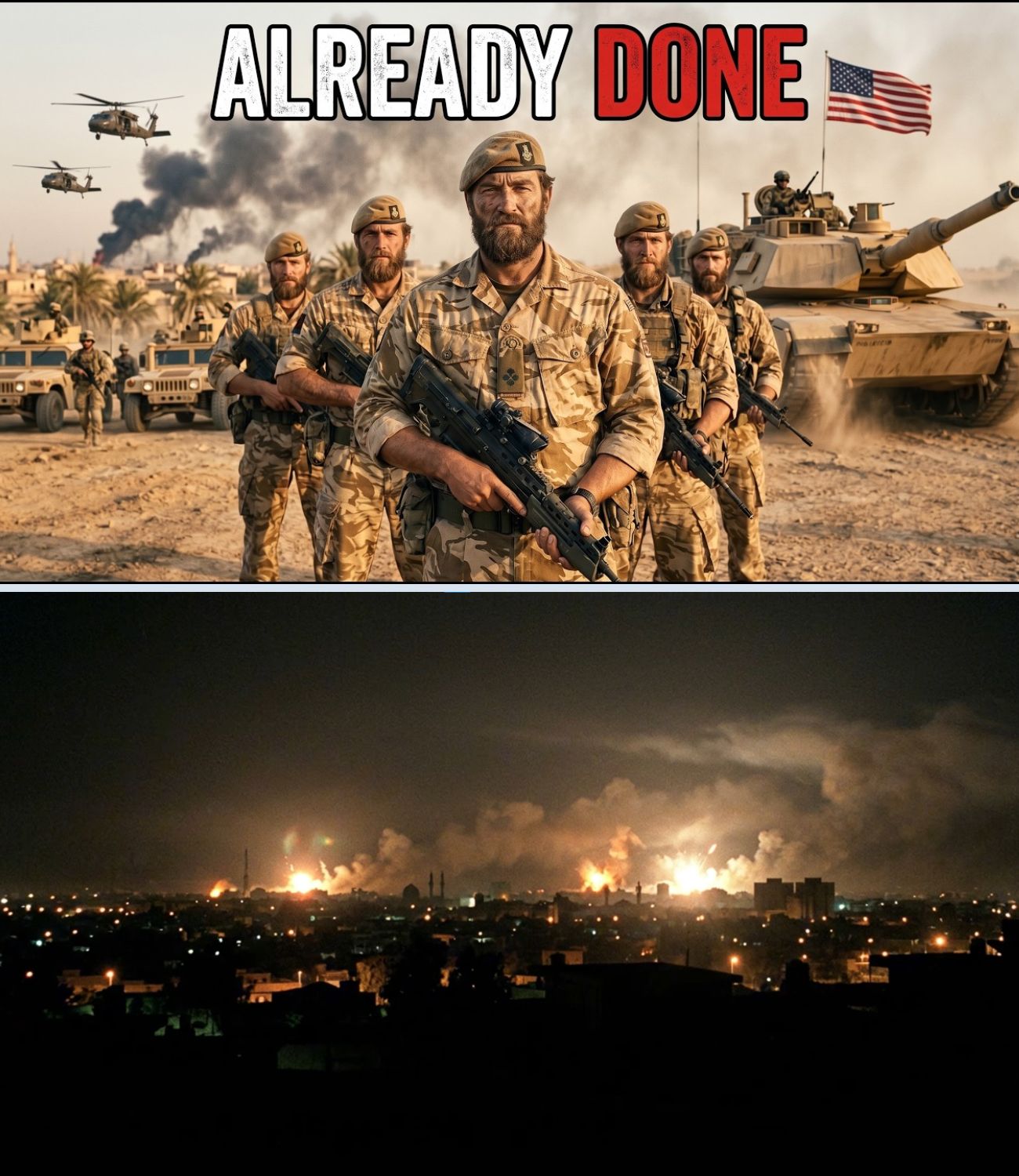
“Anvil, it’s already done.”
There was a pause on the net that Price said afterwards felt longer than the entire previous night.
“Say again,” a voice in Qatar, a young American signals officer, asked him.
He said it again.
The second pause was shorter. Then the net went very quiet, and the sound that came through the headset was not a voice, but the muffled noise of a tented room where a great many people were suddenly all speaking at once.
In Qatar, it took 11 minutes to establish that the message was real.
The signals officer who had taken it first assumed a mistake. A British patrol was not supposed to be on the objective. A British patrol had been told in writing to clear the strike box.
He checked the grid. He checked the authentication. He walked the paper across the tent himself to Major Callaway, who read it standing up.
She did not say anything for a moment. Then she asked for Colonel Mayhew.
Mayhew was in a briefing. The room was full because the amended Anvil order was the most important thing on the board that morning.
The heavy aircraft were already being fuelled at a base hundreds of kilometres to the south. The Rangers had been told to be ready on the apron by midday, and the gunship crew was asleep in a trailer so that they would be fresh at dusk.
Callaway handed him the message. He read it and set it face down on the table. Nobody in the room spoke. The silence lasted longer than he would have liked.
“Verify,” he said finally.
They verified. The SAS liaison cell confirmed the troop’s authentication. A satellite image taken an hour earlier on a routine pass and not yet analysed showed the mast, the buildings, the berm, and four small pale vehicles parked in the lee of the signals hut.
Someone put it on the screen. The room looked at it. What happened next was not dramatic, but it was instructive.
A staff officer asked whether the compound could be considered secure. A second asked whether the British could be relied upon to hold it against a counterattack.
A third asked who had authorised a patrol to move on the objective without informing the strike cell.
“The troop had authorization from its own chain of command, which is not the same thing as ours,” Callaway answered the third question.
She said it neutrally. She said it in the voice of a woman who knew what the answer would cost her and who nonetheless thought it should be said aloud.
The logistics lieutenant colonel with the calculator asked the only question that anyone remembered afterward. He asked what had been spent.
It was a good question. 11 aircraft had been on alert. Fuel had been moved. A Ranger company had spent 30 hours in isolation studying a model of a compound that was already in friendly hands.
All of this cost money, not a hundred million perhaps, but a very great deal, and none of it could be recovered.
The honest answer was that nothing had been spent yet because the package had not flown. And the more honest answer was that the package had existed for exactly one purpose. And the purpose had been fulfilled by 13 men and four Land Rovers.
Mayhew stood up. He walked to the board. He took a marker and drew a line through the words ‘Anvil Strike’ and did not write anything beside it.
“Stand them down,” he said.
Nobody was angry at the SAS. Exactly. That was the strange part.
The mood in the tent was something between relief and a faint embarrassment, the kind a man feels when he has bought a very expensive lock for a door and discovers that someone has walked in through the window.
There was irritation, too, and it was not entirely unreasonable. A British troop had moved without telling them. If the strike had gone ahead as planned, the first ordnance would have fallen on a position held by friendly forces.
The fact that it had not was a matter of timing and a stubborn signaller, and it was not the sort of fact a careful colonel could be expected to admire.
He was careful, and he did not admire it. But he stood the package down, and that decision, made at about 0615 on the morning of the 23rd, was the one that mattered.
At the compound, Hollis had less time than he had thought to enjoy the quiet. The first complication was the prisoners.
41 men do not take up much room, but they take up a good deal of attention, and Hollis had 13. Keen arranged them in the concrete hut by the gate, took their bootlaces, and left two men on the door in rotating shifts.
Lennox gave the Iraqi captain’s wounded corporal an injection and a bandage.
The captain, who spoke English with the careful grammar of a man who had learned it from cassette tapes, politely asked if he might telephone his wife in Rutba.
“I regret that this is not possible,” Hollis said.
The captain nodded and said that he understood.
The second complication was the water. The compound had a tank, a good one, filled by a tanker truck every 10 days, but the tank had been drawn down in the weeks before the conflict, and the water in it was brackish.
Keen tested it, tasted it, and said it could be used for washing and perhaps for prisoners. He did not recommend it for anyone he liked.
The troop’s own supply, after three days in the open, stood at a little under 300 litres across the 13 men, plus the 41 prisoners who, under the law of armed conflict, were owed the same ration as their captors.
That arithmetic is the sort that does not appear in plans. It changed everything. Hollis did the sum on the back of a signal pad and handed it to Keen without comment.
The two of them looked at it. At five litres a day per man in that heat, they had enough for roughly five days. If the prisoners were to drink the same, they had enough for one and a half.
The third complication arrived at 10:11. The gunner on the mast, a trooper who had been sent up a ladder with binoculars, reported dust on the road to the northeast.
Hollis went up to see for himself. Along the highway toward Rutba, a column of vehicles was moving in the haze, six trucks, perhaps eight, with a lighter vehicle at its head.
They were two kilometres out and moving at the sort of pace that suggested they knew where they were going.
“Iraqi?” Price asked from below.
“Not sure,” Hollis said. “Possibly the half of the garrison that went to Rutba.”
It was a reasonable guess. The boy had said that half the garrison had gone away on a truck. That truck had apparently been to collect reinforcements or perhaps to run away. Either way, it was coming back, and it was coming back to a compound it believed to be its own.
The troop had one advantage, and it was a small one. The column did not know the compound had changed hands.
The floodlights were on. The mast light was on. The Iraqi flag, or what passed for it, still hung from a pole by the gate. Hollis, who was a former engineer and therefore a man who disliked leaving things to chance, had left it there for exactly this reason.
He put a heavy machine armament on the berm facing north. He put the grenade launcher on the corner of the signals hut. He put the two remaining armaments where they would cross. He told Keen to keep the prisoners in the hut with the door closed and told Lennox to stay with them.
Then he waited as the dust came up the road with his rifle on the sandbag and his notebook in his breast pocket.
The column stopped 400 metres short of the gate. The lead vehicle, a battered pickup, went on alone for 100 metres, and Hollis watched it through his binoculars.
A man in the passenger seat was holding a white cloth out of the window.
It was not a counterattack. It was a convoy of 62 Iraqi soldiers and five officers, most of them in rags, who had spent the previous night walking out of Rutba under a rumour that the Americans were about to strike the town.
They had been told to return to the compound because it would be safer. They had been told the compound was theirs.
One of them, a lieutenant colonel with a very large moustache, got down from the cab of the lead truck and walked toward the gate with his hands raised and a document in his teeth.
Hollis counted 103 prisoners now, 13 men guarding them, less than a day of water for all of them.
It was a ridiculous situation. And for about 30 seconds, nobody in the troop did anything at all. Then Keen, standing beside the gate, said something that was recorded in the troop’s log in the dry language of the log and that the men repeated for years afterward in a rather different form.
“It is not what we trained for, but it’s a good deal better than the alternative,” he said.
They put the Iraqi soldiers in a drainage ditch beside the berm and sat them in rows. They took the lieutenant colonel’s document, which turned out to be an order to reinforce the compound against a parachute landing, signed three days earlier by a brigadier in Baghdad.
It specified the hour at which the Americans were expected. It had been wrong by about 48 hours in the Iraqis’ favour, and it had been meaningless by about 0410 that morning.
By noon, the wind had gone from a push to a roar. The shamal that the weather officer had predicted arrived in full force at about 1300.
It was only the opening of the great storm that would, over the following days, turn the sky the colour of a bruise and ground much of the coalition’s air power. But it was enough.
Visibility fell to 200 metres, then to 50. Dust sifted through every seam in the hut. The mast light disappeared. Price on the roof of the signals hut had to tie himself to the antenna with a webbing strap to keep from being blown off.
In Qatar, the weather officer had been right. By evening, helicopter flights across the western desert were being cancelled one after another.
The Chinooks that had been meant to lift the Ranger Company to Anvil would have sat on the apron with their rotors tied down.
There is no way to know exactly what would have happened to the strike package if Mayhew had not stood it down that morning, but it is not difficult to imagine.
Gunships would have been blind. Strike aircraft would have found nothing but dust. A company of Rangers would have been put down in a storm to take an objective that was already taken.
There was nothing the SAS could do about the weather. There was nothing they needed to. The relief did not come that day or the next.
Keen issued the water himself, a plastic cup at a time from a can he kept chained to his own belt, and wrote every issue in a small black book.
“Why a book?” Baines asked him.
“Men argue about water, and never argue about arithmetic,” Keen said.
When a Royal Marine corporal later looked at the book, he found the last entry for the Iraqi prisoners was in the same hand and the same ration as the first, and that the sergeant had drunk less than anyone.
The troop and its prisoners lived in the compound through two nights of howling wind in a hut that smelled of sweat and diesel and scorched tea. Lennox slept four hours in 48.
Keen rationed the water with a plastic cup and a notebook, writing down every issue, and no prisoner complained.
The Iraqi lieutenant colonel with the moustache turned out to be a former engineer who had run the compound’s generators for 11 years.
He offered through the captain to show Baines how to keep them running in the dust. Baines accepted.
For two days, the two men worked side by side in the generator shed, one in a British smock and the other in a tattered Iraqi uniform, passing a spanner back and forth and saying almost nothing.
On the 25th, Price reported that the net was clearing. On the 26th, a column of Royal Marines from 45 Commando reached the compound along the highway with a water bowser and a Land Rover ambulance, and an American special forces team arrived the same afternoon in a pair of trucks and relieved the troop of its prisoners.
Hollis signed over 103 men on a clipboard and received a receipt in triplicate for them from a sergeant in sunglasses who looked as if he had never been so thoroughly surprised.
Further south, on one of those nights, the Rangers did jump. A company of Third Battalion, 75th Ranger Regiment, parachuted onto the airfield known as H1 in the last days of March and found it empty.
They cleared the runway of abandoned vehicles with equipment they had dropped alongside them, and the airfield became one of the first forward bases deep inside Iraq.
That was a different objective with a different purpose and a plan that suited it. Nobody in the SAS ever suggested otherwise.
The point of Anvil had never been that the Americans lacked courage. It was that their plan had been built for the worst case, and the worst case had never turned up.
The debrief took place at Muwaffaq Salti on the 29th in a corner of a hangar with a folding table and a pot of tea.
Hollis sat on one side of the table. On the other sat Major Ashworth, who had come in from the squadron, and a lean American lieutenant colonel with a notepad, and Major Callaway, who had not slept properly for a week, and sat with her arms folded.
She had been sent to listen. She did with the full attention of a woman who had a conversation to report to a colonel.
Hollis spoke for 20 minutes. He gave the times, the distances, the fuel figures. He described the sand, the wadi, the wind. He said nothing about the radio call.
When he had finished, the lieutenant colonel with a notepad asked in a tone Hollis later described as perfectly courteous how much the operation had cost.
Hollis glanced at Keen, who was standing at the back.
“Fuel, sir,” Keen said. “About 2,000 litres between the four vehicles, a wheel bearing, a fuel line, rations for a week, and 13 men for six days.”
“That’s all?”
“Yes, sir.”
The lieutenant colonel wrote it down. For a while, he did not look up.
“Did the troop consider waiting for the strike?” he asked quietly.
“We did,” Hollis said.
“Why didn’t you?”
Hollis thought about it. It is easy to imagine a number of answers, some of them quotable.
“The strike had been designed for a compound that was defended, and the compound had not been,” he said, as recorded in the squadron’s account. “This is not something you could know from the other side of a map. It is something you find out by going to look.”
Callaway unfolded her arms. She said nothing at all.
The written report that followed ran to three pages. It contained the grid of the objective, the times of the approach, the numbers of prisoners, and the quantity of fuel burned.
It contained one flat sentence that did more work than the rest. ‘The objective was secured before the strike package was available and without it.’
Some weeks later, the lessons from the Western Desert were folded into the training that Sabre squadrons did at Credenhill and in the Brecon Beacons.
Not the heroics, which were minor, and not the Americans, who were not to blame.
The lesson that stayed was an unglamorous one. The approach the planners had thought too dangerous to risk had been the approach with the fewest people on it.
The assumption behind the expensive plan had been that the enemy would fight for the place. The troop had found out with 13 men and a dry wadi that the only way to learn it was to go and look.
In Price’s notebook, beside the time, the entry in pencil was still there when the pages were collected for the squadron’s records. There was the date, the 23rd of March, there was a time, 0405. And beneath them, in the corporal’s small, neat hand, the sentence that nobody in Qatar had been ready to read.
“Anvil. It’s already done.”
You Might Also Enjoy

“We Thought They Would Negotiate”—What Argentine Soldiers Said When The British Attacked Goose Green

“You’ll Never Finish My Ruck March, Limey” — US Sergeant Who Challenged the SAS, Then Fell Out First






