JUST IN: Prince William UNCOVERS Diana’s Hidden Letter! What He Reads Leaves Camilla SPEECHLESS!
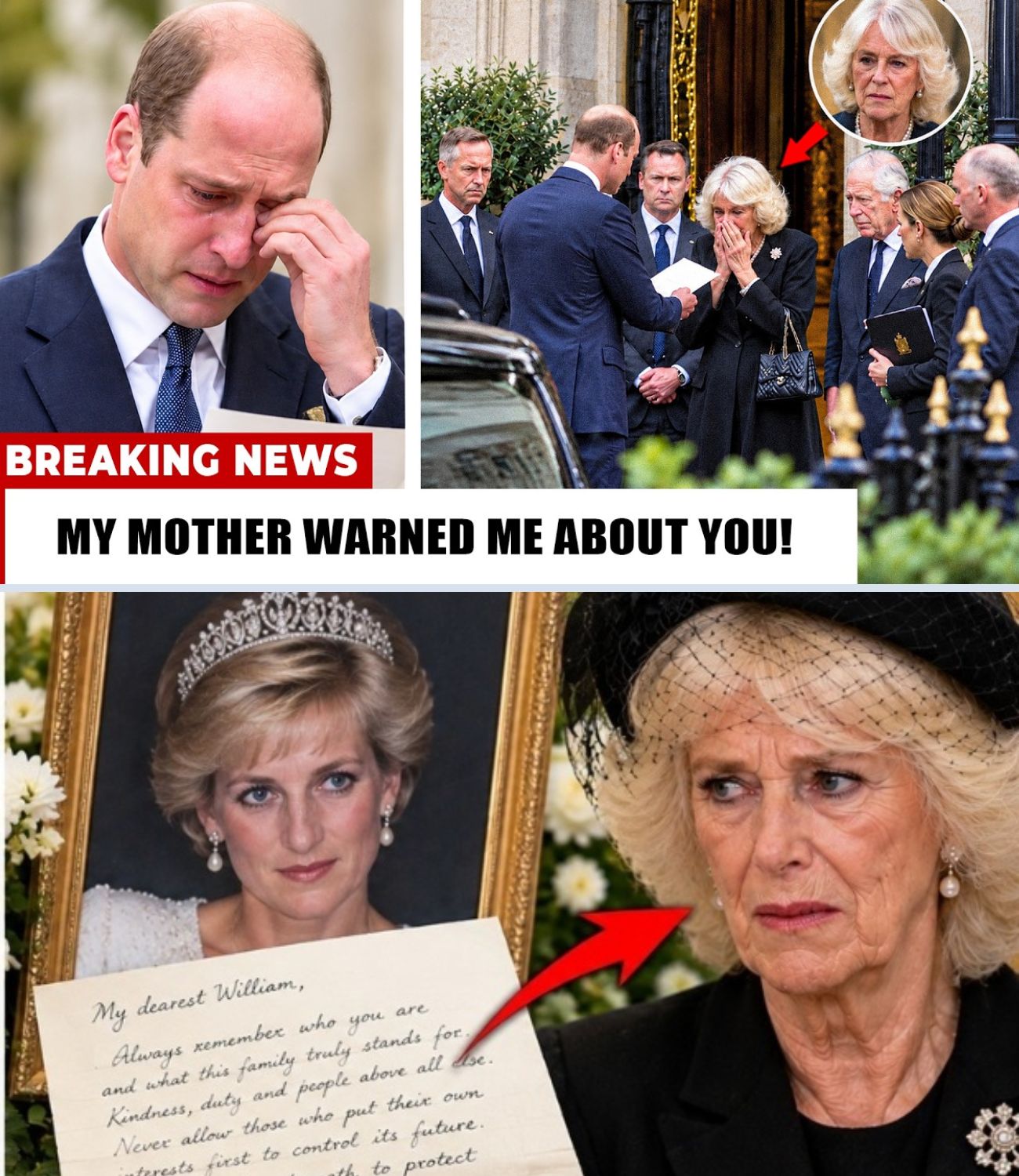
The Vellum Memorandum: How Prince William Uncovered Diana’s Final Legal Strike and Cornered Queen Camilla
History is rarely buried beneath marble monuments or grand state archives; more often, it rests quietly in the dark, climate-controlled silence of a cellar vault, waiting for the precise hour when the past can finally settle its accounts. For nearly three decades, a scarred leather writing case bearing the faded gold-foil initials DS lay locked inside the private basement vaults of the Althorp Estate. To anyone unfamiliar with the intricate, unyielding mechanics of aristocratic probate law, it was merely another box of historical ephemera. But on a cold, overcast morning in late March 2026, that silence was shattered.
Prince William’s dark blue Range Rover pulled up quietly to the stable courtyard of the ancestral Spencer family home. Eschewing pomp, ceremony, or advance public notification, he climbed out of the driver’s seat entirely alone. Accompanied only by close protection officers who hung back in respectful deference, the Prince of Wales bypassed the grand ceremonial entrance entirely. Instead, he walked directly toward the heavy oak side door—the working entrance used by estate staff rather than visiting dignitaries. In the rarefied world of royal geography, arriving through the side door is a deliberate statement: it is the entrance chosen when one wishes to pass unseen, leaving no administrative footprint until the trap has already been sprung.
Waiting for him in the dimly lit stone corridor was his uncle, Earl Charles Spencer. Offering no theatrical pleasantries or familial small talk, the Earl simply held up a small, tarnished brass key attached to a faded red ribbon and wordlessly gestured for his nephew to follow him downstairs. Descending deep beneath the floorboards, past rows of solemn family portraits and crated 19th-century silver, the two men reached a heavily reinforced, climate-controlled chamber at the far end of the labyrinthine cellar. Resting squarely upon a steel examination table in the exact centre of the room was the leather case.
According to estate records, a senior solicitor had stumbled upon the box just three days prior while clearing out an antiquated filing cabinet in the estate’s private legal offices—an artifact that had remained entirely untouched since September 1997. What William was about to unlock inside that basement would trigger an institutional crisis of seismic proportions, setting off a chain reaction that would leave Queen Camilla’s entire operational apparatus reeling in unprecedented panic.
The Sealed Envelope and the August 1997 Memorandum
Stepping forward, William took the brass key from his uncle’s hand, fitted it into the reluctant brass lock, and turned it until the internal mechanism released with a sharp, metallic snap. As he lifted the heavy leather lid, he revealed a sparse contents: a small stack of faded private photographs, an old leather-bound diary, and a single, heavy vellum envelope secured with an intact blue wax seal.
The wax bore the unmistakable, deeply impressed stamp of Princess Diana’s personal signet ring. Across the front, written in his mother’s distinctively sharp, sweeping, and hurried cursive, was his own name. Turning the envelope over, William examined a secondary red ink stamp stamped by a London courier firm, dated August 15, 1997. A quick security check confirmed what the timestamp implied: Diana’s personal driver had made an unlisted, highly secure journey from London to Althorp on that exact Friday afternoon, carrying an administrative pouch whose chain of custody had never once been broken or compromised in the intervening decades.
Earl Spencer quietly withdrew from the room, leaving his nephew to grapple with history in absolute solitude. Sitting down on a plain wooden chair beneath the harsh glare of a single bare bulb, William used his pocketknife to slice carefully through the blue wax. He withdrew three pages of densely written text dated August 14, 1997—precisely seventeen days before the fatal crash in the Pont de l’Alma tunnel in Paris.
It was not a sentimental farewell note, nor was it a personal reflection on her turbulent personal life. It was a formal, meticulously drafted legal memorandum. And halfway down the very first page, a heavily underlined clause stopped the future king completely cold.
The Financial Power Grab: Camilla’s Quiet Consolidation
To fully comprehend why those three vellum pages represented an atomic weapon in modern royal politics, one must examine the delicate, high-stakes financial maneuvers that had been unfolding quietly inside the royal households over the preceding twelve months.
When Diana divorced Prince Charles in 1996, her final legal settlement included exceptionally stringent property clauses. Historic heirlooms—including the famed Spencer tiara, several irreplaceable sapphire sets, and key pieces from her private collection—were released to the royal pool strictly for her lifetime use alone. The instant she drew her last breath, legal ownership automatically reverted to a private family trust managed jointly by Earl Spencer and her two sons, placing those treasures entirely beyond the reach of the Crown or palace officialdom.
Yet, under the radar of public scrutiny, Queen Camilla’s administrative team had been steadily expanding their operational footprint. Stripped of bureaucratic euphemisms, their ultimate objective was clear: merge the administrative costs of the Duchy of Cornwall with the central royal household budget under a single, consolidated accounting framework. Framed publicly as routine “operational efficiency” and “unified financial oversight,” the reality was far more aggressive.
Such a consolidation would grant Camilla’s financial team direct, line-item visibility into every single pound of expenditure flowing out of William’s private estate—an estate generated by the Duchy of Cornwall, which pulls in a staggering £23 million annually. Oversight of that budget equated directly to oversight of how William hired his staff, ran his household, and managed his entire public operation. It was not administrative housekeeping; it was a masterclass in institutional leverage.
Worse still, Camilla’s office had pushed this audit proposal through the King’s private secretariat via a fast-tracked review that deliberately bypassed normal inter-household consultation. William’s team was kept entirely in the dark, caught in a bureaucratic ambush designed to make executive policy a fait accompli before opposition could be mounted. Simultaneously, a parallel visual strategy had been deployed: Camilla was regularly positioned at public engagements wearing royal jewels that carried strong, deliberate public associations with Diana’s memory, slowly normalising the aesthetic transition in the public eye.
Lady Sarah’s 30-Year Vigil
What Camilla’s strategists failed to anticipate was that Diana had foreseen this exact institutional encroachment nearly thirty years prior.
The morning after the Althorp discovery, William walked into a quiet private dining room in Belgravia to meet his aunt, Lady Sarah McCorquodale—Diana’s eldest sister and co-executor of her original 1996 will. Sitting by the window in a dark wool coat and a strand of pearls, Lady Sarah slid a small velvet jewellery box across the white tablecloth without standing. Inside rested a gold charm shaped like a polo mallet, engraved with the initials D and W—an exact match to the charm found tucked inside the vellum envelope the night before.
With quiet gravity, Lady Sarah reframed the entire narrative. She revealed that she was the person who had personally placed the leather writing case into the Althorp filing cabinet in the spring of 1998, months after her sister’s passing. She had retained the master brass key in her personal safe for nearly three decades, acting as a silent sentinel waiting for the precise moment when the Spencer family legacy was genuinely threatened by the new palace hierarchy.
Diana had not merely written a letter; she had engineered a timed explosive device, handing the detonator to the one person she trusted implicitly. Lady Sarah’s mandate was not to act out of malice or premature grievance, but to wait until William attained the full, sovereign-level institutional authority necessary to enforce the document’s terms against the machinery of the court. Observing Camilla’s recent financial maneuvers, Lady Sarah recognised that the exact contingency triggers stipulated by Diana had finally been tripped.
Scotland Yard Forensics and the Golden Polo Mallet
Before walking into a confrontation that could permanently alter the British monarchy, William took an extraordinary precaution. At midnight, exactly 24 hours after retrieving the documents, he brought Dr. Elizabeth Vance—a retired senior forensic handwriting and document analyst from Scotland Yard—into his private study at Kensington Palace.
Working under specialised ultraviolet light with a high-resolution digital scanner, Dr. Vance subjected the vellum pages to intense scrutiny. William was closing off the inevitable defensive counter-move: Camilla’s lawyers would inevitably claim the document was an unverified draft or a fraudulent fabrication.
Dr. Vance’s conclusions were definitive and unassailable. The ink indentation depth matched a standard Mont Blanc fountain pen popular in the mid-1990s, and the paper stock bore a distinct watermark from a Gloucestershire stationery manufacturer that had permanently ceased operations in 1999. Furthermore, tucked into the envelope’s fold was the solid gold polo mallet charm bearing the initials D and W—a deeply private, irreplaceable personal detail from Diana’s Kensington Palace charm bracelet that no outside forger could possibly have known to include.
Because the document originated from Althorp and never entered official state archives, it fell squarely under civil probate law rather than royal prerogative. The Spencer trustees possessed the immediate legal standing to launch an injunction in the High Court without requiring the King’s permission or Parliament’s consent. William held all the cards.
The Clarence House Panic and the Sudden Cancellation
The institutional shockwaves hit Clarence House with brutal speed. The morning after the discovery, Queen Camilla was scheduled to deliver a major, highly polished national television broadcast promoting her literary charity. Studio lighting grids were calibrated, airtime was cleared, and technical crews stood ready.
Then, the red telephone from Clarence House rang. The message delivered to the network was jarringly abrupt: a “sudden scheduling conflict,” offering no medical framing, no apologies, and no rescheduled date. In the high-security rhythm of royal media management, cancelling a cleared national broadcast with less than twenty-four hours’ notice is never a casual inconvenience—it is a five-alarm institutional emergency signal. It meant only one thing: something catastrophic had fractured within the household, requiring senior legal counsel locked in a room before another public word could be uttered.
Camilla’s legal team scrambled to draft preliminary defense papers, initially hoping to dismiss the document as an unverified draft. But when Dr. Vance’s forensic authentication report landed on their desks—accompanied by the sobering reality that Camilla herself instantly recognised Diana’s unmistakable handwriting from their turbulent 1990s correspondence—resistance crumbled into quiet desperation. The operation had shifted entirely from legal defiance to damage limitation.
The Windsor Castle Summit
At 1:45 p.m. on a Saturday afternoon inside the sovereign’s drawing room at Windsor Castle, afternoon light cut sharply across the massive Gothic windows. King Charles sat by the marble fireplace with a tartan blanket across his knees; Queen Camilla stood near the writing desk; and the head of the Privy Purse stood ready with the sovereign’s private financial ledgers.
William walked in unannounced, carrying his leather briefing case. Without taking a seat, he stepped to the centre of the room, unzipped the case, and laid the original three vellum pages flat upon the polished coffee table, alongside the two matching gold polo mallet charms.
He stated quietly that the document had been forensically verified by Scotland Yard’s former lead specialist less than twelve hours prior. The head of the Privy Purse scanned the final clauses, looked up at King Charles, and confirmed the bleak reality in a hushed tone: under civil probate law, the Spencer trustees held absolute legal authority to initiate a devastating public asset reclamation lawsuit in the High Court without royal or parliamentary intervention.
William laid down two non-negotiable conditions:
Camilla’s office must sign a formal, legally binding declaration renouncing any future claim, oversight, or administrative visibility regarding the Duchy of Cornwall finances, permanently withdrawing the audit proposal.
The specific Spencer heirlooms held within palace vaults must be returned to the physical custody of Althorp House ahead of the summer retreat.
King Charles looked down at the gold charms glistening on the table, then up at his eldest son. Offering no emotional appeals or procedural defenses, the King instructed the head of the Privy Purse to draft the executive orders immediately. Turning to his wife, Charles made it unequivocally clear that the traditional boundaries of the household must be respected.
Without uttering a single word, Camilla picked up a silver fountain pen, signed the formal declaration of non-interference, turned on her heel, and walked out through the private side door. The summit was over in twenty minutes.
Though official accounts will frame the episode as routine administrative restructuring, the reality remains monumental. Princess Diana, silenced in life by the machinery of the state, penned a final legal instrument from beyond the grave—and ensured her eldest son was armed with the truth to deliver the final word.
You Might Also Enjoy

“We Thought They Would Negotiate”—What Argentine Soldiers Said When The British Attacked Goose Green

“You’ll Never Finish My Ruck March, Limey” — US Sergeant Who Challenged the SAS, Then Fell Out First






