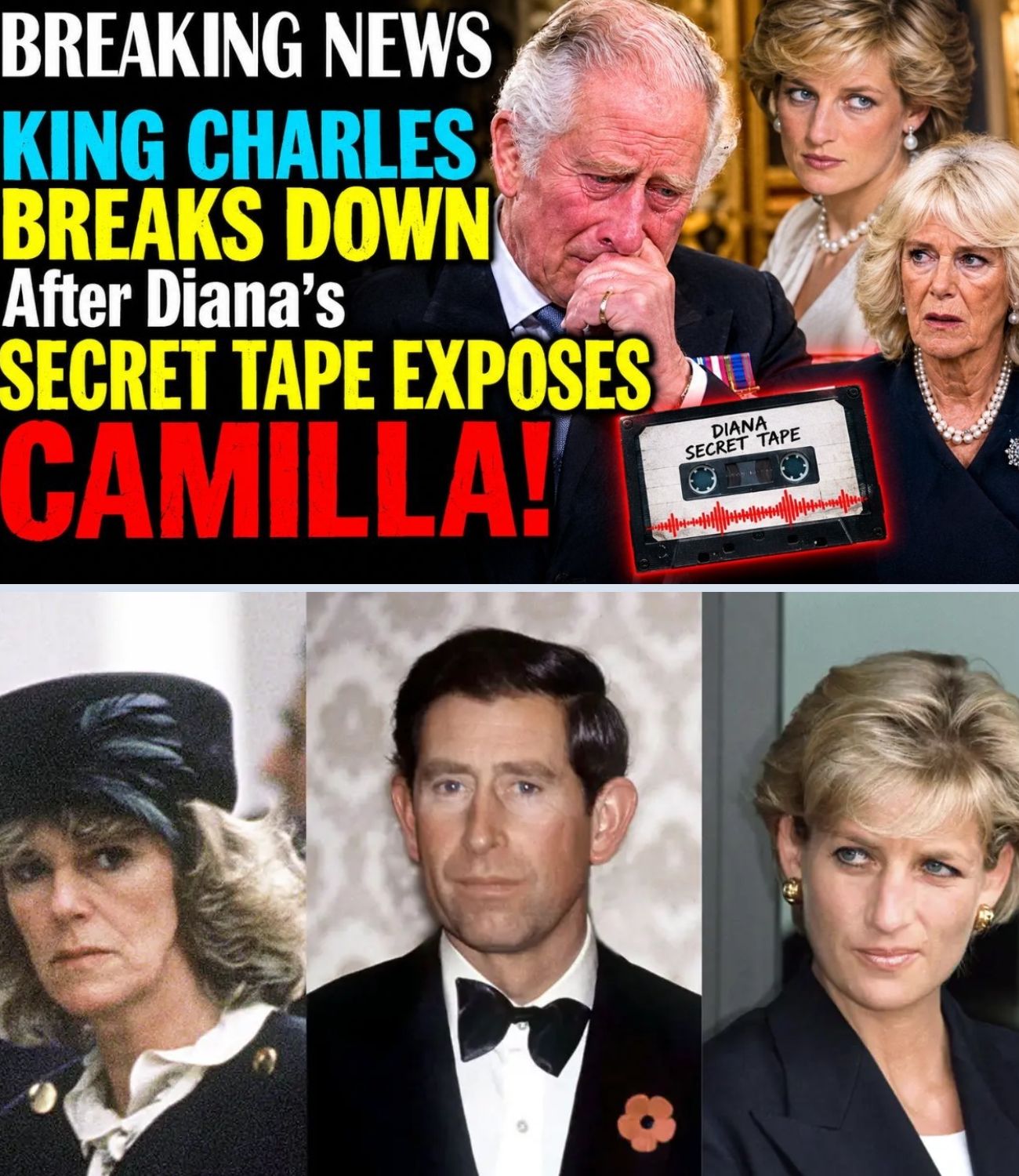
KING CHARLES BREAKS DOWN After Diana’s SECRET TAPE EXPOSES Camilla!
The Envelope at Sandringham
It was an ordinary morning at the Sandringham estate, heavy with the quiet dignity that usually defines the private quarters of the British monarchy. King Charles had walked into his private study anticipating a straightforward consultation with his eldest son, the Prince of Wales. Instead, he found Prince William standing in sombre silence beside the polished stone fireplace. In William’s hands rested an unassuming, padded postal envelope bearing no return address, no official royal crest, and no stamp from any sorting office. Scrawled across the front in faded, unmistakable blue ink was a single instruction: For William when his father is ready.
Charles required no forensic examination to identify the handwriting. It was a script burned into his memory from decades past, belonging irrevocably to Diana.
With measured deliberation, William tipped the envelope downward. Sliding out into his palm was an antique cassette tape—an archaic recording medium untouched by modern hands in decades. Across its spine, a strip of masking tape bore five typed words: Play this when he is ready. Beneath it lay a single, stark letter: D.
Seated near the tall Georgian window, Queen Camilla had been nursing a cup of Earl Grey tea. The moment her eyes locked onto the cassette, her hand jerked, setting the porcelain down so sharply against its saucer that the sharp clatter fractured the stillness of the room. Neither man acknowledged the sudden movement, but the atmosphere shifted instantly from calm anticipation to profound apprehension.
The Delivery and the Machine
As William explained to his father, the package had not arrived through standard royal mail sorting channels. It had been delivered directly into the hands of palace security at the Kensington gates by an elderly woman who steadfastly refused to give her name or credentials. She offered only a cryptic declaration: that she had fulfilled a solemn promise made nearly thirty years prior, and that her duty was now complete before walking back out into the London morning.
With the tape loaded into a portable player brought up from the archives, William’s thumb hovered over the playback mechanism. He pressed down.
For several seconds, the study was filled only with the faint, rhythmic hiss of magnetic tape running through an empty machine—an auditory ghost from a turbulent era. Then, Diana’s voice broke the silence. Calm, resonant, yet unmistakably fatigued, her words filled the room: “Charles, if you are hearing this, then the letter never reached you.”
Charles froze. His gaze snapped toward William, then drifted slowly across the room to Camilla, who stared intently at the parquet flooring.
Diana’s voice continued, recounting events from the spring of 1996—a period of intense legal and personal upheaval. She explained that she had personally sealed an exhaustive missive, entrusting its delivery to a confidante with strict instructions that it bypass the standard administrative channels and reach Charles directly at Highgrove. She had waited day after day for an acknowledgement, a reply, or even a brief signal that her message had been received. When none came, she concluded that institutional gatekeepers had intercepted it. Consequently, she had recorded the audio log to ensure her testimony survived.
Before Charles could even articulate a query, Camilla offered a preemptive explanation. Her voice remained steady, though tight at the edges: “The post in those days went through so many hands—secretaries, private offices, household staff. Anything could have happened to it.”
The rationalisation was plausible, perhaps even historically probable. Yet, a cold knot formed in William’s stomach. His father had asked no question aloud. Camilla had answered a query that had not yet been spoken.
The Highgrove Logbooks and the Initials ‘CPB’
Prompted by the revelation, William placed the cassette back on pause and immediately placed a secure call to the Royal Archives at Windsor. Within the hour, digitised logs from Highgrove’s domestic records and visitor registers for May 1996 were transmitted to his secure tablet.
Scanning the handwritten ledgers for the weekend in question, William’s finger stopped on a specific entry dated the 11th of May 1996: Private delivery by hand. Personal letter for the Prince of Wales received at the door.
Beside the entry was a routing column traditionally reserved for private secretaries, valets, or equerries. Instead, it bore three handwritten initials: CPB.
The study fell into an absolute vacuum of sound. Camilla stood slowly, her hands trembling against the edge of the mahogany desk. There was no longer any room for evasion.
“Yes,” she whispered, her voice dropping to a near-inaudible register. “The letter was given to me. The staff member at the door knew I was expecting you back that evening and handed it to me to pass on. It was not unusual; it happened with many things.”
“Did you give it to me?” Charles demanded, his voice cracking under the weight of betrayal.
Camilla hesitated. That fraction of a second answered the question definitively before she spoke the words: “No. I did not.”
Her defense was rooted in fear—a conviction that opening communication channels during that volatile period would reignite old hostilities, exposing Charles to fresh attacks and destabilising an already fragile fragile equilibrium. She had placed the envelope into a locked writing box at Ray Mill House, intending to return to it when calmer days prevailed. Those days never arrived, overtaken by the tragedy in the Pont de l’Alma tunnel in August 1997.
The Broken Box and the Warning
Urgent orders were dispatched. Within hours, royal protection officers retrieved the locked writing box from Camilla’s private retreat in Wiltshire. Upon its arrival at Sandringham, however, an alarming anomaly greeted them: the brass lock had already been forced open.
Inside the chest lay bundles of ribbon-tied correspondence, faded photographs, and pressed botanical keepsakes. At the very bottom rested the cream-coloured envelope bearing Diana’s script, its red wax seal entirely intact. The intruder had bypassed the personal letter entirely. Instead, tucked neatly beside it was a modern card bearing newer ink and a chilling ultimatum: “You will give him this or I will.”
Someone had penetrated her most private sanctuary, monitored the hidden relic for decades, and orchestrated its eventual release. The elderly woman at the Kensington gates was merely the final executor of a long-laid trap.
Investigators soon traced the former staff member. Having served in Diana’s private household in the early nineties before transferring to Ray Mill House, she had witnessed the original handover in May 1996. Knowing Diana’s intentions, she had quietly preserved the secondary audio cassette as an insurance policy against historical erasure. When decades passed and Camilla’s silence held firm, the former housekeeper took matters into her own hands, breaching the writing box to leave her warning before delivering the evidence directly to the royal estate.
Breaking the Seal
With the physical envelope finally resting between his palms, Charles broke the red wax seal. Inside lay three pages of personal stationery. Unable to maintain his composure, he handed the first page to his son, urging him to read the contents aloud.
In a measured, steady tone, William gave voice to his mother’s final written plea:
“Charles, I am not writing to fight with you… I am writing because I am frightened. And when I am frightened, the only thing I can think about is the boys. I know what the world says about us. I know what it says about her. And I know you love her. I have known for a very long time… I want to meet Charles privately, just the two of them, with no advisers and no lawyers before the end of the summer. She wanted to agree on how they would raise William and Harry now that the marriage was over. She wanted them to stand together at every school event, every birthday, every milestone, so the boys would never feel pulled in two directions.”
The letter moved beyond logistical arrangements into profound emotional territory. Diana wrote of Camilla with an unexpected clarity—not with venom, but with a tragic recognition that both women were trapped within the same rigid institutional machinery. One had chosen to leave; the other had chosen to stay. Diana offered a definitive truce: if Camilla ensured the boys remained close to their father, the public blame would cease. It was an olive branch offered from the precipice of uncertainty.
A Message Across Generations
As William turned to the third and final page, he discovered that the closing words were not addressed to the King at all. They were inscribed specifically to him.
“My darling William, if your father is giving you this, then it means something has happened and I am not there to say it myself. I am so sorry, my darling. I am sorry for all the shouting you heard through the walls. I am sorry for the cameras… Please do not become a man who never cries. Your father learned that lesson far too well. And look what it cost him. And please, William, look after your brother. Harry feels everything so deeply. He will need you even when he pretends he does not.”
Tucked into the very corner of the page, squeezed in as a final afterthought, was a line that altered the trajectory of the evening: Share this with Harry. He deserves to hear it, too.
Despite the geographical and emotional chasms that had grown between the brothers across the Atlantic, the directive was absolute. Charles encouraged his son to act without delay.
A call was placed to California. When Prince Harry answered, his tone was defensive, conditioned by years of transatlantic scrutiny and familial estrangement. Without preamble, William placed the phone near the audio player, letting the magnetic tape replay their mother’s warm, familiar cadence, followed by a full recitation of her written words.
On the other end of the line, silence stretched until it became heavy. Then came the sound of quiet, unshielded grief. Harry’s voice, raw and unfiltered, broke through the speaker: “She was giving you a chance, Camila. Even then, after everything.”
The Final Resolution
In the quiet aftermath, decisions were reached not with institutional coldness, but with weary acceptance. The materials would remain strictly confidential—exempt from memoirs, media syndication, or public exhibitions. They belonged solely to the family lineage they concerned.
Camilla announced quietly that she would step back from public duties for an extended period, removing her coronation brooch and placing it beside the archival papers as an acknowledgment of moral debt. Charles, pen in hand, drafted a final, delayed response to his late first wife, sealing it within the archive box alongside her own words—a reply twenty-nine years too late, yet necessary for closure.
The unearthing of the Sandringham cassette did not dismantle the crown, nor did it spark a constitutional crisis. Instead, it achieved something far more disruptive and deeply human: it stripped away decades of political posturing, forcing a monarch to confront the ghost of a missed conversation, a queen to reckon with the cost of self-preservation, and two estranged brothers to hear, across an abyss of time, the unifying voice of a mother asking only for mercy.
You Might Also Enjoy

“We Thought They Would Negotiate”—What Argentine Soldiers Said When The British Attacked Goose Green

“You’ll Never Finish My Ruck March, Limey” — US Sergeant Who Challenged the SAS, Then Fell Out First






