King Charles FINALLY Gives Rare Royal Title To Princess Charlotte — Camilla Shocked
THE WINDSOR SUCCESSION SHOCKWAVE: Inside King Charles’s Secret Coronation of Princess Charlotte—And the Furious Palace Fallout That Left Queen Camilla Reeling
The mahogany double doors of the private state briefing room at Windsor Castle closed with a heavy, final thud, sealing off the murmurs of the courtyard outside. To those few senior courtiers and family members summoned for what had been advertised as a routine operational review of the younger generation’s future duties, the atmosphere felt unnaturally charged. The air was thick with that peculiar brand of breathless anticipation that always precedes a major royal decree. Yet, nothing in the briefing papers, the polished agenda, or the whispered speculations of the past week could have prepared the room for what was about to unfold.
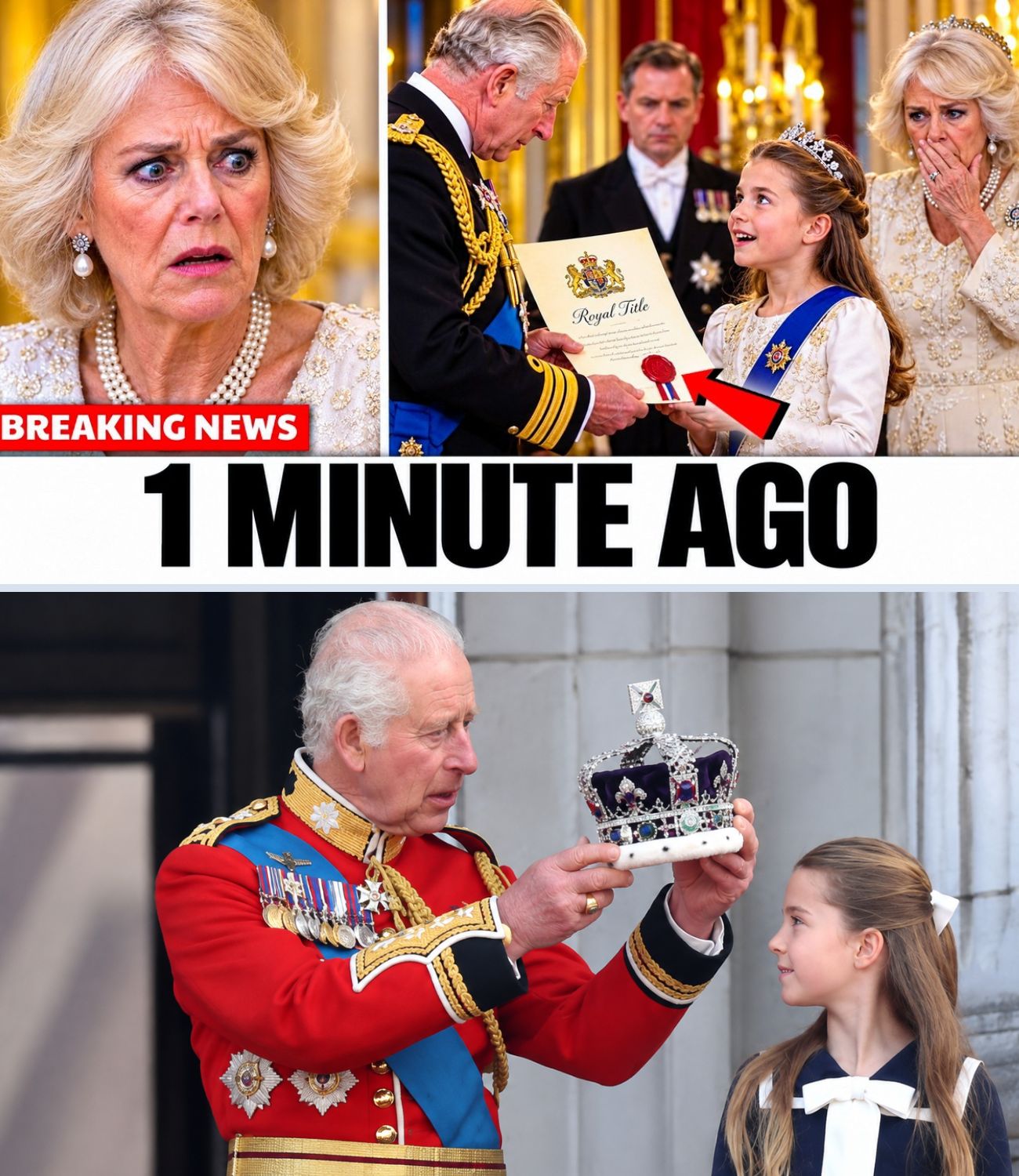
King Charles III, his expression set in lines of resolute, unyielding gravity, did not indulge in the usual preamble of small talk. Instead, he reached across the polished surface of the table, broke the crimson wax seal of a thick, heavy-stock document, and looked directly across at nine-year-old Princess Charlotte.
What the King was about to announce would instantly shatter the emotional equilibrium of the inner circle. Charlotte, remarkably steady for her tender years, sat motionless, absorbing the sudden weight of collective gazes. Prince William stiffened, his jaw clenching as his protective instincts flared into immediate life. And across the table, the subtle shift in Queen Camilla’s expression betrayed a sudden, sharp jolt of shock before a single syllable had even been uttered into the hushed room.
The designation was as rare as it was historically profound: King Charles had formally decided to confer upon his granddaughter the rare, prestigious status of Princess Royal in Waiting. It was a deliberate, calculated move designed to groom her for the senior distinction traditionally held by Princess Anne—a lifelong anchor of royal duty. But while the King viewed this as an essential masterstroke of institutional continuity, the human cost within the family was immediate, raw, and fiercely contested.
The Spark at St George’s Chapel
To understand how a nine-year-old child came to be placed at the center of a high-stakes succession realignment, one must rewind several months to a quiet, solemn remembrance ceremony at St George’s Chapel. It was an event meant to unfold with the rigid, predictable choreography that defines British state occasions. Rows of dignitaries, military veterans, and working royals stood in precise alignment as the national anthem echoed through the vaulted stone ceilings.
Amidst the formality, an elderly military widow, visibly frail and overwhelmed by the grandeur of the surroundings, lost her place in the procession. Caught in the crushing tide of attendees, she faltered, her face draining of colour as panic set in. Courtiers, bound by strict protocol and terrified of disrupting the live television broadcast, hesitated.
Charlotte did not.
Breaking rank with a quiet, unshakeable resolve that stunned those nearest to her, the young princess stepped out of the royal line. Ignoring a frantic gesture from a nearby equerry attempting to herd her back into position, she walked softly over to the distressed woman. Taking the stranger’s trembling hand in her own, Charlotte offered a reassuring smile and gently guided her forward step by step until she reached her correct place in the formation.
From several paces away, King Charles watched the entire exchange. For the monarch, whose mind is constantly preoccupied with the fragile future of an institution facing modern cynicism, the moment struck a deep, resonant chord. It was not a rehearsed wave from a balcony or a carefully staged photocall; it was an unprompted act of raw human empathy executed by a child who understood responsibility before she even understood privilege.
That very evening, the King summoned Princess Anne to a private, recorded family consultation. Repeating Charlotte’s instinctive actions almost word for word, Charles asked his formidable sister a blunt question: did the young princess possess the rare, unteachable instinct required for long-term public service?
Anne, who has spent over five decades navigating the crushing burdens of royal duty without complaint, did not answer immediately. She reminded the King that true royal authority only survives when the person carrying it understands that obligation stretches far beyond mere ceremony. She added a vital caveat: such instinct should be carefully guided, never exploited. That single conversation laid the architectural blueprint for the decree that would later rock Windsor Castle to its foundations.
Camilla’s Blind-Sided Fury
If Princess Anne was the architect of the consultation, Queen Camilla was the last to know the building had even begun.
As the reality of the announcement settled over the Windsor briefing room, Camilla’s reaction cut through the diplomatic silence. She gripped the edge of the document papers, turned sharply toward her husband, and asked a direct, pointed question: was the decision already final?
The Queen Consort did not raise her voice—royal protocol rarely permits such vulgarities—but the acoustic chill in the room was unmistakable. Charles answered only with a slow, deliberate nod. That silence carried a devastating subtext; this was not a proposal tabled for familial debate or collaborative refinement. It was a fait accompli, engineered and sealed within an inner sanctum she had never been invited to enter.
When the meeting finally adjourned, Camilla requested an immediate private audience with the King behind closed doors. Once the heavy oak panels clicked shut, the dam broke.
She demanded to know why everyone of consequence within the family hierarchy had been privy to the discussions whilst she remained completely in the dark. Charles refused to retreat, defending his actions by stating that the decision concerned the foundational structure of the future monarchy itself. To Camilla, however, the exclusion felt deeply personal and politically ominous. It signaled that as the crown prepared for its next generational transition, her own influence was quietly being marginalized, pushed aside in favor of a bloodline axis anchored by William and Anne.
“Would my opinion have changed anything?” Camilla asked, her voice dangerously quiet.
Charles paused—a second too long—before answering softly, “No.”
The silence that followed was heavier than any shouting match. For Camilla, it confirmed a bitter truth: she had been bypassed not by accident, but by design. For Charles, it proved he was willing to absorb personal domestic friction if he believed the future survival of the crown demanded it.
William and Catherine’s Protective Fortress
Whilst the adults navigated the sharp edges of palace politics, the immediate human priority remained the young girl at the heart of the storm.
In a quiet, stone-lined corridor outside the briefing room, Catherine found her daughter. Kneeling down so her eyes were level with the overwhelmed nine-year-old, the Princess of Wales asked gently whether she was holding up. Charlotte admitted she felt an immense surge of pride, but confessed that she was frightened by the sudden, heavy shift in how everyone in the room had looked at her the moment the title was spoken aloud.
Catherine wrapped her arms around her daughter, offering a grounding, maternal anchor. She reassured her that no parchment decree, royal title, or courtier’s whisper could ever alter who she was at her core within the family. Yet, the unease lingered in the young girl’s eyes.
That anxiety was mirrored, albeit with adult fury, by Prince William. Seeking out his father in a private study immediately following the meeting, the Prince of Wales laid down an unyielding boundary. He acknowledged the symbolic weight of the designation, but delivered a stern warning: Charlotte had to remain his daughter before she became a royal symbol.
Charles listened intently, noting that responsibility rarely waits for someone to feel entirely ready. William did not argue, but the tension between father and son was palpable—two generations measuring the same crown from radically different philosophical standpoints. William feared the suffocating machinery of the institution; Charles feared its eventual irrelevance.
To bridge this chasm, a rigorous framework of safeguards was hammered out behind closed doors. William insisted on, and secured, unprecedented control over his daughter’s schedule. Charlotte would not be thrust into an expanded public workload. Instead, under a private mentoring arrangement championed by Princess Anne, she would occasionally attend select events purely as an observer—learning the invisible strains of public life before ever being asked to carry them.
Furthermore, a specific clause was written into the agreement stating unequivocally that Charlotte’s role could not expand by even an inch without the explicit, joint consent of both William and Catherine. It was a masterclass in parental protection, ensuring that schooling, privacy, and the simple sanctity of childhood would remain fiercely guarded against the relentless demands of the firm.
The Heart-to-Heart That Changed Everything
The emotional turning point, however, did not happen in a boardroom or across a ministerial desk. It happened late at night, in the quiet sanctuary of the King’s private sitting room.
Without aides, advisers, or anxious parents hovering nearby, Princess Charlotte walked up to her grandfather’s door, knocked softly, and asked for a private audience. She did not come bearing questions of protocol, seating arrangements, or ceremonial precedence. Instead, she asked the one fundamental question no adult in the palace had dared to voice.
She looked up at the King and asked what would happen if, one day, her own moral judgment told her to do something entirely different from what the palace expected of her.
Charles motioned for her to sit, stripping away the ceremonial armour of his office. He told his granddaughter that true responsibility was never meant to mean blind, unthinking obedience. Tradition, he explained, only possesses genuine value when it serves to help people rather than silencing their conscience.
Charlotte then confessed her deeper worry: she had noticed Queen Camilla growing distant, quieter, and visibly hurt in the wake of the announcement, and she desperately wanted to know if her new title had caused avoidable pain. The King reassured her firmly, stressing that adults alone carry the burden of managing their own emotional reactions and that she must never shoulder guilt for a decision he had made.
The following morning, Charlotte took matters into her own hands once more. Walking unaccompanied into the Queen Consort’s private sitting room, she closed the door behind her. No cameras captured the exchange, and no courtiers recorded the minutes. But within those walls, a nine-year-old princess and a veteran royal consort confronted the human reality behind the glittering titles. Charlotte expressed her sincere wish that her elevation would never make anyone feel diminished, and in that moment of raw vulnerability, the frost between them finally melted. When Camilla reached across the table to take the young girl’s hand, years of political tension dissolved into genuine mutual respect.
A Crown Redefined
When the official announcement finally broke across the airwaves, the public reaction was instantaneous and deafening. Television networks interrupted their regular programming, front-page splashes declared a historic generational shift, and royal commentators feverishly debated the exact pecking order of the future monarchy.
Yet, as the family stepped out together for their next public appearance—with Charlotte offering a warm, deliberate smile toward Camilla before taking her place beside Princess Anne—the reality on the ground was far calmer than the headlines suggested.
The rare title bestowed upon Princess Charlotte was never designed to spark a palace revolution or sideline those who had served before her. It was a deliberate, carefully calibrated act of institutional insurance. It proved that the House of Windsor, often accused of being a cold and calcified relic of the past, was learning how to secure its future not through blind adherence to ancient hierarchy, but by passing down the torch of duty with empathy, restraint, and profound human courage.
You Might Also Enjoy

“We Thought They Would Negotiate”—What Argentine Soldiers Said When The British Attacked Goose Green

“You’ll Never Finish My Ruck March, Limey” — US Sergeant Who Challenged the SAS, Then Fell Out First






