King Charles’s Final Letter: Refusing $16.7 Million in Aid to Save the Montecito Mansion
The Anatomy of an Unravelling Empire
In the high-stakes theatre of modern royal survival, noise is rarely a reflection of true authority. For over half a decade, public commentators marvelled at the relentless media offensive orchestrated from the sun-drenched enclave of Montecito. Every streaming documentary, every multi-million-pound memoir, and every high-profile celebrity endorsement appeared designed to dwarf the ancient, calcified machinery of Buckingham Palace. To the casual observer viewing from across the Atlantic, Prince William and King Charles III frequently appeared outmatched—too stiff, too traditional, and dangerously silent whilst their younger relatives commanded the global cultural conversation with slick, fast-moving public relations.
Yet, true constitutional authority is built neither on viral headlines nor on talk-show appearances. In the opening fortnight of September, during a damp, overcast week that saw Prince Harry return to British soil to launch the official countdown for the Birmingham Invictus Games, a seismic tectonic plate shifted beneath the feet of the entire Sussex enterprise. The shield that had protected the couple from public accountability for six long years was dismantled not with a dramatic courtroom brawl or an explosive television interview, but through cold, unyielding arithmetic and precise institutional discipline.
The Deed Holders: Beyond the Montecito Façade
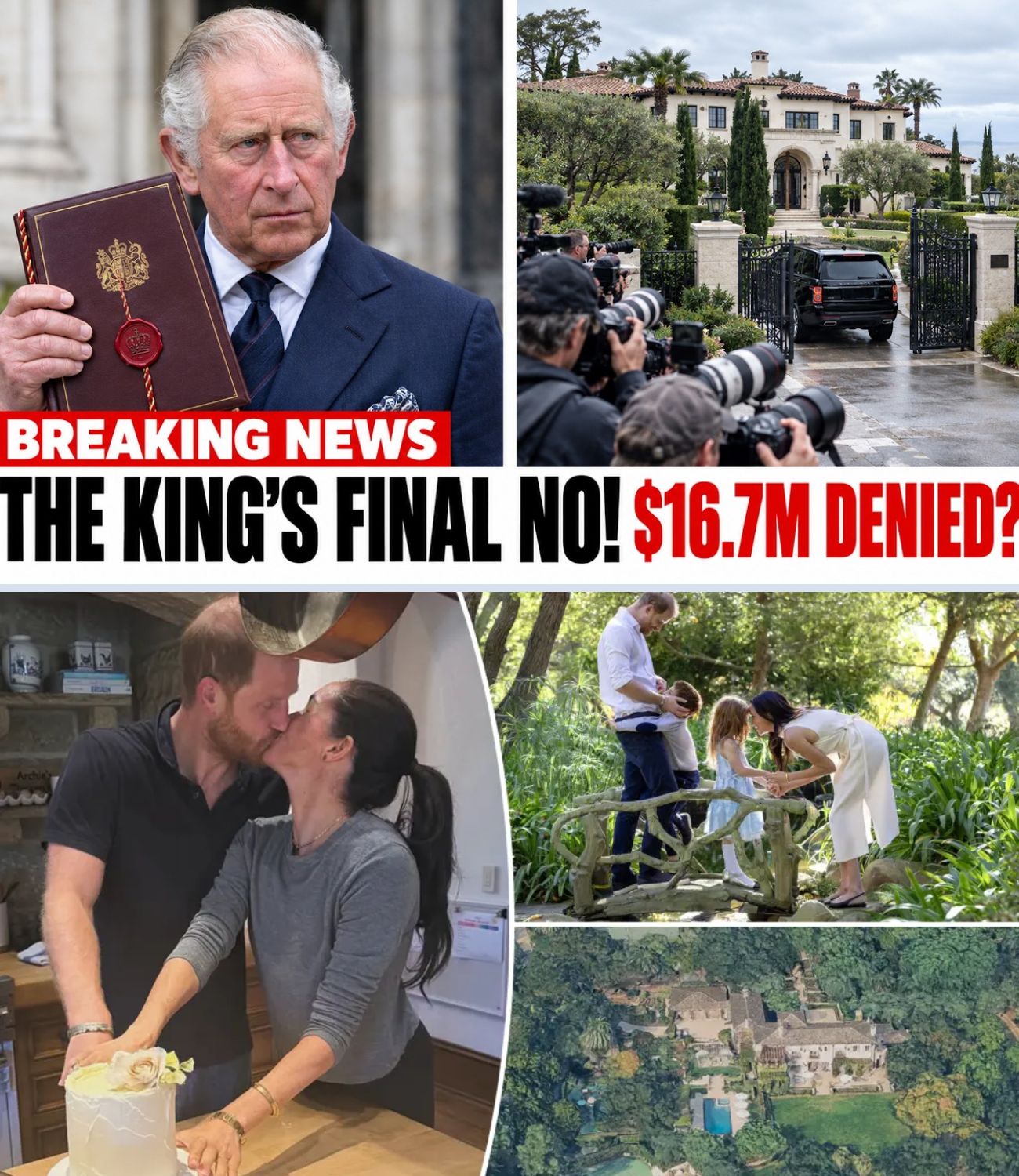
To understand why the ground finally gave way beneath the sprawling California estate, one must examine the paper trail that property insiders and local residents had whispered about for months. The $16.7 million Montecito mansion that had served as the physical backdrop for countless interviews, promotional trailers, and glossy magazine spreads was never fully owned by the Duke and Duchess of Sussex in the traditional sense. Property records and discreet disclosures leaked across exclusive California lanes revealed that the primary financial position on the deed remained firmly anchored in the hands of Tyler Perry.
When Harry and Meghan arrived in Southern California in the spring of 2020, fleeing the turbulence of their departure from the royal family, Perry had stepped in as a protective benefactor. He provided his Beverly Hills sanctuary, absorbed carrying costs, and backed the Montecito purchase when the couple had nowhere else to turn. What was initially presented to the public as an independent property acquisition by self-made entrepreneurs was, in operational reality, a high-end residency backed by an invisible financial guarantor.
For years, the Sussexes treated Perry’s generosity like an open overdraft facility. Every emergency legal retainer, every deferred carrying expense, and every private security invoice was quietly absorbed under the assumption that these were temporary bridge funds while commercial streaming ventures found their footing. But as Spotify cancelled contracts after a single season, and production costs outpaced incoming revenues, the financial reality caught up with the illusion.
The turning point arrived when Tyler Perry made a decisive move of his own. Realising that his role as a benevolent protector had mutated into a permanent, uncompensated banking service for a lifestyle he no longer wished to subsidise, Perry listed his own massive Beverly Hills estate for $57 million as part of a broader relocation to Puerto Rico. He was not acting out of petty spite; he was executing a cold, unsentimental clearance of non-performing assets. When Harry placed an urgent phone call seeking yet another extension and a multi-million-pound cash injection to stave off a liquidity crunch, Perry refused to write another check. The Montecito mansion was quietly queued for private liquidation, with every recovered dollar earmarked to satisfy mortgages and outstanding encumbrances on Perry’s side of the ledger. The benefactor had officially called time.
The Cotswolds Ambush and the Village Pub
Desperate to replace their fading American capital and convinced that physical presence on British soil would force the Crown’s hand, the Sussexes hatched an elaborate operational plan for the autumn. The strategy was staggering in its audacity. Rather than seeking quiet permission from Buckingham Palace, the couple arranged a long-term lease on an idyllic rural property in the heart of the English Cotswolds, nestled deep within an exclusive enclave beside American media allies like Ellen DeGeneres and Portia de Rossi.
Simultaneously, inquiries were launched to enroll Prince Archie and Princess Lilibet in an ultra-exclusive local preparatory school. The narrative fed to sympathetic journalists claimed that California had merely been a temporary chapter, and that the children desperately needed to reconnect with their British heritage whilst bringing the family closer to an ailing King Charles. Beneath the surface, however, the maneuver was designed as a constitutional trap. By planting their feet on British soil and bringing two royal grandchildren into English borders, they calculated that the Home Office and the Metropolitan Police would face catastrophic public backlash if any security threats materialized, effectively forcing the state or the King’s private purse to resume their crushing £3 million annual protection bill.
Once the security detail was restored, Harry intended to use that renewed official status as leverage to reopen negotiations for an annual bridge subsidy from royal estate revenues. The trap was set, the lease was signed, and the moving vans were practically idling.
Yet, the execution of this grand reentry met with immediate, unyielding reality. The public manifestation of this strategy took place on a damp afternoon at The Three Horseshoes, a centuries-old country pub in Oxfordshire. Meghan arrived alongside Ellen DeGeneres and Portia de Rossi, styled impeccably in light blue linen and crisp white denim to project the polished image of a woman gracefully embracing pastoral English village life.
Before they even crossed the threshold, four heavy, armored security vehicles pulled up, blocking the narrow country lane and forcing local farm tractors and delivery trucks to a standstill. Bodyguards in dark suits surveyed the sleepy village with surveillance gear, treating a historic rural pub as if it were a high-threat zone in a hostile foreign territory. When the party walked inside expecting deference, cleared rooms, and whispered flattery, the atmosphere in the room turned ice cold.
The pub staff did not clear private tables, nor did they rush to offer complimentary champagne. Multiple eyewitnesses confirmed that staff members quietly refused to offer special service, delivering not a loud political speech, but the oldest and most devastating weapon in English social repertoire: cold, flat indifference. They were treated precisely as the King’s recent administrative directives had classified them—ordinary private customers encumbered by excessive baggage.
Within forty-eight hours of that disastrous village appearance, the local blowback was absolute. The enrollment trial for the children at the local preparatory school collapsed entirely. While public relations teams planted stories citing sudden privacy concerns, parents on that lane knew the brutal truth: the school community had flatly rejected the disruptive security perimeter demanded by a family that no longer possessed official royal authority. In British society, an empty table at a country pub and a closed school gate are the unmistakable sounds of iron doors shutting for good.
The Lord Chamberlain’s Directive: A Constitutional Firewall
While Meghan managed the fallout in Oxfordshire, the real institutional blow was already sealed in Whitehall. What Harry had hoped would be an emotional reconciliation meeting with his father turned out to be a total misreading of how the British monarchy operates under pressure.
In the first week of September, rather than a personal, tear-stained letter from a grieving father, an official royal directive issued through the Lord Chamberlain’s office and stamped with the formal seal of the royal household landed on government desks across Whitehall, Downing Street, and the Home Office. Unlike a private letter that can be debated, leaked, or spun across American television networks, an administrative directive issued through the Lord Chamberlain is a legally binding constitutional instrument.
When Harry’s legal team reviewed the memorandum, they were confronted with three explicit, devastating clauses that effectively eradicated their connection to the state:
Clause One (Non-Working Status and Titles): Reaffirmed in unequivocal administrative language that Harry and Meghan are non-working members of the royal family. It placed their His and Royal Highness styles in permanent abeyance, legally prohibiting their use in any commercial contract, philanthropic initiative, or official state function. Furthermore, it instructed civil servants and foreign missions that the couple must be received strictly as private citizens abroad, stripped of all diplomatic courtesies.
Clause Two (Absolute Financial Prohibition): Established an absolute ban on the couple receiving any taxpayer funding from the sovereign grant, private allocations from the Duchy of Lancaster, or institutional subsidies from royal estates. Any funding requests or sponsorships connected to the Sussex household were ordered to be forwarded directly to Buckingham Palace for immediate, standardized rejection. The vault doors were welded shut.
Clause Three (The Security Firewall): Explicitly stated that the royal household would neither request, endorse, nor subsidize armed police protection for the couple. If Harry desired armed protection on British soil, he would have to petition authorities as a private foreign individual, prove an imminent threat under ordinary citizen standards, and pay every penny from his own depleted funds.
The Iron Spines of Windsor: William and Anne Draw the Line
How did this ironclad directive come to pass when King Charles had spent years attempting to keep a paternal door cracked open? The answer lies in the unyielding resolve of the two individuals who manage the operational engine of the modern monarchy: Prince William and Princess Anne.
Left entirely to his own inclinations, King Charles might have sought a quiet compromise, perhaps offering a discreet cash allowance through private Duchy accounts or arranging a grace-and-favour cottage to avoid a messy public spectacle. But Prince William and Princess Anne viewed the situation through the lens of long-term institutional survival.
Princess Anne, universally respected across the royal household as the iron spine of the House of Windsor, carried a blunt message to her brother during a private summit at Balmoral. Having dedicated decades to relentless public service without complaint or private jet indulgence, Anne made it clear that working royals would not tolerate a situation where a rogue prince monetizes relentless attacks on the institution while expecting that same institution to fund his lifestyle. Her warning was stark: if you do not perform the public duty, you do not touch the public purse. Bailing out Harry, she argued, would trigger an open revolt among family members who actually shoulder the burden of the Crown.
Prince William’s intervention was even more decisive. Bearing the deep, permanent scars of six years of calculated betrayals—including explosive television interviews conducted while Prince Philip lay dying, documentaries filmed inside private royal spaces, and memoirs exposing intimate family conversations for commercial gain—William drew an absolute line in the sand. He presented the King with an unyielding constitutional ultimatum: his own future reign would not be mortgaged to clean up his brother’s financial disasters.
William reminded his father that every previous compromise offered to Harry had immediately been weaponized as content for commercial media deals. He informed the King that if Harry were permitted to return on an ambiguous half-in, half-out footing, William and Catherine would refuse to share any platform, attend any joint event, or participate in any family gathering where Harry was present.
To ensure the decision could never be undone in a moment of paternal weakness, William insisted that the resolution be drafted as an official administrative order distributed across the machinery of Whitehall. By converting a private family dispute into an immutable state policy, William erected an airtight legal perimeter around the Crown.
The Final Severing of Ties
The contrast between the two worlds could not have been starker. Whilst Harry and Meghan juggled frantic media narratives and watched their California property slide toward auction, the working royal family presented an image of unbreakable unity. Just days after the Whitehall directive took effect, King Charles, Queen Camilla, Prince William, Catherine, and Princess Anne stepped out together for a public state engagement in London, radiant, composed, and entirely absorbed in the duty of the day. They did not acknowledge that an ocean away, an entire manufactured media empire was unravelling.
Back in Montecito, the silence finally returned to the eucalyptus-lined lanes. The private security barricades that had choked the lower roads were systematically dismantled, the surveillance cameras mounted along perimeter walls went dark, and the idling delivery vans vanished from the driveways. Rob Lowe and his fellow residents walked down their private lane without encountering armed guards demanding identification. There was no celebration, only the calm, unsentimental relief that accompanies the departure of an exhausting circus.
Prince William did not need to wage a public war or issue petty counter-briefings to win this battle. He simply enforced the rules of constitutional duty, allowed arithmetic and reality to run their course, and permitted silence to deliver the final verdict. The boy born into an ancient institution who spent six years attempting to prove he could outsmart it ultimately discovered a timeless truth: when borrowed royalty collides with the real world, the bill for independence always comes due in cash.
You Might Also Enjoy

“We Thought They Would Negotiate”—What Argentine Soldiers Said When The British Attacked Goose Green

“You’ll Never Finish My Ruck March, Limey” — US Sergeant Who Challenged the SAS, Then Fell Out First






