King Edward VII Was A Weird Guy
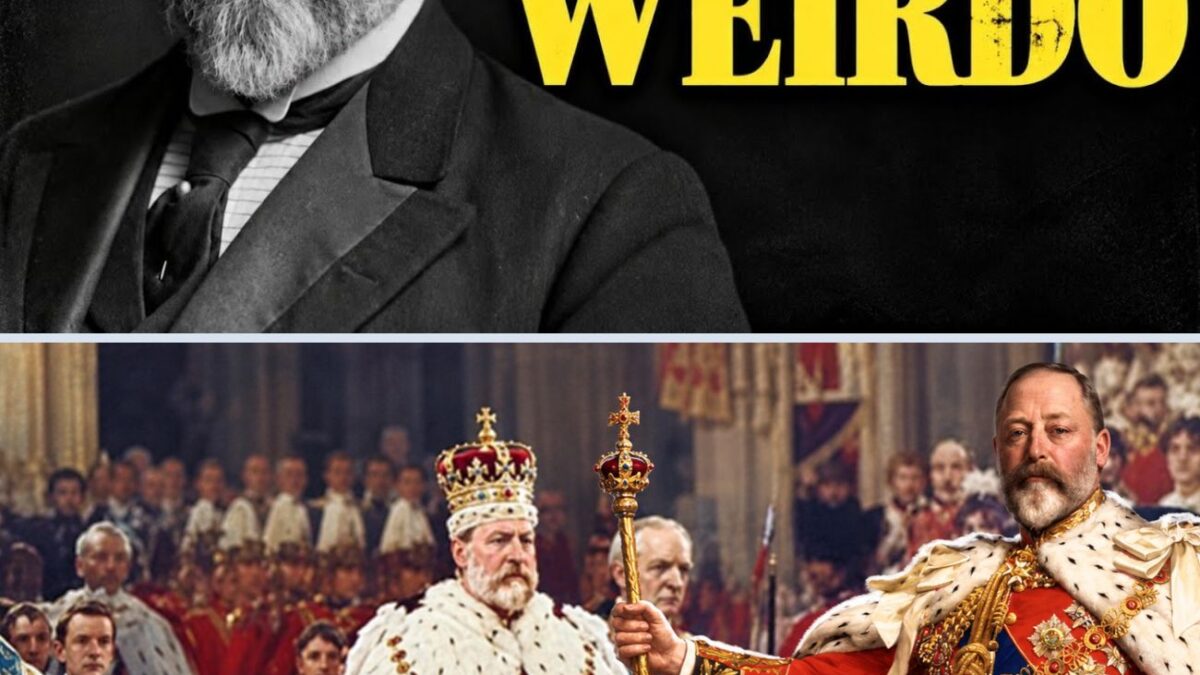
King Edward VIIth commissioned a custom chair at a Paris brothel specifically engineered to accommodate his body weight during sexual activity. He bathed in champagne with multiple women simultaneously. He was booed in the streets of London by the public he was supposed to one day rule. He stood in open court and lied about adultery while his mother watched from the newspapers in fury. He smoked 12 large cigars per day and refused to stop even when his lungs were failing. He waited 59 years for the British throne, longer than any heir apparent in recorded history, and nobody who knew him was surprised.
King Edward VIIth was without question a weird guy. To understand exactly how weird, you have to go back to the day this man was born. Because the person he became was not an accident. It was a direct consequence of what the crown did to him first.
Albert Edward was born on the 9th of November 1841 at Buckingham Palace, eldest son of Queen Victoria and Prince Albert of Saxe-Coburg and Gotha. From that first day the machinery of the British throne engaged around him. His parents did not allow it to rest lightly. Prince Albert in consultation with the Baron Stockmar designed a formal educational program for his son that was by any modern assessment punishing. Tutors reported directly to Prince Albert in writing. Beatings were employed as corrective instruments. Isolation was administered as punishment. Deliberate humiliation was used as a motivational technique. Albert wrote in private correspondence that he intended to develop his son the way one develops a machine to produce a specific output on demand. That output was a morally irreproachable, intellectually disciplined, constitutionally prepared heir to the British throne.
The machine did not comply. Tutors filed reports year after year. A boy who could not sustain concentration, who resisted structured learning, who showed emotional volatility under pressure. Albert described himself as distressed beyond measure. Victoria communicated her disappointment in letters to her eldest daughter, Princess Vicki, already married, already in Berlin as the wife of Crown Prince Friedrich III of Prussia, already producing grandchildren on schedule. The contrast between Vicki and Bertie was invoked constantly. It was not an accident. It was applied pressure.
Bertie enrolled at Christ Church, Oxford in October of 1859. He was not permitted to live among the general student population. Not permitted to dine in the common hall. A curated group of approved companions was selected by his parents. He was housed separately, supervised. He transferred to Trinity College, Cambridge in 1861, and it was there that the first catastrophic rupture in the crown’s plan occurred. But the summer of 1861 was about to produce an incident so damaging that it would reach the deathbed of Prince Albert himself and permanently alter how Queen Victoria looked at her son.
In August of 1861, Bertie was dispatched to the Curragh camp in County Kildare, Ireland for a 10-week military training attachment with the Grenadier Guards. The objective was structured military education. What followed was not. Officers of the guards, aware of how sheltered and inexperienced the 19-year-old prince was, arranged an introduction to a young actress named Nelly Clifton. Coded entries in Bertie’s own appointment book recorded meetings designated simply N.C. On the 6th, 9th, and 11th of September, 1861, the guards talked. The story moved through aristocratic London. By autumn, it had reached Prince Albert.
Albert was already ill. Typhoid fever is the most cited diagnosis, though gastric cancer has also been proposed. What is not in dispute is that he was gravely unwell by November of 1861. He nonetheless made the journey from Windsor to Cambridge to confront his son in person. Father and son walked together across the university grounds in cold, wet conditions. A formal paternal censure. Albert returned to Windsor. His condition deteriorated at speed. On the 14th of December 1861, Prince Albert died at Windsor Castle.
Queen Victoria chose her explanation immediately. She wrote that she could never look at him again without a shudder. She wrote that Albert had been killed by that dreadful business. For years afterward, across the full remainder of her 63-year reign, she returned to the Clifton episode in letters to Bertie. She used it as rebuke. She used it as justification. At one documented point, she compelled Bertie to explain the episode to a third party and formally apologize for it. The 1861 incident did not fade. It calcified.
Victoria moved on the marriage question immediately. She had already identified Princess Alexandra of Denmark as the appropriate candidate. Bertie had met Alexandra at Speyer Cathedral in September of 1861, the same autumn, the same weeks as the Curragh camp episode. He had met her twice before the betrothal was formalized. Victoria described it as a union born of love. The diplomatic calculation was more honest. The House of Glücksburg offered favorable geopolitical positioning against the rising influence of Prussia. Alexandra was also, by the consistent assessment of contemporary accounts, exceptionally beautiful. Victoria noted this explicitly. A wife of that appearance, she reasoned, might retain her son’s attention.
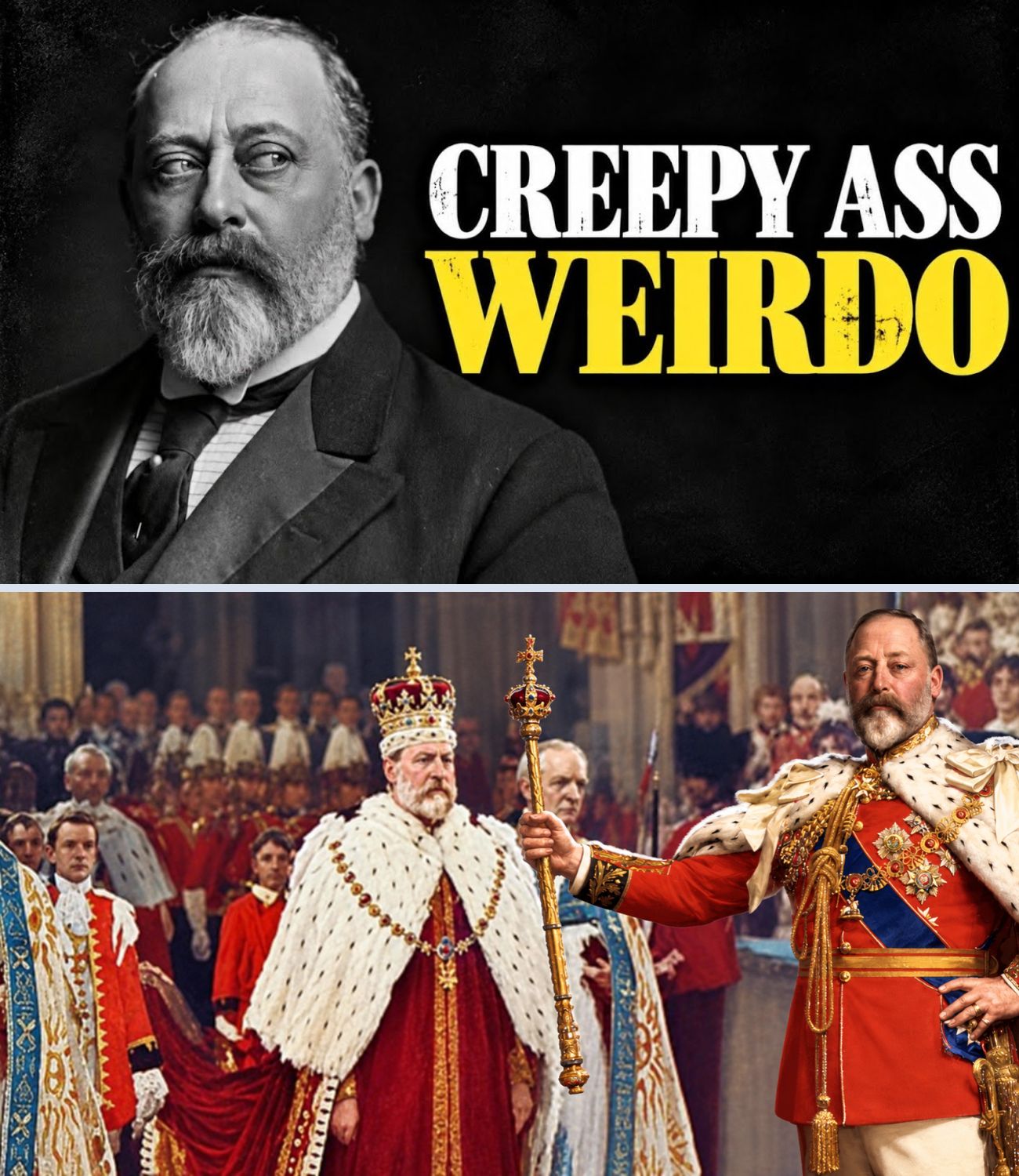
The marriage was solemnized at St. George’s Chapel, Windsor Castle on the 10th of March 1863. The treaty assigned Alexandra a jointure of £10,000 per annum and transferred a £100,000 dowry from the Danish royal house. Bertie’s parliamentary annuity was set at £100,000 per year. He was 21. Alexandra was 18. Victoria attended the ceremony from a gallery above the nave. She wore her widow’s mourning. She did not occupy the sovereign’s position. She watched from above, dressed in black, separated from the proceedings below by elevation and grief.
Sandringham House in Norfolk had been purchased by the Duchy of Cornwall in 1862 for £220,000 as a private country seat. Marlborough House in London served as the London residence. Six children followed: Albert Victor, George, Louise, Victoria, Maud, and a sixth child, Alexander John, who died within 24 hours of birth in April 1871. The crown’s dynastic requirement had been met. What Bertie would do with the remaining decades of his life remained structurally unresolved.
Victoria refused across the full span of her reign to permit her son any substantive access to state papers, government briefings, or political responsibility. Excluded from dispatch boxes, not consulted on foreign policy, not briefed on domestic legislation. He held the title of Prince of Wales for 59 years, the longest tenure of any heir apparent in British history. The heir to the most powerful sovereign throne on earth was given nothing to do. He found things to do.
The social circle that formed around Marlborough House became known as the Marlborough House set, an aristocratic network built around house parties, horse racing at Newmarket and Ascot, gambling, and a carefully maintained internal code that permitted adultery among members, provided that discretion held. Affairs were not only tolerated, they were expected, they were structured. Husbands looked away, names stayed out of print. The Prince of Wales sat at the center with the structural protection of his position and the disposable energy of a man who had been given money, social access, and nothing legitimate to do with his afternoons.
The British state paid him £100,000 per year to be heir apparent. It gave him the residences, the staff, the ceremonial functions. It then refused systematically to give him any of the actual work. He was funded and excluded in equal measure simultaneously. The Marlborough House set was not debauchery for its own sake. It was an administrative solution to a structural problem that Queen Victoria had created and refused to acknowledge. In certain circles he had acquired a nickname, Edward the Caresser. It was not a compliment. It was an observation.
The Marlborough House set had one rule above all others: discretion, not morality, not faithfulness, not even basic civic compliance, discretion. The code held because its violation carried one specific consequence, public exposure of the entire network. Every husband who had looked away, every wife received at Sandringham with an understanding attached, every member who had participated in an evening that could not be described in print. They all held each other by the same point. The system held as long as all of them held it.
In February of 1870, the system cracked. Sir Charles Mordaunt, 10th Baronet, Conservative Member of Parliament for South Warwickshire, filed for divorce from his wife, Lady Harriet Mordaunt, born Harriet Sarah Moncreiffe, on grounds of adultery with multiple men. Lady Harriet, moving freely in the same aristocratic circles as Bertie, had confessed directly to her husband that she had been intimate with several men. She named the Prince of Wales. Mordaunt threatened to add Bertie as a co-respondent. The inclusion never formally occurred, but the proceedings had gone far enough.
Bertie was subpoenaed. He appeared before the divorce court on the 23rd of February, 1870. He was cross-examined. He denied any improper relations with Lady Harriet. Letters between them, admitted into evidence, were not explicit enough to contradict his denial. He withdrew. The crowd outside booed him. Newspapers ran pointed commentary for weeks. The Privy Council noted the reputational exposure with alarm. A prince of Wales had been forced to stand in a civil court and deny adultery with a married woman of his own social circle. Whatever the truth, the structural damage was done in public.
Lady Harriet was subsequently found by the court to be of unsound mind. She spent the next 36 years confined to private residences and a succession of lunatic asylums. She died at Sutton, Surrey on the 9th of May 1906. She was 58 years old. The divorce case never properly concluded. The man at its center continued, but a second exposure was already building, one that would force the Prince of Wales into open court again in 1891, this time over an illegal card game in a Yorkshire country house.
Bertie traveled frequently to Paris where the protocols of the British court had no jurisdiction. By the late 1870s, his visits were organized around specific addresses. The most significant was Le Chabanais, a licensed establishment at 12 Rue de Chabanais in the 2nd arrondissement, founded in 1878 by an Irish proprietor. Bertie maintained a permanent suite there fitted with a copper-lined bathtub. Contemporary sources establish that he used this bathtub filled with champagne for involvement involving multiple women simultaneously.
He also commissioned a custom-built apparatus known as the siège d’amour, a purpose-engineered chair designed to accommodate his considerable physical bulk and permit specific arrangements with more than one partner at once. It was designed for him, constructed for him, used on repeated visits. After his death, it was purchased at auction and cataloged as a documented artifact of the period. This is not rumor. It is documented institutional excess.
In September of 1890, Bertie accepted an invitation to Tranby Croft, the Yorkshire country home of Arthur Wilson, a shipping magnate. The party included Sir William Gordon-Cumming, 4th Baronet, a lieutenant colonel of the Scots Guards who had served in South Africa, Egypt, and Sudan. Over the course of the evening, the party played baccarat, a card game declared illegal under British statute. Multiple members of the Wilson household independently alleged that Gordon-Cumming was manipulating his stake chips after each hand’s result was known.
Bertie presided over a private confrontation. Gordon-Cumming signed a document pledging never to play cards again in exchange for suppression of the allegation. 11 witnesses signed the same document. The secret held for approximately 5 months. In early 1891, it reached the press. Gordon-Cumming filed a writ for slander against the Wilson family and the other signatories. The case Gordon v. Wilson and others opened before Lord Chief Justice Lord Coleridge in June 1891.
Sir Edward Clarke invoked article 42 of the applicable procedural code to compel the Prince of Wales to appear as a witness. Bertie had no avenue of refusal. He appeared in court for the second time in 21 years. Gordon-Cumming lost. He was cashiered from the British Army. Every club, every house party, every aristocratic connection was severed within weeks. The Prince of Wales was not vindicated. He had been present at an illegal card game. He had managed a suppression agreement in private rather than reporting the matter to proper authority. He had obtained a signed silence from a decorated soldier, and watched the entire arrangement collapse when that soldier decided public exposure was preferable to quiet destruction.
The Archbishop of Canterbury, Edward White Benson, stated publicly that the association of the heir to the throne with illegal gambling was a matter of grave concern. Victoria wrote to Bertie, expressing her distress. The public agreed with both of them. Bertie’s popularity reached its lowest point in 20 years. He was 49 years old. He had approximately 10 years left to wait before the throne was his.
The women who occupied sustained positions in Bertie’s life constituted in practical terms a functioning parallel institution. Each moved within the Marlborough House set system according to its rules. Each occupied her position for a distinct period. The succession was not accidental. Lillie Langtry, born Emily Charlotte Le Breton in Jersey, introduced to Bertie in 1877, was already a recognized figure in London’s artistic world, painted by Sir John Everett Millais, and among the first women in Britain to appear in commercial advertising. Her understood relationship with Bertie lasted several years. When it concluded, Bertie provided direct financial backing for her professional theater career. She became one of the most celebrated stage performers in Britain and America. The patronage was the departure settlement.
But not every departure was that orderly, and the crown would eventually be forced to suppress Bertie’s private correspondence through legal intervention to prevent a national scandal that would have broken after his death. Frances Evelyn Maynard, the Countess of Warwick, known as Daisy, held the position from approximately 1889 through 1898, 9 years, the largest arrangement of that phase. After the relationship ended, Daisy Warwick converted to socialism, joined the political left, and in 1914 attempted to sell Bertie’s private letters to a newspaper. She demanded payment for their suppression. King George V intervened through solicitors. The letters were contained. The episode confirmed what the historical record had already implied: that whatever discretion the Marlborough House set demanded in life, it did not survive financial desperation in the years after.
Alice Frederica Keppel, born Edmonston, 29th of April 1868 at Woolwich, Kent, became the last and most institutionally significant companion. She came to Bertie’s attention in 1898. By February of that year, he was making open regular visits to the Keppel residence at Portman Square. He was 56. She was 29. Contemporaries described her consistently as possessing extraordinary social intelligence, beauty, and the quality Bertie prized above all others: discretion. Her husband George, categorized within the set as compliant, accepted the arrangement without protest. The king’s financial adviser, Sir Ernest Cassel, managed Alice’s personal investments. The structure was mutually workable. Bertie called her La Favorite. She traveled with him to Biarritz each year. She was received at court. She moved through royal occasions as a recognized figure with a recognized function.
Queen Alexandra was aware of all of it. Alexandra had, by the later decades of the marriage, constructed a formal private discipline around her husband’s conduct, an enforced strategic silence that kept the household intact and the institution functioning. She was not deceived. She was not passive. She had simply identified at some point in the long middle of her marriage that institutional continuity required a specific kind of patience. She exercised it with precision.
Queen Victoria died at Osborne House, Isle of Wight, on the 22nd of January, 1901. 63 years and 7 months of reign. Her son Albert Edward was 59 years old. He had been heir apparent longer than any individual in the recorded history of the British crown. He was proclaimed King Edward VIIth. The coronation was set for the 26th of June 1902. On the 14th of June, the king was diagnosed with perityphlitis, an acute appendicular inflammation requiring emergency surgery. The procedure was performed on the 24th of June. The coronation was postponed. He was crowned at Westminster Abbey on the 9th of August 1902. He was 60 years old.
His reign lasted 9 years, 3 months, and 12 days. But from the earliest months of the reign, his physicians were already tracking a respiratory deterioration that his tobacco consumption was making irreversible. The 9 years he held the throne were diplomatically active. A state visit to France in May of 1903 contributed to the conditions that produced the Entente Cordiale formalized on the 8th of April 1904. His family connections across the continent were not metaphorical. He was the maternal uncle of Kaiser Wilhelm II, the uncle by marriage of Tsar Nicholas II. His continental peers called him the uncle of Europe. The designation was genealogically literal. He was also in those 9 years working with the urgency of a man who understood precisely how little time remained.
But the body that had sustained 59 years of excess could not sustain the crown indefinitely. He ate four to five full meals each day. His waistline exceeded 48 inches. His physician, Sir Francis Laking, raised concern. It was not acted upon. He smoked 12 large cigars daily, supplemented by 20 cigarettes. By 1909, his bronchial capacity was measurably compromised. He refused to reduce his tobacco consumption. His physicians documented this refusal. The pattern held. By spring of 1910, bronchial collapse episodes were recurring. He was losing consciousness with increasing frequency. On the 2nd of May, he returned from Biarritz, his final visit to France, in a state of visible deterioration. He refused to suspend his public schedule. He conducted audiences. He received briefings. He stood for formal photographs. He continued because stopping was not a category his self-conception permitted.
On the 5th of May, he received word that his horse, Witch of the Air, had won at Kempton Park. He reportedly said:
“I am very glad.”
They were among his last coherent words.
On the 6th of May, 1910, King Edward VIIth suffered a succession of cardiac events at Buckingham Palace. He lost consciousness. He died at 11:45 in the evening. He was 68 years old. Queen Alexandra was present at the bedside. Earlier that afternoon, she had sent word that Alice Keppel might come. Keppel was admitted to the room. The visit was brief. Alexandra told the physicians to remove her. He was succeeded by his son, George Frederick Ernest Albert, King George V. The man the press had booed in the streets of London in the 1870s had by the day of his death become genuinely popular. His funeral drew nine reigning sovereigns to London simultaneously. The largest assembly of crowned heads in modern European history to that point. Kaiser Wilhelm II, who had feuded with his uncle for decades, wept publicly at the graveside. The city of London suspended its business. The streets were full.
9 years of reign. 59 years of waiting. Those are the numbers. The institution that had spent six decades refusing him access to the work his title implied now stood at his graveside in collective mourning, representing every state he had been quietly excluded from influencing. The crown had withheld the position. Then it buried him in it.
Let us step away from the formal historical records to speak plainly. When you look at Bertie’s life, not the crown, not the treaty terms, not the diplomatic maneuvers, but the actual life, you find a person who was told from the first coherent years of his existence that he was not what was needed. His parents wrote it down. They said it to each other. They built an educational system designed to manufacture the heir they required. And when the system failed to produce the right result, they did not examine the system, they continued to examine the son.
His mother held him responsible for his father’s death at 19. She referenced it in letters for the rest of her life. She kept him from the work he was born to do for six decades. And he responded, not with collapse, not with public revolt, but by building a parallel world, one constructed entirely outside the reach of institutional judgment, where he could eat and drink and travel and exist for a few hours at a time, as something other than a failed product of royal manufacture. He got 9 years on the throne. Nine years after 59 of waiting, and then he was gone. That is not a portrait of a weird man. That is a portrait of what happens when you spend 60 years telling someone their only function is to wait.
You Might Also Enjoy

“We Thought They Would Negotiate”—What Argentine Soldiers Said When The British Attacked Goose Green

“You’ll Never Finish My Ruck March, Limey” — US Sergeant Who Challenged the SAS, Then Fell Out First






