“Let Them Surrender” — The US Captain Who Ignored the SAS Warning About a Fake White Flag
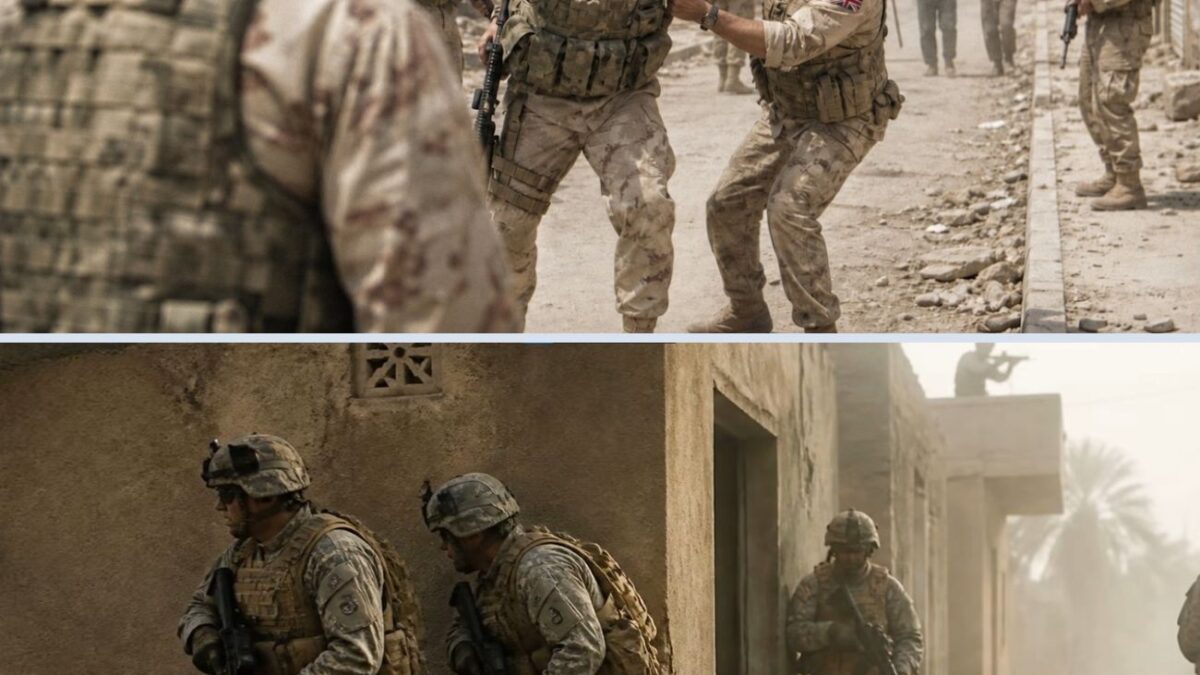
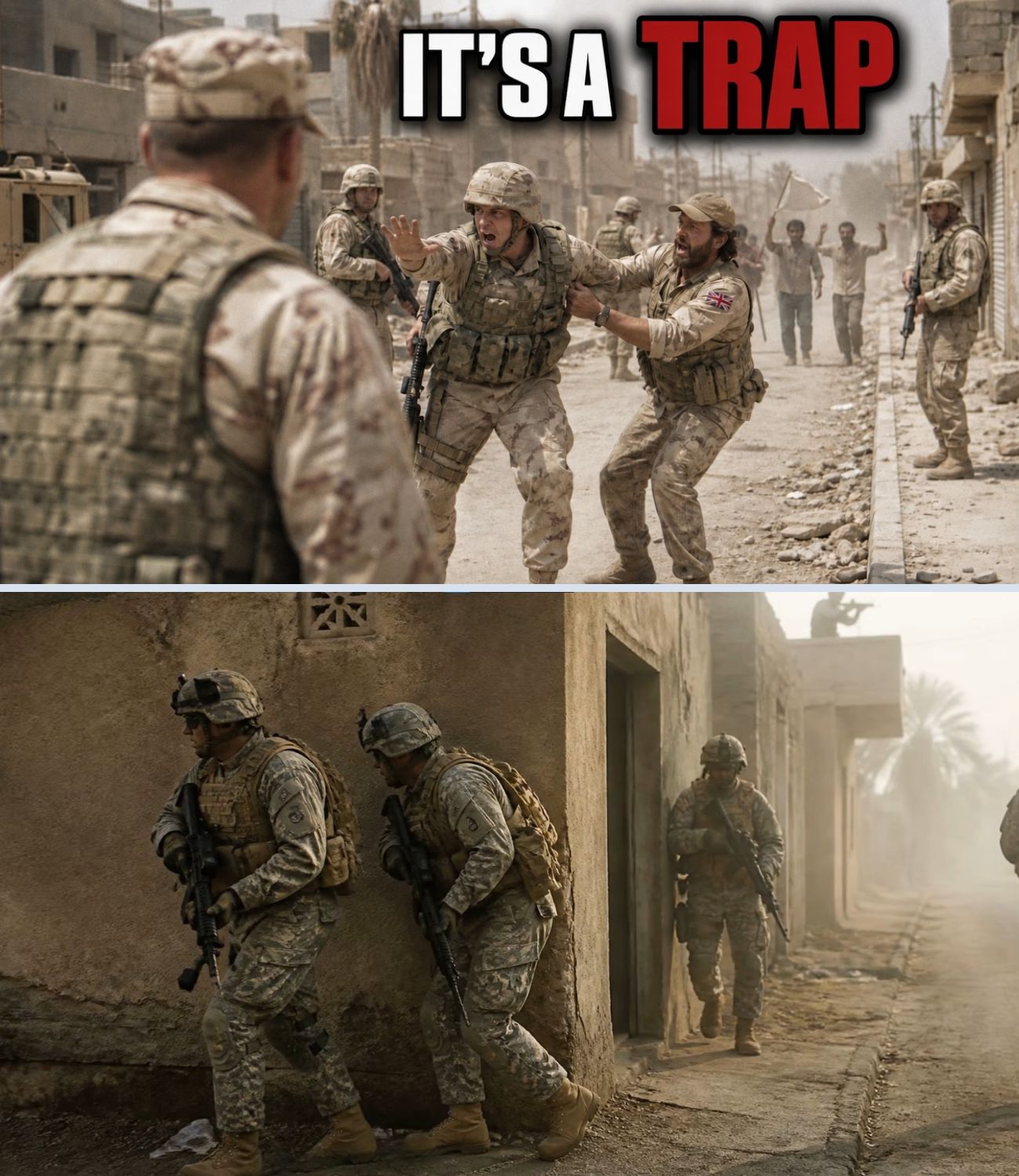
There is a street in western Iraq that was owned by a United States Army captain at 9:00 a.m., but no longer owned by him at 9:00 a.m., the next time anyone bothered to look. Three men walk it towards its border with their hands raised and a white sheet tied to a broom, and the British midshipman standing next to him says quietly and clearly that the hands are not the same.
“Let them surrender.”
This is Captain Dale Rickett, with a Ranger patch, a Bronze Star, two tours of duty in Afghanistan and one before that, talking to a man he was introduced to 40 minutes ago.
“They raised their hands. You British people see a ghost in every doorway. Step aside, Sergeant Major. This is an order.”
He will remember how he said it. He will be forced. The midshipman does not argue. He doesn’t raise his voice. He turns on the radio attached to his battleship, speaks six words that the Americans cannot hear over their own idling diesel engines. And then he does what in his craft is considered a scream, which is to freeze and watch.
Beside him, a bearded sergeant major with a union flag on his sleeve takes a short half-step forward and places his left hand on the ensign’s elbow, not pulling him, simply the way a man supports another man who already knows what’s coming next. The three men on the market road continue walking. The sheet flutters in the hot wind.
One of them smiles. Two— no. What Ricketts doesn’t know in the last pristine minute of his career is that the corporal from the regiment lying behind the parapet 200 yards down the street has already counted the fingers on each of those raised hands and has already told his sniper partner, in a voice gentle on the paper, which of the men will lower his hand first and which way the broom will fall when he does.
What Rickert doesn’t know is that his own translator, a Baghdadi who was a dentist until war took the city from him, heard one of the men at the edge of the border mutter a word in Arabic that is not a word used by the person giving the appearance. Rickert is unaware that the midshipman next to him has been doing this particular job, reading other men’s hands before they can lie down with them, for longer than Rickert has been wearing a uniform.
Rickert knows he has a Ranger card, a company, and orders to accept surrenders when they are offered. He gives the order to retreat. The midshipman does not retreat. The staff sergeant does not retreat. And 5 seconds later, on a street in a town called Al-Rafain, whose name no one at home will ever know, three raised hands come down together, and the morning ceases to belong to the United States Army.
The warning was given. The order to ignore him was given louder. The rest is what it cost. To understand why Captain Dale Rickert said what he said, you have to understand that the man who said it was not a fool. He was, by all the standards used by his army, a very good officer. 31 years old, a 1998 West Point graduate, Ranger School on his first try, three combat tours before he wore the captain’s badge: two in Afghanistan, one in Iraq, the second of them in Korangal in 2006, where he led a platoon down a terraced hillside under fire for 90 minutes to pull two wounded men and the body of a third, then came down the other side with a Bronze Star with a “V” for valor and a pin on his jacket that said, in careful Army parlance, that he was an officer who runs to the sound of guns. He had a badge, a medal, a command, and the respect of the people he brought with him to Anbar.
He was not a man accustomed to being told he was wrong by someone who had not outranked him in rank for a decade. He was also very tired that late summer. His company lost four men in nine weeks to roadside bombings. Three of them from the same department. And the fourth was a boy from Georgia whose mother Rickett had personally called from a forward operating base, and whose voice on the other end of the wire he had heard silently ever since.
Inside his helmet band, he wore a laminated photo of two little girls, his twins, which he showed to no one and touched twice before each patrol. He arrived in Al-Rafain with a reinforced platoon and a specific mission: to hold the market quarter while the civil affairs team delivered a message of reconciliation to the people.
And he arrived with the quiet confidence of a man who, somewhere between calls home, decided that he would not lose another soldier on this mission without accepting the helping hand extended to him – that’s when the British showed up and the problems began. Six men. Two stripped Land Rovers with open doors and dust-blackened roll bars.
An ensign in his forties with the sun-bleached look of a man who had worked in the desert since Ricketts was in high school. A staff sergeant with a beard that the rules did not forgive. And a union flag on Velcro on the left sleeve. The three soldiers, who moved around their cars like dock workers move around a dock, silently and without missing a step.
And a couple of snipers who had already gone into the city before the Americans finished parking. The warrant officer’s name was Easton Price. He spoke Welsh from the Swansea valleys. Squadron Master Sergeant in B Squadron, Special Air Service. 19 years in the regiment, five times as commanding officer in the Brecon Beacons.
Four previous rotations in Iraq. He was assigned to Operation Ricketts at the request of the coalition task force in a liaison role that was described in documents as advisory, which is the word armies use when they prefer not to say “supervisory.” That morning, he introduced himself to Rickett at the forward operating base with a nod, a handshake, and one sentence:
“If the hands are wrong, we hold on.”
Rickett said he understood. He didn’t understand. He saw six quiet men in dusty gear with no visible rank, carrying weapons he didn’t immediately recognize. Diemaco L119—it’s not an M4, although it looks like one if you don’t know what you’re looking at. And he saw the kind of restraint his service had taught him in another idiom, perceived as gentleness.
He saw the beard, heard the accent, and watched as the midshipman refused the offered coffee with the words:
“I’m fine. Thank you.”
And he put it all in the category he had worn since Fort Benning, which was: “allies, nice to have,” not the main goal. Six men in two Land Rovers against his reinforced platoon. And the point, he thought, was that his platoon was the point.
So when they entered Al-Rafain and three men came up the market road with a white sheet and their hands raised, Price leaned over and said in that same low voice:
“Captain, I would hold them at the border and strip them one by one. Their hands don’t fit properly.”
Rickett took this as a precaution for the sake of the cause itself. He took it as a British habit. He took it as the ensign’s reflex to turn every civilian into a threat, because the ensign had been doing it for too long and had stopped meeting people. And he answered loudly enough for his platoon sergeant, the executive officer, and Specialist Dupard from almost a .50 caliber to hear him clearly:
“Let them surrender. They raised their hands. You British people see a ghost in every doorway. Stand back, Sergeant Major. This is an order.”
First Lieutenant Garrett Hobel, his executive officer, muttered something in Latin under his breath that no one heard. Sergeant First Class Dale Oxbrough looked at the ground. Price didn’t say anything because Price had already turned on the radio.
This is the person who said it. This is the morning that said it. Now look what happens next. Al-Rutba in late August 2006 was a city half forgotten by the war and half remembered at inconvenient moments. It was located on a wadi south of the Euphrates, 40 km from anywhere the journalist went. The buildings were the color of weak tea, mostly two-story.
Their roofs, a flat crust of concrete and rebar, jutted out, as if they were sticking out, as if onto a second floor that no one had ever built. A row of date palms stretched along the eastern edge of the market road, dusty gray from the heat. And at the far end of this road, the half-finished minaret of a half-finished mosque cast a short, sharp shadow on a wall that no one was painting.
The air smelled of diesel, goat meat, and the sweetest rotting fruits that had been lying on carts for too long. The ginger cat watched the convoy approach from the top of the parapet, and did not move. The Americans dismounted in order. Rickett’s platoon knew its battle tactics. Hobel pushed the first fire crew to the north corner. Oxbrough put the 50 on the front-running Hummer, with specialist Rene Dupard behind him. And the second team dispersed, setting up a boundary on the market road 150 m away. Ricketts himself took his place in the center of the group behind the leading vehicle, Price two paces to his left and Farris Aldulaimi, the interpreter, three paces behind.
It was a textbook, and the textbook matched exactly what the textbook saw. The soldiers from the regiment did nothing like the Americans. Staff Sergeant Hollis Travaskis, the bearded deputy commander, had positioned one Land Rover at an oblique angle to the first, so that from the market road side the two vehicles formed a shallow V-shaped line, sending anyone who tried to run through them into the intersecting field of fire, and no one on the British side would have to move.
He did this without being asked, without saying anything, and, as far as Ricketts could tell, without looking at any of the cars while doing so. In his hip pocket he held a tattered tobacco tin that he hadn’t opened in four years. Private Edris Bickwell, the youngest of them, had swum 12 meters from the near corner of the area to Rickett’s right and was standing in a doorway that no American on the border had cleared, because Bickwell had already looked inside and knew who was there: a woman, three children, and a goat on a rope.
The woman saw him and saw that he saw her, and began to grind something in the bowl again, which was the only important assessment of a soldier’s work in such a city. Bickwell, who had learned Pashto from a shopkeeper in Cardiff and still wrote to him, said nothing to her because there was no need to.
A pair of snipers, Sergeant Marek Oval and Corporal Noah Lindon, disappeared. They disappeared in the regiment’s specific way, which is not to hide, but to go where the casual eye does not go. Lyndon, the proofreader, lay on the flat roof of a building that was not the tallest on Market Street, but had the best view of both ends of it.
With his bergen as a stand and his elbows on a folded shemagh so the hot concrete wouldn’t burn his sleeves. Taped to the inside of the lid of his range card wallet was a baby tooth that his daughter had left in a saucer six months ago. Oval, the gunner, was 2 meters behind him, with the L115 on the bipod and the muzzle in deep shadow, which is the only thing that matters at distance.
In his left breast pocket, folded flat, lay the same tattered Patrick O’Brien novel that he took with him on every business trip, never reading beyond chapter nine. Neither of them sweated much getting there. They took up position before the Hammer, leading under Rickett, came to a complete stop. They will take position if nothing happens within the next five hours.
They will take position if something happens within the next five seconds. Price stood next to Rickett and remained silent, which Price did on purpose. In his left breast pocket, under his flak jacket, lay the Swansea City badge, worn on his thumb, which his son had given him before the first team, and which he had yet to see any reason to take off.
Faris, who had been attached to the British elements for a week, approached Price under the pretext of asking if the midshipman wanted water, and Price, who did not need water, took the bottle anyway, for Faris never asked such a question when he had no reason to. The two men froze for a moment on the edge of the car.
Faris, shielding his eyes from the sun with his hand. Price bit the inside of his cheek. And Faris said in English, quiet enough to belong only to them:
“A man in a blue shirt by the second booth. He’s watching our cars, not our weapons.”
Price nodded once, the way a man who already knows nods.
“And the hands,” he said in an almost conversational tone.
“Hands,” Faris said.
“The civilians who came to surrender,” Price said, “hold their hands up as if to show they’ve missed something. Palms facing outward, fingers spread wide, elbows relaxed. Men who hide something behind their backs hold it as if they are still holding it. Fingers are bent, palms are bent at an angle, elbows are bent. You can see it from afar if you know how to look.”
Faris didn’t look at Price. He looked at Market Road. Then he looked at the man in the blue shirt. Then he said:
“Men who are leaving, if they come…”
“If they come,” Price said, “you look at your hands.”
Rickert, who was standing 4 feet away, didn’t hear it. He heard the end, the words “watch your hands,” and he hid the document in the same drawer where he had hidden the ensign’s document: “I’m fine, thank you.” And he returned to Gobal and asked for a report on the situation from the northern corner. Lyndon’s voice, from the roof, echoed through the grid at a volume so loud it would have been impossible to hear in the kitchen.
“Nine, proofreader. Three figures, 270 m, Market Road, moving along the border. One has a stick with a sheet, white, hands up.”
Price adjusted his device and said:
“Hands?”
There was a pause, maybe 2 seconds. Lyndon said:
“Reading.”
Another pause, then:
“Wrong.”
Price closed his eyes for 1 second and opened them again. He said:
“In the net. Wait. Confirmed.”
This time it’s oval, flat like a board.
“Confirmed.”
“Left-handed, fingers clenched, right elbow locked. Central, broom in the wrong hand for a right-handed person. Right-handed, left wrist behind hip when he thinks no one is looking. All three are wrong.”
Price opened his mouth to speak to Rickett, but Rickett, seeing the ensign’s lips move and already deciding he knew what he was going to say, interrupted him:
“Put them at the border. Hands up. Ferris, tell them in Arabic not to advance and move on.”
Ferris looked at Price. Price said in English so the Americans could hear:
“Captain, I will stop them at the border and strip them one by one. Their hands don’t fit properly.”
The three men on the market road were already 180 meters from the border and were approaching. The slope rose in the hot wind. Somewhere a goat was complaining. The ginger cat on the parapet stood up, turned around twice, and sat down again with his back to the whole scene, which was the last unsentimental review Captain Rickett was to receive this morning. Rickett looked at the three raised hands and saw hands.
Price looked at the three raised hands and saw a lie. The three men on the market road were 150 meters from the border when Price said a second time:
“Captain.”
He said it the way a person says the name of a horse that is about to step on a nail. Ricketts did not turn his head.
“Sergeant Major, I gave you an order.”
“This order,” Price said, “will kill one of your soldiers in about 40 seconds, sir.”
This made Ricketts give up. But that didn’t make him change his mind. He commanded for seven months. He had been under fire a dozen times, and never once had a non-commissioned officer spoken to him in the tone the warrant officer had just used. The tone was not defiant. This was the problem. Was that the tone a doctor uses when he directly tells a patient what will happen if the patient doesn’t sit down? It was a tone that implied that the room already belonged to the person speaking, and Rickett, who had earned his room one Afghan slope at a time, was not about to lose it to a man with a dusty beard who hadn’t even bothered to pin a title to his sleeve.
“Let them surrender,” he said loudly, so that Gobal could hear it, and so that Oxbrough could hear it, and so that Specialist Dupard on Route 50 could hear it. “They raised their hands. You British people see a ghost in every doorway. Stand back, Sergeant Major. This is an order.”
Price did not back down. Instead, he turned on the radio and spoke a sentence into it that would be read aloud in three weeks in a conference room in Baghdad, presided over by a colonel who had never been to Al-Raffahine, while Ricketts sat in the second row, not looking up.
“Sunny Charlie, it’s nine. The hands are wrong. I repeat, the hands are wrong. Keep the lever in the open position. Accepted.”
A pair of snipers confirmed this with two clicks. Trevaskis confirmed, slowly moving from the nearest Land Rover to a position 6 feet closer to Executive Officer Ricketts so that when it happened he would be between Hobal and Market Road. Bickwell, standing in the doorway, shifted his weight from his back leg. The woman who was grinding in a bowl had already taken her children to the inner room, for Bickwell had ordered her to do so with a slight movement of two fingers. Ricketts noticed none of this. He watched the three hands raised: 120m, 100.
The man in the center with the broom was now smiling broadly, the kind of smile you might see in a shopping town seeing a cousin after a long absence. He was shouting something in Arabic. Farris, standing behind Rickett, translated in a tired voice:
“He says, ‘We are peaceful.’ We are peaceful. Don’t shoot. We are peaceful.”
“See?” Rickert asked.
He didn’t quite look at Price. Price did not answer.
“-80 m. -70″.”
The left-handed man’s right elbow still didn’t move, not once. A man who has walked 300 m with his arm in the air moves that arm. He displaces her. He changes his shoulder. He lets his elbow bend when he thinks no one is close enough to see. This man didn’t do that. His hand was raised because something behind him demanded it. And what required this was not relief at the sight of American soldiers.
“—60 m. —Upstairs, on the roof,” Lyndon said very quietly. “The other man, waist-deep, under the sheet, is typing.”
“—Noticed.”
Price said into the radio:
“Permission to move.”
Then, adding loudly to Rickert:
“Captain, their hands are down in 3 seconds. You must tell your 50th to move left on my command.”
“Delay,” Rickert said sharply.
“—No one is shooting.”
“—These people are giving up.”
Specialist Dupard, 19, looking down the market road through the scope of his heavy machine gun and who hadn’t been in Iraq long enough to have earned an opinion, said quietly:
“Sir, the left guy’s elbow.”
“—What?”
Asked Rickert, his senior non-commissioned officer Oxbrough, who was looking at the same elbow, said:
“One word.”
“—Captain.”
It was the word that mattered, not Price’s word. Oxbrough. Because Oxbrough worked with Rickert for 11 months, knocked a bullet through a ceramic plate for him in Korengal, never once questioned an order in front of people. Oxbrough said “captain” just as Price had said it, and Rickard heard for the first time what hung in the air, and what everyone but him had heard for a minute and a half. He opened his mouth to say “step aside,” this time meaning it, meaning it for everyone. The hands dropped. They lowered themselves together, the way hands lower when three men count in whispers. The broom fell to the side. The man in the middle was no longer smiling.
The left man’s right hand reached behind his back and pulled out a long-barreled Kalashnikov, which hung on his spine under his dishdash and would have been visible if someone had looked at the shape of his back rather than his face throughout the approach. The man on the right got the second one from the same place. The man with the broom fell face down. Specialist Dupard did not fire. Dupar was not ordered to shoot. Dupar was 19 years old and his captain had just told him that no one had fired. The rifles opened fire from a distance of 50 meters in fully automatic mode near the border.
The noise was like the heavy, dry stuttering of poorly cleaned Kalashnikovs up close, and the air above the Hummer was filled with dust, bouncing off the sun-cracked hood of shells. Dupar pierced the plate near the seam of the collar and flew back from the gun. Two more shots passed through the engine block of the main machine and knocked out the radio in Hobel’s hand.
“—From the roof,” Lyndon said. “Nine, proofreader, into battle.”
And after 52 seconds of absolute stillness, Oval fired one shot that hit the left-hander in the base of the throat and knocked him down like a sack. The second shooter turned to run. Travaskis, who had covered the 20-meter gap between the Land Rover and the Hummer parked nearby, no one noticing his movement, fired two shots from his L119 into the second man’s thigh and shoulder from a kneeling position that Ricketts could not see.
The man with the broom, lying on the road, began to crawl. Price walked past Ricketts, not around him, but past him. Close enough for his shoulder to catch Rickett’s battleship, and he stepped out from behind the Hammer towards the man on the ground. And he did it at the speed at which a person walks to pick up a dropped tool.
Behind him, Bickwell had already emerged from the door and was moving from the flank. For 40 seconds, the man with the broom was handcuffed, face down, with Price’s knee between his shoulder blades, and Price spoke Pashto to him out of habit before correcting him to Arabic through Farris. And the broom lay in the dust with the sheet attached, because no one had bothered to pick it up yet.
Specialist Dupard was alive. The plate held up. The shot broke his collarbone, knocked out his breath, and left a bruise he would carry for a year. But he was alive. And he was alive because Price told Travaskis to be six feet closer to the senior officer. And because Ovil had already decided which throat to shoot at before the throat decided to shoot.
Rickett stood where he stood. He was still right. Hobel, his senior officer, glanced at him once. And Hobel’s face at that moment was the face of a man who had just realized, before his captain, that the morning now belonged to someone else. And that was only the first time that day that the captain was wrong. 3 minutes after Dupard fired his heavy machine gun, Captain Rickett did what his training had told him to do, namely seize the initiative.
He ordered his platoon to advance along the market road in two sections with a heavy gun on guard to clear the border from the first sharp corner near the closed pharmacy and to fortify the half-finished mosque at the end as a line of operation. It was an order to storm, like in a textbook. This was an order he had given in another valley two years earlier and for which he had been rewarded.
This was the wrong order for Al-Rafa’in, because Al-Rafa’in was not a hillside. Al-Rafa’in was a city, and the men who had set up the ambush did not set it up with three arrows on the market road. Three shooters on the market road became the trigger. The ambush waited for Rickett’s reaction to the trigger for a precise squeeze, on the exact street as the textbook demanded, and waited in windows, doorways, and rooftops that Rickett had not cleared because Rickett was dealing with the surrender he had been promised.
Price, kneeling over the man in lightning-fast handcuffs with a broom, saw the order come through the mesh and looked up.
“Captain,” he said in that same patient voice, “don’t lead your men down this road.”
Ricketts, who had just shot a specialist on orders he had given, was in no mood.
“Sergeant Major, I need to clear this city. I’m not going to sit in this border while whoever did this walks out the back door.”
“They won’t come out the back door,” Price said. “They are waiting for you to pass in front. You have at least four shooters in the first-floor windows between this place and the pharmacy, and a ribbon shooter on the roof of the mosque. I can see two of them from where I’m kneeling.”
“Then identify them and I’ll put 50 on them.”
“The 50,” Price said, “won’t start firing until the tape fire starts on your forward section. First you need a roof. You need to take the roof off people they’re not watching. They are watching your people.”
Ricketts clenched his jaw. He had something between Dupin’s fall and this conversation went from confidence to another kind of confidence, which was the confidence of a person who has made one mistake and intends not to make another, pretending to be led.
“Then I’ll clean the roof,” he said. “Oxbrough, take the first division.”
“—Captain,” said Oxbrough.
This was the second time. Oxbrough was not a man who shouted “Captain” twice a day. Price didn’t wait. He turned on the radio.
“Nine nobles, push two to the back…row. Take over the roof of the pharmacy from the alley. Watch, stay on the mosque line. Act on my challenge. Faris, with me.”
Trevaskis has already moved. He crossed the road at full speed, which no one on the first floor would see, because no one on the first floor was watching for Land Rovers. They were following the Hummers. Bickwell went with him.
The third policeman, a tall man named Karu, who had been doing nothing but standing still, jumped out into the alley. In 40 seconds, the three of them were in a doorway that Ricketts didn’t know existed, and in another 90 seconds, they were on the roof of the pharmacy. Two stories above Market Road, Ricketts, standing next to his Hummer, heard three muffled gunshots, one after the other, from somewhere to his right. Lyndon, on the far roof, said into the net:
“The pharmacy roof is free. Two are scored, one is pinned. Travaskis from the roof of the pharmacy, visible on the line of the mosque. He didn’t see us. Price, hold on.”
He turned to Rickett.
“Captain, push now. The roof of the pharmacy holds you to the right…a flank and a couple of snipers holding the mosque, a barrage of fire is yours when you need it.”
Rickett looked at Price. He looked at the roof of the pharmacy. He looked at the mosque. He looked at the half-dozen windows between him and the end of the market road and wondered how long it would take his first detachment to clear them with a frontal assault.
The honest answer was that his first division wouldn’t have been able to clear them. His first division would suffer three losses in the first 30 meters and would be pinned down on the corner of the pharmacy. And the ribbon firing at the roof of the mosque would fire at them in an enfilade as much as the ammunition would last, which, based on the pace of fire waiting to be unleashed, would be enough.
He didn’t say anything about it. He said:
“Press on my team.”
And he ordered his first detachment to attack the roof of the pharmacy, holding the right flank. The branch is gone. They took the first house in 60 seconds. They took the second one for 40. The tape aimed at the mosque did not fire because the Oval hit the shooter in the mouth from a distance of 420 m before the shooter had time to realize that his line of sight was no longer his.
Two more gunmen tried to open fire from a first-floor window 20 meters from the start of the attack, and were shot down by Travaskis from the roof of the pharmacy with a crossfire that Ricketts, if he had been watching, would have found hard to believe. Ricketts didn’t look. Ricketts listened to the radio, looked at the map, and held his jaw very carefully, because he had just received the correct order from the man he had ordered to stand down 40 minutes earlier, and because he kept his face still enough that no one would notice him thinking about it.
Hobel next to him muttered something in Latin. Oxbrough on the other side of the Hammer said nothing at all. Schoolgirls in shorts, he…called them. That morning back at the forward operating base, not out loud, not to Price, but to Gobel over coffee. When he was pointed out the British element through the car park – schoolgirls in shorts – the phrase came to mind again.
Now, standing in the shadow of his Hummer, listening to Diemaco’s muffled cough from the roof, which he hadn’t thought to release as his first squad advanced down the street that 4 minutes ago he had been ready to blindly follow them down. He didn’t repeat it again. The first squad reached the pharmacy corner at 12:10. By that time, two of Rickett’s men had been killed. A specialist named Keene with a bullet in his thigh, being dragged into a doorway by the squad leader, and a private named Olmos, who had been ricocheted in the face and was bleeding into his folded hands, with the special silence of a man trying very hard not to scream. None of them will die. Both will remember this morning for the rest of their lives.
Ricketts himself went to the pharmacy corner, because that’s what…He decided to become a captain, which he did. He took Gobel, Oxbrough, and two riflemen with him and advanced 120 meters under the watch of the pharmacy roof, managing a range of five and ten, which he did well, because he had done it before on worse terrain.
When he reached the corner, he knelt by the shutter, turned on his radio, and asked Price over the network for an update on the end of the street by the mosque. Price did not answer. Instead, Trevaskis answered from the roof of the pharmacy directly above him:
“—Captain, there are still two shooters operating in the courtyard from the side of the mosque, and we have a wounded man. One of yours is on the street between us and them. He went forward during the last jump and didn’t move.”
“—Rickett’s stomach clenched.”
“Who?” he said.
“—Can’t identify from here, sir. Young guy. It is in the open air about 40 meters this side of the mosque gate. It doesn’t move. We are watching.”
Rickett turned and looked down Market Road toward the border and the image of his platoon he carried in his mind: Keene, Olmos, Dupar already below, the two squads in the middle buildings.
The first compartment ahead of him had re-formed, and he couldn’t immediately find a face that wasn’t there. Then he was able to. Then he understood. Specialist Rene Dupar was 19 years old, from a town in Louisiana that Ricketts couldn’t find on a map, and he wrote his mother’s name on a piece of paper every Sunday because he hadn’t grown up with the habit of using a telephone.
Dupard was knocked out of the gun during the first salvo by a shell that shattered his collarbone, and Dupard, who had been patched up by the platoon medic and ordered to stay on the border, decided somewhere in the chaos of the onslaught that he was not going to stay on the border. Dupard went forward with the second squad and in a final dash crossed the line of advance of his fire team and walked another 20 meters on his own, because he saw movement in the window, and because he was 19, and because somewhere in it… He decided that after he had already been shot down once that morning, he would not fall again.
He was shot down again. He was alive. Travaskis could see him breathing through the scope. But he was in the open line opposite the two shooters in the mosque courtyard, and as soon as someone from the pharmacy side tried to come up and grab him, both of those shooters had to open fire, because they had been watching Dupard breathe for 90 seconds and waiting for the second American to come up to him.
Rickett said into the radio:
“I’ll grab him.”
The price instantly appeared online:
“—You are not a sergeant major, Captain. Listen to me. If you go this way, they will shoot you. Then they will shoot him. Then they will shoot whoever comes after you. We will catch your soldier. Hold your ground.”
“—He is my husband.”
“He’s my job,” Price said for the next 6 minutes. “Hold your position.”
Ricard held his ground. He held it because Oxbrough had put his hand on his strap and wouldn’t take it off. He held it because Hobel, who was standing next to him, had already drawn his Beretta and was watching the mosque at the end of the road through a crack in the shutter, muttering something under his breath in the Latin one utters when there is nothing else to say.
He held her because, over the course of 90 minutes, he finally realized that the warrant officer whose order he had canceled at 9:00 was leading the battle that he, Captain Dale Rickard, had started and failed to finish. He was watching. This is what he observed. Price was coming up the market road, not along it but through it, actually through the wall, because in the previous 30 seconds, without asking him, Bickwell had taken the sled to the back of the courtyard three buildings from the drugstore and made a mousehole into the next complex, and then the next. Price went through four complexes in 2 minutes, never showing up on Market Road.
On the fourth, he stepped into a doorway 12 meters from Dupar. Trevaskis’s voice echoed in his ear, telling him where the two shooters were looking, which was still from the pharmacy side, because the shooters hadn’t yet realized that the man they were waiting to kill was no longer coming from the direction they were watching from.
Ovel from the far roof held the first shooter in the air at a distance of 400 m. The second shooter had 1 second to decide what had happened. In that second, Price emerged from the doorway, covered the 12 meters to Dupaard at a pace that wasn’t quite a run, took Dupaard under his arms, and pulled him back into the doorway, never once breaking the line of sight that Trevaskis maintained at the second gunner’s position.
The second shooter stood up to hit the moving target. Trevaskis shot him through the sternum from the roof of the pharmacy. Dupaard, whose eyes were open and mouth was moving, was in the compound 43 seconds after Price emerged from the mouse hole.
The medic approached him from the pharmacy side after 2 minutes and said the words that he would live in.. hearing the three American soldiers who passed them along the network in the order in which they heard them. Ricketts heard them on the radio. He didn’t turn on the radio for confirmation. He put the phone down on the cracked concrete by the shutter and looked at his shoes for maybe 6 seconds, and when he looked up again, Hobel, who had been his executive officer for 7 months and who had so far been doing his job during this trip, wasn’t looking at him.
Hobel looked down the market road at the mosque, and Hobel’s lips moved, and the Latin he was now muttering was not nervous. It was a prayer for Dupaard, or perhaps more likely, judging by the expression on his face, for the man who had just followed him. That’s when Rickett stopped arguing.
At 10:34, the first unit of the US rapid response task force arrives at the assembly point a kilometer east of Al-Rafain, and Major Brennan Vale, the operations officer of the task force to which both Rickett’s company and the British unit are attached, already has his boots on the ground. and his hand on the hood of the Hummer, and the stopwatch he habitually wears on his left palm.
He was a West Pointer, Vail. He was once a goalkeeper. He still catches dropped mugs in midair without thinking. He read the network traffic coming from Al-Rufain for the past 41 minutes, and during that trip he made a decision that would have taken the colonel a week to make under other circumstances.
The solution is that this city will be cleared now, before whoever set up the ambush consolidates. It will be cleared by the element that has been fighting on the ground for the past half hour, and the captain from whom it will be cleared will stand at that boundary and watch, because the captain has a wounded man at the door and two more at the casualty collection point, and because Task Force Major Weil has decided in the quiet of his head not to lose the seventh soldier in Al-Rufain because of a plan that the captain very clearly no longer has.
He takes Ricketts aside near the border. He does this with his back to the men so that…The platoon can’t read anything in the body language. He says:
“Captain, your unit is holding the border. The British unit clears seven buildings on both sides of the road, from the pharmacy to the mosque. Price is in command of the cleanup. I’m going to time it because the depot manager in Baghdad is going to ask me how long it took, and I’m going to tell them.”
Rickett says:
“Sir.”
Vale says:
“Do you have anything to add, Captain?”
Ricketts says:
“No, sir.”
He returns to the border. He is standing by the nearest Hummer near Oxbrow, where Dupard shot at 9:00 AM. His hand reflexively reaches for the end of his helmet, where lies a laminated photo of his two daughters, which he has worn on every patrol for 16 months. He taps it once. His hand stops. He doesn’t tap it a second time.
At the end of Market Road, where the pharmacy was, Price lines up his unit without saying anything. Travaskis attacks with a left hand with Bickwell and Carew. Price in the center, Ferris three steps behind. Orville and Lyndon. Long observation from a distant rooftop. Six men, including the translator, near seven buildings. Two confirmed positions with tape feed. Unknown number of shooters. And the street where four Americans died in just 40 minutes.
Price carries out orders for the group in a voice that Ricketts, 240 meters away at the border, cannot hear. It takes him 40 seconds. He had run this in some form in the Welsh forest, in the Herefordshire murder house, in a dozen similar towns, several hundred times. Major Vale stands 20 meters from Price with a stopwatch in his left hand.
Price looks at him. Vale nods. Price says:
“On me.”
Vale clicks the stopwatch. What happens over the next 6 minutes and 41 seconds is not a battle in the sense in which Rickett is trained to understand battle. This is a sequence. Each movement points to the next. Nobody screams. Nobody fires stray bullets. Two long-barreled guns on the far roof hit four shooters in the first 90 seconds at distances of 300 and 420 m through windows that look identical to all the other windows from the market road.
Travaskis’ team captures the first house in the comic with a stun grenade and three shells in that order. And the shooter on the first floor of the second house, who bends over to see what happened in the first house, is already lying downstairs when Travaskis’ second man walks in his door. Because the Oval hit him in the base of the skull at the exact moment Travaskis’s boot touched the floor beneath him, which isn’t luck, it’s consistency.
Price personally enters the third house with Bickwell on his hip, and does so through a mousehole that Bickwell has opened with the help of…a sled. Because Price decided that the front door of the third house was the one with the wire on it. He is right. The wire leads to an artillery shell buried in the hallway floor, and the shell doesn’t explode because Price enters through the kitchen.
Travaskis clears the fourth. The fifth one clears the punishment. The sixth house is the one where a shooter with a belt gun stands on the roof, who, since the first volley at the border, has been waiting for a target that he has not yet been able to see. And Oval shoots the shooter in the throat from 400m at the exact moment Price’s team enters the first floor, because Oval had been holding this shooter’s throat for the previous 20 minutes and was just waiting for the moment when the shooter’s hands would rise to the gun.
The seventh building is the courtyard of the mosque. There are three men in the mosque courtyard, and as Price’s element passes through the back wall of the adjacent compound, because Price correctly decided that no one setting up a fake ambush for liberation would…expect an assault through the back wall of the mosque courtyard, the three men raise their hands.
Price reads their hands in half a second. He reads them twice because he doesn’t want to make the same mistake Ricketts made at 9:00 in the other direction. He reads them for the third time. Their hands are correct. He takes them alive. Farris talks to them on his knees while Travaskis and Bickwell clear the inner building and Caru holds the back wall.
“Men on their knees are not fighters,” Faris says a minute later. “They are the brothers of a man with a broom. They had been locked in the mosque’s pantry since early dawn. They are very scared.”
Price lets them get up. Behind him, at the border, Major Vale looks at the stopwatch in his left hand. The number on the stopwatch shows 6 minutes 41 seconds. Twenty yards from Vail, Captain Ricketts stands, his hand off his helmet strap, his eyes averted from the mosque, listening to Hollis Trevaskis’ voice on the internet, repeating the words Hollis Trevaskis has already spoken after 41 previous clearance operations in his career.
“The last building has been cleared. Four wounded Americans recovered. Number of enemies–11. There are no losses among our members. 6:41.”
Vale says out loud to everyone and to no one. He doesn’t look at Ricketts. He doesn’t need to. He writes the number on the back of his left hand with a marker because he doesn’t trust the stopwatch. And because he’s going to bring that number to a conference room in Baghdad in 3 weeks and read it firsthand.
The warning was given at 9:00. The order to ignore him was given at 9:00. The street was retaken at 10:41. 6 minutes 41 seconds from the stopwatch click to the end of the network call.
“The shooters,” Price said at 9:00, “were wrong. The arrows at 10:41 were correct.”
The difference between them was that Captain Dale Rickett was going to spend the rest of his career not mentioning it. They forced him to watch. Not intentionally. No one in Price’s element spent a single word on Ricketts for an hour after the mosque was cleared. No one looked at him.
This, in its own way, was worse than when he was being looked at. The British forces did what the British did at the end of every clearing, which was to consolidate, photograph, search, mark, call in a helicopter for the wounded, and slowly walk the ground once more, just in case the ground had anything more to say.
Price did not go down the market road to the border. He remained at the edge of the mosque, kneeling beside one of the men they had captured alive, with Farris at his side. And he talked to the man for 20 minutes in the quiet, patient voice of a person who was in no hurry.
Rickett stood at the border. He watched as teams carried out his wounded on stretchers. Dupard passed him on a stretcher, unconscious, pale, and a medic with an IV walked next to him.
Dupard looked at his captain and said nothing. Next came Keane, and then Olmos with a bandage on his face. Each of them was carried past Rickett at a slow pace, and Rickett kept his face still, waiting for each of them, for it was the only thing left for him to do in the morning.
Major Weil came over and at some point stood next to him. Weil didn’t look at Ricketts either. Weil was looking down the market road at the mosque, the tag number still on the back of his left hand, and after a while he said in a voice that wouldn’t be heard past the hood of the Hummer:
“Captain, there’s going to be an inspection. You will be invited to it. A number of things will be discovered during the inspection. One of them would be that you overturned a correctly given warning to your soldiers from a liaison officer with 19 years of specialized experience for the exact scenario that occurred at the time. Do you understand me?”
Rickett replied:
“Yes, sir.”
Weil said:
“I’m not going to say anything else right now. You can hear it in Baghdad.”
He left.
Faris approached from the direction of the mosque about 10 minutes later. He wasn’t asked for it. He stood beside Rickett for a long time, holding a small notebook open to his hip, and said, in the careful English of a man who learned the language in dental school in Baghdad before the war took the city from him:
“Captain, the man we took alive, the one in the courtyard of the mosque, he was the brother of the man with the sheet on the stick. He told the ensign how the ambush was organized. He said something that I have to tell you.”
Ricketts said:
“Yes.”
Faris said:
“He said the person who paid them told them that Americans always accept surrender. He said they were told the British would not accept, but the British were only six men and the Americans would be in command, so the surrender would be accepted. Here’s the plan.”
Ricketts was silent. Faris closed the notebook in a moment and went back to the mosque. The last thing Ricketts was told in Al-Rafain that day was said by Sergeant First Class Dale Oxbrough, who had fired a shot through the plate for Ricketts in Korengal, served under him for 11 months, and in all that time had said nothing to him that was against the rules.
In his hip pocket, Oxbrough carried three batteries he didn’t need, a habit left over from a friend who had asked for them.
“Sir, I will go with you to Baghdad,” Oxbrough said.
Rickett said:
“You don’t have to, Dale.”
Oxbrough said:
“No, sir. I know.”
That was the end of the conversation. Three weeks later, in a conference room in Baghdad, where a map of Al-Rafain hung on the wall and Major Wyell’s hand, stained with marker, held a stopwatch for a colonel who had never been there. The report on the consequences was read aloud by the staff officer in an even voice from a thin folder.
The report was written by British elements and signed by their commander, Lieutenant Colonel Horse Fenniman, who signed it with a fountain pen, which was his habit, and which, in the barn at Credenhill, belonged only to him. The report was 11 pages long. Only one line of it survived the review, because the presiding colonel read it twice to make sure.
The line belonged to Horse Fenniman. It read:
“The warning was given at the right volume. The order to ignore him was given with the wrong message.”
Rickett, sitting in the second row, did not look up. He retained command. The Army doesn’t discharge a captain from the Bronze Star because of one bad morning, unless that morning ended in the death of an American.
He retained his command, retained his service, and returned home for Christmas. And, as far as anyone who served with him afterwards could tell, he never again in his career told a non-commissioned officer that he saw a ghost in the doorway.
He did not become a follower of the regiment. He did not visit Hereford. He didn’t write a letter to Price. He didn’t need to do that. The lesson was given where lessons usually given to captains are usually remembered, that is, in front of their platoons.
The man who said, “Let them surrender” on a Tuesday morning in August was shown for two hours what the hands of people who don’t surrender look like. He was shown this by a man whom he ordered to retreat. He was shown before his executive officer, platoon sergeant, operations officer, and the stretcher bearer who had once served with his heavy gun.
The show was sentences. That morning he said that the British see a ghost in every door. He was right about the appearance and disastrously wrong about what it meant. The British he met didn’t see ghosts at every door. They saw hands. They saw elbows. They saw the right-handed man carrying a stick that did not belong to him. And how a left-handed person forgets which hip his wrist is on. They saw, in the specific sense in which one learns to see the craft, the only door out of a hundred where a ghost actually stood.
The ensign, who had ordered him to keep his stick in the open, was not afraid of the market road. He read it. The staff sergeant, who put his hand on the ensign’s elbow, did not restrain him. He placed it the way an electrician places a wire where he will need the current in six seconds.
The six men who came back down the street were not the schoolgirls Rickett had mumbled about over coffee. These were men whose job was to be incomprehensible to the people who read them.
“He saw a ghost in every door,” said the captain.
The ghost was only in one. This was Al-Raffain, a city half forgotten by the war. A street that a Bronze Star captain was holding at 9:00 AM and not holding at 10:00 AM.
The number on the stopwatch that the major brought to Baghdad on the back of his left hand because he didn’t trust the stopwatch to remember the number without it. Four wounded Americans are alive. 11 dead on the other side. One line in the report, signed in pen by a colonel who had never been there, indicated that the warning had been given at the right time, but the order had been wrong.
At the camp on Craden Hill three months later, a Welsh warrant officer took the Swansea badge worn on his thumb from his left breast pocket, looked at it for a moment, and put it back. The habit of some men is to keep small things in small places and do big things where big things need to be done, without any ceremony about either.
The lesson of a morning like this is not that one army is better than another. She’s older than… this, and younger than that, and it’s worth saying once and then leaving it lying. It is this contempt, that special contempt that confuses a quiet person with a soft one, and a patient voice with a frightened one, that is the most costly mistake a commander can make in a city he does not understand.
Captain Rickett did so at 9:00 a.m. Tuesday. At 10:41, Major Vale had a number on the back of his hand.
You Might Also Enjoy

“We Thought They Would Negotiate”—What Argentine Soldiers Said When The British Attacked Goose Green

“You’ll Never Finish My Ruck March, Limey” — US Sergeant Who Challenged the SAS, Then Fell Out First






