“Limeys Can’t Swim” — The SEAL Instructor Who Mocked The SAS, Then His Own Dive Course Broke Him
“Limeys Can’t Swim” — The SEAL Instructor Who Mocked The SAS, Then His Own Dive Course Broke Him
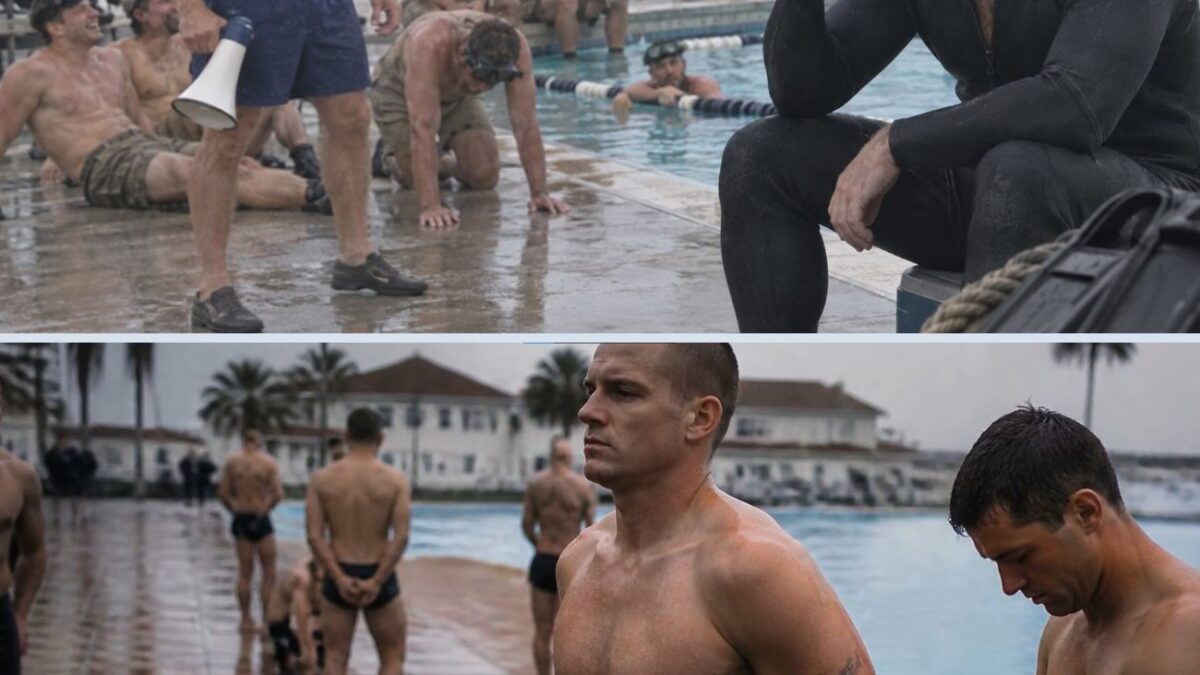
There is a pool in Coronado where the deck never quite dries. The drizzle comes in off the Pacific in a gray curtain and leaves the concrete slick and the chain link fence beads with water. And the palm trees stand very still because there is no wind to move them. And under all of it a man in a blue t-shirt with a whistle around his neck lifts a megaphone to his mouth and says this, exactly this, so that both lines of men on the deck hear every word.
“Limeys can’t swim, not properly. You people row, you drink your tea, you play at frogmen in cold ponds. This is a man’s pool. Try not to drown in it.”
He laughs after he says it. His head goes back and his teeth show and the laugh comes out of the megaphone louder than the words did. And the eight men in the second line do not laugh and do not move and do not look at each other because they are special boat service and they have been told on the aircraft from Brize Norton that they will be the only British boots on this deck for 3 weeks and that whatever is said to them, they will absorb it and they will not be the ones who make it a diplomatic incident.
The man with the megaphone is Master Chief Petty Officer Wade Costner. He is 49 years old. He has 22 years in the United States Navy. He has run this dive school for nine of them. He has a laminated card on the back of his clipboard with the fastest times anyone has ever posted in his pool. And the top line of that card has his own name on it and in 9 years nobody has beaten it. He has every reason, by the arithmetic he trusts, to be the loudest man on this deck. He will remember saying it. He will be made to. He does not know yet that the quiet Welshman at the end of the British line is already counting under his breath in a language Costner does not speak at a tempo Costner has trained a man to hold.
He does not know that one of the men he has just told not to drown has a resting heart rate of 41. He does not know that in 19 days in this same pool under his own stopwatch in front of the one officer on the base whose job it is to read the number out loud, the top line of that laminated card is going to be scored through in dry wipe marker and rewritten.
He only knows that he has an audience and a megaphone and the right as he sees it to use both. The drizzle keeps coming. The deck stays wet. He has just said the thing he is going to spend three weeks trying to walk back and he will not manage it. To understand how far Master Chief Costner was going to fall, you have to understand how high he was standing when he opened his mouth.
He had come up through the pipeline the hard way in the years when the pipeline still broke men on purpose and he had broken none of the ways it tried. He had done the basic underwater demolition course in a class that lost two thirds of its starters before the second week was out and he had done it with a grade in the top five and he had come out of it the kind of young enlisted man the chiefs point at from across a chow hall.
He had done three combat tours in places the Navy was quiet about at the time and is still quiet about now. He had two bronze stars with the valor device, one from a night in a river valley that he never talked about and one from a day on a rooftop that he did occasionally when the beer was cold and the audience was the right audience.
He had been a platoon chief and then a troop chief and then they had pulled him off the line and told him he was too valuable to lose and put him on the pool deck at the dive school and he had been there for nine years. Nine years of watching good men quit on his tiles. Nine years of pass outs and wash outs and the particular specific sound a man makes when he comes up off the bottom of the pool having lost his composure in a way he will not get back.
Nine years of the laminated card on the back of his clipboard with its column of names and its column of times and his own name across the top of it in capitals undefeated because he had set the top line time himself in the year he took the job and nobody who had come through since had taken it off him. He was by any measure that mattered to him the single most experienced combat diver instructor in his navy.
He was not wrong to think so. Sit with that for a moment. Because the man we are watching fall is not a clown. A clown’s humiliation would not be worth your evening. Costner was the real article which is why when the eight British divers filed onto his deck on a Monday morning in late October with their kits stowed and their boots off and their eyes on the water rather than on him.
He looked at them the way a man looks at a problem he has already solved. They were a special boat service detachment on a three-week combat diver familiarization hosted by naval special warfare under a joint training memorandum nobody on either deck had read in full. Their commanding officer was Lieutenant Colonel Ewen Price Harris a lean Welshman in his early 40s with a face that gave very little back who had put his burgan down at the end of the line and taken a chipped white enamel mug out of a side pocket and poured tea from a thermos and set the mug on the poolside bench before he turned to listen. He was still the only officer on the British side. The rest were his senior non-commissioned officers and his best divers boat troop men to a man. Costner saw the mug. The mug was what did it. He walked the length of the deck with his clipboard against his thigh and his whistle swinging and he stopped in front of the mug and he looked at it the way you look at a thing that has confirmed everything you already thought and then he lifted the megaphone and he said the words. The laugh that followed was not his alone. Half of the navy line laughed with him because the master chief had just said the thing out loud that the master chief said in some form on the first morning of every foreign course and the ones who had been on the deck before knew the rhythm of it.
Petty Officer First Class Hollis Beck, the master chief’s second, did not laugh but he smiled and he chewed the inside of his cheek the way he always did when something was about to be interesting. Lieutenant Commander Garrett Vane, Costner’s immediate superior and the pool safety officer of record, was not on the deck for the opening because Vane was in the office signing a form and this is a detail worth filing because when Vane did come out later with a stopwatch in his hand, the master chief was going to wish very much that he had been there to stop him talking in the first place. Price Harris, for his part, did not react. He did not look at the mug. He did not look at the megaphone. He looked at Costner briefly the way a man looks at a weather report he has already decided to ignore and then he looked at his own line and he said in a voice that did not need volume to carry:
“Right. Boots off. Listen in. We are the guests.”
Staff Sergeant Die Merriman, at the end of the British line, did not speak either. He was already counting. The insult sat on the deck between the two lines like a dropped tool nobody was going to pick up. Costner moved on to the brief. The first day of a combat diver course in any navy that runs one properly is almost deliberately boring.
There is paperwork. There is a safety brief read off a laminated sheet by a petty officer who has read it a thousand times. There is a swim test that is not really a test, more a confirmation that the men on the deck can do the thing their records say they can do, so that when the real work starts, the instructors know the floor they are building on.
The master chief ran his first day the way he had run every first day for nine years. He had the British divers in the pool inside 20 minutes. The swim test at Coronado is 500 m side stroke with fins in a time Costner’s school considered unremarkable. All eight of the boat troop men made it inside the window. None of them was fast.
None of them was slow. They came out of the water in the same order they had gone in, dripping onto the deck, and they stood in their line, and they waited. Costner noted the times. He wrote them in the second column of his clipboard. He did not write them on the laminated card because none of them were anywhere near the laminated card.
“Adequate,” he said through the megaphone, although there was no one on the deck more than 10 m from him. “Adequate is a start. We will see what adequate looks like at 12 m in the dark with a problem.”
The boat troop line did not react. This is the moment to look at them properly because the man watching them was not looking at them properly, and the gap between what he was seeing and what was there is the whole story of the next three weeks.
Staff Sergeant Dyne Merriman was 36 years old and had been in the service for 14 of those. He was the boat troop lead, the senior non-commissioned man on the trip, and he was, in the quiet way the service rewards, the single most respected diver his detachment had. He was 5 ft 9 and he weighed 13 stone, and when he stood on a pool deck, he stood with his hands clasped loosely in front of him and his weight even on both feet and his eyes on the water and he counted.
He had been counting all morning. He counted in Welsh, undau, try, pedwar, because he had been taught to by an old service diver in the late ’90s who had told him that a man who counts in his own second language keeps better rhythm under stress than a man who counts in his first. He counted when he was in the water and he counted when he was out of it.
And in 14 years nobody he had served with had ever heard him raise his voice above a conversational pitch on a pool deck or anywhere else. Costner looked at him and saw a quiet man. Costner was wrong about what the quiet was. Sergeant Reese Cadwalader was 29, a lance corporal 18 months ago and now carrying three stripes with the ink still fresh on them.
Before he had come anywhere near the regiment, he had been a competitive free diver on the Pembrokeshire coast. He had held national junior records in the static apnea discipline, which is the discipline of lying face down in a pool and not breathing for as long as the body will tolerate. He had been persuaded out of the sport by a recruiting sergeant who had seen the junior records and said politely that the service could probably find a better use for a lung like that.
His resting heart rate at the poolside, in the drizzle, in a wet suit, was 41 beats per minute. The medic who clipped the finger pulse oximeter onto him later in the week would read the number twice before he said it out loud because he did not believe it the first time. Corporal Niall Bray was 31 and the detachment’s demolitions man.
He kept a photograph of his daughter inside the lid of his dive watch case and he opened the case and looked at the photograph before every descent, every single one, whether it was a familiarization dive in a heated indoor pool in Hampshire or a tie in on a hull in the Firth of Clyde in February, he did it without making a show of it.
The men who had dived with him had noticed. The men who had not had not. Trooper Edwin Lasseter was the youngest, 24, and the only one on the detachment who had never set foot in the United States before. He had mispronounced Coronado when they had got off the aircraft at North Island. He had put the stress on the wrong syllable the way an Englishman reading it off a page would, and nobody on his own side had corrected him because that is how a boat troop teaches its youngest.
He would say it correctly eventually, when the trip was over, and he would say it correctly to nobody in particular. The four other men in the line were boat troop divers of varying tenure and no present need to name. They were all, to a man, calmer than the four American trainees across the deck who were there to complete the course alongside them.
The boat troop was quieter than the deck wanted them to be. That is the thing to understand. A dive school is a loud place by design. The instructors shout because the water is louder than the voice, and the trainees answer because the school is built on the habit of answering. The British line did not shout and did not answer unless asked a direct question.
And when they did answer, they answered flatly with the fewest words the question would take. Costner read the quiet as fear. He said as much to Beck under his breath on the walk back along the deck.
“They are keeping their heads down,” he said. “Good. They should.”
Beck chewed the inside of his cheek and did not reply. Costner was wrong.
The quiet was not fear. The quiet was the thing boat troop had been doing for 14 years with Merriman and nine with Cadwalader and all their adult lives with each other. It was the habit of men who had learned, in cold water, in bad weather, on operations they were not going to tell anybody about afterwards, to be bored under pressure, to let the heart slow, to let the breath lengthen, to let the count go on, to not react because reaction costs oxygen.
The whole climax of this story is going to be a stopwatch and a number. The stopwatch is already in Lieutenant Commander Vane’s desk drawer in the office at the end of the deck, next to a dry-wipe marker. The number is already, in a sense, in Reese Cadwalader’s lungs. The only thing that has not happened yet is the moment when Kostner, who has spent his career being the loudest man on the loudest deck in his Navy, puts his mouth to a megaphone and tells a group of men whose entire training consists of staying quiet that they are not, in his view, serious. He has done that already. He did it in front of them on the first morning. The rest of what you are about to watch is him finding out.
The first blow landed on day two in the drown-proofing block, and it landed because the Master Chief chose the drill himself.
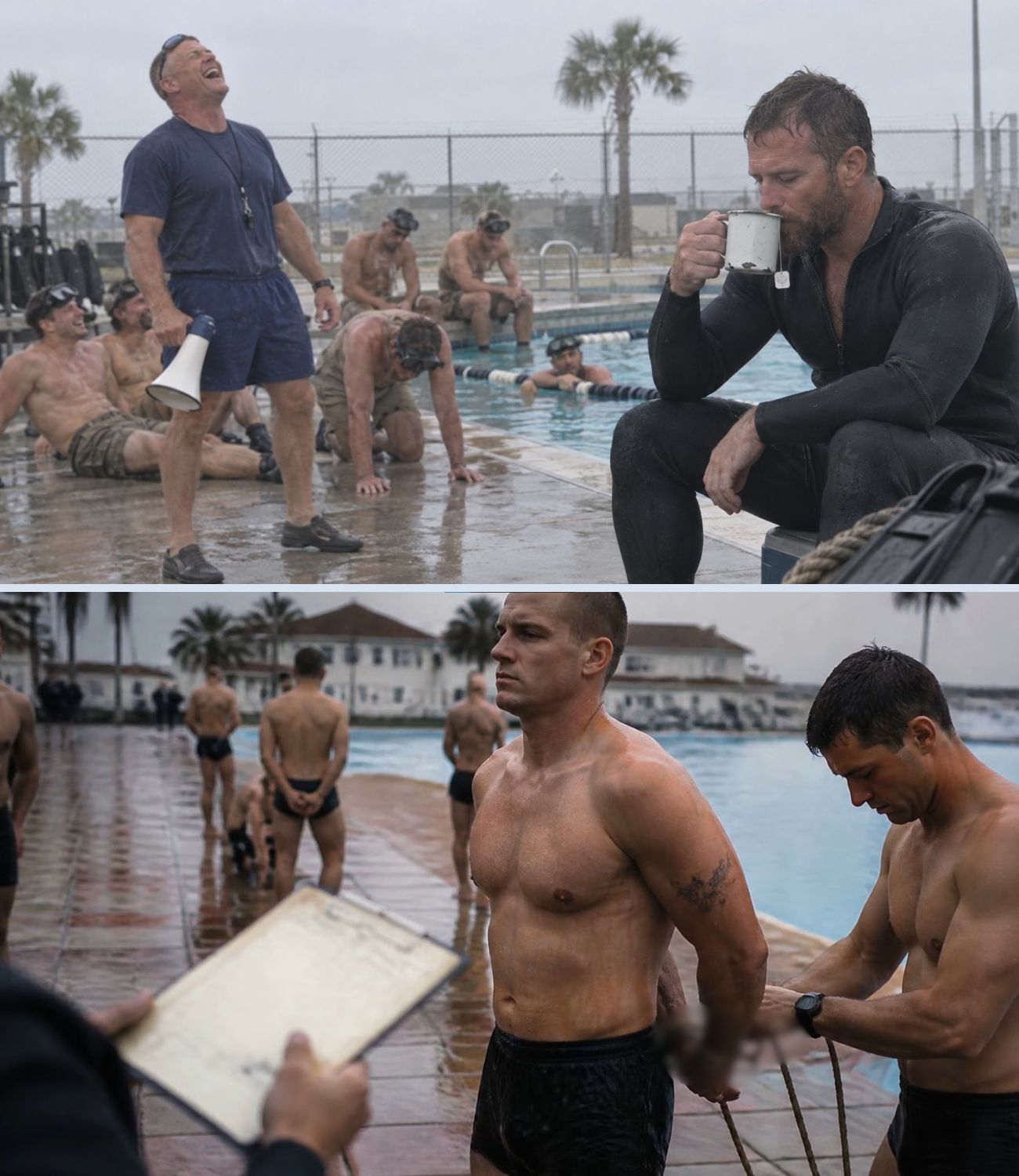
Drown-proofing in the Naval Special Warfare pipeline is the exercise that most reliably breaks the men it is going to break. The trainee’s wrists are tied behind his back and his ankles are tied together, and he is put into the deep end of the pool, and he is required to sink and bounce and bob and travel the length of the pool and retrieve a face mask from the bottom with his teeth, and come back.
It is a test of composure under water with no limbs and no air. Kostner liked it because it was the drill at which, in his nine years, no foreign student had ever matched his own best time. He announced the drill through the megaphone, although there was no need for the megaphone. He said that the British divers would be the first to run it because the British divers would appreciate, he said, the chance to show the deck what a real pond was for.
He said the word pond and he smiled through it because he meant the Atlantic and he meant everything about the Atlantic and he meant the men who had crossed it on the aircraft to be in his pool. He looked at Price Harry’s when he said it. Price Harry’s did not look back. Price Harry’s had picked up the enamel mug from the bench and was holding it with both hands and he was looking at the surface of the tea in it and he was not blinking very often.
“Who is first?” said Costner.
Merriman stepped out of the British line. He did not raise his hand. He did not say his name. He walked to the edge of the pool and he turned his back to Beck who tied his wrists and then he sat down on the edge and let Beck tie his ankles and then he nodded once at Beck. And Beck pushed him in.
He did the drill. He did it the way he had done it in the training tank at Horsea Island six years earlier which was not the way the school taught it. The school taught the drill with a hard bounce. Kick off the bottom, break the surface, snatch a breath, sink again, repeat. Merriman did not bounce hard.
Merriman let himself sink slowly to the bottom, settled his heels on the tiles, bent at the waist, pushed off with the smallest kick the physics would accept and rose to the surface the way a bottle rises, slowly, without panic, without noise. He took a breath that was not a gasp. He sank again. He did it 11 times in a row.
Each one at a tempo so even you could have set a watch to it and on the 12th descent he found the mask on the bottom, picked it up with his teeth and rose with it and spat it onto the tiles beside Beck’s boot. He did it start to finish in a time that Beck wrote down on his own clipboard and then looked at twice before he showed it to Costner.
The time was inside the top 10 on the laminated card. Costner looked at the number. He looked at Beck. He looked at Merriman, who was already being untied and who was already standing up and who was already walking back to his place in the British line, dripping without a word as if he had done something unremarkable because to him he had.
“Lucky run,” Costner said into the megaphone, although there was no need for the megaphone. “Who is next?”
Cadwallader stepped out of the line. Cadwallader did the drill in a time that was not in the top 10. It was in the top three. It was below a line on the laminated card that had been held until that morning by a man who had graduated the school in 2014 and who was now a lieutenant commander in Virginia and who had, Costner occasionally reminded the deck, been the best natural waterman he had ever trained. Beck wrote the time down. Beck did not show it to Costner immediately. Beck chewed the inside of his cheek. He walked the clipboard over to Costner the way a man walks a difficult envelope to a superior and he held it out and he waited. Costner read the number. He read it twice. The deck was quiet enough that you could hear the drizzle on the surface of the pool.
“Run it again,” he said.
Cadwallader ran it again. Cadwallader ran it again in a time 2 seconds faster than the first. The American trainees across the deck who had been laughing at the opening of day one were not laughing now. One of them, a young man from Michigan whose name does not matter, looked across at the British line with his mouth slightly open, which is the specific face a young operator makes when a thing he had been told was impossible has just been done twice in front of him by a man he had been told was not very good.
Price Harry’s put the mug down. He did not say anything. He put the mug down on the bench carefully in the exact wet circle it had left on the paint and he folded his arms and he waited. Costner looked at the mug.
“Next,” he said.
Bray did the drill. Bray’s time was in the top 15 which on a laminated card 9 years old and used by the hardest dive school in the United States Navy is not a bad time at all.
Lassiter did the drill. Lassiter’s time was in the top 30 which for the youngest man on the detachment on a strange deck in a strange country with the Master Chief Petty Officer of the course standing 6 feet away with a megaphone is a time that any serious diver would tell you is a very good time indeed.
Every man in the boat troop line did the drill. Every man in the boat troop line finished it in a time that would in any other combination of eight students the school had ever hosted have been remarked on and congratulated. Four of the eight were in the top 50 on the card. Two of the eight were in the top 10. One of them, Cadwallder, had just stepped onto the podium at the top of the card and taken the number three slot and the man whose name he had displaced from that slot was Petty Officer First Class Hollister.
Beck did not say anything about his name coming off the card. Beck wrote the new entry in his neat square hand. He showed it to Costner. Costner looked at it and said nothing.
“Lucky pool,” Costner said eventually to no one in particular.
And the American side of the deck did not laugh at the joke because the joke was not funny and because the Master Chief had said less than 24 hours earlier that the men who had just done this were men who could not swim properly, and that was only the first time that day he would be wrong. The second blow was not a time. The second blow was a test of composure, and composure in the dive school at Coronado is not scored on a stopwatch. It is scored by instructors who stand on the pool deck with a clipboard and watch the trainee’s face through the water and decide by eye whether the man below them is still thinking.
The drill is called pool competency in the course handbook and pool tool in the chow hall, and it is the drill around which the school is built. The trainee is on the bottom of the pool breathing from a twin hose open-circuit set kneeling with his eyes closed because the mask has been taken off him. The instructor approaches from behind.
The instructor attacks the kit. The instructor pulls the regulator from the trainee’s mouth, loops the hose into a knot, pulls the mask away entirely, cross-threads the valve, kinks the hose against the trainee’s shoulder, and in the hardest version of the drill, which is the version Costner called the unfriendly one, turns the air off at the tank.
The trainee is required to not surface. The trainee is required to not stand up. The trainee is required, kneeling on the tiles of the deep end with his eyes closed, to find each problem by touch in order and to fix it. He is allowed to be out of breath. He is not allowed to look like he is out of breath.
He is scored on his hands and on whether his face shows the thing in his chest. Costner ran the unfriendly version on day four. He did not announce that he was going to. He announced a routine competency drill, and he ran the unfriendly version. He did it to Cadwallader first because he had decided, somewhere between day two and day four, that Cadwallader was the problem.
Cadwalader was on the bottom of the pool. His eyes were closed. He was kneeling. He was breathing from the regulator with the slow even draw of a man who has in his life held his breath for longer than most people on the deck would believe. Costner came down behind him in a weight belt and goggles, pulled the regulator out of his mouth, kinked the hose, tied an overhand knot in the second stage, pulled the mask away, and reached around and turned the valve off at the tank.
Cadwalader did not react. He opened his eyes underwater, which is permitted in the drill, and he found the regulator by touch, and he unkinked the hose by touch, and he untied the knot by touch, and he reached back and turned the valve on by touch, and he put the regulator back in his mouth, and he purged it, and he took a breath.
The whole sequence took him 48 seconds, which is a long time for a man to be kneeling on the bottom of a pool with no air, and it is a very long time for a man to do it with his resting composure visible on his face to the instructor watching him through the water. Costner surfaced. Cadwalader stayed down and finished the drill as the drill required.
When he came up, the medic on the deck, a hospital corpsman first class whose name again does not matter, walked over to him with a finger pulse oximeter and clipped it onto Cadwalader’s left index finger because that is what the medic was there to do. The medic looked at the number. The medic looked at the number again. The medic looked at Beck.
“Say it,” said Beck.
“41,” said the medic.
Beck chewed the inside of his cheek. He said nothing.
“41 what?” said Costner from across the deck with the megaphone, although there was no need for the megaphone.
“Resting pulse,” said the medic, “30 seconds after a 48-second zero air drill, 41 beats per minute.”
Costner did not say anything for a moment. He looked at Cadwallader. Cadwallader was un-clipping the pulse oximeter and handing it back to the medic and walking back to the British line. He was not dripping very much because the drill is done in a wet suit and the wet suit holds the water close to the skin and he was not out of breath because he had not in any meaningful sense been out of breath to begin with.
“Lucky,” said Costner, and it was the third time in 4 days he had used that word on this deck and it was the first time he had said it quietly enough that only the people within 3 m heard it.
He ran the drill on three more of the boat troop men, Merriman, Bray, Lasseter. None of their pulses measured on the deck afterwards by a medic who was now very interested in his own clipboard was higher than 52.
Lasseter’s was 51. Lasseter was 24 years old and this was his first time in a foreign dive school and after a 40-second zero air drill his pulse was 51. The men who had been described on day one as the tea drinkers who could not swim properly were in the view of a medic who had worked that deck for 6 years the four calmest men he had ever put a clip on.
Costner, to his credit, did not say anything through the megaphone for the rest of the morning. He had stopped using the word lucky by lunch. By the end of the afternoon he had started doing a thing he had not done in 9 years on that deck, which was to ask Beck quietly over the clipboard whether he was reading the numbers right.
Beck told him each time that he was. The schoolgirls, he had called them through the megaphone in front of both lines, the men who could not swim properly, the ones who were by his count playing at frogmen in cold ponds. He did not say any of those phrases on day four. He did not say them on day five, either.
He was still the loudest man on the deck, because the deck belonged to him, and the pool belonged to him, and the course belonged to him. He was still, by the laminated card, the fastest man on the deck, but something had changed in the way he looked at the second line. He was looking at them the way a man looks at a thing he has not finished working out.
And the boat troop was looking back the way they had been looking at him since Monday morning, which is to say, not really at all. The ratchet was turning. He was not the one turning it. The dive on the night of day 11 was the dive the course existed for. The whole first fortnight of the combat diver pipeline builds, drill by drill, to the thing combat divers are for, which is to go in cold, in the dark, under the surface, breathing a rebreather that puts no bubbles into the water, and to fix an inert training charge to the hull of a target vessel, and to come out without the target vessel ever having known they were there. It is the thing the school is built around, and it is the thing Kostner, for all nine years of his tenure, had regarded as the dividing line between the men who could call themselves combat divers, and the men who were still, in his private view, pool trainees in wet suits.
The target that night was a decommissioned fleet oiler at anchor off the far end of the bay, inert, lit up by two spotlights on her bow and stern as the training rig required, with a rigid hull inflatable in attendance, and a safety team on her deck. The exercise was a two-man insertion from a small boat drop at a point 400 m off the bow, a subsurface swim on compass, bearing a tie-in at a marked point on the hull below the waterline.
A secondary tie-in at a second marked point on the stern, and an exfiltration to a pickup point 600 m further out. Open circuit was not permitted. Closed circuit only. No bubbles. No surface breaks. The route was timed by the safety team on the oiler, who were listening on a hydrophone for the one sound that would fail the exercise, which was the sound of a bubble.
The boat troop sent Bray and Cadwalader. Bray checked the dive watch case before he put his hood on. He opened the lid, and he looked at the photograph of his daughter. She is seven in the photograph, and she is holding a plastic shovel on a beach in Pembrokeshire, and squinting against a sun that is well off to the camera’s right.
He closed the lid, and he put the case back in the dry pocket of his Bergen, and he zipped the Bergen, and he put the Bergen in the boat. Back on the pier, Beck watched him do it and said nothing. Because Beck had been watching the boat troop for 10 days by that point, and had learned to watch them without speaking.
Costner was on the oiler. He had put himself on the oiler because the oiler was where the drama of the exercise lived, and he was a man who liked to be where drama lived. Price Harrys was on the pier with Merriman, with the enamel mug, with the thermos. The small boat went out. The two divers rolled off the gunwale at the 400 m mark.
The safety team on the oiler started the clock. For the next 41 minutes, the hydrophone on the oiler’s deck heard nothing. Nothing is a specific sound in a hydrophone in a bay in the dark. It is the sound of the tide moving against the hull. It is the sound of a halyard against a mast 200 m away. It is the sound of a gull on the water.
It is not the sound of a bubble breaking the surface, which is the sound a closed-circuit rebreather is designed to not make, and which a tired diver with a cold regulator can nonetheless produce by accident at the wrong moment of a long dive. The hydrophone heard nothing. Kostner, standing beside the hydrophone operator with his arms folded and his chin up, heard nothing.
He heard the tide and the halyard, and once, somebody’s radio in the small boat, which was a mistake and which Beck would mention in the debrief. He did not hear a bubble. At the 41-minute mark, the safety team’s underwater camera, mounted on the oiler’s hull at the first tie-in point, picked up Bray. He was 6 ft off the hull and rising slowly on the current, and his hand was on Cadwallder’s forearm, and in Cadwallder’s other hand was the first training charge.
And the training charge was being placed against the hull at the marked point with the deliberation of a man setting a cup down on a shelf. They tied it in. They did not look up at the camera. They would not have known the camera was there. They moved along the hull. At the 49-minute mark, the second charge went on at the stern.
At the 1-hour and 4-minute mark, the pickup boat, 600 m further out, radioed in that both divers were on board. Both charges confirmed, said. Both regulators dry, both watches reading inside the window. The safety team on the oiler stared at the hydrophone, which had still heard nothing. Kostner did not speak for the duration of the exfiltration radio call.
He stood at the rail of the oiler with the two spotlights behind him and the drizzle on the back of his neck, and he looked out across the black water at the pickup boat, and he did a thing he had not done. Beck would say later, in the 9 years Beck had worked for him, he put his hand flat on the rail.
He laid it there the way a man lays a hand on a thing to be sure the thing is real, and he left it there for a full 10 seconds, and then he took it off. He said quietly to the hydrophone operator:
“Replay the last 41 minutes.”
The hydrophone operator replayed the last 41 minutes. The two of them stood over the speaker and listened to the tide and the halyard and the gull and the radio from the small boat and nothing else.
“Clean,” said the operator.
“Clean,” said Costner.
He said it twice because the first time he was saying it to the operator and the second time he was saying it to himself. The small boat came back in. Bray and Cadwalader climbed up onto the pier. They were slower on their legs than they had been going out because a closed-circuit dive at depth in the dark takes something out of a man that the man does not get back until he has had a hot shower and a hot meal and 6 hours of sleep.
Bray walked past Price Harry’s without looking at him. Price Harrys, without looking at Bray, handed him the enamel mug half full of tea that was still warm. Bray took it. Bray drank it. Bray handed it back. Price Harrys put the mug on the bollard. He said:
“Charges confirmed.”
“Confirmed, sir,” said Bray.
“Good lad,” said Price Harrys.
That was all that was said on the pier. Costner, on the oiler, still had his hand off the rail. He had stopped saying lucky. He had stopped saying anything. The last block of the course is static apnea. It is the quietest block the school runs and it is the one Costner has for 9 years used as his signature. The drill is simple.
The diver lies face down on the surface of the pool in a wet suit with a snorkel and he holds his breath. He does not swim. He does not move. He holds his breath for as long as his body will tolerate, and he taps the lane rope on the far side when he is done, and the clock stops. The clock is held by the records keeper, who in Costner’s pool is Chief Warrant Officer Marcus DeLyle, a lean, dry-mannered man in his 50s, who has held the clipboard at this school for 17 years, and whose entire function on the pool deck is to say the number out loud so that no one can argue it afterwards. The top line on the laminated card has read for 9 years, Costner W 5 minutes 48. It is day 19. The pool is Costner’s. The clock is Costner’s. The deck is Costner’s. The drizzle has eased, and the sun is nearly through, and the surface of the water is as flat as the surface of a dish.
Price Harris is on the bench. The enamel mug is on the bench beside him. He is not drinking from it. He is sitting with his hands on his knees, and his chin slightly down. Merriman is on the deck beside the pool. Cadwalader is in the water. He is lying face down. His arms are loose. His legs are loose. His snorkel is clear.
The pulse oximeter is clipped to his left index finger, which is extended slightly out from his body so that the medic can read the display without disturbing him. The display reads 41. DeLyle is at the lane rope with the stopwatch. He is not looking at Cadwalader. He is looking at the stopwatch. Vane, the lieutenant commander, has come out of the office.
He has the dry wipe marker in his breast pocket. He has not said what the marker is for. He is standing 6 ft behind DeLyle with his arms folded. Costner is on the deck with the megaphone, which is switched off by his side. Merriman says, very quietly in Welsh:
“Dechrau”
which means begin, and nobody on the American side hears him say it, and the leal, who does not need to hear him, starts the clock.
At 1 minute, Cadwalader has not moved. The display reads 41. At 2 minutes, Cadwalader has not moved. The display reads 40. This is the point in a static apnea hold at which the body first registers that something is wrong. The diaphragm pulses. The urge to breathe arrives. Trained men do not fight the urge.
Trained men let it pass through them, because the urge is the brain’s first warning, and not the body’s last. Cadwalader lets it pass through him. His back does not twitch. His fingers do not close. On the pool deck, Price Harrys lifts his chin very slightly, which is the only indication he gives in 19 days of being present as an officer of men.
At 3 minutes, Cadwalader has not moved. The display reads 40. Merryman on the deck is counting in Welsh under his breath. His lips move slightly. Un gant, dau gant, tri gant. The long count, the slow count. The count he has used for 20 years. Nobody on the American side knows what he is saying. Beck, who has moved to stand near him, chews the inside of his cheek and watches the water.
At 4 minutes, Cadwalader has not moved. The display reads 39. The deck is silent. The drizzle has stopped. A gull is somewhere over the far end of the pool and does not land. The American trainees across the water are not laughing and are not moving and are not looking at each other. At 4 minutes 30, Costner’s own best time is 30 seconds away. He is looking at the water.
He is not looking at the stopwatch. His hand, which is at his side, is open and then closed and then open again, which is the first visible thing his body has done to his composure since Monday of week one. At 5 minutes, Cadwalader has not moved. The display reads 38. At 5 minutes 30, DeLisle lifts his head very slightly because he has in 17 years at this clipboard held this watch across the top line time more than a dozen times, and he knows the shape of the next 10 seconds.
At 5 minutes 48, the top line on the laminated card falls. Cadwalader does not know it has fallen because Cadwalader is not counting the clock. Cadwalader is counting himself. He goes past 6 minutes. He goes past 6 minutes and 10 seconds. At 6 minutes and 14 seconds, his left hand lifts, finds the lane rope, and taps it twice, and his face comes up out of the water, and he breathes. He does not gasp.
He breathes once, long through the nose, and then he breathes out through the mouth, and then he breathes once more, and he takes the snorkel out, and he lifts his head, and he looks at Merriman. Merriman nods. DeLisle stops the clock. He looks at the reading. He does not say anything for a count of three, which is the longest DeLisle has in 17 years held a reading before saying it. Then, he says it:
“6 minutes 14 seconds.”
Vane takes the dry wipe marker out of his pocket. He walks the three paces to Costner’s clipboard, which is on the bench. He picks up the clipboard. He uncaps the marker. He draws a single clean line through the top entry on the laminated card, which has read for 9 years, Costner W 5 minutes 48.
Underneath the struck line, he writes, in the same square hand Beck has been using all three weeks:
“Cadwalader, uh 6 minutes 14.”
He caps the marker. He puts the clipboard back on the bench. He walks back to his place 6 ft behind Dalil. He folds his arms. He has not said a word. Costner has not moved. Price Harrys on the bench lifts the enamel mug for the first time in 19 minutes. He drinks from it.
He puts it back down in the wet circle it has left on the paint. He says to Merriman, and only Merriman is close enough to hear him:
“Right, that’ll do.”
Merriman nods. Cadwalader in the pool has his arms on the lane rope. His pulse on the display still clipped to his left index finger is 42. It has gone up by one.
The number 6 minutes and 14 seconds is now on the laminated card on the back of a clipboard in Coronado in the handwriting of a petty officer who had 19 days earlier written his own name three slots further down on the same card. The top line, which for 9 years had the name of the man with the megaphone on it, has that name on it no longer.
The name underneath the struck line belongs to a sergeant from Pembrokeshire whose resting pulse at the poolside is one beat above the record he has just broken and who did it in a pool that was not his, under a clock that was not his, in a wet suit his hosts had issued him on the first morning of a course they had told him he was not qualified to be on.
Hear the number again, 6 minutes and 14 seconds. The debt is paid. They did not make him pick up the megaphone. That is the thing to understand about what happened next. There was no theater in it. No one on the boat troop side walked up to him. No one on his own side laughed. Price Harrys did not stand up from the bench.
Merriman did not come over. Cadwalader, when he climbed out of the pool, did not look at Costner at all. He walked past him on the deck with a towel over his shoulder and went to the bench where his kit was, and he sat down on the bench, and he dried his hair. Costner was left standing on his own deck in his own pool with a megaphone switched off at his side and a clipboard on a bench behind him that had, on the back of it, a laminated card with somebody else’s name on the top line.
He did not pick up the megaphone. He did not pick up the clipboard. He stood for perhaps 40 seconds without moving. The pool was flat. The drizzle had not resumed. One of his own trainees, the young man from Michigan, was looking at him from across the deck with the specific face of a trainee who is waiting to see what the loudest man on the deck is going to do when the deck has gone quiet on him, and Costner was not giving him anything to see.
Vane walked past him. Vane did not stop and did not look at him. Vane walked the length of the deck to the office at the end, and he opened the door, and he went inside, and the door swung shut behind him. And that was Vane’s contribution to the moment. Because Vane was the pool safety officer of record, and Vane had already said, with the marker, the only thing he was going to say. Beck did stop.
Beck stopped beside Costner on the deck, and he said quietly, without Chief. Costner did not answer.
“Chief,”
“I’m going to put the clipboard away,” said Beck.
“All right,” said Costner.
Beck picked up the clipboard. He walked it to the office. He went inside. The door swung shut. That left Costner on the deck with the eight-boat troop men and the four American trainees across the water and the pool and the megaphone.
Bray, on the far bench, was putting the dive watch case back in the dry pocket of his Bergen. He had opened it once after the hold and looked at the photograph and closed it. He zipped the Bergen. He walked past Kostner on his way to the gear room. He did not look up. He went inside.
“Coronado,” said Lasseter under his breath to no one in particular, and he said it correctly, with the stress on the right syllable.
And he said it the way a man says the name of a place he is leaving. He did not look at Kostner. He went inside. Merriman walked past Kostner. Merriman did stop. Merriman stopped three paces away from Kostner on the wet deck and he did not say anything. He stood for perhaps five seconds looking at the water, not at Kostner, and then he turned his head and he looked at Kostner.
And he said one word which was not the word any of the men on either side of the deck would have predicted him to say.
“Thanks,” he said.
He said it flatly, in the register he used for everything, and he meant it, which was the worst part, because he was thanking Kostner for the use of the pool and the clock and the course and the three weeks. And he was thanking him in the way a senior non-commissioned officer thanks a host whom he is never going to see again. And the thanks landed on Kostner the way a stone lands on a windscreen. Merriman walked on. He went into the gear room. Price Harry stood up from the bench. He picked up the enamel mug. He picked up the thermos.
He walked the length of the deck. He stopped beside Kostner. He did not speak. He looked briefly at the water, which was flat, and at the pool, which was his host’s, and at the megaphone, which was switched off. Then he nodded once, the way an officer nods at another officer on a day when the professional work has been done. He walked on.
He went into the gear room. Costner was alone on the deck. Beck came out of the office. He crossed the deck to Costner. He did not say anything. He stood beside him for perhaps 10 seconds. Then he said, as quietly as he had said anything in 19 days:
“Chief, they were serious.”
Costner did not answer. Beck went back inside. The deck stayed empty. The pool stayed flat. The megaphone stayed switched off. The laminated card in the office on the clipboard on Beck’s desk had the top line struck through in dry white marker. And the name underneath it in square petty officer’s handwriting and the time was 6 minutes and 14 seconds.
And the record by the regulations of the school was not Costner’s anymore. He did not try to pick up the megaphone. He never would again. Master Chief Costner was not sacked. He was not reprimanded. There was no diplomatic incident. And there was no formal complaint. And there was no letter from the office of a commodore in Virginia requiring an explanation.
There did not need to be. The record on the back of the clipboard was the only document the deck had ever needed. And the record on the back of the clipboard had a line through it. He finished out his tour at the school. He had another 18 months to run. He ran them. He stopped using the megaphone on the first morning of foreign courses.
He stopped using the word limeys at all. When he retired 19 months later he did it quietly at a small ceremony in a function room on the base. And the laminated card went in a drawer in the office and the drawer stayed shut. The boat troop went home on a Tuesday. They flew out of North Island on a transport that routed through Travis.
And they slept most of the way, the way men sleep after 3 weeks of a dive course. Price Harris washed the enamel mug in the galley of the aircraft and put it back in the side pocket of his Bergen. Cadwalder did not mention his time to anyone outside the detachment and never has because the service does not reward men who talk about their times.
Meriman went back to pool and in the following summer took another detachment through a cold water block on the west coast of Scotland where the water was colder than the pool at Coronado by 18° and the drizzle was heavier and he counted in Welsh under his breath and he did not raise his voice.
The thing the master chief had said on the first morning through the megaphone had been this, that Englishmen could not swim, not properly, that they rode and drank their tea and played at frogmen in cold ponds and that his pool was a man’s pool and that they should try not to drown in it. He had been right about the tea.
He had been wrong about the men who drank it. That is the whole of it and it is why this lane of story keeps repeating itself across the long record of the British special forces. The men who learn their trade in cold water, in bad weather, on operations they are not going to tell anyone about afterwards, do not look on a sunny deck in a warm climate like serious men.
They look quiet. They look slow. They look like they are not reacting. The contempt that comes at them, when it comes, mistakes the quiet for incapacity. It is almost always the last mistake the contempt makes because quiet in a diver is not the absence of a thing. Quiet is the thing. Quiet is the whole thing.
Quiet is the discipline the laminated card measures and the stopwatch measures and the hydrophone measures and it is the discipline the loudest man on the deck did not, for 9 years, know how to see. He saw it on day 19. He did not pick up the megaphone again.
You Might Also Enjoy

“We Thought They Would Negotiate”—What Argentine Soldiers Said When The British Attacked Goose Green

“You’ll Never Finish My Ruck March, Limey” — US Sergeant Who Challenged the SAS, Then Fell Out First






