Meghan’s ESCAPE With Archie And Lilibet DESTROYED As Harry Snatches Their Passports!
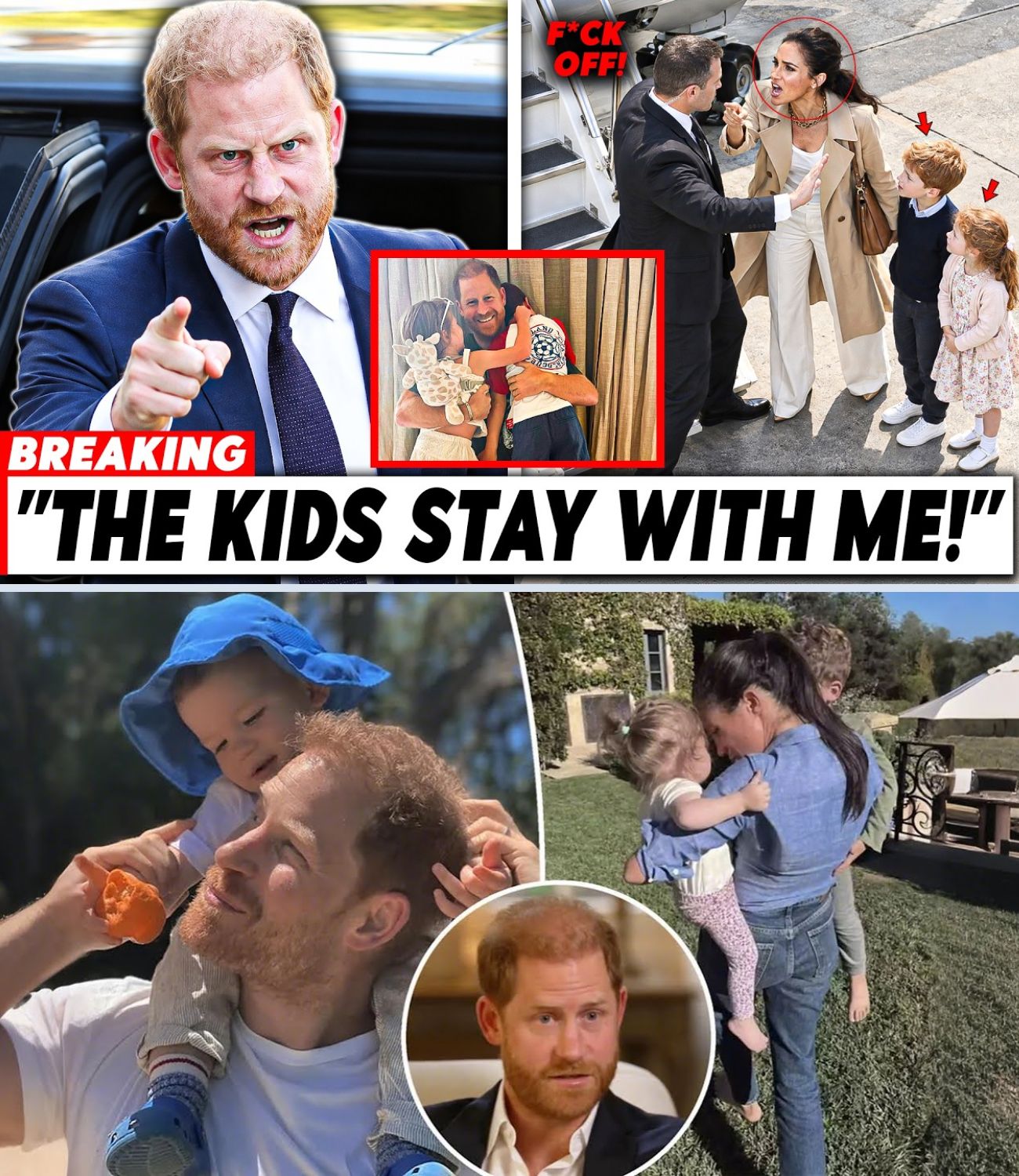
THE PASSPORT LOCKDOWN: Inside the Secret New York Airport Drama Where Harry Snatched Archie and Lilibet’s Travel Papers to Block Meghan’s California Escape!
The Billfold That Spilled a Royal Secret
There is a particular kind of silence that descends upon an international arrivals terminal when the veneer of public perfection cracks and the messy, unpolished reality of human panic spills out onto the linoleum floor. For years, the grand narrative emanating from the sprawling, sun-drenched sanctuary of Montecito—and later from the carefully vetted corridors of their temporary English boltholes—has been one of unbroken solidarity. We were told of a couple bound together by shared adversity, two outcasts weathering the storms of institutional hostility hand in hand, presenting an unshakeable united front against a hostile world.
Yet, truth has a stubborn habit of revealing itself in the most mundane, unscripted moments. Imagine the scene at the New York airport checkpoint: an ordinary customs processing desk, the hum of fluorescent lights, and a royal traveler fumbling through his personal effects. When Prince Harry reached into his leather billfold to present his travel credentials to border officials, he was not merely pulling out his own paperwork. Spilling out onto the counter, right alongside his diplomatic or temporary visa documentation, came two smaller, unfamiliar booklets. They were the British passports of five-year-old Princess Lilibet and seven-year-old Prince Archie.
To the casual observer standing in the queue, it might have seemed like a harmless domestic oversight—perhaps a busy father throwing everything into his travel wallet before a transatlantic dash. But to seasoned watchers of the Windsor dynasty, intelligence analysts, and diplomatic sources whispering through the U.S. State Department, that single visual oversight detonated like a thunderclap.
Why on earth would a father travelling entirely alone across the Atlantic for a high-profile climate summit, charity engagements, and a whirlwind media tour take the physical custody of his young children’s international travel documents with him? Why pack the very instruments required to cross oceans into a solo briefcase, leaving a mother empty-handed thousands of miles away?
According to explosive reports filtering out through high-level royal circles, the answer points toward a chilling psychological reality: Prince Harry did not trust his wife with the keys to their children’s exit. The grand homecoming to the British countryside was rapidly unravelling into a high-stakes psychological chess match, where the most precious pieces on the board were being kept firmly under lock and key.
Life Behind High Walls in the North Cotswolds
To understand the volatile atmosphere that prompted a father to snatch his children’s passports, one must cast an eye back across the ocean to the lush, rolling hills of the North Cotswolds, where the Sussexes had supposedly established their idyllic English base. The grand return was heralded by glossy press releases as a triumphant reconnection with British heritage, a chance for Archie and Lilibet to experience the crisp air of rural England and perhaps even catch a glimpse of their grandfather.
Yet, the local reception in the sleepy Cotswolds villages was nothing like the cinematic homecoming scripted by West Coast publicists. In these tight-knit communities, where privacy is an unwritten religion and ostentatious display is viewed with quiet suspicion, the arrival of the Sussex entourage was met not with cheers, but with a profound, icy indifference.
While Harry was off globe-trotting—jumping out of aeroplanes in Canada for charity stunts and rubbing shoulders with dignitaries in Manhattan—Meghan’s domestic routine quickly became the talk of the local parish. Rather than settling into quiet domesticity or integrating into the school gate community like ordinary mothers, the Duchess was reportedly spotted frequenting tourist-trap country pubs during school pickup hours, indulging in afternoon wine sessions at establishments like the Three Horseshoes near Burford.
Local whispers quickly turned sharp. Eyewitnesses noted the incongruous spectacle of armed bodyguards hovering awkwardly in country beer gardens while the Duchess worked off the stress of a modest school run with reformer Pilates sessions at the ultra-exclusive Soho Farmhouse. To the chattering classes of the Cotswolds, the whole performance felt theatrical, performative, and above all, deeply common. Staff members at local watering holes reportedly raised eyebrows at the entourage, while local residents offered a verdict that would sting far worse than outright hostility: raging, unimpressed indifference. Nobody was asking for autographs; nobody was rolling out the red carpet. They were simply viewed as a passing tourist curiosity—expensive, loud, and profoundly out of touch.
Behind the high stone walls of their rented estate, the domestic friction was mounting. Rumours began to circulate that the entire English relocation was buckling under the weight of unmet expectations, chief among them the stubborn refusal of the British government to reinstate taxpayer-funded armed security details for the family.
The Security Blackmail and the Threat to Bolt
The underlying tension fuelling the Sussexes’ movements has always circled back to one combustible commodity: armed protection. Harry’s ongoing legal battles with the Home Office and the RAVEC committee are well-documented. He has made it abundantly clear that he believes his life, and the lives of his wife and children, are in perpetual danger on British soil unless guarded by the full, elite apparatus of the Metropolitan Police.
Yet, behind closed doors, that security demand had reportedly morphed into an aggressive strategic threat. According to well-connected royal commentators and insiders, the couple’s advisors were floating a blunt ultimatum to anyone who would listen: grant the family top-tier, state-funded armed protection equivalent to that given to working senior royals, or the children would be unceremoniously packed up and shipped back to the safety of California within a matter of weeks.
It was, in every sense of the word, a textbook blackmail attempt. Use the children as leverage; threaten to deny the British public—and by extension, King Charles—any future access to the young royals unless the state capitulated to their financial and security demands.
The audacity of the threat did not land well in London. Most commentators and ordinary citizens responded with a collective, resounding shrug, offering a polite “good riddance” to the notion that British taxpayers should foot a multi-million-pound annual security bill for a family living a semi-private life overseas.
Yet, within the intimate theater of the Sussex household, the threat of packing up and fleeing back to Montecito carried a very different weight. For Meghan, California represented freedom, media networks, sunny weather, and complete control over her narrative. For Harry, caught between the gravity of his royal lineage, upcoming philanthropic commitments like the Invictus Games in Birmingham, and a profound alienation from his homeland, the prospect of a sudden, unilateral relocation by his wife was an ever-present nightmare.
If Meghan decided she had had enough of the cold British drizzle and the icy local indifference, what was to stop her from simply gathering the children, boarding a private jet, and flying back to the Pacific Coast, locking him out of his family’s daily life once more?
The answer, as it turned out, was sitting quietly in the pocket of his travel billfold as he cleared customs in New York.
A Husband Keeping One Eye on the Door
The revelation that Harry carried Archie and Lilibet’s passports across an ocean while leaving his wife behind in England paints an extraordinarily bleak portrait of domestic trust. A passport is not merely a travel document; in the context of international family law and high-net-worth domestic disputes, it is the ultimate instrument of geographical freedom.
A mother with her children in the Cotswolds can drive to the village shop, take them to the park, or navigate a school run. But without those little blue booklets tucked safely into a handbag, she cannot board an international flight out of Heathrow. She cannot legally cross an international boundary and remove the children from the jurisdiction of English family courts.
By taking the passports with him to New York, Harry effectively placed a geographic tether around his family. Whether consciously calculated or driven by a deep-seated paranoia that his wife might unilaterally pull the plug on their English experiment while he was away on state business, the act spoke volumes. You can walk the red carpets together, you can issue polished statements about family unity, and you can release curated Netflix documentaries celebrating your domestic bliss—but when a husband refuses to leave his children’s travel documents within reach of his wife, the illusion of an unshakeable partnership shatters completely.
The psychological profile emerging from those close to the situation suggests a man living in a state of high alert. While in New York, even brief processing delays at the border—reportedly long enough to make him sweat over his temporary U.S. visa status—underscored his precarious standing in the world. He was a prince without an institutional safety net, clinging tightly to the physical tokens of his fatherhood because they represented the only leverage he truly controlled.
And the moment he touched down on foreign soil—whether jumping out of an aeroplane on a tandem skydive in Canada or standing before a podium at the Clinton Global Initiative—his first instinct wasn’t to call his children to check on their day at school. According to astounded reporters covering his movements, his immediate, compulsive reflex upon landing was to dial his wife’s phone number, maintaining an umbilical cord of constant communication that betrayed an obsessive, anxious need for control.
Yet, controlling the phone lines is a far cry from controlling the horizon.
The Unravelling of the Cotswolds Experiment
As the weeks wear on, the grand narrative of the Cotswolds relocation is showing severe structural fractures. The local elite remain indifferent; the village pubs have grown tired of the security fuss; and the administrative machinery of the British state has refused to bow to the pressure of security threats.
The children, sequestered behind high stone walls and glimpsed only from the back of their heads in carefully angled social media snippets or privacy-conscious outings, remain trapped in a bizarre modern iteration of a witness protection programme of their parents’ own making. They are shielded from the press, yet entirely isolated from the extended family network they were supposedly brought back to embrace. King Charles, grappling with his own health and sovereign duties, has seen vanishingly little of his grandchildren since their return to British soil—a tragic irony given that proximity was supposed to be the foundational premise of the move.
Meanwhile, the financial anchor in Montecito remains suspiciously warm. Despite persistent rumors of a permanent return to the UK, real estate records confirm that their nine-bedroom California mansion has not been permanently shuttered; a skeleton crew remains on standby, maintaining the estate as an insurance policy against the inevitable failure of their European adventure. The Montecito property sits downwind of a local bird sanctuary—a detail local wags love to cite, noting that the property “stinks to high heaven” both literally and metaphorically. But it remains fully operational, a ready-made getaway car with the engine idling in the driveway.
And therein lies the core tragedy of the current Sussex stalemate. One partner is tethered to the UK by upcoming obligations—chiefly the Birmingham Invictus Games slated for next summer—desperately trying to salvage a shred of his military and philanthropic legacy on home turf. The other partner views the English countryside through the bottom of a wine glass at a local pub, acutely aware of the social isolation and eager for the next flight back to the flashing cameras of Los Angeles.
Between them lie two small passports, zipped securely inside a traveller’s wallet, crossing time zones and security checkpoints thousands of miles away from the nursery beds they belong in.
When the dust finally settles on this extraordinary chapter of modern royal history, history will judge the Sussexes not by the glossy impact reports of their foundations or the dramatic headlines of their television interviews, but by the quiet, telling details of their daily paranoia. Trust is not built on multimillion-dollar PR campaigns or high-priced crisis management firms in Beverly Hills. It is built in the spaces where no cameras are rolling—in the kitchens of the Cotswolds, at airport customs desks, and in the unspoken realization that when a marriage is built on quicksand, even the children’s travel papers become ammunition in a war without end.
You Might Also Enjoy

“We Thought They Would Negotiate”—What Argentine Soldiers Said When The British Attacked Goose Green

“You’ll Never Finish My Ruck March, Limey” — US Sergeant Who Challenged the SAS, Then Fell Out First






