Meghan’s Shocking Family SECRET: SHOCK Rumors CONFIRMED!
THE GENEALOGY LABYRINTH: Inside the Explosive Archival Mystery That Has Upended the Sussex Narrative
I. The Shadows of the Past
There is an old, immovable axiom whispered within the smoke-filled backrooms of constitutional historians and royal biographers alike: no secret in the modern public sphere remains buried forever, no matter how securely institutional gatekeepers attempt to lock the vault. In an era where digital databases, parish registers, and relentless genealogical sleuthing converge with high-stakes tabloid commentary, the past is never truly dead; it is merely waiting for the right key to turn in the lock.
For years, the public-facing narrative surrounding Rachel Meghan Markle—the Duchess of Sussex—has been charted, scrutinised, and dissected with forensic intensity. From her early days as an American television actress to her whirlwind romance, fairy-tale wedding, and subsequent dramatic, unceremonious departure from the structured confines of the British royal family, every single facet of her life has been mined for narrative gold. Yet, whilst millions of column inches have justifiably focused on the theatrical stand-offs at Windsor, the multi-million-pound streaming deals in California, and the bitter legal battles waged across London’s High Court, a far darker, more subterranean controversy has been quietly bubbling away beneath the surface of the mainstream media cycle.
It is a controversy that touches upon the delicate architecture of genealogy, historical record-keeping, and the relentless public fascination with bloodlines, genetics, and family origins. Investigators and commentators poring over archival documents have recently brought to light a series of startling claims concerning the maternal lineage on the Ragland side—claims that speak of hidden names, redacted records, and sensational theories regarding ancestral relationships.
To understand why these whispered rumours have suddenly exploded into the public consciousness, one must travel back through the dusty ledgers of American genealogical history, examine the peculiar silence maintained by establishment handlers during the height of the 2018 royal wedding frenzy, and confront the uncomfortable questions that continue to dog the Sussexes as they attempt to chart an independent course far away from the British Isles.
II. The “Unknown Mother” and the Parish Record Puzzle
To trace the origins of this labyrinthine mystery, one must return to the breathless days leading up to St George’s Chapel in May 2018. As the global media machine converged upon Windsor to chronicle the marriage of Prince Harry and the American divorcee, ancestral researchers working for major Fleet Street publications scrambled to construct comprehensive family trees for the bride.
It is a time-honoured tradition of royal reportage. Whenever a commoner marries into the House of Windsor, genealogists scour census reports, marriage certificates, and immigration records to trace their lineage back through the centuries, offering readers a comforting sense of historical continuity. Yet, when researchers attempted to chart the maternal lineage of Doria Ragland—Meghan’s mother—they hit an unexpected, impenetrable brick wall.
According to the official genealogical breakdowns published across the British press at the time, Doria Lois Ragland’s maternal parentage was listed simply as “unknown.” Official birth and marriage certificates from the period offered scant clarity, leaving a glaring blank space where a mother’s name should traditionally reside. At the time, mainstream commentators and casual observers alike chalked this up to the standard archival blind spots that frequently plague families of colour tracing their roots through post-bellum American history, where record-keeping was often fragmentary, racially biased, or poorly maintained.
However, astute investigators and relentless internet sleuths viewed the “unknown mother” designation with profound scepticism. In an age where digital forensics can trace lineages across continents within seconds, the complete absence of a maternal record for Doria’s side felt anomalous. Was it merely a historical casualty of institutional neglect, or was it the deliberate product of selective archiving—a quiet clerical omission designed to smooth over uncomfortable genealogical complexities before a high-profile international union?
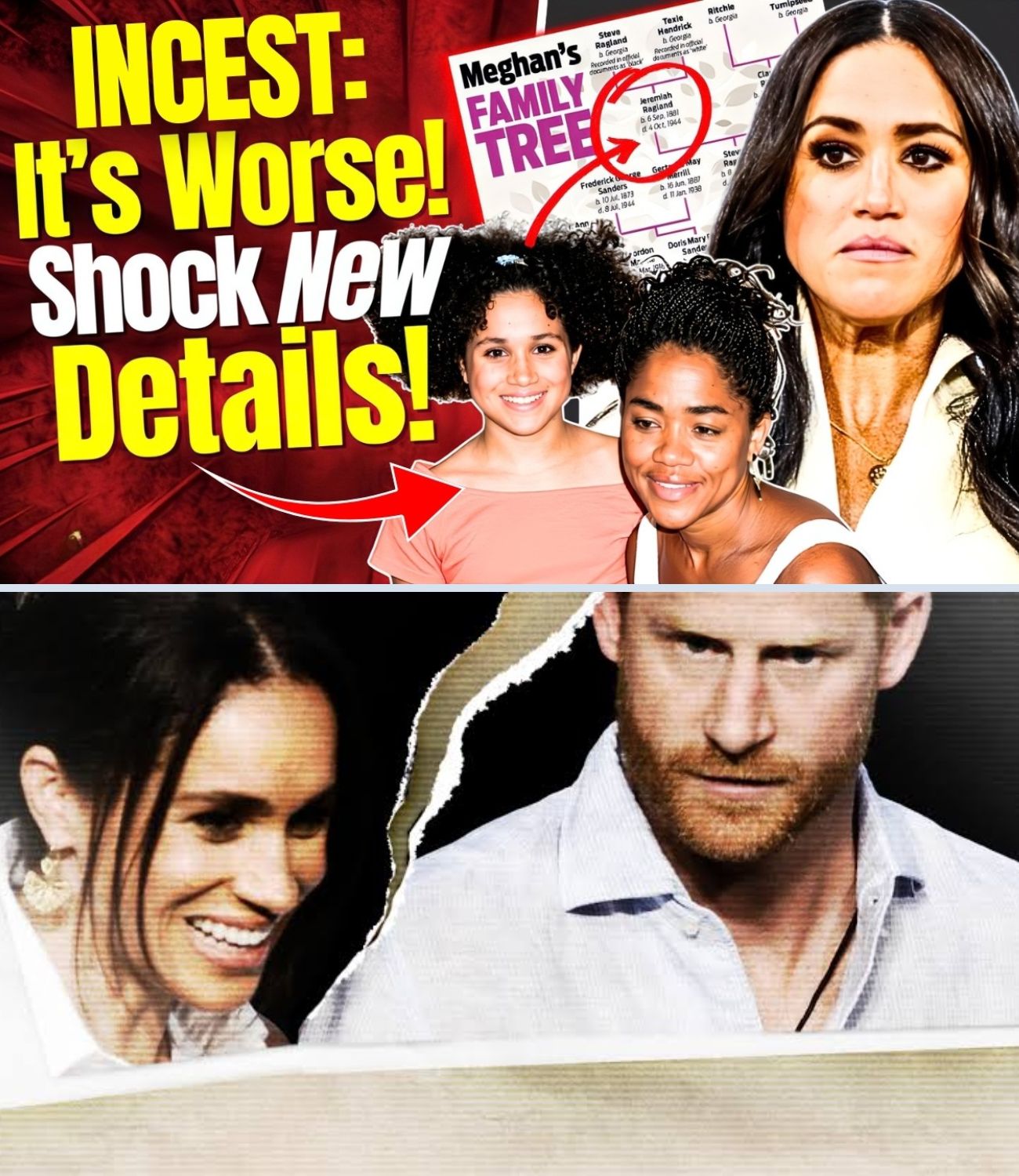
The mystery lingered in the shadows for years until stray fragments of information began to surface through unexpected channels. Intermittent interviews given by Thomas Markle—Meghan’s estranged father—gradually let slip names and historical breadcrumbs that challenged the official narrative. Slowly, painstakingly, independent researchers began to piece together a very different genealogical puzzle, unearthing the name Jeanette Arnold and tracing a complex web of familial interconnections that challenged the sanitised, carefully curated origin stories presented to the British public during the height of the wedding preparations.
III. The Architectural Blueprint of the Allegations
As the archival pieces fell into place, the nature of the rumours shifted dramatically from a bureaucratic curiosity into something far more explosive. Commentators and online investigators began pushing forward extraordinary allegations concerning the relationships binding Meghan’s maternal ancestors together.
According to these alternative genealogical reconstructions, the domestic arrangements surrounding Doria’s forebears—specifically involving figures within the Arnold and Prichard branches—featured structural anomalies that critics argue point directly toward historical instances of consanguinity, or incestuous unions within extended family networks. Proponents of this theory point to shared surnames, overlapping household registrations, and complex marital histories where individuals allegedly wed multiple partners across overlapping timelines.
In the cold, clinical language of genetic science, the implications of such ancestral arrangements are well-documented. When closely related individuals reproduce, the coefficient of inbreeding rises sharply, exponentially increasing the statistical probability of offspring inheriting deleterious recessive genetic disorders. Commentators diving deep into these speculative genealogies have argued that these ancestral patterns could help explain a myriad of subsequent family behaviours, ranging from selective estrangements and fiercely guarded personal privacy to the deliberate decision to exclude extended maternal relatives from high-profile ceremonial events.
Critics of the Sussexes have long scratched their heads over why Meghan chose to invite a roster of Hollywood celebrities—many of whom she had reportedly never met prior to the wedding—whilst leaving her entire extended family, both maternal and paternal, sitting at home across the Atlantic. Mainstream apologists framed this as a natural consequence of family estrangement, exacerbated by the media circus surrounding Thomas Markle’s staged paparazzi photographs. However, conspiracy-minded sleuths and tabloid commentators argue that a far more calculated panic was at play.
The core assertion underpinning these sensational theories is simple: if genealogical skeletons of a particularly sensitive nature were lurking within the family vault, establishment handlers and PR strategists would have had every incentive to maintain an ironclad perimeter of silence. The palace vetting process, renowned for its ruthless efficiency, would undoubtedly have uncovered the full scope of the family tree long before the archbishop blessed the union. Did the establishment know, and if so, did they actively assist in massaging the narrative to protect the immaculate aesthetic of a modern royal spectacle?
IV. Genetics, Optics, and the Montecito Paradox
The public fascination with these genealogical rabbit holes is inextricably linked to the broader, ongoing psychodrama of the Sussexes’ public existence. Every single detail surrounding Harry and Meghan is viewed through a hyper-partisan lens, where innocent anomalies are routinely magnified into grand conspiracies.
Nowhere is this more evident than in the endless online commentary surrounding the physical appearance of Prince Archie and Princess Lilibet. Tabloid detractors and social media critics frequently seize upon the children’s fair complexions, blue eyes, and golden hair, weaponising these superficial traits to fuel bizarre, speculative conspiracy theories about surrogacy, digital manipulation, or genetic impossibility. Commentators love to point out the statistical improbability of two children exhibiting such striking European phenotype traits given their mixed-race heritage, ignoring the basic, unvarnished realities of Mendelian genetics, where recessive traits can skip generations and manifest in wildly unpredictable ways.
Yet, this obsessive fixation on genetics and lineage forms the emotional bedrock upon which anti-Sussex rhetoric thrives. When fringe commentators attempt to link ancestral genealogical anomalies to modern reproductive choices—such as speculative tabloid claims regarding medical procedures, egg freezing, or planned family limitations—they are engaging in a form of character assassination designed to undermine the authenticity of the family unit.
The irony, of course, is staggering. For an institution that spent centuries arranging marriages between first and second cousins across the courts of Europe to consolidate territorial power and maintain dynastic purity, the British royal family hardly occupies a position of moral superiority when it comes to the complex science of inbreeding. The history of the House of Windsor—and European royalty at large—is littered with the physical and psychological toll of closed-gene-pool reproduction, from haemophilia to the distinctive Habsburg jaw.
Yet, public discourse remains perversely captivated by the notion that external bloodlines carry hidden vulnerabilities, as if royal pedigree somehow immunises an individual against the messy, unpredictable realities of human genetics.
V. The Complicity of the Media Machine
Perhaps the most compelling angle within this bizarre saga is not the speculative genealogy itself, but the role played by the media establishment in reporting, shaping, and ultimately burying these narratives.
When major media outlets such as The Daily Mail, The Sun, and various American syndicates published glowing genealogical profiles during the 2018 engagement, the unanimous framing of Doria’s maternal side as “unknown” was accepted as gospel. In the tightly managed ecosystem of royal public relations, journalists rarely possess the appetite—or the institutional clearance—to dig too aggressively into the uncomfortable background details of a royal bride, provided those details do not directly threaten the immediate PR objectives of the Crown.
Once the honeymoon phase dissolved and the bitter war of attrition between Montecito and Buckingham Palace commenced, however, the rules of engagement shifted permanently. Armchair investigators, operating completely outside the traditional constraints of mainstream journalism, began filling in the blanks that the legacy press had conveniently left unaddressed. They discovered old census tracts, untangled ambiguous marriage records, and connected dots that palace fixers had spent years keeping out of the headlines.
This dynamic exposes a profound truth about the modern information ecosystem: institutional secrecy is no longer sustainable in the digital age. No matter how many confidentiality agreements are signed, how many legal threats are issued by high-powered Beverly Hills attorneys, or how many royal vetoes are quietly enforced across palace corridors, the raw data of history remains accessible to anyone with an internet connection and the patience to sift through the digital archives.
When commentators like Paula AM and various online sleuths unpack these convoluted family histories on video platforms and substacks, they are tapping into a voracious public appetite for institutional deconstruction. They are peeling back the glossy veneer of celebrity PR to expose the messy, complicated, and frequently uncomfortable human realities that lie beneath.
VI. Conclusion: The Past That Refuses to Stay Buried
Step back from the breathless speculation, the convoluted family trees, and the partisan mudslinging, and the core of the matter reveals itself with stark clarity. The story of Meghan Markle’s maternal genealogy is a microcosm of the modern cultural battlefield—a space where historical fact, tabloid embellishment, and conspiratorial obsession collide in a chaotic, unending spectacle.
Whether the sensational rumours concerning ancestral consanguinity hold any substantive weight or merely represent the fevered projections of internet sleuths looking for smoke where there is no fire, the underlying message is unmistakable. The royal family and their transatlantic exiles live in a transparent fishbowl where the ghosts of the past can never be safely locked away.
As Harry and Meghan continue their high-stakes dance with the media, juggling fading commercial contracts, shifting Hollywood alliances, and the distant, stone-cold silence of Buckingham Palace, the collateral damage of their public exposure accumulates by the day. Every single family secret—real or imagined, historical or contemporary—will inevitably be dragged into the glaring light of public scrutiny.
The red files may be sealed at Windsor, the palace gates may be bolted from the inside, and the official court circular may ignore the noise entirely, but out in the digital wilderness, the hunt for hidden truths continues unabated. And as this latest genealogical rabbit hole proves, the most explosive secrets are often the ones hiding in plain sight, waiting patiently for someone to finally read between the lines.
You Might Also Enjoy

“We Thought They Would Negotiate”—What Argentine Soldiers Said When The British Attacked Goose Green

“You’ll Never Finish My Ruck March, Limey” — US Sergeant Who Challenged the SAS, Then Fell Out First






