NO WAY OUT: King Charles Cuts Off Meghan as Jennifer Aniston Drops Restraining Order Threat
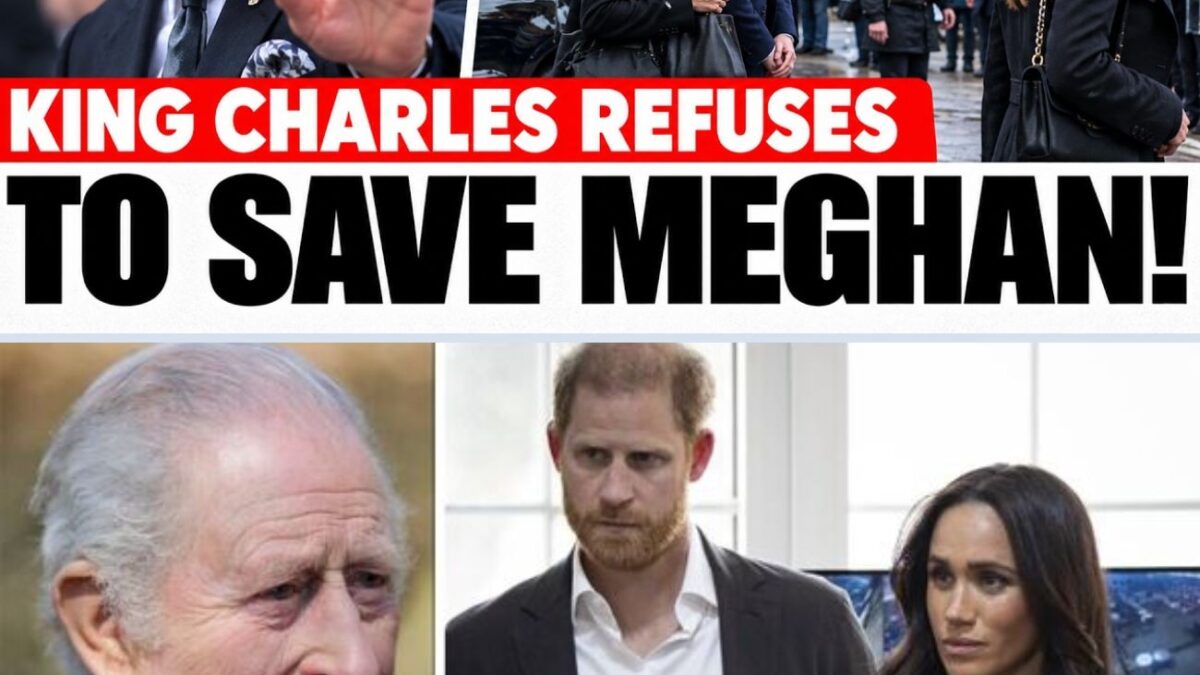
The breaking point did not arrive with a shouting match or a public spectacle. It arrived on a quiet Tuesday evening behind the fiercely guarded gates of Bel Air, after the household staff had gone home and the manicured estate had fallen silent. Jennifer Aniston sat at her kitchen counter, staring at a glowing smartphone screen that should never have contained the name of the woman messaging it.
She read the text once. She paused, inhaled sharply, and read it a second time before slowly setting the device down on the marble surface.
The message was not sent to her directly. It had been sent to Jim Curtis, the respected hypnotherapist and author with whom the beloved actress has been quietly partnered for over a year. Jim did exactly what any trustworthy partner does when a famous, notoriously calculating woman attempts to corner him: he put the phone squarely in front of Jennifer. He didn’t hide the notification or try to brush it off as an innocent industry inquiry. He let her read every single polite, meticulously calculated sentence. Meghan Markle had reached out yet again, writing from across the Atlantic whilst temporarily staying in Britain with Prince Harry.
On its surface, the note was dressed up in immaculate professional courtesy. It smoothly suggested that Jim’s published work on focus, habit, and psychological healing might align beautifully with a conversation the Duchess of Sussex wanted to initiate. She proposed a “mutual collaboration”—an intimate exchange between public figures who supposedly understood the unique, crushing psychological toll of global exposure.
But Jim Curtis is a man whose entire lucrative career is built on hearing the sentence underneath the spoken sentence. He heard the hidden angle immediately. The note deeply flattered his speaking career, but then came the inevitable pivot. Only after establishing a veneer of professional contact did Harry’s name casually slip into the text. And right behind the Prince came the unspoken, ultimate target: Jennifer.
Meghan floated the idea of a private dinner—an effortless, four-person gathering. She vividly pictured the Sussexes being warmly welcomed into the impenetrable inner sanctuary of Bel Air. Jim did not swallow the bait. He replied with crisp, professional distance. Meghan, completely undeterred by the polite brush-off, sent another note anyway.
If that had been the entirety of the situation, it might have simply been written off as an awkward, slightly desperate social overreach by an exiled royal. But this is the chilling detail that stopped Jennifer Aniston cold: these messages were not happening in a vacuum.
The private security logs at Jennifer’s Bel Air residence had already recorded something far more disturbing. On several quiet afternoons before the Sussexes had travelled back to Britain, a dark vehicle with tinted windows had slowed to a creeping crawl on the road running directly past Jennifer’s gated perimeter. The woman sitting in the passenger seat was Meghan Markle.
She never got out of the car. She never pressed the buzzer at the front intercom. She simply sat there in the passenger seat, staring up at the private estate. Furthermore, she returned on different days, specifically when the daylight shifted and the private guard rotations changed. Elite private security officers—men who instantly know the difference between a confused tourist consulting a sat-nav and a person methodically studying a secure gate—logged every single pass.
When Jennifer placed those disturbing security logs right beside the persistent, flattering messages sent secretly to her partner, she stopped calling it social persistence. She called it deliberate harassment. A woman who has spent the better part of three decades being hunted by ruthless paparazzi does not romanticise a dark car repeatedly returning to her fence line.
Jennifer picked up the phone and called her senior legal counsel.
The very next morning, the legal warning sent back through the attorneys was brutally clear and completely stripped of any lingering Hollywood politeness. Meghan was to cease all communication immediately. No more outreach to Jim. No more cloying notes carried by mutual friends. And absolutely no more cars slowing down outside that gate. If one more approach occurred, Jennifer Aniston was fully prepared to file a formal restraining order in a California municipal court.
To understand why the threat of a restraining order caused absolute, unmitigated panic behind closed doors in both Montecito and London, you have to understand the fundamental difference between sheer fame and actual power.
Most of the public looks at Meghan Markle and sees a royal title, multi-million-dollar production deals, and endless global headlines. But in the brutal, true hierarchy of American entertainment, titles do not buy loyalty. Jennifer Aniston is not a fleeting influencer trying to stay relevant on TikTok. She represents thirty years of unshakable, blue-chip cultural capital. She is part of an untouchable, fiercely protective inner circle that includes Courtney Cox, Jason Bateman, Jimmy Kimmel, and the most powerful studio executives in California. In that rarefied world, privacy is not just a preference; privacy is the very currency that buys your entry into the room.
When you understand what this really meant for the Sussexes, the strategy behind the harassment becomes completely transparent. Meghan did not just want to have dinner with Jennifer; she needed Jennifer.
By the time those messages were sent to Jim Curtis, the Sussexes were watching their initial American momentum evaporate before their eyes. Corporate contracts were being aggressively re-evaluated, production deadlines were slipping into the abyss, and the public fascination with their royal grievances was rapidly souring into widespread fatigue. To survive as commercial power players in the United States, they desperately needed the authentic stamp of approval from beloved American royalty. If Jennifer Aniston had invited Meghan to her home, sat on her patio for a photo, or appeared on her podcast, every single locked door in Hollywood would have immediately swung open. It would have signalled to every major studio head that the Duchess was officially received by the cultural elite.
But Meghan made one fatal miscalculation. She assumed that Hollywood operates entirely on the same superficial vanity that drives tabloid gossip. She believed that offering an intimate dinner with an actual British Prince would be an irresistible lure. She forgot that Jennifer Aniston has spent decades watching the wealthiest, most powerful people on earth try to buy their way into her living room. Jennifer does not need royal proximity. When someone treats her private partner as a strategic stepping stone, Jennifer does not see an exciting networking opportunity—she sees a parasite attempting to commercialise her personal life.
That specific detail is why London watched this collapse with quiet, mounting horror. King Charles and his senior advisers immediately understood the catastrophic legal reality. If an American judge issued a formal restraining order against the Duchess of Sussex for trespassing and digital harassment, the royal brand would suffer a devastating, unprecedented international blow. A British royal title would be officially logged in a California municipal court as an instrument of stalking. For Charles, who had spent his entire life defending the dignity of the monarchy, it was an unbearable prospect.
That is exactly why Prince Harry panicked. That is why Montecito desperately tried to reframe the entire affair as a simple misunderstanding about busy schedules. But as Jennifer’s legal counsel meticulously prepared the paperwork, a ghost from more than a decade earlier resurfaced, proving that this bitter personal clash had started long before the world ever heard of the Duke and Duchess of Sussex.
To truly understand why Jennifer Aniston could slam the door shut without flinching, you have to go back to the early 2000s. While Jennifer was still famously married to Brad Pitt, Meghan was a struggling actress trying to claw her way into the industry. During that period, Meghan made an uncomfortably specific remark to industry acquaintances. She casually declared that she fully intended to become “the next Mrs. Pitt.”
At the time, some might have laughed it off as a piece of ambitious Hollywood bravado. But the people who heard it did not see it as humour. They experienced it as someone coldly evaluating another woman’s marriage the way a vulture looks at a wounded animal. In Los Angeles, circles are tight, and words travel fast. The conversation was eventually repeated back to Jennifer. She remembered it.
A decade later, their paths collided directly. In the summer of 2011, on the Warner Bros. lot during the filming of the comedy Horrible Bosses, Jennifer was the indisputable A-list star of the production. Meghan had booked a brief cameo as a FedEx delivery driver that lasted barely thirty seconds on screen. The main cast was not scheduled to work during Meghan’s scene, but Jennifer had returned to the studio lot in the afternoon to retrieve personal items left in her dressing room.
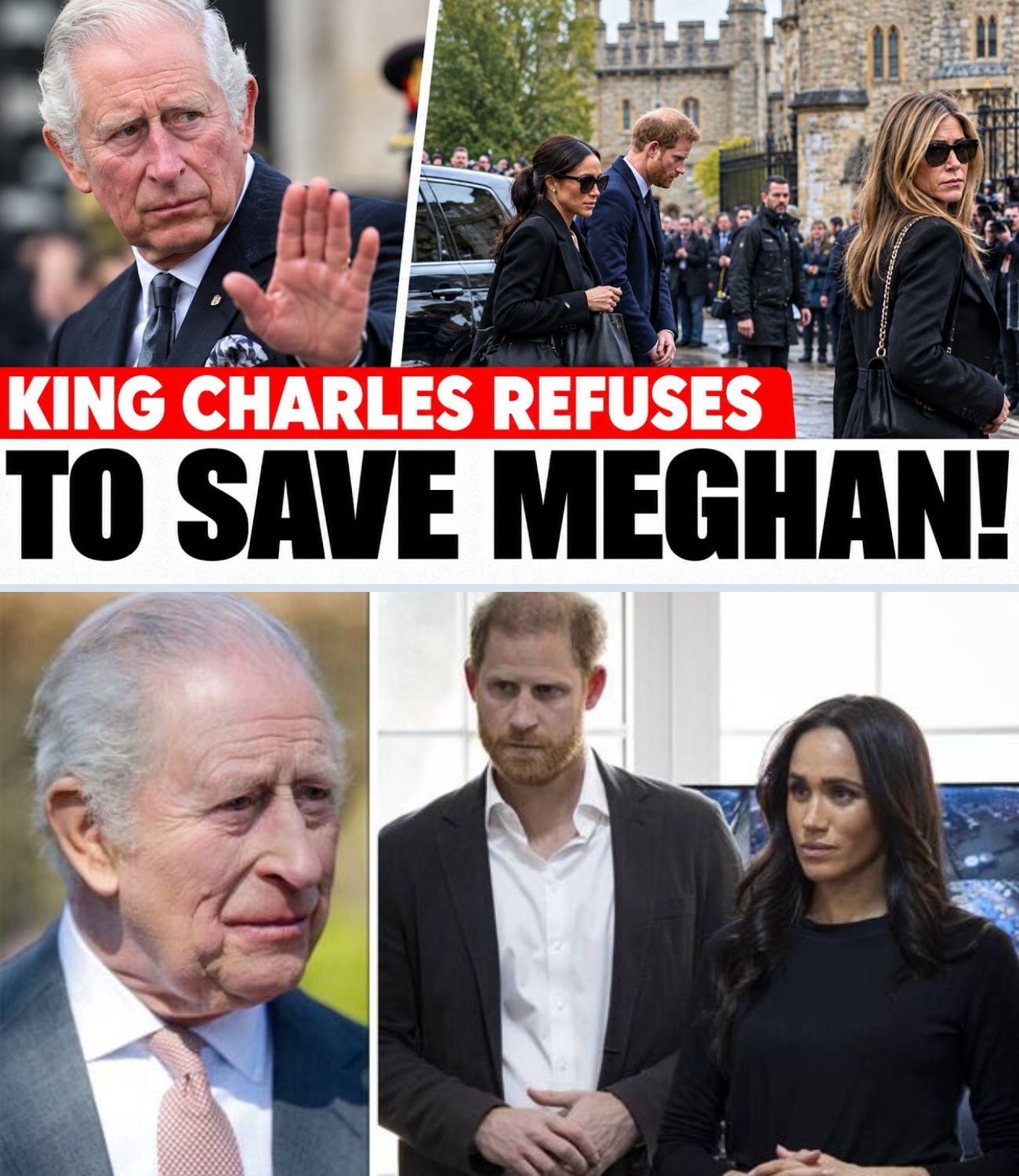
That was when she walked past an open doorway and heard someone shouting.
This is the exact moment where a person’s true character becomes impossible to hide. Jennifer did not find a nervous young actress practising her lines. She found Meghan Markle aggressively dressing down a terrified junior production assistant over a minor delay that was completely out of the young girl’s control. The voice was cold, sharp, and dripping with unearned entitlement. It was the tone of someone who fundamentally believed that the people lower on the call sheet existed purely to absorb her private frustration.
Jennifer stopped dead in her tracks. She stepped right into the room and shut it down immediately. She told Meghan directly that the abusive behaviour ended right then and there. She made it crystal clear that if she ever heard Meghan speaking to crew members like that again, she would personally have her thrown off the film. Meghan went completely silent. The scene was eventually filmed, but the star of the movie had marked her permanently.
When Meghan married into the British Royal Family and later moved down the California coastline, she arrogantly believed her Duchess title would magically erase that 2011 confrontation. She expected Jennifer to open her private doors simply because she was now royalty. But Jennifer Aniston respects character, not coronets.
And when Meghan realised that six years of polite, deafening silence from Bel Air was actually an absolute refusal, she began assembling a calculated scheme that would push the Friends star right to the edge.
The campaign Meghan waged over the next six years was remarkable in its sheer audacity. Invitations were repeatedly dispatched toward Bel Air. The notes were always written in a cloying, familiar tone, framing an afternoon tea as simple neighbourliness. Jennifer never answered a single one of them. In Hollywood, silence is a polite, definitive refusal. But Meghan refused to interpret silence as a closed door; she treated it as a temporary obstacle.
When personal invitations failed, she pivoted to professional bait, pitching for Jennifer to appear on her flagship podcast, Archetypes. Jennifer ignored that too. A public refusal would have given Meghan a media narrative about being rejected by a territorial star; silence gave her absolutely nothing to weaponise.
Then came the breaking point at the San Vicente Bungalows. The Bungalows is an exclusive, fiercely protected private club in West Hollywood where photography is strictly forbidden. It is a sanctuary where stars can eat without turning into tabloid fodder. When Harry and Meghan’s visits resulted in highly suspicious paparazzi swarms waiting right outside the private exit, the club took unprecedented action and quietly revoked their memberships. Jennifer Aniston, an esteemed founding member, fully supported that decision. Meghan took the revocation as a deeply personal insult.
Which brings us back to the targeting of Jim Curtis. If she could not walk through Jennifer’s front gate, Meghan decided she would construct a back door.
But what Meghan did not realise was that her scheme was already unravelling back in London. The messages sent to Jim were not just an isolated attempt to arrange a casual dinner party. They were the visible tip of an orchestrated diplomatic back-channel aimed directly at Buckingham Palace.
At the exact same time Meghan was writing flattering notes to Jim, Prince Harry’s private office had quietly submitted an informal briefing document to King Charles’s senior courtiers. The briefing proposed an ambitious joint wellness initiative, floating the idea of an American foundation backed by influential cultural figures. Tucked inside that proposal was a deliberate, highly calculated suggestion that Jennifer Aniston’s private circle was already engaging in “exploratory discussions” with the Sussexes.
Meghan was trying to extract a single, friendly reply from Jennifer’s partner so she could brandish it in front of the King’s advisers as definitive proof that Montecito had secured the backing of Hollywood royalty. They were attempting to use Jennifer Aniston as an unwitting bargaining chip to force King Charles back to the negotiating table regarding their diminished royal status and security funding.
When the full scope of that paper trail landed in Bel Air, Jennifer was done analysing motives. She picked up the phone, dialled her senior litigation team, and instructed them to draft a counter-move so ruthless and binding that it would permanently shatter the Sussex illusion.
By mid-morning the next day, a private legal communication had been formally transmitted to the Sussex representation in Montecito, copied directly to their legal team in London. The language was written in cold, binding statutory terms. Jennifer was not negotiating. She was issuing a final, non-negotiable instruction that terminated six years of unwanted pursuit.
Under California civil law, obtaining a protective order does not require someone to break down your front door; it requires proof of an ongoing pattern of intentional conduct causing substantial emotional distress. Jennifer possessed an airtight evidentiary dossier. She had the complete electronic chain of custody of the messages. Most critically, she possessed the detailed security logs documenting Meghan’s vehicle prowling outside her gate. Placed before a judge, that is not neighbourliness—that is statutory stalking.
The legal notice stated unequivocally that if any vehicle associated with the Sussex security detail slowed down, parked, or loitered along that road again, private security officers had standing orders to file a formal police report on the spot. If a single boundary was violated, Jennifer’s counsel was authorised to immediately file the emergency restraining order in open court.
Meghan’s worst nightmare was suddenly sitting on her desk: the terrifying prospect of her royal title appearing in public court records alongside the words “domestic harassment.” Simultaneously, Jennifer’s inner circle closed ranks like an iron vault. The most influential producers in town quietly removed the Sussexes from every private event roster.
Within hours, the reverberations reached the private secretaries at Buckingham Palace. When Prince Harry attempted to call in a royal favour to make the problem disappear, he found the ground beneath his feet had turned to quicksand.
Harry reached across the ocean, pleading for the Palace communications team to issue an official diplomatic clarification to the American press to intimidate Jennifer’s legal team. He genuinely believed that blood and family loyalty would compel King Charles to shield them from total public humiliation.
He fundamentally misread the man on the British throne.
King Charles did not summon an emergency family council. He did not release a protective statement. Instead, Charles issued a formal executive directive that closed the Palace gates forever. He reminded his household of the fundamental doctrine established by the late Queen Elizabeth II at the Sandringham summit: you cannot commercialise royalty or demand its privileges while discarding its duties.
The King instructed his aides to transmit a crystal-clear response: The Crown would offer zero diplomatic intervention. Zero legal representation. If private citizens living in California chose to harass their neighbours, they would face American justice entirely on their own. By formally withholding diplomatic immunity, King Charles stripped away the last invisible shield Harry and Meghan possessed. He was defending the integrity of a thousand-year-old institution, recognising that enabling Montecito’s reckless behaviour would eventually corrode the dignity of the throne itself.
The trap snapped shut with irreversible force. In California, Jennifer Aniston had drawn a binding legal perimeter around her life. In London, King Charles had drawn an unyielding institutional perimeter around the Crown. Both gates had officially locked from the inside.
The power shift did not arrive through noisy press conferences. It arrived through two unforgettable public images that told the entire story.
In Los Angeles, at an elite creative arts gathering, Jennifer Aniston walked into the room radiating effortless confidence, accompanied by Jim Curtis. Surrounded by top studio chiefs and lifelong friends, her very presence sent an unmistakable broadcast across the industry: the doors of authentic Hollywood belong to those who earn them, and the circle was officially closed to outsiders.
Meanwhile, five thousand miles away in London, King Charles hosted a major diplomatic reception at Buckingham Palace. When informal inquiries filtered through the press pack regarding the explosive rumours of a California restraining order, the Palace offered a cold, deafening silence. Charles was showing the world that the monarchy would not act as a legal shield for private misbehaviour in California.
The Duchess of Sussex had lost the approval of the Palace, and she had permanently lost the respect of Hollywood.
For six long years, the world was told that Harry and Meghan were building a revolutionary alternative to the British Royal Family. They believed fame was something you could demand rather than something you earn through character and humility. Jennifer Aniston earned the fierce loyalty of Hollywood because she values personal integrity. King Charles protects the Crown because he understands that moral authority disappears the moment you degrade the institution into a commercial sideshow.
Meghan Markle made the fatal mistake of thinking those boundaries were negotiable. She assumed King Charles would blink because Harry was his son, and that Jennifer Aniston would fold because Harry was a Prince.
When the dust finally settled, the reality was undeniable. King Charles did not bend, and Jennifer Aniston did not yield an inch. In their desperate attempt to conquer both worlds, the Sussexes ended up alienating both, stranding themselves in the quiet isolation of an empty estate where the cameras only show up when they call them themselves.
The warning is filed. The lesson is permanent. A closed door was never an invitation to find the side window, and as the Duke and Duchess of Sussex have devastatingly learned in both London and Bel Air: when the gate locks from the inside, nobody comes back out to open it.
You Might Also Enjoy

“We Thought They Would Negotiate”—What Argentine Soldiers Said When The British Attacked Goose Green

“You’ll Never Finish My Ruck March, Limey” — US Sergeant Who Challenged the SAS, Then Fell Out First






