Prince Philip Despised His Own Son Prince Edward The REAL Reason Is SHOCKING
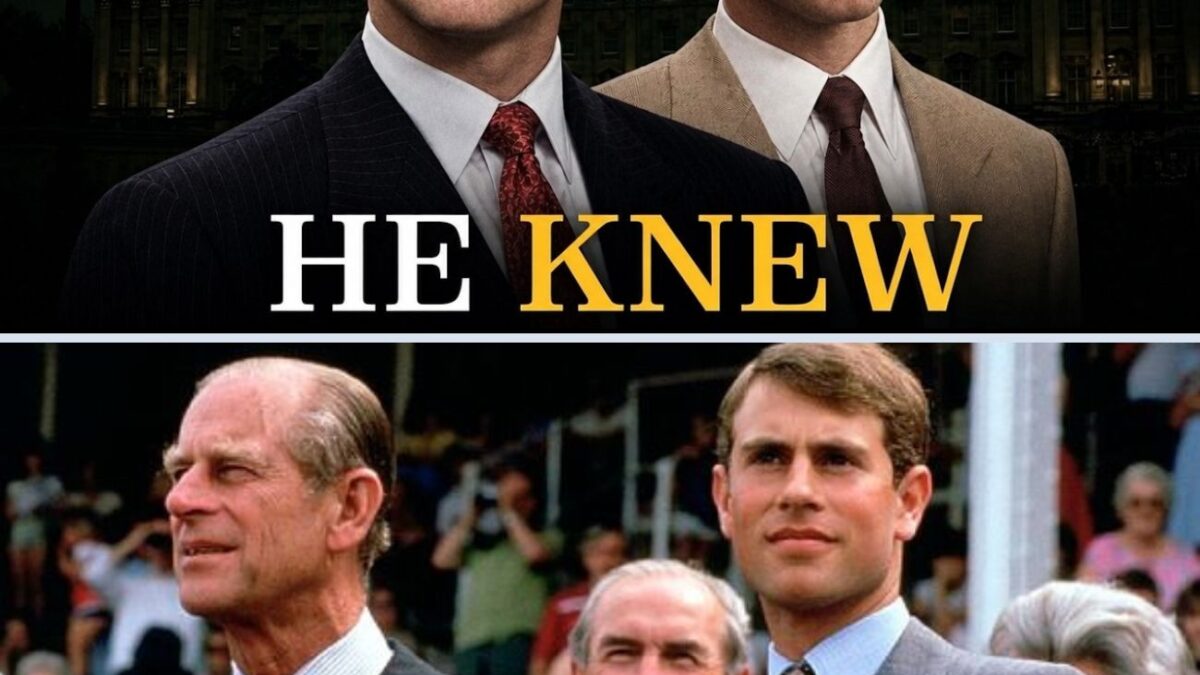
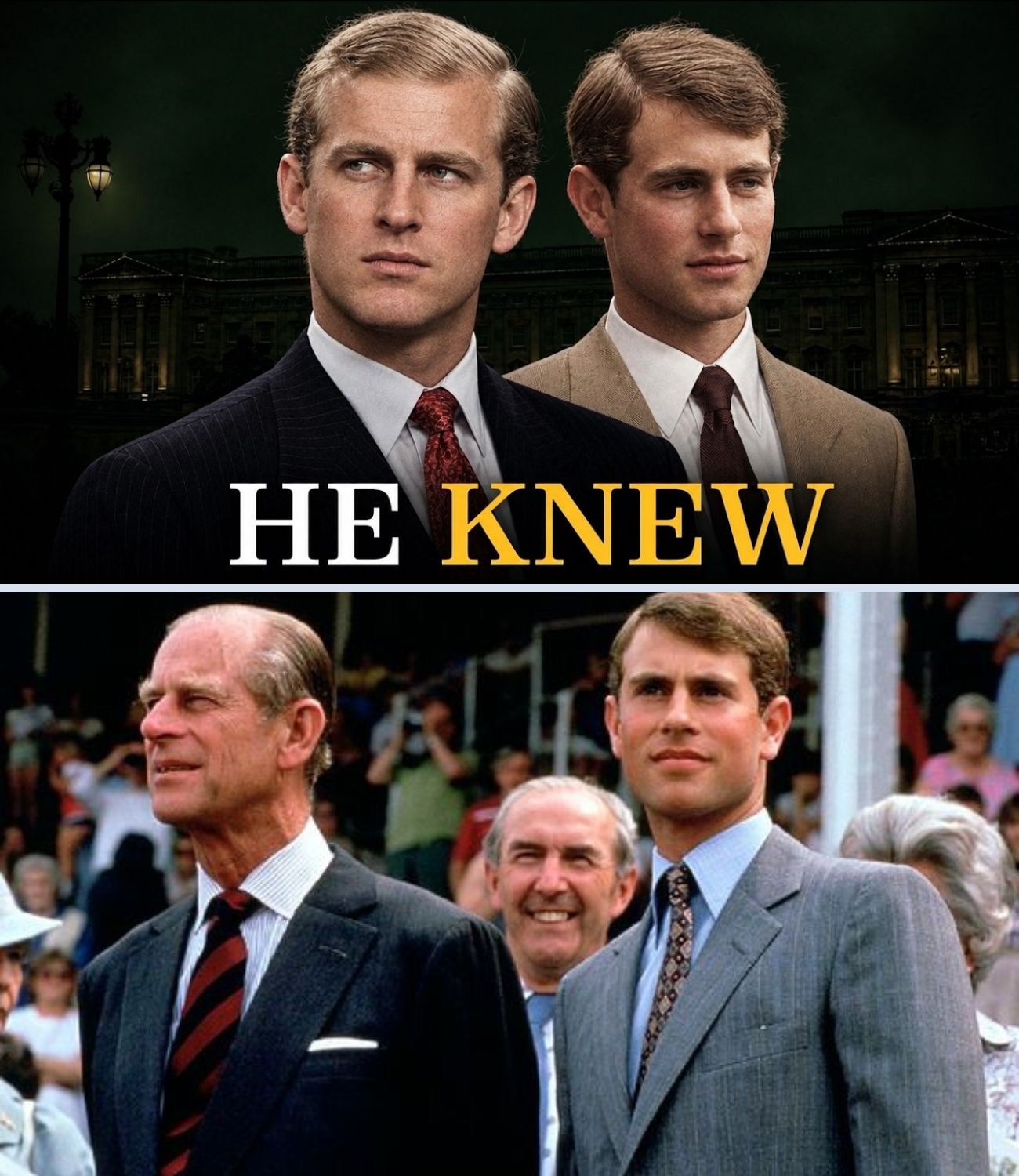
On March 10th, 2023, Edward turned 59 and Buckingham Palace handed him his father’s name, Duke of Edinburgh, the title Philip carried for 74 years. The press called it a reconciliation, proof the coldness had been overstated. Read the letters patent closely, and something else appears. The duke was granted for life only.
It dies with Edward. His son inherits nothing of it. So the family restored the name and refused the dynasty. In the same sentence, why promise a son that title in 1999, then deliver it stripped? To understand, go back to January 1987 and a green beret. That January, the Ministry of Defense confirmed that Prince Edward, 22 years old, had withdrawn from Royal Marines officer training at Lympstone in Devon.
He had lasted somewhere around 4 months of a 12-month course. The announcement was brief and administrative. The reaction was not. For the next 15 years, that single decision functioned as the fixed point of Edward’s public identity, and it did something stranger than damage his reputation. It defined his relationship with his father in public for the rest of Philip’s life.
Here is the part that gets skipped. Philip was at that exact moment captain general of the Royal Marines. He had held the post since 1953. It was not honorary in the way people assume. It was the single military role he kept closest after he gave up his own naval career, and he held it for 64 years, longer than most men hold anything.
His son did not quit an anonymous training course. He quit his father’s regiment while his father’s name was on the letterhead. The tabloids understood the shape of the story immediately, even if they got the substance wrong. Within days, the narrative was set. The weak fourth child, the tears, the humiliated war hero father.
Weepy Windsor entered the language and stayed there. Over the next three decades, the claim hardened into something everyone knew. That Philip was disgusted, that he never got over it, that he regarded Edward with a contempt he barely troubled to hide. I want to be careful here because that version is the premise of almost every retelling.
And the evidence for it is thin. The sourcing traces overwhelmingly to unattributed royal insider quotes in 1987 and to biographies written decades later that recycled those quotes without adding anything. Edward himself gave a different account in contemporary interviews and has repeated it since. The decision was his.
He had come to the conclusion the Marines were not the life he wanted and his parents backed him. Several biographers have concluded Philip was privately furious. Others have concluded Philip was, if anything, more understanding than the Queen. Both camps are working from secondhand recollection. Nobody has produced a letter.
What we can do is stop asking whether Philip was angry and start asking a better question. Why would this particular failure in this particular family land the way it did? Because of what quitting meant to Philip specifically, not to fathers in general, to him. Philip’s family lost everything when he was a year old.
His father, Prince Andrew of Greece, was arrested after the Greco-Turkish disaster of 1922, court-martialed and banished. The family left Corfu on a British warship. And the detail everyone repeats: the baby carried aboard in a crate improvised from an orange box may be embellished, but the underlying fact is not.
They left with no throne, no country, and no money. Philip grew up in borrowed houses belonging to relatives. Then the household dissolved entirely. His mother Alice was removed to a sanatorium in Switzerland in 1930 after a psychiatric diagnosis. He was 8 or 9. His four sisters all married into German aristocratic families in rapid succession, which scattered them across a continent that was about to become very complicated.
His father moved to the south of France and effectively out of his life. When Andrew died in Monte Carlo in 1944, Philip had not seen him in years and inherited, by most accounts, a signet ring, some clothes, and a shaving brush. So, Philip arrived at Gordonstoun in Scotland in 1934 as a boy with no home to go back to during holidays.
Gordonstoun’s founder, Kurt Hahn, was a German Jewish educator who had fled the Nazis and built a school around the proposition that character is produced by physical hardship. The school motto is a German-rooted phrase Hahn liked: Plus est en vous, there is more in you. Cold water swims, seamanship, early runs, rescue training on a coastline that kills people.
For most boys, it was an eccentric education. For Philip, it was the first structure that had ever held, and it worked in the most literal sense. He went to Dartmouth, went to sea, was mentioned in dispatches at the Battle of Cape Matapan in 1941, when he was 20, and became one of the youngest first lieutenants in the Royal Navy at 21.
He had no title worth anything, no fortune, and no nationality he could reliably claim. Endurance was not one of his qualities. It was the entire inventory. Then he gave it up. When George VI died in February 1952, Philip’s naval career ended, and he spent the next several decades in a role with no defined function, walking two paces behind his wife.
He compensated by building things. The most successful of them, founded in 1956 with Kurt Hahn and the mountaineer John Hunt, was a scheme that took Gordonstoun’s methods and offered them to any teenager in the country. Expeditions, service, physical challenge, a badge at the end—bronze, silver, gold—the Duke of Edinburgh’s Award.
Millions of young people have finished it. The one thing the scheme measures is whether you complete what you started. Keep that in mind; it comes back. Edward was born at Buckingham Palace on March 10th, 1964, and the circumstances of the birth are worth 30 seconds because they cut directly against the legend. Philip was reportedly present in or near the room, which in 1964 was not a normal thing for any father to do, and was distinctly unusual for a royal one.
The Queen had come back from Elizabeth’s traditional distance with her elder, too. With Andrew and Edward, she was more hands-on, and by the accounts of people in the household, Philip was too. Whatever went wrong later did not start at the beginning. What started at the beginning was something else. Edward was the fourth child and third son.
He had no throne to inherit, no duchy, no estate, no obvious job. The crown is very good at producing heirs and extremely bad at answering the question of what to do with the spares once there are several. So the family did what families with a strong personality at the head tend to do. They gave him the founder’s program: Heatherdown Prep School, then Gordonstoun.
And here you have to notice what the Windsors already knew by then because Charles had been sent to Gordonstoun in 1962 and had by his own later accounts and his letters home been miserable there. The school had been Philip’s salvation and Charles’s endurance test, and the family ran the experiment again anyway. The difference is that Edward did well.
He liked it. He became head boy, which Charles also technically was, but Edward seems to have wanted it. He finished a gap year teaching in New Zealand at Wanganui Collegiate, and came back with the reputation of the easy one, then Cambridge, and the first public crack. Edward went up to Jesus College in 1983 to read history.
His A-level grades were reported in the press at the time as modest. The figures that circulated were a C and two D’s, and academics inside and outside the university said publicly that a candidate with those results would not normally have gotten in. The college defended the admission. The story ran anyway for weeks. It was Edward’s introduction to a particular experience: being publicly assessed against a standard he had not set for himself on grounds of a privilege he had not personally arranged.
He came out with a 2:2 in 1986, and waiting for him already paid for was the Royal Marines. The arrangement had been made years earlier. Edward had been accepted under a sponsorship scheme that paid a bursary through his university years on the understanding that he would enter officer training afterward. Reports at the time put the figure at around £12,000.
So before he had finished his degree, before he had spent a day at Lympstone, the Marines had money in him, and the corps had a public expectation attached to the name. Consider what that actually was structurally: a young man of 22 entering a 12-month commando course, one of the hardest military training programs in the world, where the commanding officers reported up a chain that terminated in his father.
Every instructor on that course knew whose son he was. Every one of them knew the captain general would hear how he did. He had not chosen the school that shaped him, the university that took him, or the regiment that had already paid him. He had been cast. There is a photograph from that autumn of 1986, the standard press handout of the new officer cadet in uniform.
And it reads now exactly the way it was meant to read then. The family’s youngest doing the correct thing, following the correct man. The green beret is not in it. You do not get the beret until you pass. He never got one. What happened over those four months at Lympstone has never been established in detail, and I am not going to pretend otherwise.
Contemporary reporting mentioned the physical demands and the weather. Later accounts mentioned that he had been unhappy well before he arrived. Edward’s own consistent line has been that he realized the career was wrong for him and that dragging it out would have been worse for everyone, including the corps. The Ministry of Defense statement in January 1987 said he was leaving.
Buckingham Palace said the Queen and the Duke of Edinburgh supported his decision and understood it had not been an easy one. That last sentence is the one to hold on to. The palace put Philip’s name on a statement of support within days. And within weeks, according to the reporting that followed, Edward began work on a project designed to prove he could produce something of his own.
A televised charity event involving his siblings, a medieval theme, and a national audience. His parents would not appear in it. And the reason people rarely notice that detail is that the event itself was so strange, nobody bothered to check the guest list. Before getting to Alton Towers, though, it’s worth looking at what Edward’s life actually consisted of in the spring of 1987, because the phrase “he had no job” undersells the situation considerably.
He had no job, no profession, no property, no independent income, and no address that belonged to him. He lived in Buckingham Palace, not as a visitor. He had rooms there and he kept them until he married at 35. Compare that with his siblings. Anne had been given Gatcombe Park in Gloucestershire in 1976, a working estate of her own.
Charles had the Duchy of Cornwall, an inherited private business producing millions a year, and would take Highgrove in 1980. Andrew would be given Sunninghill Park as a wedding present, a house the tabloids christened “SouthYork” and mocked for a decade, but a house nonetheless. Edward got a bedroom in his mother’s palace and a place on the civil list, which meant the state paid him a modest sum, and Parliament debated periodically whether it should.
That is the whole power situation in one sentence. Every member of that family had somewhere to go. Edward had somewhere to stay. It shaped the practical texture of everything. His diary was run through the palace press office. His travel was arranged by people who reported to the Queen’s household.
The charities attached to his name were largely inherited ones in the sense that they came to him because he was available rather than because he had built them, and the largest organization in his orbit, the one everyone assumed he’d eventually be involved with, belonged to his father. Now, the tournament: It’s a Royal Knockout, formerly the Grand Knockout Tournament, was Edward’s idea.
And it is important to say that the idea was not obviously stupid. The BBC had run It’s a Knockout for two decades as a Saturday evening slapstick contest, teams in oversized foam costumes falling into water. It was enormously popular. Edward’s proposal was to stage a one-off celebrity version with royal team captains and give the money to charity.
In 1987, the younger royals were the most photographed people on Earth. The commercial logic was sound. It was filmed at Alton Towers in Staffordshire on June 15th, 1987, and broadcast 4 days later. Edward captained one team. Anne captained another. Andrew and Sarah, Duchess of York, married barely a year, captained the other two.
The celebrities included John Travolta, Christopher Reeve, Meat Loaf, Tom Jones, Barbara Windsor, Gary Lineker, Nigel Mansell, and others. Stuart Hall commentated in the high shrieking register he’d used for years. Everyone wore mock Tudor costume. Meat Loaf chased Viscount Linley with a papier-mâché ham.
Each team played for a charity. Anne’s was Save the Children. Andrew’s was the World Wildlife Fund. Sarah’s was the International Year of Shelter for the Homeless. Edward’s team played for the Duke of Edinburgh’s Award. The event raised somewhere around a million pounds. By the metric Edward had set himself, it worked.
By every other metric available, it was the single most damaging thing the House of Windsor did to itself in the 1980s, and it did the damage instantly. The critics were vicious. Columnists who had spent years defending royal dignity described the family as having voluntarily entered a fancy dress game show. The word that recurs in the coverage is “undignified.”
Some commentators later argued it marked the beginning of the end of a certain kind of royal difference. And while that’s probably overstated, the perception stuck hard enough that the family would not attempt anything comparable again for the rest of the century. The Queen and the Duke of Edinburgh were not there.
I want to be precise about what we can and cannot conclude from that. There is no document establishing that Philip refused. Royal engagements are planned months ahead, and the monarch does not turn up to television recordings as a matter of course. But this was not a routine broadcast. It was his three youngest children and his daughter-in-law in costume on national television.
One team competing for the money that funded his own life’s work. Attending would have been trivially easy. He was 15 weeks from his 66th birthday and in the full flow of a schedule that ran hundreds of engagements a year. He did not attend. Neither did the Queen. Neither did Charles and Diana, who had been asked and declined.
That is where the story is usually left. What’s more interesting is what happened in the press tent. Edward went in to face the journalists after filming, and the accounts of what followed are consistent across multiple contemporary reports. He asked the assembled press what they had thought of it. He got nothing back. He asked again.
The room stayed quiet. He then said something to the effect of thanking them for being so enthusiastic and walked out. It’s a small moment and it has been replayed for 38 years as evidence of a thin skin. Look at it from inside his position instead. He was 23. Five months earlier, he had walked out of the Marines and taken the worst press of any young royal in a generation.
He had responded by building something intended to demonstrate he could organize, deliver, and produce, and he had delivered in the narrow sense that the charities got their money. He then walked into a room full of the people who had spent January calling him a quitter, and they would not give him a sentence.
He walked out of that room, too. It became the clip. Here is the thing that makes 1987 the hinge year rather than just a bad year. Before January, Edward’s public identity was undefined. By July, it was fixed, and it was fixed as the inverse of his father. Philip was the man who had endured the unendurable and built a program to teach endurance to teenagers.
Edward was now permanently the boy who left and then made a game show. The contrast wrote itself, and the press used it for the next 15 years without needing to check whether it was true. What it did to the actual relationship between the two men is harder to establish. And anyone who tells you they know is guessing.
What we can see is behavior. And Philip’s behavior in the years that followed was neither warm nor punitive. It was absent. There is no public rupture on record, no exile, no stripped patronage, no withdrawn invitation, no reported confrontation from a named witness. Edward continued to appear at Sandringham and Balmoral and Windsor.
He continued to turn out on the balcony. What is missing from the record across those years is any documented instance of Philip publicly associating himself with anything Edward did. Withdrawal is much harder to prove than cruelty and much harder to complain about. You cannot hold a press conference about an absence.
Edward’s next move is the one that gets the least attention and probably deserves the most because it was the only genuinely independent thing he ever did. He went to work in theater. In 1987, he joined Andrew Lloyd Webber’s Really Useful Theater Company as a production assistant, and the reported salary was somewhere in the region of £100 a week.
Some accounts put it slightly higher. Either way, it was a junior wage for a junior job, making tea, running errands, handling the unglamorous mechanics of getting shows onto stages. He worked around Cats, Starlight Express, and The Phantom of the Opera. Colleagues who spoke to the press at the time described him broadly as unpretentious and willing.
He used the name Edward Windsor. There’s a temptation to read that as a man hiding. I’d read it differently. He was a prince of the United Kingdom, taking a £100-a-week job in an industry his family had no stake in—the only sector of British life where the Windsor name bought him nothing but embarrassment. If you are looking for the moment Edward tried to construct an identity his father had not assigned him, this is it.
And it is genuinely admirable. And it was reported almost entirely as a joke. The press treated the theater job as confirmation of everything. A royal duke’s son in a profession the tabloids of that era coded as effeminate. After failing the commandos, from roughly 1987 onward, British newspapers ran a persistent, sniggering line of speculation about Edward’s private life, never stated outright because the libel risk was real, but implied constantly through nudge and adjective and the repeated pairing of Marines with musicals.
He addressed it once directly in 1990 during a press appearance in New York connected to a theatrical charity venture. A reporter raised it. Edward said flatly that it was not true and made clear how much the persistence of the speculation angered him. The denial made headlines on both sides of the Atlantic, which tells you the story had been running long enough to be worth denying.
And that is the second thing 1987 handed him alongside the reputation for quitting. A private life under permanent low-grade public interrogation in his 20s with no house of his own to retreat into. He kept working. In 1993, he left Really Useful and set up his own company, Ardent Productions, with himself as joint managing director.
The plan was television, documentaries, drama, history programming. He raised money from outside investors, which meant for the first time that Edward had commercial obligations to people who were not related to him. Ardent lost money. It lost money nearly every year it existed. Filings showed losses running into the hundreds of thousands.
The company repeatedly recapitalized and had a commercial output that critics found thin. Its most discussed production was a documentary series on Edward’s father. There were persistent questions raised in the press and in Parliament about whether investors had put money into Ardent because they believed in its programming or because its managing director was the Queen’s son.
He was 31 years old, running a loss-making company from an office in Surrey, living in his mother’s palace, and being asked in public whether his business existed only because of his father’s surname. And then in 1999 at St. George’s Chapel, the family gave him something none of the coverage had expected.
They had met in the loosest sense in 1987, the year of the Marines and the tournament, when Edward was dating a friend of hers, though nothing came of it then. They met properly in 1993 at a real tennis charity event where Sophie Rhys-Jones was standing in for someone else. She was a public relations executive, the daughter of a car parts salesman from Kent, educated at a comprehensive and a secretarial college.
She had a job, an income, a flat, and a career that existed independently of the Windsors. Of everything Edward acquired in the 1990s, that was the most unusual item. They were together 6 years before the engagement, which by royal standards is glacial, and by the standards of that specific decade was obviously deliberate.
Charles and Diana had married after roughly a dozen meetings. Andrew and Sarah had gone from courtship to wedding in under a year. Both marriages had come apart publicly and expensively in 1992 and after, and by 1996, both were formally over. The family had learned something. And what it had learned was: wait. The wedding took place on June 19th, 1999, at St. George’s Chapel, Windsor—not Westminster Abbey, not St. Paul’s.
The scale was deliberately reduced. Evening ceremony, no ceremonial carriage procession through London. Guests asked to come without formal morning dress or tiaras. Around 8,000 members of the public were admitted to the castle precincts. The press called it the modern royal wedding, which in 1999 was a compliment.
Then came the announcement issued by Buckingham Palace that same day: Edward would not be created a royal duke. He was made Earl of Wessex with the subsidiary title Viscount Severn. Every previous son of a monarch in the modern era had been given a dukedom at marriage.
Charles had Cornwall from birth. Andrew had been made Duke of York on his wedding morning in 1986. Edward got an earldom, and the explanation given was that he preferred it. The second half of the statement is where the story lives. It said that Edward would eventually succeed to the title Duke of Edinburgh when it reverted to the crown, meaning after both Philip and the Queen had died and the dukedom passed through Charles back into the monarch’s hands.
The palace made clear this was the wish of the Queen and the Duke of Edinburgh, too. Read that sequence in the order it actually happened. On the same day that Edward was denied a dukedom, he was promised the dukedom. The most valuable title available in the family, the one his father had carried since 1947, was assigned to him in advance and made contingent on two deaths and an unspecified date.
I’ve seen this described as the moment Philip forgave him. I’d put it differently because there’s something more interesting in it than forgiveness. By 1999, Philip was 78. He had spent 43 years building the Duke of Edinburgh’s Award into a scheme operating in over a 100 countries. He had held the Royal Marines Captain Generalcy for 46 years.
The title itself was going to vanish into the monarchy the moment Charles became king, absorbed and extinguished. Philip had no way to prevent that. What he could do was name a successor and make the family say so in public. He chose the son who had quit, not Andrew, who had flown helicopters in the Falklands and was the closest thing the family had to Philip’s own naval record.
Andrew already had York. He chose the youngest, the one with the theater job and the loss-making company and 15 years of bad press, and he chose him in writing on a day guaranteed to generate maximum coverage. That is not the behavior of a man who despised his son. It is, however, entirely consistent with a man who had decided what his son was for.
Because look at what the promise did structurally. It gave Edward the most powerful incentive imaginable to stay inside the family system and behave. The title could not be earned early. It could not be transferred. It required him to still be in good standing decades later when the succession finally opened.
Philip had handed his son a reason to never again do anything embarrassing and made the payment date unknowable. Hope with conditions attached and no completion date. The immediate years were good ones, and I don’t want to skate past that because the record genuinely supports it. The Wessexes were popular. Sophie was widely liked.
She was the first royal bride in a generation who had held a real job, and she kept holding it. She was a director of her own public relations firm, RJH, and Edward continued to run Ardent. The Queen had permitted something unprecedented: two working royals who also worked. They moved into Bagshot Park in Surrey, a Victorian pile leased from the Crown Estate, which Edward paid to renovate himself.
He had at 35 finally acquired the two things he’d never had: an address that was not his mother’s, a future title that was his father’s. Both were about to be tested inside 18 months by two separate press operations, 3 weeks apart. The first hit Sophie. In March and April 2001, a News of the World reporter named Mazher Mahmood approached her firm posing as a wealthy Arab businessman, the fake sheikh method he had used on dozens of targets.
Sophie and her business partner met him. She was recorded. The transcripts published across several editions included her making indiscreet remarks about senior politicians and members of the royal family and, more damagingly for the business case, discussing the value her royal connection brought to clients.
The palace tried containment and made it worse. Sophie gave an interview to a rival paper attempting to get ahead of the story, which the News of the World then used as justification for publishing more of the tapes. Within weeks, she announced she was leaving her company.
The second hit Edward directly, and it was the one that could not be survived. Prince William had started at the University of St. Andrews in September 2001. The arrangement negotiated with the media was explicit and had been honored. The press would leave him entirely alone for the duration of his degree in exchange for agreed access at set moments. It was the single most sensitive media agreement the palace had, and it existed because of Diana, and everyone understood that.
In September 2001, an Ardent Productions crew turned up at St. Andrews and filmed there working on a program about young royals. Edward was not with them. He was abroad. It does not matter. It was his company, his name on the letterhead, and the family’s most protected agreement was breached by the one Windsor who had spent eight years insisting he could run a commercial television business without conflict.
Charles’s reaction was reported at the time as furious, and unusually for royal anger, it did not stay private. It was briefed out, which is itself the significant part. The Prince of Wales’s office allowed it to be known that he was incandescent. Within the family’s internal grammar, that was a public execution.
The industry verdict on Ardent had already been brutal and was now unanswerable. Trade insiders quoted in the press described the company as a joke. The financial record was worse than the reputation. Ardent lost money in every single year it operated, with one exception: the year Edward took no salary. He had personally put in £25,000. Roughly £700,000 more came from outside businessmen.
And here is the detail that should stop you. Most of those investors were already connected to the Duke of Edinburgh’s Award. His father’s charity network had underwritten his independence. Think about what that means for the power question. Edward had spent from 1987 to 2001 trying to construct a life his family had not assigned him.
The theater job under the name Edward Windsor, the company built on ambition and motivation and strength. The documentaries, the business cards, the money that made it possible came through the donor list of the organization his father founded to teach young people persistence. He had never been outside the system.
He had been renting a room in a different part of it. In March 2002, Edward announced he was stepping down from Ardent to concentrate on royal duties and support the Queen through her Golden Jubilee. Sophie had already gone from her firm. Both of them within a year out of commerce and onto the civil list full-time.
The Jubilee framing was elegant and largely fiction. This was a settlement. The family had absorbed two commercial disasters in under a year, one of which had damaged the protection of the future king, and the terms were straightforward: give up the businesses, come inside, take the diary the palace gives you.
Ardent limped on as a shell and was wound up voluntarily in June 2009 with assets of £40. Reports indicate the Queen provided financial support to both Edward and Sophie around the withdrawal, which is not surprising and is also the whole point. The moment they stopped earning, they became dependent on the household again.
Here’s the micro-verdict, and I think it’s the load-bearing one in the entire story: Edward did not fail his way into royal duty. He was priced into it. The 1999 promise had established what he would eventually receive. The 2002 surrender established what he had to hand over first. The company, the income, the name on the business cards, the possibility of ever again being anything other than a working member of his mother’s household.
15 years after walking out of Lympstone to find a life of his own, he had returned every piece of it, and the diary he was handed reflected exactly where he now sat. Not the glamour engagements—the county shows, the regimental visits, the overseas tours to small Commonwealth nations, the charity galas nobody else wanted. In 2002 alone, he and Sophie began building the volume of low-visibility work that would 20 years later make them structurally essential, though nobody, including them, could have known that at the time.
There was one more thing the palace gave him in those years, and it arrived without ceremony: Philip’s organization needed running. The Duke of Edinburgh’s Award had grown into an international federation operating across more than a 100 countries with a foundation board, national licenses, and an endowment to raise. Philip was in his 80s.
He had given his son the eventual right to his title. Now he began handing over the thing the title actually meant. Edward started taking the awards, international travel, then the trusteeship. Then in time, the chairmanship of the International Award Foundation itself. The son who had left a 12-month course after 4 months was being made custodian of the only national institution in Britain whose entire purpose is to certify that a young person finished what they began.
I’ve thought about whether that’s cruelty, and I don’t believe it is. I think it’s something colder and more characteristic of Philip. It was work. It needed doing. There was one person in the family with the time, the obligation, and no competing empire of his own. But the shape of it is unmistakable. Edward would spend the next two decades flying to awards ceremonies across the Commonwealth, standing on stages, pinning gold badges onto teenagers who had done the thing he had not.
He did it for 20 years, and somewhere in there, the job stopped being penance and became the thing he was best at. That’s the part the tabloid version has no room for. From roughly 2002 onward, Edward and Sophie assembled the least glamorous and most functional operation in the family.
And they did it while everyone’s attention was somewhere else. Two or 300 engagements a year between them. Small Commonwealth tours to places the senior royals skipped: St. Lucia, Grenada, Malta, Sri Lanka. The bits of the map that matter enormously to the institution and not at all to the front pages. Hospices, cadet forces, regional theater, gold award presentations at St. James’s Palace—10 or 12 a year, 500 teenagers at a time—and no scandals, not one after 2002.
In a family that spent the following two decades generating them at a rate that overwhelmed its own press office, the Wessexes produced nothing. No leaked tapes, no divorce, no lawsuit, no interview. Their children, Louise and James, were sent to local schools and kept almost entirely out of view.
And at the children’s birth, the couple did something no one had asked them to do: they announced that Louise and James would be styled as the children of an earl rather than as prince and princess. Lady Louise Windsor, James, Viscount Severn. Read that against everything that came before. Edward had spent his 20s and 30s trying to build an identity outside the Windsor machine and had been forced to sell all of it back.
The first genuinely free decision he made afterward was to withhold royal titles from his own children. He had learned what the title costs; he declined to bill his kids for it in advance. Sophie, meanwhile, was doing something quieter and far more consequential. After the News of the World affair, she could have retreated permanently.
Plenty of royal spouses have. Instead, she rebuilt from the bottom, took on the unfashionable portfolios—avoidable blindness—and then from the mid-2010s, survivors of sexual violence in conflict zones, which took her to Kosovo, South Sudan, Chad, the Democratic Republic of Congo, and Iraq. She addressed the UN Security Council on Women, Peace, and Security in 2019.
It is genuinely serious work, and it was almost entirely uncovered by the British press, which had no interest in her once she stopped being a story. She also became, by every reliable account from inside the household, the person Elizabeth II most liked having around. They were photographed driving together at Windsor.
Sophie was described repeatedly by journalists with good palace sourcing as the Queen’s favorite in-law. That is soft power, and it is real power. Access to the monarch is the only currency that has ever mattered in that building, and the woman the press had written off in 2001 had accumulated more of it than almost anyone.
The couple had one other advantage, and it was entirely accidental: they were cheap. Bagshot Park cost them a commercial lease. Their staff was small. The Sovereign Grant reports published annually from 2012 made royal expenditure a permanent subject of political argument, and the Wessexes never appeared in the bad paragraphs.
None of this was a strategy for power. It was a strategy for survival. And for a long time it produced nothing except a diary. Edward was in his 50s, still the Earl of Wessex, still waiting on a title promised in 1999 with no date attached. In March 2019, for his 55th birthday, the Queen gave him an additional Scottish title, Earl of Forfar—a pleasant gesture, and also, if you are counting, the fourth or fifth consecutive occasion on which the family found a way to honor Edward without giving him the thing it had already promised him.
Then the structure around him began to collapse, and it collapsed in the exact places that had always stood above him. On August 2nd, 2017, Philip carried out the last solo public engagement of his life. He was 96. The event was a parade on the forecourt of Buckingham Palace, marking the finish of the Royal Marines 1664 Global Challenge, a fundraising endurance series.
It rained. He stood in it in a bowler hat for the length of the parade and raised the hat at the end while the Marines gave him three cheers. 64 years as captain general, and he chose to end his public career with that corps, not the Navy, not the Award, the Marines. Four months later, in December 2017, the captain generalship was passed to Prince Harry.
That is the line nobody draws, and it is the sharpest fact in this entire story. Philip’s regimental role, the one he had held since 1953, the one attached to the course Edward abandoned in 1987, went past Edward to the grandson 30 years his junior. Harry had served 10 years in the Army and done two tours of Afghanistan.
On military logic, the choice is unarguable. On family logic, it was, for the second time in his life, Edward being publicly measured against the Marines and coming second. He said nothing about it. He never has. 14 months later, the whole arrangement disintegrated. In January 2020, Harry and Meghan announced they were stepping back.
In February 2021, Buckingham Palace confirmed the return of Harry’s honorary military appointments, including the Captain Generalcy. Between those two dates, in November 2019, Andrew had given the Newsnight interview about Jeffrey Epstein and withdrawn from public duties within 4 days. Count who was left: Charles and Camilla, William and Catherine, Anne who was 70, Edward and Sophie.
The family that had spent 30 years treating Edward as the one who didn’t count now had a working roster of six people and a 94-year-old monarch. And the Wessexes were suddenly carrying tours, investitures, and Commonwealth commitments that had never previously come near them. The promotion came not from merit being recognized, but from everyone above them leaving the building.
Philip died at Windsor Castle on the morning of April 9th, 2021, 2 months short of his 100th birthday. The funeral was held on April 17th in St. George’s Chapel, the same building where Edward had married 22 years earlier, the same building where he had been handed an earldom and a promise. COVID restrictions capped attendance at 30.
The coffin was carried on a modified Land Rover Defender that Philip had helped design himself, specifying the hearse over 16 years of revisions down to the shade of green. He had arranged his own last public appearance with the same instinct for control he’d applied to everything else, and the family was photographed walking behind it in silence.
The day after his death, Sophie spoke to reporters outside Windsor. She was the first member of the family to say anything unscripted. She said the Queen had been amazing and described Philip’s death as gentle, as though somebody had taken him by the hand and he’d gone. Whether that is an accurate account of a death or a wife’s kindness to her mother-in-law, it is the only first-person description any of them offered, and it came from the woman who had joined the family last.
Edward and Sophie also gave a joint television interview in the days that followed, the most open any of them gave. They talked about the Queen, about the shock of the household adjusting, about Philip’s independence and impatience. What Edward did not do then or since was offer any account of the personal relationship.
He has spoken warmly and generally about his father in documentaries and award-related interviews for years—about his energy, his curiosity, his refusal to be sentimental. He has never once been drawn on the personal question. That reticence is itself a trait he demonstrated at 23 in a press tent at Alton Towers when he asked journalists what they thought, got silence, and left the room rather than argue.
He has been leaving rooms rather than arguing ever since. It cost him his reputation in 1987, and it saved him after 2002 when the two members of the family who could not stop explaining themselves—Andrew on Newsnight, Harry in Spare—removed themselves from the roster and left the quiet one holding the diary.
So here’s where the ledger actually settles. Sophie, the PR executive caught on tape by a fake sheikh in 2001, is Duchess of Edinburgh. She spent 20 years rebuilding, became the late Queen’s closest in-law, took on conflict-zone sexual violence as a portfolio when nobody wanted it, and she now carries a title that has belonged to exactly two women in modern history, one of whom was Queen Elizabeth II.
She is, by most accounts inside and outside the household, among the most effective working members of the family. The press that destroyed her has almost nothing to say about her. Their son James holds the earldom and will never be Duke of Edinburgh. Their daughter Louise—styled Lady rather than Princess by her parents’ own choice in 2003—took a summer job at a garden center while at school and reportedly earned around £6.45 an hour.
That decision, made when she was born, now reads as the most quietly deliberate thing in the whole account: a man who had been priced into his family’s system, declining to enroll his children in it. And Edward has everything his father had except the two things that mattered most to Philip: the naval record and the hereditary line.
Look at the March 2023 announcement one more time. It reads on first pass as the family finally admitting it had been wrong about him, the apology arriving in the strongest available currency, the name restored, the story closed. That reading is persuasive because it is the reading the palace wanted. And because after 36 years of bad press, people are inclined toward a warm ending. Here’s what it excludes:
It excludes the clause. It excludes that the gift was paid for in 2002 with a company, an income, and the last piece of an independent life. It excludes that the promise was made in 1999 on a day he was denied a dukedom and structured so it could only be honored after both parents were dead. It excludes that the man who signed it invoked two corpses to authorize it.
Who benefited from the warm version? Everyone. Charles got a reconciliation story in the run-up to a coronation. The institution got a shrunken title bill described as a tribute. Edward got the name. Nobody had any reason to read the second sentence carefully.
Who paid for it? The boy in the 1986 handout photograph standing in a new uniform without a beret on a course his father’s name presided over, which he would leave 4 months later and spend the rest of his life answering for.
Philip did not despise Edward. The record doesn’t support it and never did. What the record supports is colder and harder to put on a headline: a father who had lost everything by the age of nine and rebuilt himself entirely out of not stopping, who had one son who stopped and who could never afterward find a way to say, “I forgive you.” Only: “Here, do this.”
Award. Marines. Title. Three assignments delivered across 36 years, each one a version of the same sentence he could not say out loud. Edward completed every one of them. He is Duke of Edinburgh. He runs the Award. He is Captain General of the Royal Marines. He finished the course his father set him—decades late.
You Might Also Enjoy

“We Thought They Would Negotiate”—What Argentine Soldiers Said When The British Attacked Goose Green

“You’ll Never Finish My Ruck March, Limey” — US Sergeant Who Challenged the SAS, Then Fell Out First






