Prince Philip Lived A Double Life For Years, And No One Knew—Until Now
30 people. That was the entire guest list for his funeral, and he had helped write it himself. Windsor, April 2021. The Queen sitting alone in her pew. Among those 30, Penny Knatchbull, the woman Fleet Street had spent 27 years calling his other woman. His widow approved the name. The public version says 73 years of devotion, her strength, and stay.
The private record says something stranger. In 1957, the palace denied a rift nobody had alleged while he was 4 months at sea. She had let him live half of his life elsewhere. What had she already taken? Start with the denial because the denial is the crack in the plaster. In February 1957, the Duke of Edinburgh was on board the Royal Yacht Britannia somewhere in the Atlantic on the back end of a voyage that had lasted since the previous October.
He had opened the Melbourne Olympics in November. He had gone on to Antarctica, the Falklands, Ascension, Gambia, 4 months, no wife, no children, no court. And in the middle of it, an American newspaper, the Baltimore Sun, suggested that the marriage of the young queen of England was in trouble. What happened next had no precedent.
Commander Richard Colville, the palace press secretary, a man whose entire professional philosophy was that the press should be told nothing, issued a statement. "It is quite untrue," it read, "that there is any rift between the queen and the Duke." Read that again as an administrative act rather than a piece of news. Buckingham Palace, an institution that had refused to comment on the abdication of a king until it was practically over, chose to publicly deny the state of a marriage.
Nobody in Britain had formally accused them of anything. Colville’s job was silence. He broke it. Institutions do not deny things that are not being said about them somewhere they can hear. Here is what was being said. Philip’s private secretary and closest friend, Michael Parker, an Australian naval officer who had served with him in the Pacific and had been with him every day since, had just been named in a divorce petition by his wife Eileen.
The story broke while the yacht was at sea. Parker left the ship at Gibraltar and resigned. He did not come home with Philip. He came home to a press pack and a dissolved marriage, and his employer, who had shared a cabin corridor with him for four months, did not publicly defend him. The two men had run something together in Soho called the Thursday Club, which met in an upstairs room at Wheeler’s Oyster Restaurant on Old Compton Street. It was not a conspiracy.
It was a lunch club. Photographers, actors, a few journalists, a great deal of drink, and a firm understanding that nothing said in the room left the room. That club is where every rumor about Philip’s private life in the 1950s originates. Hold that for later, because the sourcing on it matters enormously, and almost nobody checks it.
The reunion happened in Lisbon. The Queen flew out to begin a state visit to Portugal, and Philip came in from the ship to meet her. He had grown a beard on the voyage, a full dark naval beard, the kind of thing a serving officer grows because he is at sea and nobody can stop him. He shaved it off before the plane doors opened, according to the account he gave later, and which his biographers have repeated from him.
When he boarded the aircraft, the queen and her ladies were wearing false ginger beards. It’s a charming story. It is also, if you sit with it for a second, a story about a man being teased by a woman surrounded by her own staff on her own aircraft for the one visible souvenir of the only stretch of adult life he had recently spent as his own man.
11 days after that, on 22 February 1957, Elizabeth issued letters patent granting her husband the style and title of a prince of the United Kingdom. That is the fact people quote as a romantic gesture. 10 years married and she finally made him a prince. What almost nobody says out loud is the timing, the rift denial, the resignation of his closest friend, the shaved beard, the tabloid weather, and then the title arriving inside a fortnight.
A gift certainly, also a press release with a crown on it. And notice what the gift actually was. It restored a word. He had been born a prince. Prince Philip of Greece and Denmark at Mon Repos on Corfu in June 1921. He had given the word up in 1947 in order to marry her. 10 years on, she gave him back a title he’d already had before he met her and it was reported as generosity.
That is the shape of this entire relationship and you cannot understand it from the wedding photographs. So we have to go back not to a childhood but to a specific question. What kind of man goes to sea for 4 months in the 10th year of his marriage and comes home to a fake beard joke and says nothing? A man with nowhere else to go.
In 1922 when he was about 18 months old, a British warship HMS Calypso took his family off Corfu. His uncle was the deposed king of Greece. His father, Prince Andrew, had just been court-martialed over the disaster at the Battle of the Sakaria and sentenced to exile. The family had hours. The story repeated in every account originating in family recollection rather than any document is that the baby was carried aboard and slept in a cot improvised from a fruit crate.
Whether it was an orange box or something less picturesque, the structural fact underneath it is the one that matters. His nationality was removed by a committee before he could speak. Everything he would later have he would be given by somebody else. Within a decade, the family dissolved. His four sisters, Margarita, Theodora, Cecilie, Sophie, all married German princes between 1930 and 1931 in a run of weddings so compressed it reads like an evacuation.
His mother, Princess Alice, was taken in 1930 to a sanatorium in Switzerland at Kreuzlingen after a religious crisis and a diagnosis of schizophrenia. She was removed from the family without being able to consent to it and Philip did not see her for years. His father went to the south of France and stayed there, living in Monte Carlo on other people’s hospitality.
Philip was 8 or 9. He was not an orphan. He simply had no household. He spent school holidays being passed between relatives, the Milford Havens in England, the Mountbattens, his sister’s castles in Germany, and he learned very early a particular skill that will matter later. How to be an agreeable guest in a house that is not yours.
Then November 1937, his sister Cecilie, her husband, their two young sons, and her mother-in-law were killed when their aircraft came down in fog near Ostend. She was pregnant. Philip was 16. At Gordonstoun, he traveled to Darmstadt for the funeral, and there is a photograph of that procession that circulates every few years online.
He is walking behind the coffins in a dark overcoat. The men around him, his brothers-in-law, his cousins are in the uniforms of the National Socialist regime, which by 1937 had absorbed the German princely families he had spent his boyhood holidays with. That photograph is usually deployed as an accusation.
It is more useful as arithmetic. Of his four sisters, three had husbands with Nazi party affiliations. By 1939, he was a naval cadet in the service that would be fighting them. He would serve with distinction. He was mentioned in despatches at Cape Matapan in 1941. He was a first lieutenant at 21 and his own family was on the wrong side of the line.
So when the courtiers of Buckingham Palace later described him as a foreigner with no money and dubious connections, they were not inventing the connections. They were just declining to notice what he had done about them. Count what he owned in 1939. No country of citizenship he could use, no income, no house, no living parental household, a mother in a religious order, and a father who would die in Monte Carlo in 1944, leaving him, according to the accounts of what reached him, a shaving brush, a signet ring, some clothes, and a few trunks. He wore that ring for the rest of his life.
Remember the ring? It is one of the very few objects in this story he brought with him rather than received. That is the man who walked into the Royal Naval College at Dartmouth in July 1939 to entertain two visiting girls while their parents toured the buildings.
He was 18, a cadet, and had been asked to look after Princess Elizabeth, who was 13, and Princess Margaret, who was nine. Our main account of that afternoon comes from Marion Crawford, the princess’s governess, who published it in 1950. And Crawford is an interested witness because publishing it ended her relationship with the family entirely.
She describes him showing off, jumping over tennis nets, eating shrimp and a banana split, and Elizabeth watching him the whole time. Was it love at 13? The honest answer is that the only contemporary evidence of what Elizabeth felt comes later, and the only reliable thing we can say about the Dartmouth visit is who arranged it.
Lord Louis Mountbatten was Philip’s uncle, an ambitious naval officer with a dynastic imagination, and he was aboard the royal yacht that weekend. He had already effectively adopted Philip’s career. Over the following years, he pushed, steered, wrote letters, arranged invitations, and with a thoroughness that is documented in his own correspondence, set about converting his nephew from a stateless Greek prince into a British naval officer who could marry the heir to the throne.
The courtship happened by letter through the war, and Elizabeth’s side of it survives only in fragments and in the recollections of the people around her. What is firm is this. By 1946, she had made her decision and would not be moved off it, and the resistance came from her mother’s circle and the household. He was blunt to the point of rudeness. He had no fortune.
He had German brothers-in-law. One private assessment attributed to palace figures and reported by later biographers rather than preserved as a document held that he was rough, ill-mannered, and would probably not be faithful. They were negotiating a man who had nothing to negotiate with, so the terms were entirely theirs.
On 28th February 1947, he was naturalized as a British subject and because he had no surname to enter on the form, he took one from his uncle’s anglicized family name, Lieutenant Philip Mountbatten. In October, he was received into the Church of England, leaving the Greek Orthodox faith of his christening. He renounced his Greek and Danish titles and his place in the Greek succession.
Nationality, name, religion, royal rank, four things surrendered before the wedding in order to be allowed to attend it. And yet, and this is the part that has to sit uncomfortably alongside everything else, what survives in his own handwriting from that autumn is not calculation. After the honeymoon at Broadlands and Romsey, he wrote to his mother-in-law.
The letter is quoted in the biographies and is one of the few pieces of direct evidence we have of his own voice at that moment. "Liet is the only thing in this world which is absolutely real to me," he wrote. "And my ambition is to weld the two of us into a new combined existence." And then the line that has outlasted everything else: "Cherish Lileette. I wonder if that word is enough to express what is in me."
Take that seriously. It ruins the cynical reading and it is supposed to. Whatever else this was, and it was several other things simultaneously, a 26-year-old with no house, no money, and no country wrote that sentence in private to the one person in the family who had spent two years working against the match.
He was not performing for the press. He had no press. He wrote it because he meant it. Which is exactly why what followed is worth telling properly. The tragedy of this marriage is not that the love was fake. It’s that the love was real and the arrangement around it was non-negotiable. The wedding was 20 November 1947, Westminster Abbey, 2,000 guests, broadcast by radio to 200 million people. Britain was on rations.
Norman Hartnell’s dress was made partly with clothing coupons the government granted specially and women across the country posted their own coupons to the palace which had to send them back because it was illegal to transfer them. Now look at the guest list because the guest list is the contract.
The king of Iraq was there. The Queen of Spain was there. 200 assorted European royals were there. Philip’s three surviving sisters were not, and neither were their husbands, and neither were any of his German relations. Two and a half years after the war ended, the household decided, and by every account this was the palace’s decision rather than his, that German princes could not walk into Westminster Abbey on newsreel.
His mother came. She sat in the abbey in the gray habit of the nursing order she had founded, and she had sold or reset the last of her jewels to make an engagement ring for Elizabeth. That ring, three carats of Alice’s diamonds, made up by Philip Antrobus of Bond Street, is the only substantial material thing he contributed to the entire proceeding.
It came from a woman with no money, who had been institutionalized, and it went onto the hand of the wealthiest young woman in Europe. He was made Duke of Edinburgh, Earl of Merioneth, Baron Greenwich the morning of the ceremony, and appointed a Knight of the Garter 8 days before his wife, so that he would rank beneath her.
Even the choreography of the honors was designed to establish precedence. He gained a dukedom and lost a family in the same building on the same morning. Nobody asked him which he’d have preferred. For a while, though, it almost worked. And this is the part that gets skipped because it doesn’t fit either the fairy tale or the expose.
From the autumn of 1949, Philip was posted to Malta as first lieutenant of the destroyer HMS Chequers. And in 1950, he was given command of the frigate HMS Magpie. Elizabeth came out to join him. She lived on and off across two years at Villa Guardamangia in Pietà, a rented house belonging to the Mountbattens up a narrow street with bougainvillea on the walls and a staff of a handful rather than a hundred.
She drove herself. She went to the hairdresser on Tower Road like anybody else. She sat in the stands at polo matches with the other officers’ wives while her husband captained his own ship and drove his men hard enough that Magpie won most of the fleet regattas in 1950.
Those Malta months are the control experiment for this entire story. It is the only period in 73 years of marriage in which Elizabeth lived in a house that was functionally his under his roof on his posting subject to his professional timetable ranked as his wife rather than the other way round—2 years out of 73. Everything afterwards is measured against it. He talked about Malta for the rest of his life.
In 2007, the two of them went back to the island for their diamond wedding anniversary, which tells you something about which chapter he’d have chosen if the choosing had been his. The ship ended in July 1951. George VI’s health had collapsed. Lung surgery in September, a diagnosis the family was not fully told, and the public was not told at all, and Philip was granted indefinite leave from the Navy to take on royal duties. He was 30.
He never commanded a vessel again. He did not resign his career. It was suspended on the assumption of a few years and then it simply never resumed. That distinction matters because it explains the behavior of the next decade far better than any rumor does. Then Kenya. On 5 February 1952, the couple spent the night at Treetops, a lodge built into a fig tree above a watering hole, filming elephants.
The following day at Sagana Lodge, the news came through, confirmed first by a local journalist’s wire copy before any official channel, which is a small absurdity that tells you how thin the machinery was. Michael Parker took the call. And Parker’s account of what happened next is the single most quoted line in Philip’s biography.
"He looked," Parker said, "as if half the world had dropped on him." Philip took her out into the garden and walked with her alone and told her himself. What they said is not recorded, and nobody should pretend otherwise. What we know is behavior. She came back inside, wrote the telegrams cancelling the tour, and was asked by her private secretary what name she wished to reign under.
"Her own," she said. "Elizabeth." He flew home as the husband of a queen, and inside the year, he discovered what that meant in practice. Queen Mary, the old king’s mother, went to see Churchill. Mountbatten had reportedly been heard at a house party saying that the House of Mountbatten now reigned in Britain, a remark sourced to a guest’s later recollection, so treat it as credible report rather than transcript, but its consequences were entirely real.
The cabinet took a view. On 9th April 1952, Elizabeth issued a declaration that her children and descendants would bear the name Windsor. Philip’s reaction survives in reported form through Mountbatten’s circle rather than in his own hand, and it has been repeated so often that people forget it’s secondhand.
He was, he is said to have complained, "nothing but a bloody amoeba, the only man in the country not allowed to give his name to his own children." Qualify the wording. Do not qualify the grievance. The grievance is visible in what he did about it for the next 8 years and understand what the decision actually was. Not a slight from his wife.
She had signed it. But the pressure came from her grandmother, her prime minister, and her household. And she was 25 years old and 3 months into the job. The decision was made by an institution that had looked at him and concluded that his name was a liability. He had given up the name he was born without. He had accepted Mountbatten because his uncle offered it.
Now the borrowed name was taken off his children too, and he was left holding a title the palace had issued him and a naval rank he was no longer allowed to use. Romance, 1947. Constitutional demotion, 1952. Same two people. The living arrangements followed the same logic. They had spent 5 years and a great deal of money renovating Clarence House, which was the first home either of them had chosen together.
Churchill and the courtiers wanted the sovereign at Buckingham Palace. Philip argued to stay. He lost, and in May 1952, they moved into the palace, which he reportedly described in terms suggesting a museum rather than a house. She moved into her office. He moved into her office, too, and had no office of his own in it. Watch what he did with the one thing he was handed.
He was given the coronation, named chairman of the coronation commission in 1952. He took the assignment seriously in a way that genuinely altered British life. And he did it by picking a fight with the prime minister. Churchill did not want television cameras in Westminster Abbey. Neither did the Archbishop of Canterbury initially, nor the cabinet, nor much of the household. The anointing was sacred.
The machinery was vulgar. The queen herself was reportedly reluctant. Philip pushed. The argument he made, and which contemporary accounts and subsequent histories both credit to him, was that the people paying for the monarchy ought to be allowed to see it. He won with the anointing itself excluded from the cameras.
On 2nd of June 1953, 20 million people in Britain watched a coronation on television and the number of sets in the country roughly doubled in a year. It is not much of an exaggeration to say that the modern relationship between the British public and the crown was designed by a man who at that moment had no constitutional standing whatsoever.
Because here is what those 20 million people then watched him do. After the crowning, the homage, Philip was the first to kneel, before the archbishop, before the dukes of the blood royal. He knelt on the steps in front of his wife, took her hands between his, and swore the medieval formula that he would become her liege man of life and limb, and bear her faith and truth.
Then he kissed her cheek and backed away, a husband kneeling to his wife in front of the largest television audience in British history on a stage he had personally fought to build. There is no evidence he resented the oath itself. He was serious about institutions and he understood exactly what he was doing. But the image is the truest single photograph of this marriage that exists and it’s one almost nobody reads properly.
He made the monarchy visible and made himself visibly its subject. Nine days later he was made a field marshal, admiral of the fleet and marshal of the Royal Air Force. Every service at once, all five-star, all ceremonial, all of it awarded rather than earned through command. He was 32, honorary rank in three armed forces, and not a single man under his orders.
That is the exchange rate that governs everything that follows. When Philip lost real authority, he was compensated with symbolic authority and he was expected to be grateful. He was not particularly. What he did instead was go looking for territory where the compensation could be turned back into something real. The first territory he was actually granted came in October 1952 when the queen gave him formal responsibility for the running of the royal estates.
Sandringham, Balmoral and the household machinery around them. It sounds small. It was in his hands the beginning of a second life conducted entirely inside the marriage and a decade later it would give him the one thing the institution could not take back. It also gave him authority over one other domain and he used it on his eldest son in a way that neither of them recovered from.
Charles was born in November 1948 and Anne in August 1950. And on the question of how they were raised, the record is clear about who decided what. Elizabeth had a country to run. The children were in the nursery with Helen Lightbody and Mabel Anderson, which was standard for their class and their era. And there is no serious dispute that both parents were absent for long stretches.
The 1953-54 Commonwealth tour alone took them away for nearly 6 months and the reunion photographs show a 5-year-old boy shaking his mother’s hand. Education, though, was Philip’s file. He had been handed the household, and the household included the schooling of the heir, and this is one of the few areas where his decision beat hers on the record.
He sent Charles to Cheam, his own prep school, in 1957. Then in 1962 to Gordonstoun, the school in Moray-shire run on the outward-bound principles of Kurt Hahn where Philip himself had been sent as a boy with no home to go back to. Cold showers, runs before breakfast, boat repairs, a deliberate stripping away of status.
For Philip, it had been the best thing that ever happened to him because it gave a stateless teenager somewhere to belong and a set of rules he could win under. Charles hated it. He said so at the time in letters home that were later published with his cooperation in Jonathan Dimbleby’s 1994 authorized biography, a source with an obvious interest since Charles commissioned it.
But the letters themselves are contemporary documents and they are grim. He called it Colditz in kilts according to accounts from his circle. He was bullied. He was isolated. And the bullying was partly because hitting the future king was a story you could tell for the rest of your life. The queen mother lobbied for Eton, which was 4 miles from Windsor and full of the sons of the men Charles would one day deal with.
Elizabeth did not overrule her husband. Charles went north. Look at the mechanics of that decision rather than the parenting. A woman who outranked everyone in the country deferred to her husband on the one domestic question where his authority had been formally granted. Whether she agreed with him or simply would not fight him in the one room he’d been given, the surviving record does not establish.
Both readings explain the outcome. Neither flatters it. Philip later defended the choice by pointing out that Charles had not complained to him, which from a father who had been sent away from a dissolved family and thrived on it, may be the single most revealing thing he ever said about his own childhood. He genuinely believed he was giving his son the thing that had saved him.
What he gave him instead was 5 years of misery and a relationship with his father that never fully repaired. That is the cost of the compensation arrangement and it was paid by a third person who had not agreed to any of it. By the mid-1950s the pattern of the marriage had set and it was not the pattern anyone outside the palace saw.
She had the state papers, the red boxes, the weekly audience with the prime minister, the residences, the income, the name. He had the estates, the honorary ranks, the household, and a rapidly expanding portfolio of things to do—roughly 800 organizations before he was finished, the Duke of Edinburgh’s Award from 1956, the science and engineering push, the Commonwealth tours.
He also had an appetite for absence that is difficult to explain purely as duty. Which brings us back to the Britannia and to what the rift denial was actually about. Because now the arithmetic is different. A man given honorary command of three armed forces and actual command of nothing, four months at sea in a yacht with his best friend in the 10th year of a marriage where his own name had been legally removed from his children.
You can read that as a husband escaping his wife. Several tabloids did, and one American paper put it in print, and the palace’s response was the statement that started all of this. You can also read it as the only place on earth where he was the senior man in the room. Eileen Parker’s divorce petition is the fact that made the story printable.
She filed in early 1957 citing her husband’s behavior and the timing—filed while both men were at sea on a royal voyage—turned a private collapse into an international news story with the Duke of Edinburgh standing next to it. Parker was not accused of anything involving Philip. His marriage had simply failed, in part because his job required him to be away from it for months at a time, which is a detail worth sitting with.
He resigned anyway, not because he had done anything to the crown, but because divorce and the palace of 1957 were incompatible in the way that was still, 21 years after the abdication, the organizing principle of the whole institution. Divorced people could not be presented at court. Margaret’s engagement to Peter Townsend had collapsed over it two years earlier.
Parker went ashore at Gibraltar and that was the end of a friendship of daily proximity that had lasted since the war. Eileen Parker published a memoir in 1982, Step Aside for Royalty. It is the origin of a good deal of the later insinuation about what the men got up to, and it needs to be labeled accurately.
She was the wronged party in a divorce, writing 25 years after the fact about a household that had discarded her husband. That does not make her a liar. It makes her a witness with a grievance. And any claim that appears in her book and nowhere else should be treated as exactly that. Philip lost his closest male friend to a rule he had no power to change in the same month that his marriage was publicly denied to be in trouble and three weeks later he was made a prince.
He never had another friendship of that intimacy in the household again. The men who came after Parker were staff now. The Thursday club—because if you have heard one scandalous thing about Prince Philip it came out of that upstairs room at Wheeler’s. The membership was real and is documented. Parker, the photographer, Baron Nahum, who had taken the couple’s engagement pictures, the actors James Robertson Justice and David Niven, the painter Felix Topolski, assorted journalists and naval officers, lunch on Thursdays, oysters, a great deal of drink, competitive rudeness, and occasional practical jokes of a schoolboy register.
Baron also ran evening parties at his studio, and those parties are the hinge on which every allegation hangs. The most famous allegation concerns Pat Kirkwood, the musical star, with what were then advertised as the best legs in Britain. In October 1948, his wife eight months pregnant with Charles, Philip was taken by Baron to see Kirkwood’s show, then backstage, then to dinner at Les Ambassadeurs, then dancing at the Milroy until the early hours, then back to Baron’s flat for scrambled eggs.
Baron was there the whole time. So was Kirkwood’s companion. That is the entire documented event. One late night in company with witnesses. Kirkwood spent the next 59 years being asked about it. She denied an affair consistently, publicly, angrily, until her death in 2007, and she said repeatedly that the rumor had damaged her career, that she had been in effect punished professionally for a dinner. She wrote to Philip years later asking him to issue a denial that would clear her name.
According to her own account, he declined on the grounds that denying it would only give the story oxygen. Think about the asymmetry there. The story cost her work and followed her into her obituaries. It cost him nothing, and he would not spend a sentence to end it. Philip’s own recorded position came through Gyles Brandreth, who interviewed him and reported the reply that he had never even been to a nightclub in his life.
An overstatement obviously given the Milroy followed by the harder point which was that it was up to the accusers to prove it. There is no document, no letter, no hotel register, no dated diary entry, no firsthand witness to anything beyond a dinner, no financial trace, nothing in 70 years of the most aggressive royal press corps on earth.
The Helene Cordet rumor—she was a childhood friend whose children he sponsored and whose son’s school fees he reportedly helped with—collapses on the same test, and Cordet herself denied it in print. The Sasha Abercorn stories rest on a 1990s interview in which the Duchess described a close friendship, said explicitly that it was not a full physical relationship and used the word liberating. That’s it.
I want to be careful here because the honest position is not that Philip was provably faithful. Nobody can prove that about anybody. The honest position is that after 70 years of surveillance, the evidentiary file on Prince Philip’s alleged affairs consists of one dinner in 1948, a set of parties hosted by a photographer, the memoir of a divorced woman, and a great deal of repetition.
Compare that to what is in the documentary record about how he spent his time and the entire premise of the tabloid version inverts. He was not conducting a secret erotic life. He was conducting a secret administrative one. A parallel existence built out of jobs, estates, aircraft, committees, sport, and travel.
Constructed piece by piece inside a marriage that had removed almost every other form of standing a man of his generation expected to have. The double life was structural and it was not remotely hidden. It was just boring enough that nobody bothered to call it what it was. Start with the aircraft because it’s the clearest single example.
In 1952, he began flying lessons with the RAF and got his wings in 1953. He went on to helicopters in 1956 over the objections of Churchill’s government, which did not want the presumptive queen’s husband in a rotor aircraft, and he logged over the following four decades around 5,900 flying hours in 59 types. He flew himself to engagements.
He sat in the left-hand seat, a man with no command in three services he nominally led at the controls of his own aircraft alone above a country where everyone he met had to bow to his wife first, then the house. In the 1950s he took the Sandringham estate apart and put it back together as a working business, the fruit farms, the shooting, the commercial horticulture, the truffle plantation.
Later on, the decision to demolish the derelict upper floors of the main house in 1975 because the thing cost more to heat than it returned. He kept the accounts. Balmoral too. When people describe him as running the family, what they mean specifically is that he ran the land, the buildings, and the money on the estates.
And those are the only places in the world where he could issue an instruction and have it obeyed without reference to the crown. Inside Buckingham Palace, he built his own quarters. A study on the first floor, north side, a private sitting room, a darkroom because he was a serious enough photographer to have work published, a kitchen installed on his own initiative so that food could arrive hot rather than after a quarter-mile trolley journey from the basement.
A domestic detail that says more about the absurdity of the building than any amount of architectural description and separate bedrooms which the press discovered much later and reported as evidence of a dead marriage. It was the standard arrangement for aristocratic couples of their generation and it proves nothing about intimacy either way.
What it does prove is that by the early 1960s in a palace with 775 rooms, Philip had assembled a suite of them that were unambiguously his, and that he had done it himself, room by room, the way a guest eventually stops being a guest. He was still not allowed to give his children his name. He had been working on that problem for 8 years, and in February 1960, he finally got a result.
The timing of it is the strangest documented sequence in the entire marriage. On 8th February 1960, an order-in-council was issued declaring that while the Queen’s children would remain of the House and family of Windsor, her descendants, other than those styled Royal Highness with the title of Prince or Princess, and female descendants who married, would carry the surname Mountbatten-Windsor.
11 days later on 19th February 1960, Prince Andrew was born. Those two dates are documented and undisputed. What connects them is not. The most common telling is that Elizabeth, pregnant for the first time in a decade, insisted on the change before the birth because she wanted her husband’s name attached to the family, and that Macmillan’s cabinet grumbled and gave way.
Macmillan’s own diaries record the cabinet’s irritation at being asked to spend time on it. The Queen’s declaration says she had it in mind to make the change and had taken the advice of her privy council. What the record does not contain is a letter, a memorandum, or any contemporary statement in which either of them explains why the 8-year fight ended in the fortnight before a birth.
Here is what I think you can say responsibly. Timing is not motive. But a couple who had gone eight years without addressing a grievance and then addressed it 11 days before a child arrived were not resolving an abstract constitutional question. Something between them was being settled. And look closely at what was actually conceded because this is where the story turns.
It did not apply to Charles. It did not apply to Anne, Andrew, or Edward while they held the style of Royal Highness. The name Mountbatten-Windsor attached in practice to grandchildren and great-grandchildren outside the top tier of the family and to daughters on marriage. Anne used it when she married in 1973, signing the register at Westminster Abbey as Anne Mountbatten-Windsor, which was reported at the time as the first practical appearance of the name.
Philip fought the institution for eight years and won a hyphen that would mostly be used by people not yet born. That is the exact moment the compensation economy of this marriage becomes legible. He was not given power. He was given eventually tokens, a title he had already owned, ranks with no command, a surname with no immediate holder.
And every one of those tokens was reported publicly as her generosity. Two things were happening at once and both were true. She was in whatever way she could inside the constraints of her office trying to give him something and the thing she could give him was never the thing he had lost. So he stopped asking the institution and started building around it.
The clearest evidence of that shift is what he did with his own time from the 1960s onward, and the scale of it is genuinely strange when you lay it out. He undertook, by the palace’s own final tally, 22,219 solo public engagements, not joint appearances, solo, separate schedules, separate cars, separate aircraft, separate countries.
For more than 60 years, he was president or patron of some 800 organizations. He chaired the World Wildlife Fund’s UK arm from 1961 and its international operation from 1981, which put him in rooms with heads of state in a capacity that had nothing to do with his wife. He ran the Duke of Edinburgh’s Award from 1956 until he retired.
And by then it had put millions of teenagers through it in more than a 100 countries, an institution he invented, named after himself, and controlled. That’s the part people miss when they call him a man with no job. He built a parallel public life with his own name on the door. And he did it because the name on the other door was not his.
He also had a talent that made him useful in a way she structurally could not be. And it’s worth being blunt about it. The queen could not say anything, constitutionally. She was required to be empty: no opinions, no jokes that could be quoted, no positions. Philip said whatever he liked, and a great deal of it was indefensible.
The Beijing remark in 1986 about a ghastly country. The 1981 line about the recession and everyone being idle. The questions to foreign dignitaries that turned into international apologies. Some of it was the humor of a naval wardroom in 1943 that never updated. Some of it was straightforwardly offensive and the offense landed on real people.
It also served a function nobody in the palace would admit. A monarchy that cannot speak needs somebody who does. And he absorbed decades of coverage—hostile, comic, affectionate—that gave the institution a human register while keeping her above it. He was the only member of the firm who could generate a headline on purpose.
The man who had fought Churchill to get cameras into the abbey understood press attention better than anyone in that building. He used it. He also repeatedly mishandled it and the mishandling was tolerated because the alternative was silence. Now the carriage, which is the object this whole story eventually turns on.
He played polo into his late 40s and gave it up in 1971 because of arthritis in his wrist. He was 50. Rather than stop competing, he took up carriage driving, four-in-hand, a sport he had barely encountered and which at that point had almost no formal international structure. He then helped write the rulebook.
He served on the relevant committee of the International Equestrian Federation and had a hand in drafting the competition rules that still govern the discipline. He competed for Britain. He was still driving competitively in his 80s. Notice the pattern by now: handed no authority, he located activities where authority was unclaimed and took it.
The coronation broadcast, the estates, the award scheme, the WWF, the rules of a minor equestrian sport. He was a man who could not be given a kingdom and so kept founding small ones, and the carriage had two seats. In 1994, he began driving with Penny Knatchbull, then Lady Romsey, later Countess Mountbatten of Burma. She had married Norton Knatchbull, the grandson of Lord Mountbatten, the same uncle who had engineered Philip’s entire life and who had been killed by an IRA bomb on his boat at Mullaghmore in 1979 along with his 14-year-old grandson Nicholas and two others.
Penny came into the family through that line. She and Norton lost their daughter Leonora to kidney cancer in 1991. She was five. Philip and the Queen were both close to the family through Mountbatten. Philip became a godparent to Leonora’s memory in the practical sense. The countess has spoken publicly about his support during the child’s illness and after her death and about the fact that carriage driving was something he taught her afterwards, something to do.
She was 32 years younger than him. She became his regular driving companion for the next 27 years at Windsor, at Sandringham, at competitions, at Balmoral. The press did what the press does. The insinuation ran for decades in the same register as the Kirkwood story and with the same evidentiary basis: proximity, a gap in age, a woman who was not his wife appearing in photographs.
There is no evidence of an affair. None. No document, no witness, no account from anyone inside either household. What there is instead is a great deal of documented behavior from the Queen, who if she had been humiliated by this friendship, had every mechanism available to a monarch for making somebody disappear from her houses.
She did the opposite. Penny and Norton were at Balmoral and Sandringham repeatedly across those decades. Penny was on the guest list at Charles’s wedding to Camilla in 2005. She was photographed driving out with Philip at Windsor into his late 90s. She was not tolerated at the edges.
She was inside the family arrangements with the Queen present. Hold that because it pays off at the funeral. Then the other side of the ledger, and it’s the one that complicates any reading of Philip as a man simply escaping his marriage. In 1997 after the crash in Paris, it was Philip who was at Balmoral with William and Harry.
And it was Philip who, according to multiple accounts from staff and from Blair’s team during the negotiation over the public response, wrote to William about whether the boys should walk behind their mother’s coffin and then said he would walk with him. He did. He was 76. Harry has spoken about that and so has William, the same man who had sent his own son to a school that broke him, showing up for his grandsons in a way their father could not manage that week.
And in 2002, when the Queen lost her sister in February and her mother in March, and then had to stand through a golden jubilee summer, the person beside her on every one of those appearances was her husband. She said what she thought about it later in Guildhall in November 1997 on their 50th anniversary and it is the only substantial public statement she ever made about him.
He had, she said, quite simply been my strength and stay all these years. That line gets quoted as proof of the fairy tale. Read it as a job description and it’s more interesting. Strength and stay—not partner, not equal, not the love of my life. The two nouns she chose describe what he provided to her position.
She also said in the same speech that he was a man who did not take easily to compliments. By the 2000s, the geography of the marriage had begun to formalize. She was at Buckingham Palace during the week, Windsor at weekends, Balmoral in August, Sandringham for Christmas and January. He had his own suites in all of them, his own study, his own staff, his own diary, and increasing stretches at Wood Farm on the Sandringham estate, a plain five-bedroom farmhouse, no state rooms, a handful of staff where the family had put up guests for decades.
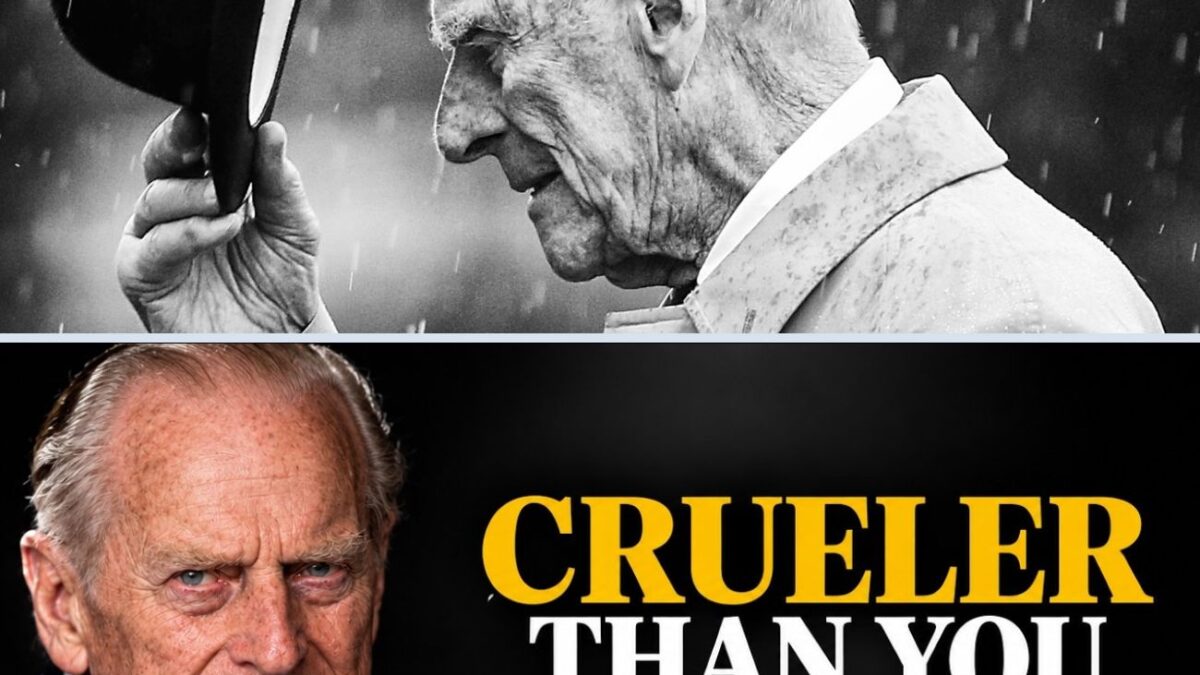
He liked it there. He read, painted in watercolor, ran the estate business, had a barbecue, and saw whom he chose. In May 2017, the palace announced he would retire from public duties at the age of 96. His final solo engagement was in August 2017 in the forecourt of Buckingham Palace in the rain taking a parade of Royal Marines.
He wore a bowler hat. He did not use an umbrella. Then he moved out. Not in the language of separation. Nobody used that word and nobody should. But the arrangement from 2017 until the pandemic was that Prince Philip lived principally at Wood Farm in Norfolk, while the Queen continued to live and work in London and Windsor, separate houses 200 meters apart in the 70th year of the marriage.
She visited, he came down for Christmas and for family occasions. They spoke on the phone. Staff accounts describe him as content in a way he had not obviously been for years. The couple the world called inseparable spent the last stretch of their life together at two addresses by mutual arrangement and the institution did not pretend otherwise.
It simply declined to explain it. That is not a marriage collapsing. It’s a marriage finally admitting out loud what it had been for decades, and the admission was so undramatic that most people read it as retirement rather than as the end of a 70-year negotiation. Then the pandemic closed the country and the arrangement reversed one last time.
In March 2020, they were put back together. The Queen moved to Windsor Castle with a reduced staff—the group the papers nicknamed HMS Bubble, which he would have appreciated—and Philip was brought down from Norfolk to join her. For the first time in decades, the two of them lived in the same house with almost nobody else in it, with no diaries, no engagements, and nowhere to go.
Neither of them ever described what that was like. The only public trace is a photograph released for their 73rd anniversary in November 2020: the pair of them in an archway at Windsor looking at a card the great-grandchildren had made. He is thin. She is holding the card. 73 years after the abbey and the surviving image of the marriage is two people in their 90s in an empty castle with the country shut down outside.
He went into King Edward VII’s Hospital in London on 16th February 2021 for what the palace called an infection and then to St Bartholomew’s for a heart procedure and he was there 28 nights, the longest hospital stay of his life. He was 99. The Queen did not visit. Whatever the reason—protocol, the pandemic, her own age, or the practical fact that a monarch cannot walk into a hospital without the entire country knowing within an hour—the record shows that during the last long illness of her husband of 73 years, she stayed at Windsor and he was in London.
Charles drove down from Gloucestershire to see him, a 200-mile round trip, and the photographs of him leaving were in every paper the next morning because that one visit was the only visit there was to photograph. Philip came home to Windsor on the 16th of March. He died there on the morning of 9th April 2021, 2 months short of 100.
Now the funeral, because the funeral is the document, he had been planning it for years. The plan had an internal code name, Forth Bridge, and it was his. He had worked on the arrangements with the Lord Chamberlain’s office over a long period, and the elements that were unmistakably his choices survived the pandemic intact. No lying in state, no procession through London, no eulogy, no sermon of any length.
The service ran 50 minutes. The coffin was carried on a Land Rover Defender TD5 130 that he had helped design and had continued to modify as late as 2019. He specified the open-topped rear, the stops to hold the coffin, and the colour, which was changed at his instruction to a military dark bronze green. A man who spent his life being driven arranged to be driven one final time in a vehicle he had built.
And then the list. Coronavirus restrictions capped the congregation at 30. Not 30 rows, 30 people, masked, spaced apart across a chapel built for 800. The palace had to cut the guest list of the Duke of Edinburgh’s funeral down to a size that would fit in a village hall, and the cutting was done against the list he had left behind. Foreign royalty gone. Heads of state gone. Every one of the 800 organisations he had presided over, unrepresented.
The Duke of Edinburgh’s Award, the World Wildlife Fund, the regiments, the universities, none of them had a seat. His German relations, however, were there. Three of them—the Prince of Baden, the Prince of Hohenlohe-Langenburg, the Hereditary Prince of Hohenlohe-Langenburg—descendants of the sisters who had been kept out of Westminster Abbey in 1947 because their husbands’ uniforms were politically impossible.
It took 74 years and a global pandemic to get Philip’s family into the church. And in the choir, seated with the family, was Penny Knatchbull, Countess Mountbatten of Burma. 30 seats. One of them went to the woman the press had spent 27 years calling his other woman. Her husband was not there. The couple had separated some years earlier. She sat alone, three rows from the widow.
That seat was not an accident, and it was not smuggled. Every name on that list was signed off by Buckingham Palace, which is to say by the Queen, at a moment when she could have quietly reduced the congregation to her own children and grandchildren, and nobody on earth would have asked a question. The tabloids reported it as an outrage and a mystery. It is neither.
It is the clearest statement the Queen ever made about her marriage, and she made it without saying a word, which was the only way she ever made statements. She had taken his name, not personally—the pressure came from Queen Mary and Churchill and the household—but she had signed the declaration, and she had lived for 70 years as the reason his name was not on his children.
She had taken his career. The frigate went in 1951, and never came back. She had taken his rank at the coronation and handed him back honorary five-star titles with no men attached. And she had watched him kneel on television and swear himself her liege man. What she had given him over 70 years was permission.
The estates, the aircraft, the award scheme, the study, the darkroom, the kitchen he installed himself, the separate diary, 22,000 engagements with nobody else’s name on them, Wood Farm, the carriage, and the second seat in that carriage. Look at the funeral list again with that in mind. She was not forgiving an affair for which no evidence has ever existed.
She was doing something plainer and in its way harder. At the last possible public occasion, the woman who had absorbed his entire identity into her office put the person who belonged to his separate life into the church in front of the cameras with the family. It was the last thing she had left to give him, and it was the only thing she could give that the institution had not already issued as a token.
Then look at who controlled everything we know about any of this, because that is the final reversal. Philip never wrote a memoir. He gave interviews, but on his own terms and rarely about the marriage. When an authorized biography was finally produced, Basil Boothroyd published it in 1971. It was written with palace cooperation, which in that era meant palace shaping.
Boothroyd was given access and was in return useful. The book is charming and tells you almost nothing. The rift denial of 1957 was written by a palace press secretary. The Kirkwood story was never denied because Philip decided a denial would feed it—a decision that protected the institution and cost Pat Kirkwood 59 years of being asked about a dinner.
Helene Cordet denied it and was ignored. Sasha Abercorn gave one careful interview and spent the rest of her life being misquoted from it. Penny Knatchbull, 27 years in, has never given an interview about him at all. Every single denial in this story was made by the women. Not one of them was made by the palace on their behalf.
The royal archives at Windsor hold the correspondence, and access to them is granted at the sovereign’s discretion. Philip’s papers went there. His will was sealed by order of the High Court in September 2021, a 90-year seal standard for senior royals under an arrangement running since 1910, confirmed in a judgment that also kept the hearing itself private.
So the honest state of the evidence after all of it is this. We know what he built because buildings and flight logs and engagement counts and estate accounts survive. We know what he surrendered because letters patent and orders in council and naturalization papers survive. What we do not have and will not have for the better part of a century is the private correspondence between them.
And the reason we don’t have it is that the institution he served for 73 years decided we shouldn’t. He gave up his name, his nationality, his religion, and his career to join a system. And that system now controls the record of what the marriage cost him. He had no say in that either except in one place.
The surname he fought Churchill and Queen Mary and the cabinet and 8 years of institutional resistance to attach to his family. The hyphen he finally won in February 1960, 11 days before Andrew was born, and which he then had to watch skip his own children entirely. That name went on to the last official document of his life.
He died as the Duke of Edinburgh and when Anne married in 1973, she signed the register as Mountbatten-Windsor and when the family’s descendants file their paperwork now, that is the name on the forms. He lost the argument in 1952 and won it posthumously in the only way a man in his position could win anything—slowly in the paperwork on a time scale longer than his own life.
There is a photograph from the Lisbon reunion in February 1957. He has just come off the Britannia after 4 months. The beard is gone. He shaved it before the aircraft doors opened, and the ginger beards the Queen’s party wore as a joke were in the end the only trace of it that anybody remembers.
That beard was the visible residue of the last stretch of his adult life in which he was the senior man in the room on a ship with his own friend beside him. He removed it before he saw his wife because the arrangement required it. Three weeks later he was made a prince and the papers called it a love story and Michael Parker went home to a divorce and never held a position in that household again.
He spent the next 64 years reassembling piece by piece out of estates and aircraft and committees and a farmhouse in Norfolk and a sport nobody was watching something approximating the life he had shaved off in Lisbon. He never hid it. That’s the part that ought to land.
The double life was in the engagement diaries, in the flight hours, in the Sandringham accounts, in 200 meters of Norfolk road between his house and hers, public, filed, countable, and nobody called it what it was because it didn’t involve a bed. And when it was over, the woman who had taken everything he arrived with looked at a list of 30 names in a chapel where his own charities could not get a seat, and left his carriage partner on it.
That was the whole marriage in one line of a printed order of service.
You Might Also Enjoy

“We Thought They Would Negotiate”—What Argentine Soldiers Said When The British Attacked Goose Green

“You’ll Never Finish My Ruck March, Limey” — US Sergeant Who Challenged the SAS, Then Fell Out First






