Prince William SEIZES The Crown As Charles RUSHED To Hospital! Camilla’s Dark Secret EXPLODES!
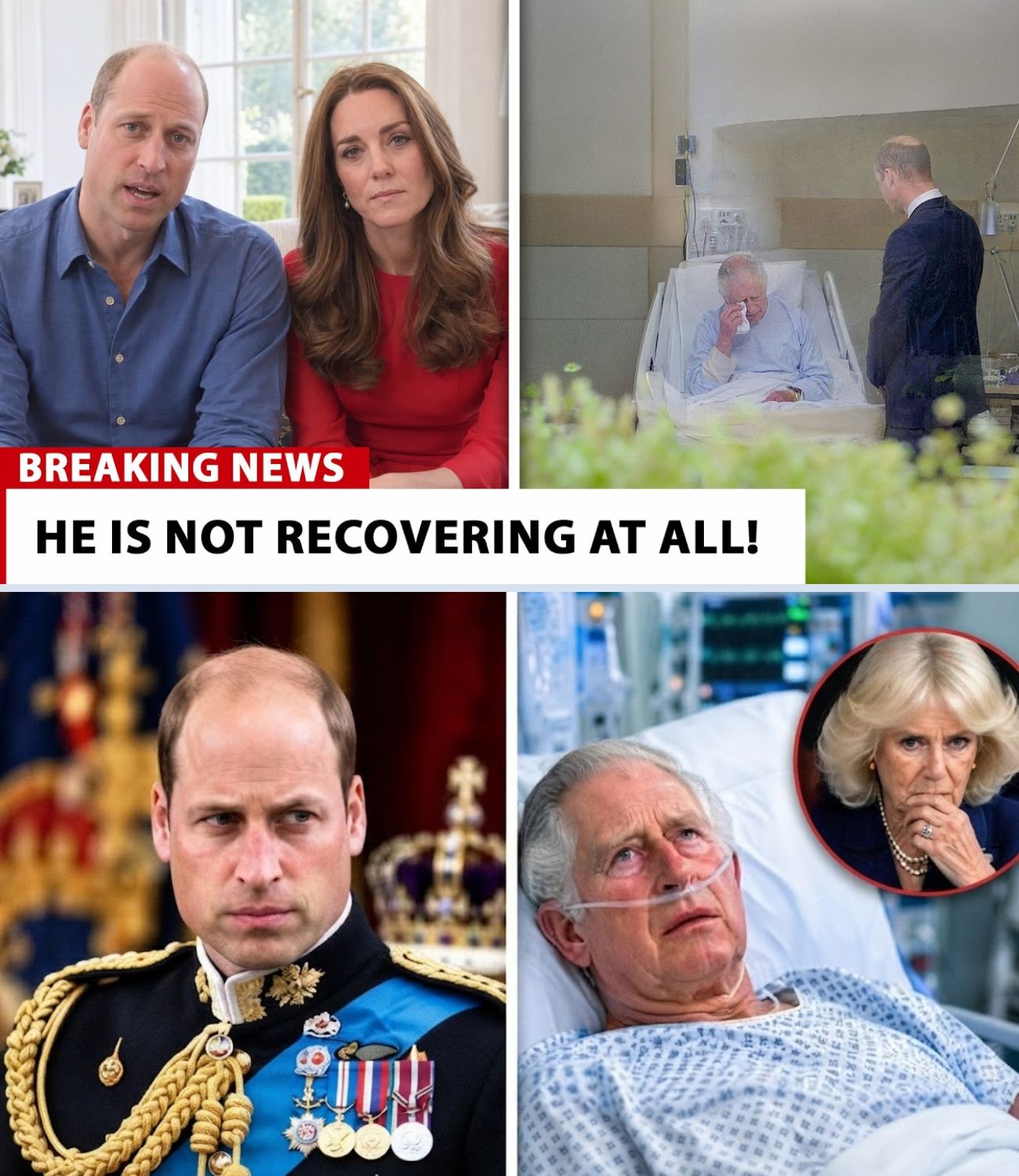
MIDNIGHT TREASON AT BUCKINGHAM PALACE: Inside Prince William’s Dramatic Hospital Showdown, Camilla’s Secret Power Grab, and the Night the Monarchy Changed Forever!
There are nights in the long, storied history of the British monarchy that change the trajectory of an empire before the sun has even begun to crest over the London skyline. Such a night unfolded in absolute, terrifying secrecy when the red-brick facade of Buckingham Palace became the epicentre of a constitutional earthquake. What began as a catastrophic medical emergency behind closed doors rapidly metastasised into a ruthless power struggle—a high-stakes game of political chess played out in sterile hospital corridors, featuring secret dossiers, intercepted digital transmissions, and a future king who proved he will not be managed, manipulated, or undermined by anyone.
While the official palace machinery attempted to cast a blanket of calm over the realm, insiders have begun to piece together the extraordinary sequence of events that occurred when King Charles III collapsed at his desk. It was a night that shattered the fragile illusion of harmony within the House of Windsor, laying bare an audacious attempt to rewrite the Regency Act and culminating in a dramatic confrontation that permanently ended the era of Camilla’s shadow court.
The Midnight Collapse
The clock on the mantelpiece in the monarch’s private study at Buckingham Palace had just ticked past midnight. While the rest of London slumbered, King Charles remained hard at work, hunched over his mahogany desk working through the heavy red leather dispatch boxes containing confidential government briefings, state papers, and classified intelligence reports. For months, royal communications teams had insisted to a anxious public that the sovereign was stable, that his grueling cancer treatments were progressing smoothly, and that he was managing his duties with characteristic stoicism.
Yet, the reality behind those locked doors was far more fragile than anyone outside the inner circle dared to imagine.
According to eyewitness accounts from royal protection officers stationed outside, the silence of the corridor was suddenly shattered by a sharp, violent gasp for air, followed by a heavy thud. A single crystal glass crashed to the floor, shattering into shards and alerting the guards on duty. Rushing into the study, officers found the King collapsed on the carpet, unconscious and struggling to breathe.
Within seconds, the sprawling palace machinery went into an emergency lockdown that bypassed standard protocol. Eschewing the usual public bulletins or cautious press updates, senior aides ordered an immediate, total communications blackout. No phone calls were permitted to leave the premises; email servers were frozen, and outer gates were slammed shut against the encroaching night. This was not the measured response to a routine health scare; this was the unmistakable blueprint of a full-blown constitutional crisis.
Minutes later, an unmarked, heavily armoured vehicle slipped out through a subterranean exit beneath the palace. There were no flashing blue police escorts, no wailing sirens, and no state motorcades to alert Fleet Street photographers. The sovereign was spirited away into the London night, racing toward a private medical facility while the fate of the British crown hung precariously in the balance.
The Midnight Phone Call and the Heir’s Resolve
Seventeen miles away at Adelaide Cottage in Windsor, Prince William was pulled from sleep by a jarring ringtone. It was precisely 12:15 AM. On the other end of the line was the Lord Chamberlain—the most senior official in the royal household, a man who does not dial a prince’s private quarters in the dead of night unless the empire itself is fracturing.
The message delivered to the heir to the throne was brutally direct: Your father is down. He is unconscious. We do not know if he will pull through.
In that fraction of a second, the emotional weight of a grieving son collided with the unyielding reality of statecraft. Yet, those close to the Wales household note that William did not panic, nor did he break down. Instead, his mind immediately pivoted to the machinery of governance—asking precise, tactical questions about the communications blackout, the readiness of the Privy Council, and whether Downing Street had been briefed.
Beside him, Princess Catherine awoke instantly. Sensing the magnitude of the moment, she did not flinch. With absolute steel in her voice, she urged William to take immediate command, warning him not to let anyone hijack the narrative or manage his authority in the vacuum of his father’s collapse. It was a stark reminder that William and Catherine had long anticipated the fragility of this transition, possessing a clear-eyed readiness that would alter history.
Within moments, William was speeding toward London in an armoured Range Rover. But before his vehicle even cleared the Windsor perimeter, a digital alert pinged across his security team’s secure terminal—an intercepted transmission that would turn a medical emergency into an outright political war.
The Secret Regency Protocol and the Intercepted Plot
While the King was being stabilised under heavy guard, a parallel operation was frantically being set into motion. Camilla’s legal team, anticipating the inevitable vulnerability of the sovereign’s health, had spent months quietly drafting a highly controversial document known formally as the Joint Consort and Air Regency Protocol.
Designed to be slipped into the administrative workflow while Charles was heavily medicated, the protocol contained a constitutional landmine. Its core clause dictated that if the sovereign became incapacitated, Prince William would be legally barred from making major structural changes to the royal household, its private funding, or its vast property portfolios without the explicit, written sign-off of the Queen Consort. In plain English, Camilla was attempting to carve out a permanent executive veto over the future king—effectively rewriting the Regency Act to insert herself into the line of supreme authority.
And the timing of her attempted filing told its own damning story. While Charles lay unconscious and William raced through the London dark, Camilla’s private office attempted to rush the document through to the Lord Chancellor and the Cabinet Office before the heir could arrive at the hospital.
It was a calculated, lightning-fast maneuver to lock in power before the dust could settle. But Camilla had drastically underestimated the loyalty William had cultivated within the palace ranks. Over the previous two years, the Prince of Wales had quietly built strong alliances among younger digital communications staff, IT security directors, and protection officers who had long watched Camilla’s shadow court operate with growing unease.
The moment Camilla’s private secretary transmitted the classified document through the administrative mainframe, a silent security flag was tripped. A vigilant IT director intercepted the digital packet, recognised its explosive contents, and forwarded it directly to the secure terminal in the back of William’s speeding Range Rover.
Reading the treasonous clauses by the dim glow of his mobile screen, William’s reaction was chillingly calm and utterly unforgiving. With a few sharp commands, he ordered the transmission instantly blocked, all outgoing communications from Clarence House frozen, and Camilla’s administrative staff locked out of the palace mainframe. He wasn’t just heading to a hospital anymore; he was heading to intercept a coup.
The Hospital Corridor Showdown
When Camilla arrived at the private wing of the London hospital roughly twenty minutes after her husband had been admitted, she expected a carefully choreographed reception. Believing she would walk straight into the sovereign’s suite and seize immediate control of the medical and public narratives, she arrived flanked by her private secretary and her personal security team, dressed impeccably for the cameras she assumed were waiting in the wings.
Instead, when she stepped off the elevator into the pristine, sterile corridor of the royal medical wing, there were no flashing camera lenses, no welcoming committee of deferential courtiers.
There was only Prince William.
Standing dead-centre in the hallway, flanked by four armed protection officers whose expressions were carved from granite, the Prince of Wales did not budge an inch. As Camilla attempted to sweep past him, insisting that she needed immediate access to her husband, William stepped forward and uttered a single, authoritative word: “Stop.”
Sensing her authority slipping, Camilla attempted to pull rank, reminding him sharply that she was the Queen and demanding passage. What followed was a confrontation that will echo down through the annals of royal history.
According to stunned witnesses within earshot, William looked her dead in the eye and delivered a verdict that cut through the sterile air like a razor: “You are not the Queen. You are a traitor.”
Before a stammering Camilla could marshal a defense, William pulled the intercepted protocol document from his jacket, holding it up under the fluorescent lights. He cataloged every single clause of her attempt to steal executive power while his father lay fighting for his life, dismantling her flimsy excuses that it was merely a “family backup plan.”
Overwhelmed by the sheer force of his fury, Camilla reached out a trembling hand to touch his arm. With cold, absolute disgust, William swatted her hand away. Slowly, deliberately, he took the multipage legal document, ripped it in half, tore it into quarters, and let the fluttering pieces drop onto the linoleum floor at her feet. The symbolism was as brutal as it was unmistakable: her shadow court, her months of plotting, and her dreams of reigning supreme had been shredded in less than sixty seconds.
William’s purge was immediate and merciless. Turning to Camilla’s trembling private secretary, he demanded his palace credentials on the spot. Stripping the man of his security clearance, William banished him from all royal properties and threatened immediate criminal prosecution if a single word of the night’s events leaked to the press. The disgraced aide fled down the service stairs like a common thief.
Turning back to his stepmother, William delivered the final, crushing blow. She would not enter the King’s room. She would not control medical updates, nor would she issue public statements. Her influence was permanently revoked. A security detail was already en route to Clarence House to seize her servers, clear out her remaining loyalists, and freeze her access to discretionary funds. She was ordered to return to her quarters and remain there under strict watch—isolated from journalists, diplomats, and the outside world.
Camilla, a woman who had spent half a century clawing her way from the periphery of British society to the cusp of absolute power, stood utterly defeated. Without uttering another word, she nodded to the officers and was led away into silence.
Dawn Over a New Reign
When the heavy oak doors of the King’s hospital room finally clicked shut behind him, the adrenaline faded, leaving William to confront the profound reality of the moment. Charles lay small and frail amidst a labyrinth of biomedical monitors and humming life-support machinery—a man whose lifelong obsession with the crown had ultimately broken him.
Stepping forward, William placed a steady hand over his father’s limp fingers. There were no tears, no dramatic proclamations. The transition of power had occurred not through pomp and grand ceremonial cannon fire, but in the quiet, antiseptic solitude of a hospital room in the dead of night.
Moments later, Catherine slipped into the room, stepping quietly to her husband’s side and linking her arm through his. They exchanged a silent, knowing look. They were no longer merely a prince and princess navigating the thorny politics of an extended family; they were now the undisputed centre of gravity for the British empire.
As the sun slowly climbed over the London skyline, the machinery of state swung into immediate motion. The Prime Minister was briefed in an emergency dawn meeting at Downing Street. The Privy Council began drafting the formal statutory instruments required to invoke the Regency Act. And across the palace corridors, the whispered news of Camilla’s dismantling spread like wildfire among the staff.
The message echoing through the halls of power was unmistakable: Prince William is not a diplomat who trades principle for the sake of polite appearances. He will amputate any threat to the crown, regardless of title or rank.
The era of Charles and Camilla has reached its abrupt, unceremonious conclusion. William’s de facto reign has begun, forged in the crucible of a midnight medical emergency and sealed in a hospital corridor where a future king proved that the ancient British crown remains anchored not to personal ambition, but to duty, law, and unyielding steel.
You Might Also Enjoy

“We Thought They Would Negotiate”—What Argentine Soldiers Said When The British Attacked Goose Green

“You’ll Never Finish My Ruck March, Limey” — US Sergeant Who Challenged the SAS, Then Fell Out First






