Prince William Takes CHARGE! King Charles RUSHED To Hospital! Camilla Left STUNNED!

THE MIDNIGHT COUP: Inside the 90-Minute Hospital Showdown Where Prince William Seized the Crown’s Command Structure
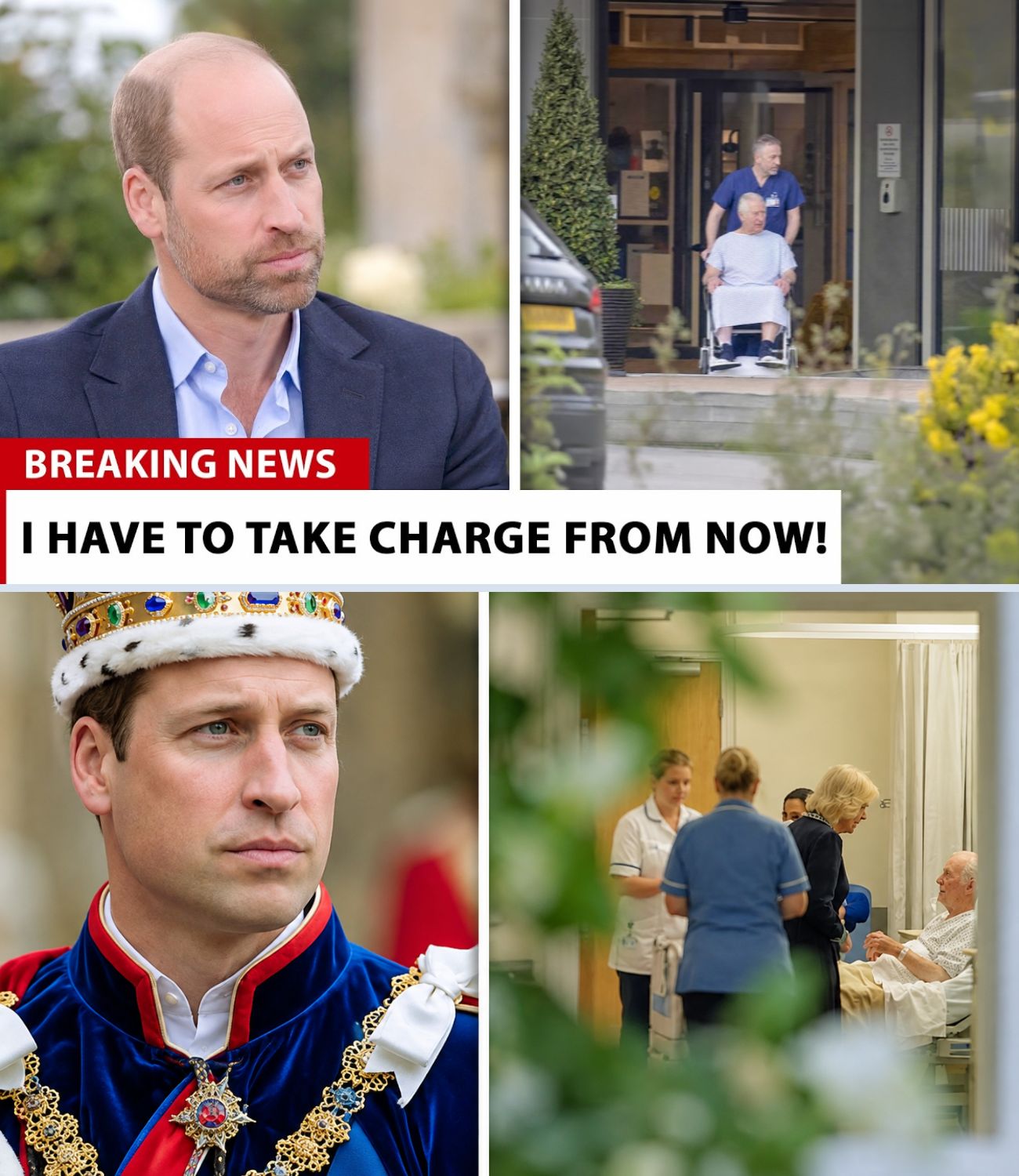
In an institution built entirely upon the glacial predictability of protocol, centuries of tradition, and rigid chains of subordination, absolute crises do not announce themselves with fanfare. They arrive in the dark, unannounced, through encrypted radio channels and urgent late-night phone calls that pierce the silence of country estates.
When King Charles III was rushed to hospital in the middle of the night, the public was handed a masterclass in bureaucratic minimalism: an official palace statement consisting of a mere 23 words. To the casual observer, it appeared to be a standard, measured health update from a sovereign managing his ongoing recovery. But behind that terse bulletin lay a very different reality—one involving a broken communication chain, a frantic bid to control the levers of royal information, a high-tension midnight confrontation in a sterile hospital corridor, and an heir to the throne who decisively took command of the British monarchy before dawn.
This is the hidden story of the night the shadow court fell, the Regency Act was quietly invoked through sheer force of will, and the power dynamic at the heart of the British state shifted forever.
The Collapse at Clarence House
The evening had begun with the quiet exhaustion typical of a monarch battling both a demanding schedule and ongoing cancer treatments. It was approximately 11:40 p.m. when King Charles returned to Clarence House following a full day of private audiences. For weeks, insiders had whispered of mounting strain; medical check-ups had quietly increased in frequency, and public-facing engagements had been steadily pruned from hour-long appearances down to brief 20-minute windows. Yet, the official narrative remained steadfastly unyielding: the King was feeling well, the King was working, and the King continued to perform his constitutional duties.
That illusion shattered in an instant. Sitting in his private living room alongside two senior aides, poring over late-night state correspondence, the King suddenly turned pale, his speech slurred before he slumped sideways, unable to finish his sentence.
Quick-thinking staff prevented a catastrophic fall. One aide caught him before he slipped from his chair, while another instantly pressed the emergency line connecting directly to the Royal Medical Unit. Within four minutes, a royal physician was in the room. Within twelve minutes, the medical team delivered an uncompromised verdict: the sovereign required immediate hospitalisation.
It was at this precise junction that standard royal protocol was violently upended—not by accident, but by design.
The Broken Chain: How the Heir Was Kept in the Dark
In any constitutional monarchy operating under normal conditions, a medical emergency involving the head of state triggers a strict, mandatory alert chain. The private secretary notifies the heir apparent; the heir notifies the government; and the royal court coordinates a unified public response. This system exists for a singular purpose: to ensure that in a moment of acute vulnerability, there is only one version of events, one clear line of command, and zero room for rogue manoeuvring.
That night, the chain snapped.
According to sources with deep visibility into the inner workings of the household, the very first call placed from Clarence House was not directed to Prince William at Adelaide Cottage in Windsor. Instead, the initial notification went directly to a senior official within Queen Camilla’s private office.
For the next forty minutes, whilst medical staff prepared the King for his emergency transfer, a parallel administrative operation swung into action. Camilla’s team allegedly contacted private legal counsel—not the institutional lawyers of the royal household, but external attorneys.
Meanwhile, miles away in Berkshire, Prince William remained fast asleep. He was not roused by an urgent summons from the palace, nor by a call from the Lord Chamberlain’s office. He was woken abruptly by his own personal protection officers, who had intercepted unusual, high-priority traffic on secure communication channels and deduced that the King was being moved before any official report had crossed the heir’s desk.
In an ecosystem governed entirely by hierarchy, failing to notify the Prince of Wales of his father’s medical emergency is not a clerical error; it is an overt, conscious decision. When William was finally briefed by his security detail, those present noted an immediate transformation. The instinct of the grieving son stepped back, and the cold, unyielding resolve of the future king took its place.
Before leaving Windsor, William engaged in a brief, poignant exchange with Catherine. As he headed for the door, she offered five words that would anchor him through the hours ahead: “Don’t let me decide tonight without you.” He carried that mandate with him into the dark as his motorcade raced toward London.
The Hospital Collision: A Forty-Minute Corridor Showdown
Whilst William’s convoy tore down empty motorways, Queen Camilla had already arrived at the hospital. Eyewitnesses and administrative insiders describe her arrival not as that of a purely distressed spouse, but as an organised, highly specific tactical deployment.
Her objectives were clear: she sought absolute control over the medical briefings, authority over all family statements, and designation as the exclusive primary point of contact for every decision relating to the sovereign’s treatment. In the machinery of a modern state, the role of gatekeeper to an incapacitated monarch is functionally identical to holding sovereign power. Control the information surrounding the throne, and you control the crown itself.
William’s arrival shortly after 1:00 a.m. was anything but a family reunion; it was a high-voltage institutional collision. Entering the private wing with a lean entourage—his private secretary, the commander of his guard, and an impenetrable expression—William bypassed the formalities. His security team had already compiled a meticulous timeline during the drive down: the delayed notification, the outreach to external lawyers, and the systematic attempt to centralise medical intelligence under Camilla’s office.
The confrontation unfolded in a compact administrative annex at the end of the royal corridor. Requesting a private audience, William and Camilla spent nearly forty minutes behind closed doors.
When the door finally swung open, the balance of power had flipped entirely. By executive instruction from the Prince of Wales, the information blockade was instantly dismantled. The King’s private secretary was ordered to report directly to William rather than awaiting clearance from Camilla’s staff. Government ministers, who had been starved of coherent updates throughout the night, received a unified, authoritative briefing directly from the heir. The Prime Minister was informed via the Prince of Wales, bypassing Clarence House completely.
In less than ninety minutes, the entire command structure of the British monarchy had been rewritten. The final blow fell when Camilla reportedly demanded to participate directly in ongoing medical consultations, citing her status as wife and companion during years of treatment. The response delivered to her was framed in the coldest, most unyielding institutional language: she was informed that medical panels would henceforth exclusively comprise the King’s medical team, his private secretary, and the Prince of Wales.
Constitutional Leverage: The Regency Act 1937
For those questioning the legality of William’s swift intervention, the answer lies enshrined in the statute books of the United Kingdom. The Regency Act 1937 explicitly dictates the transfer of authority should a British sovereign become incapacitated.
Under the provisions of the act, the functions of the Crown devolve automatically upon the next qualified adult in the line of succession—the heir apparent. The legislation contains no provision for a Queen Consort to assume executive state functions; a royal spouse holds an honorary title, whereas the Prince of Wales holds a concrete constitutional position.
This distinction, often invisible during periods of stability, became the decisive weapon of that night. Crucially, William did not need to consult legal texts on the fly. Insiders reveal that his office had spent over a year quietly modelling emergency scenarios, calculating precisely how state mechanisms would respond to a sudden health crisis. Whilst Camilla had anchored her influence in personal access and loyal administrative appointments accumulated over two decades, constitutional law cannot be charmed away by courtly influence. When the dust settled, the law belonged entirely to the heir.
The Fall of the Shadow Court
William’s masterstroke did not stop at the hospital doors; it extended into a systematic reorganisation of the royal household. For years, royal watchers whispered of a dual-court system: the official apparatus surrounding the monarch, running parallel to a quieter, highly protected shadow court operating around Camilla, complete with dedicated communications personnel and patronage networks.
In the wake of the midnight emergency, that shadow apparatus began to dissolve. The transformation was executed without public theatricals, driven entirely by internal memos and structural realignment. Reporting lines were redrawn, and senior officials aligned with Camilla’s faction found themselves quietly eased into early retirement or excluded from core briefings. William’s signature method—described by observers as institutional furniture-moving until dissenting voices find themselves in a room without a chair—proved devastatingly effective.
Notably, Prince Harry remained entirely outside the perimeter of trust. Notified of his father’s hospitalisation alongside the general public, the exclusion was neither an administrative oversight nor a casual accident, but a deliberate operational choice reflecting William’s overriding priority: absolute stability above all else.
Catherine’s Narrative Masterclass
Whilst William secured the physical and constitutional machinery of the state, Catherine played an equally vital role behind the scenes, managing the public narrative. Rejecting frantic media speculation, she spent the pre-dawn hours on the secure phone lines with trusted communications strategists, personally refining the wording of the palace’s eventual public bulletin.
Her instinct for brevity proved decisive. By authoring a stark, unelaborated statement of just 23 words, she starved the global media cycle of oxygen. With no leaks, no emotional interviews, and no material to dissect, speculation crashed against an impenetrable wall of silence. The 40-minute corridor confrontation and the dismantling of Camilla’s network remained safely sealed within an elite inner circle.
Dims of light broke through the hospital windows as William was finally left alone at his father’s bedside. Though weak, the King was conscious. Witnesses to their brief, private exchange report no raised voices or emotional melodrama. William assured his father that the government was informed and the institution was secure.
According to one deeply placed insider, the King simply nodded and offered two quiet words: “Go on.”
In royal circles, those two syllables were interpreted as the closest thing to a formal transfer of sovereign momentum this reign has ever witnessed. The mechanisms of the realm now rest firmly in William’s hands, and neither time nor tradition will ever shift them back. The shadow court is gone, the heir has stepped into his inheritance, and the next chapter of British history is now being written by a son who answered a midnight call and took command of an empire before the dawn could break.
You Might Also Enjoy

“We Thought They Would Negotiate”—What Argentine Soldiers Said When The British Attacked Goose Green

“You’ll Never Finish My Ruck March, Limey” — US Sergeant Who Challenged the SAS, Then Fell Out First






