Princess Anne DESTROYS Harry’s Hidden UK School Scheme! Royal Plan CRUMBLES Instantly!
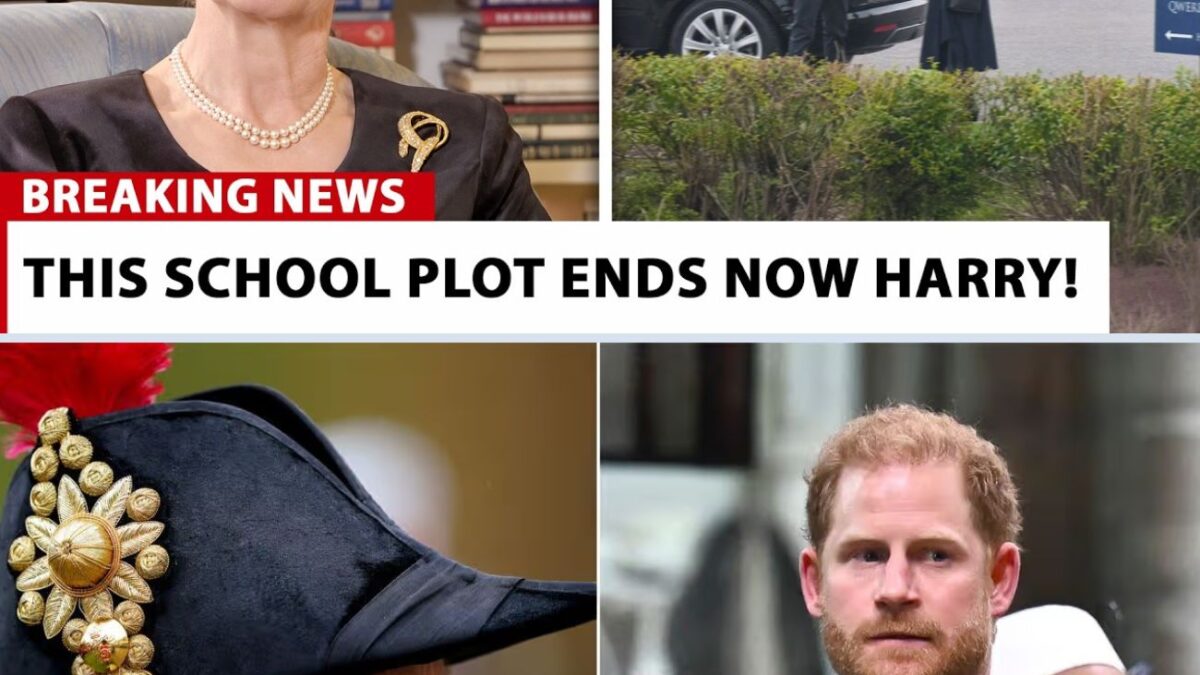
PRINCESS ANNE’S ICY REBUFF: How Prince Harry’s Secret UK School Plot Collapsed When His Royal Privilege Met British Law!

The Quiet Arrival at Birmingham
The Bombardier Global Express lifted off from an airstrip north of Los Angeles as the California sun began to dip, carrying an atmosphere of tense anticipation within its cabin. Twelve hours later, the private jet touched down quietly at Birmingham Airport shortly before noon British time. There were no flashing blue lights slicing through the midday drizzle, no welcoming committees of courtiers, no open-door state limousines idling on the tarmac. A family that had spent six successive years broadcasting their desire to sever all ties with the British establishment had just materialized in the West Midlands, accompanied by two young children, twenty oversized leather suitcases, and a deliberate absence of official fanfare.
Within ninety minutes of their wheels hitting the runway, every major royal correspondent stationed in London received an identical, carefully worded bulletin from the Sussex communications camp. The narrative was clear and frictionless: the family had relocated back across the Atlantic strictly for the welfare of the children. Prince Archie, now seven years old, and Princess Lilibet, aged five, were purportedly slated to begin classes at an exclusive private preparatory school in the rolling hills of the Cotswolds the very following week.
According to the issued statements, the entire transatlantic upheaval had been executed with lightning speed, with school places allegedly secured a mere ten days prior. To the uninitiated observer, it sounded like a triumph of modern family logistics. But to anyone remotely acquainted with the rigid, centuries-old rhythms of British preparatory education, the timeline was an absolute fairy tale.
One does not simply pick up the phone ten days before the start of the academic year, snap one’s fingers, and expect desks, lockers, bespoke uniforms, and enrollment registers to materialize. In the conservative world of rural British private schools, admissions slots are allocated many months—frequently a full year—in advance, accompanied by substantial, non-refundable deposits. You cannot simply roll up at the gates in late August expecting an administrative red carpet to roll out.
Yet, this was the polished version presented to a skeptical press corps as the family decamped to a heavily fortified, rented estate surrounded by forbidding stone walls. Behind those tall gates, however, the reality was not one of peaceful domesticity, but of rising panic. Because while the private jet had landed without incident, the children remained entirely barred from stepping foot inside a classroom. The headmaster of the Cotswolds preparatory school had politely, but with absolute finality, refused to pick up a pen and sign the official enrollment register.
The impasse had nothing to do with tabloid gossip, petty family feuds, or palace palace politics. It happened because the legal documentation required to admit the children was fundamentally incomplete.
The Paperwork Maze and the Birth Certificate Contradictions
To understand why a wealthy, high-profile couple could stumble so disastrously over basic administrative hurdles, one must look past the glamour of private aviation and examine the cold, unyielding machinery of the Pupil Registration and School Attendance Regulations in England, which were heavily reinforced under updated legislation.
Enrolling a child in any recognized English school—whether a modest village primary or an elite private academy—is governed by strict statutory law. Regulation 8 mandates that every institution maintain an immaculate, legally binding admission register containing the child’s full legal name, gender, exact date of birth, residential address, and, crucially, the verified legal names of both mother and father. The statute does not care for aristocratic styles, courtesy titles, or brand identities. It demands civil reality: the true, unvarnished legal names of the parents inscribed permanently into a government record.
Ordinarily, a parent walks into a school reception hall in early September, hands over a certified birth certificate, a valid passport, previous academic transcripts, and proof of parental responsibility, and the transaction is completed in ninety seconds at the photocopier. But for the headmaster reviewing the Sussex application, ninety seconds was an impossibility.
Under modern child protection statutes, an educational administrator bears severe personal and institutional liability if an enrollment register contains fraudulent, contradictory, or unverified parent names. A headmaster who signs off on irregular documentation faces heavy regulatory fines or professional ruin—not the parents seeking admission. Schools cannot—and legally will not—admit pupils based on titles alone.
Upon inspection, the four documents submitted by the Sussex camp were not merely mismatched; they were a labyrinth of administrative contradictions that made signing the register a punishable offense. The roots of this bureaucratic nightmare stretched back across two continents and years of shifting paperwork.
Consider the documentation of the firstborn. Archie Harrison Mountbatten-Windsor arrived on May 6, 2019, at the Portland Hospital in London, with his birth registered eleven days later at the Westminster Register Office. The initial entry recorded the mother’s name as Rachel Meghan, Her Royal Highness The Duchess of Sussex. Yet, nineteen days after the ink had dried, a rare administrative correction was forced through, striking out the civil name “Rachel Meghan” entirely and leaving only the titular designation: Her Royal Highness The Duchess of Sussex.
Under English common law, altering a birth certificate requires rigorous proof of clerical error or inheritance rights. If Rachel Meghan was indeed her legal name at birth, erasing it in favor of a marital title created a glaring legal anomaly.
Then consider the second child. Princess Lilibet Diana Mountbatten-Windsor was born on June 4, 2021, at Santa Barbara Cottage Hospital in California. California state law explicitly demands the mother’s maiden name for vital statistics records. Consequently, while Archie’s British certificate listed a royal title, Lilibet’s American document recorded her mother as Rachel Meghan Markle.
Worse still was the documentation concerning the father. Lilibet’s California birth record listed the father’s name not as Henry, Charles, or Mountbatten-Windsor, but simply as The Duke of Sussex, with the surname entered as His Royal Highness. The actual civil identity of the father was entirely omitted, replaced by an honorary title that flatly violated British statutory requirements for civil registration.
Prince Harry was acutely aware that this administrative house of cards was bound to collapse the moment it met British oversight. Having spent months locked in frustrating negotiations with the UK passport office over conflicting nomenclature, he knew normal bureaucratic channels would lock him out. Realizing he could not simply breeze past a school registrar with mismatched titles, he resolved to pull an extraordinary, high-stakes lever. He needed someone within the royal establishment who commanded absolute, unquestioned authority to clear the path before his family’s arrival.
That person was Princess Anne.
The Secret Package and the Royal Gamble
In mid-August, roughly a fortnight before the family’s departure from Montecito, an expensive, discreet courier arrived at Gatcombe Park, the sprawling Gloucestershire estate of Princess Anne. Eschewing the conventional palace mail routes, the package bypassed standard security protocols and was handed directly to the Princess Royal’s private staff.
Inside the heavy leather casing was an exquisitely bound photo album. Its glossy pages chronicled the early years of Archie and Lilibet, featuring intimate, sun-drenched snapshots of the children playing in California, taking their first tentative steps, and smiling innocently toward the camera. It was designed to evoke warmth, familial nostalgia, and protective instinct.
Tucked neatly into the front pocket of the album was a four-page, handwritten letter penned by Harry himself. The prose was passionate, deeply personal, and carefully calculated. Harry expressed an ardent desire for his children to experience the grounding reality of a traditional British education—the very sort of upbringing he had known. He invoked the memory of his late mother, Princess Diana, suggesting that she would have fiercely desired her grandchildren to walk the green quadrangles of England. He framed his current predicament not as a self-inflicted administrative blunder, but as a family tragedy: two innocent children, kept away from their ancestral homeland for six long years, now returning simply to claim their birthright.
Had the letter stopped there, it might have been read as a simple, if sentimental, family plea. But as Anne turned to the third page, the true objective of the correspondence revealed itself.
Harry was not merely asking for a warm family welcome; he was demanding high-level institutional intervention. He laid bare the humiliating reality of the school enrollment deadlock in Gloucestershire, frankly admitting to the tangled contradictions plaguing his children’s birth certificates. He then asked Princess Anne to exercise her formidable influence to bypass the deadlock entirely. Specifically, Harry requested that Anne issue an official royal directive to the local education authority and the Cotswolds school board, compelling them to list Archie and Lilibet under their royal titles while waiving the legal requirement for verified civil names.
In plain terms, the Prince was asking his aunt to lean on British civil servants and a private headmaster, convincing them to break statutory child protection laws and ignore national registration standards for the sake of family convenience. The photo album was never a mere sentimental gift; it was an emotional crowbar designed to soften a notoriously unyielding royal so she would shatter the rules on his behalf.
The Iron Will of Princess Anne
Those who have worked alongside Princess Anne across her grueling, five-decade career will attest that her reaction to reading that third page was devoid of sentimental sorrow. It was a flash of pure, cold disbelief that instantly hardened into unadulterated institutional anger.
For over fifty years, Anne has stood as the most industrious, disciplined, and uncompromising anchor of the British monarchy. When her own children, Peter and Zara, were born, she made a deliberate, conscious decision to reject royal titles for them entirely. She insisted that they grow up under the exact same civil laws, educational expectations, and societal responsibilities as any other British citizen. Her nephew’s brazen request that she violate the law and subvert national standards to accommodate royal exceptionalism was not just misguided—it was a direct insult to everything she stood for.
Anne did not grant interviews, she did not issue public retorts, and she did not draft a weeping reply. She simply summoned her private secretary, laid the letter upon the desk, and issued an instruction that brought the entire manipulation to an abrupt halt.
Her response was calm, immediate, and final. She ordered her private office at Gatcombe Park to inform the royal court that she would offer zero assistance. There would be no private telephone calls to the Gloucestershire County Council, no informal lobbying sessions with the Department for Education, and no letters of endorsement dispatched to the headmaster of the Cotswolds preparatory school.
Her message was brutally succinct: The Crown exists to uphold the law of the realm, not to carve out special privileges for those who find the law inconvenient.
The rejection hit Harry’s camp like a physical shockwave. Realizing his primary institutional lifeline had snapped, he escalated the crisis, placing an urgent, frantic telephone call from his rented Cotswolds retreat to Balmoral Castle in Scotland, where King Charles III was spending his summer holiday. Harry pleaded with his father to overrule Anne’s refusal and command the Gloucestershire authorities to expedite the paperwork.
The response from the sovereign’s office was swift and ice-cold. King Charles declined to intervene, communicating that all domestic family affairs and legal compliance on British soil were strictly under the purview of the Princess Royal. The King refused to shield his son from the legal consequences of his own administrative chaos, leaving Harry entirely isolated.
The Unshakable Reality of Rule 13
Without royal patronage to bulldoze the local bureaucracy, the unyielding reality of British school law reasserted itself. The headmaster could not enroll children lacking proper civil documents that satisfied national legislation. He could not fabricate titles without verified parental surnames, and he certainly could not ignore the glaring statutory discrepancies sitting in his filing cabinet.
The legal peril facing the school principal was crystallized by a powerful legislative update that had come into effect on August 19, 2026—just weeks before the start of term. Known widely as Rule 13 under the updated School Attendance Registration Regulations in England, this strict statute is formally titled “New Student Reporting.”
Rule 13 mandates that every school in the country submit a comprehensive, formal digital report to the local county council within five school days of any new pupil’s registration. This statutory report must explicitly detail the child’s full legal name, permanent home address, exact date of birth, and the verified civil names of both parents. The only narrow exception applies to children commencing their primary education on the very first day of the academic year—a category that might apply to five-year-old Lilibet, but categorically excluded seven-year-old Archie, who was entering Key Stage 2.
Imagine the professional pressure weighing upon that headmaster in the Cotswolds. Had he yielded to pressure, accepted unverified titles, and entered blurred or contradictory names into the admission register, he would have been legally obligated to transmit those falsified details to the Gloucestershire County Council within five working days. Any routine inspection by Ofsted—the Office for Standards in Education—could subpoena that register at a moment’s notice.
The school principal was not about to sacrifice his career, destroy his institution’s hard-earned reputation, and invite criminal investigation to bail out parents incapable of sorting out their own paperwork. Harry’s attempt to paint Princess Anne as a bureaucratic villain fell flat upon the realization that Anne was not the author of the statute; Parliament was.
Meghan’s Unforeseen Legal Trap
While Harry wrestled with the fallout of his aunt’s refusal, Meghan Markle was forced to confront an altogether more terrifying reality that threatened the very bedrock of their legal autonomy.
For six peaceful years, the family had anchored their lives behind the secure gates of Montecito, California. That geographical haven offered immense legal protection. California family law traditionally leans heavily toward maternal preference in matters of marriage, residency, and child custody. As long as the children were domiciled within the Golden State, local American courts held exclusive jurisdiction over their upbringing and future.
The moment Harry signed a long-term commercial lease on a Gloucestershire estate, packed up their belongings, and formally submitted applications to British schools, the legal chessboard shifted violently beneath their feet.
By enrolling Archie and Lilibet into the British educational system, the Sussexes made England their primary legal residence. This pivot carried monumental legal consequences. Meghan could no longer stand before a Los Angeles family court and argue that California remained the children’s primary home when their father resided in the Cotswolds and their offspring occupied seats in an English classroom.
Should their marriage ever face critical strain—a prospect frequently whispered among transatlantic circles—the competent forum for any custody or divorce proceedings would instantly shift from a favorable California court to the imposing chambers of the High Court of Justice in London.
And English family law operates under an entirely different philosophical universe. Within the London High Court, the Crown, the judiciary, and the deep institutional framework of the British establishment exert immense gravitational pull. In an English courtroom, Harry stands as the beloved son of a reigning British monarch, backed implicitly by the institutional, legal, and financial weight of the state. Meghan, conversely, would find that her former royal titles carry zero legal leverage or special privilege within domestic British jurisprudence.
In their desperate, hurried rush to prove a point to the royal family and integrate the children into British society, Harry had inadvertently walked his family straight into a profound legal trap. They thought they were merely securing a prestigious prep school education; in truth, they were surrendering their American jurisdictional sanctuary and stepping directly back under the legal sovereignty of the Crown.
The Lesson of the Uniform
On September 4, just as the private negotiations in Gloucestershire reached their terminal deadlock, Princess Anne offered a masterclass in institutional composure.
That morning, while crisis PR teams in Beverly Hills and frantic lawyers in the Cotswolds scrambled for leverage, the 76-year-old Princess Royal attended a formal ceremonial engagement with the Blues and Royals cavalry regiment. Arriving with absolute confidence, she wore her full military uniform, displaying her medals and decorations with quiet pride. Her posture was ramrod straight; her stride was steady. She moved with the physical grace of a woman who had spent over half a century serving the nation without seeking shortcuts, exemptions, or special dispensations.
Outside the venue, a pack of reporters shouted eager questions regarding her nephew’s sudden return, the enrollment crisis in the Cotswolds, and whether the royal family was engaging in malicious gatekeeping against innocent children.
Princess Anne did not break her stride. She looked straight ahead, ignoring the flashing camera lenses and shouted inquiries with an expression of profound, unbothered serenity. Her silent message echoed louder than any press release: There are no private backroom deals here, no secret exemptions, and the House of Windsor does not negotiate its legal responsibilities in public.
Moments later, senior palace officials dropped a concise, devastatingly effective statement to leading royal editors across Fleet Street. It comprised a mere ten words, yet carried the crushing weight of an anvil: “The Crown makes no exceptions to the child protection laws of the realm.”
In a single sentence, the palace obliterated the victimhood narrative Harry’s team had labored to construct. The children were not being excluded out of petty spite or lingering vengeance; they were simply being subjected to the exact same statutory child protection laws that govern every single family living in the United Kingdom.
On one side stood 76-year-old Princess Anne in her military tunic, embodying the timeless principle that true public service requires submitting oneself to the exact same rules that bind the lowliest citizen. On the other side stood Prince Harry within his rented Cotswolds fortress, confronting the bitter realization that a royal title cannot compel a headmaster to break the law of the land.
For Harry and Meghan, the ensuing palace silence became a harsh, inescapable reality. Their PR machinery attempted one final, frantic counter-offensive, leaking anonymous complaints to sympathetic American outlets alleging that cold, unfeeling bureaucrats were weaponizing administrative red tape to harm the education of two innocent children.
Yet, in Britain, those complaints crashed harmlessly against the unyielding stone wall of Rule 13 and national statute. The headmaster in the Cotswolds remained safely behind his locked gates, having avoided a career-ending compliance violation. Meghan retreated behind closed doors, suddenly awakened to the sobering legal reality of their new domestic jurisdiction. And Prince Harry was left staring at a rejection letter from his aunt that proved, once and for all, that the modern British monarchy will not sacrifice its integrity, break its own laws, or bend its constitutional duty for anyone—not even a prince.
You Might Also Enjoy

“We Thought They Would Negotiate”—What Argentine Soldiers Said When The British Attacked Goose Green

“You’ll Never Finish My Ruck March, Limey” — US Sergeant Who Challenged the SAS, Then Fell Out First






